Tapkee
: An Efficient Dimension Reduction Library
Sergey Lisitsyn [email protected]
Samara State Aerospace University 34 Moskovskoye shosse
443086 Samara, Russia
Christian Widmer∗ [email protected]
Computational Biology Center
Memorial Sloan-Kettering Cancer Center 415 E 68th street
New York City 10065 NY, USA
Fernando J. Iglesias Garcia [email protected]
KTH Royal Institute of Technology 79 Valhallav¨agen
10044 Stockholm, Sweden
Editor:Cheng Soon Ong
Abstract
We presentTapkee, a C++ template library that provides efficient implementations of more than 20 widely used dimensionality reduction techniques ranging fromLocally Linear Embedding(Roweis and Saul, 2000) andIsomap(de Silva and Tenenbaum, 2002) to the recently introduced Barnes-Hut-SNE (van der Maaten, 2013). Our library was designed with a focus on performance and flexibility. For performance, we combine efficient multi-core algorithms, modern data structures and state-of-the-art low-level libraries. To achieve flexibility, we designed a clean interface for ap-plying methods to user data and provide a callback API that facilitates integration with the library. The library is freely available as open-source software and is distributed under the permissiveBSD 3-clauselicense. We encourage the integration ofTapkeeinto other open-source toolboxes and libraries. For example,Tapkeehas been integrated into the codebase of theShoguntoolbox (Son-nenburg et al., 2010), giving us access to a rich set of kernels, distance measures and bindings to common programming languages including Python, Octave, Matlab, R, Java, C#, Ruby, Perl and Lua. Source code, examples and documentation are available athttp://tapkee.lisitsyn.me. Keywords:dimensionality reduction, machine learning, C++, open source software
1. Introduction
The aim of dimension reduction is to find low-dimensional representations of data to facilitate data visualization, interpretation and preprocessing for further analysis. It has applications in diverse fields including bioinformatics, physics and computer vision. Our library,Tapkee, provides numer-ous efficient implementations of both linear and non-linear dimension reduction algorithms, ranging from established methods to more recent developments in the field.
Implementations of modern dimensionality reduction algorithms are available in several other open-source toolboxes, such asScikit-learn(Pedregosa et al., 2011),Waffles(Gashler, 2011) and the
Matlab Toolbox for Dimensionality Reductionby Laurens van der Maaten. In contrast to existing toolkits, our aim is to provide a generic C++ library in the spirit of theStandard Template Libraryto allow for greater flexibility. In particular, we designedTapkeeto be callback-centric (i.e., externally defined functions may be passed to the library as arguments), which naturally enables the user to combine our library with custom distance or similarity measures, which are at the core of the most dimensionality reduction algorithms. Our second central design goal is efficiency. For this, we combine advanced data structures (such as cover tree by Beygelzimer et al., 2006), with efficient libraries (as ARPACK) and carefully engineered, well-tested C++ code. Furthermore, we provide parallel implementations of many algorithms usingOpenMPand preview preliminary support for
GPU computing. Finally, we want Tapkee to be easy to use. Therefore, we provide a simple, well-documented API and usage examples for each method. To support the user in the choice of algorithms, we provide mathematical background for each method on the project website.
To facilitate the use of Tapkeefor the end-user, we distribute our library as part of theShogun
toolbox, providing access to its language bindings to such languages as Python, MATLAB, Java and a rich set of kernel and distance functions. However, we emphasize thatTapkeeis a stand-alone library. The integration ofTapkeeinto C++ projects or other toolkits is therefore highly encouraged by its software design (a template library with callbacks and only few dependencies) as well as the choice of a permissive software license (BSD). Source code, documentation and various graphical and code examples can be found on the project website:http://tapkee.lisitsyn.me.
2. Implemented Algorithms
Currently, our toolkit provides implementations of the following algorithms:
1. Local neighborhood methods, such asLocally Linear Embedding (Roweis and Saul, 2000) andNeighborhood Preserving Embedding(He et al., 2005). This group also includes Hes-sian Locally Linear Embedding(Donoho and Grimes, 2003),Local Tangent Space Alignment
(Zhang and Zha, 2004) andLinear Local Tangent Space Alignment(Zhang et al., 2007);
2. Classic distance-based methods such asMultidimensional ScalingandIsomapalong with its landmark approximations such asLandmark Multidimensional ScalingandLandmark Isomap
(de Silva and Tenenbaum, 2002);
3. Graph-based methods, such asLaplacian Eigenmaps(Belkin and Niyogi, 2002),Locality Pre-serving Projections(He and Niyogi, 2003) andDiffusion Maps(Coifman and Lafon, 2006);
4. Iterative methods such asStochastic Proximity Embedding(Agrafiotis, 2003),Factor Analy-sis,t-SNEandBarnes-Hut-SNE(van der Maaten, 2013);
5. Widely knownPCAandkernel PCA,Randomized PCA(Halko et al., 2011) algorithms.
3. Software Design
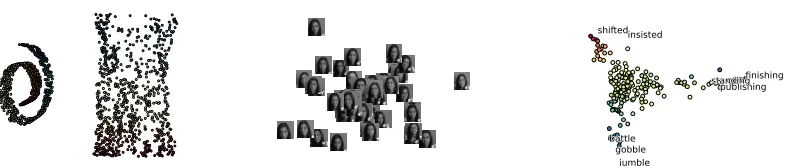
Figure 1: Swissroll 3D data and its embedding constructed withIsomap(on the left); embedding of the faces data set computed witht-SNE(in the middle); embedding of English words computed withkernel LLEusingRatcliff-Obershelpas similarity measure (on the right).
principle, our library is engineered to becallback-based(with externally defined functions passed to the library as arguments). The algorithms in our library are implemented as generically as possible (formulated in terms of callback functions) with callbacks providing the interface between the user data and algorithm. For example, the user may want to embed biological sequences using a string kernel from a third party library, which—using callbacks—can be passed toTapkee as a custom similarity measure. A major benefit of our callback-centric design is the improved re-usability of our software, as user-defined callback functions may contain complex custom code or operate on custom data structures without any changes to our library code.
Most dimensionality reduction algorithms rely on linear algebra operations, nearest neighbor finding and the solving of eigenproblems. To address the need for high performance linear algebra we leverage theEigen3 template library. This makes our implementations safe, easy to read and fast. Next, we approach the nearest neighbor problem with thevantage point treeand thecover tree
data structures (Beygelzimer et al., 2006) which can be used with arbitrary metric spaces. Finally, to solve eigenproblems arising in most of the implemented algorithms we employ three methods: QR decomposition, Lanczos method from theARPACKlibrary and a randomized method described in Halko et al. (2011). The library supports all major platforms (Linux,Mac OS XandWindows). To ensure quality we combine unit-testing and continuous integration withTravis.
4. Applications
We have successfully appliedTapkeeto compute low-dimensional representations of various data sets including images and biological sequences. Images were taken from the widely-knownMNIST
data set. To demonstrate an embedding of string objects, we computed a 2Dembedding of English words and biological sequences (gene starts) for several organisms. See Figure 1 for examples of 2Drepresentations computed withTapkeeand the website for more graphical examples. At the time of writing, we are aware of several successful applications ofTapkeeto problems in hydrodynamics, bioinformatics and exploratory analysis of energy landscapes, from user feedback.
5. Comparison To Related Work
com-Tapkee Scikit-learn Waffles MTfDR
LLE ISOMAP LLE ISOMAP LLE ISOMAP LLE ISOMAP
Swissroll, k=15 0.45(0.68) 3.84(14.60) 0.89 20.71 − 227.71 11.88 2433.31
MIT-CBCL, k=20 1.15(2.57) 1.20(3.06) 12.77 5.94 64.76 20.05 2.75 5.56
MNIST, k=20 2.55(3.63) 1.93(4.67) 8.40 9.12 − 29.92 2.80 253.55
AVIRIS, k=80 5.37(6.27) 7.44(19.85) 10.76 21.53 − 62.25 25.42 763.55
Table 1: Performance comparison forTapkee,Scikit-learn(Pedregosa et al., 2011),Waffles (Gash-ler, 2011) andMatlab Toolbox for Dimensionality Reduction(MTfDR). Time is given in seconds (−means no convergence in 3 hours). ForTapkee, results for 4 threads and for a single thread (in parentheses) are shown.
parison1 for implementations of two widely-used methods, which were present in all of the above libraries: Locally Linear Embedding and Isomap. For this comparison we used four data sets: a subset of MNIST (2000 vectors of size 784), swissroll with 5000 3D vectors, images from MIT-CBCLface recognition data set (384 vectors of size 40,000) and subsampled hyperspectral image
obtained from theAVIRISproject (2520 vectors of size 224). We report convergence times for each implementation, method and data set in Table 1. We note that when using a single threadTapkee
outperforms the other implementations in all but one case. When using 4 cores, Tapkeeis con-siderably faster and outperforms the other libraries in all experiments. Scikit-learnhas the second best overall performance, which hints at the high quality of code. Furthermore,MTfDRhas good performance for high-dimensional data sets, but shows slow convergence for problems with a large number of vectors. Finally,Waffles’ LLE implementation sometimes fails to converge - this may be caused by the use of the power iteration method.
In summary, we find that the choice of algorithms and low-level libraries enables Tapkeeto outperform other implementations under various conditions. For the code to reproduce the above experiments (and additional benchmarks) and an overview of available methods for each toolkit, please see our supplementary webpagehttp://iglesias.github.io/tapkee_benchmarks/.
6. Conclusion
We have implemented an efficient and flexible library for dimension reduction with all the methods implemented using state-of-the-art algorithms and data structures. Our library readily handles big data sets and facilitates interaction with custom code using a callback-centric API. To compare our toolkit to existing software, we provide a speed comparison on a range of data sets showing considerable speed-up. We believe the infrastructure provided by Tapkee(such as API, modular design, bindings to libraries) can serve as a platform for further dimension reduction development. Finally, we hope that our work proves to be valuable to researchers, students and practitioners.
Acknowledgments
We would like to thank: L. van der Maaten, J. Langford, V. Gorbatiuk, E. Andreev, D. Harmon and D. Okanohara for their code; G. R¨atsch, K.-R. M¨uller, S. Sonnenburg and D. Kuo for helpful comments. The work was supported by Google (GSoC 2011), the Russian Foundation for Basic Research (13-07-12030, 12-07-00581-a), the Max Planck Society and DFG grant RA1894/1.
References
D. K. Agrafiotis. Stochastic proximity embedding. Journal of Computational Chemistry, 24(10): 1215–1221, 2003.
M. Belkin and P. Niyogi. Laplacian eigenmaps and spectral techniques for embedding and cluster-ing. Science, 14:585–591, 2002. ISSN 10495258.
A. Beygelzimer, S. Kakade, and J. Langford. Cover trees for nearest neighbor. Proceedings of the 23rd International Conference on Machine Learning ICML 06, 1:97–104, 2006.
R. Coifman and S. Lafon. Diffusion maps. Applied and Computational Harmonic Analysis, 21(1): 5–30, 2006.
V. de Silva and J. B. Tenenbaum. Global versus local methods in nonlinear dimensionality reduction.
Advances in Neural Information Processing Systems, 15:705–712, 2002.
D. L. Donoho and C. Grimes. Hessian eigenmaps: Locally linear embedding techniques for high-dimensional data. Proceedings of the National Academy of Sciences of the United States of America, 100(10):5591–5596, 2003.
M. S. Gashler. Waffles: A machine learning toolkit. Journal of Machine Learning Research, 12 (July):2383–2387, 2011.
N. Halko, P.-G. Martinsson, Y. Shkolnisky, and M. Tygert. An algorithm for the principal component analysis of large data sets. SIAM Journal on Scientific Computing, 33(5):2580–2594, 2011.
X. He and P. Niyogi. Locality preserving projections. Matrix, 16(December):153–160, 2003.
X. He, D. Cai, S. Yan, and H.-J. Zhang. Neighborhood preserving embedding. Tenth IEEE Interna-tional Conference on Computer Vision ICCV05 Volume 1, 2:1208–1213, 2005.
F. Pedregosa, G. Varoquaux, A. Gramfort, V. Michel, B. Thirion, O. Grisel, M. Blondel, P. Pretten-hofer, R. Weiss, V. Dubourg, J. Vanderplas, A. Passos, D. Cournapeau, M. Brucher, M. Perrot, and E. Duchesnay. Scikit-learn: Machine learning in Python. Journal of Machine Learning Research, 12:2825–2830, 2011.
S. T. Roweis and L. K. Saul. Nonlinear dimensionality reduction by locally linear embedding.
Science, 290(5500):2323–2326, 2000.
S. Sonnenburg, G. Raetsch, S. Henschel, C. Widmer, J. Behr, A. Zien, F. De Bona, A. Binder, C. Gehl, and V. Franc. The SHOGUN machine learning toolbox. Journal of Machine Learning Research, 11(x):1799–1802, 2010.
L. van der Maaten. Barnes-Hut-SNE. arXiv preprint arXiv:1301.3342, 2013.
T. Zhang, J. Yang, D. Zhao, and X. Ge. Linear local tangent space alignment and application to face recognition. Neurocomputing, 70(7-9):1547–1553, 2007. ISSN 09252312.