Discrete Reproducing Kernel Hilbert Spaces: Sampling and
Distribution of Dirac-masses
Palle Jorgensen [email protected]
Department of Mathematics The University of Iowa
Iowa City, IA 52242-1419, U.S.A.
Feng Tian [email protected]
Department of Mathematics, Informatics, and Cybersecurity Trine University
Angola, IN 46703, U.S.A.
Editor:John Shawe-Taylor
Abstract
We study reproducing kernels, and associated reproducing kernel Hilbert spaces (RKHSs) H over infinite, discrete and countable sets V. In this setting we analyze in detail the distributions of the corresponding Dirac point-masses of V. Illustrations include certain models from neural networks: An Extreme Learning Machine (ELM) is a neural network-configuration in which a hidden layer of weights are randomly sampled, and where the object is then to compute resulting output. For RKHSs H of functions defined on a prescribed countable infinite discrete setV, we characterize those which contain the Dirac masses δx for all points x in V. Further examples and applications where this question
plays an important role are: (i) discrete Brownian motion-Hilbert spaces, i.e., discrete versions of the Cameron-Martin Hilbert space; (ii) energy-Hilbert spaces corresponding to graph-Laplacians where the setV of vertices is then equipped with a resistance metric; and finally (iii) the study of Gaussian free fields.
Keywords: Gaussian reproducing kernel Hilbert spaces, sampling in discrete systems, resistance metric, graph Laplacians, discrete Green’s functions
1. Introduction
A reproducing kernel Hilbert space (RKHS) is a Hilbert space H of functions on a pre-scribed set, sayV, with the property that point-evaluation for functionsf ∈H is continu-ous with respect to theH-norm. They are called kernel spaces, because, for everyx ∈V, the point-evaluation for functions f ∈H, f(x) must then be given as aH-inner product of f and a vectorkx, inH; called the kernel.
2010; Zhang et al., 2012; Lata and Paulsen, 2011; Vuleti´c, 2013; Schramm and Sheffield, 2013; Hedenmalm and Nieminen, 2014; Shawe-Taylor and Cristianini, 2004; Schlkopf and Smola, 2001). But the literature so far has focused on the theory of kernel functions defined on continuous domains, either domains in Euclidean space, or complex domains in one or more variables. For these cases, the Diracδxdistributions do not have finite H-norm. But
for RKHSs over discrete point distributions, it is reasonable to expect that the Dirac δx
functions will in fact have finiteH-norm.
An illustration from neural networks: An Extreme Learning Machine (ELM) is a neural network configuration in which a hidden layer of weights are randomly sampled (Rasmussen and Williams, 2006), and the object is then to determine analytically resulting output layer weights. Hence ELM may be thought of as an approximation to a network with infinite number of hidden units.
Here we consider the discrete case, i.e., RKHSs of functions defined on a prescribed countable infinite discrete setV. We are concerned with a characterization of those RKHSs
H which contain the Dirac massesδxfor all pointsx∈V. Of the examples and applications
where this question plays an important role, we emphasize three: (i) discrete Brownian motion-Hilbert spaces, i.e., discrete versions of the Cameron-Martin Hilbert space; (ii) energy-Hilbert spaces corresponding to graph-Laplacians; and finally (iii) RKHSs generated by binomial coefficients. We show that the point-masses have finite H-norm in cases (i) and (ii), but not in case (iii).
Our setting is a given positive definite function k on V ×V, where V is discrete. We study the corresponding RKHSH (=H (k)) in detail. Our main results are Theorems 1, 2, and 3 which give explicit answers to the question of which point-masses from V are in
H. Applications include Corollaries 29, 41, 46, 48, 52, and 53.
The paper is organized as follows: Section 2 leads up to our characterization (Theorem 1) of point-masses which have finiteH-norm. It is applied in Sections 3 and 4 to a variety of classes of discrete RKHSs. Section 3 deals with samples from Brownian motion, and from the Brownian bridge process, and binomial kernels, and with kernels on sets V ×V which arise as restrictions to sample-points. Section 4 covers the case of infinite network of resistors. By this we mean an infinite graph with assigned resistors on its edges. In this family of examples, the associated RKHSs vary with the assignment of resistors on the edges inG, and are computed explicitly from a resulting energy form. Our result Corollary 46 states that, for the network models, all point-masses have finite energy. Furthermore, we compute the value, and we study V as a metric space w.r.t. the corresponding resistance metric. These results, in turn, have direct implications (Corollaries 48, 52 and 55) for the family of Gaussian free fields associated with our infinite network models.
A positive definite kernel kis said to be universal (Steinwart, 2002; Caponnetto et al., 2008) if, every continuous function, on a compact subset of the input space, can be uniformly approximated by sections of the kernel, i.e., by continuous functions in the RKHS. In Theorem 3 we show that for the RKHSs from kernelskcin electrical networkGof resistors,
this universality holds. The metric in this case is the resistance metric on the vertices ofG, determined by the assignment of a conductance function con the edges in G.
distribution, i.e., meaning learning from samples of training data. Other applications of an analysis of weighted graphs include statistical mechanics, such as infinite spin models, and large digital networks. It is natural to ask then how one best approaches analysis on “large” systems. We propose an analysis via infinite weighted graphs. This is so even if some of the questions in learning theory may in fact refer to only “large” finite graphs.
One reason for this (among others) is that statistical features in such an analysis are best predicted by consideration of probability spaces corresponding to measures on infinite sample spaces. Moreover the latter are best designed from consideration of infinite weighted graphs, as opposed to their finite counterparts. Examples of statistical features which are relevant even for finite samples is long-range order; i.e., the study of correlations between distant sites (vertices), and related phase-transitions, e.g., sign-flips at distant sites. In designing efficient learning models, it is important to understand the possible occurrence of unexpected long-range correlations; e.g., correlations between distant sites in a finite sample.
A second reason for the use of infinite sample-spaces is their use in designing efficient sampling procedures. The interesting solutions will often occur first as vectors in an infinite-dimensional reproducing-kernel Hilbert space RKHS. Indeed, such RKHSs serve as powerful tools in the solution of a kernel-optimization problems with penalty terms. Once an optimal solution is obtained in infinite dimensions, one may then proceed to study its restrictions to suitably chosen finite subgraphs.
In general when reproducing kernels and their Hilbert spaces are used, one ends up with functions on a suitable set, and so far we feel that the dichotomy discrete vs continuous has not yet received sufficient attention. After all, a choice of sampling points in relevant optimization models based on kernel theory suggests the need for a better understanding of point masses as they are accounted for in the RKHS at hand. In broad outline, this is a leading theme in our paper.
2. Discrete RKHSs
Definition 1 Let V be a countable and infinite set, and F(V) the set of all finite subsets of V. A function k:V ×V →C is said to be positive definite, if
X X
(x,y)∈F×F
k(x, y)cxcy ≥0 (1)
holds for all coefficients {cx}x∈F ⊂C, and all F ∈F(V).
Definition 2 Fix a set V, countable infinite.
1. For all x∈V, set
kx:=k(·, x) :V →C (2)
as a function on V.
2. Let H := H (k) be the Hilbert-completion of the span{kx:x∈V}, with respect to
the inner product
DX
cxkx, X
dyky E
H :=
X X
modulo the subspace of functions of zero H-norm. H is then a reproducing kernel Hilbert space (HKRS), with the reproducing property:
hkx, ϕiH =ϕ(x), ∀x∈V, ∀ϕ∈H. (4)
Note. The summations in (3) are all finite. Starting with finitely supported summa-tions in (3), the RKHSH =H (k) is then obtained by Hilbert space completion. We use physicists’ convention, so that the inner product is conjugate linear in the first variable, and linear in the second variable.
3. If F ∈ F(V), set HF = closed span{kx}x∈F ⊂ H, (closed is automatic if F is
finite.) And set
PF :=the orthogonal projection onto HF. (5)
4. For F ∈F(V), set
KF := (k(x, y))(x,y)∈F×F (6)
as a #F×#F matrix.
Remark 3 It follows from the above that reproducing kernel Hilbert spaces (RKHS) arise from a given positive definite kernelk, a corresponding pre-Hilbert form; and then a Hilbert-completion. The question arises: “What are the functions in the completion?” Now, before completion, the functions are as specified in Definition 2, but the Hilbert space completions are subtle; they are classical Hilbert spaces of functions, not always transparent from the naked kernel k itself. Examples of classical RKHSs: Hardy spaces or Bergman spaces (for complex domains), Sobolev spaces and Dirichlet spaces (Okoudjou et al., 2013; Strichartz and Teplyaev, 2012; Strichartz, 2010) (for real domains, or for fractals), band-limited L2
functions (from signal analysis), and Cameron-Martin Hilbert spaces from Gaussian pro-cesses (in continuous time domain).
Our focus here is on discrete analogues of the classical RKHSs from real or complex analysis. These discrete RKHSs in turn are dictated by applications, and their features are quite different from those of their continuous counterparts.
Definition 4 The RKHS H = H (k) is said to have the discrete mass property (H is
called a discrete RKHS), if δx ∈H, for all x ∈V. Here, δx(y) = (
1 if x=y
0 if x6=y, i.e., the
Dirac mass at x∈V.
Lemma 5 Let F ∈F(V), x1 ∈F. Assume δx1 ∈H. Then
PF(δx1) (·) = X
y∈F
KF−1δx1
(y)ky(·). (7)
Proof Show that
δx1 − X
y∈F
KF−1δx1
(y)ky(·)∈HF⊥. (8)
(The notation (HF)⊥ stands for orthogonal complement, also denoted H HF =
ϕ∈H hf, ϕiH = 0, ∀f ∈HF .)
Lemma 6 Using Dirac’s bra-ket, and ket-bra notation (for rank-one operators), the orthog-onal projection onto HF is
PF = X
y∈F kyihky∗
; (9)
where
kx∗ :=X
y∈F
KF−1
yxky (10)
is the dual vector to kx, for allx∈V.
Proof Let kx∗ be specified as in (10), then
hkx∗, kziH = X
y∈F D
KF−1yxky, kz E
H
= X
y∈F
KF−1xyhky, kziH
= X
y∈F
KF−1xy(KF)yz =δx,z,
i.e., kx∗ is the dual vector tokx, for all x∈V.
For f ∈H, and F ∈F(V), we have
X
y∈F kyihk∗y
f =
X
y∈F
k∗y, f H ky
= X X (y,z)∈F×F
KF−1
z,yhkz, fiH
= PFf.
This yields the orthogonal projection realized as stated in (9). Now, applying (9) toδx1, we get
PF(δx1) = X
y∈F
ky∗, δx1
H ky
= X
y∈F X
z∈F
KF−1yzhkz, δx1iH !
ky
= X
y∈F X
z∈F
KF−1
yzδx1(z) !
ky
= X
y∈F
KF−1δx1
where
KF−1δx1
(y) :=X
z∈F
KF−1yzδx1(z).
This verifies (7).
Remark 7 Note a slight abuse of notations: We make formally sense of the expressions for
PF(δx)in (7) even in the case whenδx might not be inH. For all finite F, we showed that
PF(δx) ∈ H. But for δx be in H, we must have the additional boundedness assumption
(18) satisfied; see Theorem 1.
Lemma 8 Let F ∈F(V), x1 ∈F, then KF−1δx1
(x1) =kPFδx1k
2
H . (11)
Proof Setting ζ(F):=KF−1(δx1), we have
PF(δx1) = X
y∈F
ζ(F)(y)kF(·, y)
and for all z∈F,
X
z∈F
ζ(F)(z)PF(δx1) (z)
| {z }
ζ(F)(x 1)
= X
F X
F
ζ(F)(z)ζ(F)(y)kF(z, y) (12)
= kPFδx1k
2
H .
By Lemma 6, the LHS of (12) is given by
kPFδx1k
2
H = hPFδx1, δx1iH
= X
y∈F
KF−1δx1
(y)hky, δx1iH
= KF−1δx1
(x1) =KF−1(x1, x1).
Corollary 9 If δx1 ∈H (see Theorem 1), then
sup
F∈F(V)
KF−1δx1
(x1) =kδx1k
2
H . (13)
The following condition is satisfied in some examples, but not all:
Corollary 10 ∃F ∈F(V) s.t. δx1 ∈HF ⇐⇒
KF−01(δx1) (x1) =K −1
F (δx1) (x1)
Corollary 11 (Monotonicity) If F and F0 are in F(V) and F ⊂F0, then
KF−1δx1
(x1)≤ KF−01δx1
(x1) (14)
and
lim
F%V K
−1
F δx1
(x1) =kδx1k
2
H . (15)
Proof By (11),
KF−1δx1
(x1) =kPFδx1k
2
H .
Since HF ⊂HF0, we have PFPF0 =PF, so
kPFδx1k
2
H =kPFPF0δx
1k
2
H ≤ kPF0δx
1k
2
H
i.e.,
KF−1δx1
(x1)≤ KF−01δx1
(x1). So (14) follows; and the limit in (15) is monotone.
Theorem 1 GivenV, k:V ×V →Rpositive definite (p.d.). Let H =H (k) be the cor-responding RKHS. Assume V is countable and infinite. Then the following three conditions (i)-(iii) are equivalent;x1∈V is fixed:
(i) δx1 ∈H;
(ii) ∃Cx1 <∞ such that for all F ∈F(V), the following estimate holds:
|ξ(x1)|2 ≤Cx1
X X
F×F
ξ(x)ξ(y)k(x, y) (16)
(iii) For F ∈F(V), set
KF = (k(x, y))(x,y)∈F×F (17)
as a #F×#F matrix. Then
sup
F∈F(V)
KF−1δx1
(x1)<∞. (18)
Proof (i)⇒(ii)For ξ∈l2(F), set hξ=
X
y∈F
ξ(y)ky(·)∈HF.
Then hδx1, hξiH =ξ(x1) for allξ.
Since δx1 ∈H, then by Schwarz:
hδx1, hξiH
2
≤ kδx1k
2
H
X X
F×F
But hδx1, kyiH =δx1,y = (
1 y=x1 0 y6=x1
; hence hδx1, hξiH =ξ(x1), and so (19) implies (16).
(ii)⇒(iii) Recall the matrix
KF := (hkx, kyi)(x,y)∈F×F
as a linear operatorl2(F)→l2(F), where (KFϕ) (x) =
X
y∈F
KF(x, y)ϕ(y), ϕ∈l2(F). (20)
By (16), we have
ker (KF)⊂
ϕ∈l2(F) :ϕ(x1) = 0 . (21) Equivalently,
ker (KF)⊂ {δx1} ⊥
(22)
and so δx1 F
∈ker (KF)⊥= ran (KF), and∃ζ(F)∈l2(F) s.t.
δx1
F = X
y∈F
ζ(F)(y)k(·, y)
| {z }
=:hF
. (23)
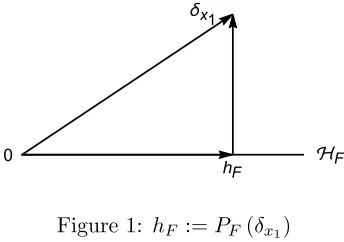
Claim. PF (δx1) =hF, wherePF = projection ontoHF; see (5) and Lemma 5. (See Figure
1.) Indeed, we only need to prove that δx1 −hF ∈H HF, i.e.,
hδx1 −hF, kziH = 0, ∀z∈F. (24)
But, by (23),
LHS(24)=δx1,z− X
y∈F
k(z, y)ζ(F)(y) = 0.
This proves the claim.
If F ⊂ F0, F, F0 ∈ F(V), then HF ⊂ HF0, and PFPF0 = PF by easy facts for projections. Hence
kPFδx1k
2
H ≤ kPF0δx
1k
2
H , hF :=PF(δx1)
and
lim
F%V kδx1 −hFkH = 0.
(iii)⇒(i)Follows from Lemma 8 and Corollary 9.
Corollary 12 The numbers ζ(F)(y)
y∈F in (23) satisfies
ζ(F)(x1) = X X (y,z)∈F×F
0
δx1
hF ℋF
Figure 1: hF :=PF(δx1)
Proof Multiply (23) by ζ(F)(z) and carry out the summation.
Remark 13 To see that (23) is a solution to a linear algebra problem, with F ={xi}ni=1,
note that (23) ⇐⇒
k(x1, x1) k(x1, x2) · · · k(x1, xn)
k(x2, x1) k(x2, x2) · · · k(x2, xn)
..
. . .. . .. ... ..
. . .. . .. ...
k(xn, x1) k(xn, x2) · · · k(xn, xn)
ζ(F)(x1) ζ(F)(x2)
.. .
ζ(F)(xn−1) ζ(F)(xn)
= 1 0 .. . 0 0 (26)
We now resume the general case of kgiven and positive definite onV ×V.
Corollary 14 We have
ζ(F)(x1) =kPF(δx1)k
2
H (27)
where
PF(δx1) = X
y∈F
ζ(F)(y)ky(·) (28)
and
ζ(F)=KN−1(δx1), N := #F. (29)
Proof It follows from (26) that
X
j
k(xi, xj)ζ(F)(xj) =δ1,i
and so multiplying by ζ(F)(i), and summing over i, gives
X
i X
j
k(xi, xj)ζ(F)(xi)ζ(F)(xj)
| {z }
=kPF(δx1)k
2 H
Corollary 15 We have
(i)
PF(δx1) =ζ
(F)(x
1)kx1+ X
y∈F\{x1}
ζ(F)(y)ky (30)
where ζF solves (26), for allF ∈F(V);
(ii)
kPF(δx1)k
2
H =ζ(F)(x1) (31)
and so in particular:
(iii)
0< ζ(F)(x1)≤ kδx1k
2
H (32)
Proof Formula (31) follows from the definition ofζ(F)as a solution to the matrix problem KNζ(F)=δx1, but we may also prove (31) directly from
PF(δx1) = X
y
ζ(F)(y)ky. (33)
Applyh·, δx1iH to both sides in (33), we get
hδx1, PF(δx1)iH
| {z }
kPF(δx1)k
2 H
=ζ(F)(x1)
sincePF =PF∗ =PF2; i.e., a projection in the RKHSH =HV of k.
Example 1 (#F = 2) Let F = {x1, x2}, KF = (kij)2i,j=1, where kij := k(xi, xj). Then
(26) reads
k11 k12 k21 k22
ζF(x1)
ζF(x2)
=
1 0
. (34)
Set D:= det (KF) =k11k22−k12k21, then: ζF(x1) =
k22
D, ζF(x2) =− k21
D .
Example 2 Let V ={x1, x2, . . .} be an ordered set. SetFn:={x1, . . . , xn}. Note that with
Dn= det (KFn) = det
(k(xi, xj))ni,j=1
, and (35)
D0n−1 = (1,1) minor of KFn = det
(k(xi, xj))ni,j=2
; (36)
then
ζ(Fn)(x1) = D0n−1
Dn
= KF−1 nδx1
Corollary 16 We have
1 k(x1, x1)
≤ k(x2, x2)
D2
≤ · · · ≤ D
0
n−1 Dn
≤ · · · ≤ kδx1k
2
H .
Proof Follows from (37), and if F ⊂F0 are two finite subsets, then
kPF (δx1)k
2
H ≤ kPF0(δx
1)k
2
H ≤ kδx1k
2
H .
Letk:V ×V →Rbe as specified above. Let H =H (k) be the RKHS. We setF(V):= all finite subsets of V; and if x∈V is fixed,Fx(V) :={F ∈F(V) |x∈F}.
ForF ∈F(V), let KF be the #F×#F matrix given by (k(x, y))(x,y)∈F×F. Following
Karlin and Ziegler (1996), we say thatkisstrictly positive iff detKF >0 for allF ∈F(V).
Set DF := detKF. If x∈V, and F ∈Fx(V), setKF0 := the minor inKF obtained by
omitting row x and columnx, see Figure 2.
x
x
x
x
Figure 2: The (x, x) minors,KF →KF0 .
Corollary 17 Suppose k:V ×V →Ris strictly positive. Let x∈V. Then
δx ∈H ⇐⇒ sup F∈Fx(V)
D0F DF
<∞. (38)
2.1 Unbounded Containment in RKHSs
Definition 18 Let K and H be two Hilbert spaces. We say that K is unboundedly containedinH if there is a dense subspaceK0 ⊂K such thatK0⊂H; and the inclusion
operator, with K0 as its dense domain, is closed, i.e.,
K incl,→ H, dom(incl) =K0.
Letk:V×V →Rbe a p.d. kernel, and letH be the corresponding RKHS. SetK =l2(V), and
Proposition 19 If δx ∈H for ∀x∈V, then l2(V) is unboundedly contained in H.
Proof Recall that H is the RKHS defined for a fixed p.d. kernelk:V ×V →R. Let kx
be the vector in H, given by kx(y) =k(x, y), s.t.
f(x) =hkx, fiH , ∀f ∈H. (40)
To finish the proof we will need:
Lemma 20 The following equation
hδx, kyiH =δx,y (41)
holds if δx∈H for ∀x∈V.
Proof (41) is immediate from (40).
Lemma 21 On
span{kx|x∈V} ⊂H (42)
define M kx := δx, then by Lemma 20, M extends to be a well defined operator M :H →
l2(V) with dense domain (42). We have
hk, M fil2(V)=hk, fiH , ∀k∈span{δx}, ∀f ∈dom(M). (43)
Proof By linearity, it is enough to prove that
hδx, δyil2 =hδx, kyiH (44)
holds for ∀x, y∈V. But (44) follows immediate from Lemma 20.
Corollary 22 If L:l2(V)→H denotes the inclusion mapping with
dom(L) =span{δx :x∈V},
then we conclude that
L⊂M∗, andM ⊂L∗. (45)
Since dom(M) is dense in H, it follows that L∗ has dense domain; and that therefore L
is closable.
Remark 23 This also completes the proof of Proposition 19.
Corollary 24 Supposek:V ×V →R is as given, and thatH =RKHS(k). LetLbe the
densely defined inclusion mappingl2(V)→H. Then L∗Lis selfadjoint with dense domain in l2(V); and LL∗ is selfadjoint with dense domain in H. Moreover, the following polar decomposition holds:
L=U(L∗L)1/2 = (LL∗)1/2U (46)
3. Point-masses in Concrete Models
Suppose V ⊂ D⊂Rd where V is countable and discrete, but D is open. In this case, we get two kernels: k on D×D, and kV := k
V×V on V ×V by restriction. If x ∈ V, then
k(xV)(·) =k(·, x) is a function on V, while kx(·) =k(·, x) is a function on D.
This means that the corresponding RKHSs are different, HV vs H, where HV = a
RKHS of functions on V, and H = a RKHS of functions onD.
Lemma 25 HV is isometrically contained in H via k
(V)
x 7−→kx, x∈V.
Proof If F ⊂V is a finite subset, andξ =ξF is a function on F, then
X
x∈Fξ(x)k
(V)
x
H
V =
X
x∈F ξ(x)kx
H .
The desired result follows from this.
We are concerned with cases of kernels k :D×D→ R with restrictionkV :V ×V → R, whereV is a countable discrete subset ofD. Typically, forx∈V, we may have (restriction) δx
V ∈HV, butδx ∈/H; indeed this happens for the kernelkof standard Brownian motion:
D=R+;
V = an ordered subset 0< x1< x2 <· · ·< xi < xi+1<· · ·,V ={xi}∞i=1. In this case, we compute HV, and we show that δxi
V ∈ HV; while for Hm = the
Cameron-Martin Hilbert space, we have δxi ∈/ Hm.
Also note thatδx1 has a different meaning with reference toHV vsHm. In the first case,
it is simply δx1(y) = (
1 y=x1 0 y∈V\ {x1}
. In the second case,δx1 is a Schwartz distribution.
We shall abuse notation, writingδx in both cases.
In the following, we will consider restriction toV×V of a special continuous p.d. kernel k onR+×R+. It is k(s, t) =s∧t= min (s, t). Before we restrict, note that the RKHS of thiskis the Cameron-Martin Hilbert space of functionf onR+with distribution derivative f0 ∈L2(R+), and
kfk2H :=
Z ∞
0
f0(t)
2
dt <∞. (47)
For details, see below.
Remark 26 (Application) The Hilbert space given byk·k2H in (47) is called the Cameron-Martin Hilbert space, and, as noted, it is the RKHS of k:R+×R+→ R: k(s, t) :=s∧t.
Now pick a discrete subset V ⊂ R+; then Lemma 25 states that the RKHS of the V ×V
restricted kernel, k(V) is isometrically embedded into H, i.e., setting
J(V)kx(V)=kx, ∀x∈V; (48)
J(V) extends by “closed span” to an isometry HV J(V)
−−−→ H. It further follows from the lemma, that the range of J(V) may have infinite co-dimension.
Note that PV := J(V) J(V) ∗
is the projection onto the range of J(V). The ortho-complement is as follow:
H HV =
ψ∈H
Example 3 Let k and k(V) be as in (48), and set V := πZ+, i.e., integer multiples of π.
Then easy generators of wavelet functions (Bratteli and Jorgensen, 2002) yield non-zero functions ψ on R+ such that
ψ∈H HV. (50)
More precisely,
0<
Z ∞
0
ψ0(t)
2
dt <∞, (51)
where ψ0 is the distribution (weak) derivative; and
ψ(nπ) = 0, ∀n∈Z+. (52)
An explicit solution to (50)-(52) is
ψ(t) =
∞ Y
n=1 cos
t 2n
= sint
t , ∀t∈R. (53)
From this, one easily generates an infinite-dimensional set of solutions.
3.1 Brownian Motion
Consider the covariance function of standard Brownian motionBt,t∈[0,∞), i.e., a
Gaus-sian process {Bt}with mean zero and covariance function
E(BsBt) =s∧t= min (s, t). (54)
We now show that the restriction of (54) to V ×V for an ordered subset (we fix such a set V):
V : 0< x1 < x2<· · ·< xi< xi+1 <· · · (55) has the discrete mass property (Definition 4).
Set HV =RKHS(k
V×V),
kV (xi, xj) =xi∧xj. (56)
We consider the set Fn={x1, x2, . . . , xn} of finite subsets ofV, and
Kn=k(Fn) =
x1 x1 x1 · · · x1 x1 x2 x2 · · · x2 x1 x2 x3 · · · x3
..
. ... ... ... ... x1 x2 x3 · · · xn
= (xi∧xj)ni,j=1. (57)
We will show that condition (iii) in Theorem 1 holds forkV. For this, we must compute all
the determinants, Dn= det (KF) etc. (n= #F), see Corollary 17.
Lemma 27
Dn= det
(xi∧xj)ni,j=1
Proof Induction. In fact,
x1 x1 x1 · · · x1 x1 x2 x2 · · · x2 x1 x2 x3 · · · x3
..
. ... ... ... ... x1 x2 x3 · · · xn
∼
x1 0 0 · · · 0
0 x2−x1 0 · · · 0 0 0 x3−x2 · · · 0
..
. ... ... . .. ... 0 · · · 0 · · · xn−xn−1
,
unitary equivalence in finite dimensions.
Lemma 28 Let
ζ(n) :=Kn−1(δx1) (·) (59)
be as in (11), so that
kPFn(δx1)k
2
HV =ζ(n)(x1). (60)
Then,
ζ(1)(x1) = 1 x1 ζ(n)(x1) =
x2 x1(x2−x1)
, forn= 2,3, . . . ,
and
kδx1k
2
HV =
x2 x1(x2−x1)
.
Proof A direct computation shows the (1,1) minor of the matrixKn−1 is D0n−1= det
(xi∧xj)ni,j=2
=x2(x3−x2) (x4−x3)· · ·(xn−xn−1) (61)
and so
ζ(1)(x1) = 1 x1
, and
ζ(2)(x1) =
x2 x1(x2−x1) ζ(3)(x1) =
x2(x3−x2) x1(x2−x1) (x3−x2)
= x2 x1(x2−x1) ζ(4)(x1) =
x2(x3−x2) (x4−x3) x1(x2−x1) (x3−x2) (x4−x3)
= x2 x1(x2−x1) ..
.
Corollary 29 PFn(δx1) =PF2(δx1), ∀n≥2. Therefore,
δx1 ∈H
(F2)
V :=span{k
(V)
x1 , k
(V)
x2 } (62)
and
δx1 =ζ(2)(x1)k
(V)
x1 +ζ(2)(x2)k
(V)
x2 (63)
where
ζ(2)(xi) =K2−1(δx1) (xi), i= 1,2.
Specifically,
ζ(2)(x1) =
x2 x1(x2−x1)
(64)
ζ(2)(x2) =
−1 x2−x1
; (65)
and
kδx1k
2
HV =
x2 x1(x2−x1)
. (66)
Proof Follows from the lemma. Note that
ζn(x1) =kPFn(δx1)k
2
H
and ζ(1)(x1) ≤ζ(2)(x1) ≤ · · ·, since Fn = {x1, x2, . . . , xn}. In particular, x11 ≤ x1(xx2−2 x1),
which yields (66).
Remark 30 We showed that δx1 ∈HV, V ={x1< x2<· · · } ⊂ R+, with the restriction
of s∧t = the covariance kernel of Brownian motion.
The same argument also shows that δxi ∈HV when i >1. We only need to modify the
index notation from the case of the proof for δx1 ∈HV. The details are sketched below.
Fix V ={xi}∞i=1, x1 < x2 <· · ·, then
PFn(δxi) =
(
0 if n < i−1
Pn
s=1 K
−1
Fnδxi
(xs)kxs if n≥i
and
kPFn(δxi)k 2
H =
0 ifn < i−1
1
xi−xi−1 ifn=i
xi+1−xi−1
(xi−xi−1)(xi+1−xi) ifn > i Conclusion.
δxi ∈ span
n
kx(Vi−)1, kx(Vi), kx(Vi+1)
o
, and (67)
kδxik 2
H =
xi+1−xi−1 (xi−xi−1) (xi+1−xi)
Corollary 31 Let V ⊂ R+ be countable. If xa ∈ V is an accumulation point (from V),
thenkδakHV =∞.
Remark 32 This computation will be revisited in Section 4, in a much wider context.
Example 4 An illustration for 0< x1 < x2 < x3< x4: PF (δx3) =
X
y∈F
ζ(F)(y)ky(·)
ζ(F) = KF−1δx3 .
That is,
x1 x1 x1 x1 x1 x2 x2 x2 x1 x2 x3 x3 x1 x2 x3 x4
| {z }
(KF(xi,xj))4i,j=1
ζ(F)(x1) ζ(F)(x2) ζ(F)(x3) ζ(F)(x4)
=
0 0 1 0
and
ζ(F)(x3) = x1(x2−x1) (x4−x2) x1(x2−x1) (x3−x2) (x4−x3) = x4−x2
(x3−x2) (x4−x3)
=kδx3k
2
H .
Example 5 (Sparse sample-points) Let V ={xi}∞i=1, where
xi =
i(i−1)
2 , i∈N.
It follows thatxi+1−xi =i, and so
kδxik 2
H =
xi+1−xi
(xi−xi−1) (xi+1−xi)
= 2i−1
(i−1)i −−−→i→∞ 0.
We conclude that kδxikH −−−→
i→∞ 0 if the setV ={xi} ∞
i=1 ⊂R+ is sparse. Now, some general facts:
Lemma 33 Let k:V ×V →Cbe p.d., and let H be the corresponding RKHS. Ifx1∈V,
and if δx1 has a representation as follows:
δx1 = X
y∈V
ζ(x1)(y)k
y , (69)
then
kδx1k
2
Proof Substitute both sides of (69) intohδx1,·iH whereh·,·iH denotes the inner product
inH.
Example 6 (Application) SupposeV =∪nFn,Fn⊂Fn+1, where eachFn∈F(V), then
if x1 ∈Fn, we have
PFn(δx1) = X
y∈Fn
x1, KF−n1y
l2ky (71)
and
kPFn(δx1)k
2
H =x1, KF−n1x1
l2 = K −1
Fnδx1
(x1) (72)
and the expression kPFn(δx1)k
2
H is monotone in n, i.e.,
kPFn(δx1)k
2
H ≤
PFn+1(δx1)
2
H ≤ · · · ≤ kδx1k
2
H
with
sup
n∈N
kPFn(δx1)k
2
H = limn→∞kPFn(δx1)k
2
H =kδx1k
2
H .
Question 34 Let k : Rd×Rd → R be positive definite, and let V ⊂ Rd be a countable
discrete subset, e.g.,V =Zd. When doesk
V×V have the discrete mass property?
Examples of the affirmative, or not, will be discussed below.
3.2 Discrete RKHS from Restrictions
LetD:= [0,∞), andk:D×D→R, with
k(x, y) =x∧y= min (x, y).
Restrict toV :={0} ∪Z+ ⊂D, i.e., consider
k(V) =k V×V.
H (k): Cameron-Martin Hilbert space, consisting of functions f ∈L2(R) s.t.
Z ∞
0
f0(x)
2
dx <∞, f(0) = 0.
HV :=H (kV). Note that
f ∈H (kV)⇐⇒ X
n
|f(n)−f(n+ 1)|2 <∞.
Proof Introduce the discrete Laplacian ∆, where
(∆f) (n) = 2f(n)−f(n−1)−f(n+ 1),
then ∆kn=δn, and
h2kn−kn+1−kn−1, kmiHV =hδn, kmiHV =δn,m.
Remark 36 The same argument as in the proof of the lemma shows (mutatis mutandis) that any ordered discrete countable infinite subset V ⊂[0,∞) yields
HV :=H
k V×V
as a RKHS which is discrete in that (Definition 4) ifV ={xi}∞i=1, xi∈R+, thenδxi ∈HV, ∀i∈N.
Proof Fix vertices V ={xi}∞i=1,
0< x1 < x2 <· · ·< xi < xi+1<∞, xi → ∞. (73)
Assign conductance
ci,i+1=ci+1,i=
1 xi+1−xi
= 1 dist
(74)
Let
(∆f) (xi) =
1 xi+1−xi
+ 1 xi−xi−1
f(xi)
− 1
xi−xi−1
f(xi−1)− 1 xi+1−xi
f(xi+1) (75) Equivalently,
(∆f) (xi) = (ci,i+1+ci,i−1)f(xi)−ci,i−1f(xi−1)−ci,i+1f(xi+1). (76) Remark 37 The most general graph-Laplacians will be discussed in detail in Section 4 below.
Then, with (76) we have:
∆kxi =δxi
wherek(·,·) = restriction ofs∧tfrom [0,∞)×[0,∞) to V ×V; and therefore
δxi = (ci,i+1+ci,i−1)kxi−ci,i+1kxi+1−ci,i−1kxi−1 ∈HV (77)
as the right-side in the last equation is a finite sum. Note that now the RKHS is
HV =
(
f :V →C
∞ X
i=1
ci,i+1|f(xi+1)−f(xi)|2<∞ )
3.3 Brownian Bridge
LetD:= (0,1) = the open interval 0< t <1, and set
kbridge(s, t) :=s∧t−st; (78)
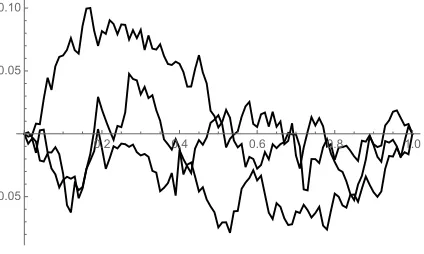
then (78) is the covariance function for the Brownian bridge Bbri(t), i.e.,
Bbri(0) =Bbri(1) = 0 (79)
0.2 0.4 0.6 0.8 1.0
-0.05 0.05 0.10
Figure 3: Brownian bridge Bbri(t), a simulation of three sample paths of the Brownian
bridge.
Bbri(t) = (1−t)B
t 1−t
, 0< t <1; (80)
whereB(t) is Brownian motion; see Lemma 25. The corresponding Cameron-Martin space is now
Hbri=
f on [0,1] ;f0 ∈L2(0,1), f(0) =f(1) = 0 (81) with
kfk2H bri :=
Z 1
0
f0(s)
2
ds <∞. (82)
If V = {xi}∞i=1, x1 < x2 < · · · < 1, is the discrete subset of D, then we have for Fn∈F(V),Fn={x1, x2,· · ·, xn},
KFn = (kbridge(xi, xj))
n
i,j=1, (83)
see (78), and
detKFn =x1(x2−x1)· · ·(xn−xn−1) (1−xn). (84) As a result, we get δxi ∈H
(bri)
V for all i, and
kδxik 2
H(bri)
V
= xi+1−xi−1 (xi+1−xi) (xi−xi−1)
.
Note limxi→1kδxik 2
H(bri)
V
3.4 Binomial RKHS
Definition 38 Let V =Z+∪ {0}; and
kb(x, y) := x∧y X
n=0
x n
y n
, (x, y)∈V ×V.
where nx = x(x−1)···n(!x−n+1) denotes the standard binomial coefficient from the binomial expansion.
Let H =H (kb) be the corresponding RKHS. Set
en(x) =
( x
n
if n≤x
0 if n > x. (85)
Lemma 39 (Alpay and Jorgensen, 2015)
(i) en(·)∈H, n∈V;
(ii) {en}n∈V is an orthonormal basis (ONB) in the Hilbert space H.
(iii) Set Fn={0,1,2, . . . , n}, and
PFn=
n X
k=0
|ekihek| (86)
or equivalently
PFnf =
n X
k=0
hek, fiH ek. (87)
then,
(iv) Formula (87) is well defined for all functions f :V →C, f ∈Func(V).
(v) Given f ∈Func(V); then
f ∈H ⇐⇒
∞ X
k=0
|hek, fiH|2<∞; (88)
and, in this case,
kfk2H =
∞ X
k=0
|hek, fiH|2.
Fix x1 ∈ V, then we shall apply Lemma 39 to the function f1 = δx1 (in Func(V)),
f1(y) =
(
Theorem 2 We have
kPFn(δx1)k
2
H =
n X
k=x1
k x1
2
.
The proof of the theorem will be subdivided in steps; see below.
Lemma 40 (Alpay and Jorgensen, 2015)
(i) For ∀m, n∈V, such that m≤n, we have
δm,n = n X
j=m
(−1)m+j
n j j m . (89)
(ii) For all n∈ Z+, the inverse of the following lower triangle matrix is this: With (see
Figure 4)
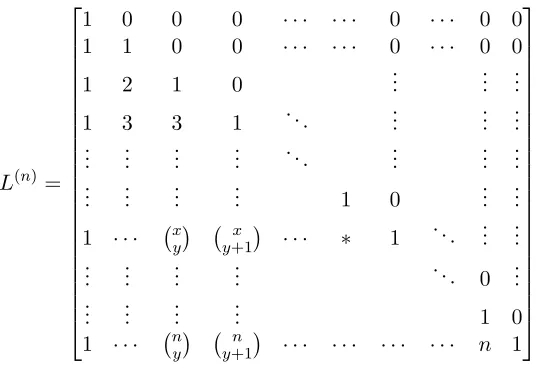
L(xyn)=
( x
y
ify ≤x≤n
0 ifx < y (90)
we have:
L(n)−1
xy = (
(−1)x−y xy if y≤x≤n
0 if x < y. (91)
Notation: The numbers in (91) are the entries of the matrix L(n)−1
.
Proof In rough outline, (ii) follows from (i).
L(n)=
1 0 0 0 · · · 0 · · · 0 0 1 1 0 0 · · · 0 · · · 0 0
1 2 1 0 ... ... ...
1 3 3 1 . .. ... ... ... ..
. ... ... ... . .. ... ... ... ..
. ... ... ... 1 0 ... ...
1 · · · xy x y+1
· · · ∗ 1 . .. ... ... ..
. ... ... ... . .. 0 ... ..
. ... ... ... 1 0 1 · · · ny n
y+1
· · · n 1
Figure 4: The matrixLn is simply a truncated Pascal triangle, arranged to fit into a lower
Corollary 41 Let kb, H, and n∈Z+ be as above with the lower triangle matrix Ln. Set
Kn(x, y) =kb(x, y), (x, y)∈Fn×Fn, (92)
i.e., an (n+ 1)×(n+ 1) matrix.
(i) Then Kn is invertible with
Kn−1= Ltrn−1
(Ln)−1; (93)
an(upper triangle)×(lower triangle) factorization.
(ii) For the diagonal entries in the (n+ 1)×(n+ 1) matrixKn−1, we have:
x, Kn−1xl2 =
n X
k=x
k x
2
Conclusion: Since
kPFn(δx1)k
2
H =
x1, Kn−1x1
H (94)
for all x1 ∈Fn, we get
kPFn(δx1)k
2
H =
n X
k=x1
k x1
2
= 1 +
x1+ 1 x1
2
+
x1+ 2 x1
2
+· · ·+
n x1
2
; (95)
and therefore,
kδx1k
2
H =
∞ X
k=x1
k x1
2
=∞.
In other words, noδx is in H.
4. Infinite Network of Resistors
Here we introduce a family of positive definite kernels k :V ×V → R, defined on infinite setsV of vertices for a given graphG= (V, E) with edges E ⊂V ×V\(diagonal).
There is a large literature dealing with analysis on infinite graphs (Jorgensen and Pearse, 2010, 2011, 2013; Okoudjou and Strichartz, 2005; Boyle et al., 2007; Cho and Jorgensen, 2011).
Our main purpose here is to point out that every assignment of resistors on the edges E in Gyields a p.d. kernelk, and an associated RKHSH =H (k) such that
δx ∈H, for all x∈V. (96)
Definition 42 Let G= (V, E) be as above. Assume
2. ∃c:E→R+ (a conductance function = 1 / resistance) such that
(i) c(xy)=c(yx), ∀(xy)∈E;
(ii) for all x∈V, #y∈V |c(xy) >0 <∞; and
(iii) ∃o∈V s.t. for ∀x∈V\ {o}, ∃ edges(xi, xi+1)n0−1 ∈E s.t. xo= 0, and xn=x;
called connectedness.
Given G = (V, E), and a fixed conductance function c : E → R+ as specified above, we now define a corresponding Laplace operator ∆ = ∆(c) acting on functions on V, i.e., on
Func(V) by
(∆f) (x) =X
y∼x
cxy(f(x)−f(y)). (97)
LetH be the Hilbert space defined as follows: A functionf on V is inH ifff(o) = 0, and
kfk2H := 1 2
X X
(x,y)∈E
⊂V×V
cxy|f(x)−f(y)|2 <∞. (98)
Lemma 43 (Jorgensen and Pearse, 2010) For all x∈V\ {o}, ∃vx∈H s.t.
f(x)−f(o) =hvx, fiH , ∀f ∈H (99)
where
hh, fiH = 1 2
X X
(x,y)∈E
cxy
h(x)−h(y)(f(x)−f(y)), ∀h, f ∈H. (100)
(The system {vx} is called a system of dipoles.)
Proof Let x∈V\ {o}, and use (97) together with the Schwarz-inequality to show that
|f(x)−f(o)|2 ≤X
i
1 cxixi+1
X
i
cxixi+1|f(xi)−f(xi+1)|
2 .
An application of Riesz’ lemma then yields the desired conclusion.
Note that vx = v(xc) depends on the choice of base point o ∈ V, and on conductance
functionc; see (i)-(ii) and (98).
Now set
k(c)(x, y) =hvx, vyiH , ∀(xy)∈(V\ {o})×(V\ {o}). (101)
It follows from a theorem thatk(c) is a Green’s function for the Laplacian ∆(c) in the sense that
∆(c)k(c)(x,·) =δx (102)
Lemma 44 (Jorgensen and Pearse, 2011) Let G = (V, E), and conductance function
c : E → R+ be a s specified above; then k(c) in (101) is positive definite, and the
cor-responding RKHS H k(c) is the Hilbert space introduced in (98) and (100), called the energy-Hilbert space.
Proof See Jorgensen et al. (2010; 2011; 2013).
Proposition 45 Let x ∈ V\ {o}, and let c : E → R+ be specified as above. Let H =
H (kc) be the corresponding RKHS. Then δx∈H, and
kδxk2H = X
y∼x
c(xy)=:c(x). (103)
Proof We study the finite matrices, defined for ∀F ∈F(V), by
KF(x, y) =kc(x, y), (x, y)∈F ×F. (104)
Fixx∈V\ {o}, and pickF ∈F(V) such that
{x} ∪ {y∈V |y∼x} ⊂F, (105)
see Figure 5; an interior point:
x
y1
��
��
��
��
F F
Figure 5: Neighborhood ofx, see Definition 42 (ii). An interior pointx.
LetF ∈F(V) be as in (104) and in Figure 5, and let ∆ = ∆(c)be the Laplace operator (97), then for all (x, y)∈F ×F, we have:
x, KF−1y
l2 = hδx,∆δyil2
= (∆δy) (x)
=
c(x) ify=x; see (103) −c(xy) ify∼x
0 for all other values ofy
In particular,
sup
F∈F(V)
(KFδx) (x)<∞;
and in fact,
kδxk2H =c(x), for all x∈V\ {o},
as claimed in the Proposition.
The last step in the present proof uses the equivalence (i)⇔(ii)⇔(iii) from Theorem 1 above.
Finally, we note that the assertion in (106) follows from
∆vx =δx−δo, ∀x∈V\ {o}. (107)
And (107) in turn follows from (99), (97) and a straightforward computation.
Corollary 46 Let G = (V, E) and conductance c : E → R+ be as specified above. Let ∆ = ∆(c) be the corresponding Laplace operator. Let H =H (kc) be the RKHS. Then
hδx, fiH = (∆f) (x) (108)
and
δx=c(x)vx− X
y∼x
cxyvy (109)
holds for allx∈V.
Proof Since the system{vx} of dipoles in (99) span a dense subspace inH, it is enough
to verify (108) when f =vy fory∈V\ {o}. But in this case, (108) follows from (102) and
(106).
Corollary 47 Let G = (V, E), and conductance c : E → R+ be as before; let ∆(c) be
the Laplace operator, and HE(c) the energy-Hilbert space in Definition 42 (Equation (98)). Let k(c)(x, y) = hvx, vyiH
E be the kernel from (101), i.e., the Green’s function of ∆ (c).
Then the two Hilbert spacesHE, and H k(c)
=RKHS k(c), are naturally isometrically isomorphic via vx7−→kx(c) where kx(c)=k(c)(x,·) for allx∈V.
Proof Let F ∈F(V), and let ξ be a function on F; then
X
x∈Fξ(x)k
(c)
x
2
H(k(c)) =
X X
F×F
ξ(x)ξ(y)k(c)(x, y) =
(101)
X X
F×F
ξ(x)ξ(y)hvx, vyiHE
=
X
x∈Fξ(x)vx
2
The remaining steps in the proof of the Corollary now follows from the standard com-pletion from dense subspaces in the respective two Hilbert spaces HE andH k(c)
.
In the following we show how the kernels k(c) :V ×V → R from (101) in Lemma 43 are related to metrics on V; so called resistance metrics (Jorgensen and Pearse, 2010; Alpay et al., 2013).
Corollary 48 LetG= (V, E), and conductancec:E →R+be as above; and letk(c)(x, y) := hvx, vyiHE be the corresponding Green’s function for the graph Laplacian∆(c).
Then there is a metric R =R(c) =the resistance metric
, such that
k(c)(x, y) = R
(c)(o, x) +R(c)(o, y)−R(c)(x, y)
2 (110)
holds on V ×V. Here the base-pointo∈V is chosen and fixed s.t.
hVx, fiHE =f(x)−f(o), ∀f ∈HE, ∀x∈V. (111)
Proof Set
R(c)(x, y) =kvx−vyk2HE. (112)
We proved (Jorgensen and Pearse, 2010) thatR(c)(x, y) in (112) indeed defines a metric on V; the so called resistance metric. It represents the voltage-drop fromx toy when 1 Amp is fed into (G, c) at the point x, and then extracted at y.
The verification of (110) is now an easy computation, as follows:
R(c)(o, x) +R(c)(o, y)−R(c)(x, y) 2
= kvxk 2
HE +kvyk 2
HE − kvx−vyk 2
HE 2
= hvx, vyiHE
= k(c)(x, y) by (101).
Proposition 49 In the two cases: (i) B(t), Brownian motion on 0< t <∞; and (ii) the Brownian bridgeBbri(t),0< t <1, from Section 3 (Figure 3), the corresponding resistance
metric R is as follows:
(i) If V ={xi}∞i=1 ⊂(0,∞),x1< x2 <· · ·, then
RB(V)(xi, xj) =|xi−xj|. (113)
(ii) If W ={xi}∞i=1⊂(0,1), 0< x1 < x2 <· · ·<1, then
R(bridgeW) (xi, xj) =|xi−xj| ·(1− |xi−xj|). (114)
In the completion w.r.t. the resistance metric R(bridgeW) , the two endpoints x = 0 and
4.1 Gaussian Processes
Definition 50 A Gaussian realization of an infinite graph-network G= (V, E), with pre-scribed conductance function c :E → R+, and dipoles (vxc)x∈V\{o}, is a Gaussian process
(Xx)x∈V on a probability space (Ω,F,P), where Ωis a sample space;F a sigma-algebra of
events, and P a probability measure s.t., for ∀F ∈F(V), the random variables (Xx)x∈F,
are jointly Gaussian with
E(Xx) = Z
Ω
XxdP= 0 (115)
and covariance
E(XxXy) =k(c)(x, y) = D
vx(c), vy(c)
E
HE
; (116)
i.e., the covariance matrix (E(XxXy))(x,y)∈F×F is
KF(x, y) :=k(c)(x, y) on F×F. (117)
Lemma 51 (Jorgensen and Pearse, 2010) For all G = (V, E), and c : E → R+, as
specified, Gaussian realizations exist; they are called Gaussian free fields.
Corollary 52 Let G= (V, E), c:E →R+ be as above; and let(Xx)x∈V be an associated
Gaussian free field. Then the point Dirac-masses (δx)x∈V have Gaussian realizations
e
δx =c(x)Xx− X
y∼x
cxyXy, ∀x∈V. (118)
Corollary 53 Let G = (V, E), and c : E → R+ be as above. Let {Xx}x∈V be the
corre-sponding Gaussian free field, i.e., with correlation
E(XxXy) =k(c)(x, y) = D
vx(c), v(yc)E
HE
(119)
where the dipoles {v(xc)} ⊂HE are computed w.r.t. a chosen (and fixed) based-point o∈V,
i.e.,
D
v(xc), f
E
HE
=f(x)−f(o), ∀f ∈HE, x∈V. (120)
Finally, let R(c)(x, y) be the corresponding resistance metric onV. Then
E(XxXz) +E(XzXy)≤E(XxXy) +R(c)(o, z) (121)
holds for all vertices x, y, z∈V; see Figure 6.
Proof Use Corollary 48, and (112). We have
kvx−vyk2H ≤ kvx−vzk2H +kvz−vyk2H ,
x
z
o
y
Figure 6: Covariance vs resistance distanceR(c)(o, z) for three vertices x, y, z∈V. 4.2 Metric Completion
The next theorem illustrates a connection between the universal property of a kernel in a RKHSH, on the one hand, and the distribution of the Dirac point-massesδx, on the other.
We make “distribution” precise by the quantity E(x) := kδxk2H, the energy of the
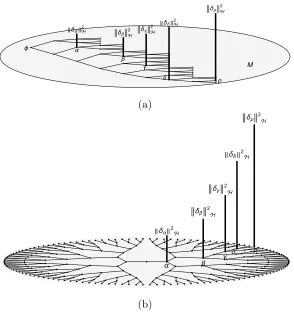
point-mass at the vertex pointx. We introduce a metric completionM, and the universal property of the RKHSH asserts that the functions fromH are continuous and 1/2-Lipschitz onM, and that they approximate every continuous function on M in the uniform norm. Recall, the vertex setV is equipped with its resistance metric. The universal property here refers to the corresponding metric completion M of the discrete vertex set. In the interesting cases (see e.g., Example 7), M is a continuum; in the case of the example below, the boundary of V is a Cantor set. One expects the value ofE(x) to go to infinity asx approaches the boundary M, and this is illustrated in the example; with an explicit formula for E(x).
Of special interest is the class of networks (V, E) where the resistance metricR(on the given vertex vertex-setV) is bounded; see (ii) in Theorem 3 below. This class of networks, for which the diameter of V measured in the resistance metric R is bounded, includes networks having lots of edges with resistors occurring in parallel (Jorgensen and Pearse, 2011).
Theorem 3 Let G = (V, E), c :E → R+ be as above, and let R(c) : V ×V → R+ be the resistance-metric in (112). Let M be the metric completion of V, R(c). Then:
(i) For every f ∈H, the function
V 3x7−→f(x)∈C (122)
extends by closure to a uniformly continuous function fe:M 7→C.
(ii) IfR(c) is assumed bounded, then the RKHSH is an algebra under point-wise product:
(f1f2) (x) =f1(x)f2(x), fi∈H, i= 1,2, x∈V. (123)
Proof The assertions in (i) follow from the following two estimates: Let f ∈H, then
|f(x)−f(y)|2 ≤ kfk2H R(c)(x, y), ∀x, y∈V; (124) and
|f(x)| ≤ |f(o)|+R(c)(o, x)12 . (125)
The estimates in (124)-(125), in turn, follow from Corollaries 47 and 48.
To prove (ii), we compute the energy-norm of the productf1·f2 wherefi ∈H,i= 1,2;
and we use Corollary 47:
X
x X
y
cxy|f1(x)f2(x)−f1(y)f2(y)|2 = X
x X
y
cxy|(f1(x)−f1(y))f2(x) +f1(y) (f2(x)−f2(y))|2
≤ X
x X
y
cxy
|f1(x)−f1(y)|2+|f2(x)−f2(y)|2
·|f2(x)|2+|f1(y)|2
(by Schwarz inside)
≤ kf1k2∞+kf2k2∞
·kf1k2H +kf2k2H
;
and we note that the right-side is finite subject to the assumption in (ii).
Proof of (iii): We are assuming here that M is compact, and we shall apply the Stone-Weierstrass theorem to the subalgebra
n
e
f f ∈H o
⊂C(M). (126)
Indeed, the conditions for Stone-Weierstrass are satisfied: The functions on LHS in (126) form an algebra, by (ii), closed under complex conjugation; and it separates points in M by Corollary 48.
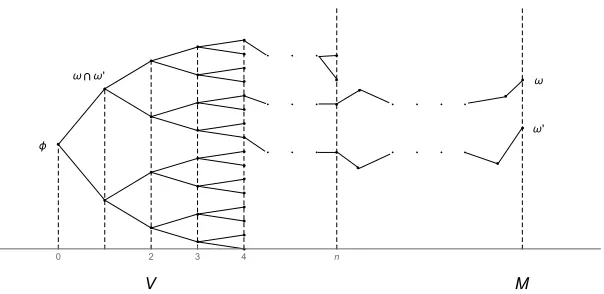
Example 7 (The binary tree) Let A = {0,1}, and M := Q
NA the infinite Cartesian
product, as a Cantor space. Set V := all finite words:
V = [
n∈N
(α1, α2,· · ·, αn)
αi∈ {0,1} ; (127)
and set l((α1, α2,· · ·, αn)) =:n.
For ω= (ωk)∞1 ∈M, set ω
n:= (ω1, ω2,· · · , ωn)∈V. (128)
For two points ω, ω0 ∈M, we shall need the number
l ω∩ω0= supn : ωn=ω0
Let r:N→R+ be given such that
r(∅) = 0, X
n∈N
r(n)<∞. (130)
For conductance function c:E→R+, set
cα,(αt) = 1
r(l(α)), ∀α∈V, t∈ {0,1}. (131)
One checks that, when (130) holds, then
lim
n,m→∞R
(c) ω
n, ω m
= 0.
Consider the graph G2 = (V, E) where the edges are “lines” between α and (αt), where t∈ {0,1}. See Figure 7.
Lemma 54 With the settings above, the metric completionRg(c)w.r.t. the resistance metric
onV is as follows: For ω, ω0 ∈M (see Figure 9),
g
R(c) ω, ω0
= 2
∞ X
n=l(ω∩ω0)
r(n). (132)
Let H be the corresponding energy-Hilbert space ' the RKHS of kc. For α ∈V, let δα be
the Dirac-mass at the vertex point α. Then
kδαk2H =
2 r(l(α))+
1
r(l(α)−1). (133)
(See Figure 8.)
Proof To see this, note thatαhas the three neighbors sketched in Figure 7, i.e., α∗, (α0), and (α1), where α∗ is the one-truncated word,
g
R(c) ω, ω0
= 2
∞ X
n=l(ω∩ω0)
r(n). (134)
One checks that when (130) is assumed, then the conditions in point (iii) of the theorem are satisfied.
Corollary 55 Now return to the discrete restriction of Brownian motion in Section 3.1. Set V ={x1, x2, x3,· · · } where the points {xi}∞i=1 are prescribed such that x1 < x2 <· · ·< xi < xi+1 < · · ·. We turn V into a weighted graph G as follows: The edges E in G are
nearest neighbors; and we define a conductance function c:E →R+ by setting
cxixi+1:=
1 xi+1−xi
α*
α
(α0)
(α1)
Figure 7: Edges inG2.
ϕ
M
α
β γ
δ ρ
δαℋ2 δβ2ℋ δγℋ 2 δδℋ2
δρℋ2
(a)
α β
γ δ ρ
δα2ℋ
δβ2ℋ δγ2ℋ
δδ2ℋ δρ2ℋ
(b)
Figure 8: Histogram for kδαk2H as vertices α ∈V approach the boundary. See (133), and
ϕ
V M
ω ⋂ ω' ω
ω'
0 2 3 4 n
Figure 9: The binary tree and its boundary, the Cantor-set.
and Laplace operator,
(∆f) (xi) =
1 xi+1−xi
(f(xi)−f(xi+1)) + 1 xi−xi−1
(f(xi)−f(xi−1)). (136)
Then the RKHS associated with the Green’s function of∆in (136) agrees with that from the kernel construction in Section 3.1, i.e., the discrete Cameron-Martin Hilbert space.
Proof Immediate from the previous Proposition and its corollaries.
Acknowledgments
The co-authors thank the following colleagues for helpful and enlightening discussions: Pro-fessors Daniel Alpay, Sergii Bezuglyi, Ilwoo Cho, Ka Sing Lau, Paul Muhly, Myung-Sin Song, Wayne Polyzou, Gestur Olafsson, Keri Kornelson, and members in the Math Physics seminar at the University of Iowa. We are grateful to the referees for their care to details and for their kind and very helpful suggestions. We have revised following them all.
References
Daniel Alpay and Harry Dym. On reproducing kernel spaces, the Schur algorithm, and interpolation in a general class of domains. In Operator Theory and Complex Analysis (SApporo, 1991), volume 59 ofOper. Theory Adv. Appl., pages 30–77. Birkh¨auser, Basel, 1992.
Daniel Alpay and Harry Dym. On a new class of structured reproducing kernel spaces. J. Funct. Anal., 111(1):1–28, 1993.
Daniel Alpay, Vladimir Bolotnikov, Aad Dijksma, and Henk de Snoo. On some operator colligations and associated reproducing kernel Hilbert spaces. In Operator Extensions, Interpolation of Functions and Related Topics, volume 61 of Oper. Theory Adv. Appl., pages 1–27. Birkh¨auser, Basel, 1993.
Daniel Alpay, Palle Jorgensen, Ron Seager, and Dan Volok. On discrete analytic functions: products, rational functions and reproducing kernels. J. Appl. Math. Comput., 41(1-2): 393–426, 2013.
Daniel Alpay, Palle Jorgensen, and Dan Volok. Relative reproducing kernel Hilbert spaces.
Proc. Amer. Math. Soc., 142(11):3889–3895, 2014.
Nachman Aronszajn. La th´eorie des noyaux reproduisants et ses applications. I. Proc. Cambridge Philos. Soc., 39:133–153, 1943.
Nachman Aronszajn. Reproducing and pseudo-reproducing kernels and their application to the partial differential equations of physics. Studies in partial differential equations. Tech-nical report 5, preliminary note. Harvard University, Graduate School of Engineering., 1948.
Brighid Boyle, Kristin Cekala, David Ferrone, Neil Rifkin, and Alexander Teplyaev. Elec-trical resistance of N-gasket fractal networks. Pacific J. Math., 233(1):15–40, 2007.
Ola Bratteli and Palle Jorgensen. Wavelets Through a Looking Glass. Applied and Numer-ical Harmonic Analysis. Birkh¨auser Boston, Inc., Boston, MA, 2002.
Andrea Caponnetto, Charles A. Micchelli, Massimiliano Pontil, and Yiming Ying. Universal multi-task kernels. J. Mach. Learn. Res., 9:1615–1646, 2008.
Ilwoo Cho and Palle Jorgensen. Free probability induced by electric resistance networks on energy Hilbert spaces. Opuscula Math., 31(4):549–598, 2011.
Felipe Cucker and Steve Smale. On the mathematical foundations of learning. Bull. Amer. Math. Soc. (N.S.), 39(1):1–49, 2002.
Minh Ha Quang, Sung Ha Kang, and Triet M. Le. Image and video colorization using vector-valued reproducing kernel Hilbert spaces. J. Math. Imaging Vision, 37(1):49–65, 2010.
S. Haeseler, M. Keller, D. Lenz, J. Masamune, and M. Schmidt. Global properties of Dirichlet forms in terms of Green’s formula. ArXiv e-prints, 2014.
Haakan Hedenmalm and Pekka J. Nieminen. The Gaussian free field and Hadamard’s variational formula. Probab. Theory Related Fields, 159(1-2):61–73, 2014.
Palle Jorgensen and Erin P.J. Pearse. A Hilbert space approach to effective resistance metric. Complex Anal. Oper. Theory, 4(4):975–1013, 2010.
Palle Jorgensen and Erin P.J. Pearse. Resistance boundaries of infinite networks. In
Palle Jorgensen and Erin P.J. Pearse. A discrete Gauss-Green identity for unbounded Laplace operators, and the transience of random walks. Israel J. Math., 196(1):113–160, 2013.
Samuel Karlin and Zvi Ziegler. Some inequalities of total positivity in pure and applied mathematics. In Total positivity and its applications (Jaca, 1994), volume 359 ofMath. Appl., pages 247–261. Kluwer Acad. Publ., Dordrecht, 1996.
Sanjeev Kulkarni and Gilbert Harman. An elementary introduction to statistical learning theory. Wiley Series in Probability and Statistics. John Wiley & Sons, Inc., Hoboken, NJ, 2011.
Sneh Lata and Vern Paulsen. The Feichtinger conjecture and reproducing kernel Hilbert spaces. Indiana Univ. Math. J., 60(4):1303–1317, 2011.
Yi Lin and Lawrence D. Brown. Statistical properties of the method of regularization with periodic Gaussian reproducing kernel. Ann. Statist., 32(4):1723–1743, 2004.
Edward Nelson. Kernel functions and eigenfunction expansions. Duke Math. J., 25:15–27, 1957.
Kasso A. Okoudjou and Robert S. Strichartz. Weak uncertainty principles on fractals. J. Fourier Anal. Appl., 11(3):315–331, 2005.
Kasso A. Okoudjou, Robert S. Strichartz, and Elizabeth K. Tuley. Orthogonal polynomials on the Sierpinski gasket. Constr. Approx., 37(3):311–340, 2013.
Carl Edward Rasmussen and Christopher K. I. Williams. Gaussian processes for machine learning. Adaptive Computation and Machine Learning. MIT Press, Cambridge, MA, 2006.
Bernhard Schlkopf and Alexander J. Smola. Learning with Kernels: Support Vector Ma-chines, Regularization, Optimization, and Beyond (Adaptive Computation and Machine Learning). The MIT Press, 1st edition, 12 2001.
Oded Schramm and Scott Sheffield. A contour line of the continuum Gaussian free field.
Probab. Theory Related Fields, 157(1-2):47–80, 2013.
John Shawe-Taylor and Nello Cristianini. Kernel Methods for Pattern Analysis. Cambridge University Press, 2004.
Steve Smale and Ding-Xuan Zhou. Online learning with Markov sampling. Anal. Appl. (Singap.), 7(1):87–113, 2009.
Ingo Steinwart. On the influence of the kernel on the consistency of support vector machines.
J. Mach. Learn. Res., 2:67–93, March 2002.
Robert S. Strichartz and Alexander Teplyaev. Spectral analysis on infinite Sierpi´nski fractafolds. J. Anal. Math., 116:255–297, 2012.
Mirjana Vuleti´c. The Gaussian free field and strict plane partitions. In 25th International Conference on Formal Power Series and Algebraic Combinatorics (FPSAC 2013), Dis-crete Math. Theor. Comput. Sci. Proc., AS, pages 1041–1052. Assoc. DisDis-crete Math. Theor. Comput. Sci., Nancy, 2013.