SERVICE-LEARNING AS A CORE ACADEMIC
COMPONENT IN UNDERGRADUATE
PROGRAMMES: A BRIEF INTRODUCTION
TO THE HONG KONG POLYTECHNIC
UNIVERSITY MODEL
Stephen C F Chan
Grace Ngai
C
ommunity engagement has been integrated into undergraduate programme to varying degrees in many universities. The Hong Kong Polytechnic University, in particular, has made it compulsory for all students to take at least one credit-bearing subject in Service-Learning (SL). Each SL subject is offered with purpose-designed academic teaching, rigorous service and structured assessment components. At full implementation, in each year, more than 2,800 students enrolled in 4-year full time undergraduate programs are expected to enroll in around 60 subjects offered by a wide range of departments and faculties across the university. These subjects covera diverse range of topics, such as digital divide, learning difficulties, engineering
design, healthy living environments, orthotics, and eco-tourism, to name a few examples. Many of the projects involve ICTs (Information and Communication Technologies) in some way, ranging from digital literacy training to constructing
community learning centers to data analysis and simulation. The target beneficiaries
are equally diverse: students serve slum dwellers, disabled people, children with HIV, villagers without water nor electricity, new immigrants, mentally ill patients, ethnic minorities, and so on. To date, they have served in Hong Kong, Chinese Mainland, Cambodia, Vietnam, Indonesia, Myanmar, and Rwanda. This paper reports on the pedagogical design of the program, challenges and strategies for implementation, and the experiences so far, with around 2,000 students enrolled in 2013-14.
Key Words: Service learning, academic requirement
Introduction
In 2012, there was a rare opportunity for reform in higher education in Hong Kong. All public-funded universities changed from a 3-year undergraduate degree
structure to a 4-year one. One intended benefit of the change is that “(t)he higher
put on the role of universities in educating students into socially responsible citizens with a heart to serve the community (e.g., Andrzejewski and Alessio, 1999; Purdue, 2005; Mohamedbhai, 2011; UNESCO, 2009).
The Hong Kong Polytechnic University (PolyU)’s strategic plan states that
its core business is to “develop all-round graduates with … social and national responsibility, and … global outlook … with responsible citizens …” To this end,
the university has successfully encouraged many students to engage with society through community service, mostly in the form of non-credit-bearing, co-curricular activities both local and offshore. With the approach of the new curriculum, the university realised that it could do better in the more intangible areas of civic responsibility, social justice and ethics. Hence it took the opportunity afforded by the change to stipulate a Service-Learning Requirement, in which all students are required to successfully complete a 3-credit subject with an approved SL component in order to qualify for graduation. To plan and prepare for the implementation of the university-wide SL Requirement is a mammoth task, as it involves the development of more than 60 SL subjects, offered by more than 20 academic departments, to cater for over 2,800 students each year. There are major challenges including:
1. Designing a rigorous academic structure for the development, offering, and quality control of SL subjects.
2. Cultivating long-term service projects and collaborative relationships with external collaborators such as non-government organisations.
3. Building a critical mass of academic staff with the passion and expertise to offer SL subjects.
4. Developing a robust mechanism for funding SL subjects and associated projects.
This paper will examine the major challenges and the institutional strategies
in meeting these challenges, which constitute an outline of the “Hong Kong
Polytechnic University Model of Service-Learning”. The model is obviously still under development. It is also not necessarily unique. In the development of the institutional strategy, we have carefully studied and researched experiences at many institutions, including University of San Francisco, University of Pennsylvania, Tufts University, Purdue University, among others, as well as the consolidated information at Campus Compact. We have adopted many of their good practices.
Hence, the reader may find many similarities. Nevertheless, the PolyU experience
offers a serious and practical case study for ourselves, as well as for other institutions
and educators. We will also briefly report on the progress made so far.
Academic Structure
As an important type of experiential learning, SL integrates community service
with instruction and reflection to enrich students’ learning experience, in order to
sense of civic responsibility and engagement on the one hand, and benefits the
community at large on the other (NSLC, 2006).
A Credit-Bearing Service-Learning Subject
Service-learning has certain similarities with, but is not the same as, volunteer work. While volunteer work stresses service without compensation or reward, service-learning calls for a balanced approach integrating community service with learning, and emphasizes learning through participation in services (Furco 1996).
Hence students’ self-reflection and assessment are critical elements of
service-learning (Bringle & Hatcher 1999).
At PolyU, a relatively broad definition of service-learning is adopted. It primarily
focuses on activities that serve people directly, but nevertheless also covers indirect service activities relating to civic responsibility and engagement. It can include direct service activities such as tutoring of children in poverty, construction for remote villages, and health education for under-developed communities as well as
indirect services such as field research on sustainable development and advocacy
for social justice. Both local and offshore activities are included. Students are also
“rewarded” by academic credits when academic objectives are achieved.
PolyU is a comprehensive university with a wide range of disciplines. Each
academic programme is typically composed of Discipline-Specific Requirements
(DSR) and General University Requirements (GUR). GUR includes languages and general education subjects, with a total of 30 credits and is equivalent to one year’s worth of studies. Service-Learning is designed as a 3-credit subject as part of the GUR.
A SL subject can be offered by any academic department. It may target general
issues such as poverty relief or assisting the elderly; or it may target more specific
issues such as assistive devices for the handicapped, housing problems, or dyslexia. It may require generic skills such as communication in English and Chinese; or it
may require discipline-specific skills such as bridge-building, accountancy, nursing
or graphic design. It may be designed for all university students; or for students
from a specific discipline of study. Put simply, an academic subject qualifies as a SL subject if it satisfies the following:
1. Clear academic objectives and expected outcomes for the students, which may
be generic, discipline-specific, or both. Four common learning outcomes have been specified for SL subjects, while individual subjects may specify additional
learning outcomes. The 4 common outcomes are:
i) Apply the knowledge and skills they have acquired to deal with complex issues in the service setting.
ii) Reflect on their role and responsibilities both as a professional in their
chosen discipline and as a responsible citizen.
iv) Demonstrate an understanding of the linkage between the academic content of the subject and the needs of society.
2. A significant amount of community service activities (at least 40 hours, roughly
one-third of the total amount of the expected student effort for a 3-credit subject),
which address identified needs in the community in a meaningful way, which
must be supervised and assessed.
3. A rigorous process for student reflections, on the linkage of their studies to the
needs of the community and the services, their personal role and growth, and the impact of their services.
Variety in SL Subjects
Based on literature and the experiences of other universities, it is recognised that the common SL learning outcomes can be achieved in many different ways. Each subject may differ in the background of the students, the associated academic discipline, the type of services involved, the type of clients served, the location, etc. SL subjects are offered by a wide range of academic departments rather than
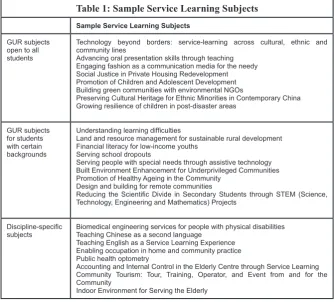
Table 1: Sample Service Learning Subjects
Sample Service Learning Subjects
GUR subjects open to all students
Technology beyond borders: service-learning across cultural, ethnic and community lines
Advancing oral presentation skills through teaching Engaging fashion as a communication media for the needy Social Justice in Private Housing Redevelopment Promotion of Children and Adolescent Development Building green communities with environmental NGOs
Preserving Cultural Heritage for Ethnic Minorities in Contemporary China Growing resilience of children in post-disaster areas
GUR subjects for students with certain backgrounds
Understanding learning difficulties
Land and resource management for sustainable rural development Financial literacy for low-income youths
Serving school dropouts
Serving people with special needs through assistive technology Built Environment Enhancement for Underprivileged Communities Promotion of Healthy Ageing in the Community
Design and building for remote communities
Reducing the Scientific Divide in Secondary Students through STEM (Science, Technology, Engineering and Mathematics) Projects
Discipline-specific
subjects Biomedical engineering services for people with physical disabilitiesTeaching Chinese as a second language Teaching English as a Service Learning Experience
Enabling occupation in home and community practice Public health optometry
Accounting and Internal Control in the Elderly Centre through Service Learning Community Tourism: Tour, Training, Operator, and Event from and for the Community
a specific department such as social work, public affairs, etc. At this point in time,
2 years after the policy came into effect, about 90% of academic departments at the university are offering at least one SL subject, and soon, hopefully, it will be 100%. Table 1 shows some examples of subjects designed for students with different backgrounds.
Broadly speaking, there are two major types of SL subjects. There are
“general education” types (referred to as General University Requirement, GUR)
subjects. They are intended to enhance students’ general knowledge. They do not
require specific pre-requisite subjects or knowledge beyond what is required of all
undergraduate students: basic language skills, analytical skills, computer literacy, etc. Hence many GUR subjects are open to all undergraduate students, without pre-requisites. There are, nevertheless, some GUR SL subjects that are designed for students with certain backgrounds, such as engineering, health-related disciplines,
business, etc., so that they carry out specific services.
At the other extreme are subjects that are designed for students in a specific
discipline, e.g., optometry, English, biomedical engineering, etc. These are designed so that students specialising in professional disciplines can use their specialist knowledge to serve, and in the process enhance their professional expertise. These are generally designed for students in their senior (i.e. 3rd or 4th) years of studies. All SL subjects, including those that are open to all students, are expected to have strong academic objectives and learning outcomes. Students are given rigorous training in the academic elements and relevant skills prior to engaging in the prescribed community service projects. And they are rigorously assessed in the
achievement of the expected learning outcomes. For example, the “Technology
Beyond Borders” subject is focused on information technology. One of the main
topics of study is the “digital divide” between communities with advanced IT
technologies and those who are without. Students learn about the digital divide, appropriate technologies and methods for bridging it, and then participate in service projects applying those technologies and methods.
Large SL Subjects
The first strategic decision regarding service-learning was to make it
credit-bearing. The second was to make it compulsory for all undergraduates. There are two major arguments for the decision. Firstly, the learning objectives of civic responsibility, social justice and ethics are critical components of all-round education, and hence should be required of all students. Secondly, it is often those who would not volunteer for community service that need the exposure.
designing and carrying out their projects. Many of the SL subjects at the PolyU also
fit this pattern.
The offering of service learning subjects to large classes (e.g., over 100 students), however, may be one of the distinguishing characteristics of SL at PolyU. This is a result of both necessity and design. On the one hand, there is a need to provide thousands of places each year for the students who are required to take SL subjects; hence the need for large classes. On the other hand, some of these students may not be as highly motivated as some others, having been required to take an SL subject – even though they do have a wide variety of SL subjects to choose from. Hence there are some SL subjects in which the service projects are highly structured, which can also accommodate a large number of students. For example, a subject that addresses the enhancement of teaching of science at secondary schools may enroll 100 students. It may send 50 PolyU students to one secondary school, with 10 PolyU students in one classroom for 40 secondary students, to help the secondary students carry out pre-designed science projects. Another 50 students may be sent to another secondary school, with similar projects. Within this structure, however, there is still a lot of room for autonomy and self-initiative. For example, the PolyU students may be given only a general topic for the science project, and they have to develop the project details, procure the materials, write the lesson plans and worksheets, etc.
Quality Assurance and Control
With such a broad diversity of subjects and staff, it is important to have a process for assuring the quality of the student learning experience. To this end, a committee on service learning subjects was formed with the objective to oversee the offering of SL subjects at the university.
The committee is composed of faculty members from diverse faculties and departments, who are experienced in SL and general academic matters. The composition of the committee ensures that a broad spectrum of disciplines and
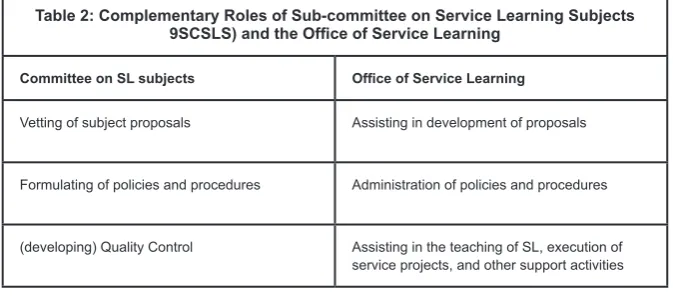
Table 2: Complementary Roles of Sub-committee on Service Learning Subjects 9SCSLS) and the Office of Service Learning
Committee on SL subjects Office of Service Learning
Vetting of subject proposals Assisting in development of proposals
Formulating of policies and procedures Administration of policies and procedures
(developing) Quality Control Assisting in the teaching of SL, execution of
departments are represented, and that a balanced academic viewpoint is present.
The committee invites proposals for new subjects, vets the proposals and finally recommends them to the university for final approval.
The committee works closely with the Office of Service Learning (OSL), which
can be considered the operational arm of the support structure. The OSL assists departments in developing subject proposals, projects, and student supervision, and will be described in greater detail in a subsequent section. The complementary roles of the committee and OSL are summarised in Table 2.
The decision to make SL credit-bearing and compulsory was made in December 2010, while the decision applies to the cohort of students entering in 2012, which is expected to graduate by 2016. Between 2011-14, the main goal of the committee and OSL was to promote and develop SL subjects. Approximately 15-20 new subjects were approved each year. By June 2014, 49 subjects from 22 academic departments have been approved. While new subjects continue to be developed, the focus now necessarily shifts to the development of a process to rigorously evaluate SL subjects, consolidation, research on effective pedagogy, and evidence-based improvement.
The fact that SL subjects are offered by multiple departments poses particular challenges in quality control. Generally departments are responsible for quality control of the subjects that they offer. However, as most departments offer only a few SL subjects, of which half of the contents may be related to community service or other issues not necessarily in the core expertise of the department, there is an on-going discussion in favour of a centralised unit to oversee the operation of SL subjects across campus. There is also an on-going teaching development project on the evaluation of SL subjects, which will provide research-based input to the development of a rigorous academic quality control process for SL.
Operational Support
At PolyU, a small selection of departments were already experienced in SL prior to the implementation in 2012, because of the nature of their discipline. Most of these departments are in the health sciences, such as social work, nursing and rehabilitation sciences. Some other departments, such as computing, design and biomedical engineering, have acquired some experience because of their own initiatives. Most of the other departments and their staff, however, are relatively inexperienced. Therefore, it is important for the university to provide needed support for developing subject syllabi, teaching methods, service projects, etc. This need is also evident from studying practices at many leading universities. Hence the
Office of Service-Learning was formed to provide central support and coordination.
Office of Service Learning (OSL)
projects, liaise with non-government organisations to find suitable projects for the
teachers, liaise with funding agencies and donors to support projects, offer staff development workshops and courses, and organise a number of exploratory projects. Working closely with the committee in charge of vetting subject proposals, the OSL also developed an eLearning module for students, which covers basic concepts on service learning that can be used as a core part of an SL subject. The module is designed to be completed in roughly 10 hours and has been integrated into many SL subjects. It reduces the teaching load of the teaching staff, ensures some consistency in teaching, and in general promotes the implementation of service learning.
Collaboration with External Partners
In most cases, the service projects are carried out in collaboration with external
organisations, such as non-profit organisations, primary schools, secondary schools,
and other universities. In some cases, the PolyU staff are responsible for designing and planning the majority of the project, while the external partner contributes little.
For example, in some of the projects aimed at reducing the “scientific divide”,
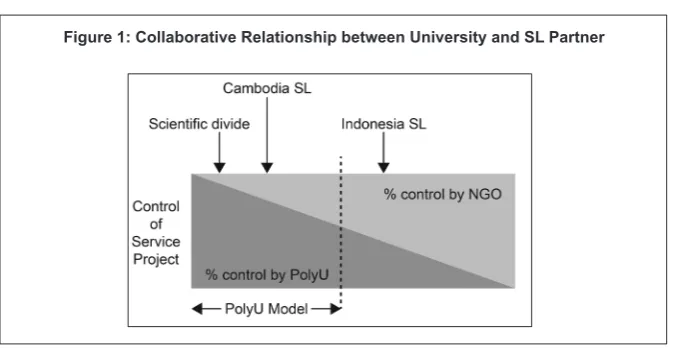
the collaborating schools are responsible for selecting the participating students, scheduling the sessions and venue, etc. The PolyU staff are in charge of the service projects: designing the projects, providing the project material and notes, transportation for the students, etc. Such a subject will be positioned close to the left edge of the diagram in Figure 1.
In some other projects, the external partner may play a much more significant
role. This is particularly true for offshore projects outside of Hong Kong (e.g. in the Chinese mainland or overseas). For example, one of our projects in rural development collaborates with a university in Indonesia. Our partner institution has a strong service learning program of their own, good connections to the local government and many villages around Yogyakarta, and their students speak the local language. In this particular case, the local partner takes a lot of initiatives in the planning of the services, selection of villages, logistics, accommodation in village homes, interpretation, etc. Our faculty members work closely with the local university, and retain full control in supervising and assessing our students in the execution of the service projects. The case will be positioned near the middle of the diagram in Figure 1.
Many of the projects occupy some point in between the “scientific divide” case above (PolyU having practically full control) and the “Indonesia” case (our partner
9 Angelica
10 Arial 6pt
We discourage (and never approve) service learning projects that give complete control to our external partners. Given that service learning is a core requirement of the university, it is imperative for the learning outcomes and the learning experience of our students that the design of the project be an integral part of the subject, which makes out-sourcing to external partners inappropriate. Hence the range of collaboration relationships supported in the PolyU model covers generally the left half of the diagram in Figure 1
Staff Development
Prior to the implementation of academic credit-bearing SL in 2011, there were
few faculty members who had significant experience in developing, delivering and
assessing credit-bearing service-learning. On the other hand, at full implementation, we probably need an estimated 100 faculty members to teach around 60 SL subjects, some of which will be taught jointly because of the large class size, heavy supervisory duties, or the multi-disciplinary nature of the subject or services. Hence staff development is critical. A number of actions have been taken, many of which have turned out to be highly effective.
Workshops and Seminars
From the start, workshops and seminars were heavily used to promote the concept of service learning, as well as to educate staff on aspects of teaching an SL subject. These seminars were organised on the average of once a month, on a broad range of topics: the policy on service-learning, how to write a syllabus, how to assess students’ performance, etc. At the beginning, outside speakers were invited, but, increasingly, internal speakers experienced in various aspects of SL are providing these workshops.
eLearning
An eLearning short course for staff was developed and deployed in September 2012. It takes 3 hours to complete and covers the basic concepts, advantages, myths, subject and project development guidelines, samples of SL subject syllabi and projects, etc. (Shek & Chan, 2013). More than 50 staff members have since taken the eLearning course. An evaluation survey found that overall satisfaction with the eLearning short course was around 4 out of a maximum of 5. Many who have taken the course have gone on to propose and teaching SL subjects themselves. It has also been shared with staff from other institutions.
Practical Training
Staff who are interested but perhaps less experienced in offering SL subjects are given opportunities to participate in service projects to acquire hands-on experience.
Starting in 2011, some of our more “mature” projects, such as the Cambodia
off-shore service learning project, have accommodated other faculty members joining
as observers. A practical experience short course was offered for the first time in
summer 2013, and repeated in 2014. Staff join the students on a SL course with a
project in Cambodia to acquire first hand experience in supervising and monitoring
students’ performance, planning service projects and in collaborating with NGOs. Several of the staff who participated have come back to become strong advocates and supporters with SL subjects of their own.
Community of Practice
A community of practice is being formed, as a platform for staff to share experiences, collaborate in exploratory projects and research, and to promote the practice of service learning. As discussed earlier, SL subjects are distributed among a wide range of departments. As a result, some departments have relatively few (perhaps as few as 1 or 2) staff engaged in SL. To provide support to our SL faculty, an institution-wide community of practice was created. The community has a modest budget for supporting small-scale projects, attendance at conferences, etc. Regular gatherings encourage staff to share experiences and information on writing proposals for new subjects, seeking funding, assessing student performance, etc. Such gatherings are usually well-attended, testifying to their usefulness.
Funding Support
Funding for Service Learning Subjects
are offered and funded like other academic subjects. In addition, it is recognised
that service-learning involves significant amounts of activities conducted outside
the classroom. Hence there may be a need for additional resources for supporting
the subject delivery such as field supervision, travelling and equipment. The total
funding of SL subjects is approximately 30% higher than other GUR subjects.
Project and Travel Expenses
While most (around 80%) of our students will participate in service learning projects in Hong Kong, an increasing number are serving in offshore projects beyond Hong Kong. These include sites in the Chinese mainland, as well as foreign countries such as Cambodia, Indonesia, Vietnam, Myanmar and Rwanda. These projects serve multiple purposes in addition to learning through service. To begin with, Hong Kong is geographically very small and relatively racially homogeneous. In addition, many of our students are from working-class backgrounds who may not have previously travelled out of Hong Kong, even on vacation. Put together, this means that many of them have not previously had experience interacting with peers from a different race or culture for extended periods of time. Offshore projects therefore afford students an additional learning experience from interacting with people from different cultures and races. For projects that involve appropriate technology, such as the many ICT projects, they also afford students the opportunity to work in a low-resource environment.
These projects will necessarily incur additional costs beyond that of a conventional academic subject, and even beyond that of local service learning subjects. While the university is expecting the students to cover part of their own costs to ensure ownership and accountability, it is also making funds available to subsidise the students’ expenses. It is encouraging to witness that many donors, both individuals and institutions, are quite willing to donate generously to fund SL
projects, seeing the benefits to the students and the communities that they serve.
Since the initiative started in 2011, donations of approximately two million US dollars have been received.
Interim Results
Subjects Developed
It is estimated that an average SL subject can accommodate 50 students, and we need to offer around 60 subjects each year to accommodate all the 2,800 students in full-time 4-year undergraduate degree programs needing to take a SL subject, when the initiative is in full implementation.
offered by health and social science departments. It is encouraging, however, to see a number of subjects being offered by engineering and construction & environment departments. All faculties and schools are now active in offering service-learning.
Impact on Students
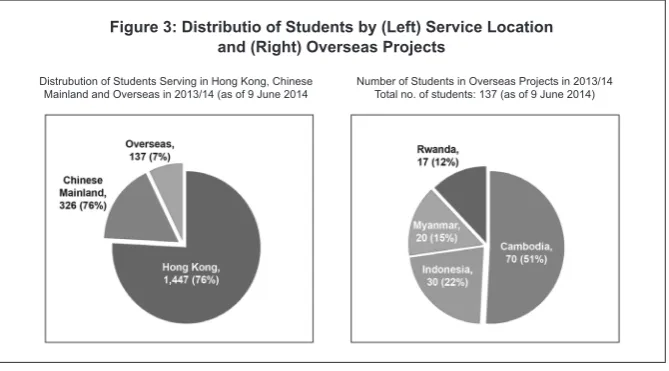
In the academic year 2013-14, around 1,900 students enrolled in SL subjects. Over 75% of the students participate in projects in Hong Kong. About 25% of them serve in
projects in the Chinese mainland, and a small but significant number serve in overseas
countries, mostly in South-East Asia, and a few as far as in Rwanda, Africa (Figure 3). Figure 2: Number of SL Subject Approved, Offered by each Faculty/School
Figure 3: Distributio of Students by (Left) Service Location and (Right) Overseas Projects
Distrubution of Students Serving in Hong Kong, Chinese
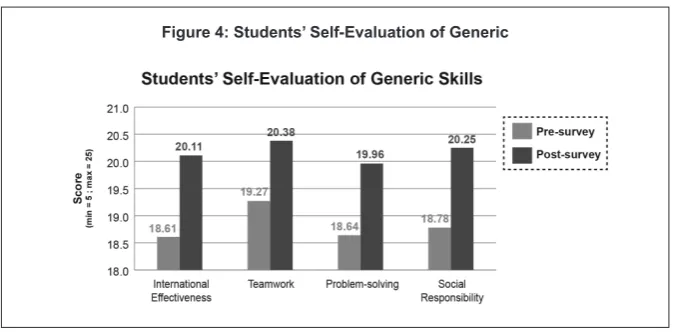
Students are surveyed before and after they have taken their SL subjects. At the time of reporting, data has been collected from around 360 students who have completed a credit-bearing SL subject, and the preliminary results are quite encouraging (Figure 4). These are, of course, very early results from a small population. We will have to continue to monitor the implementation of these subjects and perform more in-depth analysis in order to better understand the impact of the initiative.
The objective of the SL initiative at the university is, of course, not only for students to take a SL subject. It is, rather, to cultivate a culture of civic engagement and social responsibility at the university. It is encouraging to observe that some of the students who have taken a SL subject have returned to participate in service project as students assistants and leaders, organise their own service projects, and even developing their own organisations in community service. The university is developing a number of mechanisms, including scholarships, internship opportunities, and participation in SL-related conferences, to encourage and support students in furthering their involvement in service learning.
Impact on Staff and the University
When the SL initiative was proposed, and even when it was approved by the
university, there remained a significant number of doubters and skeptics. In the
past several years, however, there are encouraging signs that more staff members are actively involved. There is as yet no concrete data, but there are indicators in the number of new subjects proposed, number of staff who participate in the Community of Practice, number of new staff involved in the proposing and teaching of SL subjects. We are also seeing increasing interest from alumni, individuals
and organisations external to the university, which is concretely reflected in the
Case Studies
The previous sections described the background of the service learning initiative at the Hong Kong Polytechnic University. In this section, we will describe some case studies of representative projects that use ICT as a means for empowering the target
beneficiaries and enhancing student learning.
IT Literacy through Digital Storytelling
The pace of technology development in this day and age has made IT literacy an invaluable skill for young people all over the world. In many developing countries, ICT is a much-desired discipline of study and people with even basic IT skills are in high demand.
The digital storytelling project was designed in response to a request from a rural primary school in China, which had received a donation of computers and wished to integrate ICTs into their curriculum. The initial request was for lessons in
Office automation (e.g. Microsoft Word, Power Point, etc) and Internet usage (e.g.
email, information search, etc). Upon analysis of the situation, however, we felt that
skills-based workshops would be boring for primary school children and difficult for
our students to motivate and teach well. A counterproposal was therefore made to
host a project-based workshop on digital storytelling through micro-film production, which would introduce skills such as basic computer operations, file manipulations, Internet search (for stock images to insert into their films), etc. Once the theme of
the workshop had been decided, our students designed a lesson schedule and made up the teaching materials and worksheets.
The final workshop took place over five full days and involved 40 primary
school students, working in groups, and 8 university students, acting as the group leaders or mentors. A few changes were incorporated along the way to accommodate student preferences – for example, some children wanted to incorporate their own artwork into the movie, so painting software was added as an extra topic for that group. The teachers at the school were observers for a majority of the workshop, and sometimes also assisted the children in completing their work and helping with classroom management.
The school did not have the resources or the know-how to continue with these types of workshops after we left, but the skills and concepts that were taught as part of the workshop were incorporated into their everyday classes. One year later, a follow-up visit observed changes such as the use of Power Point in classes and teachers’ meetings, and Google Maps in General Studies classes.
Building a Mobile Community Learning Center
was developed for an NGO in Cambodia. The NGO wished to start a computer literacy course for schoolchildren in a rural suburb, about 40 minutes from the city
center. For logistical and financial reasons, constructing a community learning center
for the suburb was not deemed to be possible, nor was it deemed feasible to transport the children to the NGO’s center in the city.
The solution that was worked out between our faculty and the NGO staff drew from the mobile library bookmobiles that serve underprivileged communities in the United States. Mobile devices were repurposed as the computing devices, rather than conventional KVM devices, and a Raspberry Pi was set up as a server with
e-Learning resources, such as e-books and flipped classroom-style lecture videos
on mathematics and science topics. A battery-powered router created a local area network that would enable the mobile devices to access the content on the server, and another battery powered the Raspberry Pi. The resulting lab was housed into
a shockproof and waterproof case (usually used for storing/transporting filming
equipment). One charge in the city would be enough to power the lab for 4-6 hours, which would be more than enough for one session.
Under our supervision, our students collaborated with the local NGO in designing and constructing the lab. They had to research into usability factors such as the local modes of transportation, which they had to take into consideration when deciding on
the final form factor of the equipment. They also investigated the local curriculum
and translation/transcription issues, which were used to inform the e-Resources that were used to populate the lab server. In addition, they also planned workshops in digital literacy for the local children as a means of familiarising the NGO staff with the equipment and modes of education with e-Resources. These workshops were then organised during a one-week service on-site service.
Conclusion and Future Work
Starting from scratch in 2011, the SL initiative has been largely progressing on schedule. This is the result of adopting best practices from leading universities, determination and strong support from the senior management, clear and balanced policies, the effort of a number of enthusiastic advocates, and most importantly, support from a broad spectrum of staff and students from across the university.
Nevertheless, from the experience in the past three years, a number of issues
requiring attention have been identified, which we will have to address in the coming
years:
1. Quality assurance - There is a need to ensure that the subjects offered are genuine SL subjects, and that they are taught in the way it was designed.
2. Funding support - Many subjects, particularly those involving travelling and
equipment incur significant expenses.
Grace Ngai is an Associate Professor in the Department of Computing at the Hong Kong Polytechnic University. She has been active in service learning since 2005 and currently the coordinator of the Subcommittee of Service Learning Subjects at the Hong Kong Polytechnic University, which is responsible for approving and monitoring academic service learning subjects.
Stephen C F Chan is currently the Head of the Office of Service Learning (OSL) and an associate professor in the Department of Computing at Hong
Kong Polytechnic University. He has been involved in service-learning since 1996, and is currently co-teaching two information technology-related service-learning subjects, with projects in Hong Kong, Cambodia, Myanmar and Rwanda.
4. Scalability - To develop a number of large-scale subjects/projects to accommodate the very large number of students involved
References
Andrzejewski, J. & Alesso, J. (1999, Spring). Education for Global Citizenship and Social Responsibility. Progressive Perspectives: 1998-99 Monograph Series, vol. 1, no. 2.
Bringle, R. & Hatcher, J. (1999) Reflection in Service Learning: making meaning of experience, Educational Horizons, vol. 77, no. 4, Summer 1999, p. 179-185.
Chan, S., Ng, V. & Ngai, G. (2006) A Framework for Service Learning in Professional Context, Asia-Pacific Educational Research Association International Conference 2006, Hong Kong, pp 74.
Education and Manpower Bureau (2005). The New Academic Structure for Senior Secondary Education and Higher Education: Action Plan for Investing in the Future of Hong Kong. Hong Kong: Education and Manpower Bureau.
Furco, A.(1996). Service-Learning: A balanced approach to experiential education, Expanding Boundaries: Serving and Learning. Washington, DC: Corporation for National Service, 2-6.
Mohamedbhai, G. (2011). Social Responsibility of Universities in a Knowledge-Based Economy. Paper presented at the 2nd International Conference and Exhibition On Higher Education, Riyadh, Saudi Arabia, 19-22 April 2011.
National Service Learning Clearinghouse (2006). http://www.servicelearning.org.
Purdue University (2005) Engineering Projects in Community Service (EPICS). http://epics.ecn.purdue.edu/ Shek, D. & Chan, S. (2012) Service Learning from the eyes of university teachers: A qualitative study based
on focus groups, accepted for publication in International Journal of Adolescent Medicine and Health (IJAMH).
Shek, D. & Chan, S. (2013) Development of an e-learning package on Service Learning for university teachers, accepted for publication in International Journal of Adolescent Medicine and Health (IJAMH). UNESCO (2009). Communiqué from the UNESCO World Conference on Higher Education: The New