________________________________ Author for Correspondence:
Byasabhusan Das,
Anwarul Uloom College of Pharmacy
Department of Pharmaceutical Analysis and QA
Research Article
ISSN Print 2231 – 3648 Online 2231 – 3656
Available Online at: www.ijpir.com
Stability indicating method development and validation for the estimation
of belinostat by rp-hplc method in bulk and pharmaceutical dosage form
Byasabhusan Das1*, Vinesh Kumar 2
1
Research scholar, Department of Pharmacy, Sunrise University, Alwar, Rajasthan.
2Department of Pharmacy, Sunrise University, Alwar, Rajasthan.
ABSTRACT
A simple, Precise, Accurate method was developed for the estimatio n of Belinostat by RP-HPLC technique. Chromatographic conditions used are stationary phase Discovery c18 250 x 4.6 mm, 5. Mobile phase O- phosphoric acid buffer: Acetonitrile in the ratio of 50:50and flow rate was maintained at 1ml/min, detection wave length was 230nm, column temperature was set to 30oC and diluent was Acetonitrile: Water (50:50), Conditions were finalized as optimized method. System suitability parameters were studie d by injecting the standard five times and results were well under the acceptance criteria. Linearity study was carried out between 25% to150 % levels, R2 value was found to be as 0.999. Precision was found to be 0.2 for repeatability and 0.4 for intermediate precision. LOD and LOQ are 0.42µg/ml and 1.28µg/ml respectively. By using above method assay of marketed formulation was carried out 100.83% was present.
Keywords: HPLC Belinostat, Method development. ICH Guidelines
INTRODUCTION
Belinostat is a novel investigational small molecule drug that inhibits the enzyme histone deacetylase[1] (HDAC). PXD101 has been shown in preclinical studies [2] to have the potential to treat a wide range of solid and hematologic malignancies either as a monotherapy or in combination with other active agents, and both an oral and intravenous formulation of the drug are being evaluated in clinical trial [3,4]. Its IUPAC
name is
(2E)-N-hydroxy-3-[3-(phenylsulfamoyl)phenyl]prop-2-enamide. PXD101 is a small molecule HDAC inhibitor [5] being investigated for its role in the treatment of a wide range of solid and hematologic malignancies either as a single-agent, or in combination with other active anti-cancer agents, and is currently being evaluated in a Phase II clinical trial [6,7,8] for the treatment of multiple myeloma. UGT-1A is a uridine diphosphate glucuronosyltransferase (UDP-glucuronosyltransferase, UDPGT)[9, 10].
Equipment and Apparatus used
HPLC instrument used was of WATERS HPLC 2965 SYSTEM with Auto Injector and PDA Detector.
Software used is Empower 2. UV-VIS spectrophotometer PG Instruments T60 with special bandwidth of 2mm and 10mm and matched quartz was be used for measuring absorbance for Belinostat solutions.
METHODS
[11-14]
Diluent: Based up on the solubility of the drugs, diluent was selected, Acetonitrile and Water taken in the ratio of 50:50
Preparation of Standard stock solutions: Accurately weighed 50mg of Belinostat transferred10ml and volumetric flasks, 3/4th of diluents was added and sonicated for 10 minutes. Flasks were made up with diluents and labeled as Standard stock solution (5000µg/ml of Belinostat)
Preparation of Standard working solutions (100% solution): 1ml of Belinostat from each stock solution was pipetted out and taken into a 10ml volumetric flask and made up with diluent. (500µg/ml of Belinostat)
Preparation of Sample stock solutions: Belinostat equivalent to 50 mg was taken and transferred into a 10 ml volumetric flask, 5ml of diluents was added and sonicated for 25 min, further the volume was made up with diluent and filtered by HPLC filters.(5000 µg/ml of Belinostat)
Preparation of Sample working solutions (100% solution): 1ml of filtered sample stock solution was transferred to 10ml volumetric flask and made up with diluent. (500µg/ml of Belinostat)
PREPARATION OF BUFFER [15-17]
0.1%OPA Buffer: 1ml of Perchloric acid was diluted to 1000ml with HPLC grade water.
PRECISION
Preparation of Standard stock solutions: Accurately weighed 50mg of Belinostat
transferred to 10ml and volumetric flasks, 3/4 th of diluents was added and sonicated for 10 minutes. Flasks were made up with diluents and labeled as Standard stock solution (5000µg/ml of Belinostat)
Preparation of Standard working solutions (100% solution): 1ml of Belinostat from stock solution was pipetted out and taken into a 10ml volumetric flask and made up with diluent.500 µg/ml of Belinostat)
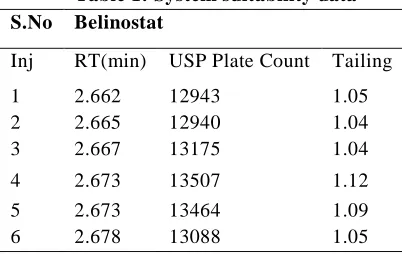
System suitability parameters:
The system suitability parameters were determined by preparing standard solutions of Belinostatstat (200ppm) and the solutions were injected six times and the parameters like peak tailing, resolution and USP plate count were determined.
The % RSD for the area of six standard injections results should not be more than 2%.
LINEARITY
Preparation of Standard stock solutions: Accurately weighed 50mg of Belinostat transferred to two separately 10ml and volumetric flasks, 3/4 th of diluents was added and sonicated for 10 minutes. Flasks were made up with diluents and labeled as Standard stock solution (5000µg/ml of Belinostat)
ACCURACY
[18-20]
Preparation of Standard stock solutions: Accurately weighed 50mg of Belinostat transferred to two separately 10ml and volumetric flasks ,3/4 th of diluents was added and sonicated for 10 minutes. Flasks were made up with diluents and labeled as Standard stock solution (5000µg/ml of Belinostat) Robustness: Small deliberate changes in
method like Flow rate, mobile phase ratio, and temperature are made but there were no recognized change in the result and are within range as per ICH Guide lines.
LOD sample Preparation:
10ml volumetric flasks and made up with the same diluents.
LOQ sample Preparation: 0.25ml standard stock solutions was pipetted out and transferred to two separate 10ml volumetric flask and made up with diluent. From the above solutions 0.3ml Belinostat of, solutions respectively were transferred to 10ml volumetric flasks and made up with the same diluent.
DEGRADATION STUDIES [21-23]
Oxidation
To 1 ml of stock solution of Belinostat, 1 ml of 20% hydrogen peroxide (H2O2) was added separately. The solutions were kept for 30 min at
600c. For HPLC study, the resultant solution was diluted to obtain 500µg/ml solution and 10 µl were injected into the system and the chromatograms were recorded to assess the stability of sample.
Acid Degradation Studies
To 1 ml of stock s solution Belinostat, 1ml of 2N Hydrochloric acid was added and refluxed for 30mins at 600c .The resultant solution was diluted to obtain 500µg/ml solution and 10 µl solutions were injected into the system and the chromatograms were recorded to assess the stability of sample.
RESULTS
Fig. 1: Chromatogram of Belinostat eluted with good peak shape and retention time
Table 1: System suitability data S.No Belinostat
Inj RT(min) USP Plate Count Tailing
1 2.662 12943 1.05
2 2.665 12940 1.04
3 2.667 13175 1.04
4 2.673 13507 1.12
5 2.673 13464 1.09
Linearity
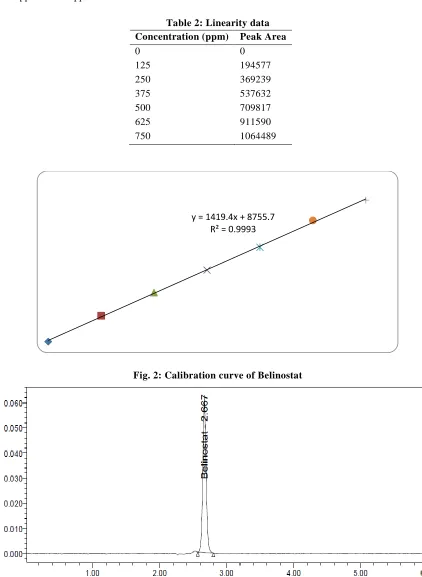
To demonstrate the linearity of assay method, inject 6 standard solutions with concentrations of about 125ppm to 750ppm of Belinostat. Plot a
graph to concentration versus peak area. Slope obtained was 1419, Intercept was 8755 and Correlation Co-efficient was found to be 0.999 and Linearity plot was in the figure 2.
Table 2: Linearity data Concentration (ppm) Peak Area
0 0
125 194577
250 369239
375 537632
500 709817
625 911590
750 1064489
Fig. 2: Calibration curve of Belinostat
Intermediate precision
Six working sample solutions of 500ppm are injected on the next day of the preparation of
samples and the % Amount found was calculated and %RSD was found to be 0.4
.
Table 3: Intermediate precision data
S.No Peak Area
1 714158
2 714827
3 715051
4 714595
5 714749
6 707803
AVG 713531 STDEV 2821.7 %RSD 0.4
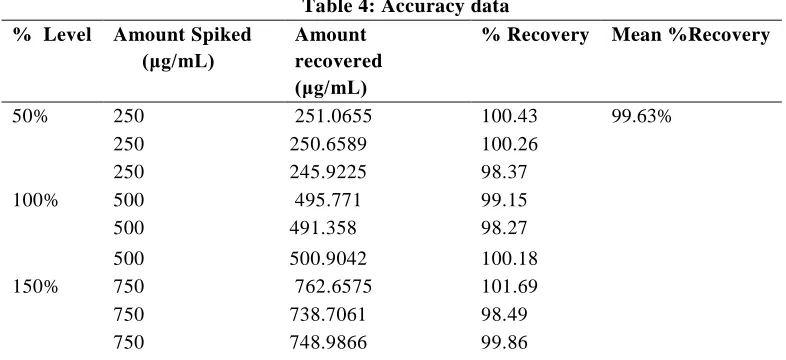
Table 4: Accuracy data % Level Amount Spiked
(μg/mL)
Amount recovered (μg/mL)
% Recovery Mean %Recovery
50% 250 251.0655 100.43 99.63%
250 250.6589 100.26
250 245.9225 98.37
100% 500 495.771 99.15
500 491.358 98.27
500 500.9042 100.18
150% 750 762.6575 101.69
750 738.7061 98.49
Fig. 4: Chromatogram showing Observation: LOD & LOQ data of Belinostat.
Table 5: Degradation data of belinostat
S.NO Degradation Condition % Drug Degraded Purity Angle Purity Threshold
1 Acid 4.01 0.295 0.345
2 Alkali 3.96 0.325 0.360
3 Oxidation 0.523 0.873 0.577
4 Thermal 0.51 0.193 0.328
5 UV 0.90 0.430 0.535
6 Water 0.07 0.264 0.331
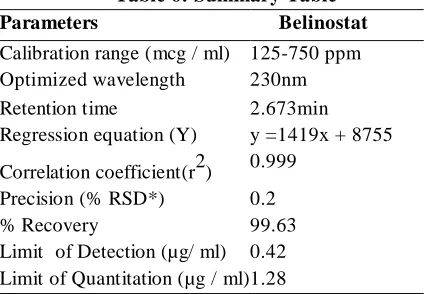
Table 6: Summary Table
Parameters Belinostat
Calibration range (mcg / ml) 125-750 ppm Optimized wavelength 230nm
Retention time 2.673min
Regression equation (Y) y =1419x + 8755 Correlation coefficient(r2) 0.999
Precision (% RSD*) 0.2
% Recovery 99.63
Limit of Detection (µg/ ml) 0.42 Limit of Quantitation (µg / ml) 1.28
CONCLUSION
Chromatographic conditions used are stationary phase Discovery c18 250 x 4.6 mm, 5. Mobile phase O- phosphoric acid buffer: Acetonitrile in the ratio of 50:50and flow rate was maintained at 1ml/min, detection wave length was 230nm, column temperature was set to 30oC and diluent was Acetonitrile: Water (50:50), Conditions were finalized as optimized method. System suitability parameters were studied by injecting the standard
five times and results were well under the acceptance criteria. Linearity study was carried out between 25% to150 % levels, R2 value was found to be as 0.999. Precision was found to be 0.2 for repeatability and 0.4 for intermediate precision. LOD and LOQ are 0.42µg/ml and 1.28µg/ml respectively. By using above method assay of marketed formulation was carried out 100.83% was present.
REFERENCES
[1]. R. S. Satoskar, S. D. Bhandarkar and S. S. Ainapure. “Pharmacology and Pharmacotherapeutics”, Popular Prakashan, Mumbai, India, 17, 2001.
[2]. “Burger’s Medicinal Chemistry and drug discovery”, Wiley Interscience, New Jersey, 6, 2007.
[3]. “Wilson and Gisvold’s Textbook of Organic Medicinal and Pharmaceutical Chemistry”, Lippincott Williams & Wilkins, New york, 11, 2004.
[4]. A. Korolkovas. “Essentials of Medicinal Chemistry”, Wiley Interscience, New Jersey, 2, 1988.
[5]. “Goodman and Gilman’s The Pharmacological Basis of Therapeutics”, McGraw-Hill health professions division, New york, 9, 1996.
[6]. Foye’s “Principles of Medicinal Chemistry”, Lippincott Williams & Wilkins, New york, 6, 2008. [7]. Drugs & Cosmetics Act, 1940 & Rules, 1945, Susmit publishers, Mumbai, India, 2, 2000.
[8]. Indian Pharmacopoeia, Ministry of Health & Family Welfare, Government of India, New Delhi, 1996. [9]. The United States Pharmacopoeia- the National Formulary, United States Pharmacopoeial convention,
Rockville, 2007.
[10]. British Pharmacopoeia, The Stationary Office, London, 2005.
[11]. “Martindale - The Extra Pharmacopoeia”, The Pharmaceutical Press, London, 33, 2002, 7.
[12]. A. H. Beckett and J. B. Stenlake. “Practical Pharmaceutical Chemistry”, Volume I and II, CBS Publishers & Distributors, New Delhi, India, 2000.
[13]. P. D. Sethi. “Quantitative Analysis of Drugs in Pharmaceutical Formulations”. 3 rd edition, CBS Publishers & Distributors, New Delhi, India, 1997.
[15]. R. A. Day and A. L. Underwood. “Quantitative Analysis”, HI learning private limited, New Delhi, India, 6, 2009.
[16]. G. Ramana Rao, S. S. N. Murthy and P. Khadgapathi. Gas chromatography to pharmaceutical analysis (Review). Eastern Pharmacist. 30(353), 35 (1987).
[17]. G. Ramana Rao, S. S. N. Murthy and P. Khadgapathi. High performance liquid chromatography and its role in pharmaceutical analysis (Review). Eastern Pharmacist. 29 (346) , 53 (1986).
[18]. Ll-Yord R. Snyder, Joseph J. Kirkland and Joseph L. Glajch. Practical HPLC Method development. John Wiley & Sons, INC, U.S.A. New York, 2, 1997.
[19]. Satinder Ahuja and Michael W. Dong. Handbook of Pharmaceutical Analysis by HPLC, Elsevier academic press, 6(1), 2005.
[20]. M. Thompson, S. L. R. Ellison and R. Wood. Harmonized guidelines for sin gle laboratory validation of methods of analysis. Pure Appl. Chem. 74(5), 835- 855(2002) 8
[21]. USP 31/NF 26, United States Pharmacopoeia, 31st rev. and the National Formulary, United States Pharamcopoeial Convention, Rockville, 26, 2008.
[22]. Ch. Naveen Kumar, V. Prathyusha and N. KannapKiesel BF, LC-MS/MS assay for the quantitation of the HDAC inhibitor Belinostatstat and five major metabolites in human plasma