Job Commitment and Quality of Personal Life: A Study of Doctors in
Public and Private Sector
MOHAMMAD TUFAIL
Lecturer AWKUM, Buner CampusEmail: [email protected]
Abstract
The aim of this paper was to investigate the job commitment of the doctors is affects the quality of their personal and professional lives or not. Stress was taken as moderator. For this purpose the data was collected via well developed questionnaire from the reputable hospital of Khyber Pakhtonkhwa in both Public and Private sectors. It was found that Doctors working in Public sectors hospitals were not satisfied with their work. Further research avenues have been suggested to be investigated.
Key words: Job Commitment, Doctors, Stress, Quality of life.
Introduction
Commitment is defined in terms of attitudinal dedication or individual’s psychological bond to particular commitment reference & intended to reflect a combination of attitudes & behavioral intentions. An employee’s job is defined as the set of work tasks performed in one’s occupational role. It is the degree of attitudinal dedication to the set of work tasks, given to one’s present occupation. Job commitment is generally associated with retention, high productivity & less absenteeism but negatively associated with turnover (Meyer, Stanley, Herscovitch, Topolnytsky, 2002).
Job commitment has positive and negative effect on the quality of personal life. If the individual is getting some incentives, privileges from his/her job then he/she will be honest and loyal to his/her job, otherwise not. (Salancik, 1977).
Commitment, loyalty and involvement are unidimensional. They give a wide range of meanings that can be interchangeably used i.e. work ethics, career salience, job involvement, work as a central life interest, organizational commitment. The exception in these terminologies is the organizational commitment. Committed employees of an organization are labeled as loyal employees who are committed because of organizational values, culture, work quality & quantity. Personal behaviors of the employee are also important for the commitment to work. (Poter, Steers, Mowday, Boulain & Buchana, 1974).
Salancik (1977) suggested that few studies on the relationship of work commitment and family behavior and their influence on each other have been carried out,he found that workers have less stress with strong social system and strong moral support from the family which makes employees free from depression, stress and conflicts which also eventually results in high productivity, high commitment and less absenteeism.
Most of the organizations provide job and family balanced policies for the high performance of employees and for their family support system which include the job security, salary increment and benefits which increases satisfaction & loyalty of the employee to the organization. In his study found that most of the organizations are providing extra benefits to their employees like, child care, offered spouse employment assistance or provided family counseling (Firestone & Rosenblum, 1988).
The relationship of job commitment and family life is important itself because they influence heavily on each other. They have positive and negative impacts. Like good quality of personal life results in job satisfaction, high involvement, high commitment and vice versa. Like wise if the families are disturbed, under stressed or they have conflicts then the individuals would not be as loyal and committed to the organization as they could be in the absence of all these (Meyer and Allen 1991).
Literature Review
Commitment is defined by various researchers. Sheldon defines commitment as, "an attitude or an orientation towards an organization which links or attaches the identity of the person to the organization" (Sheldon, 1971, p. 143).
Job satisfaction, involvement & commitment are closely related to each other in their meanings. They have only the difference of intensity in their meanings. When the person is satisfied from his/her job then he/she becomes committed to his work thus he gets involved in his work of job which results in the better performance of the individuals. They further suggested that other than that Job commitment and job involvement can be defined in different ways like job commitment is the mental and psychological intention of an individual towards work (Mowday, Steers, & Porter, 1979).
According to Pferre & Lawler (1980) when people are highly motivated their perform once in the organization is good and they are satisfied with their work and perform well, alternatively when people are less motivated they perform and don’t continue to perform good or well.
To grow one self in his or her career, is through opportunities. Individuals must use their skills and abilities so that they can become master of these. After then new jobs become routine and individuals become used to accept challenges which will enhance his/her personal accomplishments. People must have the knowledge how to get success in their field, if they are unaware of that knowledge then they would not be able to perform in the organization well and they will be unaware of their efforts and success as well. Because, success and self appreciation are the keys to success and growth From the job design literature it is clear that job involvement has five core characteristics, (Hackman, Oldham, 1980) i.e. need for achievement & growth. (Sheldon, 1971), job satisfaction, performance (Hall & Scheinder 1974) & organizational commitment (Mottaz, 1988).
Mowday, Streers & Porter (1979) in their study found the influence of job involvement on quality of personal life through these three indicators i.e. job satisfaction, career satisfaction & organizational commitment. Prior studies like (Koch & Steers, 1978; Weiner & Gechman, 1977) found the positive relationship between job involvement, job satisfaction & organizational commitment.
Reicher (1985) suggested that job involvement plays the mediating variable role in the relationship of employment status in the organization & life changes promotion opportunities and growth of career are positively related to job satisfaction and negatively related to organizational commitment.
So, employees who have job with low career growth opportunities would have low satisfaction and also decreased commitment to the job and organization (Kanter, 1977).
Becker (1960) identified that an individual would be more concerned & loyal to the organization when the organization would give him any benefit like, provident fund, pension etc. By getting security of his job in the organization the employee would be more committed to the organization.
Most of the time, the span of control of an individual in the organization has great impact on his commitment to the job. If the span of control is close or less then the commitment of employee would be more to the organization otherwise the inverse case would be there (O’Reily and Chatman 1986).
Lee, Cheng, & Lin (2000) found that other than that the length of time on a single position makes the employee less committed to the organization and in other case if the growth of career opportunity is unavailable in recent times then the employee would not be loyal to the organization. Similarly work overload has negative effect on job commitment but the job content has a positive effect on the commitment to the organization. But there is an important factor, which most of the time lessen the commitment of employees or individuals towards job or organization and that is change. When there is no change in job position & organizational environment then commitment gets lesser.
In a similar way Bagraim (2003) found that work life balance policies provided by the organization play an important role in the work life balance of employees. Employees who are supported by these policies and have colleagues who are using such policies feel comfort in using such policies for their quality of personal life.
It is also evident that work life conflict creates stress in employees. This reduces the work life balance & work family balance of the employees. These things decrease the motivational level of employees & also the commitment to his/her job which in turn reduces the productivity of the organization. To improve the level of commitment, quality of personal life, work family balance & organizational productivity, home to work responsibility policies are introduced by the organizations (Moris & Steers, 1980).
If there is the case of gender base quality of personal life and job commitment then it is said that women are most likely to be committed to their job then men and men are committed when their spouse work at home because it gives them psychological satisfaction (Hellman 1997).
Kanter (1968) idwntified that the job satisfaction is an important integral part of job commitment so in health sector, it is also important to retain the level of commitment of each employee. For this purpose the managers should know the rewards & incentive system otherwise there would be no commitment in employees.
The concept of quality of life has been increased in few decades in developing countries. It can be seen in the growing interest of individuals in their quality of life in the organization. The concept of quality of life has not been well defined yet but many authors say that it is the social and personal desire to improve one’s condition or to prevent one self from degradation (Hacker, 1978).
People are going to join the industries not only to enhance their careers only but also to improve their quality of personal life. Now labor unions are concentrating on the daily quality of personal as well as working life other than their wages. They are personally committed to their families for the purpose of improvement in their personal life. Individuals are concentrating on the personal dedication than constraint commitment. Personal dedication refers to improvement in personal life, to improve the relationship with spouse, to continue it, to invest in it, to get the welfare of the partner and lastly to achieve the goals of the personal life (Korman, Wittig-Bernam & Lang, 1981).
In the study conducted by Harrison & Hubbard (1998) it was found that in the case of doctors then we will find that until now there were no prior studies on the job satisfaction, commitment & quality of personal lives of doctors. They were self directed and have their own opinions about their jobs and its timings. But after many changes in financial & clinical set ups they have to follow the rules which have eliminated their freedom. It also resulted in the dissatisfaction of physicians. Autonomy, relationship with colleagues, relationship with patients, pay, status, resources & relationship with staff plays an important role in the job satisfaction of the physicians.
Other than that there are some other factors which are also important for the job satisfaction and quality of personal life of doctors. i.e. if they are healthy, happy and free from any tension or anxiety then their performance and satisfaction of job will be better, other wise physicians with stress and anxiety would have conflicts in their personal life (Weiner & Vardi 1980). In the light of above discussion the following hypothesis have been derived.
H1 : Job commitment has positive effect on the quality of personal life of doctors.
H2 : Job commitment has negative effect on the quality of personal life of doctors.
-ve
Job Commitment
Job Stress
Quality of Life
Quality of Family Life Quality of Work Life
+
ve
I
Methodology
The unit of analysis was the employees of public and private sector hospitals in Khyber pakhtunkhwa. The sample size was 245. The questionnaires were distributed personally. The number of usable questionnaire was 190 and thus was included in the study. Unit of research which I have taken was public and private hospitals. Data regarding commitment was collected through the questionnaire designed by Meyer and Allen (1991) while that of quality of life was collected by the tool designed by Cohen, et all (1997).
Results
Descriptive Statistics
Descriptive statistics was performed to check the normality of data. The results indicate that the data is normal and skewness 1and kurtosis 2are within the prescribed range that is skewness = +1, -1 and kurtosis = +3. The results of descriptive statistics are shown in table 1.
Table 1 Descriptive Statistics
Minimum Maximum Mean Skewness Kurtosis Affective Commitment 1.63 5.00 3.6171 .136 .119 Continuance Commitment 1.60 5.00 3.2611 .191 .465 Normative Commitment 2.00 5.00 3.3895 .020 .435 Emotional Pressure 2.00 4.91 3.6263 -.723 .707 Time Pressure 1.50 5.00 3.6711 -.104 -.241 Fear Complaint Criticism 1.71 4.43 3.1421 -.276 -.851 Work Home Interface 1.40 5.00 3.1758 -.311 -.293 Quality Personal Life 2.00 4.83 3.3798 -.056 -.821 Qualty Work Life 1.20 5.00 3.4084 -.465 -.537 Valid N (listwise) 190
Table 2 Reliability
Dimension Cronbach
Alpha
No. of items
Affective Commitment 0.768 8 Continuance Commitment 0.770 5 Normative Commitment 0.731 5 Emotional Pressure 0.849 11
Time Pressure 0.844 6
Fear of Complaint and Criticism 0.786 7 Work Home Interface 0.799 5 Quality of Personal Life 0.715 6 Quality of Work Life 0.869 5
1Skew: to turn aside or swerve; take an oblique course
2Kurtosis: the state of quality of flatness or peakedness of the curve describing a frequent distribution in
the region about its mode.
Correlations
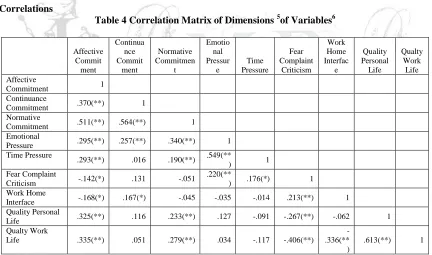
3Correlation analysis was performed to find out the significant relationships among the study variables and also to check for Multicollinearity 4(Leech, Barret & Morgan, 2005). Results of the analysis are shown in Table 3 and 4.
Table 3 Correlations Matrix of Variables
Commitment Stress Quality of Life
Commitment 1
Stress .195(**) 1
Quality of
Life .295(**) -.292(**) 1
** Correlation is significant at the 0.01 level (2-tailed). N = 190
Correlation matrix indicates that commitment has week positive (.195**) but significant relationship with stress and has relatively higher and significant but not strong enough (.295**) relationship with quality of life while stress and quality of life has significant (-.295**) but negative relationship.
Correlations
Table 4 Correlation Matrix of Dimensions 5of Variables6
Affective Commit ment Continua nce Commit ment Normative Commitmen t Emotio nal Pressur e Time Pressure Fear Complaint Criticism Work Home Interfac e Quality Personal Life Qualty Work Life Affective
Commitment 1
Continuance
Commitment .370(**) 1
Normative
Commitment .511(**) .564(**) 1
Emotional
Pressure .295(**) .257(**) .340(**) 1
Time Pressure
.293(**) .016 .190(**) .549(**
) 1
Fear Complaint
Criticism -.142(*) .131 -.051
.220(**
) .176(*) 1
Work Home
Interface -.168(*) .167(*) -.045 -.035 -.014 .213(**) 1
Quality Personal
Life .325(**) .116 .233(**) .127 -.091 -.267(**) -.062 1
Qualty Work
Life .335(**) .051 .279(**) .034 -.117 -.406(**)
-.336(** )
.613(**) 1
** Correlation is significant at the 0.01 level (2-tailed). * Correlation is significant at the 0.05 level (2-tailed).
3Correlation: Mutual relation of two or more things, parts, etc. 4
Multicollinearity: Statistics the condition occurring when two or more of the independent variables in a regression, equation are correlated.
5Dimension: Scope, importance, magnitude, size. A property of space, extension in a given direction. 6Variable: apt or liable to vary or change.
Affective Commitment has positive and significant relationships with Continuance Commitment (.37**), Normative Commitment (.511**), emotional pressure (.295**), time pressure (.293**), quality of personal life (.325**) and quality of work life (.335**) but the same has negative relation with fear complaint criticism (-.142*) and work home interface (-.168). Continuous commitment has positive and significant relationship with normative commitment (.564**), emotional pressure (.257**) and work home interface (.167*). Again normative commitment has positive and significant relationship with emotional pressure (.34**), time pressure (.19**), quality of personal life (.233**) and quality of work life (.279**). Emotional pressure has strong positive relationship with time pressure (.549**) and fear complaint criticism (.220**). Time pressure has weak positive relation with fear complaint criticism (.176**). Fear complaint criticism has positive relation with work home interface (.213**) while the same has negative relationship with quality of personal life (-.267**) and quality of work life (-.406**). Work home interface has negative but significant relationship with quality of work life (-.336**) and quality of personal life has very strong positive and significant (.613**) with quality of work life.
Composite Regression
7for C-QL Model
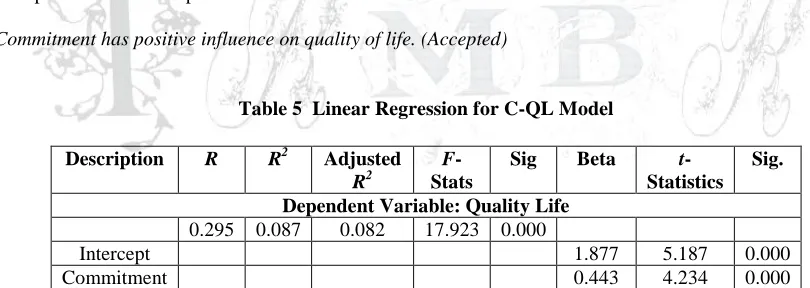
To check the impact of commitment on quality of life, linear regression was applied on the variables of commitment and quality of life. The results are shown in Table 5.
The value of R is 0.295 showing a moderate relationship between commitment and quality of life. The value of R2 is 0.087, which shows commitment explains 8.7 % of variation in quality of life. The value of F statistics is 17.923 (p < 0.01). This authenticates the fitness of model (R2≠0).
Table 5 also shows the values of coefficient, t statistics and significance. The Beta coefficient of commitment is 0.443. The value of t statistics 4.234 (p < 0.01) is significant. The Beta coefficient of commitment has a positive value which indicates a direct relationship of commitment with quality of life. This proves that H: 1 is proved.
Commitment has positive influence on quality of life. (Accepted)
Table 5 Linear Regression for C-QL Model
Multiple (Simultaneous) Regression for C-QL Model
To investigate the effect of individual dimensions of commitment multiple regression analysis was also performed. The results are shown in Table 6. The three dimensions of commitment have been taken as independent variables and their individual impact was checked on the dependent variable of quality of life. The results indicate that there is moderate relationship (R = 0.405) of all the independent variables with the dependent variable. The F-statistics (12.138) for the relationship was p < 0.05 i.e. less than or equal to the level of significance. Thus the result reveals that there was a significant relationship between C-QL (R2 ≠ 0). Table 6 also shows the coefficients for the set of independent variables of commitment The results reveal that two of the independent variables which are affective and normative commitments were causing the highest level of variations in the dependent variable (β = 0.416, β = 0. 0.262 respectively). Whereas the third variable namely continuance commitment (β = -0.167; t = -1.834, p = 0.068) was having negative but
7Regression: the act of going back to a previous place or state; return or reversion; retrogradation
Description R R2 Adjusted
R2
F -Stats
Sig Beta t -Statistics
Sig.
Dependent Variable: Quality Life
0.295 0.087 0.082 17.923 0.000
Intercept 1.877 5.187 0.000
Commitment 0.443 4.234 0.000
insignificant relation with the dependent variable. The table also shows the collinearity diagnostics for the independent variables. The results reveal that there exists no Multicollinearity among the independent variables as the values are within the prescribed limits that is tolerance below 1 and VIF below 3.
Table 6 Multiple Regression for C-QL Model
Description R R2 Adjusted
R2
F -Stats
Sig Beta t
-Statistics Sig.
Dependent Variable: Quality Life
0.405 0.164 0.150 12.138 0.000
Intercept 1.546 4.282 0.000
Affective
Commitment 0.416 3.999 0.000
Continuance
Commitment -0.167 -1.834 0.068
Normative
Commitment 0.262 2.409 0.017
Test of Moderation
8of C-QL Model
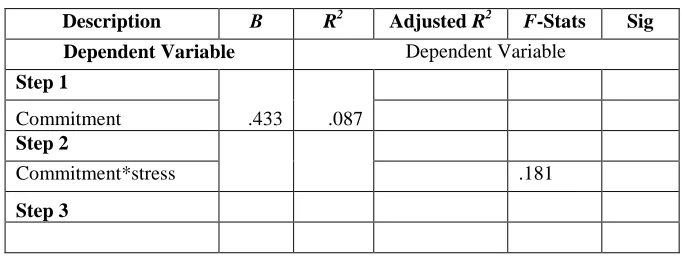
To test the effect of stress on commitment and quality of life Baron and Kenny (1986) method for testing moderation was applied. The results are shown in Table 7. Moderation testing has been performed in three steps as shows in Table 7. Firstly, the relationship of commitment (IV) has been tested with quality of life (DV). The F statistics here is 8.927 (p < 0.01). The value of R2 (0.087) shows a weak variation in quality of life caused by commitment. However, commitment has a significant positive relationship with quality of life as revealed by the value of Beta Coefficient i.e. 0.433 (p < 0.01).
Secondly, the relationship of stress has been tested with quality of life (moderator). The results are approximately similar to step one, except the negative relation of stress with quality of life. The beta coefficient shows a significant negative effect of stress on quality of work life.
Thirdly, the product of moderator and independent variable has been obtained to test the hypothesis that stress moderates the relationship between commitment and quality of life. After this, the step 3 has been performed in which the relationship of obtained product of IV and Moderator has been tested with quality of life. The value of F statistics here is 0.181 (p > 0.05). This shows that stress does not moderate the relationship of commitment and quality of life.
Table 7 Moderation Analysis
Description Β R2 Adjusted R2 F-Stats Sig Dependent Variable Dependent Variable
Step 1
.433 .087
Commitment
Step 2
Commitment*stress .181
Step 3
8Moderation: the quality of being moderate, restraint; avoidance
Discussion
The purpose of this study was to investigate the relationship between job commitment and quality of personal life of doctors (public and private). The research showed that there is positive relationship between their job commitment and quality of personal life.
They are more concerned and loyal to their job when they are provided by all commitment variables like, rewards, recognition, appreciation, allowances, and incentives etc. which are the basic element of quality of life improvement.
The results shows that there were majority of the public sector doctors who were not satisfied with their working hours but there are some doctors of private sectors who have their own timings according to their will and are well satisfied. These research findings contradict earlier findings regarding working hours put in by the doctors. While considering the research (Reichers, 1985) conducted in foreign countries on doctor’s working hour satisfaction it was found that they were more satisfied at that time than today. Now due to certain compulsory rules and regulations they do not have enough freedom as they want.
Job commitment of doctors depends on the indicators of commitment like compensation packages, rewards & recognition, passion, etc. from the study it is clear that in the profession of medicine doctors are availing only a few types of compensation package in both sectors. The results are consisted with study like (Schein, 1968). And they have the awareness that it increases the quality of their personal life. These types of packages are according to the designation of the doctors. These types of packages are important itself because they give them motivation towards their work or job. And due to high motivation the honesty and loyalty becomes high. From the previous research like (Schwarts, 1973) it is also clear that motivation is the key to get committed to one profession. It is also shown in the study that reward system enhances the performance and commitment of the doctors. It also has positive effect on the quality of personal life which gives them motivation. and they become more committed and take every case as a challenge for their career.
From the literature (Sparrow, & Cooper, 2003) it is also clear that they want to prove themselves as a good doctor and practitioner for the purpose of commitment and good quality of life. They learn at every step and try to improve themselves to become more loyal. Most of the doctors take their profession as their passion and do their work whole heartedly so that they can become more committed to their profession and patients. Physicians have to be loyal and committed because they do not have any chance of mistake in their practical field so to become loyal and get involved in their profession they have to be more cautious, serious and honest. In the previous research like (Stebbins, 1970) it was found that doctors are agreeing that they have to do a lot of hard work for the purpose of commitment to the profession and success in their career.
Literature has showed that quality of life includes food, shelter, clothing & social needs. Every individual want to secure all these things. Every person has their commitments with their families but from different researches it is clear that doctors have to sacrifice for the purpose of their professional requirements. They have to prefer their work and job commitments over it (Travers, 1990). That’s why they have to struggle a lot to make balance between their professional and personal life. Some times it creates problems for them and it decreases their quality of personal life. Similarly sometimes doctors have to prefer their profession due to emergencies and have to leave their personal activities.
As the profession of medical is very different from others because it is totally welfare oriented and caring profession which make the doctors to become more loyal to it. And due to this they cannot meet the demands of their personal life. From this research it is also clear that due to high commitment and involvement doctors cannot maintain balance between their personal and professional life.
From our literature review it was clear that senior’s appreciation is also important which is the important factor or indicator of job commitment. All doctors of each sector agree with this statement.
Conclusion
In this study the major significant relationship was shown that physician are committed to their profession but to get more job commitment they must be provided with their legal privileges e.g. compensation, rewards, recognition, flexible timings, and policies related to their quality of personal life.
They are not fully satisfied with their quality of life as they can’t meet their personal requirements. From this study it is also proved that sometimes they get imbalance in their personal life due to high commitment and workload. They need to be recognized as a good practitioner and physician. Concluding the study we can say that physicians are committed to their professions in case when they are provided benefits from the organizations and then it really improves their quality of personal life which is the important factor for them.
After complete study of literature and practical research work there are some future research avenues which will enhance the job satisfaction and commitment in relation to quality of personal life.
First of all it must be investigated that why the compensation packages and reward system is different from organization to organization. Then is may be proceeded in a way that is there really significance difference among the sectors, if these packages are the same. Another research direction may be by assuming that the level of motivation is the same and the level of performance should be measured.
References
Bagraim, J. J. (2003). The nature of measurement of multiple commitment foci amongst south Africa knowledge workers. Management dynamics, 12(2), 13-23.
Becker, H. (1960). Notes on the concept of commitment. American journal of Sociology,66, 32-42. Cohen SR, Mount BM, Bruera E, Rowe J & Tong K, Validity of the McGill Quality of Life Questionnaire
in the palliative care setting. A multi-center Canadian study demonstrating the importance of the existential domain. Palliative Medicine. 11 (1997) 3-20.
Firestone, W. A., & Rosenblum, S. (1988). Building commitment in urban high school. Educational Evaluation and Policy Analysis, 10, 285-299
Hacker, A. (1978). Loyalty- and the whistle-blower. Across the Board, 15 (11), 45-59.
Hall, D. T., & Scheinder, B. (1972). Correlates of organizational identification as a function of career pattern and organizational type. Administrative Science Quarterly, 17,340-350.
Harrison, J. K., & Hubbard, R. (1998). Antecedents to organizational commitment among Mexican employees of a U.S. firm in Mexico. Journal of Social Psychology, 138(5) 609-624.
Hellman, C. M. (1997). Job satisfaction and intent to leave. Journal of Social Psychology,137(6), 677-690. Kanter, R. M. (1968). Commitment and social organization: A study of commitment mechanism in
utopisn communities. American Sociology Review, 33, 499-517.
Koch, J., & Steers, R. M. (1978). Job attachment, satisfaction, and turnover among public sector employees. Journal of Vocational Behavior, 12, 119-128.
Korman, A., Wittig-Bernam, U., & Lang, D. (1981). Career success and personal failure: Alienation in professionals and managers. Academy of Management Journal, 24, 342-360.
Lawrence S. Lince, Joel Yager (1986). Factors associated with life satisfaction among practicing internists. Medical care,24,830-837.
Lee, Y. D., Chung, C. M., & Lin, Y. L. (2000). A research on the measuring of employees' organisational commitment in Taiwanese business. Journal of National Cheng-Kung University, 35, 133-157.
Magid igbari, Saroj Parasuraman, (1994) Work experiences, job involvement, and Quality of work life among information systems personnel. MIS Quaterly, 18,175-201.
Meyer, J. P. & Allen, N. J. (1991). A Tree-component conceptualitazation of organizational commitment. Human Resource Management Review, 1, 61-89.
Meyer, J. P., Stanley, D. J., Herscovitch, L., & Topolnytsky, L. (2002). Affective, continuance, and normative commitment to the organization: A Meta analysis of antecedents, correlates and consequences. Journal of Vocational Behavior, 61, 20-52.
Mottaz, C. J. (1988). Determinants of organizational commitment. Human Relations, 41, 467-482.
Morris, J. H., & Steers, R. M. (1980). Structural influence on organizational commitment. Journal of Vocational Behavior, 17, 50-57.
Mowday, R. T., Steers, R. M. & Porter, L. W. (1979). The measurement of organizational commitment. Journal of Vocational Behavior, 14, 224-247.
O’Reily, C. A., & Chatman, J. (1986). Organizational commitment and Physchological Attacement: The Effects of Compliance, identification and internationalization on prosocial behavior. Journal of Applied Psychology, 71, 492-499.
Pfeffre, J., & Lawler, J. (1980). Effects of job alternatives, extrinsic rewards, and behavioral commitment on attitude towards the organization: a field test of the insufficient justification paradigm. Administrative Science Quarterly, 25, 38-56.
Porter, L. W., Steers, R. M., Mowday, R. T., & Boulian, P. V. (1974). Organizational commitment, job satisfaction and turnover among Psychiatric Technicians. Journal of Applied Psychology. 59, 603-609.
Reichers, A. E. (1985). A review and reconceptualization of organizational commitment. Academy of Management Review, 10, 465-476
Salancik, G. R. (1977). Commitment and the control of organizational behavior and belief. New directions in organizational behavior, edited by B.M. Staw and G.R. Salancik. Chicago: St. Clair Press
Schwarts, S. H. (1973). Normative explanation of helping behavior: A critical, proposal and empirical test. Journal of experimental Social Psychology, 9, 349-364.
Schein, E. H. (1968). Organizational socialization and the profession of management. Industrial Management Review, 9 (2), 1-15.
Sheldon, M.E. (1971). Investments and involvements as mechanisms producing commitment to the organization. Administrative Science Quarterly, 16, 142-150.
Sparrow, P., & Cooper, C. (2003). The employment relationship: Key challenges. Perceived organizational support. Journal of Applied Psychology, 71, 500-507.
Stebbins, R. A. (1970). On misunderstanding the concept of commitment: A theoretical clarification. Social Forces, 48, 526-529.
Travers, C. (1990). Survey of occupational stress among teachers in the United Kingdom. Birmingham: Newman College Press.
Weinner,Y. & Vardi, Y. (1980). Relationship between job, organization and career commitment and work outcomes: An Integrative Approach. Organizational Behavior and Human Performance, 26, 81-96. Weiner, Y., & Gechman, A, S. (1977). Commitment:A behavioral approach to job involvement.
Journal of Vocational Behavior, 23, 254-269.