1
e-Journal of Media & Society
Depression Among University Students
Muhammad Adli Bin Mohd Ranizal Wan Qatrunnisa Binti Wan Zabidi Saidatul Aziera Binti Mohd Shariff Jackleyn Stanis Shahira Amiera Binti Shamsul Amir
Universiti Teknologi MARA *Correspondent: [email protected]
ABSTRACT: This study is done in order to find the factor of depression among the college
student in Malaysia. Depression among the college student are increasing as it come from
many factor. This study used behavioural theory as the foundations theories for the model development. The study involved 406 respondents, selected through google form responses involving all the university students around Malaysia. A structured questionnaire was used for data collection. All variables were measured through scales previously used by other researchers. In behavioural theory, state that depression people precisely those who do not know how to cope with the fact that they are no longer receiving positive reinforcement like they before. Results shows the data analysis described that respondents having a financial problem where did not what how to differentiate between wants and need with the overall mean (M=2.51) and students always spend their money on uncertain things.
KEYWORDS: Depression, positive reinforcement
INTRODUCTION:
Depression is a huge critical psychological concern worldwide because of high prevalence rates, the chronic nature of the condition and difficult treatment and recovery (Carrillo, et.al, 2012). It has been positioned as one of the four ranked major illnesses, due to the utmost burden for individuals, families, and society. Moreover, depression can be the reason for other diseases such as diabetes, cancer, heart disease, and Parkinson's disease. According to Nuyen et.al
2
(2005), depression is connected with decreased quality of life, increased morbidity and mortality.
University students face numerous difficulties including independent living, academic stress, peer pressure as well as family problems and this predispose them to depression (Shamsuddin et. al, 2013). This emotional and mental stresses can influence them to high risk behaviours' such as increased levels of smoking, increased alcohol and drug consumption, increased self-injurious behaviours (Serras et. al, 2010). Furthermore, according to Arria et. al, (2009), depression can also influence their physical and mental health as it has been related with acute infectious illness, self-destructive ideation and suicide.
Increasing trend found for the commonness of depression among university students as well as in society. In a recent review, the commonness of depression among university students was reported to be higher than the general population. Among Malaysian students, the commonness of moderate depression found 27.5% and 9.7% found as severe or extremely severe depression (Shamsuddin et. al, 2013). The finding is supported by Angelone et, al. (2011), various risk factors for depression among university students have been identified such as higher study year, lower socioeconomic status, poor academic performance and life satisfaction, post-traumatic stress disorder, physical inactivity, overweight or obesity and sleeping problems.
University students are a special group of people in critical transition from adolescence to adulthood and one of the most stressful moments in a person's life. This is because of their potential to give back to the society, as well as in the country, it is significant for them to study on their depression problem. Therefore, the purpose of this study is to determine the main factor of depression among university student and society (Muhammad Ashraful Islam et. al, 2018).
PROBLEM STATEMENT
3
mental illness. According to Mowbray et al, (2006), there were numbers of students experience their first psychiatric episode while at college, and 12 to 18% of students have a diagnosable mental illness. For example, epidemiological studies suggest that 15 to 21 age category (typical college years) has the highest past-year prevalence rate of mental illness which is at 39%. An article written by Hyattsville (2004), entitled Centers for Disease Control and Prevention, mentioned that suicide is the third leading cause of death among teenagers and young adults. Regarding to this facts, depression has consistently been considered a core factor in suicide, along with substance abuse, adverse life events, family history, a history of sexual abuse, troubled relationships, and difficulties with sexual identity (Agerbo et. al 2002). Last but not least, there is another point of view from Chen et al. (2013), where they stated that students who were living away from their parents (5.1%) were 1.63 times (1.08-2.45) more likely to develop depression than those who were staying with their parents. This could be due to the undertaking to a new surroundings and the loss of the familiar environment that leads students to depress.
Depression
Carillo (2012), stated that depression is a significant mental health concern worldwide because of high prevalence rates, the chronic nature of the condition and difficult treatment and recovery.
Depression have been ranked as one of the four major illnesses. This is proven by Sarokhani (2013). Regarding to the statement, the reason for why depression is happening is because of the utmost burden that suffered by individuals, families or society. This is reported by the World Health Oragnization in 2002.
Social Factors Associated With Depression Among University Students
4
factor of depression. Several studies have shown that having unsupportive friends may be worse for adolescent well-being than having no friends at all (Güroğlu, Lieshout, Haselager, & Scholte, 2007; Prinstein et al., 2001). The role of both friendship problems such as social isolation and poor quality friendships as well as problematic friends (i.e., friends who are disconnected from school and delinquent friends) in depression is important for us to know. Sometimes, they have to be someone else in order to be accepted by their new spouse and blend in with people that they are not comfortable with so that they would not feel left out. Due to that, university students experience depression by their own friends.
On the other hands, the negative association between social problems and depression was found in the current study. The social problems reflect “one’s opinion of self in relation to other people” in term of emotional distance (Lee, R.M, 1995). When students start to live in a new environment, their social networks begin to change. Living in a new environment where the ideological setting and surrounding people are different, students have to adapt and make new friends. This process can also be explained by the Mindsponge concept.
5 Financial Contraints Among University Students
The central problems of university students in Malaysia would be financial. According to Md Ashraful Islam et.al, (2016) about 63.4% of students from poor economic background experienced depression. The study also showed that students from poor, not well off family background are more likely to be at risk of depression because they have no money to pay for course fee, examination fee etc. For students hailing from alow socioeconomic background, the added element of financial vulnerability further exacerbates depression, anxiety and stress (Andrews and Wilding, 2004). Furthermore, a previous study conducted on students in Malaysia found the students to screen positive for depression among those with current financial struggles. University students who are originated from rural areas were reported to score higher depression and anxiety compared to students with an urban background (Bayram and Bilgel, 2008). This is due to economic situation where students with rural backgrounds reported poorer family economic situations. In addition, according to Shamsudin et.al (2013) wrote in his study that the Malays and those from a low income family were found to experience higher stress compared to others. Maybe more Malays in this study came from a low income family.
Effect Of Depression
According to Buchanan (2012), individual who suffered depression can suffer diseases such as diabetes, cancer, heart disease and also Parkinson’s disease. Furthermore, emotional and mental stresses also can influence the individual to engage in alcohol consumption (Weitzman, 2004) and also self-injuries behaviours (Serras, 2010). Not only that, depression also lead to suicidal ideation (Buchanan, 2012 & Arria, 2009) and the worst one is depression also lead to suicide (Buchanan, 2012).
Behavioral Theories
Human behavior has nothing to do with internal unconscious conflicts, repression, or problems with object representations as being said by the behaviourist. In order to study about human behaviour, principles of learning theory is the most used method by behavioral psychologist to explain human behaviour where according to behavioral theory, dysfunctional or unhelpful behavior such as depression is learned.
Traditionally, behaviorists did not focus too much on people's thoughts, perceptions,
6
observable and measurable behavior. The reason on why the behaviourist did so is not because
they were not aware of these internal feelings and thoughts, but because they thought them
relatively irrelevant to the process of influencing behavior, and too difficult to measure with
any accuracy. It turns out that this position was too extreme. Recently, research has shown that
behaviour is influenced by internal events such as perceptions, expectations, values, attitudes,
personal evaluations of self and others, fears, and desire. That is why it is important to take into
account when doing therapy. As a result, old-fashioned "strict" behavioral approaches to
treating depression are not as popular today as they used to be.
Findings To Reveal The Main Factors That Causing Depression To University Students
In Malaysia
Based on researched that we carried out, the main factor that lead to depression among university students in Malaysia was on the factor of financial problem with the overall mean 2.52 followed by factors of social (M=2.45), factors of lecturers and health state shared the same mean which is 2.33, friends (M=2.31), state of mind (M=2.18) and the last ranked factors that lead to depression is fall under the factor of family which is only 2.06.
7 RESEARCH METHODOLOGY
According to Abdul Rauf Ridzuan, et al. (2015), methodology is a way to systematically solve the research problems. In order to complete this research study, the size and sample methods, the practices and techniques utilized to collect data and the process to analysis data is acquired. Researchers used Raosoft Simple Calculator software to get the number of sample size. (Ridzuan, Ridzuan and Ridzuan, 2018). In this research, researcher manage to get 406 respondents.
FINDING AND DISCUSSION
In this part, the researcher has analyse the collected data from the respondents among the university students.
PART A – DEMOGRAPHY BACKGROUND
ITEMS FREQUENCY PERCENTAGE (%) Sex Female Male 296 107 73.4 26.6 Age 21-23 18-20 24-26
26 and above
195 149 40 22 48.0 36.7 9.9 5.4
Category of University Public university Private university 342 64 84.2 15.8
Location of University Southern Coast Central Region Western Coast Northern Coast East Coast 130 127 61 52 36 32.0 31.3 15.0 12.8 8.9 Student Residency Residence Non-residence 309 97 76.1 23.9
Level of CGPA 3-3.49
154 110
8
3.5-4.0 New Student 0-2.99
81 61
20.0 15.0
Do you ever feel depress? Yes
No
Can you handle you depress? Yes
No
321 85
326 80
79.1 20.9
80.3 19.7 Table 1: Demography
The table 1 shows the profile background of respondents among university students in Malaysia. Based in the findings, the most respondents that answered the questionnaire are female which 73.4% and 48% are respondent that aged between 21-23 years old. Moreover, mostly of them are also a residence (76.1%) and public university students (84%) in Southern Coast (32%). The university students that responded to this questionnaire are also from the level of CGPA 3 – 3.49 as much (37.9%). Other than that, the most respondent are also was a university student that ever feel depress (79.1%) can also handle them depress (80.3%).
PART B
THE FACTORS OF DEPRESSION AMONG UNIVERSITY STUDENTS
a) FRIENDS
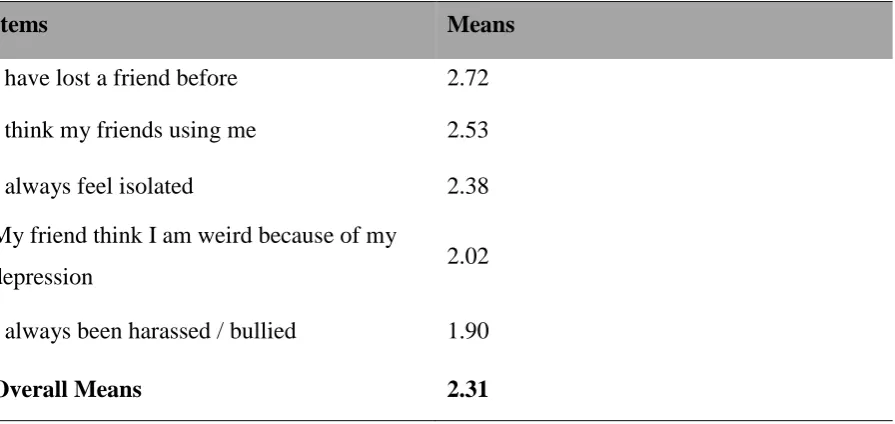
Items Means
I have lost a friend before 2.72 I think my friends using me 2.53
I always feel isolated 2.38 My friend think I am weird because of my
depression 2.02
I always been harassed / bullied 1.90
Overall Means 2.31
Table 2
9
feel depress when their friends are using them (M=2.53). Then, only a few of the respondent feel depress when their friend think that they are weird (M=2.02) or being bullied (M=1.90). Overall the average means of the friend’s aspect is (M=2.31). Therefore, its shows that all the respondents are not agree with the factor of depression is cause by friends.
b) LECTURER
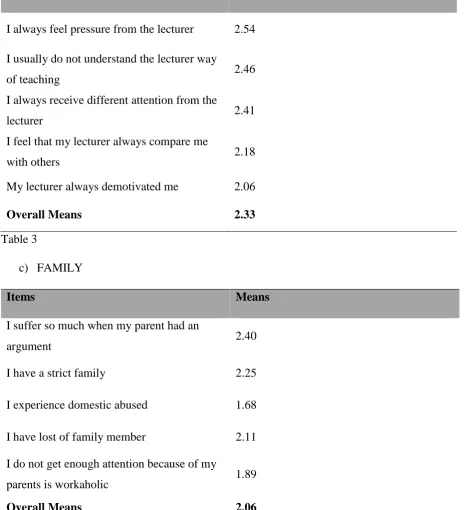
Items Means
I always feel pressure from the lecturer 2.54
I usually do not understand the lecturer way
of teaching 2.46 I always receive different attention from the
lecturer 2.41
I feel that my lecturer always compare me
with others 2.18 My lecturer always demotivated me 2.06
Overall Means 2.33
Table 3
c) FAMILY
Items Means
I suffer so much when my parent had an
argument 2.40
I have a strict family 2.25
I experience domestic abused 1.68
I have lost of family member 2.11
I do not get enough attention because of my
parents is workaholic 1.89
Overall Means 2.06
10
Based on table 4 shows above, the respondent that suffer when their parents had argument is (M=2.40) and only some of them have a strict family (M=2.25) that lead them to feel depress. Furthermore, the family aspect of factor of depression are not agree by all the respondent among university students. It is because the overall of average means is (M=2.06).
d) FINANCIAL
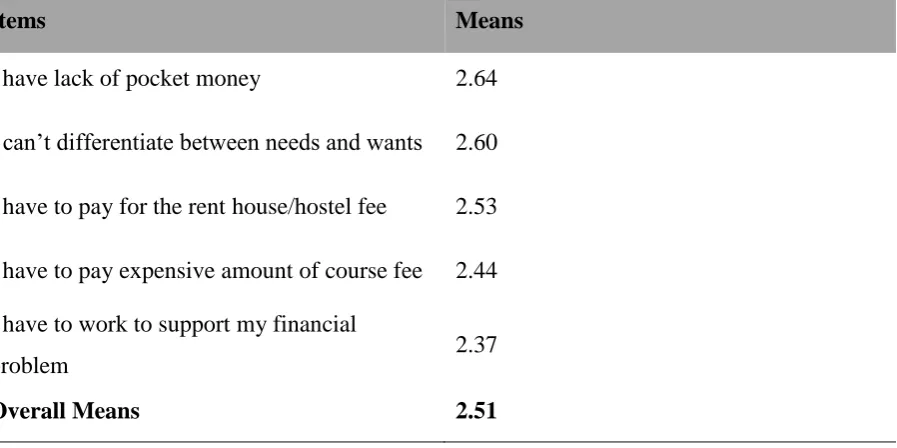
Items Means
I have lack of pocket money 2.64
I can’t differentiate between needs and wants 2.60
I have to pay for the rent house/hostel fee 2.53
I have to pay expensive amount of course fee 2.44
I have to work to support my financial
problem 2.37
Overall Means 2.51
Table 5
Based on table 5 shows, most of the respondents are in depression when they have lack of pocket money (M=2.64) and also they can differentiate between their needs and wants (M=2.60). The university students mostly tend to waste their money without knowing it. The respondent also has to pay for the rent house and hostel fee a lot (M=2.53). Overall of the average means for the financial aspect of factors depression are the highest which (M=2.51) and respondents agree that the factor of depression among university students is financial.
Section C – The level of depression among universities students.
a) Social
11
and mental stresses also can influence the individual to engage in substances use. Overall, the average mean for respondent’s level of depression in social is M=2.45.
Table 6: Social
b) Health State
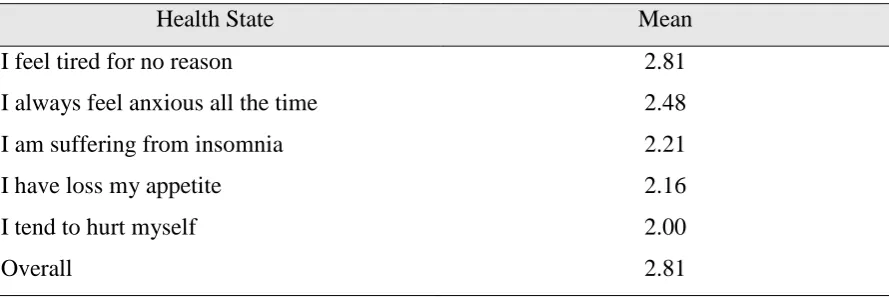
From table 7, we can see that the effect of the health state to respondents is they always feel tired for no reasons (M=2.81). After that, the respondents always feel anxious all the time (M=2.48) and have an insomnia (M=2.21). There are a few of the respondents have lost their appetite (M=2.16) due to depression. Depression also can tend the respondents to hurt themselves (M=2.00). According to American Psychiatric Association (2013), depression can lead to variety of emotional and physical problems such as changes of appetite and loss of energy or become fatigue. Overall, the average mean for respondent’s level of depression in health state is M=2.33.
Table 7: Health State
c) State Of Mind
Social Mean
I am short-tempered person 2.65 I have no self-esteem with myself 2.59 I always isolate myself from outside world 2.52 I always feel irritable and intolerance 2.43 I start to involve in substance use 2.00
Overall 2.45
Health State Mean I feel tired for no reason 2.81 I always feel anxious all the time 2.48 I am suffering from insomnia 2.21 I have loss my appetite 2.16 I tend to hurt myself 2.00
12
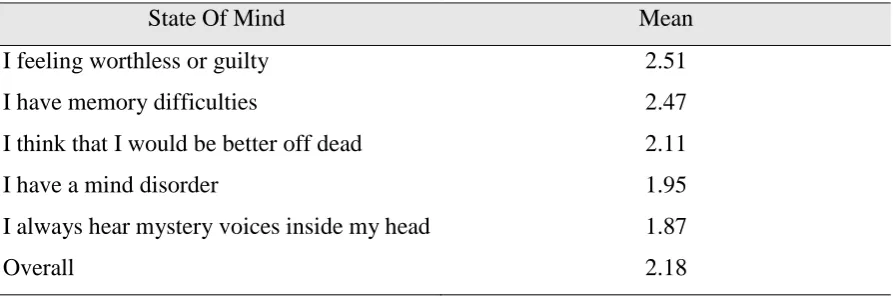
The data analysis in table 8 described that respondents always feel worthless in their life (M=2.51). Table 8 also shows that respondents have a memory difficulty (M=2.47) and they always think that they are better off dead (M=2.11). It shows that respondents have mind disorders (M=1.95) and that always effect their studies. A few of the respondents sometimes heard a mystery voices in their head (M=1.87). Depression also lead to suicidal ideation (Buchanan, 2012 & Arria, 2009) and the worst one is depression also lead to suicide (Buchanan, 2012) Overall, the average mean for respondent’s level of depression in state of mind is M=2.18.
Table 8: State of Mind
CONCLUSION
Based on the table, the mean score achieved for all respondents on financial problem the highest mean for depression among the college student in Malaysian is a financial problem(M=2.52) followed by factors of social (M=2.45), factors of lecturers and health state shared the same mean which is 2.33, friends (M=2.31), state of mind (M=2.18) and the last ranked factors that lead to depression is fall under the factor of family which is only 2.06. It shows that financial problem is the main factor for the depression among the college students as they cannot differentiate between want and needs and they tend to waste their money on uncertain things. According to the behavioural theory, depressed people typically have a heightened state of self-awareness about their lack of coping skills that often leads them to self-criticize and withdraw from other people. Based on the Lewinsohn’s theory, he explains the development of depression for some individual where they did not pay much attention to people's thoughts, perceptions, evaluations or expectations and instead focused solely on their external and directly observable and measurable behaviour.
State Of Mind Mean I feeling worthless or guilty 2.51 I have memory difficulties 2.47 I think that I would be better off dead 2.11 I have a mind disorder 1.95 I always hear mystery voices inside my head 1.87
13
References
Agerbo E, N. M. (2002). Familial, psychiatric, and socioeconomic risk factors for suicide in young people. Nested case-control study, pp. 325;74-77.
American Psychiatric Association. Diagnostic ans Statistical Manual of Mental Disorders (DSM-5). (Fifth Edition. 2013).
Andrew, B. (2004). The relation of depression and anxiety in life=stress and achievement in students. British Journal of Psychology.
Angelone A, M. A. (2011). Prevalence and correlates for self reported sleep problem among nursing students. Journal of preventive medicine and hygiene., 52.
Arria AM, O. G. (2009). Suicide ideation among college students: A multivariate analysis. Archives of suicide research, 13:230-46.
Abdul Rauf Ridzuan, Jusang Bolong, S. Salahudin Bin Suyurno, Rusydi
Bin Mohamad Kamal, Fakrulnizam Bin Jafri (2015). Developing Sns Factors Structures Towards Constructing Sns Survey Questions, Journal Of Human Capital Development, 8(2), 25-35.
Bos, J. N. (2005). Accuracy of diagnosing depression in primary care. The impact of chronic somatic and psychiatric comorbidity Psychological medicine.
Carillo M. A, V. O.-A. (2012). Depressive symptoms among Mexican medical students: high prevalence and the effect of a group psychoeducation intervention. Journal affective disorders, 136;1098-103.
Chen L, W. X. (2013). Prevalence and Socio-Demographic Correlates PLoS ONE.
Cooper J, A. L. (2002). Life events preceding suicide by young people. Social Psychiatry and Psychiatry Epidemiology, 37;271-275.
D., A. M. (2009). Wish Suicide ideation among college students. A multivariate analysis Archives of suicide research.
Eisenberg D, G. S. (2007). Prevalence and correlates of depression, anxiety and suicidality among university students. American Journal of Orthopsychiatry, 77;534-542.
Eisenberg, A. S. (2010). Self-injury, substance use, and associated risk factors in a multi-campus probability sample 0f college students. Psychology of Addictive Behaviors.
14
Eraslan-Capan, B. (2016). Social Connectedness and Flourishing. The Mediating Role of Hopelessness. Univers,J. Educ. Res.
Erin Winterrowd, E. L. (14 Jan, 2011). Friendship Factors and Suicidality: Common and Unique Patterns in Mexican- and European-American Youth. Retrieved from HHS Public Access: https://www.ncbi.nlm.nih.gov/pmc/articles/PMC3071144/
Furr, S., Westefeld, J., McConnel, G., & Jenkins, J. (2001). Suicide and depression among college students: A decade later. Prof.Psycho.Res. Pract ,32,97-100.
Garlow SJ, R. J. (2008). Depression, desperation, and suicidal ideation in college students: Results from the American Foundation for Suicidal Screening Project at Emory University. Depression and Anxiety, pp. 25; 482-488.
Güroğlu B, V. L. (2007;17:357–386.). Similarity and complementarity of behavioral profiles of friendship types and types of friends: Friendships and psychosocial adjustment. Journal of Research on Adolescence.
Hyattsville, M. (2004). Centers for Disease Control and Prevention, National Center for Health Statistics. Health United States, 2004 with chart book on trends in the health of Americans. Kumar, C. R. (2008). Research Methodology. -: APH Publishing.
Lee, R., & Robbins, S. M. (1995, 42, 232–241.). Measuring belongingness: The Social Connectedness and the Social Assurance scales. . J. Couns. Psychol.
Mahadevan, K. S. (2013). Correlates of depression, anxiety, and stress among Malaysian students. Journal of Psychiatry.
Mauro, S. D. (2006). Depression is the main determinant of equality of life in multiple sclerosis. A classification-regression (CART) StudyDisability and Rehabilitation.
MD. Ashraful Islam, W. Y. (17 May, 2018). Factors Associated with Depression among University students in Malaysia. A cross-sectional study.
Melo-Carillo A, V. O.-A. (2012). Depressive symptoms among Mexican medical sstudents: High prevalence and the effect of a group psychoedducation intervention. Journal of affective disorders, 136:1098-103.
Minh Hoang Nguyen, T. T. (2019 February , 8 February 2019). Depression, Acculturative Stress, and Social Connectedness among International University Students in Japan: A Statistical Investigation. Retrieved from Sustainability:
https://www.mdpi.com/2071-1050/11/3/878/htm#B1-sustainability-11-00878
Mowbray CT, M. D. (2006). Campus mental health services: Recommendations for change. American Journal of Orthopsychiatry, 76;226-237.
Muhammad Ashraful Islam, W. Y. (17 May, 2018). Factors Associated with depression among University students in Malaysia. A cross-sectional study.
15
Nur Hamizah Hj Ramli, M. A. (15 Jan, 2018). Academic Stress and Self-Regulation among University Students in Malaysia: Mediator Role of Mindfulness. Retrieved from Behavioral Science: https://www.ncbi.nlm.nih.gov/pmc/articles/PMC5791030/
Nuyen J, V. A. (2005). Accuracy of Diagnosing Depression in Primary care: The Impact of Chronic somatic and Psychiatric co-morbidity. Psychological medicine, 35;1185-95.
Orio, A. M. (2011). Prevalence and correlates for self-reported sleep problems among nursing students. Journal of Preventive Medicine and Hygiene.
Prinstein JJ, B. J. (2001;26:287–298.). Adolescents’ and their friends’ health-risk behavior: Factors that alter or add to peer influence. Journal of Pediatric Psychology.
Rosembaum Asarnow, J., & Guthrite, D. (1989, 18, 129–136.). Suicidal Behavior, Depression, and Hopelessness in Child Psychiatric Inpatients: A Replication and Extension. . J. Clin. Child Psychol.
Ridzuan, A.R., Ridzuan, A.R. and Ridzuan, M. (2018). Research Methods and Communication Research. Malaysian Journal of Media and Society. 1, 1-10.
Serras A, S. K. (2010). Self-injury, subsatnce use and associated risk factors in a multi-campus probability sample of college students. Psychology of addictive behaviors, 24:119.
Shamsuddin K, F. F. (2013). Correlates of depresssion, anxiety and stress among Malaysian university students. Asian Journal of psychiatry, 6:318-23.
SJ., G. (2002). . Age, gender, and ethnicity differences in pattern of cocaine and ethanol use preceding suicide. . The American Journal of Psychiatry, 159;615-619.