http://www.sciencepublishinggroup.com/j/ijfmts doi: 10.11648/j.ijfmts.20190501.12
ISSN: 2469-8105 (Print); ISSN: 2469-8113 (Online)
Review Article
Review on Performance Optimization of Absorption Heat
Pump Systems Based on Finite-Time Thermodynamics
Paiguy Armand Ngouateu Wouagfack
1, 2, *, Brigitte Astrid Medjo Nouadje
2, Noël Djongyang
3,
Réné Tchinda
2, 41
Department of Renewable Energy, Higher Technical Teachers’ Training College, University of Buea, Kumba, Cameroon
2Laboratory of Industrial System and Environment, University Institute of Technology Fotso Victor, University of Dschang,Bandjoun, Cameroon
3
Department of Renewable Energy, National Advanced School of Engineering, University of Maroua, Sahal, Cameroon
4Laboratory of Mechanics and Modeling of Physical System, Department of Physics, Faculty of Science, University of Dschang, Dschang, Cameroon
Email address:
*
Corresponding author
To cite this article:
Paiguy Armand Ngouateu Wouagfack, Brigitte Astrid Medjo Nouadje, Noël Djongyang, Réné Tchinda. Review on Performance Optimization of Absorption Heat Pump Systems Based on Finite-Time Thermodynamics. International Journal of Fluid Mechanics & Thermal Sciences. Vol. 5, No. 1, 2019, pp. 10-27. doi: 10.11648/j.ijfmts.20190501.12
Received: March 23, 2019; Accepted: April 28, 2019; Published: May 27, 2019
Abstract:
Most of industrial processes use a lot of thermal energy by burning fossil fuel to produce steam or heat for the purpose. After the processes, heat is rejected to the surrounding as waste. The absorption heat pump is becoming more important because it can be powered by these industrial energy wastes and hence, it poses no danger to the environment. In this paper, a literature review of the theoretical finite-time thermodynamic-based performance optimization of absorption heat pump systems independent of the used mixtures is presented. The review describes and discusses the performance objective functions for the various absorption heat pump cycle models. It covers the endoreversible and irreversible three-heat-source cycle models, four-heat-source cycle models and absorption heat transformer cycles with respect to the following aspects: the heat transfer law models, the effect of heat resistance and other irreversible loss models on the performance. Findings from published works considering the heating load, the coefficient of performance, the total heat transfer area, the thermo-economic function, the ecological function, the exergy-based ecological function and the ecological coefficient of performance as objective functions have been summarized in a table. It appears that design parameters based on the maximum of the ecological coefficient of performance conditions represent a best compromise between the heating load and the loss rate of availability.Keywords:
Finite-Time Thermodynamics, Performance Optimization Technique, Objective Functions, Endoreversible, Irreversible; Absorption Heat Pump1. Introduction
More than 170 years ago, Sadi Carnot, a French engineer, published his famous article [1] and established a new field of science: classical thermodynamics. He derived the upper limit of efficiency for any heat engine known as the Carnot efficiency. Contemporary classical thermodynamics gives a fairly complete description of equilibrium states and reversible
system and the environment is infinitesimally small, and the process duration is infinitely long. A consequence of this is a zero output rate (power output for an engine, cooling load for a refrigerator, and heating load for a heat pump) for the duration average. Performance limits obtained with the aid of reversible processes are independent of the equation of state of the system and are limiting in the sense that they remain unattainable in all real processes. All real thermodynamic processes are irreversible since the rate of exchange between the system and the environment is not infinitesimally small; the system does not maintain internal equilibrium, and the process duration is finite. The classical reversible bounds are too high for real processes and require further refinement. The application of classical thermodynamics principles and the solution of thermodynamic bounds for finite-time and/or finite-size thermodynamic processes, which are characterized by a finite rate of exchange between the system and the environment, were the first steps toward the field of finite-time thermodynamics. Novikov [2], Chambadal [3], and Curzon and Ahlborn [4] provides a new performance limit, which is different from Carnot efficiency, for the heat engine characterized by finite rate, finite duration, and finite-size. It is a new efficiency limit derived first in nuclear engineering literature [2, 3] and rediscovered in physics literature [4]. Since the mid 1970s, the research into identifying the performance limits of thermodynamic processes and optimizing thermodynamic processes has made great progress in the fields of physics and engineering. In physics, it was termed Finite-Time Thermodynamics (FTT) by R. S. Berry, B. Andresen, P. Salamon, M. J. Ondrechen, A. M. Tsirlin and S. Sieniutycz, among others, or Endoreversible Thermodynamics by A. De Vos and K. H. Hoffmann, among others. In engineering, it was termed Entropy Generation Minimization (EGM) by A. Bejan, R. J. Krane, D. P. Sekulic, M. Feidt and V. Radcenco, among others, or ‘‘Thermodynamic Modeling and Optimization’’ by A. Bejan and K. C. Ng, among others. The fundamental character of both FTT and EGM are the same, that is, to bridge the gap between thermodynamics, heat transfer, and fluid mechanics, and thermodynamically optimize performance of real finite-time and/or finite-size thermodynamic systems which include the real-world irreversibilities of heat transfer, fluid flow, and mass transfer. In this review, the research field is termed ‘‘Finite-Time Thermodynamics’’. Today, finite-time thermodynamics is a large and active field. More than 1500 publications, including books [5–20], doctoral theses [21–26] and review articles [27–47] were performed on this field between 1975 and 2018 by American, English, French, Russian Chinese, and other researchers.
The objective of this work is to review the present state of optimization of absorption heat pump processes based on finite-time thermodynamics. The different optimization criteria are provided and discussed. This paper could enable the development of absorption heat pump systems.
2. Model Description
An absorption heat pump system (equivalent to
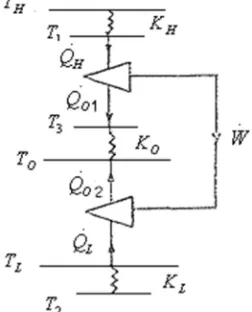
three-heat-reservoir heat pump system) affected by the irreversibility of finite rate heat transfer may be modelled as a combined cycle which consists of an endoreversible heat engine and an endoreversible heat pump that the model is shown in Figure 1 where the temperatures of the working fluid in the Carnot engine at two isothermal processes are T1 and
3
T , the temperatures of the working fluid in the Carnot heat pump at two isothermal processes are T2 and T3. T1, T2 and T3 represent the temperatures of the working fluid in the endoreversible three-heat-source heat pump when the three isothermal processes are carried out, respectively. They are respectively different from the temperatures of the corresponding three reservoirs. A single-stage absorption heat pump consists primarily of a generator, an absorber, a condenser and an evaporator which is shown in Figure 2. An equivalent single-stage absorption combined heat pump system is also shown in Figure 3. In these figures,
. H
Q is the heat-transfer rate from the heat source at temperature TH to the system,
. L
Q is the heat-transfer rate from the heat sink at temperature TL to the system,
. O
Q is the heat-transfer rate from the system to the heated space at temperature TO (in the case of three-heat-source model) and
. A
Q and .
C
Q are the heat-transfer rates from the absorber and condenser to the heated spaces at temperatures TA and TC respectively (in the case of four-heat-source model). T1, T2, T3 and T4 are the temperatures of the working fluid in the generator, evaporator, condenser and absorber,
.
W is the power output of the heat engine which is the power input for the heat pump. A single-stage absorption heat pump normally transfers heat between three temperature levels when TA =TC, but very often among four temperature levels when TA≠TC. For the three-heat-source single-stage absorption heat pump, it is generally assumed that the working fluid in the condenser and absorber has the same temperature T3 =T4. This assumption is reasonable because the working fluid in the condenser and absorber exchanges heat with the heated space at the same temperature. An absorption heat pump is endoreversible absorption heat pump when it is affected only by the external irreversibility of heat conduction between the working fluid and reservoirs.
Figure 2. Absorption heat pump system [57].
Figure 3. Equivalent cycle of an absorption heat pump system [63].
For many thermal energy systems, the heat reservoir heat capacities cannot all be infinite and the heat reservoir temperatures cannot all be constants (variable-temperature heat reservoirs). But, almost all of performance optimization on absorption heat pump based on finite-time thermodynamics were assumed that all heat reservoir heat capacities are infinite (constant-temperature heat reservoirs) as described above. Not all heat reservoir heat capacities of practical absorption heat pump plants are finite, too. The effects of heat capacities of heat reservoirs should be taken into account in finite-time thermodynamics modeling and performance analyses for absorption heat pump cycles.
An absorption heat transformer is the second type of absorption heat pumps, in which the temperature of the heat
source in lower than the temperature of the heated space.
3. Coefficient of Performance and
Heating Load Performance
Optimization Technique
3.1. Three-Heat-Source Absorption Heat Pump
Yan and Chen [48], and Chen and Yan [49] established the theoretical model of an endoreversible three-heat-source heat pump and used the optimal theory of endoreversible two-heat-reservoir heat pumps to investigate the effect of finite rate heat-transfer on the performance of three-heat-source heat pumps. They derived the coefficient of performance bounds corresponding to maximum heating load and the fundamental optimal relation between the coefficient of performance and heating load for the Newton’s law system; they also provided a unified description for Newton’s law system for three-heat-source heat pump cycle using the model of a finite thermal [50].
Chen et al [51] analyzed the effects of the linear phenomenological heat transfer law on the performance of an endoreversible three-heat-source heat pump. They investigated the relation between optimal coefficient of performance and heating load of an endoreversible three-heat-source heat pump with non linear heat transfer law. Chen et al. [52] provided a unified description for linear phenomenological law systems in various endoreversible cycles, including three-heat-reservoir heat pump.
Chen et Yan [53] and Chen et al. [54] carried out the performance optimization for an endoreversible three-heat-source absorption heat pump. In their investigation, they considered the phenomenological heat transfer law of q α ∆(1/T). Chen and Yan [53] chose the temperature of the working fluid as the optimization parameters. By introducing the Lagrangian function ( L= +ψ λπ where
λ
is the Lagrangian coefficient) and by using the Euler-Lagrangeequations ( ∂ ∂L x ,∂ ∂L y and ∂ ∂L T3 where x=T T3 1
and y=T T3 2 ), they derived the fundamental optimum relation between the coefficient of performance and heating load as:
(
)(
)
(
)
2r O L
O L
T T K
A B T T
ψ ψ ψ π
ψ
− −
=
+ (1)
where
(
)
2H L H L
K=K K K + K ,
(
)
(
)
H O L
O H L
K K K
A
K K K
± =
+ ,
(
)
(
)
L O H
O H L
K K K
B
K K K
=
+ ∓
positive sign for B correspond to Ψ<1. Using Eq. (1) and the extremal condition dπ ψd , they determined the maximum heating load as:
(
)
(
)
2
max 4
r O L
r O L
K T T B A B T T
ψ
π = ψ −
+ (2)
and the corresponding coefficient of performance as:
1 2 m
r
A B
ψ = ψ
+ (3)
Chen and Yan [53] concluded that the optimal performance coefficient of an endoreversible three-heat-source heat pump should be situated between ψm and ψr
Chen et al [54] distinguished two type of three-heat-source heat pump: the temperature amplifier (Ψ<1) and the heat amplifier (Ψ>1). The fundamental optimum relations of the temperature amplifier and heat amplifier are respectively:
(
)
( ) ( )(
)
( )(
)
2
2
1
1 1 1 1
H H L H L O O L H
H L O H O O L H L
K K K T T T T T T
T T T K K K K K K
ψ ψ π ψ + − − − = + − − + (4)
(
)
(
)
(
)
(
)
(
)
(
)
2 2 11 1 1 1
H H L H L O O L H
H L O H O O L H L
K K K T T T T T T
T T T K K K K K K
ψ ψ π ψ + − − − = + + − + (5)
When ψ =1, Eq. (4) either Eq. (5) becomes
(
)
(
1 1)
1
H H L O H
K K K T T
π
= + − − − (6)
For temperature amplifier, Chen et al [54] derived the optimum coefficient of performance at maximum heating load as:
(
)
12 1
m r rC C
ψ
ψ
ψ
− = − − (7)
where C= KH KO
(
KO KL−1) (
KH KL+1)
However for a heat amplifier, they obtained that the optimum coefficient of performance at maximum heating load is ψm =1. Figure 4 shows the relationship between theoptimal heating load of temperature amplifier (curve 1) and the heat amplifier (curve 2) and their corresponding optimal coefficient of performance.
Figure 4. π ψ− characteristics of an endoreversible three-heat-source heat pump system with linear phenomenological heat transfer law [54].
Göktun [55] treated an irreversible three-heat-source heat pump as a combined cycle of a finite-size irreversible Carnot heat engine driving an irreversible Carnot heat pump and investigated the influence of thermal resistance and working fluid internal dissipation on the optimal performance of a three-heat-source heat pump by using a finite-time thermodynamic approach.
Jincan [56] considered an irreversible three-heat-source absorption heat pump affected by the three main irreversibilities which are finite-rate heat transfer between the working fluid and external reservoir, heat leakage between heat reservoirs (
(
)
.
LC O L
LK
Q =K T −T ) and the irreversibility due the dissipation inside the working substance. In his study, Jincan [56] assumed that the total cycle time consisted only the time required to complete the isothermal processes neglecting the time spent on the adiabatic processes. He expressed the coefficient of performance and the heating load as the objective function where the optimization parameters are the temperatures of the working fluid in the three isothermal processes. The optimal relation between π and Ψ of the system was obtained as:
(
)
(
)
1
. . .
2 2
1 1 2 .
1
1 1 1 1
1
H L O LK H O L L LK H O LK
LK
K T T IT Q T IT T T B Q T B IT Q
Q
π ψ π ψ π
ψ π − = − − + − + + − + − − + (8) where
(
)
1 2 1 L L H K KI K IK
=
+ , 1
1 1 L O L H K IK B K IK + = + , 2 1
L H L O
L H
K IK K IK B
K IK
− =
+
Eq. (8) can be used to derived the fundamental optimal
The optimal temperature of the working fluid are their optimal range were derived also.
Figure 5. ψ π− characteristic of an three-heat-source heat pump affected by thermal resistance, heat leak losses and internal irreversibilities. Curves a (I=1,KLC=0), b (I>1,KLC=0) and c (I>1, KLC>0) [56].
Chen and Andresen [57] analysed the optimal performance of a single stage absorption heat pump which includes only a linear finite rate heat transfer law between the working fluid and the external reservoirs. This model was treated as a combined cycle in which an endoreversible heat engine operating between the heat reservoirs at temperatures TH and
O
T drives an endoreversible heat pump operating between the heat reservoir at temperature TO and TL. Chen and Andresen [57] assumed that the working fluid in the absorber and the condenser exchanges heat with the same heat reservoir at temperature TO. For a specified heating load of the overall system and a given total heat transfer area A, of the four heat exchangers in the system, they optimized the coefficient of performance of the combined system with respect to combined heat transfer area of the heat pump and derived the optimal coefficient of performance of the considered system as follows:
(
)
(
)
(
)
(
)
(
)
(
)(
)
1 1 2 1 2
1 1 2 1 2
1 1 1
1 1
O H L O
H O L L O H
U T T T U U U U T q U T T T T U U T U U T q
ψ ψ
ψ
ψ ψ
− + − + −
=
− + + − + − (9)
For a given specific heating load q=π A
where
(
)
2
1 H O H O
U =U U U + U ,
(
)
22 L O L O
U =U U U + U
Additionally, the behaviour of the optimal coefficient of performance as a function of the heating load was presented which is shown in figure 6. The maximum specific heating load is qmax =UH
(
TH −TO)
and the corresponding coefficient of performance is equal to 1. The more efficient branch of operation of the combined system is shown shaded in Figure 6. The optimal distribution of heat exchanger areas were also obtained.Figure 6. π ψ− characteristic of an endoreversible three-heat-source single-stage heat pump [57].
3.2. Four-Heat-Source Absorption Heat Pump
Chen [58] optimized the coefficient of performance of an irreversible cycle model of an absorption heat pump operating between four temperature levels affected by the irreversibility of finite-rate heat transfer and the internal irreversibilities of the working material for a given specific heating load. He derived a fundamental optimum relation from which the characteristic curves of the dimensionless specific heating load versus the coefficient of performance were generated and discussed the influence of the internal irreversibilities on the performance of the system. The optimal distribution of the heat-transfer areas of the heat exchangers was also determined.
Chen et al [59] established a general irreversible single stage four-heat-reservoir absorption heat pump cycle model which includes finite-rate heat transfer between the working fluid and the external heat reservoirs, heat leak from the heated space to the environment reservoirs and irreversibilities due to the internal dissipation of the working fluid. By taking the temperatures of the working fluid in the generator, condenser, evaporator and absorber as the optimization parameters and introducing the Lagrangian functions L1= +ψ λ π1 and L2 = +ψ λ π2 where λ1 and
2
λ are two Lagrangian coefficients, they derived the fundamental optimal relation which may be used directly to analyse the influence of major irreversibilities on the performance of the system. The maximum coefficient of performance and the corresponding heating load, as well as, the maximum heating load and the corresponding coefficient of performance were determined. The coefficient of performance at the maximum heating load is equal to unity.
max
region of the system. Figure 7 shows the π-Ψ characteristic curves of the system. Curve a represents the π-Ψ characteristic of an endoreversible four-heat-reservoir absorption heat pump; curve b represents the π-Ψ characteristic of a four-heat-source absorption heat pump with heat resistance and internal irreversibility; curve c represents the π-Ψ characteristic of a four-heat-source absorption heat pump with heat resistance and heat leak and curve d represents the π-Ψ characteristic of a generalized irreversible absorption heat pump. The corresponding optimal temperature of the working fluid in the four heat-transfer processes and their optimal region and the corresponding optimal heat transfer surface were obtained for a given total heat-transfer conductance ( UA=U AH H +U AL L+U AC C+U AA A ). Chen et al [56] analysed the effects of heat-leak coefficient (KLC), internal irreversibility coefficient (I) and distribution ratio (
. .
A C
m=Q Q ) and obtained that the optimal coefficient of performance and the optimal heating load decrease with the increase of KLC, I and m.
Qin et al. [60] established and analyzed the performance of the endoreversible four-heat-reservoir absorption heat pump cycle model with a generalized heat transfer law Q α
( )
Tn∆ .
(
)
.
1
n n
H H H
H
Q =U A T −T (10)
(
)
.
2
n n
L L L
L
Q =U A T −T (11)
(
)
.
3
n n
C C C
C
Q =U A T −T (12)
(
)
.
4
n n
A A A
A
Q =U A T −T (13)
Figure 7.
π ψ
− characteristic of a four-heat-source heat pump affected by thermal resistance, heat leak losses, and internal irreversibilities. Curves a (I=1,KLC=0), b (I>1,KLC=0), c (I=1, KLC >0) and d (I>1,0
>
LC
K ) [59]
Figure 8. Effects of the heat transfer law on the general relation between the coefficient of performance and the heating load of the endoreversible four-heat-reservoir absorption heat pump [60].
which includes some special cases: when n=1, the heat transfer obeys Newtonian law; when n= −1 the heat transfer obeys linear phenomenological law; when n=2, the heat transfer is applicable to radiation propagation along a one dimensional transmission line; when n=3, the heat transfer is applicable to radiation propagation along a two-dimensional surface, when n=4, the heat transfer obeys radiative law if all the bodies are black. By using the Lagrangian function, Qin et al. [60] derived the fundamental optimal relation between the coefficient of performance and the heating load of the endoreversible four-heat-reservoir absorption heat pump with linear phenomenological law ( n= −1). The fundamental optimal relation curve for n= −1, n=1, n=2 and n=4 was obtained as shown in Figure 8. Figure 9 shows the effects of the heat transfer surface area distribution on the cycle performance for n= −1 obtained by Qin et al. [60]. In this figure, the π πAm−ψ is the curve with fixed heat transfer surface area distributions and the π πAm−ψA is the curve with optimal heat transfer surface area distribution. Qin et al. [60] concluded that the cycle performance is improved with
Figure 9. Effects of the heat transfer surface area distribution on the cycle performance the endoreversible four-heat-reservoir absorption heat pump with n= −1 [60].
out by using UA=U AH H +U AL L+U AC C+U AA A to replace
H L C A
A= A +A +A +A . The fundamental optimal relation between the coefficient of performance and the heating for fixed total heat inventory with n= −1 was obtained. The relation between the optimal temperature of the working fluid and the optimal coefficient of performance and the relation between the optimal heat transfer surface area distribution and the optimal coefficient of performance were also obtained. Qin et al. [60] deduced that the total heat inventory should be distributed equally in the sides of heat input and heat output. Qin et al. [61] investigated the optimal performance of a variable-temperature four-heat reservoir irreversible absorption heat pump cycle model affected by the irreversibility induced by finite-rate heat transfer lied in the external heat reservoir and the internal working substance, the irreversibility induced by heat leakage losses between surroundings and the external heat reservoirs, and the irreversibility induced by internal working substance dissipation. They established a general expression related to the heating load, the coefficient of performance (COP), and some key parameters of variable-temperature heat reservoir irreversible absorption heat pump to optimize the main performance characteristics of the absorption heat pump and all the other heat pump cycles (two, three, and four heat reservoir; endoreversible and irreversible; infinite and finite heat capacity heat reservoirs). They analysed the influences of heat reservoir heat capacity, heat leakage irreversibility and internal irreversibility on cycle performance. The authors reported that the results may supply some guidelines for the design and operation of a practical absorption heat pump, whether the heat reservoir is variable-temperature or not.
3.3. Heat Transformer
Chen [62] presented the finite-time thermodynamics optimization of an endoreversible three-heat-source heat transformer. His work based on a model that accounted for the irreversibility of heat resistance. A general expression related to the heating load, the coefficient of performance and the overall heat transfer area of the heat transformer was derived and used to optimize the main performance parameters of the heat transformer. He determined the fundamental optimal relation between the heating load and the coefficient of performance as:
(
) (
)
(
)
(
) (
)
2
2 2
1 1 1
r H O L
L H O
K A T T T
T B T B T
ψ ψ ψ π
ψ ψ ψ ψ
− −
=
+ − + − − (14)
where K2 =U UH O
(
UH + UO)
(
1 O L) (
1 O H)
B= − U U + U U
It is a general expression which may be used to discuss the optimal performance of an endoreversible absorption heat transformer. The maximum rate of heating load and the corresponding coefficient of performance were calculated:
(
)
(
) (
)
2 3
max 2
2 2
H L O
O L H L L H L
K A T T T
T T D T T T D T T
π = −
− + − − − (15)
(
)
(
)
1 L H O
m
O L H L L
T T T
T T D T T T
ψ = −
− + − (16)
Where K3 =U UH L
(
UH + UL)
2,(
H O)(
H O) (
H L)
D= U U U − U U + U
By using Eqs. (14) and (15), Chen [62] obtained the max
π π −ψ curves of an endoreversible absorption heat transformer, as shown in Figure 10. For a given overall heat transfer area of the heat transformer, the optimal relation of the heat transfer areas of the heat exchangers was obtained:
H H O O L L
U A = U A + U A (17)
The problems concerning the optimal choices of other performance parameters were discussed.
Chen [63] used an equivalent combined cycle model of an endoreversible absorption heat transformer, consisting of an endoreversible Carnot heat pump driven by an endoreversible Carnot heat engine and, to investigate the effect of finite-rate heat transfer on the performance of an absorption heat transformer. He optimized the coefficient of performance of the combined system with respect to the total heat transfer areas of the heat engine and obtained the optimal relation of an endoreversible absorption heat transformer, the maximum specific heating load (qmax) and the corresponding coefficient of performance (ψm ). qmax and ψm are two important performance parameters of the system because they determine
Figure 10. π πmax−ψ characteristic of an endoreversible
Figure 11. π ψ− characteristic of a three-heat-source heat transformer affected by finite-rate heat transfer, heat leak and internal irreversibilities. Curves a (I=1,KLC=0), b (I>1,KLC=0) and c (I>1, KLC>0) [64].
respectively the upper bound of the specific heating load and the lower bound for the optimal coefficient of performance of the studied system. Chen [63] derived the π-Ψ curve of the system which is identical to that obtained in Ref. [63]. The optimal relation between the temperatures of the working fluid and the coefficient of performance and the optimal relation between the heat transfer surface areas and the coefficient of performance and the concise relation for the optimal distribution of heat transfer areas of the heat exchangers were also determined.
Chen [64] established a general irreversible cycle model which includes finite-rate heat transfer, heat leak, and other irreversibility due to the internal dissipation of the working fluid and analyzed the optimal performance of an irreversible heat transformer. He obtained the maximum specific heating load and the corresponding coefficient of performance as well as the maximum coefficient of performance and the corresponding specific heating load of this combined cycle heat transformer. He generated the π-Ψ curves describing the general performance characteristic of an irreversible heat transformer as shown in figure 11. He deduced the practical operating regions of a heat transformer. He also determined the optimal temperature of the working fluid and their optimal range.
Chen [65] used an endoreversible cycle model of a multi-temperature-level absorption heat transformer to analyze the performance of the heat transformer affected by the irreversibility of finite-rate heat transfer. He optimized the key performance parameters, such as the coefficient of performance, specific heating load, temperatures of the working fluid in the heat exchangers and heat-transfer areas of the heat exchangers. Some new results which are conducive to the optimal design and operation of real heat transformer systems were obtained and several special cases were discussed in detail. He derived the important results describing the optimal performance of a multi-temperature-level absorption heat transformer affected simultaneously by the internal and external irreversibilities from the corresponding formulae of the endoreversible cycle
model.
On the basis of an endoreversible absorption heat-transformer cycle, Qin et al. [66] established a generalized irreversible four-heat-source heat transformer cycle model by taking into account the heat resistances, heat leaks and irreversibilities due to the internal dissipation of the working substance. The heat transfer between the heat reservoir and the working substance was assumed to obey the linear (Newtonian) heat-transfer law, and the overall heat transfer surface area of the four heat-exchangers was assumed to be constant. Using finite-time thermodynamics, Qin et al. [66] derived the fundamental optimal relations between the coefficient of performance and the heating load, the maximum
coefficient of performance and the corresponding heating load,
the maximum heating load and the corresponding coefficient
of performance, as well as the optimal temperatures of the working substance and the optimal heat-transfer surface areas of the four heat exchangers. Moreover, they studied the effects
of the cycle parameters on the characteristics of the cycle by numerical examples. According to the fundamental optimal relation, Figure 12 shows the π-Ψ characteristic curves of the four-heat-source absorption heat transformer. In this figure, Curve a represents the π-Ψ characteristic of the endoreversible absorption heat-transformer, curve b represents the π-Ψ characteristic of the absorption heat-transformer with heat resistances and internal irreversibility, curve c represents the π-Ψ characteristic of the absorption heat-transformer with heat resistances and heat leak, and curve d represents the π-Ψ characteristic of the general irreversible absorption heat transformer.
Figure 12. π ψ− characteristic of a four-heat-source heat transformer affected by finite-rate heat transfer, heat leak and internal irreversibilities.. Curves a (I=1,KLC =0), b (I>1,KLC =0), c (I=1, KLC >0) and d (I>1, KLC >0) [66].
performance, the optimal temperatures of the working substance, as well as the optimal heat transfer surface area distributions with linear phenomenological heat transfer law. Moreover, the effects of the heat transfer law on the performance of the system are analyzed, and the performance comparison is performed for the distribution of the total heat transfer surface area by numerical examples.
Qin et al. [68] investigated the similar performance optimization of an irreversible four-temperature level absorption heat transformer cycle model which includes effects of heat resistance, heat leak and internal irreversibilities and analyzed the effects of heat transfer law, heat leak and internal irreversibilities on the optimal performance.
Coefficient of performance and cooling load criteria are used to evaluate the performance and the efficiency bounds of the absorption heat pumps. However, they do not give the performance limit from the view point of the thermo-economical design.
4. Total Heat Transfer Area Performance
Optimization Technique
The overall heat transfer area was chosen by Chen [69] as an objective function to research the performance of an endoreversible three-heat-source heat pump. The goal of the Chen’s work was to minimize the overall heat transfer area under a specified coefficient of performance and a given heating load by considering the temperature of the working fluid in the three isothermal processes as the optimization parameter. Chen [69] modelled his system by the Newton heat transfer rates between the working fluid and the heat reservoirs. Using the Langragian function L= +A λψ and the Euler-Langragian equations (∂ ∂ =L T1 0, ∂ ∂ =L T2 0,
3 0
L T
∂ ∂ = ) Chen [69] obtained the minimum overall heat
transfer areas for the fixed coefficient of performance and heating load and called it the general optimum relation for the three-heat-source heat pump because its determines the minimum overall heat transfer area that the heat pump must have for a fixed coefficient of performance and rate of heating load, as well as, the maximum rate of heat pumping (or the optimal coefficient of performance) for the fixed coefficient of performance (or heating load) and overall heat transfer area. The optimal relation for the heat transfer area was also derived.
Huang and Sun [70] carried out the similar optimization for an irreversible four-heat-source absorption heat pump. The minimum heat-transfer area was described in terms of the rate of the entropy changes of the system. The optimal relation between the heating load, coefficient of performance and heat transfer areas was achieved.
Contrary to the coefficient of performance and cooling load criteria which are the performance criteria, the overall heat transfer area is the technical criterion [71]; However, like the coefficient of performance and cooling load criteria, it does not give the performance limit of absorption heat pump from
the view point of the thermo-economical design.
5. Thermo-Economic Performance
Optimization Technique
Figure 13. Variations of the thermo-economic objective function for three-heat-source heat pump with respect to the coefficient of performance, for various I values [73].
Figure 14. Variations of the thermo-economic objective function for three-heat-source heat pump with respect to the coefficient of performance, for various k values [73].
losses is defined, as [73]:
(
)
.H L O H
F
a A A A b Q
π
=
+ + +
(18)
The variation of the objective function for the irreversible three-heat-source absorption heat pump with respect to the coefficient of performance for various I values and various
k=a b are shown in Figures 13 and 14 respectively. Kodal et al [73] maximized the objective function with respect to the working fluid temperature and derived the optimum working fluid temperature, the optimum coefficient of performance and the optimum specific heating load. The optimal distribution of the heat exchangers areas were also obtained for a given total heat transfer area (i.e. A= AH +AL+AO).
The effects of the internal irreversibility, the economic parameter (k=a b) and the external temperatures on the global and optimal economic performances were discussed.
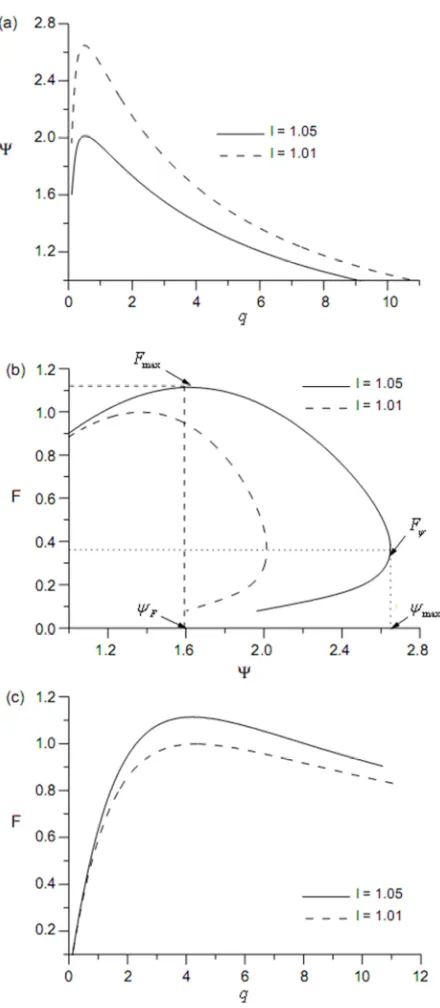
Wu et al. [74] carried out similar performance analysis to determine the influence of heat leak on the optimal thermo-economic performance of an irreversible absorption heat pump operating among three temperature levels. The thermo-economic objective function for the purpose was:
(
)
.H L O H y
F
a A A A b Q C
π =
+ + + +
(19)
where Cy is the average maintenance cost per unit time and considered to be a constant for a given heat pump. It should be noted that the thermo-economic objective function defined by Eq. (19) is general and useful, because it can include other objective functions. For example, when a=0, b=1 and
0 y
C = , the objective function becomes the coefficient of performance of the cycle, when a=1, b=0 and Cy =0, the objective function becomes the specific heating load of the cycle. By taking the temperatures of the working fluid as the optimization parameters, Wu et al. [74] calculated the maximum thermo-economic objective function and the corresponding optimal coefficient of performance (ψF) and optimal specific heating load (qF) as well as, the maximum coefficient of performance and the corresponding optimal thermo-economic objective function ( Fψ ) and optimal specific heating load (qψ) for a given total heat-transfer area of the heat exchangers. The corresponding optimal temperatures of the working fluid and the optimal distribution of the heat transfer area were also obtained. Additionally, the general performance characteristic curves were presented as shown in figures 15 and 16. From these figures, Wu et al. [74] derived the optimal operating regions of some main performance parameters as:
max
F ≥ ≥F Fψ, π π≥ ψ, ψmax≥ψ and π π≤ F (20)
The thermo-economical objective function F is used to reduce as well as possible the costs in the design and the
industrial facility of the absorption heat pumps and then to make the savings in their thermal consumption of energy. However, like the coefficient of performance, cooling load and total heat transfer areas criteria, he only takes into account the first law of thermodynamics and therefore he doesn’t describe the performance of the absorption heat pumps from the view point of the inevitable degradations of energy which occur in the system during the heat pump cycle of the working fluid. This aspect is taken into account by the second law of thermodynamics and appears in the thermo-ecological criterion.
Figure 16. The effect of the internal irreversibility factor I on (a) the ψ−q
curve, (b) the F−ψ curves and (c) the F−q curves. [74].
6. Ecological Performance Optimization
Technique
Angulu-Brown [75] proposed an ecological optimization function E for heat engines which is expressed as:
. cold
E= −W T σ (21)
where .
W is the power output and σ is the entropy generation rate. Yan [76] discussed the results of Angulu-Brown [75] and suggested that it may be more
reasonable to use:
. env
E= −W T σ (22)
if the cold reservoir temperature Tcold is not equal to the environment temperature Tenv. The optimization of ecological function is therefore claimed to achieve the best compromise between the work-energy rate (e.g. power of an engine, cooling rate of a refrigerator, or heating rate of a heat pump) and its dissipation which is produced by entropy generation in the system and its surroundings.
The ecological optimization of the heat pumps was firstly performed by Sun et al. [77]. He modified the ecological objective function defined for heat engines by Angulu-Brown [75] and Yan [76]. Su and Yan [78] carried out the similar work to analyse the influence of linear phenomenological heat transfer law on the optimal ecological performances of a three-heat-source heat pump. Similar to the definition of ecological criterion for the two-heat-reservoir, three-heat-reservoir refrigerator [79-81] and heat pump [77, 82], Chen and Yan [83] proposed an ecological optimization criterion for the best mode of operation of a new model for a class of irreversible absorption heat transformers. By using the combined cycle method, they investigated the ecological optimal performance of the heat transformer and presented the significance of the ecological optimization criterion.
Sun et al. [84] defined the ecological criterion E of the four-heat-source absorption heattransformer as:
= − − A C
A C
T T E
T T
π σ (23)
where the second term reflects the heating load dissipation or the loss rate of availability of the four-heat-source absorption heat transformer. Eq. (21) represents the compromise between the heating load and the entropy-production rate of the absorption heat transformer. Using Eq. (21), the ecological optimal performance of the four-heat-source absorption heat transformer was analyzed. Employing finite-time thermodynamics, Sun et al. [84] derived the optimal relation between the ecological criterion and the coefficient of performance, the maximum ecological criterion (Emax) and the corresponding coefficient of performance (ψE), heating load (πE) and entropy production rate (σE), as well as the ecological criterion and entropy production rate at maximum heating load (πmax) for a fixed total heat-transfer surface area. By performing comparative study with the heating load criterion, they showed that the ecological criterion has long term significance for optimal design of absorption heat transformer. Figure 17 shows the E-Ψ, π-Ψ and σ-Ψ characteristics of a four-heat-source endoreversible absorption heat transformer cycle. From this figure, the optimal region of the system for the ecological criterion optimization was obtained as:
max
Eq. (24) are two important finite-time thermodynamics optimal criteria of endoreversible absorption heat transformer for ecological optimizations. Sun et al. [84] reported similar ecological optimization study for a fixed total heat conductance.
Figure 17. E−ψ , π ψ− and σ ψ− characteristics of a four-heat-reservoir endoreversible absorption heat-transformer [84].
Qin et al. [85] performed the similar ecological optimization study for the endoreversible four-heat-reservoir absorption heat pump cycle model with linear (Newtonian) heat transfer law. They defined the ecological criterion E of the endoreversible four-heat-reservoir absorption heat pump as:
(
)
1 1 11
1 E A C
m E
m T T mT
π − + − − σ
= −
+ − − (25)
where
. .
C A
m=Q Q denotes the distribution ratio of the total heat output between the condenser and the absorber.
On the basis of above relation, the optimal relation between the ecological criterion and the COP (coefficient of performance), and the maximum ecological criterion and the corresponding COP, heating load and entropy production rate were derived. Moreover, the ecological performance was compared with that for the heating load criterion by numerical example to show that the ecological criterion is a factor which can have long-term significance for optimal design of absorption heat pumps. Qin et al. [85] included in their work the ecological optimal performance of a three-heat-source endoreversible absorption heat pump cycle and endoreversible Carnot heat pump cycle.
Huang et al. [86] analyzed the optimal performance of an absorption heat pump operation between four temperature levels with the losses of heat resistance and internal irreversibility by taking the ecological optimization criterion as an objective function. The ecological criterion function E of the system was defined as:
E
E= −π µ σT (26)
where
µ
is the dissipation coefficient of the heating load. They optimized the expression of Eq. (26) with respect to thecoefficient of performance and derived the optimal heating load, coefficient of performance and entropy production rate at the maximum ecological criterion. Figure 18 presents the heating load, the ecological criterion and the entropy production rate versus the coefficient of performance for a given total heat transfer area A at different internal irreversibility factor.
Figure 18. E−ψ , π ψ− and σ ψ− characteristics of a four-heat-reservoir absorption heat-pump with the losses of heat resistance and internal irreversibilities [86].
7. Exergy-Based Ecological Performance
Optimization Technique
For all the thermodynamic cycles, the exergy-based ecological optimization objective function was proposed by Chen et al. [87] as
env
E=EX −T σ (27)
where EX is the exergy output rate.
Very recently Qin et al. [88] established the exergy-based ecological objective function for an irreversible four-temperature-level absorption heat transformer cycle model with heat resistance, heat leakage and internal irreversibility. They defined the objective function as:
A C env
E=EX +EX −T σ (28)
where EXA is the absorber exergy output rate and EXC is the condenser exergy output rate.
Based on the above equation, they obtained the ecological relation equations and optimal performance which include the results of irreversible and endoreversible three-temperature-level absorption heat transformer cycle. The authors applied the similar technique to derive the exergy-based ecological relation equations and discussed the ecological optimal performance for four-temperature-level absorption heat pump cycle models [89].
8. New Thermo-Ecological Performance
Optimization Technique
Ust [90] has recently introduced a new dimensionless ecological optimization criterion called the ecological coefficient of performance (ECOP) which always has positive values and takes into account the loss rate of availability on the performance. Ust [90] defined the ECOP as the ratio of power output to the loss rate of availability:
.
.
= env
W ECOP
T σ
(29)
By employing the ECOP function, many studies have been done for different heat engine models [91-96]. The ECOP function defined for heat engines has been modified for irreversible three-heat-source absorption heat pump model which includes finite-rate heat transfer between the working fluid and the external heat reservoirs, heat leak from the heated space to the heat sink, and irreversibilities due to the internal dissipations of the working fluid by Ngouateu Wouagfack and Tchinda [97], as the ratio of heating load to the loss rate of availability:
. env
ECOP T
π σ
= (30)
Figure 19. Variation of the normalizedECOP(ecop), normalized COP
(cop) and the specific entropy generation rate (s) with respect to the specific heating load (q) [97].
The ECOP give information about to the loss rate of availability or entropy generation rate in order to produce a certain heating load. It should be noted that for a certain heating load, the entropy generation rate is minimum at maximum ECOP condition. The maximum of the ECOP function signifies the importance of getting the heating load from a heat pump by causing lesser dissipation in the environment. Therefore the higher the ECOP, we have a better absorption heat pump in terms of heating load and the environment considered together.
Ngouateu Wouagfack and Tchinda [97] determined analytically the maximum of the ecological performance criterion and the corresponding optimal coefficient of performance, heating load and entropy generation rate for a given total heat-transfer area of the heat exchangers. The corresponding optimal temperatures of the working fluid in the main components of the system and the optimal distribution of the heat-transfer areas were also obtained analytically. The influences of the major irreversibilities on the thermo-ecological performances were discussed. Additionally, the variations of the normalized ECOP and COP with respect to the entropy generation rate have been demonstrated which is shown in Figure 19. From this figure and analytically, Ngouateu Wouagfack and Tchinda [97] obtained that the maximum of the ECOP and COP coincides. This result was also obtained in Refs. [91-96] for heat engines, in Refs. [98, 99] for two-heat-source refrigerators, in Ref. [100] for three-heat-source absorption refrigerators and Ref. [101] for irreversible four-heat-source absorption heat pumps. In Ref. [101], Ngouateu Wouagfack and Tchinda extended the ECOP optimization technique for three-heat-source absorption heat pump models [97] to four-heat-source absorption heat pump models. Ahmadi et al [102] also carried out a thermo-ecological analysis of the performance of a three-heat-source absorption heat pump to determine the maximum COP and ECOP and the minimum heating load simultaneously by using the multi-objective optimization algorithm NSGAII in order to get the best performance.
9. Discussion
A comparison of performance optimization criteria for absorption heat pumps is presented in Table 1.
Table 1. Comparison of different optimization criteria for absorption heat pumps.
Criterion Mathematical formula Advantages drawback
Heating load rate Π =Q.A+Q.C−Q.LC
Enables to characterize the quality and the perfection of absorption heat pumps either for the given heating load levels (performance criterion: COP, П) or for an involved total heat exchanger surface (technical criterion: A).
Apply only the first law of thermodynamics and don’t describe the performance bounds of absorption heat pumps from the view of thermo-ecological design. Besides they don’t take into consideration the economic aspect in absorption heat pumps performance analysis. Coefficient of performance COP= Π Q.H
Criterion Mathematical formula Advantages drawback
Thermo-economic function
.
H
F
aA bQ
Π =
+
a: investment cost parameter for heat exchangers
b: energy consumption cost parameter
Is used to reduce as well as possible the costs in the design and the industrial facility of absorption heat pumps and then to make the savings in their thermal consumption of energy
As above criteria, applies only the first law of thermodynamics and therefore doesn’t describe the performance of absorption heat pumps from the view point of the inevitable degradations of energy which occur in the system during its cycle
Thermo-ecological function
. = Π − E
E µ σT
:
µ coefficient of performance of the reversible Carnot heat pump
Couples both the first and second law of thermodynamics and therefore is used to achieve the best compromise between the heating load and its dissipations of absorption heat pumps.
May take negative values. Such objective functions in a performance analysis of absorption heat pumps can be defined mathematically; however, it needs interpretation to comprehend this situation thermodynamically. Exergy-based ecological function E=EX−Tenvσ
EX: the exergy output rate
Couples both the first and second law of thermodynamics and therefore is used to attain a compromise in inter restricted relations between exergy output and exergy loss of absorption heat pump plants.
New thermo-ecological function .
Π =
env
ECOP
T σ
Couples both the first and second law of thermodynamics and therefore is used to achieve the best compromise between the heating load and its dissipations of absorption heat pumps. Unlike E criterion, ECOP criterion is dimensionless and always positive.
10. Conclusion
In this paper, an overview of the performance optimization criteria based on the finite-time thermodynamics for absorption heat pump systems is presented. The coefficient of performance, the heating load, the overall heat transfer area, the thermo-economic objective function, the thermo-ecological objective function, the exergy-based ecological objective function and the new thermo-ecological objective function have been discussed. It is pointed out that the ECOP objective function is more advantageous over the other considered performance criteria. The ECOP criterion is dimensionless, has always positive values and can attain a best compromise between the heating load and the entropy generation rate. It has been seen that the major irreversibilities such as thermal resistance, heat leak and internal irreversibilities due to the dissipation of the working fluid affect the performance of real absorption heat pump systems. This literature review is a contribution for the development of real absorption heat pump systems since it may provide a general theoretical tool for their design. Moreover, it is hoped that this contribution will stimulate wider interest in the definition of new performance criteria for the optimization of absorption heat pumps.
Nomenclature
a= Investment cost parameter for heat exchangers
A=Total heat-transfer area (m2) A
A =Heat-transfer area of absorber (m2) C
A =Heat-transfer area of condenser (m2) L
A =Heat-transfer area of evaporator (m2) H
A =Heat-transfer area of generator (m2)
O A C
A =A +A
b= Energy consumption cost parameter
E= Thermo-ecological objective function (W)
ECOP= Ecological coefficient of performance
EX = Exergy output rate (W)
F= Thermo-economic objective function
I =Internal irreversibility parameter
k=a b
LC
K =Heat leak coefficient (W K) H
K = Thermal conductance of heat source (W K-1) L
K = Thermal conductance of heat sink (W K-1) O
K = Thermal conductance of heated space (W K-1)
ncu= National currency unit
m= Distribution ratio of the total heat output between the condenser and the absorber
q= Specific heating load (W m-2) .
A
Q =Heat reject load from absorber to heated space (W) .
C
Q =Heat reject load from condenser to heated space (W) .
L
. LK
Q =Heat leakage load (W) .
H
Q =Heat input load from heat source to generator (W) . . .
O C A
Q =Q +Q
1
T =Temperature of working fluid in generator (K) 2
T =Temperature of working fluid in evaporator (K) 3
T =Temperature of working fluid in condenser (K) 4
T =Temperature of working fluid in absorber (K) A
T =Temperature of the absorber-side heated space (K) C
T =Temperature of the condenser-side heated space (K) Cold
T =Temperature of the cold reservoir (K) env
T =Temperature in environmental conditions H
T =Temperature of the heat source (K) L
T =Temperature of the heat sink (K)
O A C
T =T =T
A
U = Overall heat-transfer coefficient of absorber (W K /m2) C
U =Overall heat-transfer coefficient of condenser (W K /m2) H
U =Overall heat-transfer coefficient of generator (W K /m2) L
U =Overall heat-transfer coefficient of evaporator (W K /m2)
O
U = Overall heat-transfer coefficient of absorber and condenser (W K /m2)
.
W = power output (W)
Symbol
π =Heating load (W) ψ
π = Heating load at maximum coefficient of performance (W)
ψ
=Coefficient of performance for absorption heat pumpm
ψ = Coefficient of performance at maximum heating rate
r
ψ = Coefficient of performance for reversible three-heat-source heat pump
µ
=Dissipation coefficient of heating rate σ =Entropy generation rate (W / K)Subscripts
max= Maximum
References
[1] S. Carnot, Reflections on the motive power of fire. Bachelier, Paris, 1824.
[2] I. I. Novikov, The efficiency of atomic power stations (A review). Atommaya Energiya, 11 (1957), 409.
[3] P. Chambadal, Les Centrales Nucleaires, Armand Colin, Paris, 1957, pp. 41–58.
[4] F. L. Curzon, B. Ahlborn, Efficiency of a Carnot engine at
maximum power output, Am. J. Phys. 43 (1975) 22–24. [5] S. Sieniutycz, P. Salamon, Advances in Thermodynamics,
Volume 4: Finite Time Thermodynamics and Thermoeconomics, Taylor & Francis, New York, 1990. [6] A. Bejan, Entropy Generation through Heat and Fluid Flow,
Wiley, New York, 1982.
[7] B. Andresen, Finite-Time Thermodynamics, Physics Laboratory II, University of Copenhagen, 1983.
[8] A. M. Tsirlin, Optimal Cycles and Cycle Regimes, Energomizdat, Moscaw, 1985 (in Russian).
[9] M. Feidt, Thermodynamique et Optimisation Energetique des Systems et Procedes, Technique et Documentation, Lavoisier, Paris, 1987 (in French).
[10] A. De Vos, Endoreversible Thermodynamics of Solar Energy Conversion, Oxford University, Oxford, 1992.
[11] V. Radcenco, Generalized Thermodynamics, Editura Techica, Bucharest, 1994 (in English).
[12] A. Bejan, Entropy Generation Minimization, CRC Press, Boca Raton FL, 1996.
[13] A. Bejan, G. Tsatsaronis, M. Moran, Thermal Design & Optimization, Wiley, New York, 1996.
[14] L. Chen, F. Sun, Finite Time Thermodynamics for Energy Systems, Naval Academy of Engineering Publisher, Wuhan, 1992 (in Chinese).
[15] A. Bejan, E. Mamut, Thermodynamics and the Optimization of Complex Energy Systems, NATO Advanced Study Institute, Neptun, Romania, 1998.
[16] A. Bejan, E. Mamut, Thermodynamic optimization of complex energy systems, Kluwer Academic Publishers, London, 1999. [17] C. Wu, L. Chen, J. Chen, Recent advances in finite-time
thermodynamics, Nova Science Publishers, New York, 1999. [18] R. S. Berry, V. Kazakov, S. Sieniutycz, Z. Szwast, A. M.
Tsirlin, Thermodynamic optimization of finite-time processes, Wiley, New York, 2000.
[19] S. C. Kaushik, S. K. Tyagi, P. Kumar, Finite time thermodynamics of power and refrigeration cycle, Springer, 2017.
[20] Y. Bi, L. Chen, Finite time thermodynamics optimization for air heat pumps, Beijing: Science Press, 2017 (in Chinese). [21] G. Popescu, Contributions dans Latude de Ioptimisation des
Systems Endo-Regenerative et Exio-Irreversible de Type Stirling sur la Base de la Thermodynamique en Temps Fini, These de Doctorat, Universite Politechica, Bucarest, 1993. [22] J. V. C. Vargas, Combined Heat Transfer and Thermodynamic
Problems with Applications in Refrigeration, Ph. D. Thesis, Duke University, 1994.
[23] E. Geva, Finite Time Thermodynamics for Quantum Heat Engine and Heat Pump, Ph. D. Thesis, The Hebrew University, 1995.
![Figure 3. Equivalent cycle of an absorption heat pump system [63].](https://thumb-us.123doks.com/thumbv2/123dok_us/9874616.1974940/3.595.50.282.77.557/figure-equivalent-cycle-absorption-heat-pump.webp)
![Figure 4. π−ψ characteristics of an endoreversible three-heat-source heat pump system with linear phenomenological heat transfer law [54]](https://thumb-us.123doks.com/thumbv2/123dok_us/9874616.1974940/4.595.332.514.123.298/figure-characteristics-endoreversible-heat-source-linear-phenomenological-transfer.webp)
![Figure 5. −by thermal resistance, heat leak losses and internal irreversibilities. Curves a (ψπ characteristic of an three-heat-source heat pump affected I=1,K=LC0), b (I>1,K=LC0) and c (I>1, K>LC0) [56]](https://thumb-us.123doks.com/thumbv2/123dok_us/9874616.1974940/5.595.52.281.544.731/figure-thermal-resistance-internal-irreversibilities-curves-characteristic-affected.webp)
![Figure 7. πthermal resistance, heat leak losses, and internal irreversibilities. Curves a (−ψ characteristic of a four-heat-source heat pump affected by I=1,K=LC0), b (I>1,K=LC0), c (I=1, K>LC0) and d (I>1, K>LC0) [59]](https://thumb-us.123doks.com/thumbv2/123dok_us/9874616.1974940/6.595.47.288.379.687/figure-pthermal-resistance-internal-irreversibilities-curves-characteristic-affected.webp)
![Figure 10. π πmax −ψ characteristic of an endoreversible three-heat-source heat transformer [62]](https://thumb-us.123doks.com/thumbv2/123dok_us/9874616.1974940/7.595.309.547.511.729/figure-pmax-characteristic-endoreversible-heat-source-heat-transformer.webp)

![Figure 13. Variations of the thermo-economic objective function for three-heat-source heat pump with respect to the coefficient of performance, for various I values [73]](https://thumb-us.123doks.com/thumbv2/123dok_us/9874616.1974940/9.595.315.544.410.619/figure-variations-economic-objective-function-coefficient-performance-various.webp)
![Figure 15. Some optimum characteristic curves of three-heat-source absorption heat pump with the losses of heat resistance and internal irreversibilities [74]](https://thumb-us.123doks.com/thumbv2/123dok_us/9874616.1974940/10.595.316.536.221.715/figure-optimum-characteristic-curves-absorption-resistance-internal-irreversibilities.webp)