ISSN: 2306-9007 Nooraie (2014) 333
I
www.irmbrjournal.com March 2014I
nternationalR
eview ofM
anagement andB
usinessR
esearchVol. 3 Issue.1
R
M
B
R
The Roles of Decentralization of the Decision Making Process
between Contextual Factors and Decision Process Output
MAHMOOD NOORAIE
Faculty of Management Department, Islamic Azad University, Abhar Branch
Email: [email protected]
Abstract
The purpose of this paper is to identify the roles of decentralization of the strategic decision-making process between contextual factors and decision process output. From analysis of alternative research approaches, a field survey was most appropriate methodological choice. This study is a field study of real organizations rather than an artificial setting. The questionnaire consists of items measuring the variables of primary interest, namely the independent, mediator, and dependent variables. The study was conducted in central part of the country involving medium and large size manufacturing firms. The results of hierarchical regression analysis indicate that decentralization in the strategic decision-making process mediates the influence of organizational slack, environmental dynamism and managers need for achievement on quality of the decision process output. But do not mediate the influence of the decision familiarity on quality of the decision process output.
Key Words: Strategic decisions, Decision’s familiarity, Environmental dynamism, Organizational slack, Need for achievement.
Introduction
Decision-making is an important part of managers‟ jobs in any organization. More than anything else, competence in this activity differentiates the manager from the non-manager (Harrison, 1999). In reality, managers must make decisions while performing managerial functions; planning, organizing, staffing, leading, and controlling. Therefore to be a good planner, organizer, staffer, leader and controller, a manager must first be a good decision maker (Rue & Bayrs, 1986). However, the process of decision-making is not as easy as it sounds. In a classic work on the science of management decision making, Simon, (1965) treats it as a process synonymous with the whole process of management. Pearce and Robinson (1989) indicated that decision-making is inevitable, because to explicitly avoid making a decision is in itself to make a decision. Thus, making decisions is the most important job of any manager or executive (Hammond et al., 1998). To be effective in the highly competitive environment of today, managers in any organization need to devote a significant amount of skill, knowledge, and attention to managerial decision-making.
ISSN: 2306-9007 Nooraie (2014) 334
I
www.irmbrjournal.com March 2014I
nternationalR
eview ofM
anagement andB
usinessR
esearchVol. 3 Issue.1
R
M
B
R
to be the first to test the mediating impact of the decentralization of the strategic decision-making process. This study was conducted among Iranian manufacturing firms, and, therefore, comparison of its results to the findings in other countries may suggest the influence of other factors such as ideology, belief, and culture on the strategic decision-making process. This in turn may open up a promising avenue for future research. The choice to focus on strategic decisions is due to their nature and significance. This investigation is limited to firms operating in Tehran province and focuses on strategic decisions made from 2010 to 2012.
Derived from the above or similar discussions in my literature review, the questionis: to what extent do contextual factors such as decision familiarity, organization slack, environment dynamism and managers need for achievement influence the decentralization of the strategic decision-making process and quality of the decision process output? This study seeks to extend prior work on factors influencing the strategic decision-making process, and to identify the possible relationship between these factors and quality of the decision process output, while decentralization of the decision-making process mediates their relationship.
Literature Review
In discussing decision making, it is customary to focus on a decision itself. A decision is a conscious choice to behave or to think in a particular way in a given set of circumstances (Duncan, 1973). Decision-making refers to the thought process involved in choosing the most logical choice from among the options available. In making a decision the decision maker has several alternatives and the choice involves a comparison between these alternatives and an evaluation of their respective outcomes. For purposes of this article, a decision is defined as a moment, in an ongoing process of evaluating alternatives for meeting an objective, at which expectations about a particular course of action impel a decision maker to select that course of action most likely to result in attaining the objective. Strategic decision making is the most significant activity engaged in by managers in all types of organizations. This activity clearly distinguishes managers from other occupations in the society.
Decision making process is conducted by managers in three different ways. Intuitively, based on judgment, or using a more detailed problem-solving process. Making choices based on judgment is primarily an art learned through experience. And using problem-solving methods to arrive at decisions is an analytic process that is scientific in nature and requires considerable skill and knowledge Carlisle (1979). The primary focus in this article is on strategic decisions made by managers at the top of the organization. These decisions trigger dozens or even hundreds of other decisions of lesser magnitude at descending levels of management. Strategic decisions, therefore, set the tone and tempo of managerial decision making for every individual and unit throughout the entire organization. Strategic decisions are highly complex and involve a host of dynamic variables. Strategic decisions are the means by which perennially scarce resources are rationally committed to fulfill managerial expectations for success. The ability to take the right strategic decision in a complex situation is what sets an average individual apart from the rest, though the ability of arriving at the correct decision within a short span of time is a highly valued and important trait (Bose, 2013).
ISSN: 2306-9007 Nooraie (2014) 335
I
www.irmbrjournal.com March 2014I
nternationalR
eview ofM
anagement andB
usinessR
esearchVol. 3 Issue.1
R
M
B
R
In the past decades, especially in the late 90's several researches have investigated and written about managerial decision-making from a variety of dimensions and perspectives (e.g. Thompson & Strickland, 2003; Gamble and Thompson, 2009; Phatak, 2012; Bose, 2013). In spite of this on-going attention, the subject of decision-making is still in a contradictory and controversial phase with theoretical dilemmas. Harrison (1999) believed that part of the problem is derived from the multidisciplinary nature of the decision-making. The problem can be more complicated by differentiating decision maker into individual, group, and multi-group (Kriger & Barnes, 1992). Strategic decisions are shaped by environmental,
organisational, decision-maker and decision-specific characteristics (Elbanna and Child, 2007). For the
purpose of this study contextual factors are limited to four different variables such as decision's familiarity, organizational slack, environment dynamism and managers need for achievement that impact strategic decision-making process output.
Decision’s Familiarity
It refers to the degree that the decision problem is clear to the decision-maker. Papadakis et al. (1998) did not find any relationship between decision‟s familiarity and characteristics of the decision-making process. On the other hand, Fahey (1981) found that decision‟s frequency (a proxy to familiarity) influences the extent of rationality in the decision-making process.
Organizational Slack
Organizational defined as a cushion of resources, helps organizations cope with environmental changes and unexpected events. In the literature review I could not find any empirical study relating organizational slack to strategic decision-making process except the work of Sharfman and Dean (1997) that concluded a positive relationship between slack and flexibility in strategic decision-making process.
Environmental Dynamism
Environmental dynamism refers to the rate of change, absence of pattern and unpredictability of the environment (Dess & Beard, 1984). Based on these characteristics, environmental dynamism as an important factor influencing strategic decision-making process has been considered by several literatures. Some of these studies (e.g. Frederickson, 1984; Frederickson & Iaquinto, 1989) claimed that there is a negative relationship between strategic decision-making process and performance in unstable environment and positive relationship in stable environment. In contrast Bourgeois (1985) found that in high velocity environment, effective firms use rational decision-making process. On the same note Miller and Friesen (1983), and Eisenhardt (1989), suggested that an increase in environmental dynamism is accompanied by an increase in the extent of rationality in the decision-making process. In literature review relating environmental dynamism to the extent of decentralization in the decision-making process I found different views. Grinyer et al. (1986) suggested that environmental stability is associated with decentralization while Papadakis et al. (1998) found no relationship between dynamism and the extent of decentralization in the decision-making process. And according to Grant, (2003) strategic decisions are made outside the strategic plan in response to environmental opportunities and threats.
Need for Achievement
ISSN: 2306-9007 Nooraie (2014) 336
I
www.irmbrjournal.com March 2014I
nternationalR
eview ofM
anagement andB
usinessR
esearchVol. 3 Issue.1
R
M
B
R
Theoretical Framework
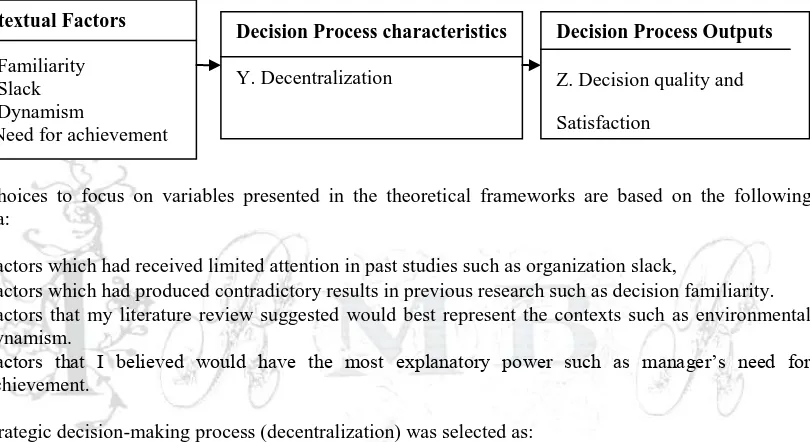
Based on my literature review and research questions I have developed an integrated framework that is presented in Fig.1. The model is descriptive in nature and focuses on the influence of conceptual factors; decision familiarity, organizational slack, environmental dynamism, and manager need for achievement on decentralization of the strategic decision-making process. Also it looks at the mediating impact of decentralization of the strategic decision-making processes between these contextual factors and quality of the decision-making process output. Two guiding assumptions derived from literature serve as the theoretical basis for this model (1) contextual factors influence the choice of process, and (2) the process choice influences output quality. Contextual factors are grounded on behavior, upper echelon, system, and contingency theories, whereas process choice is grounded on utility, behavior, and decision theories, and process quality is grounded on decision theory.
Fig
Fig .1 Theoretical Frameworks
The choices to focus on variables presented in the theoretical frameworks are based on the following criteria:
Factors which had received limited attention in past studies such as organization slack,
Factors which had produced contradictory results in previous research such as decision familiarity.
Factors that my literature review suggested would best represent the contexts such as environmental dynamism.
Factors that I believed would have the most explanatory power such as manager‟s need for
achievement.
The strategic decision-making process (decentralization) was selected as:
That is more frequently cited in literature,
Which has clearly played central roles in organization decision-making, and
Which is distinct and is related to the most important and popular organizational model.
I selected quality of the decision-making process output because the literature provides following
conceptual basis for consideration while I am not aware of any studies that focus on process output.
The final decision outcomes is a function of decision process quality and implementation (Trull, 1966),
The final decision outcomes also depends upon the quality of the process in which the decision is made
(Steiner, 1972), and
Since good decision can lead to bad outcomes and vice versa, a strategic decision-making process cannot infallibly be graded either high or low quality in terms of its final outcomes (Brown et al., 1974).
Research Hypotheses
I expected that familiarity with the decision and the decision context to encourage managers to centralize the decision-making process and not delegate decision authority to lower levels of management. This is because a manager who is familiar with the decision context will require less information and feedback from other lower level managers, in making the decision. However Papadikas et al, (1998) did not find any
Contextual Factors
X1. Familiarity X2. Slack X3. Dynamism
X4.Need for achievement
Decision Process characteristics
Y. Decentralization
Decision Process Outputs
Z. Decision quality and
Satisfaction
ISSN: 2306-9007 Nooraie (2014) 337
I
www.irmbrjournal.com March 2014I
nternationalR
eview ofM
anagement andB
usinessR
esearchVol. 3 Issue.1
R
M
B
R
relationship between decision‟s familiarity and the extent of decentralization in the decision-making process. Thus I proposed the following hypothesis.
H1.There is a negative relationship between decision familiarity and the extent of decentralization in the
decision-making process.
In my literature review I could not find any empirical study relating organizational slack to the extent of decentralization in the decision- making process while a few studies available in this area (e.g. Sharfman & Dean, 1997) mostly focused on decision flexibility. Availability of organizational slack can provide opportunities for managers to seek more information, more alternatives, and better choice. Thus managers are more likely to look for decentralization in their decision-making if the level of organizational slack is great. Based on these premises the following hypothesis was formulated for testing.
H2. There is a positive relationship between organizational slack and the extent of decentralization in the
decision-making process.
I expect that CEOs tend to be more careful and seek for more information and ideas in order to generate and evaluate more alternatives and create a better choice. This is to say that the greater uncertainty, the greater need for information and involvement of others. This leads to more participation of lower level of managers. Further, greater delegation and involvement provides avenues to spread out “blame” in the event of failure. Thus I posit the following hypothesis for assessment.
H3. There is a positive relationship between environmental dynamism and the extent of decentralization in
the decision-making process.
With respect to the manager‟s need for achievement the literature review reveals two groups of studies, with contradictory results. Miller et al. (1988) suggested that the need for achievement exerts a negative impact on decentralization of the decision-making process, while (Papadakis et al., 1998) found no such relationships between manager‟s need for achievement and the extent of decentralization in the decision-making process.
I believe that managers with high levels of need for achievement seek for more challenging works to achieve their desired goals thus, they are less likely to decide in a decentralized manner. Thus the following hypothesis for testing was suggested.
H4. There is a negative relationship between manager‟s need for achievement and the extent of
decentralization in the decision-making process.
ISSN: 2306-9007 Nooraie (2014) 338
I
www.irmbrjournal.com March 2014I
nternationalR
eview ofM
anagement andB
usinessR
esearchVol. 3 Issue.1
R
M
B
R
the decision outcomes help to differentiate between the quality of the decision-making process and the quality of the implementation process. This study is concerned only with decision-making process output. I expect that decentralization in decision-making process or more delegation of stages of planning process to lower levels of management lead to higher quality of decision process output due to the greater diversity of ideas. Given that the extent of decentralization in strategic decision-making process generate more ideas, more discussions, more evaluations, and more information, more focus will be given to possible choices, which may leads to better selection that in fact provides higher level of decision-making quality. More importantly, greater decentralization in the decision process creates awareness and acceptance of the final decision. Based on these discussions Iposit the following hypothesis for testing
H5. There is a positive relationship between the extent of decentralization in the decision-making process
and quality of the decision process output.
As I have conceptualized the relationship of the variables of study in the framework, decision process mediates influence of contextual factors on the process output. I am not aware of any existing empirical study of strategic decision-making that focuses on the relationship between familiarity, slack, dynamism and need for achievement and quality of the decision-making process output while decentralization of the strategic decision-making process function as a mediator between these variables.
According to interactional psychology, contextual variables are the major direct influence on manager‟s adjustment to choose a particular making process (Nelson, 1990). On the other hand decision-making process directly influences the quality of the decision process output thus, contextual factors will have indirect effect, through a decision-making process on quality of the decision process output. Based on these discussion following hypothesis for testing was proposed.
H6. The relationship between contextual factors and quality of the decision process output is mediated by
the extent of decentralization in the decision-making process.
Methodology
ISSN: 2306-9007 Nooraie (2014) 339
I
www.irmbrjournal.com March 2014I
nternationalR
eview ofM
anagement andB
usinessR
esearchVol. 3 Issue.1
R
M
B
R
Familiarity
Three items derived from Beach and Mitchell (1978) was used to measure and operational this variable.
Organization slack
To measure this variable two items were designed. These items measured agreement on the policy of the firm to maintain adequate money and inventory for its unknown commitment.
Environmental Dynamism
As measured by Achrol and Stern (1988) I measured and operational the environmental dynamism by the perceived frequency of changes in (1) firms marketing practices, (2) competitors marketing practices, and (3) customer tastes in terms of productions, sales, and promotion.
Need for Achievement
Five items derived from Steers and Braunstein (1976) were used to measure and operational this variable. These items measured agreement on statements pertaining to manager‟s need for achievement.
Decentralization of the decision-making process:is the extent to which different levels of management are
involved in strategic decision-making process. By using guideline of Grinyer et al. (1986) five items were designed. These items measured the extent to which top, middle, and operational management were involved in strategic decision-making process.
Decision process output: refers to outcome of decision-making process particularly the quality and
satisfaction with the process.
The decision process quality refers to how well the different stages of strategic decision–making process were carried out, This variable was measured by five items adapted from Schilit & Paine (1987). The decision process satisfaction refers to provision for implementation, contingency plan, speed of decision, and achieving goal. In order to measure these variables four items was designed.
Pilot study
To test and eliminate ambiguous or biased items and to improve the format, both for ease of understanding and to facilitate data analysis, a pilot study was conducted by computing Cronbach‟s reliability alpha. In reviewing the results of the analysis, minor changes were made and the relevant suggestions from respondents were incorporated into the final questionnaire. The results of the pilot study in Table.1 indicate that variables in the study had acceptable reliability with Cronbach‟s alpha ranging from .7086 to .8914.
Table 1 Reliability Tests
Variables Cronbach’s alpha
X1 Decision‟s familiarity .8914
X2 Organizational slack .8203
X3 Environmental dynamism .7654
X4 Need for achievement .7885
Y Decentralization .7504
Z Process Quality .7086
Respondent Profile
ISSN: 2306-9007 Nooraie (2014) 340
I
www.irmbrjournal.com March 2014I
nternationalR
eview ofM
anagement andB
usinessR
esearchVol. 3 Issue.1
R
M
B
R
Within manufacturing firms top manager or strategic level of authority is represented by Chief Executive Officer, President, and General Manager (Miller et al., 1998). Directors, Deputy Chief Executive, Vice President, and Assistance General Manager usually represent middle managers or tactical levels of authorities, and operational managers are those who have functional responsibilities and are usually engaged in accomplishing strategic and tactical actions. A particular combination of managers from three levels of authority in this study is named top management team.
The demographic characteristic of responding managers indicated that most of the managers have high level of education (Bachelor's degree or higher = 85%) and moderate and long working experience in the organization (11 years or more =53%). The average age of the managers was nearly 40 years.
Similarly, as is common in many countries, managers in the sample are mostly male (81. %) with a small minority of the female managers (19%). The table also indicates that the highest number of managers is at the operational level (53.3%) followed by middle level managers (24.4%) and top-level managers (16.2%). This is not surprising because the number of operational managers in any kind of organization is usually more than the number of middle and top managers. This is also true for composition of the top management team. Given that the members of top management team who are nominated for making strategic decisions in firms typically include of one CEO and several middle and operational managers thus it is not unusual if the higher proportion of the questionnaires received are from the middle or operational levels of management. On the other hand the results of t-test between higher levels (top and middle) managers and lower levels (operational) managers shows no any significant differences between the groups of respondents.
Hypothesis Testing
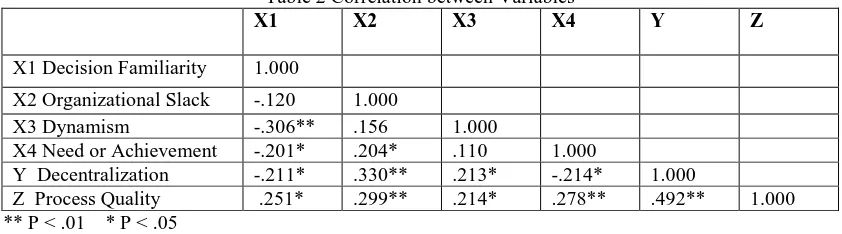
The results of correlation analysis are tabulated in Table 2. The Table indicates that as expected decision familiarity is negatively and significantly correlated with the extent of decentralization in the decision-making process (r = - .211, p - value <. 05). And organizational slack is positively and significantly correlated with the extent of decentralization in the decision-making process (r = .330, p - value < .01).
From the results of Table 2 we can see that environmental dynamism is positively and significantly correlated with the extent of decentralization (r = .213, P < .05) and manager‟s need for achievement is negatively and significantly correlated with the extent of decentralization in the decision-making process (r = - .214, p – value < .05). The table also shows that, decentralization in the decision-making process are positively and significantly correlated with quality of the decision-making process output (r = .492**, p - value < .01).
Table 2 Correlation between Variables
X1 X2 X3 X4 Y Z
X1 Decision Familiarity 1.000
X2 Organizational Slack -.120 1.000
X3 Dynamism -.306** .156 1.000
X4 Need or Achievement -.201* .204* .110 1.000
Y Decentralization -.211* .330** .213* -.214* 1.000
Z Process Quality .251* .299** .214* .278** .492** 1.000
** P < .01 * P < .05
Multiple Regression Analysis
ISSN: 2306-9007 Nooraie (2014) 341
I
www.irmbrjournal.com March 2014I
nternationalR
eview ofM
anagement andB
usinessR
esearchVol. 3 Issue.1
R
M
B
R
importance of the individual factors the multiple regression analysis was applied. Using Hair et al. (1998) recommendations in order to ensure that multiple regression models are generalizable to the population and not only to the sample used in estimations, split half validation was tested, where the sample was randomly split and regression equations estimated and their performance measures (R-square, adjusted R-square, and Standard Error of Estimate) compared. The results of this split sample validation indicated that, there are similarities in performance measures of the sub-samples and the overall sample.
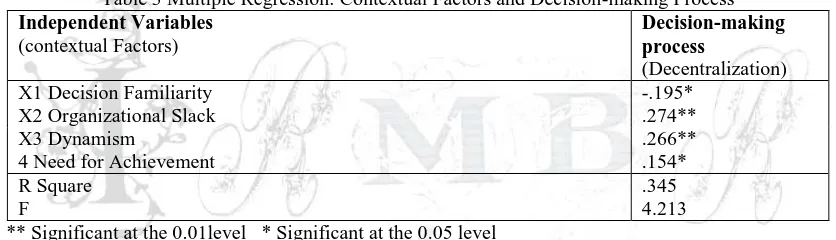
The results of probability plots of residuals indicate that the data points fall more or less along the diagonal line with no substantial deviation from the line. This together with relevant Histogram confirms the normality of the error term. The Scatter plots of standardized residuals versus the predicted values show no random pattern to indicate heteroscedasticity. The results of multi-collinearity test indicate that the values of tolerance and variance inflation factor (VIF) fall within acceptable range (tolerance 0.57 to 0.89 and VIF 1.11 to 1.74) outliers were identified and removed using a case-wise diagnostics and partial regression plot approach. Based on regression analysis that is given in Table 3 the four contextual variables cumulatively were able to explain 35% of the observed variations in the extent of decentralization in the decision-making process. This is very much lower than that achieved by Papadakis et al. (1998) who obtain a 54% explanatory power. The F-value of 4.21 is significantly large to reject the hypothesis of no linear relationship between extents of decentralization in the decision-making process with the contextual variables. An examination of the significance of each of these contextual variables indicates that four variables have significant influence on extent of decentralization of the decision process. In their order of impact, they are: organizational slack, environmental dynamism, decision familiarity and manager need for achievement.
Table 3 Multiple Regression: Contextual Factors and Decision-making Process Independent Variables
(contextual Factors)
Decision-making process
(Decentralization)
X1 Decision Familiarity -.195*
X2 Organizational Slack .274**
X3 Dynamism .266**
4 Need for Achievement .154*
R Square .345
F 4.213
** Significant at the 0.01level * Significant at the 0.05 level
Mediating Effect of Decision Process Characteristics
This article framework posits that the extent of decentralization, in the decision-making process mediate the relationship between the contextual factors and the quality of the decision process output. As tested by Ho et al. (2000) this is examined using a two stage hierarchical regression. According to Baron and Kenny (1986), in order to test mediation effect the following conditions should be satisfied.
First, the independent variable must affect the mediating variable.
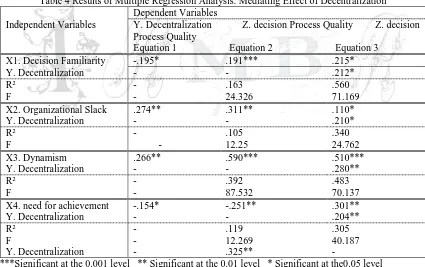
The results of analysis given in Table 4 shows that, factors such as decision familiarity, organizational slack, dynamism, and need for achievement significantly influence the extent of decentralization in the decision-making process.
Second, the independent variable must affect the dependent variable.
ISSN: 2306-9007 Nooraie (2014) 342
I
www.irmbrjournal.com March 2014I
nternationalR
eview ofM
anagement andB
usinessR
esearchVol. 3 Issue.1
R
M
B
R
Third, the mediator must affect the dependent variable.
We can see in Table 4 that decentralization of the decision-making process significantly influences the quality of the decision process output.
In additions to these three conditions establishing mediation requires that, the effect of an independent be less when the mediator is included in regression equation than it is when the mediator is not included (Keller, 2001).
Table 4 indicates that the extent of decentralization in the decision-making process is able to significantly change the amount of variance explained by organizational slack, environmental dynamism, and manager's need for achievement on quality of the decision process output. This is to say that the extent of decentralization of the decision-making is able to explain an additional: 24 % (∆R² = .340- .105 = .235, P < .05) of the variance in quality of the decision process output when functions as a mediator between organizational slack and decision process output, 19 % (∆R² = .483 - .392 = .191, P < .001) of the variance in quality of the decision process output when functions as a mediator between dynamism and decision process output, and 18 % (∆R² = .305 - .119 = .186, P < . 01) of the variance in quality of the decision process output when functions as a mediator between need for achievement and decision process output. In summary the table shows that when mediator is added the values of X2, X3 and X4 are reduced. This indicates that Y partially mediates the influence of organizational slack, dynamism and need for achievement on quality of the decision process output. But do not mediate the influence of decision familiarity on quality of the decision process output.
Table 4 Results of Multiple Regression Analysis: Mediating Effect of Decentralization Dependent Variables
Independent Variables Y. Decentralization Z. decision Process Quality Z. decision
Process Quality
Equation 1 Equation 2 Equation 3
X1. Decision Familiarity -.195* .191*** .215*
Y. Decentralization - - .212*
R² - .163 .560
F - 24.326 71.169
X2. Organizational Slack .274** .311** .110*
Y. Decentralization - - .210*
R² - .105 .340
F - 12.25 24.762
X3. Dynamism .266** .590*** .510***
Y. Decentralization - - .280**
R² - .392 .483
F - 87.532 70.137
X4. need for achievement -.154* -.251** .301**
Y. Decentralization - - .204**
R² - .119 .305
F - 12.269 40.187
Y. Decentralization - .325** -
***Significant at the 0.001 level ** Significant at the 0.01 level * Significant at the0.05 level
Discussion
ISSN: 2306-9007 Nooraie (2014) 343
I
www.irmbrjournal.com March 2014I
nternationalR
eview ofM
anagement andB
usinessR
esearchVol. 3 Issue.1
R
M
B
R
attributed to the fact that large organization has the necessary resources (human, expertise, financial, etc.) to allow for a more thorough and systematic investigation. Furthermore, in large companies managers are paid employee and not owners. As non-owner they act as agents and therefore, need to be accountable to the owners. This constraints their action and decision-making and increases the need to be more decentralized.
Research found that most of the managers who participated in this study have high level of education (Bachelor degree or higher = 85%) and moderate and long working experience in their organization (11 years or more = 53%). This indicates that the majority of managers have high potentials in their managerial position.
Decision Familiarity
As expected, research found that decision familiarity negatively is associated to the extent of decentralization in the decision-making process. That is to say that familiarity with the decision and decision context do not encourage managers to decentralize the decision. This may be due to the fact that the decision to decentralize a decision depends more on the manager than the decision itself. For example leadership or decision-making styles are known to determine whether participation and empowerments be practiced.
Organizational Slack
In literature review It could not find any empirical study relating organizational slack to decentralization in the decision-making process. As expected the results of analysis indicate that organizational slack is positively correlated to the extent of decentralization in the decision-making process; this makes sense as the availability of high level of organizational slack provides opportunities for CEOs to tolerate risks and experimentation for greater innovation. The greater confidence, and propensity to risk, in turn, can lead to greater decentralization in the decision-making process. This would mean that CEOs are more likely to delegate decision authority to more people if the level of slack is likely to be great.
Environmental Dynamism
Contrary to Papadakis et al. Research found positive relationship between environmental dynamism and the extent of decentralization in the decision-making process. I believe that the greater uncertainty, the greater need for information and involvement of others. This leads to more participation of lower level of managers. Further, greater delegation and involvement provides in an environment where the situation is highly dynamic and unpredictable managers tend to be more interested to receive different idea and help. Thus, decentralization of the decision making process may be alternative.
Manager's Need for Achievement
As expected, the results of my analyses indicate that manager‟s need for achievement is negatively associated to the extent of decentralization in the decision-making Process. This is to say that if a manager need for achievement is high he/she is less likely to go through the decentralization of the decision-making process. This is in line with Miller et al. (1988) who suggested that manager‟s need for achievement negatively influence the extent of decentralization in the decision-making process.
ISSN: 2306-9007 Nooraie (2014) 344
I
www.irmbrjournal.com March 2014I
nternationalR
eview ofM
anagement andB
usinessR
esearchVol. 3 Issue.1
R
M
B
R
process itself. Therefore, it has been believed that manager‟s need for achievement is negatively related to nature of the decision-making process.
Quality of the Decision Process Output
Researcher is not aware of any existing empirical study of strategic decision-making that focuses on quality of the decision process output and investigates how well the decision process was carried out. Most of the studies available have studied on one aspect of final decision outcomes namely organizational effectiveness or performance (e.g. Fredrickson & Mitchell, 1984; Eisenhardt, 1989; Priem et al., 1995).
This study found that the extent of decentralization in the decision-making process is positively associated with the quality of the making process output. This is to say that more participation in decision-making process or more delegation of stages of the planning process to lower level managers lead to higher quality of decision process output. Given that decentralization process in the strategic decision-making generate more ideas, more discussions, more evaluations, and more information more focus will be given to possible choices and better selection. Greater participation will also lead to greater discussion of ideas and the greater the chance of achieving better quality decision. Furthermore, greater delegation and participation will create greater awareness of the basis for the decision; thus providing greater chance of the decision to be implemented successfully.
Intervening Effects
Nelson (1990) in his interactional model of individual adjustment suggested that, organizational factors, work group factors, job characteristics, and individual‟s characteristics shape the manager‟s adjustment outcomes. Given that organization is an open system, managers are continuously affected by its external environmental factors. Thus, in addition to organizational and individual factors external environmental factors indirectly affect the manager‟s attitude and adjustment.
Since managers are different in terms of individual variables (e.g. cognitive, affect, motivations, and skills) and situations vary in terms of controllable and non-controllable factors the ways in which managers adjust or direct themselves to approach a particular decision-making process will not be identical.
Based on interactional psychology, contextual variables such as internal organizational characteristics, decision specific characteristics along with individual and group (top management team) characteristics are the major direct influence on manager‟s adjustment to choose a particular strategic decision-making process, while external environmental characteristics emerge an indirect effect on manager‟s choice. On the other hand, these contextual factors influence the quality of the decision process output indirectly through a decision-making process.
Based on the above discussions I believe that decision process functions as a mediator between contextual factors and decision process quality. This is why a manager with sensing thinking (ST) style of decision-making is more likely to choose a rational process than a manager with sensing feeling (SF) style that prefer a decentralized process.
I found that extent of decentralization in the decision-making process mediates the impact of organizational slack, dynamism and need for achievement on decision process quality. This is to say that the organizational slack does not directly lead to a better quality decision; it does so by encouraging managers to use more decentralized process in their decision-making, similarly with environmental dynamism and manager's need for achievement.
ISSN: 2306-9007 Nooraie (2014) 345
I
www.irmbrjournal.com March 2014I
nternationalR
eview ofM
anagement andB
usinessR
esearchVol. 3 Issue.1
R
M
B
R
process quality by factors (e.g. slack, dynamism and need for achievement). This would mean that the quality of the decision process output is more likely to be improved if the decision process used by the managers is more likely to be decentralized. In fact more participation leads to more discussions and better selection. This is in line with studies that indicate that centralization of power increases the use of politicization in the decision-making process and in turn, politicization process reduces the decision effectiveness (Eisenhardt & Bourgeouse, 1988; Dean & Sharfman, 1996).
Theoretical Implications
A notable implication of this study indicates that the decision process is determined by multiple contextual influences rather than a single dimension. This would mean that the type of process used in making a strategic decision mostly depends upon decision specific characteristics, organizational characteristics, environmental characteristics, and top management characteristics. This provides evidence to support systems theory that emphasizes consideration of all subsystems in managerial decision-making.
Since different organizations, with different managers, in different environments, and different problems may require different decisions, none of the strategic decision processes (decentralization) can be graded the best for all circumstances. This provides evidence to support contingency theory that recognizes the possibility of different optional decision process for different situations.
Practical Implications
Based on the results of this study a good quality decision is achieved through a decentralized process. Thus, an organization should encourage greater use of decentralized process in the decision-making. Especially if external environment is dynamism and organization has adequate slack. In sum, to the extent that a decentralized process in strategic decision-making can be encouraged, CEOs may be able to improve the quality of the decision process output.
In order to see the overall contribution of this study on the whole body of the knowledge in strategic decision-making I may highlight the following issues as the major contribution of the study:
Beyond the contradictory views on the relationship between decision‟s familiarity, environmental dynamism and manager‟s need for achievement and the extent of decentralization in the decision-making process in literature, this study confirms that organizational slack, environmental dynamism and manager's need for achievement are significantly associated with the extent of decentralization in decision-making process.
Availability of the organization slack can provide confidence and encourage managers to utilize a more decentralized process in their decision-making process.
The quality of decision-making process output is significantly improved if managers use a more decentralized process in their strategic decision-making.
Limitations of the Research
The data was collected based on perceived, self-judgment multi-choice questionnaire. This approach is adequate to gather a large amount of data within a limited time. It would have been desirable to develop a longitudinal study, interviewing all decision-team members and reviewing available documentation. Such effort would have added substantial credibility to the results, but it was entirely beyond the scope and possibilities of this study.
Suggestions for Future Research
ISSN: 2306-9007 Nooraie (2014) 346
I
www.irmbrjournal.com March 2014I
nternationalR
eview ofM
anagement andB
usinessR
esearchVol. 3 Issue.1
R
M
B
R
References
Achrol, R.S. and Stern, L.W. (1988). Environmental Determinants of decision-making uncertainty in
marketing channels. Journal of Marketing Research. 25, 36-50.
Amason, A.C. (1996). Distinguishing the effects of functional and dysfunctional conflict on strategic decision making: resolving a paradox for top management teams. Academy of Management Journal. 39, 123-148.
Astley, W.G., Axelsson, R., Butler, R.J., Hickson, D.J., and Wilson, D.C. (1982). Complexity and cleavage: dual explanations of strategic decision-making. Journal of Management Studies. 19, 357-375.
Baron, R. M. & Kenny, D. A. (1986). The moderator-mediator variable distinction in social psychological research: conceptual, strategic, and statistical considerations. Journal of Personality and Social Psychology. 51, 1137-1182.
Beach, L.R. & Mitchell, T.R. (1978). A Contingency model for the selection of decision strategies.
Academy of Management Review, 3, 439-449.
Bourgeois, L.J. III. (1985). Strategic goals, perceived uncertainty, and economic performance in volatile
environments. Academy of Management Journal. 28, 548-573.
Bose ,(2013), available at http;//WWW.buzzle.com
Brown, R.V., Kahr, A.S., & Peferson, C. (1974). Decision Analysis and Overview. U.S.A., New York: Holt, Rinehart and Winston.
Carlisle, H.M. (1979). Management Essentials Concepts and Applications. U.S.A: Science research
Associate Inc.
Colignon, R & Cray, D. (1980), Critical organizations. Organization Studies, 1, 349-366.
Dess, G.G. & Beard,. D.W (1984). Dimensions of organizational task environment. Administrative science
quarterly, 29,52,73.
Dean, J.W. Jr. & Sharfman, M.P. (1996). Does decision process matter ? A study of strategic decision
making effectiveness. Academy of Management Journal. 39, 368-396.
Eisenhardt, K.M. (1989). Making fast strategic decision in high-velocity environments. Academy of
Management Journal. 32, 543-576.
Eisenhardt, K.M. & Zbaracki, M.J. (1992). Strategic Decision-making. Strategic Management Journal. 13,
17-37
Eisenhardt, K.M. & Bourgeois, L.J. III. (1988). Politics of strategic decision-making in high velocity
environments: toward a midrange theory. Academy of Management Journal. 31, 737-770
Elbanna, S. and Child, J. (2007) „The influence of decision, environmental and firm characteristics on
rationality of strategic decision-making‟, Journal of Management Studies, Vol. 44, No. 4, pp.562–913.
Fahey, L. & Narayanan, V.K. (1986). Macroenvironmental Analysis for Strategic Management. St Paul, Minn: West.
Fredrickson, J.W. (1984). The comprehensiveness of strategic decision processes: extensions, observations,
future directions. Academy of Management Journal. 27, 445-466.
Fredrickson, J.W. & Mitchell, T.R. (1984). Strategic decision processes: comprehensiveness and
performance in an industry with an unstable environment. Academy of Management Journal. 27,
399-423.
Fredrickson, J.W. & Iaquinto, A.L. (1989). Inertia and creeping rationality in strategic decision processes.
Academy of Management Journal. 32, 543-576.
Gamble, J.E. and Thompson, A.A. (2009 Essentials of Strategic Management, McGraw-Hill.
Grant, R.M. (2003) „Strategic planning in a turbulent environment: evidence from the oil majors‟,
Strategic Management Journal, Vol. 24, pp.491–517.
Grinyer, P., Bazzaz, S. & Ardekani, M.Y. (1986). Towards a contingency theory of corporate planning:
finding in 48 U.K. companies. Strategic Management Journal. 7, 3-28.
ISSN: 2306-9007 Nooraie (2014) 347
I
www.irmbrjournal.com March 2014I
nternationalR
eview ofM
anagement andB
usinessR
esearchVol. 3 Issue.1
R
M
B
R
Harrison, E.F. (1999). The Managerial Decision-making Process, 5th ed. Boston: Houghton Mifflin
Company.
Hammond, J.S., Keeney, R.L. & Raiffa, H. (1998). The hidden traps in decision making. Harvard Business
Review, Boston. 76, 47-65.
Ho, C.K., Duffy, V. G., and Shih, H.M. (2000). Total quality management: an empirical test for mediation effect. International Journal of Production Research. 3, 529-548
Keller, R.T. (2001). Cross-functional project groups in research and new product development: diversity,
communications, job stress, and outcomes. Academy of Management Journal. 44, 547-555.
Kriger, M.P. & Barnes, L.B. (1992). Organizational decision-making as hierarchical levels of drama.
Journal of Management Studies. 29, 438-457.
Lyles, M.A. & Mitroff, J.I. (1980). Organizational problem formulation : An Empirical Study,
Administrative Science Quarterly, 25, 102-119.
Miller, D. & Friesen, P.H. (1983). Strategy Making and Environment: The Third Link. Strategic
Management Journal, 4, 221-235.
Miller, D., Droge, C., & Toulouse, J.M. (1988). Strategic process and content as mediators between
organizational context and structure. Academy of Management Journal. 31, 544-569.
Nelson, D.L (1990). Individual adjustment to information-driven technology: critical review. Management Information System: Quarterly. March, 80-98.
Schilit, W.K. & Paine, F.T. (1987). An examination of the underlying dynamics of strategic decisions
subject to upward influence activity. Journal of Management Studies. 24, 161-175.
Simon, H.A (1965). How to make a business decision. In Archer, E.R. (1980). How to make a business
decision. Management review. Feb. 54-61.
Steiner, I.D. (1972). Group processes and productivity. New York : Academic Press.
Papadakis, V.M., Lioukas, S. & Chambers, D. (1998). Strategic decision-making processes: the role of
management and context. Strategic Management Journal. 19, 115-147.
Pearce, J.A.II. & Robinson, R.B. Jr. (1989). Management. N.Y: Random House inc.
Phatak, (2012), available at http;//WWW.buzzle.com Pilgrim, G. (2010) Available at http://www.buzzel.com.
Priem, R.L., Rasheed, A.M.A. & Kotulic, A.G. (1995). Rationality in strategic decision processes,
environmental dynamism and firm performance. Journal of Management. 21, 913-929.
Rajagopolan, N., Rasheed, A.M.A.& Datta, D.K. (1993). Strategic Decision Processes: Critical Review and
Future Directions. Journal of Management. 2, 349-384.
Rue, L. & Bayrs, L. (1986). Management Theory and Application, 4th ed. Homewood, Illinois: Irwin. Sharfman, M.P. & Dean, J.W. Jr. (1997). Flexibility in strategic decision making: informational and
ideological perspectives. Journal of Management Studies. 34, 190-215.
Steers, R. & Braunstein, D. (1976). A behaviorally based measure of manifest needs in work settings.
Journal of Vocational Behavior, 9, 251-266
Thompson, A. and Strickland, A.J. (2003) Strategic management Concept and cases McGraw-Hill Inc.,