Satya Prakash Dhal et al, International Journal of Computer Science and Mobile Applications, National Conference on “The Things Services and Applications of Internet of Things”, Gandhi Institute for Education and Technology (GIET) Baniatangi, 23-24 March 2018, pg. 85-104
ISSN: 2321-8363 Impact Factor: 5.515
IOT: Making Things Better
Satya Prakash Dhal
1, Premanand Chowdhury
2, Subham Ku. Shaw
31
Dept. Of Computer Science & Engineering, E-mail address: [email protected] 2
Dept. Of Computer Science & Engineering, E-mail address: [email protected] 3
Dept. Of Computer Science & Engineering, E-mail address: [email protected]
ABSTRACT
The greatest transformation actually still lies ahead of us. Several new technologies are now converging in a way that means the Internet is on the brink of a substantial expansion as objects large and small get connected and assume their own web identity. Following on from the Internet of computers, when our servers and personal computers were connected to a global network, and the Internet of mobile telephones, when it was the turn of telephones and other mobile units, the next phase of development is the Internet of things, when more or less anything will be connected and managed in the virtual world. This revolution will be the Net‟s largest enlargement ever and will have sweeping effects on every industry and all of our everyday lives
.
The Internet Of Things is changing much about the world we live in from the way we drive and how we make purchases, and even how we get the energy for our homes. Sophisticated sensors and chips are embedded in the physical things that are surround us each transmitting some valuable data, data that‟s lets us better understand and how this thing work and work together. But how exactly these devices share such large quantities of data and how do we put that information to work. Whether we are improving the production of a factory, giving city resident real time update somewhere to park or monitoring our personal health. It‟s common Internet of Things platform that gives diverse information together and provides the common language for the devices and the apps to communicate with each other. The process starts with the devices themselves that securely communicates with the Internet Of Things platform. This platform integrates the data from many devices and applies analytics to share the most valuable data with applications that address industry facility specific needs.Keywords: Internet Of Things, Smart Homes; Home Automation; IoT-Architecture, Future Technology; Smart Transportation; Smart Healthcare; Smart Cities, Smart Energy Resources
1. INTRODUCTION
We are now at the doors of the world, where computing technology is heading towards the reimagination of today‟s working efficiency in far smarter and better way with the goal of living our day-to-day lives with all the objects working with their own intelligence. And to fulfil the idea, the concept of IoT comes into the picture.
IoT (Internet of Things) is currently an ongoing advanced concept of ICT (Information Communication Technology), which means all devices and services are collaborating to reduce human intervention and efforts for better human life. IoT is the network of physical objects—devices, vehicles, buildings and other items embedded with electronics, software, sensors, and network connectivity—that enables these objects to collect and exchange data.
Nowadays internet has an impact on education, communication, business, science, technology, government and humanity. And we also know that internet is one of the most important and powerful creations of the human history and the concept of IoT, internet becomes more favourable to have a smart life in every aspect.
Satya Prakash Dhal et al, International Journal of Computer Science and Mobile Applications, National Conference on “The Things Services and Applications of Internet of Things”, Gandhi Institute for Education and Technology (GIET) Baniatangi, 23-24 March 2018, pg. 85-104
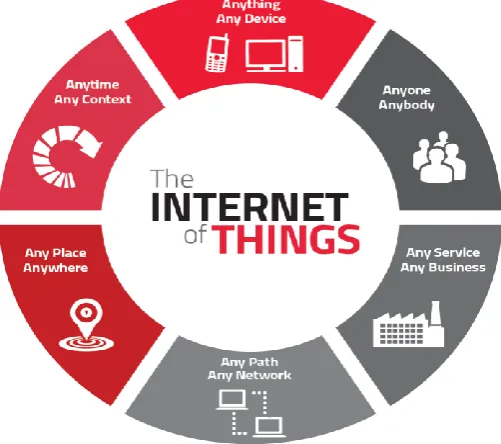
ISSN: 2321-8363 Impact Factor: 5.515 etc. They can judge by themselves what to do and what not to. These objects can also learn, exchange and access the data from other devices connected to internet and make themselves more efficient. Figure 1 shows us how with the help of IoT; anything can access the internet at any time from any place to provide any service by any network to anyone. This concept will play a drastic role in giving ideas for creating new software applications which will involve smart security, smart vehicles, smart homes, surveillance, energy saving, automation, communication, computers and entertainment. These software applications will also give notifications of all these services.
Figure 1: Concept of IoT
These days technologies related to IoT are in research and development phase also known as R&D Departments of various national and multinational companies including the core companies which are continuously testing and deploying their products with a vision of implementing smart environments by the year 2020. The near future communication and storage services will be highly pervasive and distributed: people, machines, smart objects, surrounding space and platforms connected with wired /wireless sensors, M2M devices, RFID tags will create highly decentralised resources interconnected by dynamic network of networks.
Here, the language of communication will be based on interoperable protocols operating in heterogenous environments. In this context IoT is a generic term where all the objects can play an active role with their connection on the internet while completely redefining the use of internet.
The aim of this paper is to present, how IoT (Internet of Things) is making things better and interactive in our daily lives, how proper utilisation of todays technology can give a boost towards the applications of IoT for a smarter future where technologies will be more advanced, obstacles in the field of IoT and the rest of the paper is structured as follows:
Section 2provides the concept of IoT norms and rules.
Section 3elaborates the applications of IoT.
Section 4will provide information of future technologies related to IoT and its review.
Satya Prakash Dhal et al, International Journal of Computer Science and Mobile Applications, National Conference on “The Things Services and Applications of Internet of Things”, Gandhi Institute for Education and Technology (GIET) Baniatangi, 23-24 March 2018, pg. 85-104
ISSN: 2321-8363 Impact Factor: 5.515
2. INTERNET OF THINGS NORMS AND PROTOCOLS
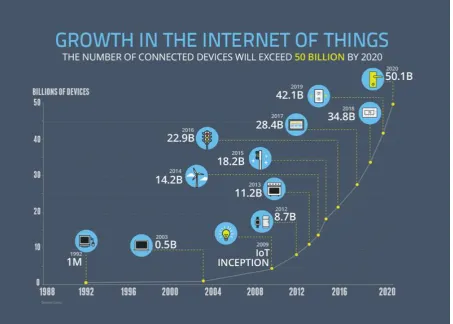
By 2020 there will be 50 billion objects connected to the internet. Also estimated by the US census bureau that there will be 7.6 billion people alive at that time. This says that for every person there will be 6.6 objects connected to the internet, we are talking about a world blanketed with billions of sensors, these sensors are taking information from real physical objects that are in the world where your environment transforms as you walk through because technology that you may not even be aware of is monitoring your every move. It‟s a world that constantly changing all around us due to these sensors and the internet and we call it internet of things. Figure 2 shows the growth of the things connected to the internet from 1988 to forecast 2020. The Internet of Things (IoT) will provide a technology to creating the means of smart action for machines to communicate with one another and with many different types of information [1]. The success of IoT depends on standardization, which provides interoperability, compatibility, reliability, and effective operations on a global scale [2]. Today more than 60 companies for leading technology, in communications and energy, working with standards, such as IETF, IEEE and ITU to specify new IP based technologies for the Internet of Things [3].
Satya Prakash Dhal et al, International Journal of Computer Science and Mobile Applications, National Conference on “The Things Services and Applications of Internet of Things”, Gandhi Institute for Education and Technology (GIET) Baniatangi, 23-24 March 2018, pg. 85-104
ISSN: 2321-8363 Impact Factor: 5.515 For the efficient use of energy and network capacity, and as well as respecting other constraints such as frequency bands and power levels for radio frequency communications the design of the IoT standards is required.
It may be necessary to review such constraints and investigate ways to ensure sufficient capacity for expansion, for example in case of additional radio spectrum allocation as it becomes available as IoT evolves.
IEEE Standards Association (IEEE-SA) develops a number of standards that are related to environment need for an IoT. The main focus of the IEEE standardization activities is on the Physical and MAC layers [4]. The IEEE provides an early foundation for the IoT with the IEEE802.15.4 standard for short range low power radios, typically operating in the industrial, scientific and medical band in addition to use ZigBee technology [5]. The IEEE-SA has an over 900 active standards and more than 500 standards under development. In its research into IoT, it has identified over 140 existing standards and projects that are relevant to the IoT. The base project related to IoT is IEEE P2413 which it is currently considering the architecture of IoT [6,7].
ETSI produces globally applicable standards for information and communications technologies (ICT), including fixed, mobile, radio, converged, broadcast and Internet technologies, discusses a similar concept under the label of “machine to machine (M2M) communication. These standards are considered as one of the basic standards of IoT, because its associate with M2M technology which is one of the basic techniques related to IoT [8,9].
Internet Engineering Task Force (IETF) is concerned with the evolution of the Internet architecture and the smooth operation of the Internet and known as large, open to international community of network designers, operators, vendors and researchers [10]. IETF provides its own description of IoT which provides a most recognizable enhancement to support IPv6, with the 6LoWPAN [11-13]. The 6TiSCH Working Group is being formed at the IETF to address the networking piece of that unifying standard. Based on open standards, 6TiSCH will provide a complete suite protocols for distributed and centralized routing operation over the IEEE802.15.4e TSCH MAC[14]. ITU's Telecommunication Standardization Sector (ITUT) considered as a first organization of standards development and coordination of the Internet of Things. They buts standards to gain benefit of integrated information processing capacity, and industrial products with smart capabilities [15,16]. In addition to make development on electronic identities that can be queried remotely or be equipped with sensors for detecting physical changes around them.
3. INTERNET OF THINGS AND ITS APPLICATIONS
Internet of Things is the evolution of mobile, home & embedded system connected to the internet enabling greater compute capabilities.
(a) Connected devices become an intelligent system of systems. (b) Intelligent system of systems can share date & analyse it.
(c) Transforms our business, our lives and our world in countless ways. (d) Improve medical outcomes.
(e) Creating better products faster with lower developing costs. (f) Making shopping more enjoyable.
(g) Optimizing energy consumption & generation.
A. SMART CITIES
Satya Prakash Dhal et al, International Journal of Computer Science and Mobile Applications, National Conference on “The Things Services and Applications of Internet of Things”, Gandhi Institute for Education and Technology (GIET) Baniatangi, 23-24 March 2018, pg. 85-104
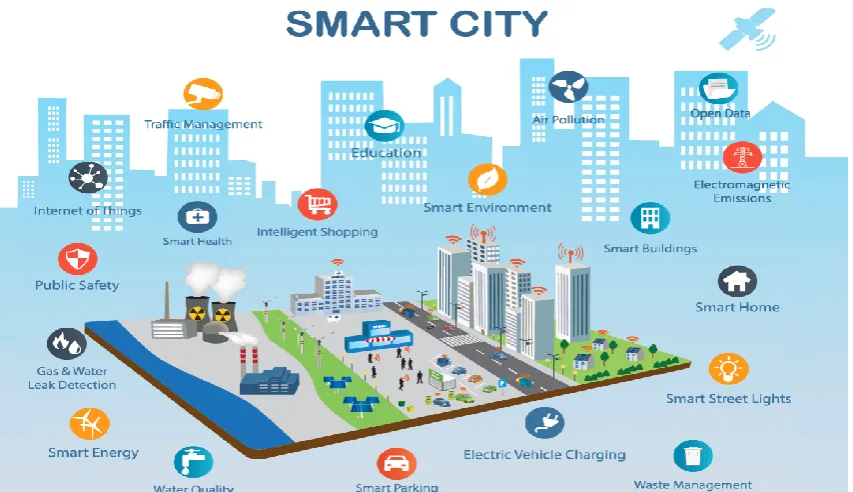
ISSN: 2321-8363 Impact Factor: 5.515 connection all systems in the cities like transportation system, healthcare system, weather monitoring systems and etc., in addition to support people by the internet in every place to accessing the database of airports, railways, transportation tracking operating under specified protocols, cities will become smarter by means of the internet of things [19,20].
Figure 3. Smart Cities Aspects
B. SMART HOME AND BUILDINGS
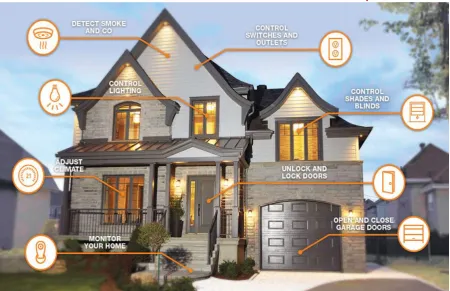
Wi-Fi‟s technologies in home automation has been used primarily due to the networked nature of deployed electronics where electronic devices such as TVs, mobile devices, etc are usually supported by Wi-Fi [21]
Satya Prakash Dhal et al, International Journal of Computer Science and Mobile Applications, National Conference on “The Things Services and Applications of Internet of Things”, Gandhi Institute for Education and Technology (GIET) Baniatangi, 23-24 March 2018, pg. 85-104
ISSN: 2321-8363 Impact Factor: 5.515
Figure 4. Smart Home & building applications
Wireless sensor networks (WSNs) with integration to the internet of things technology will provides an intelligent energy management in buildings, in addition to the obvious economic and environmental gains. Internet together with energy management systems also offers an opportunity to access a buildings‟ energy information and control systems from a laptop or a smartphone placed anywhere in the world [25]. The future Internet of Things, will provide an intelligent building management system which can be considered as a part of a much larger information system used by facilities managers in buildings to manage energy use and energy procurement and to maintain buildings system [26,27].
C. SMART ENERGY AND THE SMART GRID
Satya Prakash Dhal et al, International Journal of Computer Science and Mobile Applications, National Conference on “The Things Services and Applications of Internet of Things”, Gandhi Institute for Education and Technology (GIET) Baniatangi, 23-24 March 2018, pg. 85-104
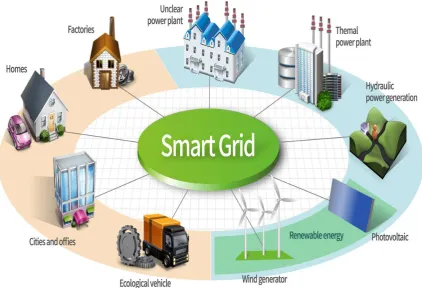
ISSN: 2321-8363 Impact Factor: 5.515 internet of things for smart grids, such as industrial, solar power, nuclear power, vehicles, hospitals and cities power control. Figure 5 shows the most important application may be enabled by the internet of things as in smart grid aspect.
Figure 5. Smart grid applications
Today‟s grid is very reliable and can deal with normal electricity fluctuations and it will take a step further towards using a low carbon energy system, by allowing integration between the renewable energy and green technologies and offering many benefits to customer in cost savings through efficient energy use at home [30]
.
D. SMART HEALTH
Satya Prakash Dhal et al, International Journal of Computer Science and Mobile Applications, National Conference on “The Things Services and Applications of Internet of Things”, Gandhi Institute for Education and Technology (GIET) Baniatangi, 23-24 March 2018, pg. 85-104
ISSN: 2321-8363 Impact Factor: 5.515 the patient‟s vital signs, instead providing a continuous automated flow of information. In this way, it simultaneously improves the quality of care through constant attention and lowers the cost of care by reduces the cost of traditional ways of care in addition to data collection and analysis [32].
Figure 6. Smart healthcare concept
Many peoples around the worlds are suffering from the bad health because they don‟t have ready access to effective health monitoring and may be a suspected to be as critical situation patients. But with small, powerful wireless solutions connected through the IoT are now making possible for monitoring to come to these patients. These solutions can be used to securely capture patient health data from a variety of sensors, apply complex algorithms to analyse the data and then share it through wireless connectivity with medical professionals who can make appropriate health recommendations[33].
Satya Prakash Dhal et al, International Journal of Computer Science and Mobile Applications, National Conference on “The Things Services and Applications of Internet of Things”, Gandhi Institute for Education and Technology (GIET) Baniatangi, 23-24 March 2018, pg. 85-104
ISSN: 2321-8363 Impact Factor: 5.515 E. SMART TRANSPORTATION AND MOBILITY
The development in transportation is one of the factors to indicate the wellbeing of the country. A road condition monitoring and alert application is one of the most important of IoT transformation
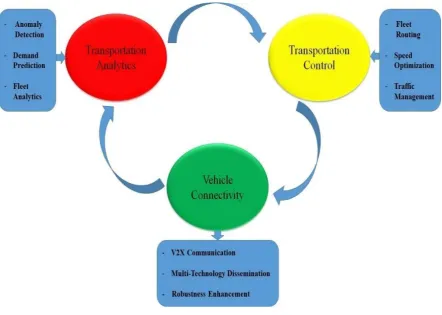
application [34]. The main idea of the concept of smart transportation and mobility is to apply the principles of crowd sourcing and participatory sensing. The process began with user identified the route wishes and marked some points as pothole in the smart phone's application [35]. The smart transportation is deal with three main conceptions as shown in Figure 7, they are transportation analytic, transportation control, and vehicle connectivity. The transportation analytic represents the analysis of demand prediction and anomaly detection. The routing of vehicles and speed control in addition to traffic management are all known as transportation control which they actually tightly related to the way of the vehicles connectivity (V2X communication), and overall governed by multi-technology dissemination.
Figure 7. Smart Transportation Aspects
Satya Prakash Dhal et al, International Journal of Computer Science and Mobile Applications, National Conference on “The Things Services and Applications of Internet of Things”, Gandhi Institute for Education and Technology (GIET) Baniatangi, 23-24 March 2018, pg. 85-104
ISSN: 2321-8363 Impact Factor: 5.515 performance test of the Li-on battery, remote monitoring with on-line debugging and error correction that could significantly reduce the maintenance cost [36].
F. SMART FACTORY AND SMART MANUFACTURING
Smart factory added new values in manufacturing revolution by integrates artificial intelligence, machine learning, and automation of knowledge work and M2M communication with the manufacturing process [37]. The smart factory will fundamentally change how products are invented, manufactured and shipped. At the same time, it will improve worker safety and protect the environment by enabling low emissions and low incident manufacturing. These advances in the way machines and other objects communicate and the resulting way in which decision-making moves from humans to technical systems means that manufacturing becomes “smarter” [37]
. New technologies such; Automation, robotics, and autonomous mobility are all provides a means of smart manufacturing but M2M communications enabled by the “industrial” internet of things will provide a full meaning of smart factory and smart manufacturing by the way of Big Data concept which in this context, refers to the analytical possibilities offered by the volume and variety of data that is generated by a networked economy to optimize the industrial processes to implying less maintenance downtime, fewer outages and much reduced energy consumption [38].
Industries and manufacturing revolution became one of the most developed technologies nowadays, the growth of the industry evolution taken many generations. The first generation related to the mechanical machines in addition to water and stream power. The second industry generation deal with mass production, assembly lines and electricity. In the end of the last century, industries operated under control of computers and automation which recognized as third generation of industries.
Satya Prakash Dhal et al, International Journal of Computer Science and Mobile Applications, National Conference on “The Things Services and Applications of Internet of Things”, Gandhi Institute for Education and Technology (GIET) Baniatangi, 23-24 March 2018, pg. 85-104
ISSN: 2321-8363 Impact Factor: 5.515
Figure 8. Smart Factory (Industry 4)
G. SMART ENVIRONMENT
Satya Prakash Dhal et al, International Journal of Computer Science and Mobile Applications, National Conference on “The Things Services and Applications of Internet of Things”, Gandhi Institute for Education and Technology (GIET) Baniatangi, 23-24 March 2018, pg. 85-104
ISSN: 2321-8363 Impact Factor: 5.515
Environment plays a major effect in human life. People, even animals, birds, fishes and plants may be affected in unhealthy environment. There were many researches efforts has been paid to solve the problems of environmental pollution and waste resources. Creating of a healthy environment is not easy because of industries and transportations wastes, with irresponsible human activities are daily factors that make the environment damaged.
The environment needs a smart ways and new technologies for monitoring and management. Monitoring the environment is important in order to assess the current condition of the environment to takes correct life decision according to collected data from monitoring systems, and management is needed to have an efficient resource consuming and use in addition to decrease the factories and vehicles wastes. Both monitoring and waste management provide a large amount of data to force the health standard by governments or healthy environment organizations to protect people and environment, and to mitigate or to avoid natural disaster that might occur.
Smart environment is an important technology in our everyday life which provides many facilities and solutions for many environmental applications such as water and air pollution, weather and radiation monitoring, waste management, natural disaster, and many other environment indicators as shown in Figure 9 and all may connect to each person through home area network. Smart environment devices integration with Internet of Things (IoT) technology is developed for tracking, sensing and monitoring objects of environment which provide potential benefits to achieve a green world and sustainable life [39].
There are many applications of internet of things in environment and that can be divided to two main categories environmental resources management, and environmental quality and protection management [40]. The resources management relates to all-natural resources include animals, plants and forests, birds and fishes, coal, petroleum, land, freshwater, air and heavy metals including gold, copper and iron. All these resources are likely to decrease significantly or affected by several factors, including pollution, waste, and abuse. IoT can provides an effective way to communicate between each of these resources sensors with research and monitoring centres to make appropriate decisions in the consumption of these sources. Renewable resources include sunlight, and wind also can be managed and sensed to Ideal use in several uses, such as the provision of renewable energy sources. IoT can control these sources and their use in a number of important applications in the environment [41].
The IoT technology is able to monitoring and managing the air quality by to collecting data from remote sensor across the city and providing full-time geographic coverage to achieve a way of better managing urban traffic in major cities [42]. The IoT also can be used to measure the levels of pollution in water in order to inform decisions on water usage and treatment. Waste management is also one of the most important environment issues [43]. The various types of waste material chemical or elements can pollute the environment and threaten life in a number of ways in ground effect on animals, peoples and plants and in addition to air and water. IoT provides an environmental protection means by control the industrial pollution by real time monitoring and management systems integrated to supervision and decision-making networks to reduce waste, and improved environment [44].
Other environment aspect is a weather forecast and monitoring. IoT can provide a high resolution, and accuracy for weather monitoring by data exchange and information sharing. It‟s enabling weather systems to collect data from various vehicles on the road, and wirelessly communicate to the weather stations to support data that is inclusive of air temperature, barometric pressure, visibility or light, motion and other data needed. Sensors equipped in many buildings, vehicles integration with IoT help in collecting weather data which is further stored in clouds for analysis [45].
Satya Prakash Dhal et al, International Journal of Computer Science and Mobile Applications, National Conference on “The Things Services and Applications of Internet of Things”, Gandhi Institute for Education and Technology (GIET) Baniatangi, 23-24 March 2018, pg. 85-104
ISSN: 2321-8363 Impact Factor: 5.515 network is able to continuous monitoring of radiation levels around nuclear facilities for leakage detection and propagation prevention [47]. The sensors network formed by wireless link dozens of sensor devices in areas surroundings nuclear power plants with closes proximity to cities [48].
A natural disaster is a major adverse event resulting from natural processes of the earth include floods, volcanic eruptions, earthquakes, hurricanes, wildfires, blizzards and, and other geologic processes. IoT can avoid or reduce the impact of a large number of natural disasters that affect in many aspects of life through the distribution of a number of sensor systems for many types of natural disasters and linking these systems with research and rescue announcement stations, also for declaration of emergency networking with hospitals and police stations [49].
IoT will provides a means of smart agriculture and adding great potential in resource saving. By using sensors networks, and scientific research databases, growing of plants and other agriculture productions needed by humans like vegetables and fruits can monitored and save their production processes based on managing many resources such as weather, water and sunlight. In addition, the IoT for environmental monitoring can aid in measuring emissions from factories detect forest fires or aid in agriculture [50].
4. INTERNET OF THINGS AND RELATED FUTURE TECHNOLOGIES
Many new technologies are related to IoT to prove the integration of wired as well as wireless control, communication and IT technologies together which are responsible for connecting several subsystems and things which operate under a unified platform controlled and managed smartly.
A. CLOUD COMPUTING
The two worlds of Cloud and IoT have seen a rapid and independent evolution. These worlds are very different from each other, but their characteristics are often complementary in general, in which IoT can benefit from the virtually unlimited capabilities and resources of cloud to compensate its technological constraints for example storage, processing, and communication [51]. Cloud can offer an effective solution for IoT service management and composition as well as for implementing applications and services that exploit the things or the data produced by them. On the other hand, cloud can benefit from IoT by extending its scope to deal with real world things in a more distributed and dynamic manner, and for delivering new services in a large number of real life scenarios. In many cases, Cloud can provide the intermediate layer between the things and the applications, hiding all the complexity and functionalities necessary to implement the latter. This will impact future application development, where information gathering, processing, and transmission will generate new challenges, especially in a multi cloud environment or in fog cloud [52]. Cloud facilitates for IoT application to enabling data collection and data processing, in addition to rapid setup and integration of new things, while maintaining low costs for deployment and for complex data processing [53]. Cloud is the most convenient and cost-effective solution to deal with data produced by IoT and, in this respect, it generates new opportunities for data aggregation, integration, and sharing with third parties. Once into Cloud, data can be treated as homogeneous through well-defined APIs, can be protected by applying top level security, and can be directly accessed and visualized from any place [54].
B. BIG DATA
Satya Prakash Dhal et al, International Journal of Computer Science and Mobile Applications, National Conference on “The Things Services and Applications of Internet of Things”, Gandhi Institute for Education and Technology (GIET) Baniatangi, 23-24 March 2018, pg. 85-104
ISSN: 2321-8363 Impact Factor: 5.515 50 billion devices will generate large volumes of data from many applications and services in a variety of areas such as smart grids, smart homes, healthcare, automotive, transport, logistics and environmental monitoring. The related technologies and solutions that enable integration of real world data and services into the current information networking technologies are often described under the term of the Internet of Things (IoT) [56].
The volume of data on the Internet and the Web is still growing, and everyday around 2.5 quintillion bytes of data is created and it is estimated that 90% of the data today was generated in the past two years. Collected data from sensors related to different events and occurrences can be analysed and turned into real information to give us better understanding about our physical world and to create more value-added products and services. Such these sensory data like data of predicted and balanced power consumption in smart grids, analysed data of pollution, weather and congestion, sensory data recorded to provide better traffic control and management, and monitoring and processing health signals data that collected by sensory devices to provide better healthcare services [57]. In addition, the information available from social media such as Facebook, tweeter, WhatsApp and user submitted physical world observations and measurements also provide a huge amount of data (Big Data) [58]. Integration of data from various physical, cyber, and social resources with the IoT enables developing applications and services that can incorporate situation and context awareness into the decision-making mechanisms and can create smarter applications and enhanced services. With large volumes of distributed and heterogeneous IoT data, issues related to interoperability, automation, and data analytics will require common description and data representation frameworks in addition to machine readable and interpretable data descriptions [59].
C. SECURITY AND PRIVACY
Due the fact that IoT applications able to access the multiple administrative domains and involve to multiple ownership regimes, there is a need for a trust framework to enable the users of the system to have confidence that the information and services being exchanged can indeed be relied upon [60]. The trust framework needs to be able to deal with humans and machines as users, for it needs to convey trust to humans and needs to be robust enough to be used by machines without denial of service. The development of trust frameworks that address this requirement will require advances in areas such as lightweight public key infrastructures (PKI) as a basis for trust management [61]. Lightweight key management systems are used to enable trust encryption materials using minimum communications and processing resources, as is consistent with the resource constrained nature of many IoT devices [62].
IoT based systems require a quality of information for metadata which can be used to provide an assessment of their liability of IoT data. A novel method is required for IoT based systems for assessing trust in people, devices and data. One of the most methods used are trust negotiation that allows two parties to automatically negotiate, on the basis of a chain of trust policies, the minimum level of trust required to grant access to a service or to a piece of information. Internet of things uses a method for access control to prevent untrusted data breaches by control the process of ensuring the correct usage of certain information according to a predefined policy after the access to information is granted [63].
Satya Prakash Dhal et al, International Journal of Computer Science and Mobile Applications, National Conference on “The Things Services and Applications of Internet of Things”, Gandhi Institute for Education and Technology (GIET) Baniatangi, 23-24 March 2018, pg. 85-104
ISSN: 2321-8363 Impact Factor: 5.515 The IoT requires a variety of access control and associated accounting schemes to support the various authorization and usage models that are required by users. The heterogeneity and diversity of the devices/gateways that require access control will require new lightweight schemes to be developed [65]. The IoT needs to handle virtually all modes of operation by itself without relying on human control. New techniques and approaches for example like machine learning, are required to lead to a self-managed IoT. Cryptographic techniques are also very important in IoT based systems for enable a means of protection for data to be stored processed and shared, without the information content being accessible to other parties. Technologies such as homomorphic and searchable encryption are potential candidates for developing such approaches [66].
D. DISTRIBUTED COMPUTING
Distributed computing uses groups of networked computers for the same computational goal. Distributed Computing has several common issues with concurrent and parallel computing, as all these three falls in the scientific computing field. Nowadays, a large amount of distributed computing technologies coupled with hardware virtualization, service-oriented architecture, and autonomic and utility computing have led to cloud computing. Internet of Things with distributed computing represents a vision in which the Internet extends into the real world embracing everyday objects. Physical items are no longer disconnected from the virtual world but can be remotely controlled and can act as physical access points to Internet services [68].
E. FOG COMPUTING
Fog computing is related to the edge computing in the cloud. In contrast to the cloud, fog platforms have been described as dense computational architectures at the network‟s edge. Characteristics of such platforms reportedly include low latency, location awareness and use of wireless access. While edge computing or edge analytics may exclusively refer to performing analytics at devices that are on, or close to, the network‟s edge, a fog computing architecture would perform analytics on anything from the network centre to the edge. IoT may more likely be supported by fog computing in which computing, storage, control and networking power may exist anywhere along the architecture, either in data canters, the cloud, edge devices such as gateways or routers, edge equipment itself such as a machine, or in sensors [69].
5. CONCLUSIONS
Internet of things is a new technology which provides many applications to connect the things to things and human to things through the internet. Each object in the world can be identified, connected to each other through internet taking decisions independently. All networks and technologies of communication are used in building the concept of the internet of things such technologies are mobile computing, RFID, wireless sensors networks, and embedded systems, in addition to many algorithms and methodologies to get management processes, storing data, and security issues. IoT requires standardized approach for architectures, identification schemes, protocols and frequencies will happen parallels, each one targeted for a particular and specific use. By the internet of things many smart applications become real in our life, which enable us to reach and contact with everything in addition to facilities many important aspects for human life such as smart healthcare, smart homes, smart energy, smart cities and smart environments.
Satya Prakash Dhal et al, International Journal of Computer Science and Mobile Applications, National Conference on “The Things Services and Applications of Internet of Things”, Gandhi Institute for Education and Technology (GIET) Baniatangi, 23-24 March 2018, pg. 85-104
ISSN: 2321-8363 Impact Factor: 5.515 internet of things, smarter applications will be developed as soon. This paper surveyed some of the most important applications of IoT with particular focus on what is being actually done in addition to thechallenges that facing the implementation the internet of things concept, and the other future technologies make the concept of IoT feasible.
AUTHORS BIOGRAPHY
Satya Prakash Dhal, he received his Matriculation under CBSE (New Delhi) from Army Public School, Bikaner, India and completed his Higher Secondary Education in Science Stream under CHSE (Odisha) from Royal College of Science & Technology, Bhubaneswar, India. He is presently pursuing his Bachelor‟s degree in Computer Science and Engineering from Gandhi Institute For Education & Technology, Bhubaneswar. His areas of research interest include, Web Development, Android IDE and App Development, Robotics, IoT, Machine Learning etc.
Premanand Chowdhury, he received his Matriculation under ICSE board from Carmel School, Bokaro Thermal, Jharkhand and completed his Higher Secondary Education in Science stream under CBSE board from Pitts Modern School, Gomia, Jharkhand. He is presently pursuing his Bachelor‟s degree in Computer Science and Engineering from Gandhi Institute For Education & Technology, Bhubaneswar. His areas of research interest include, Hadoop, Cryptography, IoT.
Subham Ku. Shaw, he received his Matriculation under JAC board from B.D.S.L. Saraswati Vidya Mandir, Mosaboni, Jharkhand and Higher Secondary Education in Science stream under JAC board from Mosaboni Mines Inter College, Mosaboni, Jharkhand. He is presently pursuing his Bachelor‟s degree in Computer Science and Engineering from Gandhi Institute For Education & Technology, Bhubaneswar. His areas of research interest include Web Development, Robotics, Networking and IoT.
REFERENCES
[1]
https://dupress.deloitte.com/dup-us-en/focus/internet-of-things/iot-commercial-realestate-intelligent-building-systems.html
[2]
Grandinetti, Lucio. Pervasive Cloud Computing Technologies: Future Outlooks andInterdisciplinary Perspectives: Future Outlooks and Interdisciplinary Perspectives. IGI Global, 2013.
[3]
http://standardsinsight.com/iot/iotworkshop[4]
Patrick Guillemin, et al., Internet of Things Position Paper on Standardization for IoTtechnologies. European research cluster on the internet of things; January, 2015.
[5]
Patrick Guillemin et al., Internet of Things standardization - Status, Requirements, InitiativesSatya Prakash Dhal et al, International Journal of Computer Science and Mobile Applications, National Conference on “The Things Services and Applications of Internet of Things”, Gandhi Institute for Education and Technology (GIET) Baniatangi, 23-24 March 2018, pg. 85-104
ISSN: 2321-8363 Impact Factor: 5.515
[6]
http://www.standardsuniversity.org/e-magazine/march-2016/security-and-iot-in-ieeestandards/
[7]
Dr Ovidiu Vermesan, Dr Peter Friess. Internet of thing from research and innovation tomarket deployment, 2014 River Publishers.
[8]
Sophia Antipolis. New ETSI specification for Internet of Things and Machine to Machine LowThroughput Networks. 30 September 2014; http://www.etsi.org/newsevents/news/827- 2014-09-news-etsi-new-specification-for-internet-of-things-andmachine-to-machine-low- throughput-networks
[9]
Building the future; http://www.etsi.org/images/files/WorkProgramme/etsi-workprogramme-2015-2016.pdf
[10]
https://www.ietf.org/proceedings/91/overview.html[11]
http://www.ipv6forum.com/iot/index.php/homepage[12]
http://iot6.eu/iot6_main_achievements[13]
Isam Ishaq et al., IETF Standardization in the Field of the Internet of Things (IoT): A Survey. J. Sens. Actuator Netw. 2 (2013) 235-287, doi: 10.3390/jsan2020235[14]
Nicola Accettura. Optimal and Secure Protocols in the IETF 6TiSCH communication. stack;http://telematics.poliba.it/publications/2014/Accettura ISIE2014 .pdf
[15]
Gérald Santucci. Internet of things: an early reality of the future internet. May 2009.http://cordis.europa.eu/pub/fp7/ict/docs/enet/iot-prague-workshop-report-vfinal20090706_en.pdf
[16]
http://www.itu.int/en/ITU-T/techwatch/Pages/internetofthings.aspx[17]
https://www.thingworx.com/ecosystem/markets/smart-connected-systems/smart-cities/[18]
Eiman Al Nuaimi1 et al., Applications of big data to smart cities. Journal of Internet Servicesand Applications 2015.
[19]
http://www.7wdata.be/article-general/how-big-data-and-internet-of-things-builds-smart- cities/[20]
A. Murray, M. Minevich, and A. Abdoullaev. Being smart about smart cities. KM World,October 2011.
[21]
Farheen Fatima, at el., Internet of things: A Survey on Architecture, Applications, Security,Enabling Technologies, Advantages & Disadvantages. International Journal of Advanced Research in
Computer and Communication Engineering Vol. 4, Issue 12, December 2015.
[22]
http://www.connected-living.org/content/4-information/4-downloads/4-studien/20mind commerce smart-homes-companies-and-solutions-2014/mind-commerce_smarthomes companies-and solutions-2014_glo_12-2014.pdfSatya Prakash Dhal et al, International Journal of Computer Science and Mobile Applications, National Conference on “The Things Services and Applications of Internet of Things”, Gandhi Institute for Education and Technology (GIET) Baniatangi, 23-24 March 2018, pg. 85-104
ISSN: 2321-8363 Impact Factor: 5.515
[24]
Jukka Suhonen. Experiences and Future Plans for WSN-enabled Service Development in Home Environment. Realin white paper 2013[25]
Amrita Sajja, D. K. Kharde, Chandana Pandey. A Survey on efficient way to Live: Smart Home It‟s an Internet of Things. ISAR - International Journal of Electronics and Communication Ethics, Volume 1. Issue 1, 2016.[26]
Gabriele Lobaccaro, Salvatore Carlucci and Erica Löfström (2016). A Review of Systems andTechnologies for Smart Homes and Smart Grids. www.mdpi.com/journal/energies
[27]
Tiago D. P. Mendes et al., Smart Home Communication Technologies and Applications:Wireless Protocol Assessment for Home Area Network Resources. Energies 2015.
[28]
Smart Grid enabling energy efficiency and low-carbon transition,https://www.gov.uk/government/uploads/system/uploads/attachment_data/file/321852/P olicy_Factsheet_-_Smart_Grid_Final__BCG_.pdf
[29]
Ramyar Rashed Mohassel et al., A survey on Advanced Metering Infrastructure. International Journal of Electrical Power & Energy Systems 63 (2014) 473-484.[30]
Rosario Miceli. Energy Management and Smart Grids. Energies 2013[31]
David Niewolny. How the Internet of Things Is Revolutionizing Healthcare.https://cache.freescale.com/files/corporate/doc/white_paper/IOTREVHEALCARWP.pdf
[32]
Bill Chamberlin. Healthcare Internet of Things: 18 trends to watch in 2016. IBM Center forApplied Insights. https://ibmcai.com/2016/03/01/healthcare-internet-of-things-18trends- to-watch-in 2016/
[33]
Mobyen Uddin Ahmed, Mats Björkman, Aida Čaušsević, Hossein Fotouhi, and Maria Lindén.An Overview on the Internet of Things for Health Monitoring Systems. https://www.researchgate.net/publication/281062554
[34]
Vahid Mirzabeiki. An Overview of the Freight Intelligent Transportation Systems; Division ofLogistics and Transportation, Chalmers University of Technology.
http://www.bth.se/tek/intelligent_gods.nsf/bilagor/Mirzabeiki,2010,ITS%20World%20 Busan_pdf/$file/Mirzabeiki,2010,ITS%20World%20Busan.pdf
[35]
Manoop Talasila, Reza Curtmola, and Cristian Borcea. Mobile Crowd Sensing; New JerseyInstitute of Technology. https://web.njit.edu/~mt57/publications/Chapter4.pdf
[36]
Georgios Chatzimilioudis, et al., Crowdsourcing with Smartphones. IEEE Internet Computing 2011.[37]
Marc Benioff. Industrial Internet of Things: Unleashing the Potential of Connected Products and Services, January 2015.http://www3.weforum.org/docs/WEFUSA_IndustrialInternet_Report2015.pdf
[38]
https://www.munichre.com/site/corporate/get/documents_E352744188/mr/assetpool.shaSatya Prakash Dhal et al, International Journal of Computer Science and Mobile Applications, National Conference on “The Things Services and Applications of Internet of Things”, Gandhi Institute for Education and Technology (GIET) Baniatangi, 23-24 March 2018, pg. 85-104
ISSN: 2321-8363 Impact Factor: 5.515
[39]
https://atos.net/content/dam/global/documents/your-business/atos-smart-factory- ascentthought leadership-paper-july-2014.pdf[40]
Nomusa Dlodlo. Adopting the internet of things technologies in environmental management in South Africa. International Conference on Environment Science and Engineering, IPCBEE Vol. 3 2, (2012) IACSIT Press, Singapore.[41]
Delphine Christin, Andreas Reinhardt, Parag S. Mogre, Ralf Steinmetz. Wireless Sensor Networks and the Internet of Things: Selected Challenges.http://www.ti5.tuharburg.de/events/fgsn09/proceedings/fgsn_031.pdf
[42]
http://www.gov.uk/government/uploads/system/uploads/attachment_data/file/409774/14-1230-internet-of-things-review.pdf
[43]
http://senseable.mit.edu/papers/pdf/20150228_Kumar_etal_RiseLowcost_EnvironmentInternational.pdf
[44]
http://auskogroup.com/how-iot-is-changing-the-waste-industry[45]
P. Susmitha, G. Sowmyabala. Design and Implementation of Weather Monitoring and Controlling System. International Journal of Computer Applications Volume 97, No. 3, July 2014.[46]
http://iotworm.com/internet-of-things-technology-weather-forecasting/[47]
Curioni, F. Murtas, M. Silari. Internet of Sensors. Politecnico di Milano, Milano, Italy.https://indico.cern.ch/event/470460/attachments/1303283/1948255/P10_TWD2016_Cur ioni.pdf
[48]
M. Dragusin, D. Stanga, D. Gurau, E. Ionescu. Radiation monitoring under emergency conditions. Rom. Journal. Phys. Vol. 59, Nos. 9-10 (2014) 891-903.[49]
IAEA Safety Standards for protecting people and environment; Environmental and Source Monitoring for Purposes of Radiation Protection; Safety Guide No. RS-G-1.8, IAES international atomic energy agency. http://www ns.iaea.org/standards/feedback.htm[50]
http://www.undp.org/content/dam/mozambique/docs/Community%20based%20BP.pdf[51]
http://www.esciencecentral.org/ebooks/smart-agriculture-an-approach-towards better agriculture management/smart-agriculture-an-approach-towards-better agriculturemanagement.pdf[52]
Alessio Botta, Walter de Donato, Valerio Persico, Antonio Pescap´e. On the Integration of Cloud Computing and Internet of Things.http://wpage.unina.it/walter.dedonato/pubs/iot_ficloud14.pdf
[53]
Yu Liu, Beibei Dong, Benzhen Guo, Jingjing Yang and Wei Peng. Combination of Cloud Computing and Internet of Things (IOT) in Medical Monitoring Systems. International Journal of Hybrid Information Technology 8(12) (2015) 367-376.[54]
Isna Khan, Prof S.D. Sawant. A Review on Integration of Cloud Computing and Internet ofThings. International Journal of Advanced Research in Computer and Communication Engineering Vol. 5, Issue 4, April 2016.
[55]
http://www.csi-india.org/communications/SeptDec2015.pdf[56]
https://5g-ppp.eu/wp-content/uploads/2014/02/Advanced-5G-Network Infrastructure- PPP-in H2020_Final_November-2013.pdf[57]
Payam Barnaghi, Wei Wang, CoryHenson and Kerry Taylor. Semantics for the Internet of Things. Early progress and back to the future.Satya Prakash Dhal et al, International Journal of Computer Science and Mobile Applications, National Conference on “The Things Services and Applications of Internet of Things”, Gandhi Institute for Education and Technology (GIET) Baniatangi, 23-24 March 2018, pg. 85-104
ISSN: 2321-8363 Impact Factor: 5.515
[58]
Dr. N. Preethi. Performance Evaluation of IoT Result for Machine Learning. Transactions on Engineering and Sciences, Vol. 2, Issue 11, November 2014[59]
Hele-Mai Haav. linked data connections with emerging information technologies: A survey. International Journal of Computer Science and Applications Vol. 11, No. 3, (2014) 21-44.[60]
Rebecca Sawyer. The Impact of New Social Media on Intercultural Adaptation. University of Rhode Island, 2011. http://digitalcommons.uri.edu/cgi/viewcontent.cgi?article=1230&context=srhonorsprog
[61]
Odulaja, G.O., Security issues in internet of the things. Computing, Information Systems, Development Informatics & Allied Research Journal, Vol. 6, No. 1, March 2015.[62]
P. Saichaitanya1, N. Karthik, D. Surender. Recent trends in IoT. International Journal of Electrical and Electronics Engineering, Vol. 8, Issue 2, December 2016.[63]
Shahid Raza. Lightweith security solutions for the internet of things. Mälardalen University Press Dissertations, 2013. http://www.divaportal.org/smash/get/diva2:619066/FULLTEXT02[64]
Jaydip Sen. Security and privacy issues in cloud computing. Innovation Labs, Tata Consultancy Services Ltd., Kolkata, India. https://arxiv.org/ftp/arxiv/papers/1303/1303.4814.pdf[65]
http://www.cloud-council.org/deliverables/CSCC-Cloud-Security-Standards-What-toExpect and-What-to-Negotiate.pdf[66]
https://www.ntia.doc.gov/files/ntia/publications/marcus_response_to_iot_rfc_rin_0660xc024__0.pdf
[67]
Paula Fraga-Lamas, et al., A Review on Internet of Things for Defence and Public Safety.Sensors (Basel) 2016 Oct., 16(10), 1644.