54
Literature Review on Convolution
Encoder and Viterbi Decoder in
Wireless communication
Parveen Sharma
1, Ms. Kajal
21
M. Tech Student, ECE Department, RN College of Engineering & Technology, Rohtak 2
Assistant Professor, ECE Department, RN College of Engineering & Technology, Rohtak
ABSTRACT
The vision of wireless communication providing high-speed and high-quality information exchange between two portable devices located anywhere in the world is the communications frontier of the current century. In this busy and unsecure world you need to be sure your data is not only safe and secure but that you are working with it at the highest speed possible. Convolutional encoding is a forward error correction technique that is used for correction of errors at the receiver end. Viterbi decoding is the technique for decoding the convolutional codes. The Viterbi Algorithm, an application of dynamic programming, is widely used for estimation and detection problems in digital communications and signal processing. It is used to detect signals in communications channels with memory, and to decode sequential error control codes that are used to enhance the performance of digital communication systems. The Viterbi decoding algorithm is widely used in radio communication: digital TV (ATSC, QAM, DVB-T, ), radio relay and satellite communications. This paper provides a literature review on Convolution Encoder and Viterbi Decoder in Wireless communication.
I. INTRODUCTION
The convolutional coding technique is designed to reduce the probability of erroneous transmission over noisy communication channels. The most popular decoding algorithm for convolutional codes is perhaps the Viterbi algorithm. Although widely adopted in practice, the Viterbi algorithm from a high decoding complexity for convolutional codes with long constraint lengths. While the attainable decoding failure probability of convolutional codes generally decays exponentially with the code constraint length, the high complexity of the Viterbi decoder for codes with a long constraint length to some extent limits the achievable system performance. Nowadays, the Viterbi algorithm is usually applied to codes with a constraint length no greater than nine.
Digital Communication
Today, there is an ever-growing demand for data communications. This remains evident, from the fact that most data communications are between computers, or between digital instruments or terminals to computers. Such digital terminations are naturally best served by digital communication systems. In addition, digital systems offer faster data processing and the potential of extremely low error rates. Also, digital circuits are not only more cost-effective but, are less subject to distortion and interference making them more reliable than analog circuits. Thus, we see why digital communication systems are fast-replacing the analog communication systems, and becoming increasingly popular in the field of telecommunications.
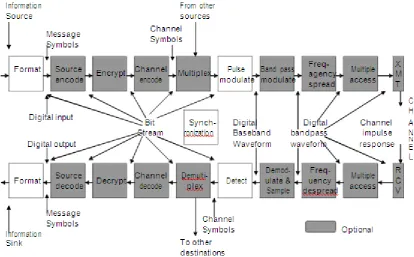
55 Figure 1: Block diagram of a digital communication system.
LITERATURE REVIEW
Mahe Jabeen, Salma Khan: Error-correcting convolution codes provide a proven mechanism to limit the effects of noise in digital data transmission. Convolution codes are employed to implement forward error correction(FEC) but the complexity of corresponding decoders increases exponentially with the constraint length K. Convolution Encoding with Viterbi decoding is a powerful FEC technique that is particularly suited to a channel in which the transmitted signal is corrupted mainly by Additive white Gaussian Noise. In this paper, we present a Convolution Encoder and Viterbi Decoder with a constraint length of 3 and code rate of 1/2.
Ezeofor C. J.1, Ndinechi M.C.2: This paper presents Graphical User Interface (GUI) for simulating convolutional coding with Viterbi decoding in digital communication system using MATLAB. Digital transmission is not free from channel impairments such as noise, interference and fading which cause signal distortion and degradation in signal to noise ratio. These introduce a lot of errors on the information bits sent from one place to another. To address these problems, Convolutional coding is introduced at the transmitter side and Viterbi decoding at the receiver end to ensure consistent error free transmission. In order to visualize the effect and evaluate the performance of the coding and decoding used, simulation programs that encode and decode digital data were designed, written and tested in MATLAB. The generated bit error rate (BER) is plotted against Energy per bit to noise spectral density (Eb/No) for different digital input data. It is seen that as Eb/No increases, bit error rate decreases thereby increasing the performance of the convolutional code rate used in the transmission channel at both end. Further analysis and discussion were made based on the MATLAB graph results obtained.
K. S. Arunlal1 and Dr. S. A. Hariprasad2: Convolutional encoding with Viterbi decoding is a good forward error correction technique suitable for channels affected by noise degradation. Fangled Viterbi decoders are variants of Viterbi decoder (VD) which decodes quicker and takes less memory with no error detection capability. Modified fangled takes it a step further by gaining one bit error correction and detection capability at the cost of doubling the computational complexity and processing time. A new efficient fangled Viterbi algorithm is proposed in this paper with less complexity and processing time along with 2 bit error correction capabilities. For 1 bit error correction for 14 bit input data, when compared with Modified fangled Viterbi decoder, computational complexity has come down by 36-43% and processing delay was halved. For a 2 bit error correction, when compared with Modified fangled decoder computational complexity decreased by 22-36%.
56 shifting operation when the number of bits increases. To overcome this we are proposing a dynamic shift register for convolution encoding and viterbi decoding. The proposed shift register shifts four bits at a time. The implementation is for code rate ½, constraint length 9 and the implementation of viterbi algorithm is by using the hamming distance instead of Euclidean distance. By using the hamming distance the complexity of the system decreases. The proposed architecture decreases the power consumption by 72% approximately. We also discuss the timing analysis of the system. The code written in Verilog and synthesized in Xilinx 13.2 version.
Vinay .B .K1, Sunil .M .P2: Convolutional encoding is a forward error correction technique that is used for correction of errors at the receiver end. Viterbi decoding is the best technique for decoding the convolutional codes. Convolution encoder and Viterbi decoder are widely used in many communication systems due to the excellent error control performance. This work deals with the design and implementation of convolution encoder and Viterbi decoder using Field Programmable Gate Array. By analysis the algorithm of Viterbi decoder, the project explores a practical method to design a parallel processing Viterbi decoder. It means trace back and decoder can simultaneously work in order to improve the processing speed. Due to parallelism, Total latency in decoding first bit will be 3L as compared to conventional approach which is 4L, where L is Trace back length. The experimental results show that this method is feasible.
Motivation about Work:-
Recently, convolutional codes have become more and more important in digital transmission. The Viterbi decoding algorithm is widely used in radio communication: digital TV (ATSC, QAM, DVB-T, ), radio relay, satellite communications, PSK31 digital mode for amateur radio ,decoding trellis-coded modulation (TCM) (the technique used in telephone-line modems to squeeze high spectral efficiency out of 3 kHz-bandwidth analog telephone lines), computer storage devices such as hard disk drives, automatic speech recognition . The vision of wireless communication providing high-speed and high-quality information exchange between two portable devices located anywhere in the world is the communications frontier of the current century. In this busy and unsecure world you need to be sure your data is not only safe and secure but that you are working with it at the highest speed possible. The main objective of this paper is first, to increase the performance of viterbi decoder. Second, to check and verify the functionality of viterbi decoder on MATLAB
PROPOSED WORK
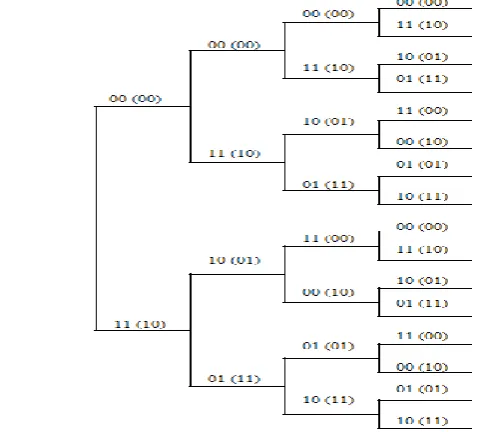
A tree diagram for the (2, 1, 3) convolutional encoder is as shown in Figure 3.3. The state diagram completely characterizes the encoder but one cannot easily use it for tracking the encoder transitions as a function of time. This is evident as the diagram does not represent time history. The tree diagram adds the dimension of time to the state diagram, i.e., it shows the passage of time as we go deeper into the tree branches. This makes it a better approach than the state diagram but for representing convolutional codes.
With the tree diagram, instead of “jumping” from one state to another, branches of the tree are travelled depending on the arrival of the bit 1 or the arrival of the bit 0. If the bit 0 is received at the encoder input, we go up and if the bit 1 is received we go down in the tree. The first two bits represent the output bits and the bits within the parentheses represent the output state.
The tree diagram attempts to show the passage of time as we go deeper into the tree branches. It is somewhat better than a state diagram but still not the preferred approach for representing convolutional codes. Here instead of jumping from one state to another, we go down branches of the tree depending on whether a 1 or 0 is received.
The first branch indicates the arrival of a 0 or a 1 bit. The starting state is assumed to be 000. If a 0 is received, we go up and if a 1 is received, then we go downwards. In the figure, the solid lines show the arrival of a 0 bit and the shaded lines the arrival of a 1 bit. The first 2 bits show the output bits and the number inside the parenthes is the output state.
A code tree of a binary (n, k, m) convolutional code presents every codeword as a path on a tree. For input sequences of length L bits, the code tree consists of (L + m + 1) levels. The single leftmost
node at level 0 is called the origin node.
At the first L levels, there are exactly 2k branches leaving each node. For those nodes located at levels L through (L + m), only one branch remains. The 2kL rightmost nodes at level (L + m) are called the terminal nodes.
57 Figure 2: Tree diagram for the (2, 1, 3) convolutional encoder
VITERBI DECODING
Channel decoding is defined as the process of recovering the encoded input data stream, at the receiver, once transmitted through a channel. There are two major forms of channel decoding for convolutional codes: sequential decoding and the maximum likelihood decoding or Viterbi decoding.
Sequential Decoding
Sequential decoding was one of the first methods proposed for decoding a convolutionally encoded bit stream and is best described by analogy. It was first proposed by Wozencraft and later a better version was proposed by Fano.
In sequential decoding, we deal with just one path at a time, thus enabling both forward and backward movements through the trellis. The main disadvantage with this decoding technique is its variable decoding time, since the number of calculations increases with the number of input bits.
Viterbi Decoding
Viterbi decoding, also often referred to as the maximum likelihood decoding was developed by Andrew J. Viterbi, a founder of Qualcomm Corporation. His seminal paper on the technique is, 'Error Bounds for Convolutional Codes and an Asymptotically Optimum Decoding Algorithm' [2].
In Viterbi decoding, unlike in sequential decoding, the decoding time is fixed and not variable thus making it more suitable to hardware implementation. Here, we narrow the options systematically at each trellis stage. The principal used to reduce the choices are:
(i) The errors occur infrequently. The probability of error is small.
(ii) The probability of two errors in a row is much smaller than a single error that is the errors are distributed randomly.
The Viterbi decoder examines an entire received sequence of a given length. The decoder computes a metric for each path and makes a decision based on this metric. All paths are followed until two paths converge on one node. Henceforth based on a decision, discussed ahead, one of the two paths is chosen. The paths selected are called the survivors. For an N bit sequence, the total number of possible received sequence is 2N. Of these only 2kL are valid.
58 Figure 3: System design of a Viterbi decoder.
As discussed, when two paths converge on one node, only one survivor path is chosen based on a decision. This decision can be achieved in two ways, resulting in the following two types of Viterbi decoding:
(i) Hard decision Viterbi decoding (ii)Soft decision Viterbi decoding
Quantization
In practical systems, we quantize the received channel data sequence with one or a few bits of precision in order to reduce the complexity of the Viterbi decoder. If the received data stream is quantized to one-bit of precision, i.e., voltages that are less than or equal to 0 are represented by the bit 0, and voltages that are greater than 0 are represented by the bit 1, then we get as what was explained before, the hard decision Viterbi decoder. If however the received data stream is quantized with two or more bits of precision we get the soft decision Viterbi decoder.
The soft decision Viterbi decoder discussed in this report uses a 3-bit quantizer to quantize the received channel data stream. A Viterbi decoder with soft decision data inputs quantized to three or four bits of precision can perform about 2 dB better than one working with hard decision inputs. The usual quantization precision is three bits as more bits provide little additional improvement. The quantized number is represented in 2's complement giving it a range of -4 to 3.
Soft decision Viterbi decoding offers better performance results than hard decision Viterbi decoding since it provides a better estimate of the noise, i.e., less quantization noise is introduced.
CONCLUSION
In this paper the author has studied about Convolution Encoder and Viterbi Decoder in Wireless communication. Specifically, we studied the measurement of the coding efficiency of each respective convolution code over 10,000 trials and assume that our message is of L = 100 bits. Moreover, this simulation is done over several SNR levels. Although one would ideally like to reach the theoretical coding gain given by Shannon’s limit, we deem the “success” of encoder/decoder if it is able to achieve roughly 4 dB using a hard decoding scheme. This base line can then be improved by substituting various branch metrics, such as the L2 norm. To this end, we studied the simulation results of the algorithm for both hard and soft decoding. For information of how to switch between the two by trivial changes to the MATLAB code.
REFERENCES
[1] Ezeofor C. J.1, Ndinechi M.C.2 ,“Graphical User Interface for Simulating Convolutional Coding with Viterbi Decoding in Digital Communication Systems using Matlab”, International Journal of Innovative Research in Science, Engineering and Technology, Volume 3, Issue 7, July 2014
[2] Shraddha Shukla1, Nagendra Sah 2 “An Experimental Implementation of Convolution Encoder and Viterbi Decoder by FPGA Emulation” International Journal of Advanced Research in Electrical, Electronics and Instrumentation Engineering, Vol. 3, Issue 5, May 2014
59
[4] Yonghui Li, Senior Member, IEEE, Md. Shahriar Rahman, Branka Vucetic, Fellow, IEEE “Duality of Channel Encoding and Decoding - Part I: Rate-1 Convolution Codes”, IEEE Transactions on Information Theory 33 pages, 19 figures, Submitted on 12 Jan 2012
[5] A. Dubey, Sophomore Undergraduate, Electrical Engineering, IIT Delhi “Convolutional Encoding and Decoding with the Viterbi Algorithm” 2011EE20061, Digital Electronic Circuits, Fall-Winter 2012, IIT Delhi
[6] K. S. Arunlal1 and Dr. S. A. Hariprasad2 “AN EFFICIENT VITERBI DECODER” International Journal of Advanced Information Technology (IJAIT) Vol. 2, No.1, February 2012.
[7] Vijay A Suryavanshi and Aria Nosratinia “Convolutional Coding for Resilient Packet Header Compression,” Multimedia Communications Laboratory, The University of Texas at Dallas Richardson, TX 75083-0688, USA Information Security, 2014, 7, 19-27
[8] Jeff Foerster and John Liebetreu, FEC Performance of Concatenated Reed-Solomon and Convolutional Coding with a. Interleaving”, IEEE 802.16 Broadband Wireless Access Working Group <http://ieee802.org/16>
[9] Md. Liakot Ali, Mohammad Bozlul Karim, S.M Tofayel Ahmad, Simulation and Design of Parameterized Convolutional Encoder and Viterbi Decoder for Wireless Communication, 2012
[10] Ripple Dhingra1 and Danvir Mandal2, “Convolutional Code Optimization for Various Constraint Lengths using PSO”, International Journal of Electronics and Communication Engineering. ISSN 0974-2166 Volume 5, Number 2 (2012), pp. 151-157
[11] Shaina Suresh, Ch. Kranthi Rekha, Faisal Sani Bala , “Performance Analysis of Convolutional Encoder and Viterbi Decoder Using FPGA” International Journal of Engineering and Innovative Technology (IJEIT) Volume 2, Issue 6, December 2012
[12] Umesh Kumar Pandey1 , Prashant Purohit2 ,“Convolution code with Hard Viterbi Decoding For MPSK in AWGN” International Journal of Emerging Technology and Advanced Engineering, Volume 3, Issue 9, September 2013 [13] Sneha Bawane1 , V.V.Gohokar2 “SIMULATION OF CONVOLUTIONAL ENCODER”, IJRET: International