27 Int J Res Med. 2017; 6(1); 27-34 e ISSN:2320-2742 p ISSN: 2320-2734
Comparison of Modified Jaffe’s Kinetic Method and Enzymatic
Method of Serum Creatinine Estimation for Precision, Linearity
and Effect of Interferent
N. R. Malukar1*, S. B. Kanazariya2, Sunil K Bapure3, Jayendra Purohit4
1
Assistant Professor,Biochemistry Department, Medical Collage Baroda.
2
Tutor, M.Sc Medical Biochemistry, Shree K. J. Maheta Hospital trust and College of Dental Science, Amargadh, Bhavnagar.
3
MDS, Reader Department of Periodontology, Collage of Dental Science, Amargadh, Bhavnagar.
4
MDS, Reader Department of Oral And Maxillofacial Surgery, Collage of Dental Science, Amargadh, Bhavnagar.
INTRODUCTION
Serum creatinine is an important laboratory marker for renal functions. The National Kidney Disease Education Program of the National Institutes of Health recommends that an estimated glomerular filtration rate (GFR) be calculated from serum creatinine And reported to physicians to assist with
*Corresponding Author: Dr Neeta Malukar 65 Narayan Greens,
Opp. Sky Marc Apartment, Sama Savli Road,
Vadodara – 390024 Contact No: 9974018305 Email: [email protected]
Early identification of patients with renal disease. The National Kidney Disease
Education Program recognizes the
importance of standardized creatinine measurements to achieve this goal1. Efforts to improve the identification and management of patients with chronic kidney disease (CKD) are based on the implementation of more accurate means for assessing kidney function and kidney damage at an early clinical stage2. In this respect, Standardization of serum creatinine measurements is very important because of the central role of this biomarker in the assessment of renal function e.g., for the calculation of creatinine clearance, a parameter largely determined by glomerular
ORIGINAL ARTICLE
ABSTRACT
BACKGROUND: Serum creatinine (Scr) measurement plays a key role in glomerular filtration rate estimation (eGFR), chronic kidney disease (CKD) diagnosis as well as CKD treatment. The purpose of this study is to find appropriate method of serum creatinine estimation for routine use and in presence of various interferents like glucose and bilirubin.OBJECTIVES: The aim of this paper was to compare precision of serum creatinine estimation by modified Jaffe's kinetic method and enzymatic method. To compare the linearity of serum creatinine estimation by modified Jaffe's kinetic method and enzymatic method.To compare the effects of some common interfering substances like Bilirubin and glucose estimation by modified Jaffe's kinetic method and enzymatic method.MATERIAL AND METHODS: It was an Analytical - Cross sectional Study in a period of 5 months, from February 2016 to June 2016 at Clinical Biochemistry laboratory, S.S.G. Hospital, Baroda. Creatinine was measured by a Modified Jaffe‟s Kinetic method and by an enzymatic method. All tests were done on ROBONIK Semi autoanalyser. RESULTS: Serum creatinine measured by the Modified Jaffe‟s Kinetic and enzymatic methods was statistically significance in healthy subjects (1.02 ± 0.23 vs. 1.10 ± 0.23 mg/dL, respectively, P=0.00001), in diabetic patients (1.30 ± 0.59 vs. 1.17 ± 0.51 mg/dL, respectively, P=0.00001) and jaundice patients (1.33 ± 1.00 vs. 1.67 ± 1.42 mg/dL, respectively, P=0.00001) and in both the parameter bilirubin and glucose was high in the patients (1.41 ± 1.00 vs. 1.46 ± 1.01 mg/dL, respectively, P=0.00433). CONCLUSION: The enzymatic method is more reliable when interfering substances are present in the samples analyzed, which makes a method of choice.
28 Int J Res Med. 2017; 6(1); 27-34 e ISSN:2320-2742 p ISSN: 2320-2734 filtration rate (GFR), and the use of
creatinine values for estimation of GFR3. Routine clinical biochemistry laboratories use several methods for the estimation of serum and urinary concentrations of creatinine, most of which are based on the Jaffe‟s reaction described first by Jaffe in 1886. Over the years, the Jaffe‟s assay has progressed through many phases. There are major analytical problems associated with the use of the Jaffe‟s reaction, in particular those relating to positive and negative interference by chromogens. More than 50 chromogenic interfering substances have been documented4,10.
Commonly encountered interfering
substances of the Jaffe‟s based methods include glucose, acetoacetate, bilirubin, and cefoxitin5. Glucose and bilirubin both inhibit the reaction between creatinine and alkaline picrate. Glucose slowly reduces picric acid to picramate6, while bilirubin, under alkaline conditions, is oxidized to biliverdin, causing a decrease in absorbance at 520 nm7. Acetoacetate and Cefoxitin, conversely, react directly with alkaline picrate and cause positive interference. Acetoacetate, in fact, reacts more rapidly with picrate than creatinine8.
Enzymatic creatinine assay is widely accepted as one of the most accurate routine methods available at present. Several studies concluded that enzymatic method is suitable as a routine diagnostic laboratory method for the measurement of serum creatinine, particularly for diabetic ketotic patients,
neonates, and patients receiving
cephalosporins9.
The enzymatic method exhibits several advantages over Jaffe‟s based methods-namely, improved specificity, smaller sample volume and hence a rapid sample throughput. Glucose, acetoacetate, and Cefoxitin do not interfere with the enzymatic method, although bilirubin causes a negative interference which depends on both creatinine and bilirubin concentrations.
The enzymatic creatinine assay deals effectively with most interfering substances but has a greater cost and shorter shelf-life compared with the kinetic Jaffe‟s method10
.
For neonates and adults with
hyperbilirubinaemia, creatinine can be significantly under-estimated at low concentrations of bilirubin with some commonly used reagent systems11.
Many uremic patients suffer from diabetes mellitus. In such cases serum creatinine can be either under- or overestimated by modified Jaffe‟s method12
.
The aim of this study was to compare analytical performance and practicability of the enzymatic method and kinetic method for serum creatinine for routine use and to compare the effects of some common interfering substances like glucose and bilirubin on the enzymatic method and modified Jaffe‟s kinetic method.
The purpose of this study is to find appropriate method of serum creatinine estimation for routine use and in presence of various interferents like glucose and bilirubin.
MATERIALS AND METHODS
Source of Data: The study was carried out at Clinical Chemistry Laboratory, Sir Sayajirao General (S.S.G.) Hospital and Medical College, Baroda. Approval of institutes Scientific Review Committee was obtained and Ethical Clearance was obtained from the Institutional Ethics Committee for Human Research, Medical College and S.S.G. Hospital, Baroda.
It was an Analytical - Cross sectional Study in a period of 5 months, from February 2016 to June 2016 at Clinical Biochemistry laboratory, S.S.G. Hospital, Baroda.
1. Sample Size
For testing precision, we tested 2 sets of quality control sera by both methods 20 times each and find mean and SD.
29 Int J Res Med. 2017; 6(1); 27-34 e ISSN:2320-2742 p ISSN: 2320-2734 modified Jaffe's kinetic method and
enzymatic method.
Minimum 66 patients required to get 0.99 Intra class correlation co-efficient (ICC) with comparison of population ICC 0.98 at 5% risk and 80% power. Therefore, in group 1,2,3,5 and 6, 66 patients per group were taken.
Minimum 110 patients required to get 0.915 Intra class correlation co-efficient (ICC) with comparison of population ICC 0.95 at 5% risk and 80% power. Therefore, in group 4, 110 patients were taken.
These samples were comprised of following six groups:
Groups Patients Sample
Test for S.Creatinine by Enzymatic
method
Test for S.Creatinine by Modified Jaffe‟s
Kinetic Method Total
Test
1. S.Creatinine
(0.7-1.4mg/dl) 66 66 66 132 2. S.Creatinine
(1.4-5.0 mg/dl) 66 66 66 132 3. S.Creatinine
(>5 mg/dl) 66 66 66 132 4. S.Bilirubin
(≥1 mg/dl) 110 110 110 220 5. Fasting Blood
Sugar (≥126mg/dl) 66 66 66 132 6. S.Bilirubin (≥1
mg/dl) + Fasting Blood Sugar (≥126mg/dl)
66 66 66 132
Total 440 440 440 880
2. Inclusion Criteria: All samples received in clinical biochemistry laboratory, S.S.G. Hospital, Baroda.
3. Exclusion Criteria
Hemolysed Sample
Lipemic sample
Methods of Collection Of Data
The study was conducted at Clinical Chemistry Laboratory of Bio-chemistry department of S.S.G. Hospital and Medical College, Baroda.
After overnight fasting the subject 5ml of blood sample was collected under aseptic precautions in fluoride vacutainer for FBS and in plain vacutainer for other biochemical parameters.
The following investigations were done:
1. Serum Creatinine 2. Serum Bilirubin
3. Plasma Fasting Glucose (FBS)
RESULT
As defined in material and methods, 440 samples were included in the study. They were divided into six groups as mentioned below in table 1:
Statistical analysis was done by using paired t-test, Intra class correlation co-efficient, regression analysis and Bland-Altman plot to find out significance of difference between two methods. Interpretation was done according to p-values as follows: p< 0.05 was considered significant p ≥ 0.05 was considered not significant All statistical analysis was done using MedCalc software and “p” value is calculated by social science statistics online software. The link is given below
http://www.socscistatistics.com/tests/ttestde pendent/Default.aspx
The observations made with respect to various aspects of the study are as follows. Mean of modified Jaffe‟s kinetic method were 1.02 mg/dl in group I; 2.52 mg/dl in group II; 8.74 mg/dl in group III; 1.33 mg/dl in group IV; 1.30 mg/dl in group V; 1.41 mg/dl in group VI and mean of enzymatic method were 1.10 mg/dl in group I; 2.57 mg/dl in group II; 9.16 mg/dl in group III; 1.67 mg/dl in group IV; 1.17 mg/dl in group V; 1.46 mg/dl in group VI.
Mean differences between enzymatic to Modified Jaffe‟s kinetic methods were -0.08 mg/dl in group I and it was statistically highly significant (0.00001); -0.05 mg/dl in group II and it was also statistically highly significant (0.00001); -0.42 mg/dl in group III and it was statistically highly significant (0.00001); -0.34 mg/dl in group IV and it was statistically highly significant (0.00001); 0.13 mg/dl in group V and it was statistically highly significant (0.00001) and -0.05 mg/dl in group VI and it was statistically highly significant (0.00433). All of the above differences were statistically
30 Int J Res Med. 2017; 6(1); 27-34 e ISSN:2320-2742 p ISSN: 2320-2734 1: Comparison (by Paired ‘t’ test) and the agreement between two methods (ICC) of the Serum Creatinine values obtained by Enzymatic Methods and Modified Jaffe’s Kinetic method
Intra class correlation coefficients for the agreement between the two methods for Group I, Group II, Group III, Group IV, Group V and Group VI were 0.931, 0.998, 0.986, 0.911, 0.967 and 0.994 respectively.
Mean± SD (mg/dl) Mean differences±
SD (mg/dl) ‘p’ value ICC Group I
S.Creatinine (0.7-1.4mg/dl)
Enzymatic (n=66) 1.10 ± 0.23
-0.08 ± 0.00 0.00001 0.931 Kinetic Jaffe‟s (n=66) 1.02 ± 0.23
Group II
S.Creatinine (1.4-5.0 mg/dl)
Enzymatic (n=66) 2.57 ± 0.93
-0.05 ± -0.02 0.00001 0.998 Kinetic Jaffe‟s (n=66) 2.52 ± 0.91
Group III
S.Creatinine (>5 mg/dl)
Enzymatic (n=66) 9.16 ± 2.72
-0.42 ± -0.28 0.00001 0.986 Kinetic Jaffe‟s (n=66) 8.74 ± 2.44
Groups IV
S.Bilirubin (≥1 mg/dl)
Enzymatic (n=110) 1.67 ± 1.42
-0.34 ± -0.42 0.00001 0.911 Kinetic Jaffe‟s (n=110) 1.33 ± 1.00
Groups V
Fasting Blood Sugar (≥126mg/dl)
Enzymatic (n=66) 1.17 ± 0.51
0.13 ± 0.08 0.00001 0.967 Kinetic Jaffe‟s (n=66) 1.30 ± 0.59
Groups VI
S.Bilirubin (≥1 mg/dl) + Fasting Blood Sugar (≥126mg/dl)
Enzymatic (n=66) 1.46 ± 1.01
-0.05 ± -0.01 0.00433 0.994 Kinetic Jaffe‟s (n=66) 1.41 ± 1.00
p >0.05 Statistically Insignificant p<0.05 Statistically Significant
(„p‟ values for mean differences between two methods by Paired „t‟ test)
ICC – Intra class correlation coefficient- used to assess the agreement between two methods. ICC: <0.2 Poor agreement,
31 Int J Res Med. 2017; 6(1); 27-34 e ISSN:2320-2742 p ISSN: 2320-2734
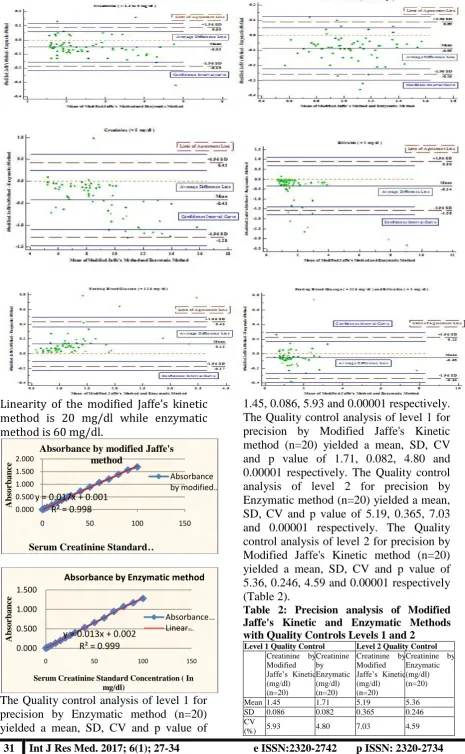
Linearity of the modified Jaffe’s kinetic method is 20 mg/dl while enzymatic method is 60 mg/dl.
The Quality control analysis of level 1 for precision by Enzymatic method (n=20) yielded a mean, SD, CV and p value of
1.45, 0.086, 5.93 and 0.00001 respectively. The Quality control analysis of level 1 for precision by Modified Jaffe's Kinetic method (n=20) yielded a mean, SD, CV and p value of 1.71, 0.082, 4.80 and 0.00001 respectively. The Quality control analysis of level 2 for precision by Enzymatic method (n=20) yielded a mean, SD, CV and p value of 5.19, 0.365, 7.03 and 0.00001 respectively. The Quality control analysis of level 2 for precision by Modified Jaffe's Kinetic method (n=20) yielded a mean, SD, CV and p value of 5.36, 0.246, 4.59 and 0.00001 respectively (Table 2).
Table 2: Precision analysis of Modified Jaffe's Kinetic and Enzymatic Methods with Quality Controls Levels 1 and 2
Level 1 Quality Control Level 2 Quality Control Creatinine by
Modified Jaffe‟s Kinetic (mg/dl) (n=20)
Creatinine by Enzymatic (mg/dl) (n=20)
Creatinine by Modified Jaffe‟s Kinetic (mg/dl) (n=20)
Creatinine by Enzymatic (mg/dl) (n=20)
Mean 1.45 1.71 5.19 5.36 SD 0.086 0.082 0.365 0.246 CV
(%) 5.93 4.80 7.03 4.59
y = 0.017x + 0.001 R² = 0.998
0.000 0.500 1.000 1.500 2.000
0 50 100 150
Ab
so
rb
a
n
ce
Serum Creatinine Standard … Absorbance by modified Jaffe's
method
Absorbance by modified …
y = 0.013x + 0.002 R² = 0.999
0.000 0.500 1.000 1.500
0 50 100 150
Ab
so
rb
a
n
ce
Serum Creatinine Standard Concentration ( In mg/dl)
Absorbance by Enzymatic method
32 Int J Res Med. 2017; 6(1); 27-34 e ISSN:2320-2742 p ISSN: 2320-2734
DISCUSSION
The enzymatic method exhibits advantages over Modified Jaffe‟s Kinetic (25μL) based methods namely, smaller sample volume (10μL) and free of interference from substances such as glucose and bilirubin. The enzymatic technique yields results directly proportional to the Modified Jaffe‟s Kinetic reaction. Access to enzymatic assays can also be useful when interference from substances such as bilirubin and glucose is suspected11. The enzymatic creatinine methods appear to be the only assays giving reliable results when specimens take time to reach the laboratory and blood centrifugation is delayed for 24 h or more. In a recently
published study, delays in sample
centrifugation caused false increases in measured creatinine by alkaline picrate assays due to the possible interference effect of some metabolites built up in vitro, such as pyruvate or ketones12. A minor disadvantage of the enzymatic method is its relatively high cost.
In our study was conducted on 440 samples, estimation of creatinine by enzymatic method showed statistically significant “p” value (0.00001) with the Modified Jaffe‟s kinetic method in samples without glucose and bilirubin interference.
Various studies have reported that there is no statistical significant “p” value in normal healthy individuals. Study of Vijaya Marakala et al reported no statistical significant “p” value 0.565 in normal healthy individuals.13 Irena I. Gencheva and Adelaida L. Ruseva reported no statistical significant “p” value >0.10 in normal healthy individuals.14 Our results did not match this study.
Study of Cheuiche AV on 123 adult
southern Brazilians with GFR>60
mL/min/1.73 m² (53 patients with type 2 diabetes, 70 healthy volunteers) and he
measured Serum creatinine by the
Modified Jaffe‟s Kinetic and enzymatic methods was similar in healthy subjects
(mean±SD, 0.79±0.16 vs. 0.79±0.15
mg/dL, respectively, P=0.76). He reported no statistical significant “p” value 0.76 in normal healthy individuals.15
In case of high creatinine (Creatinine >1.4 to 5 mg/dl) by enzymatic method showed statistically significant “p” value (0.00001) with the Modified Jaffe‟s kinetic method in samples without glucose and bilirubin interference.
In case of high creatinine (Creatinine > 5 mg/dl) by enzymatic method showed statistically significant “p” value (0.00001) with the Modified Jaffe‟s kinetic method in samples without glucose and bilirubin interference.
In the presence of glucose interference (glucose > 126 mg/dl), the samples showed statistical significant “p” value
(0.00001) between enzymatic and
Modified Jaffe‟s kinetic method.
Various studies have reported that there is no statistical significant “p” value in the presence of glucose interferent. Study of Vijaya Marakala et al reported no statistical significant “p” value 0.577 in the presence of glucose interferent.13 Irena I. Gencheva and Adelaida L. Ruseva reported statistical significant “p” value 0.0097 in the presence of glucose interferent.14 Our results match this study but did not match with Vijaya Marakala et al.
When bilirubin was present in the serum samples (bilirubin > 1 mg/dl), the “p” value (0.00001) between enzymatic and Modified Jaffe‟s kinetic method was statistically significant.
Various studies have reported that there is no statistical significant “p” value in the presence of bilirubin interferent. Study of Vijaya Marakala et al reported no statistical significant “p” value 0.186 in the presence of bilirubin interferent.13 Irena I. Gencheva and Adelaida L. Ruseva reported statistical significant “p” value 0.0305 in the presence of bilirubin interferent.14 Our results match this study but did not match with Vijaya Marakala et al.
One another study evaluated 29 samples with Bilirubin concentrations between 0.1 and 22.7 mg/dL (1.7-388.2µmol/L) and did not find a significant difference
between 2 methods of creatinine
33 Int J Res Med. 2017; 6(1); 27-34 e ISSN:2320-2742 p ISSN: 2320-2734 2 different analyzers [Roche Hitachi 917
and Dade Di-mension RXL])13.
Study of Cheuiche AV on 123 adult
southern Brazilians with GFR>60
mL/min/1.73 m² (53 patients with type 2 diabetes, 70 healthy volunteers) and he
measured Serum creatinine by the
Modified Jaffe‟s Kinetic and enzymatic methods was similar in diabetic patients
(mean±SD, 0.96±0.22 vs. 0.92±0.29
mg/dL, respectively, P=0.17). He reported no statistical significant “p” value 0.17 in diabetic patients15.
In the presence of glucose and bilirubin both interference (glucose > 126 mg/dl and bilirubin >1 mg/dl), the samples showed statistical significant “p” value (0.0043) between enzymatic and Modified Jaffe‟s kinetic method.
Various studies have reported that there is no statistical significant “p” value in the presence of glucose and bilirubin both interferents. Study of Vijaya Marakala et al reported no statistical significant “p” value 0.401 in the presence of glucose and bilirubin both interferents.13 Irena I. Gencheva and Adelaida L. Ruseva reported statistical significant “p” value <0.0001 in the presence of glucose and bilirubin both interferents.14 Our results match this study but did not match with Vijaya Marakala et al.
CONCLUSION
Serum creatinine is underestimated by Modified Jaffe‟s Kinetic method in the presence of bilirubin and overestimated in the presence of glucose. Serum creatinine is underestimated by Modified Jaffe‟s Kinetic method in the presence of both bilirubin and glucose. When Serum Creatinine level is >5 mg/dl, it is
underestimated by Modified Jaffe‟s
Kinetic method.
Enzymatic has greater linearity than the
Modified Jaffe‟s Kinetic Method.
Enzymatic method is less affected by interferences so it is a better method to measure creatinine.
The enzymatic method is more reliable when interfering substances are present in the samples analyzed, which makes a method of choice.
REFERENCES
1. Greg Miller, W., et al. "Creatinine measurement: state of the art in accuracy and interlaboratory harmonization." Archives of pathology & laboratory medicine 129.3 (2005): 297-304.
2. Delanghe, Joris R., et al. "Focusing on the clinical impact of standardization of creatinine measurements: a report by the EFCC Working Group on Creatinine Standardization." Clinical chemistry and laboratory medicine 49.6 (2011): 977-982.
3. Delanghe, Joris R., et al. "Focusing on the clinical impact of standardization of creatinine measurements: a report by the EFCC Working Group on Creatinine Standardization." Clinical chemistry and laboratory medicine 49.6 (2011): 977-982.
4. Cook, J. G. H. "Factors influencing the assay of creatinine prepared for the association of clinical biochemists' scientific and technical committee."Annals of Clinical Biochemistry: An international journal of biochemistry in medicine 12.1-6 (1975): 219-232.
5. Spencer, Kevin. "Analytical reviews in clinical biochemistry: the estimation of creatinine." Annals of Clinical Biochemistry: An international journal of biochemistry in medicine 23.1 (1986): 1-25.
6. Bowers, Larry D., and Edward T. Wong. "Kinetic serum creatinine assays. II. A critical evaluation and review." Clinical Chemistry 26.5 (1980): 555-561.
7. Knapp, M. L., and O. Hadid. "Investigations into negative interference by jaundiced plasma in kinetic Jaffe methods for plasma creatinine determination." Annals of Clinical Biochemistry: An international journal of biochemistry in medicine 24.1 (1987): 85-97.
34 Int J Res Med. 2017; 6(1); 27-34 e ISSN:2320-2742 p ISSN: 2320-2734
journal of clinical pathology84.5 (1985): 659-664.
9. Jacobs, Robert M., et al. "Effects of interferents on the kinetic Jaffé reaction and an enzymatic colorimetric test for serum creatinine concentration determination in cats, cows, dogs and horses." Canadian journal of veterinary research 55.2 (1991): 150.
10.Crocker, H., M. D. Shephard, and G. H. White. "Evaluation of an enzymatic method for determining creatinine in plasma." Journal of clinical pathology41.5 (1988): 576-581.
11.Peake, Michael, and Malcolm Whiting. "Measurement of serum creatinine-current status and future goals." Clinical biochemist reviews 27.4 (2006): 173.
12.Shepherd, J., M. H. Warner, and E. S. Kilpatrick. "Stability of creatinine with delayed separation of whole blood and
implications for eGFR." Annals of clinical biochemistry 44.4 (2007): 384-387.
13.Marakala, Vijaya, et al. "Serum creatinine assay: enzymatic vs kinetic jaffe's method." Journal of Evolution of Medical and Dental Sciences 1.4 (2012): 258-264.
14.Gencheva, Irena I., and Adelaida L. Ruseva. "Effects Of Glucose And Bilirubin On The Kinetic Jaffe's And The Enzymatic Methods For Serum Creatinine Assay." Journal of Biomedical and Clinical Research 8.1 (2015): 35-39.