Research Journal
Volume 10, No. 31, Sept. 2016, pages 274–280
DOI: 10.12913/22998624/64389 Research Article
VIDEO MATERIALS AS A MEANS OF PROMOTION AND ADVERTISING OF
THE FIELDS OF STUDY
Mirosław Malec1, Tomasz Cieplak2, Łukasz Jarmuł3
1 Faculty of Fundamentals of Technology, Lublin University of Technology, Nadbystrzycka 38, 20-618 Lublin, Poland, e-mail: [email protected]
2 Department of Enterprise Organization, Faculty of Management, Lublin University of Technology, Nadbystrzycka 36, 20-618 Lublin, Poland, e-mail: [email protected]
3 Student of Lublin University of Technology (Technical and Information Education field of study), Nadbys-trzycka 38, 20-618 Lublin, Poland
ABSTRACT
In this paper there were presented some information about marketing and advertise-ment in the aspect of acquiring customers-candidate for studies with the help of the film as a tool of this kind of action. The paper also shows the results of the survey re -search and their analysis in the scope of expected features which will be characteristic, according to the respondents, for above-mentioned transfer tool.
Keywords: marketing, advertisement, film for promotion, candidate for studies, sur -vey research.
INTRODUCTION
In a nutshell marketing is managing cordial
relationship with a client. It involves attracting
new customers via the promise of higher value and maintaining their positive outlook on sold
products or services. As stated by Ph. Kolter
“Marketing is an integrated set of tools and ac-tions which involve researching a market and
shaping it, and which are based on market rules of conduct”. Contemporary world is dependent on marketing. Marketing campaigns are one of the
most noticeable and spectacular activities of
busi-ness organizations and other institutions. Higher
education facilities take advantage of marketing
in order to promote their educational offer. When selecting a faculty a prospective student makes a groundbreaking decision that affects the path in life he will pursue. It is at this point that college or university ought to direct such candidate to its offer. Two marketing approaches prove particu
-larly effective in this scenario: direct marketing and interactive marketing. [13]
According to American Direct Marketing Association direct marketing can be defined as “a system of marketing activities which in -volves at least one kind of media and which
aim to provoke a measurable reaction, lead
-ing to successful transaction in any place, at any time”. As such it can be used for recruit
-ment purposes when the university employee has achieved direct contact with the candidate. One such opportunity are Open Day events,
when prospective students can enter into
di-rect contact with university employees. How
-ever, this form of advertising requires special
-ist training of the personnel. Not only does it involve technical aspects of presentation, but also the way the employees communicate with the client, their ability to observe the client’s interests, their use of convincing argumenta
-tion and the form of conversa-tion. Inappropri
-ate conversation, strident attitude, inability to answer questions and specialized queries may
dissuade the candidate from enrolling on this
particular facility of higher education. Received: 2016.06.04
Interactive marketing can be defined as mar -keting methods and tools dependent on data
car-riers and data channels, especially the Internet.
It involves fast and semi-direct promotion of the
offer to its target demographic. An university website would be the perfect example of this ap
-proach. It enables users to find all the necessary information quickly and efficiently. The general look and layout of the site should encourage the user to stay and browse the facility’s offer. As a result the candidate may decide to enroll on par
-ticular faculty. Film and associated video mate
-rials are another means of interactive marketing, which may constitute a perfect tool for promo
-tion of a university. It creates an opportunity to address the target demographic directly. This
leads the authors of this paper to the following
claim: that Internet and video materials combined
together constitute a crucial means of interactive
marketing.
A PROSPECTIVE STUDENT – THE
OVERVIEW OF THE CLIENT
A client can be defined as a buyer or con
-sumer. This term describes all participants in
the market that take advantage of the goods
and services available therein. It applies either to one physical entity or an organization made up of such individuals. A client is one of the market’s mainstays and as such market could not exist without clients. Clients create demand which is satisfied by providers. In effect, clients enjoy a certain degree of privileged position in comparison with providers as it’s their demands that require saturation in the best way possible. [15] A prospective student is also a form of a client, whose demands are satisfied by the fa
-cilities of higher education. However, in order to reach target demographic their personality must be carefully evaluated which is of paramount importance when choosing a career path. Per
-sonality may be understood as “inner structure of a person whose knowledge, experience and attitudes intertwine in a harmonious manner.” In summary, personality is an exceptional trait
because it results from acquired knowledge and
experience as well as inherited characteristics. It is impacted by age, gender, income and family situation. It is important to remember that per
-sonality changes as individuals age and can be defined by one or several traits. Depending on
those traits consumers can be divided into
fol-lowing categories:
• the conservatists: are adverse to experimenta -tion when faced with the choice of a product
of service,
• the tenacious: they “fight”, they are deter
-mined, they want to achieve their goals through their choice of a good or service, • the copycats: they tend to observe other con
-sumers and base their decisions on these
ob-servations,
• the high achievers: they live affluent lives and as such they are considered a model to follow by other consumers,
• the thrill seekers: they want to experience as many things as possible and are open-minded to any offers made by the providers [5].
Getting to know an individual’s personality enables providers to reach him more easily, and thus more easily convince him to take advantage of our services. Unfortunately, it is exceptionally difficult to identify personality type of target can -didate demographic when preparing an
advertise-ment. For this reason, the above-mentioned cate -gories must be accounted for during development of promotional materials so that the commercial
attracts the widest possible range of audience. Having summarized consumer types, the next
step would be focusing more on the candidate – a
prospective student himself. According to litera -ture data and empirical evidence of the authors
the following premises may factor in the decision of enrollment to particular field of study:
• wish to continue education
• possibility to continue education abroad • self-realization,
• improving one’s skills; fulfilling one’s passion and interests,
• wish to obtain higher degree,
• possibility of finding better employment, • family situation,
• peer influence.
The selected premises mentioned above do not exhaust all the aspects of this problem, but all the same it is worth giving them exceptional attention prior to making an offer and conducting
promotional activities catering for prospective
students.
An advertisement is a type of persuasive
communication which comprises techniques and
actions that draw consumer’s attention to a prod
-counts for phenomena that take place on the
mar-ket, most importantly including motives, ways of
conduct and attitudes of consumers who make
informed decisions about goods and services. It’s
fundamental role is to present information about
goods and about ways they can be purchased. Contemporary advertisements fulfill also other functions, such as: presentation, foundation and
maintenance of market outlets as well as shaping
the demand. Advertisements can take advantage of many visual forms of expression such as: albums, posters, movies, television, newspaper notices etc. Audio-acoustic means of advertising such as, radio, mobile phone advertising also enjoy sub
-stantial popularity. Advertising has become com
-monplace especially in advanced countries. The
goal of advertisements is to convince its audience
about the merits of offered services and goods. The provider attempts to frame information about the product in such a way so that he can attract consumers, building up the desire to obtain the item in question and finally to finalize the trans
-action [16]. Advertising may also enhances brand loyalty of already established consumer base. It influences the perception of the product by the consumers who already purchased it, which by
means of the word of mouth can impact the
im-age of the product in potential new buyers. It also can be purely informative providing users with news about working hours of the company or any changes that are about to take place. Moreover, advertising aids the given company in struggles against competition by persuading the consumers
to shift their attitude towards manufactured
prod-ucts and contextualize it against prodprod-ucts made by other companies. As a result, advertisements frequently contain extra information about ad
-ditional benefits of the given service or good, or ability to improve the given service or good in some way. Another function of advertising is pro
-moting products that are just entering the market. To this end the company informs about the new good or service its purpose, features - all in or
-der to draw consumer’s attention. Advertisements may be subdivided into many categories depend
-ing on certain criteria. First and foremost, depend -ing on the desired outcome of advertisement we
differentiate as follows: pioneering advertising,
competitive advertising and reminder
advertis-ing. Second, depending on the physical means of reaching target demographic we may define: ATL (above the line) advertisements and BTL (below the line) advertisements. Third, depending the
senses that are affected by an advertisement we identify: visual, acoustic, audio-visual and olfac
-tory advertisements. All of the abovestated cate -gories comprise larger part of the whole since it is
difficult to prepare an effective advertising cam
-paign relying on just one type of commercials. At the present in order to reach the largest pos
-sible audience different type of advertisements should be used in concert. However the choice of advertising category must be complimented by the choice of appropriate advertising carrier. This is conditioned by the type of the advertised product and the given market’s specification. For this purpose the following types of mass media are taken advantage of: newspapers, television, radio and Internet. However, of these it is the In
-ternet that presents the greatest potential. Its pri
-mary advantage is virtually unlimited geographic reach, which in itself poses also a considerable
challenge – the advertised product must stand out in order to be noticed from among thousands of
websites. A large number of advertisements in the Internet resulted in growing indifference towards them. For this reason an Internet advertisement is most commonly directed towards younger
people who constitute its largest user
demo-graphic. Effectiveness of advertising is reflected
in an increase of interest and sales of a good or
service. Thus an effective advertisement will be one that fulfills the following criteria: it builds brand recognition, it promotes brand loyalty, it
creates strong arguments in favor of the
prod-uct when compared with alternatives offered by the competition, it educates consumers, it im -proves reputation and it creates positive outlook
on the company’s services. In time, a successful
campaign based on these criteria is bound to be
more cost-effective than convincing consumer to make a one-time purchase. That is why devel -oping brand recognition and improving
reputa-tion, which leads to greater brand loyalty, and in turn to greater resistance against competition, is of paramount importance. If we additionally take care of good business image, entering and maintaining relationship with consumers, and in case of higher educational facilities, prospective students, should prove relatively easy. In sum
-mary, any advertisement that realizes its goal to the highest extent can be deemed effective. However, maintaining consumer’s positive im
-age of company or institution on both rational
and emotional levels is more important than
When producing advertisements of schools
one should take into consideration the method of
addressing the target audience. The way of com -municating the information with them is of
par-ticular importance. For this reason it is necessary
to familiarize oneself with aspects of social
inter-action, which constitutes the cornerstone of every advertisement. Technical considerations ought to also be taken into account, especially those that impact visual facets of the project. Communi
-cation in social interactions can be defined as a process of gathering, altering and passing infor
-mation between individuals, groups and social in
-stitutions. As such it dynamically shapes knowl
-edge, behavioral patterns and attitudes according
to the interests and values of the subjects that are
affecting it. In the course of social interaction via
multimedia the sender takes advantage of means of persuasion and manipulation with the ultimate goal of provoking certain reaction of the
recipi-ent. We can distinguish multiple layers of social interaction depending on certain criteria: means of communication: verbal, non-verbal, symbolic;
the distance between sender and receiver –
indi-rect and diindi-rect; level of communication – intra
-personal, inter-personal, group, institutional and mass communication. Within the frame of mul
-timedia projects mass communication, market -ing and communication through computer are
especially important. Mass communication is technologically demanding. It is characterized by asymmetrical relationship between both sides and being limited to one-way direction. In such sce
-nario an institution is the sender, whereas target demographic constitutes the group of recipients,
whose impact on the sender is reduced to a
mini-mum. The means of mass communication may be used as a modern form of one-way interaction and as a public forum. Mass-media certainly af -fect the decision making process of future
univer-sity candidates. It is owing to mass communica -tion that desired informa-tion can be passed on to
a large audience via, e.g. the Internet. Marketing communication conditions the state of any given company. It can be defined as a way in which that
institution transmits its knowledge about the
or-ganization itself, its products and services to po
-tential clients as a promotion or advertisement. Dialog is cornerstone in this type of communica
-tion. Based on the quality of dialog the client may form his own vision of company which thus he may deem worthy of his loyalty. Such a client will gladly take advantage of goods and services of
-fered to him. Computer as a means of communi
-cation relies on digitally formatted data which is
transferred through phone-line or other
telecom-munication link such as cable or satellite. This
term encompasses all means of digital
commu-nication, from rudimentary ones such as email to internet forums and live chat. Another paramount
facet of promoting services is inside-out
com-mand of public relations. According to German PR Association, Public Relations (PR for short) can defined as “the management of communica -tion processes between organiza-tion and indi-viduals through sets of benchmarks which enable
deliberate, purposeful and systematic defining of those processes.” As all methods of communi
-cation, the approach to PR depends on business activity conducted by the institution. However, there are some common denominators: contact
with the press – presenting news and revelations
concerning products and services in the best light; product publicity – improving product’s visibility and popularity; communication - popularizing the correct understanding of company’s mission and activities; lobbying – maintaining contact with legislators and state officials in order to be able to persuade them to particular policies; consulting – counseling the chief company’s officers in public matters and the organization’s position in the time of crisis and good economic standing alike [6].
The above-mentioned elements of PR enable
the institution to formulate the following strategic
goals:
• building positive attitudes towards the
organi-zation, its activities, values and goals,
• shaping desirable public image, reputation and consumer opinions,
• gaining, regaining and maintaining trust, • decreasing the discrepancy between the fac
-tual state of the institution and public
impres-sions as well as expectations through balanc
-ing interests.
• limiting or removing potential conflicts, en
-hancing organization’s capabilities in the time of crisis,
• enabling clients and company to reach a con
-sensus,
• positioning the institution in the awareness of
general population [12].
E-public relations is a particular form of PR that warrants further scrutiny as its based around the Internet. Internet advertising grounded in an
very successful at convincing prospective univer
-sity students. A website is one such good example of a promotional tool. Thanks to it the client can
decide on his own what he wants to see and what
he wants to focus on. A website is a form of busi
-ness card and an advertisement as well as the first step before familiarizing with the facility’s offer.
Visual cues and multimedia are the major modes
interactivity on a website. In order that the infor -mation can reach the client and be memorized it
must be interesting, attractive, and advantageous to the consumer. It is possible to differentiate two types of behaviour in the Internet: need-based and interest-based. The former describes the type of behaviour where certain information is necessary for the client and he knows how to fulfill this de
-mand, for instance, through a website where he can find the information he needs. The latter case involves seemingly aimless browsing the website, where the user activates banners, links and fol
-lows entries which catch his attention. This group may be reached through an attractive, up-to-date website. For this reason the website should con
-tain not only textual content concerning the type of studies, but also videos promoting the facility or the particular faculty [12].
SURVEY RESEARCH AND ITS RESULTS
The survey devised for this research com
-prised six questions that were directed to future candidates and currents students at university. Its
purpose was to designate the best means of
pro-moting the Technical and Information Education field of study at Lublin University of Technology and finding out what characteristics of this me
-dium are more desirable.
The respondents were asked the following questions:
Query 1.
What type of advertisement attracts you the most?
a) textual content, b) illustrations, c) video.
Query 2.
When making the decision about the fu-ture field of study you will rely on...
a) textual information,
b) photographs illustrating the field of study, c) promotional video presenting the field of study.
Query 3.
In the case of a video which promotes a field of study, how long one should be?
a) 1-3 min., b) 3-6 min., c) over 6 min.,
d) videos are not optimal to promote a field of study.
Query 4.
The promoting film should contain… a) a slideshow,
b) movie takes,
c) movie takes + slideshow,
d) videos are not optimal to promote a field of study.
Query 5.
How should the information be presented in a promotional video?
a) via textual commentary and subtitles, b) via voice commentary,
c) video without commentary,
d) videos are not optimal to promote a field of study.
Query 6.
Does the background music and sound in an advertisement catch your attention?
a) yes, b) no,
c) no opinion.
The survey research was based on the re
-search sample of 126 people. The respondents were divided into three groups. The first group
consisted of future candidates - the graduates of
August Zamoyski’s Agricultural School Complex in Jabłoń. It was made up of 30 graduates. The survey results gathered from this group can be found in table 1. Respective cells in the first col
-umn contain numbers of each survey query. The
remaining columns present the number of answer given to each option.
Table 1. The answers of high school graduates
High school graduates
Q/A a b c d
1 - 10 20
-2 6 8 16
-3 7 13 10
-4 2 8 20
-5 1 25 4
-The next group comprised full-time sec
-ond year students in the field of Technical and Information Education at Lublin Uni
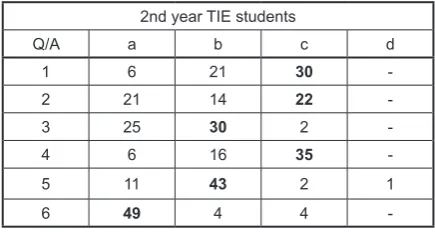
-versity of Technology. Fifty seven students participated in this survey. Its results are pre
-sented in Table 2.
The final group was made up of, 3rd year graduate students in the field of Technical and Information Education. Thirty nine stu
-dents provided answers to the queries. The results for this survey were are showcased in Table 3, whereas the consolidated results can be found in Table 4.
SUMMARY AND CONCLUSIONS
The first query received c as the most fre
-quent answer - it was selected by 79 respon
-dents. Thus it can be concluded that video ad
-vertisements enjoy the greatest degree of impact of all the available options. The respondents also
chose videos as the preferred medium of
pro-moting studies, with 57 of them selecting option “c” in the second query. Sixty nine respondents opted from answer “b” for the third query. This
suggests that and ideal promotional video should
be 3-6 minutes long. “C” was the prevalent re
-sponse for query 4 given by 83 respondents. According to them video materials promoting a field of study should consist of both movie takes and slideshows. Furthermore, “b” was the most popular answer to the fifth query as confirmed by 100 respondents. It is thus expected that all the information should be conveyed through voice commentary. As for the last question the most answers were given to option “a” by 113 respon
-dents. This confirmed that a video promoting a field of study should include an appropriate and atmospheric music score in the background.
The analysis of premises associated with marketing, social interaction, survey research
as well as practical use of multimedia project
which promotes the field of study in Technical and Information Education lead to following conclusions:
1. According to the authors of this paper, using appropriately adjusted element - advertising and the way it is conveyed to the client, is one of the crucial means of promotion. For this reason, it is paramount to learn techniques and
marketing trends that can be taken advantage of for the purpose of promoting services and
institutions, and in the abovesaid scenario, a field of study.
2. Learning aspects of social interactions im
-proves effectiveness and reach of promotional campaigns. Utilizing video as the communi -cation carrier allows for attracting new clients
more efficiently.
3. Learning the needs of the target demograph -ic is crucial in order to make the video that
could address it. Among many other, survey research proves to be one of the most efficient tools of achieving that. In the presented sce
-nario, project objectives were formulated on the basis of achieved results and their analysis Table 2. The answers given by full-time second year
students in the field of Technical and Information Edu -cation
2nd year TIE students
Q/A a b c d
1 6 21 30
-2 21 14 22
-3 25 30 2
-4 6 16 35
-5 11 43 2 1
6 49 4 4
-Table 4. Consolidated answers
Consolidated answers
Q/A a b c d
1 7 40 79 0
2 42 27 57 0
3 43 65 12 1
4 9 33 83 1
5 17 100 8 2
6 112 5 8 0
Table 3. The answers given by full-time third year graduate students in the field of Technical and Infor -mation Education
3rd year TIE students
Q/A a b c d
1 1 9 29
-2 15 5 19
-3 11 22 - 1
4 1 9 28 1
5 5 32 2 1
-as well -as their conclusions. These objectives
laid the groundwork for multimedia project -
a video promoting Technical and Information Education as a field of study.
REFERENCES
1. Armstrong G., Kotler P., Marketing wprowadze -nie. WKP Warszawa 2012.
2. Domańska K., Czas marketingu bezpośredniego. „Marketing w praktyce”, nr 3, 2007.
3. Domański T., Skuteczna reklama i promocja. Pol -text Warszawa 1993.
4. Kotra K., Pysz-Radziszewska A., Marketing w teo -rii i praktyce. WSB Poznań 2001.
5. Michalski E., Marketing podręcznik akademicki. PWN Warszawa 2004.
6. Olvier S., Strategia Public Relations. PWE Warsza -wa 2005.
7. Podgórski R.A., Metodologia badań
socjologicz-nych, Branta, Bydgoszcz – Olsztyn 2007. 8. Rószkiewicz M., Perek-Białas J.,
Węziak-Białowolska D., Zięba-Pietrzak A., Projektowanie badań społeczno-ekonomicznych. PWN Warszawa 2013.
9. Sobotkiewicz D., Waniowski P., Marketing zagad -nienia podstawowe. PLACET Warszawa 2006. 10. Śmid W., Leksykon komunikacji medialnej. Dr
Lex Publishing House, Kraków 2010.
11. White R., Reklama, czyli co to jest i jak się ją robi. Business Press Ltd., Warszawa 1997.
12. Witek E., Komunikacja wizualna nowoczesne narzędzia. ASTRUM Wrocław.
13. Wojciechowski T., Encyklopedyczne podstawy marketingu. PLACET Warszawa 2009.
14. http://www.biznesklaster.pl/company/article/123- rodzaje-reklamy-i-elementy-wpywajace-na-jej-skutecznosc/, 14.01.2015.
15. http://ksiazekreatywnosci.pl/kim-jest-klient/, 15.01.2015.