An Analysis of Software Testing Security using
Quality Assurance and Reliability
1
Dr.S.Kannan, 2Mr.T.Pushparaj 1
Research Supervisor, 2Research Scholar,
Madurai Kamaraj University, Madurai
Abstract
In our lives are directed by great, composite systems with progressively complex software, and the security, security, and dependability of these systems has established a central concern. As the software in today’s arrangements produces larger, it has extra faults, and these faults adversely disturb the safety, security, and dependability of the systems. Software engineering is the submission of a methodical, disciplined, measurable method to the development, operation, and maintenance of software. Software divides into two pieces: internal and external quality characteristics. External quality characteristics are those portions of a product that face its users, where internal quality characteristics are those that do not. Quality is conformance to product requirements and should be free. This research concerns the role of software Quality. Software dependability is a significant surface of software quality. It is the probability of failure-free process of a computer program in a quantified environment for a quantified time. In software reliability modeling, the parameters of the model are typically assessed from the test data of the conforming constituent. However, the widely used point estimators are subject to random differences in the data, resulting in uncertainties in these projected parameters. This research defines a new method to the problem of software testing. The method is based on Bayesian graphical models and offerings official mechanisms for the logical structuring of the software testing problem, the probabilistic and arithmetical action of the suspicions to be addressed, the test design and analysis procedure, and the combination and suggestion of test results. Once built, the models produced are dynamic depictions of the software testing problem. It explains essential of the mutual test-and-fix software quality approach is no longer acceptable, and characterizes the possessions of the quality approach.
I. INTRODUCTION
Testing is the process of finding alterations among the probable behavior, detailed by the requirements, and the observed performance of the system.
Testing is often achieved by designers who were not involved with the construction of the system. A fault defect or bug is the mechanical or algorithmic reason of an error. The goal of testing is to maximize the number of exposed faults, which then permits designers to correct them and growth the reliability of the system. The significance of medical software must not be underestimated. The achievement and failure of a medical practice hinges on these medical software systems. These software systems are assignment critical and need critical real time systems growth. Medical software systems also are essential independent substantiation in orders to growth the impartiality and the efficiency.
The medical software engineers grow and preserve these critical software applications by applying methods and knowledge from areas of computer science, computer engineering, biomedical engineering and project organization. The difficulty of current software requests can be difficult to understand for anyone without knowledge in modern-day software growth. Client-server and dispersed applications, data communications, and enormous relational databases have all added to the exponential development in software difficulty. If there are variations in addictions among parts of the project, they are likely to interact, reason problems, and may consequence in errors. Time pressures and development of software projects donate to these problems. Management must understand the subsequent risks, and software tester must accept a plan for incessant extensive testing to retain the predictable mistakes from running out of control.
A. Software Safety Defined
Software Safety is defined as ―The discipline of software assurance that is a methodical method to classifying, evaluating, following, modifying, and controlling software hazards and hazardous purposes (data and commands) to ensure safe operation within a system‖.
B. Software Quality Defined
product, or service contents a identified set of characteristics or requirements‖.
C. Software Reliability Defined
Software reliability as a correction of software declaration describes that "Software reliability is the probability that software will not reason the failure of a system for a detailed time under specified conditions. The probability is a function of the contributions to and use of the system as well as a function of the presence of responsibilities in the software.
D. Software Quality Assurance
Software Quality Assurance defined as ―The function of software quality that assures that the Values, Processes, and Procedures are suitable for the project and are properly executed‖.
II. SOFTWARE RELIABILITY AND ITS PROBLEM
Reliability engineering is a significant part of many system improvement efforts and accordingly there has remained an excessive contract of research in the software based schemes. One significant movement included in reliability engineering is reliability estimate. Reliability is frequently measured based on probability theory and, in overall, mathematical statistics are used to estimation these probabilities.
To control a composite industrial procedure, many varied components are wanted to work composed
with maximum reliability. The integration of varied components into mechatronics systems necessitates broadening the concepts and cooperation among dissimilar technical corrections elaborate to grow a mutual conception of the future product and come up with an enhanced solution. So the difficulty of mechatronics system is to be broken by extracting the basic important function of the dissimilar units. So, it is wanted to abstract the reliability related individualities from each discipline and unify them in a way suitable for mechatronics as whole. The reliability definition stresses four elements namely
i. probability ii. Intended functions iii. Time
iv. Operating conditions.
The numerical assessment of dependability is based on the total period of failures or the occurrence of failures. So, greatest benefit from the use of reliability can be attained at the initial phases of the design of programmable mechatronics system to recognize the acceptable assurance about the systems and its apparatuses. The reliability analyses of numerous components complicated in software based systems can be approximately classified in to
a. Software component reliability. b. Interface and networking reliability. c. Software controlled hardware reliability.
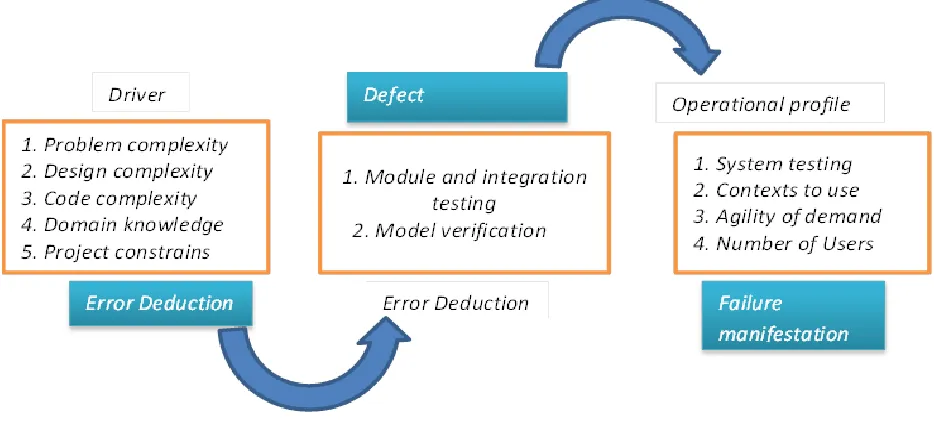
FIG 1 Model of Reliability Factors
It has remained noted that dependability of the large scaled electro-mechanical systems should be properlyassessed based on the subsystems reliability.
a customer. Software Quality deals with ―fitness of Use‖ and ―Contents user requirement‖.
IEEE describes software quality as a software feature or Characteristic used to evaluate the quality of a system. Software Quality is restrained in dissimilar methods, using internal limitations, and outside attributes. Software reliability is Quality factor. Parameter description is exact significant in Reliability. System level developed reliability factor is hard to find.
III. SOFTWARE QUALITY ASSURANCES Software Quality Assurance is the prearranged and methodical set of doings that confirms that software imitates to necessities, standards, and procedures. SQA contains the procedure of promising that values and actions are recognized and monitored through the
software attainment life cycle. Software development is a procedure of managing and handling numerous risks. These risks can be both technical and programmatic; risks that the software will not achieve as intended or will be too problematic to operate, change, or preserve are technical risks, while risks that the project will overrun cost or schedule are programmatic risks. The goal of software assurance is to decrease many of these risks. Creating standards and actions for software development is dangerous. These deliver the framework from which the growth and control procedures are associated. Proper certification of values and actions is essential since the SQA actions of process monitoring and product assessment rely upon unequivocal descriptions to measure project agreement.
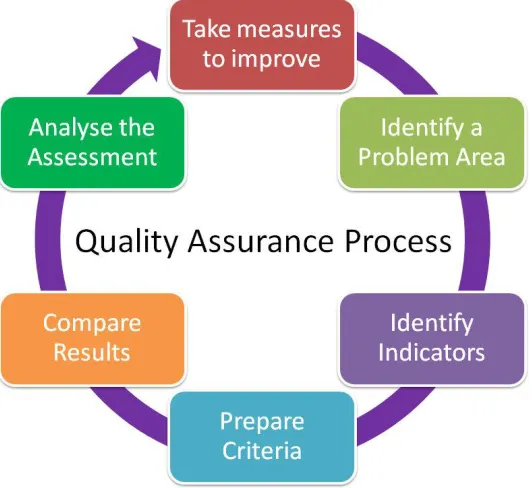
FIG 2 Software Quality Assurances
A. Software Quality Assurance Activities
Product evaluation and process monitoring are the SQA activities that assure the software development is described correctly, and that the project's procedures and standards are followed. It is recommended that the first products monitored by SQA should be those standards and procedures. SQA assures that clear standards exist and assesses compliance of the software product to the recognized values. Additional SQA action is procedure monitoring, which confirms that suitable steps to carry out the procedure are being followed. SQA monitors procedures by associating all
of the actual steps approved out with those in there cognized measures.
Validation (VV), and Format Testing (FT). SQA promises that CM doings are achieved in accordance with development plans, values, and events. The CM actions checked and checked by SQA comprise baseline control, formation identification, configuration control, conformation position accounting, and configuration verification.SQA promises Verification and Validation doings by monitoring technical appraisals, inspections, and walkthroughs. SQA also confirmsthat all actions are allocated, standard, arranged, and efficient.
FIG 3 Software Quality Assurance Activities
Technical evaluations must be showed at the end of separately phase of the life cycle to classify difficulties and control whether the creation meets all appropriate requirements. In technical appraisals, actual work done is related with standard values to control whether the invention is ready to proceed with the next phase of development. An inspection or walkthrough is a detailed examination of ainvention on a step-by-step or line-by-line beginning to find errors.
SQA assures that prescribed software testing, such as acceptance testing, is done in agreement with plans and procedures. It comprises test plans, test conditions, test actions, and test reports. By FT, SQA assures software is whole and prepared for distribution.
IV. QUALITY SAFE GROWTH MODEL In semi-supervised knowledge, choice rule is to be educated from considered and unlabeled data. In this framework, we stimulate smallest entropy regularization, which allows incorporating unlabeled data in the standard supervised knowledge. Our methodcomprises other methods to the semi-supervised problem as specific or limiting cases. A series of experiments demonstrates that the planned answers benefit from unlabeled data. Extra distinguishing challenge in software testing and reliability is the lack
of obtainable failure data from a solitary test, which often kinds modeling difficult. This lacks of data stances a bigger challenge in the indecision analysis of the software reliability modeling. The present semi-supervised knowledge methods are all not very actual for our case of lack of failure date.
A. Objective
The impartial is to enumerate the reservations in the software reliability model of system with connected limitations. Challenges in software reliability are the lack of obtainable disappointment data from a single test, which often types modelling problematic. Using that data positions a bigger challenge in the indecision analysis of the software reliability modelling. For attaining good quality, we use dependability model using Bayes method with TQM.
B. Reliability Approach
Reliability is the probability of a device execution its determination sufficiently for the period planned under the given operating conditions. The definition carries into attention four significant factors namely,
i. The dependability of a system is communicated as a probability.
ii. The system is essential to give acceptable routine. iii. The duration of acceptable performance is detailed. iv. The environmental or operating situations are prescribed.
Reliability is frequently restrained in terms of probabilities.
The theory of Bayesian numbers is a well-established and the way has remained applied in numerous parts including software, computerization systems, medical analysis, geological surveys etc. In the software based system, the indeterminate variables are related to each module where the improbability is specified by probability density. The probability density expresses our certainty or confidence in the numerous possible consequences of variable.
This probability depends provisionally on the position of other constituent founded on dissimilar input. The probabilities are assessed by resources of arithmetical approaches. Numerous statistical approaches are obtainable for approximating the dependability of the system, but these approaches are not appropriate for approximating the reliability of software based system, because, these approaches have not considered the uncertainties of unidentified parameters. The Bayesian statistical technique considers the uncertainties of unknown parameters. So, Bayesian model is mostly used for approximating the reliability of software-based schemes. This technique is Quality Assurance
also used to predict the future of the scheme by the observed information. Dependability is the probability that a scheme will activate without failure for a given time in a given environment. Note that reliability is defined for aassumed environment.
Since the test and processes environments are usually dissimilar, model consequences from test data may not apply to a processes environment. The "given time" in this definition may signify any number of definite data substances, such as number of implementations; number of appearances of code traversed, or wall clock time. The use of a model also requires careful definition of what a failure is. Reliability models can be run separately on individually disappointment type and severity level. Models have been established to measure, approximation and predict the reliability of computer software. Software reliability has established much consideration because reliability has continuously had obvious effects on extremely visible parts of software development: testing previous to delivery, and maintenance. Early efforts attentive on testing mainly because that is when the difficulties performed. As technology has matured, root reasons of improper and variable software must remain recognized previous in the life cycle. This need been due in part to the obtainability of results from dimension research and/or application of reliability models.
Step 1. Take a prior factor p (a) with respect to a certain parameter, given a set of newly observed data. Step 2. Using the newly observed data, estimate the parameter ‗f‘.
Step 3. Derive g=∫ f‘/4 by using that formulae. Step 4. Compare the values ‗f‘ and ‗g‘.
Step 4. If (f < g) or (f> g), the adjustment. should be triggered. The estimated parameter ‗E‘ is located at the extreme tails of the prior distribution.
Step 5.Adjust the degree factor d* for filtering and then recalculating the prior distribution and then repeat Step 1.
C. Measure Information
It can be used to method physical systems from the point of view of information model, because the probability deliveries can be consequent by escaping the supposition that the observer has additional information than is essentially accessible. Information theory, mostly the description of information in positions of probability deliveries, delivers a quantitative measure of inexperience that can
be exploited accurately to find the probability delivery that is extremely impartial.
D. Entropy
If any of the probabilities is identical to 1 then all the other probabilities are 0 and we then know exactly which state the system is in. Since probabilities are used to manage with our lack of information, and since one individual may have additional knowledge than additional, it follows that two observers say, because of their dissimilar information, use dissimilar probability deliveries. In this sense probability, and all amounts that are based on probabilities, are subjective.
V. VERIFICATIONAND VALIDATION PROCESS
Verification & Validation of protection critical subsystems found confidential larger systems is a great challenge, not smallest of all as the Verification and Validation procedure needs to be approved out within a specified time without conceding on the final safety of the general system. The traditional V&V method in case of safety dangerous systems is to test the embedded system with the test cases till such time as all the responsibilities are supposed to be noticed and all the tests produced for the system pass. The supposition for implementation of these tests is that the test setup is precise and the test cases for the system testing are also accurate. It is experiential that the time taken to perform these tests often take longer than the required time, many a times effecting the project schedules.
Safety Critical System under Test
Testing in the Verification and Validation process completed Each iteration executes test based on NRT, Random, Static and dynamic
Based testing Embedded system functionality Tested at each iteration. The system Functionality added in each
iteration
Verification and Validation Process:
Divide the Embedded System into `N‘ logical Functionalities
Fix the bug
Any Failure?
Are all the`N‘
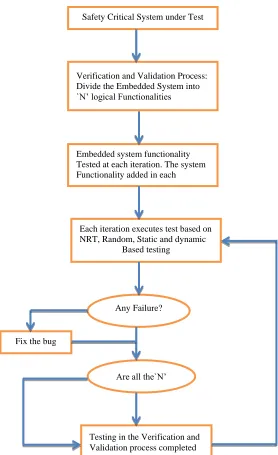
FIG 4 Verification and Validation Process Flow
The V&V of this functionality of a scheme is to be accepted out with the conventional method. This paper proposes an altered conventional method, which uses the conservative method as the framework, extra similar doings are accepted and some of actual testing actions are declared. The conventional V&V approach for an embedded system talks about the sequential execution of the low level is testing, software integration testing, hardware-software integration testing and finally the system testing. This approach is a proven process to capture bugs, defects in the system during the embedded system development lifecycle.
New tools enable this process for better productivity and reliability as the errors with the human in the loop is reduced. Model based development is a step towards in that direction.
VI. PROPOSED SYSTEM
1)Process for Emerging and Executing Software Quality Assurance.
2)Software Quality Activity Matrix: Activities of SoftwareQuality that must be achieved during each development phase (i.e., concept formation, necessities analysis, scheming, development, addition, testing, user trails, operation and maintenance).
3)SQA Data Management Plan: A database must be setupfor gathering and packing of the dissimilar kinds of data connected with the software quality doings and its artifacts.
Work instructions are the standard actions and instructions for execution Software Quality procedure and product valuations progressively through the software development life cycle.
a) Software Quality Valuation Process.
b) Software Quality Declaration Engineering Peer Review Assessment.
c) Software Quality Reporting Process.
A. Checklist
Numbers of checklists are providing to aid Software Quality department in measuring actions and products connected with software quality assurance.
1. Systems Review Checklists 2. Documentation Checklist 3. Other Assessment Checklists
B. Centralist Quality Repository Database
An integrated database comprising information that can be retrieved to produce regular reports and metrics. The database continues the records concerning quality declaration way, process valuation checklists, answers, explanations and values that can be simply sharable.
C. Forms and Templates
The dissimilar SQA strategies are recognized in main phases of, and in similar with project preparation which designates the performances that will use for detecting and appraising software growth process and products. The designs are based on IEEE 730-2002 Standards:
a) Software Quality Assurance Plan b) Software Quality Assessment Plan
c) Software Quality Assessment Report d) SQE learning and Knowledge Log: documentation of SQ knowledge and work involvement gained through project.
e) SQ Stakeholder role table: certification of project stakeholder‘s part and participation by software growth life cycle stage.
D. Motivation & Training
Software Quality personnel should have simple impression in the following disciplines finished prior experience, exercise, or authorization in organizations, procedures, and standards.
a) Software Quality Assurance b) Software Safety
c) Quality Audits and Appraisals d) Risk Management
e) FormationOrganization f) ISO 9001 and other Standards
g)IEEE Standard for quality and reliability assurance.
h) CMMI.
E. Safety
Software safety includes the methodical method to responsible, examining, and chasing software moderateness and to confirm software safety, control of dangers and hazardous purposes (e.g., data and methods) within system. Software is called Safety-Critical if it is achieve at smallest one of the following criteria:
1. Make hazard or chiefs to a hazard. 2. Delivers control for hazards.
3. Activates Safety-Critical approaches.
4. Notification and statement, or takes corrective action, if the system changes towards hazardous state.
5. Procedures Safety-Critical data or directions. 6. Cause damage if mistake happens in the
software.
7. Reside in a scheme as Safety-Critical software. 8. Software Safety program begins from
Condition stage and carries out through the software development life cycle counting hazard analysis in each stage.
F. Software V&V
Software verification and validation procedure chooses whether the growth of each movement is precisely similar as per the necessities through the product growth and whether the software achieves the user needs.
VII.PERFORMANCE ANALYSIS
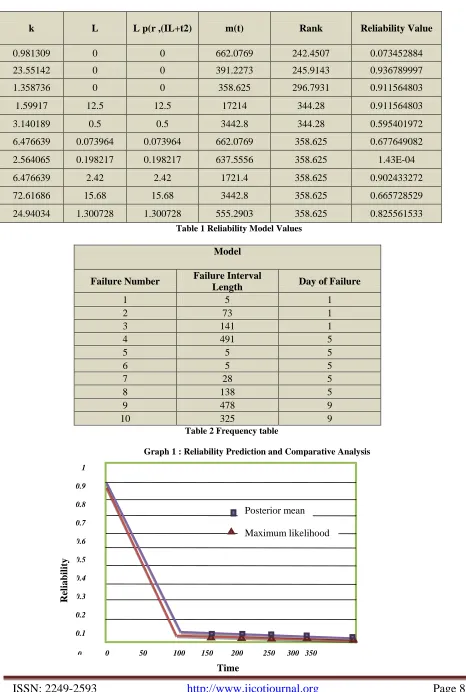
k L L p(r ,(IL+t2) m(t) Rank Reliability Value
0.981309 0 0 662.0769 242.4507 0.073452884
23.55142 0 0 391.2273 245.9143 0.936789997
1.358736 0 0 358.625 296.7931 0.911564803
1.59917 12.5 12.5 17214 344.28 0.911564803
3.140189 0.5 0.5 3442.8 344.28 0.595401972
6.476639 0.073964 0.073964 662.0769 358.625 0.677649082
2.564065 0.198217 0.198217 637.5556 358.625 1.43E-04
6.476639 2.42 2.42 1721.4 358.625 0.902433272
72.61686 15.68 15.68 3442.8 358.625 0.665728529
24.94034 1.300728 1.300728 555.2903 358.625 0.825561533
Table 1 Reliability Model Values
Model
Failure Number Failure Interval
Length Day of Failure
1 5 1
2 73 1
3 141 1
4 491 5
5 5 5
6 5 5
7 28 5
8 138 5
9 478 9
10 325 9
Table 2 Frequency table
Graph 1 : Reliability Prediction and Comparative Analysis
1
0.9
0.8
0.7
0.6
0.5
0.4
0.3
0.2
0.1
0 0 50 100 150 200 250 300 350
Reli
ab
il
ity
predic
tio
n
Posterior mean
Graph 2: System Reliability Analyses
VIII. CONCLUSION
Software progress is a procedure of commerce with many risks. These risks can be both practical and programmatic. The area of software declaration is to decrease many of these risks, particularly for critical systems such as medical or biomedical parts. Though there are numerous tools and methods obtainable to use for software testing, the best testing necessitates a tester's inspiration and involvement. Testing is not only used to locate defects but also correct them. It is also used in the authentication, confirmation process, and reliability amount of the software. Testing must be an essential component of the software procedure and it must be approved out through the life cycle. From the comparable models, we have taken practiced knowledge, historical data, and developing environments .This practiced knowledge elaborate in examining the improbability and for recompensing in adequate failure data. After analyzing the problem, this work additional spreads to more difficult systems that comprise many components, each with its own individual deliveries and indeterminate limitations.
REFERENCE
[1] G.L. Eyink and S. Kim, ―A Maximum Entropy Method for ParticleFiltering,‖ J. Statistical Physics, vol. 123, no. 5, pp. 1071-1128, 2005.
[2] A.L. Goel and K. Okumoto, ―Time Dependent Error- Detection Rate Model for Software Reliability and Other Performance Measures,‖ IEEE Trans. Reliability, vol. 28, pp. 206-211, 1979.
[3] K. Naresh Kumar, K. Krishna Reddy, Trace back of DDoS Attacks, – Volume 7 Number 1 – Apr 2014.
[4] F.E. Norman & S.L. Pfleeger, Software Metrics: ARigorousand Practical Approach, Second Edition. Boston: PWS Publishing,1997.
[5] K. Khosravi, & Y.G. Gueheneuc, ― A quality model for design patterns‖,2004.
[6] M. Goldstein, ―Subjective Bayesian Analysis: Principles and Practice,‖ Bayesian Analysis, vol. 1, no. 3, pp. 403- 420, 2006.
[7] Neha Mudgal, Virtual Reality in Cognitive Rehabilitation, Volume 34 Number2– August 2016.
[8] D.E. Holmes, ―Toward a Generalized Bayesian Network,‖ Proc. Am. Inst. Physics Conf.—Bayesian Inference and Maximum Entropy Methods in Science and Eng., vol. 872, pp. 195-202, 2006.
[9] M. Ortega, M. Perez, & T. Rojas, ―Construction of systemic quality model for evaluating a software product‖, Software QualityJournal 11: 219-242, 2003.
[10] E.T. Jaynes, ―Information Theory and Statistical Mechanics,‖ Statistical Physics, pp. 181-218, 1963. [11] C.Y. Tseng, ―Entropic Criterion for Model Selection,‖
Physica A: Statistical and Theoretical Physics, vol. 370, no. 2, pp. 530-538, 2005.
[12] K.S. Trivedi, Probability and Statistics with Reliability, Queuing, and Computer Applications. Prentice-Hall, 1982. [13] Dr. R. Satya Prasad ,Shaheen , G. Krishna Mohan, Two Step Approach For Software Reliability: HLSRGM, volume 4 Issue 10–Oct 2013.
[14] IEEE. ―IEEE standard for a software quality Metrics Methodology‖, 1993. [August 20, 2005].
[15] M. Xie, Y.S. Dai, and K.L. Poh, Computing System Reliability: Models and Analysis. Kluwer Academic, 2004.
[16] Liao H,Enke D., and Wiebe H.,‖An Expert Advisory Systems for ISO 9001 Quality System‖,Expert Systems with Applications,Vol 27,pp.313-322,2004.
[17] J. Musa, A. Iannino, and K. Okumoto, Software engineering and managing software with reliability measures. : McGraw-Hill, 1987.
[18] C.-Y. Huang and C.-T. Lin, ―Software reliability analysis by considering fault dependency and debugging time lag,‖ IEEE Trans.Reliability, vol. 53, no. 3, pp. 436–45 0, 2006. [19] Mfon-Abasi Raphael Idio, Measuring Sustainability
Impact of Software, volume 16 number 1 – Oct 2014. [20] P. Moranda and Z. Jelinski, Final Report on Software
Reliability Study McDonnall Douglas Astronautics 1
0.9
0.8
0.7
0.6
0.5
0.4
0.3
0.2
0.1
0 1 2 3 4 5 6 7 8
9 Time
Sy
stem
Reli
abi
li
ty
predic
tio
n
Company, 1972, Tech. Rep..[5] J. Musa, ―A theory of software reliability and its application,‖ IEEETrans. Software Engineering, pp. 312–327, 1975.
[21] N. Karunanithi, D. Whitley, and Y. K. Malaiya, ―Prediction of software reliability using connectionist models,‖ IEEE Trans.Software Engineering, vol. 18, no. 7, pp. 563–574, July 1992.
[22] G. A. Souza and S. R. Vergilio, ―Modeling software reliability growth with artificial neural networks,‖ in IEEE Latin American TestWorkshop, Buenos Aires, Argentina, March 2006, pp. 165–170.
[23] WasimAkram Shaik1 , Rajesh Pasupuleti, Avoiding Cross Site Request Forgery (CSRF) Attack Using TwoFish Security Approach, – volume 25 Number 2 – July 2015. [24] E. O. Costa, S. R. Vergilio, A. Pozo, and G. A. Souza,
―software reliability growth with genetic programming,‖ in XVIInternational Symposium of Software Reliability Engineering, USA, November 2005, IEEE Computer Society.
[25] G. Paris, D. Robiliard, and C. Fonlupt, ―Applying boosting techniques to genetic programming,‖ in IEEE International Joint Conference on Neural Networks, 2004, pp. 1163–1168.
[26] D. Solomatine and D. Shrestha, ―Adaboost-rt: A boosting algorithm for regression problems,‖ Intelligent Artificial Evolution, pp. 312– 326, 2001.
[27] Rodriguez-Dapena, ―Software Safety Certification: A Multinational Problem,‖ IEEE Software, July/August 1999, p. 31, © 1999 IEEE.
[28] G. Gordon Schulmeyer ―Handbook of Software Quality Assurance‖, Fourth Edition, ARTECH HOUSE, INC. 2008, pp. 212-213.
[29] The NASA Software Assurance Standard, NASA-STD-8739.8.