
STABILIZATION OF UNUSUAL SUBSTRATE COORDINATION MODES
IN DINUCLEAR MACROCYCLIC COMPLEXES
Vasile Lozan
Institute of Chemistry of ASM, 3 Academiei str., Chisinau, MD 2028, R. Moldova e-mail: [email protected]
Abstract: The steric protection offered by the macrobinucleating hexaaza-di tiophenolate ligand (L) allows for the preparation of the fi rst stable dinuclear nickel(II) borohydride bridged complex, which reacts rapidly with elemental sulphur producing a tetranuclear nickel(II) complex [{(L)Ni2}2(μ-S6)]2+ bearing a helicalμ
4-hexasulfi de ligand. The [(L)CoII
2]2+ fragment have been able to trap a monomethyl orthomolybdate in the binding pocket. Unusual coordination modes of substrate in dinuclear macrocyclic compounds was demonstrated.
Keywords: coordination chemistry, borohydride, hexasulphide, molybdate, amino-thiophenolate ligands.
Introduction 1.
The study of the coordination chemistry of classical coordination compounds with deep binding cavities is an active research area [1,2]. Motivations in this area are diverse and include molecular recognition of neutral or charged guest molecules, [3,4] stabilization of unusual substrate coordination modes, isolation of reactive species, [5] promotion of reactions within their interiors, [6-11] and construction of more effective enzyme active site mimetics, [12] to name but a few. Various types of supporting ligands for such complexes have been developed. Most of them represent mononucleating systems derived from cyclodextrines, [6] calixarenes [13], Schiff-base calixarene hybrids, and some highly functionalized tripod ligands [14-18]. Much less is known of ligand systems that encapsulate polynuclear core structures, and the chemistry of such systems is not well explored [19-21]. The coordination chemistry of binucleating hexaazadithiophenolate macrocycles has been reviewed [22-24].
The ligand H2L is effective dinucleating ligand towards various divalent metal ions. Complexes of composition [(L)MII
2(μ-L')]+ (M = Mn, Fe, Co, Ni, Zn, Cd) bearing Cl‾ and OAc‾ coligands (L') (Fig. 1) can be readily obtained by the treatment of the free ligand H2L with two equivalents of the corresponding metal(II) dihalogenides (MCl2) or acetates (M(OAc)2) in methanolic solution in the presence of a base [24]. Interestingly, the macrocycles can adopt two different conformations A and B (Fig. 1), which are reminiscent of the “partial cone” and “cone” conformations of the calixarenes. The complexes of the 3d elements of the type A conformation is only seen for small monoatomic bridging ligands such as L' = OH‾ and Cl‾. For large coligands (such as N3‾) or a multiatom bridging ligand (such as OAc‾) the bowl-shaped conformation B is assumed, the driving force being the more regular octahedral coordination environments about the MII ions.
Fig. 1.Cationic [MII
2(L)(μ-L')]+ complexes supported by the ligands (L)2− and schematic
representation of their structures (L' = coligand)
These complexes have a rich coordination chemistry since the [(L)M2]2+ fragments are able to coordinate a large variety of coligands such as Cl‾ [26 ], OH‾ [27], NO2‾ , NO3‾, N3‾ [28], and various carboxylates [29-33]. Some of the complexes feature unusual ligand coordination modes. The azide complex [(L)Ni2(μ-N3)]+ is a representative example. The planarity of the Ni–N3–Ni assembly (torsional angle τ = 0o) together with the remarkably obtuse Ni–N–N angles at 109.9(2)o has never been observed before for M–μ
mode can be traced to the complementary size and form of the binding pocket of the [(L)Ni2]2+ complex. The hydrazine complex [(L)Ni2(μ-N2H4)]2+ is an example for a complex that features an unusual conformation of a small neutral inorganic molecule. Free hydrazine exists predominantly in the gauche conformation at room temperature (dihedral angle τ ~100o) [37], also most commonly seen in dinuclear hydrazine complexes [38,39]. In [(L)Ni
2(μ-N2H4)]2+ the N2H4 ligand can only adopt the cis (ecliptic) conformation (τ = 3.7o). To the best of our knowledge, such a coordination mode is without precedence in dinuclear transition metal hydrazine complexes [40–44], albeit it is documented for mononuclear species [45,46]. The ecliptic N2H4 conformation is presumably a consequence of repulsive NH···Caryl van der Waals interactions between the N2H4 molecule and (L)2−.
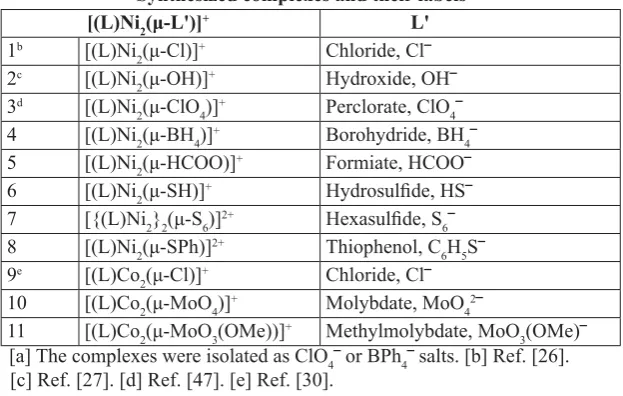
Table 1 lists the synthesized complexes and their labels. Of these, the complexes 1, 2, 3 and 9 have been reported earlier [26,27,30,47].
Table 1
Synthesized complexes and their labels [a]
[(L)Ni2(μ-L')]+ L'
1b [(L)Ni
2(μ-Cl)]+ Chloride, Cl‾ 2c [(L)Ni
2(μ-OH)]+ Hydroxide, OH‾ 3d [(L)Ni
2(μ-ClO4)]+ Perclorate, ClO4‾ 4 [(L)Ni2(μ-BH4)]+ Borohydride, BH 4‾ 5 [(L)Ni2(μ-HCOO)]+ Formiate, HCOO‾ 6 [(L)Ni2(μ-SH)]+ Hydrosulfi de, HS‾ 7 [{(L)Ni2}2(μ-S6)]2+ Hexasulfi de, S
6‾ 8 [(L)Ni2(μ-SPh)]2+ Thiophenol, C
6H5S‾
9e [(L)Co
2(μ-Cl)]+ Chloride, Cl‾ 10 [(L)Co2(μ-MoO4)]+ Molybdate, MoO
42‾ 11 [(L)Co2(μ-MoO3(OMe))]+ Methylmolybdate, MoO
3(OMe)‾ [a] The complexes were isolated as ClO
4‾ or BPh4‾ salts. [b] Ref. [26]. [c] Ref. [27]. [d] Ref. [47]. [e] Ref. [30].
In the following, selected examples of unusual substrate coordination modesoriginating from this work will be presented and discussed.
Stabilisation of a bridging borohydride co-ligand in dinickel(II) macrocyclic complex 2.
The search for dinuclear dithiolato-bridged complexes which model key features of the active site of hydrogenase enzymes is an active research area [48,49]. Two main strategies exist to access such compounds. One involves the addition of an electrophilic metal-carbonyl fragment to a nucleophilic metal complex with cis-oriented thiolate functions [50]. The resulting [NiFeS2], or [Fe2S2], assemblies are co-ligated with CO and CN‾ and represent good structural analogues of the proposed active site structures, as demonstrated recently by a number of research groups [51–54]. In the other strategy, macrocyclic dinucleating polyaza-dithiolate ligands are used for the cluster assembly [55]. Until now this strategy has only allowed for the production of homodinuclear nickel complexes, and it is unclear at present whether these more classical Werner type coordination compounds will ever be able to bind the biologically relevant co-ligands CO, CN‾ and H‾. Herein we provide the fi rst evidence for nickel–hydrogen interactions in such compounds. Our study was initiated by the recent discovery of Desrochers et al. [56], who demonstrated that the sterically encumbered hydrotris-(3,5-dimethyl-pyrazolyl)borate ligand (Tp*‾) can stabilize a hydrogen-rich nickel environment in [Tp*NiII(μ
1,3-BH4)]. In order to test whether similar dinickel(II) complexes with a bridging borohydride coligand are supported by the dinucleating hexaaza-dithiophenolate ligand (L)2‾ [26] an acetonitrile solution of the chloro-bridged complex [(L)NiII
2(μ-Cl)] ClO4 (1-ClO4) was treated with n-Bu4NBH4 under an argon atmosphere at ambient temperature. Unlike [Tp*NiIICl], [56] however, no reaction occurred. In a second approach, the reaction was carried out using the dark green perchlorato-bridged complex [(L)NiII
2(μ-ClO4)]ClO4 (3·ClO4) which was prepared by Cl‾ abstraction from
1-ClO4 with Pb(ClO4)2. This gave a pale-green solution of the desired borohydrido-bridged complex 4, which was isolated as its BPh4‾ salt in ca. 75% yield. In the absence of air and protic reagents this compound is stable for weeks, both in the solid state and in solution. This stability is quite remarkable given that nickel(II) complexes of sterically less demanding ligands are readily reduced to nickel boride [57].
presence of octahedral Ni(II) ions [λ = 650 (ν2) and 1074 nm (ν1)] [29]. Final confi rmation came from an X-ray crystal structure determination of 4·BPh4·2MeCN (Fig. 2). As can be seen, the BH4‾ ion bridges the two Ni(II) centres in a symmetrical fashion to generate a bioctahedral N3NiII(μ-S)
2(μ-BH4)NiIIN3 core structure that has never been observed before in nickel–thiolate chemistry. There are no interactions between the MeCN of solvent of crystallization and the [(L)NiII
2(μ-BH4)]+ cations. The average Ni–H distance at 1.89(4) Å compares well with that in the mononuclear NiS4H2 complex [NiII(bmp)
2] (bmp = bis(2-mercapto-1-methyl-imidazolyl)-borate), [59] the only other sulfur-rich Ni(II) complex with B–H···Ni interactions that has been structurally characterised.
Fig. 2. ORTEP representation of the structure of complex 4 at 50% probability ellipsoids. Hydrogen atoms, except those of the BH4‾ coligand, have been omitted for clarity.
Fig. 3. ORTEP representation of the structure of the formato complex 5 with thermal ellipsoids drawn at the 50% probability level. Hydrogen atoms, except that of the formato coligand, have been omitted for clarity.
Preliminary results show that 4 reacts with protic reagents HA, such as HCl, H2O, or HCO2H with liberation of H2 and formation of the respective [(L)NiII
2(A)]+ species (A = Cl‾1, OH‾2 and HCO2‾ 5). The new complex 5 is also readily produced by the reaction of 3 with CO2. IR measurements of 5·BPh4 showed two absorption bands at 1602 and 1424 cm‾1, attributable to the symmetric and antisymmetric stretching frequencies of a μ
1,3-bridging formate ion. This was also confi rmed by an X-ray crystal structure determination of 5·BPh4 (Figure 3). The electronic absorption spectra of 5 exhibits two weak absorption bands at 651 and 1114 nm which can be assigned to the spin-allowed 3A
2g→3T1g (ν2) and 3A
2g→3T2g (ν1) transitions of a nickel(II) (S = 1) ion in Oh symmetry [37]. There is also a weak shoulder around 910 nm attributable to a spin-forbidden 3A
2g→1Eg(D) transition which gains intensity due to the lowering of the symmetry. The 3A
1g→3T1g(P) transition (expected below 400 nm) is obscured in each case by the strong thiolate-to-Ni(II) LMCT transitions which occur in the same spectral region.
In summary, we have prepared the fi rst stable dinuclear nickel(II) borohydrido-bridged complex of a macrodinucleating hexaaza-dithiophenolate ligand. Work in progress is directed towards the synthesis of related compounds with bridging hydride ligands by taking advantage of the steric protection offered by the supporting ligand. Such compounds may also aid in understanding the electronic structures and the reactivities of the dinuclear active sites of the hydrogenase enzymes.
Macrocyclic dinickel(II) complexes colligated by hydrosulfi de and hexasulfi de ions 3.
So far, our studies have been confi ned to complexes bearing different coligands, we have now examined the capability of the [(L)Ni2]2+ fragment to bind as coligand hydrosulfi de (HS‾). Our motivation in this area are diverse and include: a) hydrosulfi de complexes of labile transition-metal ions are rather scarce [60–64]; b) the hydrosulfi de ion is a biologically relevant molecule [65]; c) nickel sulfur bonding is of importance in bioinorganic [66–68] and biomimetic chemistry [69–70]; d) the chemistry of SH‾ - containing complexes is of relevance to metal sulfi de hydrosulfurization catalysts [71-73]; and e) coligands with “soft” donor atoms have not been incorporated in the binding pocket of the [MII
2L]n+ complexes.
[(L)NiII
2(μ-Cl)]+ [(L)NiII2(μ-OH)]+ [nBu4N]OH
CH3CN
[(L)NiII
2(μ-BH4)]+ [(L)NiII2(μ-SH)]+ [(L)NiII
2(μ-BH4)]+ [{(L)NiII2}2(μ-S6)]2+
[(L)NiII
2(μ-ClO4)]+
1. 3 equiv S CH3CN
2. MeOH
1. 1 equiv S CH3CN
2. NaBPh4 MeOH
Na2S 9H2O RT, CH3CN, MeOH
77%
1 2
4
3
7
6
Scheme 1. Preparation of complexes 6 and 7.
Initial attempts aimed at the synthesis of the hydrosulfi de complex [Ni2L(SH)]+ (6) followed the method of preparing the hydroxide complex [Ni2L(OH)]+ (2) from [Ni
2L(Cl)]+ (1) and (n-Bu4N)OH, [27] but surprisingly, 1 proved to be substitutionally inert in reactions with Na2S·9H2O or (Et4N)SH [74]. The reduction of elemental sulfur by the borohydride complex [NiII
2L(BH4)]+ (4) [75] was sought as an alternative procedure. Indeed, when green 4·ClO4 was treated with 1 equiv of S powder in CH3CN, a yellow-brown solution forms immediately, and the desired hydrosulfi de complex 6 can be isolated from methanol as a brown-yellow ClO4‾salt in >70% yields. This reaction presumably involves thioborate/polysulfi de intermediates (as in the LiBH4/S8 system) [76,77] which hydrolyze during workup to produce hydrosulfi de anions which are trapped by the [NiII
2L]2+ fragment. It should be noted that complex 6 is also obtained, in similarly high yields, from reactions in acetonitrile of the extreme labile perchlorato complex [Ni2L(ClO4)] ClO4 (3·ClO4) with 1 equiv of Na2S·9H2O, followed by workup from methanol. That polysulfi de ions are indeed involved in these transformations was confi rmed by the isolation of the hexasulfi de complex [{Ni2L}2(μ-S6)] (BPh4)2 (7·(BPh4)2). This material could be reproducibly obtainned in yields as high as 70% when elemental sulfur is reacted with 4·ClO4 in MeCN in a 3:1 molar ratio followed by workup from wet methanol as indicated in Scheme 1. At larger (4:1) or smaller (2:1) S/3 ratios a yellow-brown solid of unknown composition precipitates. The complexes 6 and 7 are stable for weeks in the absence of air and protic reagents both in the solid state and insolution. This stability is quite remarkable given thathydrosulfi de complexes of sterically less demanding ligands are readily transformed into polysulfi des or metal sulfi des [63]. In the presence of air the yellow-brown color of solutions of 6 and 7 fades away within about 24 h and green products of unknown compositions precipitate.
The ESI-MS of a freshly prepared acetonitrile solution of 6 shows two nickel-containing fragments at m/z = 472.68 and 412.68 neither of which is the parent peak. The infrared spectrum of 6·BPh4 shows a weak sharp ν(SH) band at 2552 cm-1 typical for complexes with SH‾ groups [78]. For 7·(BPh
4)2 two weak IR bands appeared at 468 and 440 cm-1, attributable to the S-S stretching modes of the S
62‾ unit. These values agree well with those reported for K2S6 and other compounds with a S62‾ unit [79]. Electronic absorption spectra for 6·ClO
4 and 7·(ClO4)2 complexes feature three intense absorption maxima in the UV at ~270 nm, ~300 nm, and 330 nm. These are characteristic for nickel complexes of L2‾. The former two can be attributed to π-π* transitions within the aromatic rings of the supporting ligand whereas the latter corresponds to a thiophenolate → NiII charge transfer absorption. Unfortunately, the ligand-to-metal charge transfer (LMCT) bands involving the SH‾ and S62‾ groups are not resolved. Above 500 nm complex 4 exhibits two weak absorption bands at 663 and 1175 nm which can be assigned to the spin-allowed 3A
2g→3T1g (ν2) and 3A2g→3T2g (ν1) transitions of a nickel(II) (S = 1) ion in Oh symmetry [80]. The corresponding values for 6 are signifi cantly blue-shifted to 647 and 1102 nm, respectively. The 3A
1g→3T1g (P) transition (expected below 400 nm) is obscured in each case by the strong LMCT transitions. From the ν1 transition one can obtain rough estimates of the octahedral splitting parameters
Δoct for 4 (≈8511 cm-1) and for 6 (≈9074 cm-1), respectively. Such low values for Δ
oct (i.e., Δoct (4, 6) < Δoct [Ni(H2O)6]2+) 8500 cm-1) are quite typical for N
Table 2
Selected UV/Vis Data for complexes 1-4 and 6-8 complex coligand ν2/nm ν1/nm ∆0/cm-1
1a Cl‾ 658(41) 998(67) 10020
2a OH‾ 655(52) 1056(40) 9470
3b ClO
4‾ 578(129) 1066(86) 9381
4a BH
4‾ 650(43) 1074(77) 9311
6b SH‾ 663(32) 1175(49) 8511
7b S
62‾ 647(56) 1102(72) 9074
8a SPh‾ 667(52) 1141(68) 8764
a Data refer to the BPh
4‾ salts. b Data refer to the ClO4‾ salts
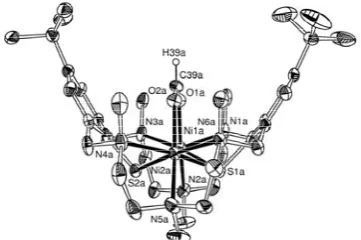
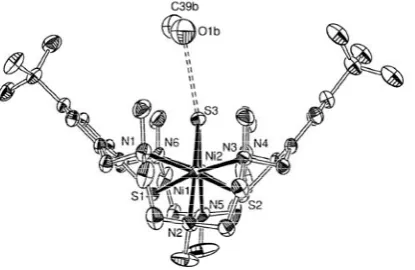
The structures of complexes 6 and 7 were further substantiated by X-ray crystallography. The atomic numbering scheme used for the central N3Ni(μ-S)3NiN3 core in 6 was also applied for 7 to facilitate structural comparisons. The structure determination of [Ni2L(SH)]BPh4·MeOH·2H2O unambiguously confi rmed the presence of the cationic hydrosulfi de complex [Ni2L(μ-SH)]+ (Figure 4).
Fig. 4. Structure of the hydrosulfi de complex 6 in crystals of 6·BPh4·MeOH·2H2O. Hydrogen atoms are omitted for reasons of clarity. The dashed line indicates a hydrogen bond between the SH moiety and the MeOH solvate
molecule (S(3)···O(1b) 3.285 Å).
Although the SH hydrogen atom could not be located from difference Fourier electron density maps, its presence is implied by IR spectroscopy and charge considerations (assuming the presence of one dianionic L2‾, one BPh
4‾, one SH‾, and two Ni2+ ions). There is also a MeOH solvate molecule that lies in the vicinity of the SH unit (S···OMeOH 3.285 Å) indicative of a weak SH···OMeOH hydrogen bond [82,83]. Unlike in isoelectronic [(L)Ni2(μ-Cl)]+ (1) or in [(L)Ni2(μ-OH)]+ (2), the macrocycle adopts the bowl-shaped conformation B as observed in [(L)Ni
2(μ-ClO4)]+ (see Figure 1 for a schematic representation of the two conformations) [47]. The presence of the type B conformation of L2‾ in 4 presumably relates to the larger ionic radii of the SH-group (OH‾: 1.19 Å, Cl‾: 1.67 Å, SH‾: 1.93 Å) [84]. Previous work has shown that the conformation of L2‾ is coupled to the size of the coligand L′ in the [Ni
2L(L′)]+ complexes [28,85] L2‾ adopts the bowl-shaped conformation when L′ is large, the driving force being the more regular octahedral coordination environment about the Ni2+ ions. Similar arguments can be used to explain the different structures of 1, 2, and 6 (which bear all single-atom bridging ligands). Thus, upon going from the μ-OH complex 2 to the μ-Cl complex 1 the macrocycle maintains conformation A and the deviations of the L-M-L angles from the ideal values increase; particularly affected are the N-M-X trans angles. On the other hand, upon going from 2 to the SH complex 6, L2‾ changes its conformation and the NiN
3S3 polyhedra become more regular. A number of dinuclear nickel complexes with μ-SR groups have been reported in the literature [86,87]. Pohl has reported a dinickel complex with two bridging SH groups [88]. As far as we are aware, 6 is the fi rst dinickel complex with a single μ-SH group. The average Ni-SR (thiolate) bond length of 2.479(1) Å in 6 is quite typical for six-coordinate NiII thiolate complexes. For example, the Ni-μ-SPh bonds in the octahedral complexes [Ni(terpy)(μ-SPh)2]2·6MeOH [89] and [(L)Ni2(μ-OAc)]BPh4 [90] are 2.465(2) Å and 2.471(1) Å long, respectively. However, the Ni-μ-SH distances in 6 (mean 2.527(1) Å) are signifi cantly longer than the Ni-μ-SR(thiolate) bonds. This is in good agreement with the notion that the SH‾ ligands are weaker
σ-donors than thiophenolates. It should be noted that the Ni···Ni distance in 6 at 3.295(1) Å is quite long for complexes containing face-sharing N3Ni(μ-SR)3 NiN3 structures. In the trinuclear complexes [{Ni2L′′}2Ni]+ and [{Ni
(L′′- octadentate N3S3 ligand), the nickel atoms are separated by only 3.008(2) and 3.029(1) Å [91]. Likewise, for [Ni2L′′′3]2+ (L′′′ - tridentate N
2S ligand) the Ni···Ni distance is 3.064(1) Å [92]. The Ni-S-Ni angles in these complexes range from 78.9 to 80.16° and are thus more obtuse than in 6 (83.3-81.4°).
The crystal structure of [{Ni2L}2(S6)]·(BPh4)2·5MeCN (7·(BPh4)2·5MeCN) consists of discrete tetranuclear [{Ni2L}2(μ-S6)]2+ dications, tetraphenylborate anions, and acetonitrile solvate molecules. Figure 5 provides an ORTEP view of the structure of 7. Two dinuclear [Ni2L] subunits are linked via a helical S62‾ chain. Again, both [Ni
2L]2+ subunits feature a bowl-shaped conformation for reasons likely to be similar to those detailed above for 6. The average S-S bond length is 2.065(2) Å, and the dihedral S-S-S-S angles range from 76.4 to 94.3°. Similar values are observed in plastic sulphur [93] and other S62‾ systems [94,95]. It should be noted that the Ni-μ-S
6 bond lengths in 7 (mean 2.479(2) Å) are signifi cantly shorter than the Ni-μ-SH bonds in 6 averaging 2.527(1) Å, an observation that correlates nicely with the stronger σ-bonding ability of the S62‾ ion (vide infra). There are no unusual features as far as bond lengths and angles of the [Ni2L]2+ units are concerned. The average Ni-N (2.262(7) Å) and Ni-S (2.498(2) Å) bond lengths in 6 are similar to the values of the compound above. There are no signifi cant intermolecular interactions between the NiII
4 complexes within the lattice. The shortest intermolecular Ni···Ni distance is at 7.711(1) Å. The present coordination mode of the S62‾ dianion linking two binuclear N
3Ni(μ-SR)3NiN3 cores is also without precedence in the literature.
Fig. 5. Structure of the [{(L)Ni2}2(μ-S6)]2+ dication in crystals of 7·(BPh
4)2·5MeCN. Thermal ellipsoids are drawn
at the 30% probability level. Only one orientation of the disordered S62‾ unit is displayed. Hydrogen atoms are
omitted
The main fi ndings of these investigations can be summarized as follows: (a) the steric protection-offered by the supporting ligand L2‾ allows for the preparation and isolation of stable hydrosulfi de complexes of labile transition metal ions; (b) the [(L)Ni2(μ-ΒΗ4)]+ complex reacts rapidly with elemental sulfur and represents a versatile starting material for [(L)Ni2(μ-SH)]+; (c) polysulfi de complexes such as [{(L)Ni
2}2(μ-S6)]2+ are also accessible from [(L)Ni2(μ-ΒΗ4)]+ and S8; (d) unlike in [(L)Ni2(μ-Cl)]+ or in [(L)Ni
2 (μ-OH)]+, the larger SH‾ and S62‾ ions induce the bowl-shaped macrocycle conformation of type B; (e) the SH‾ and S62‾ ions groups are characterized by their poor σ-donor bonding abilities.
Trapping of monomethyl orthomolybdate in the binding pocket of the [(L)Co
4. II
2]2+ fragment
The synthesis and structural characterization of a large number of polynuclear oxo-alkoxo species of hexavalent Mo have been reported. Typical examples are polymeric [Mo2O5(OMe)2] [96], tetranuclear [Mo4O10(OMe)6]2‾ [97], and octanuclear [Mo8O24(OMe)4]4‾ [98], which can be readily prepared by solvolysis reactions of soluble isopolymolybdate anion precursors, such as (n-Bu4N)2[Mo2O7] and (n-Bu4N)4[Mo8O28], in methanol [99]. While the coordination chemistry of the polynuclear oxo-alkoxo molybdates is now fairly well-understood [100], surprisingly little is known about their monomeric MoVIO
do exist but only with bulky ligands [107,108]. Our study was initiated by the fi nding that tetrahedral oxoanions, such as ClO4‾ [47] and H2PO4‾ [29] can be readily accommodated in the binding pocket of the dinuclear [(L)M2]2+ complexes. This led us to study the ability of the [(L)M2]2+ fragment to bind tetrahedral oxoanions of the transition metals [109]. In the course of our studies, we have been able to trap the elusive MoO3(OMe)‾ ion.
The neutral CoII
2 complex 10 was chosen as the target compound. Following the method of preparation of [(L) Ni2(O2P-(OH)2)]+ from [(L)Ni
2(Cl)]+ and (n-Bu4N)H2PO4 [29], 1 was treated with (n-Bu4N)2MoO4, [110, 111] in CH3CN at ambient temperature for 12 h, as indicated in Scheme 2, to yield 10 as a pale-red powder. Recrystallization from dichloromethane/ethanol produced analytically pure material in 84% yield.
[(L)CoII2(μ-Cl)][ClO4] (nBu4N)2MoO4 [(L)CoII2(μ-MoO4)]
CH3CN
[(L)CoII
2(μ-MoO3(OMe)]2[Mo4O10(OMe)6]
MoO32H2O
NEt3/ MeOH
9 10
11
Scheme 2. Synthesis of complexes 10 and 11.
In another attempt, we tried to synthesize 10 by the direct reaction of 9 with an excess of (HNEt3)2MoO4 (prepared in situ from MoO3·2H2O and NEt3) [112,113] in methanol, but this resulted in the formation of 11, which was reproducibly obtained as a dark-red-brown microcrystalline solid in ca. 45% yield. Attempts to generate a similar product by methanolysis of 9 have failed. Thus, the formation of 11 is simply a matter of trapping this species from solution.
The IR spectrum of 10 in KBr shows three strong absorptions at 861, 848, and 807 cm-1, which are tentatively assigned to the ν1(A1) and ν3(F2) stretching modes of the MoO42‾unit [114]. The splitting of ν
3 can be traced back to the lower local symmetry of the η2-bonded MoO
42‾ ion (see the crystal structure described below). The IR spectrum of 11 exhibits several absorbances in the 950-678 cm‾1 region. The bands at 941, 913, 880, 751, and 678 cm‾1 can be assigned to the various Mo-O stretching frequencies of the [Mo4O10(OMe)6]2‾ anion. Similar values have been reported for [Ph3MeP]2[Mo4O10(OCH3)6] [100]. The two remaining absorptions at 803 and 818 cm‾1 can then be attributed to the Mo-O stretching modes of the [MoO3(OCH3)]‾ unit, but these values should be taken as indicative rather than defi nitive. There may be further bands associated with the coligand that are obscured by the [Mo4O10(OMe)6]2‾ absorptions. The UV/vis spectrum of 10 is very similar to that of 9, displaying typical weak d-d transitions of octahedral high spin CoII in the 300-1600 nm range [90]. The weak broad band at 1307 nm can be assigned to the 4T
1g(F)→4T2g transition. The features in the 500-630 nm region are attributable to components of the parent octahedral 4T
1g(F)→4T1g(P) and 4T1g(F)→4A2g ligand fi eld transitions split by lower symmetry.
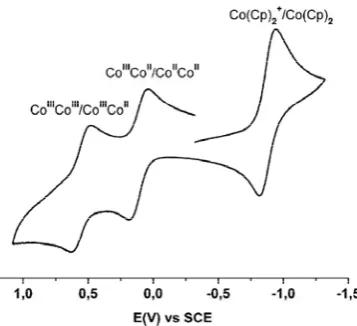
In view of the air stability of 10, it was of interest to determine its redox properties. Figure 6 shows its cyclic voltammogram in a dichloromethane solution. Two waves, one at E1
1/2 = + 0.10 V (vs SCE) with a peak-to-peak separation of 140 mV and one at E2
1/2 = + 0.55 V with a peak-to-peak separation of 146 mV, are observed. These oxidations correspond to metal-centered oxidations of the CoIICoII species 10 to its mixed-valent CoIICoIII and fully oxidized CoIIICoIII forms (eqs 1 and 2, respectively). Thus, as was observed previously for 9, the divalent CoII oxidation level is enormously stabilized over the trivalent state. Likewise, within our potential window, no reductions of theMoO42‾ ion are detected.
[(L)CoIIICoII(MoO
4)]+ + e‾ ↔ [(L)CoII2(MoO4)] E11/2 (1) [(L)CoIIICoIII(MoO
4)]2+ + e‾ ↔ [(L)CoIIICoII(MoO4)]+ E21/2 (2)
The normal potentials for 10 are slightly shifted to more negative potentials when compared with those of the acetate-bridged complex [(L)CoII
2(μ-OAc)]+ (E11/2 = 0.21 V; E21/2 = 0.60 V) [30]. These differences are likely a consequence of the charge differences. Recall that 10 is a neutral species whereas [(L)CoII
Fig. 6. Cyclic voltammogram of 10 in dichloromethane at 295 K.
The X-ray crystal structures of complexes 10 and 11·6MeOH were determined to establish the geometries about the metal ions as well as the bonding modes of the coligands.
Fig. 7. Structure of the neutral complex 10 in crystals of 10·CH2Cl2. Thermal ellipsoids are drawn at the 50% probability level. H atoms are omitted for reasons of clarity.
Fig. 8. Structure of the [(L)CoII
2(MoO3(OCH3))]+ cation in crystals
of 11·6CH3OH. Thermal ellipsoids are drawn at the 50% probability level. H atoms are omitted for reasons of clarity.
The structure of 10·CH2Cl2 consists of neutral complexes 10 and CH2Cl2 solvate molecules. There are no intermolecular interactions between the components. Figure 7 provides an ORTEP view of the structure of 10. The macrocycle adopts a bowl-shaped conformation, as observed in [(L)CoII
2(OAc)]+ [30]. Each Co atom is coordinated by two S and three N atoms from the supporting ligand and an O atom of a μ1,3-bridging MoO42‾ ion in a severely distorted octahedral fashion. The distortions from the ideal octahedral geometry are manifested in the cis and trans L-Co-L bond angles, which deviate by as much as 24.9o from their ideal values. The Co-metal ligand bond lengths in 10 are very similar to those in 9, indicative of a high-spin confi guration for the Co2+ ions [90]. The MoO
42‾ unit is slightly tilted out of the Co2O2 plane, with the oxo atom O(3) pointing in the direction of one benzene ring [distance O(3)···centroid of phenyl ring = 3.612 Å]. The coordination about Mo is not perfectly tetrahedral. The mean Mo=O [1.712(7) Å] and Mo-O [1.761(6) Å] bond lengths differ by ca. 0.05 Å, and the O-Mo-O bond angles range from 106.3(3) to 111.5(3)o. Similar values have been observed for other molybdato-bridged complexes[115] and for the oxo-alkoxo compounds MoO2(OSiPh3)2 [104] and MoO2(O-2,6-t- Bu2C6H2)2 [105]. It is also worth mentioning that the Co-O distances in 10 [mean 1.988(6) Å] are shorter than those in 11 [2.027(4) Å], an effect that may be traced to stronger electrostatic coligand-metal interactions in 10.
The crystal structure determination of 11·6MeOH unambiguously confi rmed the presence of a η2- coordinated monomethyl orthomolybdate situated in the pocket of the [(L)CoII
2]2+ fragment (Figure 9). Further components are a centrosymmetric [Mo4O10(OCH3)6]2‾ counterion and MeOH solvate molecules. Note that the asymmetric unit contains only half of the atoms of the formula unit. The three independent MeOH molecules are H-bonded to each other (O···O) 2.81-2.87 Å). One of them is also H-bonded to the polymolybdate ion, but there are no H bonds with the MoO3(OMe)‾
The Mo-O distance to the methoxide ligand [1.852(5) Å] is signifi cantly longer than the Mo=O distance [1.685- (5) Å] to the terminal oxo function. The Mo-O distances to the bridging oxides (mean value 1.734 Å) lie between these two extreme values. This is in contrast to the free MoO3(OSiCPh3)3‾ ion for which one long, one intermediate, and two short Mo-O distances have been reported [106]. The bonding situation in the MoO3(OMe)‾ ion may be described by the resonance structure depicted below, where bond orders of 2, 1.5, and 1 have been assigned to the individual M-O bonds.
It can be seen from Figure 9 that the centrosymmetric [Mo4O10(OMe)6]2‾ counterion in 11 (Figure 8) is isostructural with that in (MePPh3)2[Mo4O10(OCH3)6] [97]. There are no unusual features as far as bond lengths and angles are concerned. The average Mo-(μ-O) [1.923(4) Å], Mo-OCH3 [1.919(4) Å], Mo-(μ-OCH3) [2.135(4) Å], Mo-(μ3-OCH3) [2.287(4) Å], and Mo-Ot [1.692(4) Å] bond lengths are similar to the values of the compound above [100].
Fig. 9. Structure of the [Mo4O10(OCH3)6]2‾ anion in crystals of 11·6CH
3OH. Thermal ellipsoids are drawn
at the 50% probability level. H atoms are omitted for reasons of clarity.
In summary, we have been able to trap a monomethyl orthomolybdate in the binding pocket of the [(L)Co2]2+ fragment. Work in progress is directed toward the synthesis of other ortho esters of the transition metals by taking advantage of the steric protection offered by the supporting ligand. These compounds may also exhibit novel reactivity features that are not seen for the free oxoanions.
5. Conclusions
The main fi ndings of these investigations can be summarized as follows: a) It was prepared the fi rst stable dinuclear nickel(II) borohydrido-bridged complex of a macrodinucleating hexaaza-dithiophenolate ligand (L2‾); b) the steric protection-offered by the supporting ligand L2‾ allows for the preparation and isolation of stable hydrosulfi de complexes of labile transition metal ions; c) the [(L)Ni2(μ-BH4)]+ complex reacts rapidly with elemental sulphur and represents a versatile starting material for [(L)Ni2(μ-SH)]+ and polysulfi de complexes such as [{(L)Ni
2}2(μ-S6)]2+; d) it was demonstrate that the parent MoO3(OCH3)‾ complex can be stabilized by the steric protection of the supporting ligand L2‾ in the dinuclear cobalt complex [(L)CoII
2]2+. Work in progress in this area directed toward the synthesis of new macrocyclic complexes with more deeper binding cavities.
Acknowledgements
The author is thankful for Prof. B.Kersting (University of Leipzig, Germany) for providing facilities of work in his research group and the German DAAD for fi nancial support.
References
Wieser, C.; Dieleman, C. B.; Matt, D. Coord. Chem. Rev. 1997, 165, 93–161. [2].
Poorters, L.; Armspach, D.; Matt, D.; Toupet, L.; Jones, P. G. Angew.Chem. 2007, 119, 2717–2719; Angew. [3].
Chem., Int. Ed. 2007, 46, 2663-2665.
Hammes, B. S.; Ramos-Maldonado, D.; Yap, G. P. A.; Liable-Sands, L.; Rheingold, A. L.; Young, V. G., Jr.; [4].
Borovik, A. S Inorg. Chem. 1997, 36, 3210–3211.
Rohde, J.-U.; In, J.-H.; Lee, M. H.; Brennessel, W. W.; Bukowski, M. R.; Stubna, A.; Munck, E.; Nam, W.; Que, [5].
L, Jr. Science 2003, 299, 1037–1039.
Reetz, M. T.; Waldvogel, S. R. Angew. Chem. 1997, 109, 870–873; Angew. Chem., Int. Ed. Engl. 1997, 36, 865-[6].
867.
Ooi, T.; Kondo, Y.; Maruoka, K. Angew. Chem. 1998, 110, 3213– 3215; Angew. Chem. Int. Ed. 1998, 37, 3039-[7].
3041.
Yoshizawa, M.; Takeyama, Y.; Kusukawa, T.; Fujita, M. Angew. Chem. 2002, 114, 1403–1405; Angew. Chem., [8].
Int. Ed. 2002, 41, 1347-1349.
Engeldinger, E.; Armspach, D.; Matt, D. Angew. Chem. 2001, 113, 2594–2597; Angew. Chem. Int Ed. 2001, 40, [9].
2526-2529.
Slagt, V. F.; Reek, J. N. H.; Kramer, P. C. J.; van Leeuwen, P. W. N. M. Angew. Chem. 2001, 113, 4401– 4404; [10].
Angew. Chem., Int. Ed. 2001, 40, 4271-4274.
Yandulov, D. V.; Schrock, R. R. Science 2003, 301, 76–83. [11].
Rondelez, Y.; Bertho, G.; Reinaud, O. Angew. Chem. 2002, 114, 1086–1088; Angew. Chem.Int. Ed. 2002, 41, [12].
1044-1046.
Cameron, B. R.; Loeb, S. J.; Yap, G. P. A. Inorg. Chem. 1997, 36, 5498–5504. [13].
Kitayima, N.; Tolman, W. B. Prog. Inorg. Chem. 1995, 43, 419–531. [14].
Trofi menko, S. Scorpionates: The Coordination Chemistry of Polypyrazolylborate Ligands; Imperial College [15].
Press: London U.K., 1999.
MacBeth, C. E.; Golombek, A. P.; Young, V. G., Jr.; Yang, C.; Kuczera, K.; Hendrich, M.P.; Borovik, A. S. [16].
Science 2000, 289, 938–941.
Cho, J.; Yap, G. P. A.; Riordan, C. G. Inorg. Chem. 2007, 46, 11308–11315. [17].
Desrochers, P. J.; Cutts, R. W.; Rice, P. K.; Golden, M. L.; Graham, J. B.; Barclay, T. M.; Cordes, A. W. Inorg. [18].
Chem. 1999, 38, 5690–5694.
Herold, S.; Lippard, S. J. J. Am. Chem. Soc. 1997, 119, 145–156. He, C.; Lippard, S. J. J. Am. Chem. Soc. 1998, [19].
120, 105–113.
Hagadorn, J. R.; Que, L, Jr.; Tolman, W. B. J. Am. Chem. Soc. 1998, 120, 13531–13532. [20].
Du Bois, J.; Mizoguchi, T. J.; Lippard, S. J. Coord. Chem. Rev. 2000, 200-202, 443–485. [21].
Marr, A. C.; Spencer, D. J. E.; Schroder, M. Coord. Chem. Rev. 2001, 219-221, 1055–1074. [22].
Brooker, S. Coord. Chem. Rev. 2001, 222, 33–56. [23].
Lozan, V.; Loose, C; Kortusb, J; Kersting, B.Coord. Chem. Rev. 2009, 253, 2244–2260. [24].
Lozan, V.; Kersting, B. Inorg. Chem. 47 (2008) 5386. [25].
Kersting, B.; Steinfeld, G. Chem. Commun. 2001, 1376–1377. [26].
Klingele, M. H.; Steinfeld, G.; Kersting, B. Z. Naturforsch. 2001, 56b, 901–907. [27].
Hausmann, J.; Klingele, M. H.; Lozan, V.; Steinfeld, G.; Siebert, D.; Journaux, Y.; Girerd, J.-J.; Kersting, B. [28].
Chem.Eur. J. 2004, 10, 1716–1728.
Kersting, B. Angew. Chem. 2001, 113, 4109–4112; Angew. Chem., Int. Ed. 2001, 40, 3987-3990
[29].
.
Kersting, B.; Steinfeld, G. Inorg. Chem. 2002, 41, 1140–1150. [30].
Steinfeld, G.; Lozan, V.; Kersting, B. Angew. Chem. 2003, 115, 2363–2365; Angew. Chem., Int. Ed. 2003, 42, [31].
2261-2263.
Lozan, V.; Buchholz, A.; Plass, W.; Kersting, B. Chem. Eur. J. 2007, 13, 7305–7316. [32].
Klingele, J.; Klingele, M. H.; Baars, O.; Lozan, V.; Buchholz, A.; Leibeling, G.; Plass, W.; Meyer, F.; Kersting, [33].
B. Eur. J. Inorg. Chem. 2007, 5277–5285.
Pierpont, C.G.; Hendrickson, D.N.; Duggan, D.M.; Wagner, F.; Barefi eld, E.K. Inorg. Chem. 1975, 14, 604. [34].
Chaudhuri, P.; Guttmann, M.; Ventur, D.; Wieghardt, K.; Nuber, B.; Weiss, J. J. Chem. Soc., Chem. Commun. [35].
1985, 1618.
Ribas, J.; Escuer, A.; Monfort, M.; Vicente, R.; Cortes, R.; Lezama, L.; Rojo, T. Coord. Chem. Rev. 1999, [36].
193–195, 1027.
Hollemann, A.F.; Wiberg, E. Lehrbuch der Anorganischen Chemie, Walter de Gruyter, Berlin, 1985, Vol. 91, [37].
Sellmann, D.; Kunstmann, H.; Knoch, F.; Moll, M. Inorg. Chem. 1988, 27, 4183. [38].
Sellmann, D.; Soglowek, W.; Knoch, F.; Moll, M. Angew. Chem. 1989, 101, 1244; Angew. Chem., Int. Ed. En
[39]. gl.
1989, 28, 1271.
Henderson, R.A.; Leigh, G.J.; Pickett, C.J. Adv. Inorg. Chem. Radiochem. 1983, 27, 197. [40].
Sutton, D. Chem. Rev. 1993, 93, 995. [41].
Sellmann, D.; Engl, K.; Heinemann, F.W.; Sieler, J. Eur. J. Inorg. Chem. 2000, 1079. [42].
Matsumoto, K.; Koyama, T.; Koide, Y. J. Am. Chem. Soc. 1999, 121, 10913. [43].
Matsukawa, S.; Kuwata, S.; Ishii, Y.; Hidai, M. J.Chem. Soc., Dalton Trans. 2002, 2737. [44].
Blum, L.; Williams, I.D.; Schrock, R.R. J. Am. Chem. Soc. 1984, 106, 8316. [45].
Murray, R.C.; Schrock, R.R. J. Am. Chem Soc. 1985, 107, 4557. [46].
Lozan, V.; Kersting, B. Eur. J. Inorg. Chem. 2007, 1436–1443. [47].
Evans, D.J.; Pickett, C.J. Chem. Soc. Rev., 2003, 32, 268. [48].
(a) Marr, A.C.; Spencer D.J.E.; Schroder, M. Coord. Chem. Rev., 2001, 219–221, 1055; (b) Brooker, S. Coord. [49].
Chem. Rev., 2001, 222, 33–56.
Grapperhaus, C.A.; Darensbourg, M.Y. Acc. Chem. Res., 1998, 31, 451. [50].
Lai, C.-H.; Reibenspies, J.H.; Darensbourg, M.Y. Angew. Chem., Int. Ed. Engl., 1996, 35, 2390. [51].
Davies, S.C.; Evans, D.J.; Hughes, D.L.; Longhurst, S.; Sanders, J.R. Chem. Commun., 1999, 1935. [52].
Sellmann, D.; Geipel, F.; Lauderbach, F.; Heinemann, F.W. Angew. Chem., Int. Ed., 2002, 41, 632. [53].
Gloaguen, F.; Lawrence, J.D.; Rauchfuss, T.B. J. Am. Chem. Soc., 2002, 124, 726. [54].
Amoroso, A.J.; Chung, S.S.M.; Spencer, D.J.E.; Danks, J.P.; Glenny, M.W.; Blake, A.J.; Cooke, P.A.; Wilson, C.; [55].
Schroder, M. Chem. Commun., 2003, 2020.
Desrochers, P.J.; LeLievre, S.; Johnson, R.J.; Lamb, B.T.; Phelps, A.L.; Cordes, A.W.; Gu, W.; Cramer, S.P. [56].
Inorg. Chem., 2003, 42, 7945. Curtis, N.F. J. Chem. Soc., 1965, 924. [57].
Marks T.J.; Kolb, J.R. Chem. Rev., 1977, 77, 263. [58].
Alvarez, H.M.; Krawiec, M.; Donovan-Merkert, B.T.; Fouzi M.; Rabinovich, D. Inorg. Chem., 2001, 40, 5736. [59].
Kuwata, S.; Hidai, M. Coord. Chem. Rev. 2001, 213, 211–305. [60].
Huang, S. D.; Lai, C. P.; Barnes, C. L. Angew. Chem. 1997, 109, 1961–1964; Angew. Chem., Int. Ed. Engl. 1997, [61].
36, 1854-1856.
Howard, W. A.; Parkin, G. Organometallics 1993, 12, 2363–2366. [62].
Rombach, M.; Vahrenkamp, H. Inorg. Chem. 2001, 40, 6144–6150. [63].
Zhang, Y.; Zuo, J.-L.; Zhou, H.-C.; Holm, R. H. J. Am. Chem. Soc. 2002, 124, 14292–14293. [64].
Howard, J. B.; Rees, D. C. Chem. Rev. 1996, 96, 2965–2982. [65].
Fontecilla-Camps, J. C.; Volbeda, A.; Cavazza, C.; Nicolet, Y. Chem. Rev. 2007, 107, 4273–4303. [66].
Doukov, T. I.; Iverson, T. M.; Seravalli, J.; Ragsdale, S. W.; Drennan, C. L. Science. 2002, 298, 567-572. [67].
Peters, J. W.; Lanzilotta, W. N.; Lemon, B. J.; Seefeldt, L. C. Science 1998, 282, 1853–1858. [68].
a) Swenson, D.; Baenziger, N. C.; Coucouvanis, D. J. Am. Chem. Soc. 1978, 100, 1932–1934. b) Stavropoulos, [69].
P.; Carrie, M.; Muetterties, M. C.; Holm, R. H. J. Am. Chem. Soc. 1990, 112, 5385–5387. c) Wilker, J. J.; Gelasco, A.; Pressler, M. A.; Day, R. O.; Maroney, M. J. J. Am. Chem. Soc. 1991, 113, 6342–6343. d) Marganian, C. A.; Vazir, H.; Baidya, N.; Olmstead, M. M.; Mascharak, P. K. J. Am. Chem.Soc. 1995, 117, 1584–1594.
70. a) Liu, X.; Ibrahim, S. K.; Tard, C.; Pickett, C. J. Coord. Chem. Rev. 2005, 249, 1641–1652. b) Bouwman, E.; [70].
Reedijk, J. Coord. Chem. Rev. 2005, 249, 1555–1581. c) Mealli, C.; Rauchfuss, T. B. Angew. Chem. 2007, 119, 9100–9102; Angew. Chem. 2007, 46, 8942-8944. d) Eckert, N. A.; Dougherty, W. G.; Yap, G. P. A.; Riordan, C. G. J. Am. Chem. Soc. 2007, 129, 9286–9287.
Gaffney, T. R.; Ibers, J. A. Inorg. Chem. 1982, 21, 2857–2859. [71].
Rauchfuss, T. B.; Ruffi ng, C. J. Organometallics 1982, 1, 400–401. [72].
Mueting, A. M.; Boyle, P.; Pignolet, L. H. Inorg. Chem. 1984, 23, 44–48. [73].
Krebs, B.; Bobb, W.; Wellmer, H.-J.; Wiesmann, K. Z. Anorg. Allg.Chem. 1994, 620, 1234–1246. [74].
Journaux, Y.; Lozan, V.; Hausmann, J.; Kersting, B. Chem. Commun. 2006, 83–84. [75].
Lalancette, J. M.; Freche, A.; Brindle, J. R.; Laliberte, M. Synthesis 1972, 526–532. [76].
Banister, A. J.; Barr, D.; Brooker, A. T; Clegg, W.; Cunnington, M. J.; Doyle, M. J.; Drake, S. R.; Gill, W. R.; [77].
Manning, K.; Raithby, P. R.; Snaith, R.; Wade, K.; Wright, D. S. J. Chem.Soc., Chem. Commun 1990, 105–106.
Beck, W.; Danzer, W.; Hoferm, R. Angew. Chem. 1973, 85, 87–88; Angew. Chem., Int. Ed. Engl. 1973, 12, [78].
77-78.
Janz, G. J.; Coutts, J. W.; Downey, J. R.; Roduner, E. Inorg. Chem. 1976, 15, 1755–1759. [79].
Lever, A. B. P. Inorganic Electronic Spectroscopy, 2nd edition; Elsevier Science: Amsterdam, 1984. [80].
Krebs, B. Angew. Chem. 1983, 95, 113–134; Angew. Chem., Int. Ed. Engl. 1983, 22, 113-134. [82].
Steiner, T. Angew. Chem. 2002, 114, 50–80; Angew. Chem., Int. Ed. 2002, 41, 48-76. [83].
Huheey, J.; Keiter, E.; Keiter, R. Anorganische Chemie, 2 Aufl .; de-Gruyter: Berlin, 1995; p. 138. [84].
Gressenbuch, M.; Kersting, B. Eur. J. Inorg. Chem. 2007, 90–102. [85].
Franolic, J. D.; Wang, W. Y.; Millar, M. J. Am. Chem. Soc. 1992, 114, 6587–6588. [86].
Silver, A.; Millar, M. J. Chem. Soc., Chem. Commun 1992, 948–949. [87].
Pleus, R. J.; Waden, H.; Saak, W.; Haase, D.; Pohl, S. Dalton Trans. 1999, 2601–2610. [88].
Baidya, N.; Olmstead, M.; Mascharak, P. K. Inorg. Chem. 1991, 30, 929–937. [89].
Journaux, Y.; Glaser, T.; Steinfeld, G.; Lozan, V.; Kersting, B. Dalton Trans. 2006, 1738-1748. [90].
Beissel, T.; Birkelbach, F.; Bill, E.; Glaser, T.; Kesting, F.; Krebs, C.; Weyhermuller, T.; Wieghardt, K.; Butzlaff, [91].
C.; Trautwein, A. X. J. Am. Chem. Soc. 1996, 118, 12376–12390. Kersting, B.; Siebert, D. Inorg. Chem. 1998, 37, 3820–3828. [92].
Greenwood, N. N.; Earnshaw, A. Chemie der Elemente, 1 Aufl .; VCH: Weinheim, 1988; p. 864. [93].
a) Schnock, M.; Bottcher, P. Z. Naturforsch. 1995, 50b, 721–724. b) Bacher, A.D.; Muller, U.; Ruhlandt-Senge, [94].
K. Z. Naturforsch. 1992, 47b, 1673–1676. c) Muller, A.; Zimmermann, M.; Bogge, H. Angew. Chem.1986, 98, 259–260; Angew.Chem. Int. Ed. Engl. 1985, 25, 273-274. d) Draganjac, M.; Rauchfuss, T. B.Angew. Chem. 1985, 97, 745–760; Angew. Chem., Int. Ed. Engl. 1985, 24, 742-762. e) Furuhashi, T.; Kawano, M.; Koide, Y.; Somazawa, R.; Matsumoto, K. Inorg. Chem. 1999, 38, 109–114.
Tatsumi, K.; Inoue, Y.; Nakamura, A.; Cramer, R. E.; VanDoorne, W.; Gilje, J. W. Angew. Chem. 1990, 102, [95].
455–457; Angew. Chem.,Int. Ed. Engl. 1990, 29, 422-425. Tatsumi, K.; Kawaguchi, H.; Inoue, K.; Tani, K.; Cramer, R. E. Inorg. Chem. 1993, 32, 4317–4323.
McCarron, E. M.; Staley, R. H.; Sleight, A. W. Inorg. Chem. 1984, 23, 1043-1045. [96].
Liu, S.; Shaikh, S. N.; Zubieta, J. Inorg. Chem. 1987, 26, 4303- 4305. [97].
McCarron, E. M.; Harlow, R. L. J. Am. Chem. Soc. 1983, 105, 6179-6181. [98].
Liu, S.; Shaikh, S. N.; Zubieta, J. Inorg. Chem. 1989, 28, 723-732. [99].
Kang, H.; Liu, S.; Shaikh, S. N.; Nicholson, T.; Zubieta, J. Inorg.Chem. 1989, 28, 920-933. [100].
Piarulli, U.; Williams, D. N.; Floriani, C.; Gervasio, G.; Viterbo, D. J. Chem. Soc., Dalton Trans. 1995, [101].
3329-3334.
Kim, G. S.; Huffman, D.; DeKock, C. W. Inorg. Chem. 1989, 28, 1279-1283. [102].
Chisholm, M. H.; Folting, K.; Huffman, J. C.; Kirkpatrick, C. C. Inorg. Chem. 1984, 23, 1021-1037. [103].
Huang, M.; DeKock, C. W. Inorg. Chem. 1993, 32, 2287-2291. [104].
Hanna, T. A.; Incarvito, C. D.; Rheingold, A. L. Inorg. Chem. 2000, 39, 630-631. [105].
Klemperer, W. G.; Mainz, V. V.; Shum, W.; Wang, R. C. Inorg. Chem. 1985, 24, 1968-1970. [106].
Lubben, T. V.; Wolczanski, P. T.; Van Duyne, G. D. Organometallics 1984, 3, 977- 983. [107].
Hvoslef, J.; Hope, H.; Murray, B. D.; Power, P. P. Chem. Commun.1983, 1438-1439. [108].
McKee, V.; Nelson, J.; Town, R. M. Chem. Soc. Rev. 2003, 32, 309-325. [109].
Brauer, G. Handbuch der Praparativen Anorganischen Chemie, 3rd ) ed.; Ferdinand Enke Verlag: Stuttgart, [110].
Germany, 1981; p 1544.
Clegg, W.; Errington, R. J.; Fraser, K. A.; Richards, D. G. J.Chem. Soc., Chem. Commun. 1993, 1105-1107. [111].
Fuchs, J. Z. Naturforsch. 1973, 28b, 389-404. [112].
Thiele, A.; Fuchs, J. Z. Naturforsch. 1979, 34b, 145-154. [113].
Coomber, R.; Griffi th, W. P. J. Chem. Soc. A 1968, 1128-1131. [114].
Ghiladi, M.; McKenzie, C. J.; Meier, A.; Powell, A. K.; Ulstrup, J.; Wocadlo, S. J.Chem.Soc., Dalton Trans. [115].
![Fig. 1. Cationic [MII2(L)(μ-L')]+ complexes supported by the ligands (L)2− and schematicrepresentation of their structures (L' = coligand)](https://thumb-us.123doks.com/thumbv2/123dok_us/8796319.1769413/1.595.190.429.510.660/fig-cationic-complexes-supported-ligands-schematicrepresentation-structures-coligand.webp)
![Fig. 5. Structure of the [{(L)Ni2}2(μ-S6)]2+ dication in crystals of 7·(BPh4)2·5MeCN. Thermal ellipsoids are drawn at the 30% probability level](https://thumb-us.123doks.com/thumbv2/123dok_us/8796319.1769413/6.595.210.400.258.483/structure-dication-crystals-mecn-thermal-ellipsoids-drawn-probability.webp)
![Fig. 9. Structure of the [Mo4O10(OCH3)6]2‾ anion in crystals of 11·6CH3OH. Thermal ellipsoids are drawn at the 50% probability level](https://thumb-us.123doks.com/thumbv2/123dok_us/8796319.1769413/9.595.233.366.271.428/structure-anion-crystals-thermal-ellipsoids-drawn-probability-level.webp)
