Job Matching under Constraints
Fuhito Kojimaa, Ning Sunb, and Ning Neil Yub,c,* aStanford University, Department of Economics, United States ∗
bNanjing Audit University, Institute for Social and Economic Research, China cStanford University, Freeman Spogli Institute for International Studies, United States
October 31, 2018
Abstract
In a Kelso-Crawford job matching framework, we consider arbitrary con-straints imposed on the sets of doctors that hospitals are allowed to hire. A constraint preserves the substitutes condition if and only if it is a “generalized interval constraint,” which is a slight generalization of an “interval constraint” that specifies the minimum and maximum numbers of doctors to be hired. If all hospitals’ demand correspondences satisfy the substitutes condition, then the set of competitive equilibria is nonempty under a mild auxiliary assumption, the equilibrium salaries form a lattice, and a rural hospital theorem holds. We obtain a general comparative statics result and apply it to the case of vary-ing interval constraints. We also show that instead of compellvary-ing hospitals to obey interval constraints, the government can entice them through appropriate subsidy and taxation.
JEL Classification: C78; D47; D50; J20
Keywords: Job matching; Gross substitutes condition; Feasibility constraints; Competitive equilibria; Core allocation; Complete lattice; Rural hospital
∗
Corresponding author.
E-mail addresses: [email protected] (F. Kojima), [email protected] (N. Sun), [email protected] (N. N. Yu).
1
Introduction
Hiring entities often face various types of constraints. In the United States, firms
that receive favorable treatment from governments often promise to hire at least a certain number of workers (Byrnes, Marvel and Sridhar, 1999) – floor constraints. In Chinese cities, the household registration system distributes quotas to employers
for transferring employees’ registrations from other places (Chan and Zhang, 2009) – type-specific ceiling constraints on hiring non-locals. In rural India, a health sub-center is often required to be staffed by exactly one male and one female (Kapoor,
2011) –type-specific constraints with exact quotas. These are restrictions on the set of employees that an employer is allowed to hire. Building upon the classical framework
of Kelso and Crawford (1982), this paper studies how all possible restrictions of this type impact the existence and structure of competitive equilibria, as well as the
welfare of job market participants.
Our model endows each employer (called a hospital in our paper) with a rev-enue function that maps the set of its hires to a real number, and each employee (doctor) with heterogeneous and potentially non-quasilinear utility functions over
salaries and hospitals (unemployment is also allowed). Each hospital maximizes its
profit, that is, revenue minus total salary it pays, while each doctor maximizes her utility. Theinnate demand correspondenceof a hospital is induced by the hospital’s profit-maximizing behavior given its revenue function as well as its self-imposed constraint (if any), i.e., its set of hires can only come from aself-imposed feasibility collection.1 In addition, the hospital may be subject to an intervention, summarized by agovernment-imposed feasibility collection. A set of doctors isfeasiblefor a hospi-tal if it lies in the intersection of its self-imposed and government-imposed feasibility
collections, so its demand correspondence is required to satisfy both constraints. Our analysis starts with a standard assumption that the innate demand corre-spondence of every hospital satisfies the (gross) substitutes condition of Kelso and Crawford (1982). As shown by Gul and Stacchetti (1999), revenue functions whose
demand correspondences satisfy the substitutes condition constitute a maximal do-main that includes unit demand revenue functions and guarantees the existence
of competitive equilibrium. It is thus natural to pose the question: “What kind
of government-imposed feasibility collections preserve the substitutes condition (for
1
innate demand correspondences that satisfy it)?” We establish that there is a
sur-prisingly simple answer: a government-imposed feasibility collection preserves the substitutes conditionif and only if it is defined bya generalized interval constraint. An interval constraint commands a hospital’s total number of hires to fall between a floor and a ceiling; a generalized interval constraint forces a hospital to hire a (possibly empty) fixed subset of doctors, forbids it to hire another (possibly empty)
fixed subset of doctors, and commands its total number of hires from the rest to fall
between a floor and a ceiling. Given the aforementioned maximal domain result, our result implies that the existence of a competitive equilibrium is not guaranteed
unless the constraints take the form of generalized interval constraints.
Our analysis so far might suggest that a competitive equilibrium exists if the demand correspondences under constraints satisfy substitutability. However,
con-straints turn out to cause a new complication even under the substitutes condition.
Specifically, there is no natural upper bound on the salary that a hospital needs to pay in order to comply with its constraint, so in the standard existence proof
based on thehospital-proposing (deferred acceptance) algorithm of Kelso and Craw-ford (1982), salaries may not be bounded above, and hence the algorithm may not terminate in finite steps. Fortunately, we show that a mild technical assumption
on doctors’ utility functions is sufficient for competitive equilibria to exist, and that additional mild assumptions on feasibility collections entail the boundedness of
competitive equilibrium salaries.
We further explore the structure of competitive equilibria. Assuming that all demand correspondences satisfy the substitutes condition, we show that
competi-tive equilibrium salaries of a job market form a lattice and, if they are bounded,
a complete lattice, extending the results of Gul and Stacchetti (1999) for object assignment problems without constraints. The extension is nontrivial mainly
be-cause utility functions of doctors can be nonlinear in salaries in our setting. We
also establish a rural hospital theorem2, which is analogous to existing results in discrete matching settings while accounting for multi-valuedness of demand
corre-spondences.3
We then study welfare implications of imposing constraints. Our analysis reveals
2The recruitment problem of rural hospitals is well-known and this research project started as
an effort to address it.
3Formally, assuming the substitutes condition, given two competitive equilibria, we can replace
that raising floors or ceilings increases competitive equilibrium salaries in the weak
set order (Topkis, 1998). As a result, imposing or raising a floor constraint for a hospital benefits doctors and harms hospitals (in the weak set order); creating or
lowering a ceiling constraint for a hospital harms doctors and benefits all
hospi-tals except the one whose constraints were changed (for which the welfare effect is ambiguous).
Wary of the adverse effects of government mandates in certain situations, we
consider an alternative to imposing interval constraints: designing a transfer policy that subsidizes or taxes each hospital depending on the number of its hires. We
show that an appropriate transfer policy can induce hospitals to follow the feasibility
constraints voluntarily.
After relating our results to the literature, the remainder of the paper proceeds
as follows. Section 2 introduces our model. Section 3 characterizes constraints that
preserve the substitutes condition. Assuming that all demand correspondences sat-isfy the substitutes condition, Section 4 explores the existence of competitive
equi-libria and their structure. Section 5 studies comparative statics of varying interval
constraints. Section 6 is on how to entice hospitals to abide by interval constraints through subsidy and taxation. The concluding section discusses policy implications
and future directions of research. All proofs in this paper are relegated to appen-dices unless stated otherwise. Many lemmas that we discover in this project deepen
our understanding of the framework of Kelso and Crawford (1982) – in particular,
the substitutes condition. We state those lemmas in the main text.
Related Literature
The present paper is one of the few that study matching with constraints under
transferable utility. Bing, Lehmann and Milgrom (2004) study ceiling constraints,
although they work with a different interpretation of ceiling constraints.4 Gul, Pesendorfer and Zhang (2018) consider an assignment problem with multi-unit
de-mands and budget constraints; they also work with hierarchical ceiling constraints
under additional assumptions on revenue functions.5 Among the distinguishing fea-tures of our paper from theirs is that we provide a characterization, i.e., a necessary
4
Their interpretation of ceiling constraints is that when an agent purchases more items than is allowed she consumes an optimal feasible subset. By contrast, we ban over-hiring.
5
and sufficient condition, for preserving the substitutes condition.
Most existing studies of matching under constraints assume non-transferable utility, so they are quite different from ours. For example, a school in the
non-transferable utility setting cannot satisfy a floor constraint if too few students apply
to it, but a firm in the transferable utility setting could raise salaries to attract enough workers to satisfy the floor constraint. As might be expected given such
a difference, under non-transferable utility, stable matchings do not necessarily
ex-ist under floor constraints (Bir´o et al., 2010; Huang, 2010). By contrast, ceiling constraints of various kinds often retain desirable properties of unconstrained
prob-lems (Abdulkadiroglu and S¨onmez, 2003; Fragiadakis and Troyan, 2017; Kamada
and Kojima, 2018a).6 Other types of constraints have also been studied in the literature, such as proportionality constraints (Nguyen and Vohra, 2017),
multidi-mensional resource constraints (Delacretaz, Kominers and Teytelboym, 2016; Noda,
2018), and joint constraints imposed on multiple firms (Kamada and Kojima, 2015, 2017, 2018b). Due to the major difference in transferability of utility, none of the results in those papers is applicable to our setting nor vice versa.
More broadly, our paper contributes to the literature on matching or assignment with transfer. Significantly generalizing the one-to-one matching setting of Shapley
and Shubik (1971) to the many-to-one matching setting, Kelso and Crawford (1982) and Gul and Stacchetti (1999, 2000) find a crucial role of the substitutes condition
for guaranteeing the existence of a stable matching and a Walrasian equilibrium.
Recent works by Jagadeesan, Kominers and Rheingans-Yoo (2018) and Schlegel (2018) study some of the issues studied in the present paper regarding the structure
of Walrasian equilibria. The main difference of our paper from those contributions
is that all our results are obtained in the more general setting in which constraints are allowed. In addition, some of our results are stronger than the existing ones even
in models without constraints. For example, it was previously unknown that under
the substitutes condition, competitive equilibrium salaries form a lattice (with or without constraints).
6
2
The Model
A finite set of M doctors, D, and a finite set of N hospitals, H, participate in a
job market, which is regulated by an entity called government. A matching is represented by a function µ:D→ H, where H := H∪ {h0} and h0 stands for an
outside option called unemployment in this job market. We abuse notation and
let µ(h) :=µ−1(h) for everyh∈H.
A doctor d who is matched to h ∈ H at salary/income s ∈ R enjoys utility
Ud,h(s). Assume that any Ud,h is strictly increasing and continuous, and that for
any Ud,h(s) and h0 6= h, there exists s0 ∈ R such that Ud,h0(s0) > Ud,h(s). These
assumptions ensure that a doctor is willing to work for any hospital as long as
it compensates her well enough. We also normalize each doctor’s unemployment income and utility to 0. For each doctor d and hospital h, let the base salary
βd,h ∈ R be the level of the salary such that Ud,h(βd,h) = 0, that is, the doctor is
indifferent between working at that salary in the hospital and unemployment. A salary schedule is a function s:D→R; for any doctor d, we may write sd
in place ofs(d). It is useful to define, for eachA⊂D,eA∈RD to be the indicator
function forA, i.e., the salary schedule with all outputs zero except that eA(d) = 1 for every d∈A; we write ed:=e{d} and 1:=eD. A salary systemis an indexed
familyS :H→RD in the form of (sh)
h∈H; for any doctordand hospitalh, we may
write Sd,h in place of S(h)(d). The unemployment income schedule issh0 :=e∅; for
convenience, we set Sd,h0 = 0 for all salary systems we discuss in this paper. Given
a matchingµand a salary systemS = (sh)h∈H, theinduced salary schedule sµ,S
is defined by (i) sµ,Sd =sµd(d) ifµ(d)∈H and (ii)sµ,Sd = 0 if µ(d) =h0. An ordered
pair of a matching and a salary schedule (µ,s) specifies an allocation of the job
market if sd= 0 for everydwithµ(d) =h0.
Each hospital h is endowed with a revenue function Rh : 2D → Rsuch that
given a subset of doctors, A, the hospital generates a revenue of Rh(A). For each
h ∈H, we assume that Rh is monotone, i.e., whenever A ⊂B, Rh(A) ≤Rh(B).
This is a reasonable simplifying assumption because a hospital can always ask extra doctors to stay at home. When a hospital hhiresA⊂Dunder a salary schedules,
its profit isVh(A;s) =Rh(A)−
P
d∈Asd.
If a hospital h is constrained to choose among a nonempty collection Fh ⊂
2D, we call it the feasibility collection of h, and its elements feasible sets.
We may have Fh = F0 h ∩ F
g
h, where Fh0 is self-imposed and F g
government-imposed. A matching µ is feasible if µ(h) ∈ Fh for every h ∈ H; a
fam-ily of feasibility collections (Fh)h∈H indexed by H is compatible if there
ex-ists a feasible matching. We assume compatibility so that at least one
match-ing is allowed. A job market under constraints can be summarized as E =
(D, H,(Ud,h)d∈D,h∈H,(Rh)h∈H,(Fh0)h∈H,(Fhg)h∈H).
A hospital h facing a salary schedule s and a feasibility collection F maximizes
profit. We define the maximal profit functionby
Πh(s;F) = max{Vh(A;s) :A∈ F },
and thedemand correspondenceby
Xh(s;F) ={A∈ F :Vh(A;s) = Πh(s;F)}.
We call elements ofXh(s;F)demand sets. As a special case, when unconstrained,
the maximal profit function is Πh(·; 2D) and the demand correspondenceXh(·; 2D).
When a feasibility collection F0 is self-imposed, we call X
h( ·;F0) the innate
demand correspondence; when government-imposed constraints are included,
we callXh(·;F0∩ Fg) thecompelled demand correspondence.
Although our formal model assumes that it is simply infeasible for hospitals to violate the government-imposed constraints, in practice, the infeasibility can result
from a myriad of considerations by the hospitals to follow government guidelines, and
not from strict enforcement of government mandates. For example, hospitals may choose to follow the constraints in expectation of conditional lump-sum subsidies, or
in fear of being shut out of future job markets or other programs such as Medicare
and Medicaid.
For a collection of finite sets G, denote the maximal cardinality of its elements
by ω(G), and let Ω(G) :={G∈ G:|G|=ω(G)}; denote the minimal cardinality by
ω(G), and let Ω(G) := {G ∈ G : |G|= ω(G)}. Thus, given demand Xh(s;F), the
maximal number of hires isω(Xh(s;F)) and minimal number of hires ω(Xh(s;F)).
We are ready to define the substitutes condition, which roughly states that any set of demanded doctors can still be demanded after a rise of others’ salaries. For
any A ⊂D and two salary schedules s and s0, let I(A,s,s0) := {d ∈A :sd =s0d},
that is, the set of doctors in Awith salaries identical in s and s0.
the substitutes condition if for any two salary schedules s and s0 with s0 ≥ s,
and any A∈Xh(s;F), there existsA0∈Xh(s0;F) such thatI(A,s,s0)⊂A0.
If a demand correspondence Xh(·; 2D) which derives from a revenue function Rh satisfies the substitutes condition, we say all doctors are gross substitutes
under Rh. Given the well-known importance of the substitutes condition (Gul and
Stacchetti, 1999), a natural question to raise is: what kind of constraints preserve it?
Definition 2 (Preserving the Substitutes Condition). A government-imposed fea-sibility collectionFg preserves the substitutes conditionif whenever an innate
demand correspondence Xh(·;F0), where F0∩ Fg 6= ∅, satisfies the substitutes
condition,Xh(·;F0∩ Fg) satisfies it.
We also say that a feasibility collection F preserves the substitutes condi-tion for a class of revenue funccondi-tions(under which all doctors are gross
substi-tutes) if each of their correspondingXh(·;F) satisfies the substitutes condition.
By working with self-imposed feasibility collections, we are essentially allowing revenue functions to take the value of −∞.7 Preserving the substitutes condition
is thus stronger than preserving the substitutes condition for all revenue functions
under which all doctors are gross substitutes, because revenue functions themselves are not allowed to take the value of−∞ in our setting.
3
Preserving the Substitutes Condition
This section provides a characterization of all feasibility collections that preserve
the substitutes condition. For a feasibility collection F, we define χ(F) =∩A∈FA
as the always-hired set of doctors, χ(F) = D\(∪A∈FA) as the never-hired set of doctors, and ˆχ(F) = D\(χ(F)∪χ(F)) as the real-decision set of doctors. If a
feasibility collection F satisfies ˆχ(F) =D, we call it proper.
Restrictions on the number of hires are commonplace, and these most naturally exist in the form of interval constraints.
7
Definition 3 (Interval Constraint). A feasibility collection F is defined by an
interval constraintif there exist f, c∈ {0,1, . . . , M}such that f ≤c and
F ={A⊂D:f ≤ |A| ≤c}.
Define D[f,c] :={A⊂D:f ≤ |A| ≤ c}, and call f thefloorand cthe ceiling.
For simplicity, we denoteDf :=D[f,f]. We note that a family of feasibility collections
defined by interval constraints, (D[fh,ch])h∈H, is compatible if and only ifPh∈Hfh≤
M.
Theorem 1. A proper feasibility collection preserves the substitutes condition if and only if it is defined by an interval constraint.
The proof of this result is somewhat involved. We devote Sections 3.1 and 3.2 to the main sketch of the proof while deferring details to the Appendix. Among the
reasons for sketching the proof here is the fact that the proof contains results of
inde-pendent interest, such as previously unknown structures of demand correspondences that satisfy the substitutes condition.
In the general case where a feasibility collection may not be proper, we can
demonstrate that being defined by an interval constraint on its real-decision set is necessary and sufficient for the collection to preserve the substitutes condition.
Definition 4 (Generalized Interval Constraint). A feasibility collection F is
de-fined by a generalized interval constraintif there existf, c∈ {0,1, . . . ,|χˆ(F)|}
such thatf ≤cand
F ={A⊂D:χ(F)⊂A, χ(F)∩A=∅, and f ≤ |A∩χˆ(F)| ≤c}.
Theorem 2. A feasibility collection preserves the substitutes condition if and only if it is defined by a generalized interval constraint.
This result completely characterizes the set of feasibility collections that preserve the substitutes condition.
3.1 Interval Constraints: The Necessity
Consider two classes of revenue functions under which all doctors are gross
sub-stitutes. A revenue function Rh is a counting revenue function if there exists
binary disjunctive revenue functionif there existr >0 and a pair of doctorsd
and d0 such that for eachA⊂D,
Rh(A) =
r ifd∈A ord0∈A,
0 otherwise.
A counting revenue function is additively separable, and a binary disjunctive revenue
function is unit demand. (Gul and Stacchetti, 1999) We have the following result
that strengthens the necessity part of Theorem 1.
Lemma 1. If a proper feasibility collection preserves the substitutes condition for all counting revenue functions and binary disjunctive revenue functions, then it is defined by an interval constraint.
Two results combine to prove Lemma 1. First, preserving the substitutes
con-dition for all counting revenue functions requires that if a set of doctors and one of its proper subsets are both feasible, all sets between those two are feasible.
Lemma 2. If a proper feasibility collectionF preserves the substitutes condition for all counting revenue functions, then A, B∈ F and A⊆E⊆B imply E∈ F.
Second, preserving the substitutes condition for all binary disjunctive revenue
functions requires that all sets of the feasibility collection’s extreme cardinalities be
feasible.
Lemma 3. If a proper feasibility collectionF preserves the substitutes condition for all binary disjunctive revenue functions, then every set of doctors with cardinality
ω(F) or ω(F) is inF.
Given these two lemmas, it is easy to see why Lemma 1 is true. Take a proper
feasibility collectionF that preserves the substitutes condition for all counting rev-enue functions and binary disjunctive revrev-enue functions. By Lemma 3, we only need
to show that for anyA⊂Dsuch thatω(F)<|A|< ω(F),A∈ F. But by the same
lemma,F must contain a proper subset ofA with cardinalityω(F) and a set with cardinalityω(F) that includesA. We can apply Lemma 2 to these two sets and see
3.2 Interval Constraints: The Sufficiency
We begin by providing several conditions equivalent to the substitutes condition,
which play crucial roles in the proof of the sufficiency part of Theorem 1 as well as
the rest of the paper.
Lemma 4. For a revenue function Rh and a feasibility collection F, the following
statements are equivalent.
1. (Substitutes Condition) The demand correspondence Xh(·;F) satisfies the
substitutes condition.
2. (Single-Improvement Property) For any salary schedule sandA∈ F such that
A /∈Xh(s;F), there existsA0 ∈ F such that Vh(A;s)< Vh(A0;s),|A\A0| ≤1,
and |A0\A| ≤1.
3. (Monotone Substitutes Condition) For any two salary schedules s and s0 with
s0 ≥s, and anyA∈Xh(s;F), there existsA0 ∈Xh(s0;F)such thatI(A,s,s0)⊂ A0 and |A0| ≤ |A|.
4. (Dual Substitutes Condition) For any two salary schedulessands0 withs0≤s, and anyA∈Xh(s;F), there existsA0 ∈Xh(s0;F)such thatI(AC,s,s0)∩A0=
∅.
5. (Dual Monotone Substitutes Condition) For any two salary schedules s and
s0 with s0 ≤ s, and any A ∈ Xh(s;F), there exists A0 ∈ Xh(s0;F) such that I(AC,s,s0)∩A0 =∅ and |A| ≤ |A0|.
Given this lemma, we can use the substitutes condition interchangeably with the
other four conditions. The single-improvement property is a natural extension of the concept in Gul and Stacchetti (1999) to our setting with constraints; it states
that any feasible but suboptimal set of doctors can be improved upon by adding or
dropping one doctor, or replacing one doctor with another. The monotone substi-tutes condition is seemingly stronger than the substisubsti-tutes condition, but the above
lemma demonstrates that they are in fact equivalent.8,9 The dual substitutes
con-dition roughly states that any set of un-demanded doctors can still be un-demanded
8
It resembles the monotone substitutability condition of Hatfield et al. (2018), but our result is not directly implied by theirs.
9
Our equivalence result implies thelaw of aggregate demand(Hatfield and Milgrom, 2005) when the substitutes condition is satisfied and demands are single-valued, that is, whenevers0≥s,
after a fall of others’ salaries, analogous to how the substitutes condition governs
demanded doctors after a rise of others’ salaries. The dual monotone substitutes condition is analogous to the monotone substitutes condition.
With the equivalence results of Lemma 4 at hand, we proceed to establish several
properties of demand correspondences that satisfy the substitutes condition. First, assuming the substitutes condition, the next lemma demonstrates a rich structure
of the collection of demand sets given a fixed salary schedule. Whenever these
demand sets feature multiple cardinalities, say, with m as the maximum and m as the minimum, the collection is a union of (m−m+1)-element chains whose elements,
with cardinalities covering all integers frommtom, are totally ordered by strict set
inclusion.10
Lemma 5. If a demand correspondenceXh(·;F)satisfies the substitutes condition,
then for any salary schedulesand anyA∈Xh(s;F), there exists a sequence(Aj)j∈J,
whereJ :={ω(Xh(s;F)), . . . , ω(Xh(s;F))}, such thatA|A|=Aand for allj,|Aj|= j, Aj ∈Xh(s;F), andAj ⊂Aj+1.
The next lemma shows how a firm’s demand sets change when we adjust salaries uniformly (uniform changes of salaries turn out to play an important role in
subse-quent analysis).
Lemma 6. For a fixed salary schedule s, let σ(δ) :=s+δ1 for all δ ∈R. For any revenue function Rh and feasibility collection F with ω(F) > ω(F), there exists a
unique increasing sequence(δk)k∈K, whereK={1,2, . . . , K}, such that the following
is true:
(i) for any k∈ K, ω(Xh(σ(δk);F))> ω(Xh(σ(δk);F));
(ii) for any δ < δ1, Xh(σ(δ);F)⊂Ω(F); for anyδ > δK, Xh(σ(δ);F)⊂Ω(F);
(iii) for any k∈ K \ {K} and δ∈(δk, δk+1),
Ω(Xh(σ(δk);F)) =Xh(σ(δ);F) = Ω(Xh(σ(δk+1);F)).
Moreover, given any δ < δ, if the demand correspondence Xh(·;F) satisfies the
substitutes condition, then
10
(i) for any A ∈ Xh(σ(δ);F) and m ∈ {ω(Xh(σ(δ);F)), . . . , ω(Xh(σ(δ);F))},
there existsA∈Xh(σ(δ);F) such that |A|=m and A⊂A;
(ii) for any B ∈ Xh(σ(δ);F) and m ∈ {ω(Xh(σ(δ);F)), . . . , ω(Xh(σ(δ);F))},
there existsB ∈Xh(σ(δ);F) such that |B|=m and B ⊂B.
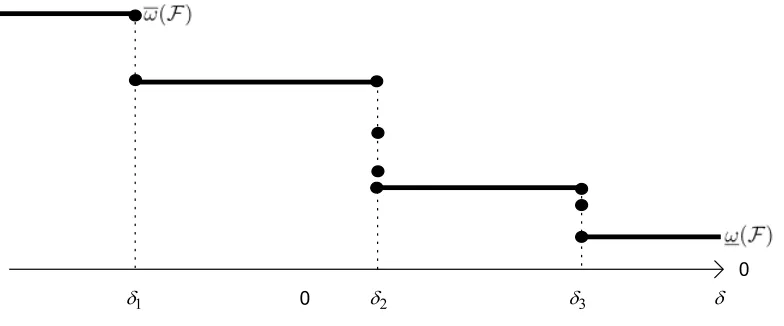
0 d2 d3 d
d1
0
Figure 1: An example of cardinalities of demand sets for eachσ(δ).The horizontal axis measures the parameter δ while the vertical axis measures the cardinalities of the demand sets. A thick line or dot means that there exists a demand set of the corresponding cardinality.
Figure 1 illustrates the first half of Lemma 6. Note that this part of the lemma does not require the substitutes condition. Lemma 5 implies that when the
substi-tutes condition is assumed, for eachδkin Figure 1, all integers between the maximal
cardinality and the minimal one must be painted thick in that figure.
A straightforward corollary of Lemma 6 is that if the cardinalities of all feasible
sets have “gaps,” then a corresponding demand correspondence can never satisfy
the substitutes condition.
Corollary 1. If a demand correspondence Xh(·;F) satisfies the substitutes
con-dition, then for each integer m between ω(F) and ω(F), there exists a feasible set
A∈ F with|A|=m.
Lemma 6 demonstrates that if a hospital’s demand correspondence satisfies the substitutes condition, uniform adjustments of its salary schedule produce
closely-related demand sets. Lemma 7 below shows that, under the substitutes condition,
adjustment, in a particular sense: when a hospital’s innate demand falls short of
the floor, the compelled demand is equal to the innate demand at a uniformly subsidized salary schedule; when a hospital’s innate demand exceeds the ceiling, the
compelled demand is equivalent to the innate demand at a uniformly taxed salary
schedule.
Lemma 7. Suppose an innate demand correspondence Xh(·;F0) satisfies the
sub-stitutes condition, and the government-imposed feasibility collection is D[f,c], with
F :=F0∩ D
[f,c]6=∅. For every salary schedule s,
(i) ifω(Xh(s;F0))< f, there exists a uniqueδ∗ <0such that Xh(s;F) =Xh(s+ δ∗1;F0)∩ D
f and for any δ > δ∗, ω(Xh(s+δ1;F0))< f;
(ii) ifω(Xh(s;F0))> c, there exists a uniqueδ >0such that Xh(s;F) =Xh(s+ δ1;F0)∩ D
c and for any δ < δ∗, ω(Xh(s+δ1;F0))> c.
We know from this lemma that, under the substitutes condition and an interval
constraint, when a hospital’s innate demand falls short of the floor, the compelled
demand meets the floor exactly. Reassuringly, Corollary 1 guarantees that there exists a self-imposed feasible set with cardinality equal to the floor. A similar
statement can be made about the ceiling.
The next lemma uncovers additional relationship between an innate demand correspondence and the associated compelled demand correspondence under an
in-terval constraint. Assuming the substitutes condition for a hospital’s innate demand correspondence, when an innate demand set falls short of the floor, we can find a
compelled demand set that includes it; when it exceeds the ceiling, we can find a
compelled demand set that is included by it.
Lemma 8. Suppose an innate demand correspondence Xh(·;F0) satisfies the
sub-stitutes condition and the government-imposed feasibility collection is D[f,c], with
F :=F0∩ D
[f,c]6=∅. For any salary schedules s and any A∈Xh(s;F0),
(i) if |A|< f, there existsB ∈Xh(s;F) such thatA⊂B and|B|=f;
(ii) if |A|> c, there exists B∈Xh(s;F) such that B⊂A and |B|=c.
Appendix A.5 utilizes the results above to prove the sufficiency part of Theorem
1. The gist of the proof is that Lemmas 7 and 8 allow us to translate hospitals’ compelled optimization problems under government-imposed interval constraints
into those without government-imposed constraints, the structure of which is
4
Competitive Equilibrium
An ordered pair of a matching and a salary system (µ,(sh)h∈H) is a competitive
equilibrium of job market E if (i) for any d ∈ D and h ∈ H, Ud,µ(d)(s µ(d) d ) ≥ Ud,h(shd), and (ii) for any h ∈ H, µ(h) ∈ Fh and Vh(µ(h);sh) ≥ Vh(A;sh) for any
feasible set A ∈ Fh. We call S ∈ (RD)H a competitive equilibrium salary
system if there exists µ ∈ HD such that (µ, S) is a competitive equilibrium. An allocation (µ,s) is feasible if µ is feasible; it is individually rational if for any
doctor d∈D,Ud,µ(d)(sd)≥0. A competitive equilibrium (µ, S) induces allocation
(µ,sµ,S); it is feasible and individually rational.
A hospital h ∈ H and a set of doctors A ∈ Fh form a blocking coalition
against an allocation (µ,s) if there exists a salary schedule s0 ∈ RD such that
(i) for any doctor d ∈ A, Ud,µ(d)(sd) < Ud,h(sd0), and (ii) Vh(µ(h);s) < Vh(A;s0).
Allocation (µ,s) is acore allocationif it is feasible, individually rational, and there
is no blocking coalition as described above. Note that this definition is equivalent to a standard one because any blocking coalition must involve a hospital and for
any blocking coalition that involves more than one hospital, we can find a smaller
blocking coalition that contains only one.
It is routine to show that a competitive equilibrium allocation is always a core
allocation, and that a core allocation can be supported by a salary system to form
a competitive equilibrium.
Proposition 1. An allocation(µ,sµ,S)induced by a competitive equilibrium(µ, S)is a core allocation. Given a core allocation(µ,s), there exists a competitive equilibrium
(µ,(sh)h∈H), where shd is defined by Ud,h(shd) =Ud,µ(d)(sd).
4.1 Existence
In this section, we study the existence of competitive equilibrium under the substi-tutes condition. For our result, the following condition proves useful.
Definition 5(Bounded Compensability). A doctordisboundedly compensable
if there is a constant ∆d > 0 such that Ud,h0(s+ ∆d) > Ud,h(s) for any h, h0 ∈ H
and s∈R.
assumption as well as the substitutes condition, we prove the existence of
competi-tive equilibrium for any job market.11
As in Kelso and Crawford (1982), we demonstrate the existence of competitive
equilibrium by considering discretized salary spaces (with the unit of salary
adjust-mentu >0) and ahospital-proposing algorithm.
Hospital-Proposing Algorithm: a
The salary system of step 0 has Sd,h0 =βd,h for any d∈D andh∈H.
forIn each stept, each hospitalhfaces a salary scheduleSt(h) and “proposes”
to all doctors in a demand set Ath ∈ Xh(St(h);Fh) that they work for the
hospital at salary specified by St(h); each doctor d “temporarily accepts” one of the options with highest utility, which may be unemployment. If a
proposal Sd,ht is “rejected” by a doctor d, the algorithm adjust the salary to
Sd,ht+1 =Sd,ht +u; otherwise,Sd,ht+1=Sd,ht .
for For both doctors and hospitals, ties are broken arbitrarily, except that
all doctors who temporarily accept a hospital h in step t −1 must con-tinue to receive those offers. This is consistent with the requirement of Ath ∈
Xh(St(h);Fh) given the substitutes condition. The algorithm ends when no
rejection occurs, at which point temporary acceptances are actualized.
The following lemma states that salaries in this algorithm cannot exceed an upper bound, and thus guarantees that the algorithm ends in finite steps. For
brevity, we define β := max{0,max{βd,h :d ∈D, h ∈H}}, β := min{0,min{βd,h :
d ∈ D, h ∈ H}}, ¯Rh := max{Rh(A)−Rh(B) : A, B ∈ Fh}, and for each d ∈ D,
∇d:= max{βd,h−βd,h0 :h, h0 ∈H}.
Lemma 9. If all doctors are boundedly compensable and all hospitals’ demand corre-spondences satisfy the substitutes condition, then in the hospital-proposing algorithm with u >0 as the unit of salary adjustment, any proposed salary is bounded above by M β−M(N + 1)β+P
h∈HR¯h+
P
d∈Dmax{∆d,∇d}+ (M+ 1)u.
Given Lemma 9, proving the existence of competitive equilibrium is straightfor-ward (Kelso and Crawford, 1982), and can be shown as follows. Consider a sequence
of salary adjustment units (uj)j∈N withuj = 1
2j for allj. The corresponding
algo-rithm outputs (µ(j), S(j))j∈Nstay within a compact space. It is easy to check that the
limit of any converging subsequence of these outputs is a competitive equilibrium.
11
Theorem 3 (Existence of Competitive Equilibrium). If all doctors are boundedly compensable and all hospitals’ demand correspondences satisfy the substitutes con-dition, then there exists a competitive equilibrium.
Theorems 2 and 3 together imply that given bounded compensability and the
substitutes condition, the government can impose generalized interval constraints
without nullifying the existence of competitive equilibrium.
Gul and Stacchetti (1999) demonstrate the necessity of the substitutes condition
for the existence of competitive equilibrium, in the sense that if a demand
corre-spondence does not satisfy the substitutes condition, there is an economy in which one agent is associated with this demand correspondence, all others are associated
with unit demand ones, and competitive equilibria fail to exist. Their construction
can be adapted for the job market setting. The necessity part of Theorem 2 thus implies that, in a sense, government-imposed feasibility collections which are not
defined by generalized interval constraints jeopardize the existence of competitive
equilibrium.
4.2 Lattice Structure
A competitive equilibrium is not unique in general (quite to the contrary, there may
be a continuum of equilibria). In this section, we study the structure of the set of competitive equilibria and establish a lattice property.
In the space of all salary systems (RD)H coupled with partial order ≤, the
infimum of a collection of salary systems S, infS, satisfies (infS)d,h = inf{Sd,h : S ∈S}; the supremumsupS satisfies (supS)d,h = sup{Sd,h :S ∈S}. Infima and
suprema may not exist, but for two salary systems S and S0, the meet S∧S0 :=
inf{S, S0} and the join S∨S0 = sup{S, S0} always exist. A collection of salary systems, S, is a sublatticeof (RD)H if whenever S, S0 ∈ S, S∧S0 and S∨S0 are
both in S. A sublatticeS iscompleteif for any S0⊂S, infS0 and supS0 are inS;
a sublatticeS of (RD)H is complete if and only if it is compact (Topkis, 1998).
We are able to prove that competitive equilibrium salary systems for a job
mar-ket in which all demand correspondences satisfy the substitutes condition form a
sublattice.
Theorem 4 is a nontrivial extension of the lattice theorem of Gul and Stacchetti
(1999) to a setting with constraints; in particular, non-quasilinear utility functions of the doctors are allowed. The theorem is a straightforward corollary of Lemma 10
below.
Lemma 10. For competitive equilibria (µ, S) and(µ0, S0), define matchings
µ(d) =
µ(d) if Ud,µ(d)(Sd,µ(d))≥Ud,µ0(d)(S0 d,µ0(d)),
µ0(d) if Ud,µ(d)(Sd,µ(d))< Ud,µ0(d)(S0 d,µ0(d));
µ(d) =
µ(d) if Ud,µ(d)(Sd,µ(d))≤Ud,µ0(d)(S0 d,µ0(d)),
µ0(d) if Ud,µ(d)(Sd,µ(d))> Ud,µ0(d)(S0 d,µ0(d)).
If all demand correspondences satisfy the substitutes condition, then
(i) (µ, S∨S0) and (µ, S∧S0) are both competitive equilibria;
(ii) |µ(h)|=|µ(h)|=|µ(h)| for allh∈H;
(iii) µ(h0) =µ(h0) =µ(h0);
(iv) for anyd∈D, if µ(d) =h0, then Ud,µ0(d)(S0
d,µ0(d)) = 0.
Given two competitive equilibria, the lemma constructs a matching that can
be coupled with the join of two competitive equilibrium salary systems to form a competitive equilibrium, and another matching that can be coupled with the meet
to form a competitive equilibrium. These constructed matchings have each hospital
hire the same number of doctors and have the same doctors unemployed as in the first competitive equilibrium. This lemma also states that given the substitutes
condition, if a doctor is unemployed in a competitive equilibrium, she obtains the
reserve utility of 0 in every competitive equilibrium.
Competitive equilibrium salary systems for a job market form a complete
sub-lattice under an additional boundedness assumption.
Corollary 2 (Complete Lattice). Assume the substitutes condition for all demand correspondences. The set of competitive equilibrium salary systems, if bounded, is a complete sublattice of (RD)H.
((µj, Sj))j∈N with salary systems converging to S∗. Due to the finiteness of the
set of all possible matchingsHD, there is a subsequence with identical matchingµ∗. It is routine to check that (µ∗, S∗) is a competitive equilibrium.
While boundedness of the set of competitive equilibrium salary systems is
di-rectly assumed in the statement of this corollary, it holds under mild assumptions on the primitives of the model (Proposition 2 in Appendix B). Completeness and
nonemptiness guarantee the existence of maximal and minimal elements; in our
setting, this translates into the existence of doctor-optimal and hospital-optimal competitive equilibria.
4.3 Rural Hospital Theorem
Various versions of rural hospital theorems are studied extensively in discrete match-ing settmatch-ings. They often state that the sets of unemployed doctors are the same
across all stable matchings, and so are the numbers of doctors hired at each
hospi-tal.12 By contrast, neither of these properties holds across competitive equilibria in our continuous-salary setting even under the substitutes condition and without
con-straints. To see this, suppose that there is no constraint, and each doctor generates
revenue that is equal to her base salary for every hospital; then, all matchings can be supported to form competitive equilibria. However, the following theorem comes
very close to a statement in the discrete matching setting.
Theorem 5 (Rural Hospital Theorem). If all demand correspondences satisfy the substitutes condition, (µ, S) is a competitive equilibrium, and S0 is a competitive equilibrium salary system, then there exists a matching µ0 such that (µ0, S0) is a competitive equilibrium, µ0(h0) =µ(h0), and for every h∈H, |µ0(h)|=|µ(h)|.
Proof. Since S0 is a competitive equilibrium salary system, there exists matching
µ00 such that (µ00, S0) is a competitive equilibrium. By Lemma 10, there exists a
competitive equilibrium (µ, S∨S0) such that µ(h0) =µ(h0) and for every h ∈ H,
|µ(h)| = |µ(h)|. Since (S ∨ S0)∧ S0 = S0, again by Lemma 10, there exists a
competitive equilibrium (µ0, S0) such that µ0(h0) = µ(h0) and for every h ∈ H,
|µ0(h)|=|µ(h)|.
12
This theorem implies that for each competitive equilibrium salary systemS, the
set of{|µ(h)|}h∈H such that (µ, S) constitutes a competitive equilibrium is the same (across all competitive equilibrium salary systems). In the context of a labor market
for medical doctors, if a (rural) hospital can never bring in enough doctors facing
one competitive equilibrium salary system, switching to another one is no solution to the problem.
Facing one competitive equilibrium salary system, hospitals and doctors may be
matched differently in different competitive equilibria, but their profits or utility levels remain the same; if their profit or utility maximizers are unique, then they
are matched in the same way. Theorem 5 thus entails that given the substitutes
condition, if a hospital’s demand correspondence is single-valued at one competitive equilibrium salary system, then that hospital hires the same number of doctors in all
competitive equilibria. Note that having only one demand set is a generic property.
One interpretation of a rural hospital theorem is that without changing the environment under which a job market operates, a rural hospital that has difficulty
recruiting enough doctors has difficulty under all circumstances. Imposing floor
constraints and providing subsidies, as shown by our paper, are remedies worthy of consideration.
5
Comparative Statics
In describing comparative statics results, we use a concept introduced by Topkis
(1998). For a partially ordered set (Y,) and setsZ, Z0 ⊂Y, we sayZ0 is (weakly)
larger than Z in the weak set orderif for eachz∈Z, there existsz0∈Z0 such thatzz0, and for each z0 ∈Z0, there existsz∈Z such thatzz0.
We first establish a general method of proving the weak set order among sets of
competitive equilibrium salary systems for different job markets. In particular, here we consider the case where (Y,) = ((RD)H,≤). The following definition formalizes
the concept that one demand correspondence permits more hiring than another (they
may correspond to different revenue functions and/or feasibility collections), which may push competitive equilibrium salaries higher.
Definition 6 (Permissiveness). A demand correspondenceXh0(·;Fh0) ismore per-missivethan another demand correspondence Xh(·;Fh) if for any salary schedule
s, (i) for any A∈Xh(s;Fh), there isA0 ∈Xh0(s;Fh0) such that A⊂A0, and (ii) for
Permissiveness is the central assumption in the following lemma for comparing
competitive equilibrium salaries in job markets with different demand correspon-dences of hospitals.
Lemma 11. Suppose that all doctors are boundedly compensable and demand corre-spondences(Xh(·;Fh))h∈H and(Xh0(·;Fh0))h∈H all satisfy the substitutes condition.
If Xh0(·;F0
h) is more permissive than Xh(·;Fh) for every h ∈ H, then the set of
equilibrium salary systems under(Xh0(·;Fh0))h∈H is weakly larger than those under
(Xh(·;Fh))h∈H.
The plan of our analysis is to apply this lemma to interval constraints.13 More
specifically, we consider changes in floors and ceilings of interval constraints.
Lemma 12. If a hospital h’s innate demand correspondence satisfies the substitutes condition, then for floorsf, f0 and ceilingsc, c0 withf0 ≥f andc0 ≥c, the compelled demand correspondenceXh(·;Fh0∩D[f0,c0])is more permissive thanXh(·;F0
h∩D[f,c]).
Lemma 12 establishes that given the substitutes condition, raising floors or
ceil-ings is the kind of changes to which Lemma 11 is applicable. Therefore, Lemmas
11 and 12 together imply that such changes indeed increase competitive equilibrium salary systems in the weak set order.
Theorem 6. Suppose that all doctors are boundedly compensable, and that all pitals’ innate demand correspondences satisfy the substitutes condition. If each hos-pital h’s government-imposed feasibility collection changes from D[fh,ch] to D[f0
h,c 0 h]
where fh0 ≥fh and c0h ≥ ch, then the set of equilibrium salary systems is larger in
the weak set order after the change.
With this understanding of how competitive equilibrium salary systems respond
to changes in floors and ceilings, we can now make statements about the impact
of policy interventions on welfare. By Theorem 6, raising the floor constraint for a hospital increases equilibrium salary systems in the weak set order. For doctors, this
change improves their welfare in the weak set order, that is, the set of competitive
equilibrium utility schedules for doctors is greater in the weak set order after the change. For hospitals, this change decreases their profits in the weak set order.
13
By contrast, lowering the ceiling constraint for a hospital decreases equilibrium
salary systems in the weak set order. For doctors, this change reduces their welfare in the weak set order; for hospitals, except the one whose ceiling constraint is lowered,
this boosts their profits in the weak set order. Lowering the ceiling constraint for a
hospital shrinks its feasibility collection, so the direct effect on its profit is negative. This change, however, also depresses equilibrium salaries, which is a positive force
on its profit. The net effect can be in either direction; we provide examples in
Appendix C.
6
Uncompelled Competitive Equilibrium
In order to achieve the policy goal specified by government-imposed feasibility col-lections (Fhg)h∈H, the government can compel each hospital h to choose a set of
doctors amongFhg, a method this paper investigates. Alternatively, the government
can provide monetary incentives. This section considers a simple monetary incen-tive scheme and its power in inducing hospitals to obey interval constraints without
coercion.
A transfer policy t:= (th)h∈H ∈RH specifies the government transfer to each
hospital h as th times the number of its hires. Thus, its post-transfer profit
function is defined by ˜Vh(A;s,t) =Rh(A) +|A|th−
P
d∈Asd. Since ˜Vh(A;s,t) = Vh(A;s−th1), it is economically equivalent to the government directly subsidizing
or taxing doctors depending on where they work, which may be administratively
easier.
A triple (µ,(sh)h∈H,t) forms an uncompelled competitive equilibrium of
job market E if (i) for any doctor d ∈ D and h ∈ H, Ud,µ(d)(sµd(d)) ≥ Ud,h(shd),
and (ii) for any hospital h ∈ H, µ(h) ∈ F0
h and ˜Vh(µ(h);sh,t) ≥ V˜h(A;sh,t) for
any self-imposed feasible setA∈ F0
h. Notably, a hospital is not required to choose
from its imposed feasibility collection. Nevertheless, when
government-imposed feasibility collections are defined by interval constraints, according to the
following theorem, we can always find an appropriate transfer policy such that hospitals collectively and voluntarily abide by the constraints in an uncompelled
competitive equilibrium.
condition, and all government-imposed feasibility collections are defined by interval constraints, then there exists an uncompelled competitive equilibrium that is feasible.
Proof. By Theorems 1 and 3, there exists a competitive equilibrium of the econ-omy, say, (µ,(sh)
h∈H), in which government-imposed feasibility collections are
en-forced. We will construct transfer policy t such that (µ,(sh)h∈H,t) is the desired
uncompelled competitive equilibrium. Consider hospital h with the government-imposed feasibility collection of D[f,c]. If ω(Xh(sh;Fh0)) < f, specify th as −δ∗,
where δ∗ <0 is given in Part (i) of Lemma 7. Since µ(h) ∈ Xh(sh;Fh0∩ D[f,c]) =
Xh(sh+δ∗1;F0)∩ Df, we know ˜Vh(µ(h);sh,t)≥V˜h(A;sh,t) for anyA∈ Fh0.
Sim-ilarly, ifω(Xh(sh;Fh0))> c, specify th as−δ, where δ >0 is given in Part (ii) of
Lemma 7. If ω(Xh(sh;Fh0)) ≥f and ω(Xh(sh;Fh0))≤ c, then µ(h) ∈ Xh(sh;F0),
and we specifyth = 0.
The proof suggests a method of finding the appropriate transfer policy: first,
calculate a competitive equilibrium under the additional government-imposed
inter-val constraints; second, for each hospital, adjust the transfer to a level that makes the compelled demand set optimal without the additional constraint. It is worth
mentioning that each proposed transfer is the least intrusive in the sense that among
all transfers that makes the hospital hire accordingly, it is the smallest in absolute value.
7
Discussion and Conclusion
Our exercise is valuable for policy making for at least two reasons. First, outcomes
predicted by matching models may mimic those in decentralized markets, which is
evidenced by studies of the US online dating market (Hitsch, Hortacsu and Ariely, 2010) and the Indian marriage market (Banerjee et al., 2013). By providing a
better understanding of how constraining hiring entities may impact the market,
policy makers can weigh pros and cons in a more educated way.
Furthermore, an “as-is” implementation of the hospital-proposing or
doctor-proposing algorithms under constraints may not be far-fetched: when most health
facilities are publicly owned or assisted, governments can create central clearing houses for hospitals to hire doctors with competing salary offers. There is already
Matching Program (Niederle, 2007);14Crawford (2008) advocates introducing wages
more explicitly in this system.
In a classical paper on the difficulty for rural hospitals in filling all of their
posi-tions in the National Resident Matching Program, Roth (1986) concludes that “this
maldistribution seems unlikely to be changed by any system that does not involve some element of compulsion, or some change in the relative numbers of available
positions and eligible students.” Our analysis suggests that in job matching with
adjustable salaries, compulsion in the form of floor or ceiling constraints is one nice solution. They maintain the existence of competitive equilibrium and carry
clear welfare implications; in addition, one can also demonstrate group
strategy-proofness for doctors of a mechanism that selects the doctor-optimal competitive equilibrium.15 Moreover, there exist policies of subsidy and taxation that, in
un-compelled competitive equilibria, induce allocations that respect those constraints.
Results of our paper are easily transferrable to an object assignment setting. There are numerous applications in which constraints are imposed on sets of objects
that agents can acquire (Gul, Pesendorfer and Zhang, 2018). The take-away
mes-sage from our analysis is that imposing both floor and ceiling constraints preserves the substitutes condition; furthermore, they can be implemented through transfers,
without explicitly constraining the agents. This is encouraging: governments which run multi-object auctions may aim for those constraints in order to manage market
power; diamond miners which sell to their wholesale customers may have long-term
goals that call for those constraints; procuring firms may utilize those constraints to ensure the survival of multiple suppliers and their competition.
The negative result that no other constraint beyond generalized interval
con-straints preserves the substitutes condition is discouraging. These cases include type-specific ceiling constraints and proportionality constraints, which, when wisely
used, could encourage diversity and promote equal opportunity. Complex
con-straints are also unavoidable in many important object assignment settings (Mil-grom, 2017; Milgrom and Segal, 2018). An ongoing project of ours is studying
alter-natives. The close relation between the job matching model of Kelso and Crawford
(1982) and the matching-with-contracts model of Hatfield and Milgrom (2005), re-vealed by Echenique (2012), also calls for an investigation of the problem in the
14
A hospital is allowed to specify several types of jobs (such as clinical and research) with different job descriptions and wages, and a doctor could apply to one or more of these different types of jobs at the same hospital.
latter context.
Although the substitutes condition is canonical, studying more general revenue functions may be interesting. For instance, the gross substitutes and complements
condition of Sun and Yang (2006) implies the existence of a stable matching and
Walrasian equilibrium. This condition may be especially interesting in applications in which workers can be naturally divided into two groups, with within-group
sub-stitutability and between-group complementarity, say low- and high-skill workers.
A similar condition is sufficient for positive results even beyond two-sided match-ing, for instance in the trading network setting of Hatfield et al. (2013). Studying
constraints in those cases is left for future research.
References
Abdulkadiroglu, Atila, and Tayfun S¨onmez. 2003. “School Choice: A Mechanism Design Approach.”American Economic Review, 93(3): 729–747.
Aygun, Orhan, and Bertan Turhan. 2016. “Dynamic Reserves in Matching Markets: Theory and Applications.” Working Paper.
Banerjee, Abhijit, Esther Duflo, Maitreesh Ghatak, and Jeanne Lafortune.2013. “Marry for What? Caste and Mate Selection in Modern India.” American Economic Journal: Microeconomics, 5(2): 33–72.
Bing, Meir, Daniel Lehmann, and Paul Milgrom. 2004. “Presentation and Struc-ture of Substitutes Valuations.” Proceedings of the 5th ACM Conference on Electronic Commerce, 238–239.
Bir´o, P´eter, Tam´as Fleiner, Robert W. Irving, and David F. Manlove.2010. “The College Admissions Problem with Lower and Common Quotas.” Theoretical Computer Science, 41(34): 3136–3153.
Byrnes, Patricia, Mary K. Marvel, and Kala Sridhar.1999. “An Equilibrium Model of Tax Abatement: City and Firm Characteristics As Determinants of Abatement Gen-erosity.”Urban Affairs Review, 34(6): 805–819.
Chan, Kam Wing, and Li Zhang.2009. “The Hukou System and Rural-Urban Migration in China: Processes and Changes.” The China Quarterly, 160: 818–855.
Delacretaz, David, Scott Duke Kominers, and Alexander Teytelboym. 2016. “Refugee Resettlement.”Working Paper.
Demange, Gabrielle, and David Gale. 1985. “The Strategy Structure of Two-Sided Matching Markets.”Econometrica, 53(4): 873–888.
Dur, Umut, Scott D. Kominers, Parag A. Pathak, and Tayfun S¨onmez. 2014. “Reserve Design: Unintended Consequences and the Demise of Boston’s Walk Zones.” Journal of Political Economy, forthcoming.
Echenique, Federico.2012. “Contracts versus Salaries in Matching.”American Economic Review, 102(1): 594–601.
Ehlers, Lars, Isa E. Hafalir, M. Bumin Yenmez, and Muhammed A. Yildirim.
2014. “School Choice with Controlled Choice Constraints: Hard Bounds versus Soft Bounds.” Journal of Economic Theory, 153: 648–683.
Ellison, Glenn, and Parag A. Pathak.2016. “The Efficiency of Race-Neutral Alterna-tives to Race-Based Affirmative Action: Evidence from Chicago’s Exam Schools.” Na-tional Bureau of Economic Research Working Paper Series, No. 22589.
Fragiadakis, Daniel, and Peter Troyan. 2017. “Improving Matching under Hard Dis-tributional Constraints.”Theoretical Economics, 12(2): 863–908.
Gale, David, and Marilda Sotomayor.1985. “Ms. Machiavelli and the Stable Matching Problem.”The American Mathematical Monthly, 92(4): 261–268.
Goto, Masahiro, Fuhito Kojima, Ryoji Kurata, Akihisa Tamura, and Makoto
Yokoo. 2017. “Designing Matching Mechanisms under General Distributional Con-straints.” American Economic Journal: Microeconomics, 9(2): 226–62.
Gul, Faruk, and Ennio Stacchetti. 1999. “Walrasian Equilibrium with Gross Substi-tutes.”Journal of Economic Theory, 87(1): 95–124.
Gul, Faruk, and Ennio Stacchetti. 2000. “The English Auction with Differentiated Commodities.”Journal of Economic Theory, 92(1): 66–95.
Gul, Faruk, Wolfgang Pesendorfer, and Mu Zhang.2018. “Market Design and Wal-rasian Equilibrium.”Working Paper.
Hafalir, Isa E., M. Bumin Yenmez, and Muhammed A. Yildirim.2013. “Effective Affirmative Action in School Choice.” Theoretical Economics, 8(2): 325–363.
Hatfield, John William, and Paul R. Milgrom.2005. “Matching with Contracts.”The American Economic Review, 95(4): 913–935.
Hatfield, John William, Scott Duke Kominers, Alexandru Nichifor, Michael
Ostrovsky, and Alexander Westkamp.2013. “Stability and Competitive Equilibrium in Trading Networks.”Journal of Political Economy, 121(5): 966–1005.
Hatfield, John William, Scott Duke Kominers, Alexandru Nichifor, Michael Ostrovsky, and Alexander Westkamp.2018. “Full Substitutability.”Working Paper.
Hitsch, Gunter J., Ali Hortacsu, and Dan Ariely. 2010. “Matching and Sorting in Online Dating.” American Economic Review, 100(1): 130–63.
Huang, Chien-Chung. 2010. “Classified Stable Matching.” Proceedings of the Twenty-First Annual ACM-SIAM Symposium on Discrete Algorithms, 1235–1253.
Jagadeesan, Ravi, Scott Duke Kominers, and Ross Rheingans-Yoo. 2018. “Strategy-Proofness of Worker-Optimal Matching with Continuously Transferable Util-ity.”Games and Economic Behavior, 108: 287–294.
Kamada, Yuichiro, and Fuhito Kojima.2015. “Efficient Matching under Distributional Constraints: Theory and Applications.”American Economic Review, 105(1): 67–99.
Kamada, Yuichiro, and Fuhito Kojima.2017. “Stability Concepts in Matching under Distributional Constraints.” Journal of Economic Theory, 168: 107–142.
Kamada, Yuichiro, and Fuhito Kojima. 2018a. “Fair Matching under Constraints.” Working Paper.
Kamada, Yuichiro, and Fuhito Kojima. 2018b. “Stability and Strategy-Proofness for Matching with Constraints: A Necessary and Sufficient Condition.” Theoretical Eco-nomics, forthcoming.
Kapoor, Neelkamal. 2011. “Expanding the Definition of Healing: Cancer Education in India.” Journal of Cancer Education, 26(1): 22–26.
Kelso, Alexander S., Jr., and Vincent P. Crawford.1982. “Job Matching, Coalition Formation, and Gross Substitutes.” Econometrica, 50(6): 1483–1504.
Kominers, Scott Duke, and Tayfun S¨onmez.2016. “Matching with Slot-Specific Pri-orities: Theory.”Theoretical Economics, 11(2): 683–710.
Milgrom, Paul.2009. “Assignment Messages and Exchanges.”American Economic Jour-nal: Microeconomics, 1(2): 95–113.
Milgrom, Paul.2017.Discovering Prices: Auction Design in Markets with Complex Con-straints.Columbia University Press.
Milgrom, Paul, and Ilya Segal.2018. “Deferred-Acceptance Clock Auctions and Radio Spectrum Reallocation.” Working Paper.
Nguyen, Th`anh, and Rakesh Vohra.2017. “Stable Matching with Proportionality Con-straints.” Working Paper.
Niederle, Muriel.2007. “Competitive Wages in a Match with Ordered Contracts.” Amer-ican Economic Review, 97(5): 1957–1969.
Noda, Shunya.2018. “Large Matchings in Large Markets with Flexible Supply.” Working Paper.
Ostrovsky, Michael, and Renato Paes Leme.2015. “Gross Substitutes and Endowed Assignment Valuations.” Theoretical Economics, 10(3): 853–865.
Roth, Alvin E. 1986. “On the Allocation of Residents to Rural Hospitals: A General Property of Two-Sided Matching Markets.” Econometrica, 54(2): 425–427.
Schlegel, Jan Christoph. 2018. “Group-Strategy-Proof Mechanisms for Job Matching with Continuous Transfers.”Working Paper.
Shapley, L. S., and M. Shubik.1971. “The Assignment Game I: The Core.”International Journal of Game Theory, 1(1): 111–130.
Sun, Ning, and Zaifu Yang.2006. “Equilibria and Indivisibilities: Gross Substitutes and Complements.”Econometrica, 74(5): 1385–1402.
Sun, Ning, and Zaifu Yang. 2009. “A Double-Track Adjustment Process for Discrete Markets with Substitutes and Complements.” Econometrica, 77(3): 933–952.
Topkis, Donald M. 1998. Supermodularity and Complementarity. Princeton University Press.
to make a line
A
Proofs
A.1 Proving Theorem 2
For necessity, we prove the contrapositive. LetFg be a government-imposed
feasi-bility collection that is not defined by a generalized interval constraint. Denote the original market byE. We can create a new marketE0 with doctorsD0 = ˆχ(Fg) and
a proper government-imposed feasibility collection F0g = {A∩χˆ(Fg) : A ∈ Fg}.
In E0, F0 is proper but not defined by an interval constraint, so by Theorem 1, it
does not preserve the substitutes condition. Hence, there existR0h: 2D0 →Rand a self-imposed feasibility collection F00 such that the innate demand correspondence
Xh0(·;F00) satisfies the substitutes condition but the compelled demand
correspon-denceXh0(·;F00∩F0g) does not. ExtendR0
hto 2Dby makingRh(A) =R0h(A∩χˆ(Fg))
for all A ⊂ D; let F0 := {A∪χ(Fg) : A ∈ F00}. It is routine to check that the
innate demand correspondenceXh(·;F0) satisfies the substitutes condition but the
compelled demand correspondenceXh(·;F0∩ Fg) does not, soFg does not preserve
the substitutes condition.
For sufficiency, letFg be defined by a generalized interval constraint, so theF0g
above is defined by an interval constraint in E0. Suppose thatFg does not preserve
the substitutes condition. There exist Rh : 2D → R and a self-imposed feasibility
collection F0 such that the innate demand correspondence X
h(·;F0) satisfies the
substitutes condition but the compelled demand correspondenceXh(·;F0∩Fg) does
not. We can restrictRh to 2D 0
by making R0h(A) =Rh(A∪χ(Fg)) for all A⊂D0;
let F00 :={A∩χˆ(Fg) :A∈ F0, χ(Fg) ⊂A, andA∩χ(Fg) =∅}. It is routine to
check that the innate demand correspondence Xh0(·;F00) satisfies the substitutes
condition but the compelled demand correspondence Xh0( ·;F00 ∩ F0g) does not.
In other words, F0g does not preserve the substitutes condition, a contradiction to
Theorem 1.
A.2 Proving Lemma 2 and 3
Proof of Lemma 2. We only need to prove the case of E =A∪ {d}, and the other cases follow by induction. Suppose A∪ {d} ∈ F/ . Consider a counting revenue
function Rh such that for all C ⊂ D, Rh(C) = |C∩B|. A salary schedule s has si= 0 for every doctor inB and si = 2M for every doctor not inB. If a setC ⊂D
profit is achieved by B, soXh(s;F) ={B}.
Now turn s into a new salary schedule s0 by making s0i = 2M for every doctor inB\(A∪ {d}). If a set C ⊂D contains any doctor not inA∪ {d},Vh(C;s)<0.
Among all subsets ofA∪ {d},Agenerates a profit of|A|, andA∪ {d}is infeasible.
So the salary increase inB\(A∪ {d}) forces the hospital to drop a doctor inA∪ {d}, a violation of the substitutes condition.
To prove Lemma 3, we first show that a proper feasibility collection that preserves
the substitutes condition for all binary disjunctive revenue functions can “separate” any two distinct doctors.
Lemma 13. Given a proper feasibility collection F that preserves the substitutes condition for all binary disjunctive revenue functions, and two distinct doctors d
and d0, there exists A∈ F such that d∈A and d0 ∈/A.
Proof. Suppose that for all A ∈ F such that d∈A, d0 ∈ A. Because F is proper, such A exists; there also exists B ∈ F such thatd0 ∈/ B, but then d /∈B. Consider
a binary disjunctive revenue functionRh such that for allC ⊂D,
Rh(C) =
2M ifd∈C ord0 ∈C,
0 otherwise.
.
Let a salary schedule s be such that si = 0 for every doctor i, which entails that
Xh(s;F) = {C ∈ F :d ∈ C ord0 ∈ C}, i.e., any feasible set containing d or d0 is
optimal. In particular, A is.
Now turn s into a new salary schedule s0 by making s0d0 = 4M. Because there
exists no feasible set that contains dbut notd0, it is impossible to generate positive profit. Because B attains zero profit, Xh(s0;F) = {C ∈ F : d0 ∈/ C}, none of
whose elements containsd. So this salary raise ofd0 causes the hospital to drop d,
a violation of the substitutes condition.
Secondly, given a proper feasibility collection that preserves the substitutes
con-dition for all binary disjunctive revenue functions, for a feasible set of doctors with
Lemma 14. Given a proper feasibility collection F that preserves the substitutes condition for all binary disjunctive revenue functions, if A∈ F, |A|=ω(F),d∈A, and d0 ∈/A, then (A∪ {d0})\ {d} ∈ F.
Proof. By Lemma 13, there exists B ∈ F such thatd0 ∈B and d /∈B. Since |A|=
ω(F),|B| ≤ |A|. IfA={d}, then|B| ≤ |A|= 1, soB ={d0}= (A∪{d0})\{d} ∈ F.
We only need to consider the case of |A|>1.
Suppose that (A∪ {d0})\ {d}∈ F/ . Consider the revenue functionRh and salary
schedule s used in the proof of Lemma 13, so, still, any set containing d or d0 is
optimal unders. In particular,A is.
Now turnsinto a new salary schedules0 by makings0d= 4M. Unders0, the profit
associated with B is still 2M, attaining the maximum, while the profit associated
with A is now −2M. So we know Xh(s0;F) = {C ∈ F : d /∈ C and d0 ∈ C}.
Because the cardinality of a demand set cannot exceed|A|and (A∪ {d0})\ {d}∈ F/ ,
no demand set unders0includesA\ {d}. So this salary raise ofdcauses the hospital
to drop at least another doctor inA, a violation of the substitutes condition.
Similarly, given a proper feasibility collection that preserves the substitutes
con-dition for all binary disjunctive revenue functions, for a feasible set of doctors with
minimal cardinality and a doctor not in this set, replacing someone in this set with that doctor brings about another feasible set.
Lemma 15. Given a proper feasibility collection F that preserves the substitutes condition for all binary disjunctive revenue functions, if A∈ F, |A|=ω(F),d∈A, and d0 ∈/A, then (A∪ {d0})\ {d} ∈ F.
Proof. Suppose that (A∪ {d0})\ {d}∈ F/ . By Lemma 13, there exists B ∈ F such that d0 ∈ B and d /∈ B. Consider the revenue function Rh used in the proof of
Lemma 13, and a salary schedule s such that sd =sd0 = 0.1 and sa = 0 for every
doctora6=d, d0. Any set containing either dord0 (but not both) generates a profit
of 2M−0.1, which is optimal under s. In particular, bothA and B are.
Now turns into a new salary schedules0 by makings0a= 4M for every doctora
except those in A∪ {d0}. The maximal profit is still 2M −0.1, attained byA. We
can show that any feasible set, say C, that contains d0 is never optimal. First, if
C contains any doctor not in A∪ {d0}, Vh(C;s0) < 0. Second, if d∈C, the profit
is at most 2M −0.2. Third, if C ⊂ (A∪ {d0})\ {d}, then by the assumption that