75
DEVELOPMENT OF EXPORT PERFORMANCE SCALE FOR FRESH
VEGETABLE-FRUIT SECTOR
Murat Keskink
ı
l
ı
nç
Istanbul Commerce University, Turkey
Mustafa Emre Civelek,
(PhD) Istanbul Commerce University, TurkeyReceived: Feb. 14, 2018 Accepted: April. 09, 2018 Published: June 1, 2018
Abstract
:The purpose of this paper is to propose a scale for assessing the performance of foreign trade companies in fresh vegetable-fruit sector. As a first step, a qualitative interviews was conducted to the sample consists of the managers working in export companies. As a result of the interviews major problems of exporters were grouped. In the second phase of the study a questionnaire was formed and a survey was conducted to the larger sample. Subsequently, validity and reliability of the scales were determined by means of explanatory and confirmatory factor analyses and reliability analysis respectively. The theoretical contribution of this research is the development of a method for evaluation of export performance of foreign trade companies in fresh vegetable-fruit sector.
Keywords:
Foreign Trade, Fresh Vegetable-Fruit Sector, Export Performance
1.
Introduction
Foreign trade is about the flow of goods and capital out of the national borders. In terms of the delivery of foreign trade transactions, import and export take place in two forms. Export is a major factor in the development of the country's economy. For this reason, increasing the exports and decreasing the imports are among the important targets in the countries. Decisions and measures taken by the businessmen to achieve these goals constitute foreign trade policy.
Fresh vegetable and fruit sector; is one of the most important sub-sectors within the agricultural sector. The fresh fruit and vegetable sector involves the cultivation of vegetables and fruits by agricultural activities and the transportation of the grown crops to the final consumers or businesses before and after the completion of the natural decay period without any change of the original structures. All fruit and vegetable species are in the category of fresh vegetables and fruits except for tubers (potatoes, ground apples, etc.) and nuts (nuts, walnuts, peanuts etc.) that grow in the trees ( Doğu Akdeniz Kalkınma Ajansı, 2015). Turkey is still about 4 million family farmers engaged in production activities in the agricultural sector. And they make their living by the agricultural sector. As in other sectors, agriculture workers have various problems both in business and in sectoral basis (Dogan, 2011). Analyzing the structure of the agricultural sector in Turkey is to see that the majority of producers have created small businesses. Manufacturers with small businesses can’t achieve high efficiency due to the insufficient use of input, financing and technology (Dogan, 2011). Turkey is among the few countries in the world in agricultural production.
obtained from the unit area by using quality seeds, high yield varieties and appropriate inputs (Gürbüzer, 2008). The marketing problem is one of the biggest problems of the industry. Many problems in the industry are affecting indirect marketing. In the fresh fruit and vegetable sector, marketing is influenced by many elements; the main direct effect is the lack of production plan. While the most important problem in our work with industry marketing problem is that there are many factors that can indirectly affect marketing, the most important problem is that the manufacturer cannot afford the effort he has shown in his product. There are many reasons for this problem. For instance, the wrong to use agricultural chemicals while producing and choosing the wrong marketing resources. The biggest problem, however, is the lack of production planning. If there is no production planning, which of our producers have been profitable in the previous year, directing that product leads to production excess. In this case, the price of the product which is much in the domestic market is decreasing and this reflects directly to our producers.
Research question of this study is that what are the most important factors exerting influence on the export performance of the firms in fresh vegetable-fruit sector. Additionally there is a need for a scale to measure of this performance. Therefore main purposes of this research are the determination of the factors and propose a scale.
2. Scale Development Process
Scale development process consists of two phases. In the first phase, qualitative interview study was conducted in order to determine the dimensions. In this study, it was found that there are 6 dimensions. These dimensions are Logistics and Customs Problems, Packaging Problems, Production Problems, Supports and Incentives Problems, Marketing Problems. And also Firm Performance dimension was added to the questionnaire. For firm performance dimension a scale developed by Akgün et al.’s (2007) scale, which was adapted from Ellinger et al.’s (2002), was used (Akgün, Keskin, Byrne, & Aren, 2007). In the second phase, explanatory factor analysis was conducted for purification and subsequently confirmatory factor analysis was conducted for determination of convergent validity (Civelek M. , 2018). After that, for the determination of reliability Cronbach α and composite reliability were calculated.
2.1. Qualitative Interview Study & Proposed Scale
In the qualitative interview study, face-to-face meetings were held with 17 senior and mid-level managers working in export departments. These interviews were semi-structured. Interview subjects consist of 17 males (100%), 9 senior (52,94%) and 8 mid-level (47,06%) professional managers. At the end of the first phase, a questionnaire was developed consists of 28 questions. In Table 1., proposed scale items are shown.
Table 1. Proposed Scale Items
Logistics and Customs
Problems
1-The loss of product due to the fact that the exported product is not
transported by the most suitable transport vehicle affects our exports
negatively.
2. The bureaucratic processes at customs and border gates negatively affect
our exports.
3- The threat of human health due to the fact that the exported product is
not transported with the most suitable transportation means negatively
affects our exports.
4- Not having enough refrigerator vehicles affects our exports negatively.
Packaging Problems
5- Not using the appropriate packaging for the product subject to export
affects our exports negatively.
6. The use of packaging dangerous for human health negatively affects our
exports.
Production Problems
8. Pesticides misused during the production stage negatively affect our
exports
9- Producing the wrong amount of product by not making production
planning affects our exports negatively.
10. Not specifying suitable products for the regions in production planning
affects our exports adversely
Supports and
Incentives Problems
11. Inadequate export incentives affect our exports negatively.
12- The fact that agricultural chambers and exporters' associations do not
provide the necessary support for the appropriate packing and storage
conditions of the product negatively affects our exports.
13- Inadequate support from farmer unions in terms of the correct use of
agricultural crops, seeds and fertilizers and the right selection of harvest time
negatively affects our exports.
Marketing Problems
14- the fact that the market research on the best market for the product is
not done properly negatively affects our exports.
15- Failure to find qualified personnel to conduct market research negatively
affects our exports.
16. Inadequate marketing department affects our exports negatively.
Firm Performance
17- The return of our investments is higher than our competitors.
18- Our average productivity per employee is higher than our competitors.
19- Our time to produce and market the product is higher than our
competitors.
20- Our market share is higher than our competitors.
21-Our sales are higher than our competitors.
22- Our profitability (in percentage) is higher than our competitors.
23- The cost of sold is lower than our competitors.
24- The number of new skills learned by our employees is higher than our
competitors.
25-Return on equity is higher than our competitors.
26- Our growth rate is higher than our competitors.
27- Our operating revenues are higher than our competitors.
28- Turnover Profit (Profit / Total Sales) is higher than our competitors.
2.2 Methodology for Testing Construct Validity and Reliability
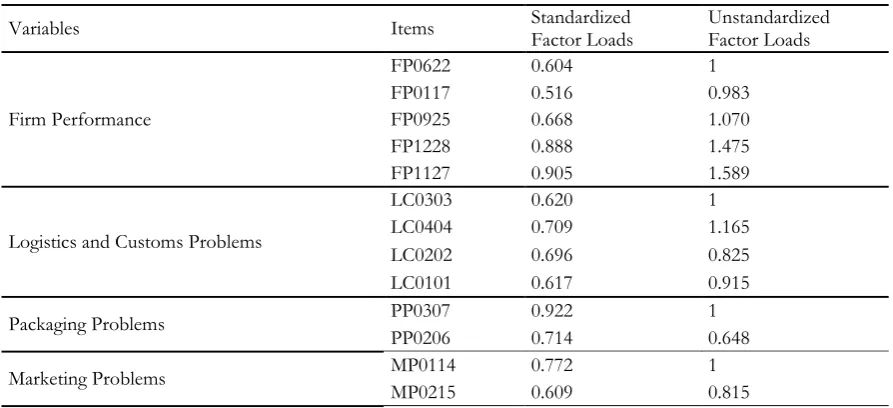
Confirmatory Factor Analysis Results are shown in Table 2 and standardized factor loads of each item are larger than 0.5 and significant. According to the results, the convergent validity of the scales were determined. Average variance extracted values were also calculated. Results are close to or beyond the threshold level (i.e. 0.5) (Byrne, 2010). Reliability of each construct individually calculated. Composite reliability and Cronbach α values are close to or beyond the threshold level (i.e. 0.7) (Fornell & Larcker, 1981).
Table 2. Confirmatory Factor Analysis Results
Variables Items Standardized Factor Loads Unstandardized Factor Loads
Firm Performance
FP0622 0.604 1
FP0117 0.516 0.983
FP0925 0.668 1.070
FP1228 0.888 1.475
FP1127 0.905 1.589
Logistics and Customs Problems
LC0303 0.620 1
LC0404 0.709 1.165
LC0202 0.696 0.825
LC0101 0.617 0.915
Packaging Problems PP0307 0.922 1
PP0206 0.714 0.648
Marketing Problems MP0114 0.772 1
MP0215 0.609 0.815
In Table 3, descriptive statistics of the dimension, average variance extracted values, composite reliabilities, Cronbach α values and Pearson correlation coefficients are shown. Additionally, in Table 3 the diagonals demonstrate the square root of AVE values of each variable. As shown in the Table 3, the square roots of AVE values are beyond the correlation coefficient in the same column. These results confirm the discriminant validity of the scales used.
Table 3. Construct Descriptives, Correlation and Reliability
Variables 1 2 3 4
1.Firm Performance (.733)
2.Logistics and Customs Problems .007 (.662)
3.Packaging Problems .134 .154 (.825)
4.Marketing Problems .120 .078 .288* (.695)
Composite reliability .844 .738 .807 0,649
Average variance ext. .537 .438 .680 0,483
3. Conclusion
At the end of this analysis, a scale was proposed to measure and assess the performance of the foreign trade companies in fresh vegetable-fruit sector. According to the findings, items were grouped under four constructs. The theoretical contribution of this research is the proposal of a method for scale development. This proposal aims to enlighten the future studies. After repeated analysis by researchers in future this measurement scale would be confirmed. The managerial contribution of this research is to provide an instrument for assessing the export performance of foreign trade companies operating in fresh vegetable-fruit sector.
References
Doğu Akdeniz Kalkınma Ajansı. (2015). Yaş Sebze Meyve Sektör Raporu.
Akgün, A., Keskin, H., Byrne, J., & Aren, S. (2007). Emotional and learning capability and their impact on product innovativeness and frm performance. Technovation, 27(9), 501-513.
Anderson, J., & Gerbing, D. (1988). Structural Equation Modelling in Practice: A Review and Recommended Two-Step Approach. Psychological Bulletin.
Bagozzi, R. P., & Yi, Y. (1990). Assessing Method Variance in Multitrait-Multimethod Matrices: The Case of Self-reported Affect and Perceptions at Work. Journal of Applied Psychology, 75(1), 547-560.
Byrne, B. M. (2010). Structural Equation Modeling with AMOS. New York: Routledge Taylor & Francis Group. Civelek, M. (2018). Yapısal Eşitlik Modellemesi Metodolojisi. İstanbul: Beta.
Doğan, H. (2011). Türkiye‟deki Üretici Birliklerinin Üretici Örgütlenmesinde Yeri ve Önemi (Kazova Bölgesi Yas Sebze Meyve Üreticileri Birliğ Örneği). Tokat: Gaziosmanpaşa Üniversitesi.
Fornell, C., & Larcker, D. (1981). Evaluating Structural Equation Models with Unobservable Variables and Measurement Error. Journal of Marketing Research, 18(1), 39-50.
Gürbüzer, A. (2008). Türkiye’de Yaş Meyve VE Sebze Üretimi, İhracatı, Karşılaşılan Sorunlar ve Çözüm Önerileri. Konya: Selçuk Üniversitesi.