Hermawan Dadang Budi, Asmawi Moch, Tangkudung James. Developing Machine Training (DBH 2MCS) To Improve Beginner Athlete Service In Sepak Takraw In Sumedang Regency. Journal of Education, Health and Sport. 2019;9(4):42-54. eISNN 2391-8306. DOI http://dx.doi.org/10.5281/zenodo.2617067
http://ojs.ukw.edu.pl/index.php/johs/article/view/6759
The journal has had 7 points in Ministry of Science and Higher Education parametric evaluation. Part B item 1223 (26/01/2017). 1223 Journal of Education, Health and Sport eISSN 2391-8306 7
© The Authors 2019;
This article is published with open access at Licensee Open Journal Systems of Kazimierz Wielki University in Bydgoszcz, Poland
Open Access. This article is distributed under the terms of the Creative Commons Attribution Noncommercial License which permits any noncommercial use, distribution, and reproduction in any medium, provided the original author (s) and source are credited. This is an open access article licensed under the terms of the Creative Commons Attribution Non commercial license
Share alike.
(http://creativecommons.org/licenses/by-nc-sa/4.0/) which permits unrestricted, non commercial use, distribution and reproduction in any medium, provided the work is properly cited.
The authors declare that there is no conflict of interests regarding the publication of this paper.
Received: 01.03.2019. Revised: 15.03.2019. Accepted: 28.03.2019.
Developing Machine Training (DBH 2MCS) To Improve Beginner Athlete Service
In Sepak Takraw In Sumedang Regency
Name
Dadang Budi Hermawan
Affiliation
Universitas Negeri Jakarta
Country
Indonesia
Bio Statement —
Principal contact for editorial correspondence.
Name
Moch Asmawi
Affiliation
Universitas Negeri Jakarta
Country
Indonesia
Bio Statement Sport Education
Name
James Tangkudung
Affiliation
Universitas Negeri Jakarta
Country
Indonesia
Abstract
The use of technology in sport can be seen as an assisting tool to support and improve athletes’ performance quality. In sepak takraw sport, there is a need to improve athlete’ skill and achievement in terms of service drill practice. This study is aimed at : (1) designing a ball conveyor (DBH 2MCS) machine to facilitate beginner athlete service drills in sepak takraw (2) producing an effective ball conveyor (DBH 2MCS) for beginner athlete service drill . To achieve the objectives of the study, research and development was applied. The results of this study show that the (DBS 2MCS) machine was effective to improve athlete service capability in sepak takraw. In line with this, several evaluation from experts to assess the machine were gathered. Assessment I in terms of material, expert rated the machine "Very Good" with a score of 84. Assessment II conducted by coach, the machine was considered "Very Good" with a score of 87. Assessment III, in terms of machinery, the expert valued it "Very Good" with a score of 89. The conclusions of this study are (1) Sepak takraw conductor (DBS 2MCS) machine can be used to facilitate athlete service drill for beginners, (2) the machine is effective as a tool to improve athlete service drill for beginners. The machine is recommended to be used to help beginner athlete improve their service training in sepak takraw.
Keyword: ball conveyor, (DBH 2MCS) machine, service drill, Sepak Takraw 1 Introduction
Science and Technology has increasingly played significant role in various field of education. In sport education, the use of technology is really helpful to facilitate athlete taking exercises. Technology in sports training can be interpreted as a means or infrastructure to support athlete activities and improve of the quality of athletes’ performance. Sport teachers seize the technology to improve athlete performance in their training. Advantages offered by technology is expected to increase the quality of the athlete performance in their training which focuses on repetitions or drill. Drill activities in sport training require a constant (consistent) level and appropriate dose of treatment.
In sport education, athletes need to have regular practice to succeed. Practice makes perfect. In sepak takraw, serve skill requires repetition or drill for athlete to achieve sound serve skill. On the part of instructors, they need to provide constant and consistent practice for their beginner athlete in training serve skill. Unfortunately, it is not easy for them to meet this demand. The problem lies on the trainers’ ability as a facilitator to provide consistent drill. Trainers’ constant treatment has something to do with appropriate treatment and meeting the demand of the developed model.
In Indonesia, national sport system requires every stakeholder especially government to go hand in hand and complement each other to achieve sport goals. Responding to this, Government has paid attention on national sport system. It has shown its involvement in terms of supporting by appropriate regulation to ensure that sport education will go hand in hand with education system. Sports education as one of the scope of sports activities cannot be separated from efforts to develop and improve quality in its implementation. This is related to the mandate of Law No. 3 of 2005 concerning the National Sports System article 25 paragraph (1) which states that the development of educational sports is carried out and directed as a systemic and sustainable unity with the national education system”1
Various effort need to be taken to support sports education. The use of technology to support sports training is one of the promising steps to implement by trainers and athlete. This study tries to bring technology to the next level in assisting sports education. It designs a model to develop quality sports training for athletes and this effort could be one of the major steps to improve national sports performance in the future. In line with this, Ermawan Susanto (2011) advocates that science and technology are very pivotal for sports supremacy. In his view, science and technology play an important role to improve the performance of athletes and hopefully to
overcome the deterioration of national sports achievements. It is widely known that international elite athletes have benefited from science and technology assistance.”2
In relation to science and technology to assist the athlete in their sports performance, many countries have invested so much to achieve sports success. Japan Australia and China develop their national sports with the cutting edge technology to support their sports industry. Each country has its own organization like Japan with JISS (Japan Institute of Sports Science), Australia with AISS (Australia Institute of Sports Science), and China with BISS (Bejing Institute of Sports Science). Their serious effort to uphold sports success is crystal clear. In the same vein, former Minister of Youth and Sports, Roy Suryo emphasized the use of technology as an integral and main component in the national sports system and it must be managed seriously.”3
In Indonesia, science and technology have not been fully implemented to overcome athlete problems in training. For instance, in sepak takraw sport, there are several problems that needs a solution with the assistance of science and technology. Based on the observations, this study found several problems in the sepak takraw sport training. Athletes have not paid attention to the systematization of movements when delivering serve in sepak takraw. Their concern was how the ball could cross the net and fall on the opponent's field. The player at the back or tekong should be able to quickly carry out service movements. The problem is that the trainer pays less attention to way tekong kicks the ball with his feet, his body position, foot position, and his legs when swinging until the end of the kick. All these stages of movement are very important to be mastered by beginners in sepak takraw. These movement should be in line with the function of the human body anatomy.
In sepak takraw training, the models of training provided are still limited. Given this circumstance, beginner athlete face several problems to master serve skill namely: (1) lack of ability to develop sepak takraw basic service techniques; (2) lack of understanding regarding the movements and objectives of the sepak takraw service techniques; (3) lack of skill to perform sepak takraw services with various targets; and (4) poor service results performed by tekong athlete.
In sepak takraw, service delivered by a tekong is important for several reasons. Good and effective service can open the initial attack to get points, while services that fail will result in a loss of possible points. It opens the opportunity to thwart the opponent's efforts in designing an attack. To be able to serve well, athletes must experience treatment and accomplish special program from their trainers. Athletes should exercise their muscles and leg flexibility. They learn the basic motion to the movement that ends in the connection between the foot and the ball. There are several service technique that players need to learn like kuda and sila technique (SUJAE & KOH., 2008).4 Correct segment settings, of course, will affect the maximum speed that impacts the foot on the ball. Service balls placed in such a way that makes the opposing team have difficulty to return the ball and fail to design the form of an attack. In the same vein, Ahmad Hamidi (2008) explains that players who fail in serving technique mean that they give points to opponents. Therefore, service must be taken into consideration by players. It must be utilized as well as possible to obtain points in a particular game (Hamidi., 2008).5
Studies have not paid attention to the solution to overcome sepak takraw athlete skill in delivering serve technique. To be more specific, technology assistance in the form of the machine to help train players in mastering serve technique has not been investigated. This study tries to fill the gap. It proposes the following problem to answer namely: (1) How is machine training (DBH 2MCS) designed to help a beginner learn service technique in sepak takraw ?; (2) Is the machine training (DBH 2MCS) effective for service technique drill?
2 Method and Material
Research is a scientific method which puts emphasis on science approaches such as rational, empirical, and systematic steps in solving a problem. It applies scientific methods to achieve its objectives. It refers basically to a systematic activity or process to solve problems by employing
2 Ermawan Susanto. PENGEMBANGAN SISTEM INFORMASI PROFIL ATLET RENANG BERBASIS WEB. Jurnal IPTEKOR. KEMENPORA (Mei 2011).h.120
3 Syakur, Badruzaman, dan Sunday. PENGEMBANGAN ALAT BANTU LATIHAN PELONTAR BOLA FUTSAL BERBASIS MIKROKONTROLER DENGAN MENGGUNAKAN SOFTWARE PEMOGRAMAN ARDUINO. Vol.02 No.01 (2017).H.29-30
4 IAN HARRIS SUJAE & MICHAEL KOH. Technique analysis of the kuda and sila serves in sepaktakraw. (Prancis : Routledge. 2008)., H.84
scientific methods. In general, it is interpreted as scientific ways to obtain data with specific purposes and uses (Emzir, 2008).6
To develop a product, research has offered special type called research and development or R and D. In educational field, Borg and Gall defines R & D as an industry based development model with several steps namely; findings are used to design new products and procedures; the products are systematically field-tested, evaluated, and refined. These steps are done to ensure that the products meet specified criteria of effectiveness, quality, or similar standard”(Ali, t.t.).7In the process of R and D, the purpose is not to test the theory, but it seeks to explore the product in the field and revise until the results are satisfactory. In an educational context, R and D, according to Borg & Gall is "A process used to develop and validate educational products”{ Borg., Gall., 1983}.8
According to Nusa, "Research and development is a term used to describe activities related to the creation or new discovery, methods, and new products or services using new knowledge found to meet market needs or demand”(Putra,.2011)9. In the same vein, Punaji (2013) defines research
[image:4.595.125.455.262.413.2]and development as, "As a systematic study to design, develop, evaluate programs and process of learning outcomes that must meet the criteria of consistency and effectiveness internally”10
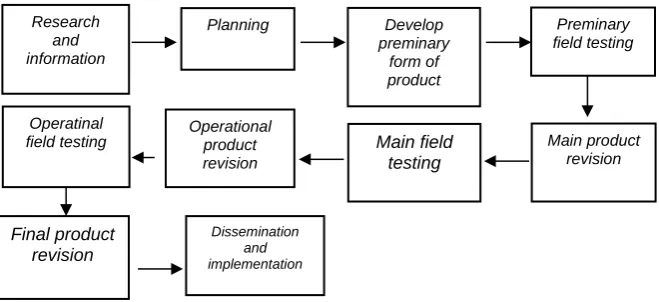
Figure. 1 Instructional Design of R and D11
The picture above describes the steps of research and development of a particular product that can be accounted for and realized in the form of technical targets. Each step can be accomplished at each stage. Each of these steps is not a standard thing, but the step can be adjusted to the needs of each researcher.
This study assigned several subject type. (1) Beginner athletes, 15 people (small group tests), (2) Beginner athletes, 100 people (large group tests), (3) Machinery experts (Dadang Hafid, S.Pd., M.Pd. ), (4) Sepak Takraw Academics (Dede Nurodin, S.Pd., M.Pd.), (5) Sepak Takraw West Java Coach (Iin Firmansyah).
This study employed interviews, questionnaires, observations and documentation. Interviews were used to find and collect information from experts. Questionnaires were given to academics and coaches to provide input and advice on the products produced. Field observations in the form of a tool assessment effectiveness format were used to measure the feasibility and acceptability of products.
The data used in this study are qualitative and quantitative data. The former was obtained from interviews with responses and input from expert teams for product revisions. The latter was obtained from the data on the effectiveness of the tool.
6 Emzir. Metodologi Penelitian Pendidikan (Jakarta: Rajawali Pers, 2008), h. 3
7 Sugiyono. Metode Penelitan dan Pengembangan. (Bandung. ALFABETA. 2015).h.34
8 Walter R. Borg and Meredith D. Gall, Educational Research: An Introduction, 4th Edition. (New York: Longman Inc., 1983), h. 772.
9 Nusa Putra, Research and Development (Jakarta: Rajagrafindo Persada, 2011), h. 77.
10 Punaji Setyosari, Metodologi Penelitian dan Pengembangan (Jakarta: Fajar Interpratama Mandiri, 2013), h. 223 11 Walter R. Borg and Meredith D. Gall, Educational Research: An Introduction, 4th Edition. (New York: Longman Inc., 1983)
Research and information
Planning Develop
preminary form of product
Preminary field testing
Operatinal
field testing Operational product revision
Main field testing
Main product revision
Final product revision
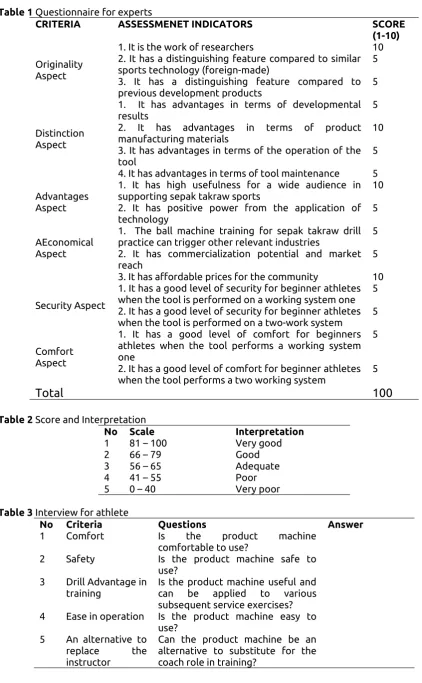
Table 1 Questionnaire for experts
CRITERIA ASSESSMENET INDICATORS SCORE
(1-10)
Originality Aspect
1. It is the work of researchers 10 2. It has a distinguishing feature compared to similar sports technology (foreign-made) 5 3. It has a distinguishing feature compared to
previous development products 5
Distinction Aspect
1. It has advantages in terms of developmental
results 5
2. It has advantages in terms of product
manufacturing materials 10
3. It has advantages in terms of the operation of the
tool 5
4. It has advantages in terms of tool maintenance 5 Advantages
Aspect
1. It has high usefulness for a wide audience in supporting sepak takraw sports
10 2. It has positive power from the application of
technology 5
AEconomical Aspect
1. The ball machine training for sepak takraw drill practice can trigger other relevant industries
5 2. It has commercialization potential and market
reach 5
3. It has affordable prices for the community 10
Security Aspect
1. It has a good level of security for beginner athletes when the tool is performed on a working system one 5 2. It has a good level of security for beginner athletes when the tool is performed on a two-work system 5
Comfort Aspect
1. It has a good level of comfort for beginners athletes when the tool performs a working system one
5
2. It has a good level of comfort for beginner athletes when the tool performs a two working system
5
Total
100
Table 2 Score and Interpretation
No Scale Interpretation
1 81 – 100 Very good
2 66 – 79 Good
3 56 – 65 Adequate
4 41 – 55 Poor
5 0 – 40 Very poor
Table 3 Interview for athlete
No Criteria Questions Answer
1 Comfort Is the product machine comfortable to use?
2 Safety Is the product machine safe to use?
3 Drill Advantage in
training Is the product machine useful andcan be applied to various subsequent service exercises? 4 Ease in operation Is the product machine easy to
use? 5 An alternative to
replace the instructor
3 Results and Discussion 3.1 Result
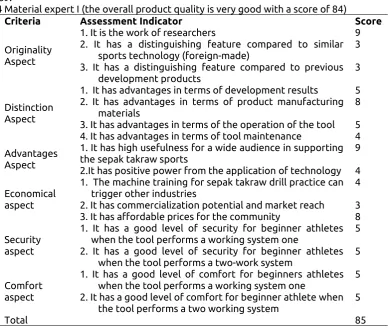
[image:6.595.104.497.206.535.2]This study was aimed at investigating the product of machine training to improve athlete service technique in sepak takraw.. To investigate its effectiveness, this study explores the experts’ judgment. There are several indicators to assess a particular product success, in this case, a machine training in sepak takraw service drill. There were three experts involved in this study to assess the product. The evaluation results from an expert I fell into the "Very Good" category, with a score of 84. Likewise, material experts II viewed the product as "Very Good" with a value of 87. The third expert, the machining expert's evaluation, considered the product quality was "Very Good" with scores 89.
Table 4 Material expert I (the overall product quality is very good with a score of 84)
Criteria Assessment Indicator Score
Originality Aspect
1. It is the work of researchers 9
2. It has a distinguishing feature compared to similar sports technology (foreign-made)
3 3. It has a distinguishing feature compared to previous
development products 3
Distinction Aspect
1. It has advantages in terms of development results 5 2. It has advantages in terms of product manufacturing
materials 8
3. It has advantages in terms of the operation of the tool 5 4. It has advantages in terms of tool maintenance 4 Advantages
Aspect
1. It has high usefulness for a wide audience in supporting
the sepak takraw sports 9
2.It has positive power from the application of technology 4 Economical
aspect
1. The machine training for sepak takraw drill practice can trigger other industries
4 2. It has commercialization potential and market reach 3 3. It has affordable prices for the community 8 Security
aspect
1. It has a good level of security for beginner athletes when the tool performs a working system one
5 2. It has a good level of security for beginner athletes
when the tool performs a two-work system 5 Comfort
aspect
1. It has a good level of comfort for beginners athletes when the tool performs a working system one
5 2. It has a good level of comfort for beginner athlete when
the tool performs a two working system 5
Table 5 Material expert II(product quality in overall aspects is very good with a score of 87))
Criteria Assessment indicator Score
Originality Aspect
1. It is the work of researchers 9
2. It has a distinguishing feature compared to similar sports technology (foreign-made)
3
3. It has a distinguishing feature with previous development products
5
Advantages aspect
1. It has advantages in terms of development results 5 2. It has advantages in terms of product manufacturing materials 8 3. It has advantages in terms of the operation of the tool 5 4. It has advantages in terms of tool maintenance 4 Usefulness
aspect
1. It has high usefulness for a wide audience in supporting the sepak takraw sports
7
2. It has positive power from the application of technology 4
Economical aspect
1. The machine training for sepak takraw drill practice can
trigger other industries 5
2. It has commercialization potential and market reach 4 3. It has affordable prices for the community 8
Security Aspect
1. It has a good level of security for beginner athletes when the tool performs a working system one
5
2. It has a good level of security for beginner athletes when the tool performs a two-work system
5
Comfort Aspect
1. It has a good level of comfort for beginners athletes when the tool performs a working system one
5
2. It has a good level of comfort for beginner athletes when the tool performs a two working system
5
Total 87
Table 6 Machinery expert(the overall product quality is very good with a score of 89)
Criteria Assessment Indicator Score
Originality Aspect
1. It is the work of researchers 9
2. it has a distinguishing feature compared to similar sports technology (foreign-made)
3
3. It has a distinguishing feature compared to previous development products
4
Advantage Aspect
1. It has advantages in terms of developmental results 5 2. It has advantages in terms of product manufacturing materials 8 3. It has advantages in terms of tool maintenance 5
4. It has advantages in tool maintenance 4
Usefulness aspect
1. It has high usefulness for a wide audience in supporting sepak takraw sports
8
2. It has positive power from the application of technology. 5 Economical
Aspect 1. The ball machine training for sepak takraw service drillpractice can trigger to other industries 5 2. It has commercialization potential and market reach 4 3. It has affordable prices for the community 9
Security aspect
1. it has a good level of security for beginner athletes when the tool performs a working system one
5
2. It has a good level of security for beginner athletes when the tool performs a two-work system
5
Comfort aspect
1. It has a good level of comfort for beginners athletes when the tool does a working system one
5
2. It has a good level of comfort for beginner athletes when the tool performs a two working system
5
[image:7.595.145.494.412.691.2]Having investigated experts panel assessment, this study received suggestions and inputs. (1) The dynamo of the driving machine is replaced by a stronger one so that the speed of the ball being lifted becomes smooth. This allows service technique training process. (2) The ball holder on the working mechanism of one machine must be replaced with a stronger one but it should be flexible. This protects from breaking when kicked by the athlete. A stronger and more flexible ball will provide both safety and comfort for athletes. (3) The dynamo speed of the driving engine must be stable. This can be done by adjusting bolts because it is easier to adjust the speed and is easy to operate.
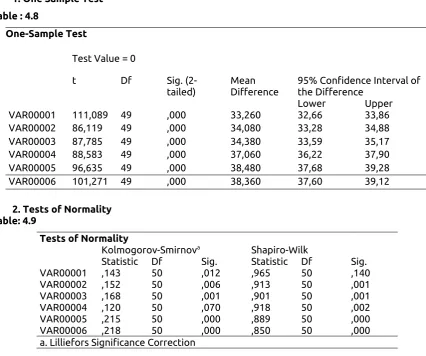
In the previous section, qualitative data have been presented. In this section, quantitative data will be elaborated. Below is a calculation of large group test statistics on the application of machine training for sepak takraw service drill for beginner athletes in Sumedang Regency.
[image:8.595.80.507.215.571.2]1. One Sample Test Table : 4.8
One-Sample Test
Test Value = 0
t Df Sig.
(2-tailed)
Mean Difference
95% Confidence Interval of the Difference
Lower Upper
VAR00001 111,089 49 ,000 33,260 32,66 33,86
VAR00002 86,119 49 ,000 34,080 33,28 34,88
VAR00003 87,785 49 ,000 34,380 33,59 35,17
VAR00004 88,583 49 ,000 37,060 36,22 37,90
VAR00005 96,635 49 ,000 38,480 37,68 39,28
VAR00006 101,271 49 ,000 38,360 37,60 39,12
2. Tests of Normality Table: 4.9
Tests of Normality
Kolmogorov-Smirnova Shapiro-Wilk
Statistic Df Sig. Statistic Df Sig.
VAR00001 ,143 50 ,012 ,965 50 ,140
VAR00002 ,152 50 ,006 ,913 50 ,001
VAR00003 ,168 50 ,001 ,901 50 ,001
VAR00004 ,120 50 ,070 ,918 50 ,002
VAR00005 ,215 50 ,000 ,889 50 ,000
VAR00006 ,218 50 ,000 ,850 50 ,000
a. Lilliefors Significance Correction
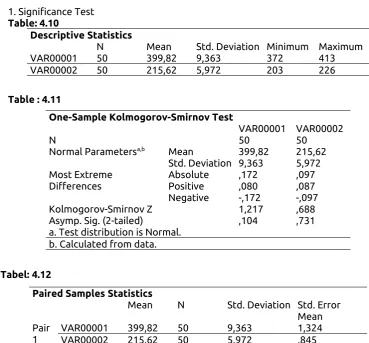
3. The Difference between Two Sample Groups’ Means
[image:8.595.85.512.233.403.2]1. Significance Test
Table: 4.10
Descriptive Statistics
N Mean Std. Deviation Minimum Maximum
VAR00001 50 399,82 9,363 372 413
VAR00002 50 215,62 5,972 203 226
Table : 4.11
One-Sample Kolmogorov-Smirnov Test
VAR00001 VAR00002
N 50 50
Normal Parametersa,b Mean 399,82 215,62
Std. Deviation 9,363 5,972 Most Extreme
Differences AbsolutePositive ,172,080 ,097,087 Negative -,172 -,097
Kolmogorov-Smirnov Z 1,217 ,688
Asymp. Sig. (2-tailed) ,104 ,731
a. Test distribution is Normal. b. Calculated from data.
Tabel: 4.12
Paired Samples Statistics
Mean N Std. Deviation Std. Error Mean Pair
1 VAR00001VAR00002 399,82215,62 5050 9,3635,972 1,324,845
[image:9.595.105.476.519.633.2]In the test of significance above, there is a significant difference between the experimental group t-observe = 1.324 and the control group t-observe = 0.845. This means that the experimental group got significant results while the control group did not. So it can be concluded that the treatment given to the experimental group has an influence on the expected results, namely an increase in the ability of beginner athletes to perform service technique in sepak takraw..
Table: 4.13
Paired Samples Statistics
Mean N Std. Deviation Std. Error Mean
Pair 1 VAR00001 399,82 50 9,363 1,324
VAR00002 215,62 50 5,972 ,845
Table: 4.14
Paired Samples Correlations
N Correlation Sig. Pair 1 VAR00001 &
Tabel: 4.15 Paired Samples Test
Paired Differences T Df Sig.
(2-tailed) Mean Std.
Deviatio n
Std. Error
Mean 95% Confidence Interval of the Difference Lower Upper Pair 1 VAR00001 -
VAR00002 184,200 11,693 1,654 180,877 187,523 111,387 49 ,000 In significance test difference with IBM Data Editor version 21, the result of t-observe=0,111,4 degree of freedom = 14 dan p-value = 0.00 > 0.05 meaning there is significant difference between pretest and posttest.
4. Graph of Increasing Result from Pretest to Posttest
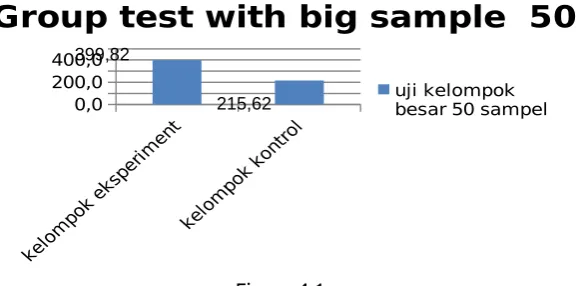
The following is a graph of the increase in athletes’ ability between groups who received treatment services models and groups that did not get treatment.
0,0 200,0 400,0
Group test with big sample 50
uji kelompok besar 50 sampel
Figure 4.1 :
Graph of increasing result from pretest to posttest
Based on the above graph, it can be concluded that there are differences between the experimental group and the control group. Experimental group showed improvement in service capabilities among beginner athletes. Their increase was significant. While the control group did not experience an increase in their service ability in sepak takraw..
3.2 Discussion
In the previous section, this study has delivered the findings both quantitative and qualitative data to answer the research questions. It is clear that the machine training for service drill in sepak takraw improved beginner athlete in their performance. The result of this study may add to the previous studies that offered a program to improve athlete performance in sepak takraw sports. The success of athletes in training and their performance in competition may be influenced by several factors including the psychology of the athlete. In their study, Vincent Varnabas (2015) discusses sepak takraw athlete performance which has something to do with their cognitive anxiety. “Cognitive anxiety is the extent to which an athlete worries or had negative thoughts, and the negative thoughts may include fear of failure, loss of self-esteem and self-confidence.”12
Like other net and rally sports such as volleyball and badminton, sepak takraw encourages its athletes to have the strength of the lower extremities which is needed for success in their performance. Each athlete in each playing position may benefit from the strength of lower
12
Vincent Parnabas, The Deteriorate Function of Cognitive Anxiety on Sepak Takraw Athletes. The International Journal of Indian Psychology.,2015.h.37399,82
[image:10.595.173.463.313.456.2]extremities to excel and achieve in their performance. “Vertical jump is an important fundamental ability for sepaktakraw players especially for the spiker”13
Sepak takraw athlete also needs to pay attention to their habit of consuming sugar and their breakfast to achieve more in their performance. A study that measures the effect of sugar levels in athletes' bodies is seen from the intake per day starting from breakfast “Participants had breakfast between 7.00-7.30 a.m. after 10 hours overnight fast and they were asked to repeat routine for each main trial. Venous blood sample (10 ml) was taken before, immediately after, and one hour after either control or sepak takraw practice. Venous blood samples were collected in serum clot activator vacuette tubes”14
(Greiner one, Austria) and sodium fluoride vacuette tubes (with EDTA K3, Greiner bio-one, Austria). “The vacuette tubes were spun at 5,000 rpm at 5°C for ten minutes. Serum was removed and the sample stored at -20°C for analysis. Serum interleukin-6 (Enzyme-linked immunosorbent assay, R&D systems, Abingdon, United Kingdom) and glycogen (Bioelectric impedance, BioScan, Maltron, United Kingdom) were assessed in two main trials. In addition, triglyceride, creatine kinase, and glucose concentrations were measured using the enzymatic colourimetric method” (Cobas 6,000 analyzer series, Switzerland).
Sepak takraw ball on a flat surface has been studied. In his study, N. Ahmad reported “In this study, two methods were employed to measure the dynamic behaviour and mechanical properties of takraw balls. The first method uses high-speed video camera together with a force plate and the second method is the used of finite element analysis (FEA).All the impact force, ball deformation, contact time, and coefficient of restitution (COR) were determined as a function of inbound ball velocities. Both methods have provided evidence that the dynamic behaviour of the takraw ball was influenced by the effects of ball velocities before impact.”15
Athlete height and its relationship with sepak takraw performance have also been investigated. The study found that Malaysian athlete of sepak takraw height is shorter than another athlete from other countries. Mean heights of the U23, U18, and U15 groups were found to be within the Malaysian population norms16 for their respective age categories. We do not have data from Malaysian players of other but similar court games and comparison is therefore difficult. But when compared to players of court games from other countries, it was found that the height of the Malaysian sepak takraw players was lower than that reported in Indian17 and Chinese badminton players18 and English squash players.19 The exact significance of height to performance in sepak takraw remains unclear, as there is no information in the literature correlating height with performance in this sport. While there may be a minimum height requirement in sepak takraw, it is unlikely that a greater than average height bestows any extra advantage to a player.20
Previous studies have shed light to improve athlete performance in sepak takraw. This study also contributes to scientific knowledge to improve athlete performance in service drill training using machine training. It may become one of the acceptable research works and fill the gap on machine training to improve athlete service drill in sepak takraw. Even though the study took place in Sumedang regency, it may serve as a reference for beginner athlete in-service training programs at national level.
13 Mahdi Rezaei.Talent Identification Indicators in Sepaktakraw Male Elite Players on the Bases of Some Biomechanical Parameters.© IDOSI Publications, 2013)h.939
14 Fischer, C. P. 2006. Interleukin-6 in acute exercise and training: what is the biological relevance? Exercise Immunology Review. 12, 6-33.
15 N.Ahmad.An experimental study of the impact of a sepak takraw ball on a Flat surface. Chapter · January 2009.h.451 16 Singh R, Singh HJ, Sirisinghe RG. Cardiopulmonary fitness in a sample of Malaysian population. Jap J Physiol 1989;39:475–85.
17 Majumdar P, Khanna GL, Malik V, et al. Physiological analysis to quantify training load in badminton. Br J Sports Med 1997;31:342–5.
18 Chin MK, Wong AS, So RC, et al. Sports specific fitness testing of elite badminton players. Br J Sports Med 1995;29:153–7.
19 Brown D, Weigand DA, Winter EM. Maximum oxygen uptake in junior and senior elite squash players. In: Lees A, Maynard I, Hughes M, eds, et al. Science and racquets sports. Vol 2. London: E&FN Spon, 1998:14–9.
4 Conclusion
This study proposes a machine training or tool called DBH-2MCS to improve athlete service drill in sepak takraw. The study has shown that the machine training is based on scientific concepts, in particular, the theory of motion mechanics which is then formed and integrated to help improve the quality of sepak takraw service results for beginner athletes. Functionally, this tool is the same as other assisting products that aim to help and facilitate the trainer in perfecting the training program. The tool is expected to help the athlete achieve the goals, namely increasing the competency of athletes who receive certain treatments according to their needs.
In this study, the machine training was designed to improve athlete ability in service drill specifically to practice the service skills of novice athletes in Sumedang Regency. Operationally, this tool has two functions to improve athlete service capabilities. There are two settings that produce a working mechanism for this DBH-2MCS. The two settings have shown two work systems that produce two functions in supporting the implementation of the training model.
The two functions can be explained as follows: the ball is manually inserted into a component called Ball Input (see in the picture), in the case of a live machine, the ball will automatically be lifted along the ball conveying path with the help of chain rotation. For the standby ball system (DBS) the ball will enter the hole and fall into the delivery channel of the dynamic ball, then move towards the dynamic ball output and stored in the dynamic ball support. Meanwhile, for the Falling Ball System (DBS) the ball will continue to track the path of the ball until the ball falls due to the gravitational force as in the actual game.
Figure: Personal document
For further study, there are several suggestions as follows: (1) The research subject should be carried out in a larger size, students, university students and other athletes who can serve as an experimental group. (2) Study to investigate the use of (DBH 2MCS) for beginners can be conducted to all universities, clubs, and to schools throughout Indonesia. (3) study to investigate government involvement to further review and finance the making of similar and/or manufactured equipment with more adequate quantities.
References
1. Brown D, Weigand DA, Winter EM. (1998). Maximum oxygen uptake in junior and senior elite squash players. In: Lees A, Maynard I, Hughes M, eds, et al. Science and racquets sports, 2: 14-9..
2. Chin MK, Wong AS, So RC, et al. (1995). Sports specific fitness testing of elite badminton players. Br J Sports Med, 29/153, 7).
3. Emzir. (2008). Metodologi Penelitian Pendidikan Jakarta: Rajawali Pers.
2. FALLING BALL SYSTEM (FBS)
4. Ermawan Susanto. (2011). Pengembangan Sistem Informasi Profil Atlet Renang Berbasis Web. Jurnal IPTEKOR. KEMENPORA
5. Fischer, C. P. (2006). Interleukin-6 in acute exercise and training: what is the biological relevance?
Exercise Immunology Review.
6. Ian, Harris Sujae & Koh, Michael. (2008). Technique analysis of the kuda and sila serves in sepaktakraw. Prancis : Routledge
7. Asisten Deputi Olahraga Pendidikan Deputi Bidang Pembudayaan Olahraga Kementerian Pemuda dan Olahraga Republik Indonesia..(2014). Jurnal Olahraga Pendidikan, 7.
8. M N Jawis, R Singh, H J Singh, M N Yassin. (Accepted 3 April 2005). Anthropometric and physiological profiles of sepak takraw players. Correspondence to: Professor Rabindarjeet Singh, Universiti Sains Malaysia, Sports Science Unit, Kota Bharu, Malaysia; [email protected].
9. Mahdi Rezaei.(2013) Talent Identification Indicators in Sepaktakraw Male Elite Players on the Bases of Some Biomechanical Parameters. © IDOSI Publications.
10. Majumdar P, Khanna GL, Malik V, et al. (1997). Physiological analysis to quantify training load in badminton. Br J Sports Med. 31: 342-5.
11. N.Ahmad. (2009) . An experimental study of the impact of a sepak takraw ball on a Flat surface.
Chapter · January.
12. Nusa Putra. (2011). Research and Development Jakarta: Rajagrafindo Persada.
13. Punaji Setyosari, (2013). Metodologi Penelitian dan Pengembangan Jakarta: Fajar Interpratama Mandiri
14. Singh R, Singh HJ, Sirisinghe RG. Cardiopulmonary fitness in a sample of Malaysian population. Jap J Physiol.
15. Sugiyono. ( 2015) Metode Penelitan dan Pengembangan. Bandung. ALFABETA.
16. Syakur, Badruzaman, dan Sunday.(2017).Pengembangan Alat Bantu Latihan Pelontar Bola Futsal Berbasis Mikrokontroler dengan Menggunakan Software Pemograman Arduino. Vol.02 No.01 17.Vincent Parnabas, (2015). The Deteriorate Function of Cognitive Anxiety on Sepak Takraw
Athletes. The International Journal of Indian Psychology, 2: 33-39.
18. Walter R. Borg and Meredith D. Gall, (1983) Educational Research: An Introduction, 4th Edition.