Organisational Behaviour
Module 1
OB – The study of the behaviour & attitudes of people in organisations. There are three units of analysis:
1. Individual (micro approach) 2. Group (micro approach) 3. Organisation (macro approach)
Management vs. OB
· Traditional field of management is defined as: Process of planning, organising, leading, and controlling the human, material, and financial resources of an organisation.
· More recent view focuses on the roles of coaching, integrating, advocating, tracking forms of unit performance, allocating resources against more autonomous employees/self directed teams.
· OB is an applied discipline, which attempts to explain behaviour in organisations in terms of valid theories.
· The field of OB contributes knowledge in critical areas important to any manager.
OB is concerned with describing organisational phenomena while management is a professional discipline, which stresses applied skills.
Role of management in describing organisational problem solving:
Three basic components of a managers job:
1. Technical – Efficient use of resources to achieve organisational goals and application of technologies to achieve productivity goals.
2. Conceptual – Development of new systems and methods of operation. 3. Human – Concerned with employee welfare.
7 basic features of a managers job:
1. Managing individual performance. 2. Instructing subordinates (supervising) 3. Representing staff (teaching and training) 4. Managing group performance (facilitation)
5. Planning and allocating resources (decision-making) 6. Co-ordinating inter-dependant groups (collaboration) 7. Monitoring the business environment (scanning)
The perceived importance and time spent on each task varies substantially depending on the manager’s organisational level.
Evolution of the 21st Century Manager
Past managers… Future managers…
Primary Role Give orders/control behaviour Facilitate the development of individual employees and their work teams
Training and Development Select and Specialise employees to reduce the
cost of training and development Training and Development are continuous andall employees cross trained
Reward Criteria Seniority, rank, effort Skills, individual results, team results
Influence Basis Formal position in hierarchy Expertise
Communication Style Top-down Multi-channel, bottom-up and top-down
Decision-making style Boss-centred with limited input from subordinates
Team-based
Nature of interpersonal relationships at work Competitive win-lose Collaborative/ co-operative win-win
Approach to change Resist Embrace-facilitate
The SOBC model amplifies this idea:
S: All sensations from the environment which trigger human perception. In OB these include all features of the work environment which activate employee behaviour.
O: The final capacities of the individual which are governed by heredity, maturity, and biological needs. These capacities also include knowledge, skills, attitudes, intentions, sentiments, and values.
B: Overt behaviours and actions such as performance or emotional responses and conceptual activities which are apparent only to the individual.
C: The outcomes of behaviour and performance such as recognition and need satisfaction. This is a ‘micro’ model (focuses on individual behaviour)
Employee needs/Organisational productivity
These are the two most pressing issues governing organisational success or failure.
Within an organisation productivity can be increased two ways:
1. A firm can acquire new technology and equipment to produce goals more efficiently.
2. A firm can make investments in future earnings through investments in training/development, leaner production systems focusing on the use of self-directed teams, and organisational designs that improve sales opportunities.
* Competitive advantage derived from an energised, well-trained workforce is much harder to duplicate that only investing in capital improvements.
Values
Definition according to Rokeach – Values are enduring beliefs that a specific mode of conduct or end state of existence is personally/socially preferable to another.
Rokeach then distinguishes;
Instrumental Values – The means to achieve goals by using acceptable behaviour to achieve an end state.
Terminal Values – The goals to be achieved or the appropriateness of desired end states.
Terminal Values Instrumental Values
Achievement, Social status, Wisdom, Beauty in art and nature Ambition
Family safety, Equality, Friendship, Equity Competence, Cleanliness, Courage, Cheerfulness Freedom, Pleasure, Happiness Independence, Forgiving nature, Imagination, Intelligence Inner calm, National security, World peace, Prosperity Self-control, Obedience, Politeness, Responsibility
As a human grows up and experiences the influence of family, social institutions, and cultures, values develop into a coherent sense of self known as our self-concept.
This is used to judge the appropriateness of our behaviour and that of others.
Used to judge the meaningfulness of our goals in life and the people around us.
Implementation of values of Global Organisations
The values in one country vary widely from those in another.
Managers in global organisations are quite often trained in culture based value differences.
The study of personality/Employees personal traits
Individual differences – Aspects of personality from which we can predict (or explain) what people do at work. Locus of Control – An individual’s belief that ones actions influence the outcomes of experiences in life.
Stimilus
Simply put it refers to the strength of ones’ belief that personal actions will/will not result in certain outcomes be they positive or negative.
Internal Locus of Control – Believe that they will External Locus of Control – Believe that they will not
Characteristics of internalisers and externalisers;
Internals tend to believe that Externals tend to believe that
Pay raises are based on hard work, achievement and initiative.
An excellent performance record is the function of hard work and effective project completion.
Good decisions are the result of tenaciously searching for information.
Pay raises are based on having the right job in the right place in the company.
Teachers have favourites and give them higher marks.
People’s attitudes cannot be changed easily by appealing to their logic.
Internalisers:
ARE
More attracted to work situations which have opportunities for personal achievement
More motivated/Better performers
WILL
Search for more knowledge which they believe will lead to outcomes they value.
Take quicker action to correct job confusion. ARE
More trusting and quicker to dismiss job failure.
Externalisers
ARE
More likely to experience adverse emotional reactions to co-workers, who put performance orientated pressure on them.
Managerial Implications
Internalisers work harder when they are told that rewards are based on superior skill and high performance.
This message encourages the development of an internal locus of control.
Participation sweeps away confusion about work responsibilities.
Extroversion & Introversion
Extroversion – The need to obtain as much social stimulation as possible from the environment
Introversion – Avoidance of external stimulation in favour of internally orientated, contemplative activity.
People can experience both of these depending on the situation they confront.
In an organisation
Introverts usually have longer tenure and fewer unexcused absences. They also perform better with few external distractions.
Extroverts engage in irrelevant behaviour when work is dull or meaningless.
The Machiavellian Personality
Employees with the tendency will manipulate others and try to induce then to think in their terms.
“High-Machs” are described as – Cool interpersonally, amoral, pleased by manipulating others, and highly rational.
Socially-Acquired Needs
Needs that are learned through personal contact with the social environment; Three most important needs from the organisational perspective:
1. Need for Achievement 2. Need for Affiliation 3. Need for Power
Need for Achievement
McClelland stated that this is defined by the following qualities
Taking moderate risks by pursuing goals that are difficult but not impossible to achieve.
Needing immediate feedback on performance and goal progress.
Finding tasks and accomplishments to be intrinsically regardless, of the financial/economic rewards.
Defining work in terms of approaching success, instead of avoiding failure.
Being totally task absorbed until the job is done.
Organisational Importance
Those with a high need for achievement perform better than those with similar ability but a lower need.
Those with a high need who find their work boring will lower effort accordingly.
If unchallenged by their work they feel that their employer does not value their effort or ideas.
Managers could apply the concepts by:
1. Use it as one basis for screening applicants. 2. Use it as a factor in promotion decisions
3. Design jobs with goals that are at least moderately challenging
Need for Affiliation
Defined by the following qualities:
Emphasising that all members of a work group be included in events which may affect the moral and cohesion of that group.
Solving or confronting interpersonal conflicts which threaten “esprit de corps”.
Emphasising the importance of social rewards such as recognition, praise, and public acclaim.
Managers can appease this need by allowing their employees to:
Be arbitrators of work-group disputes.
Be involved in community affairs which parallel work interests.
Develop and use as many forms of performance based, social rewards as possible.
Need for Power
Personalised need for Power
Defines behaviours orientated towards influencing others and searching for opportunities to gain influence and control.
Individuals possessing a personalised need for power try to dominate/rule only because they feel more self-confident when they intimidate others.
Firms frequently view this form of power as unproductive.
Social need for Power
Managers gain higher levels of performance from subordinates by demonstrating confidence in them.
Managing employees with needs of Power
Employees with a socialised need should be promoted over this with a personalised need.
Managers with a social need for power should take charge of groups where performance and morale are low.
The socialised need for power is the most important socially acquired need for predicting managerial success.
A high need for achievement without a high need for socialised power may prove to be a weakness.
Role of Job Satisfaction
Job satisfaction is key work attitudes, and a function of employee perceptions of events at work. Facets of job satisfaction are attitudes, which focus on satisfaction with:
The Work Itself
Pay
Fellow Workers
Supervision
Promotions
Job satisfaction determinants:
Individual – Years in career/ job expectations
Job Satisfaction
1 2 4 6 8 10 12 14 16 18 20 22 24 26 Years in Career
Sharp drop between 6 mths and 2 yrs attributable to employee figuring out that the job will not meet all personal needs as quickly as expected.
This sharp drop is of major concern to management. If large amounts of people leave, recruiting, hiring, and training new employees can be costly.
Many firms try to soften the blow by using realistic job previews during the recruiting/ interviewing process.
Organisational – Supervision/job challenge/job clarity/incentives
Supervision
Considerate supervision supports employees’ self-esteem and self-worth.
Using consultation on job decisions, policies and work rules will increase job satisfaction. Job Challenge
When employees are challenged they become more physically and emotionally involved in their work.
Job Clarity
The extent to which employees understand what they are to do on their jobs.
Feedback improves job satisfaction. Incentives
Extrinsic (i.e. pay raises, promotions) and Intrinsic (i.e. Pride) rewards are related to job satisfaction.
My rise Co-workers rise --- compared to
My effort Co-worker effort
If employees judge this comparison others rewards to be greater than his/her own “perceived inequity” occurs.
The only ways for an employee to restore balance are to:
Reduce effort and performance.
Change the comparison other to a more suitable co-worker.
Increase the levels of effort and performance and hope the rewards attached increase.
Eliminate the problem by leaving the job or seeking a transfer.
Key consequences of job satisfaction:
Mental and Physical health increases.
Improved employee resistance to job stress.
Lower employee turnover and unexcused absences.
Job Satisfaction and Performance
The performance – job satisfaction relationship is one of the most important in organisational behaviour.
Measuring Job Satisfaction
All methods are indirect as job satisfaction can only be inferred Methods Include:
Observation of employee behaviour.
Interviewing employees
Paper & pencil questionnaires
The Job Descriptive Index (JDI) is the most widely used measure of job satisfaction.
The JDI’s use of Positive/Negative descriptors provides balance.
Eg. Think of your present work. What is it like most of the time? In the blank beside each word or phrase given below, put: Work on present job
Y If it describes your work _____ Routine
N If it does NOT describe it _____ Satisfying
? If you cannot decide _____ Good
Another tool is the Minnesota Satisfaction Questionnaire.
Format facilitates assessment of partial agreement.
Takes longer than the JDI but yields very dependable results
Not Satisfied Slightly Satisfied Satisfied Very Satisfied Extremely Satisfied
My Job Security 1 2 3 4 5
Pay vs. Work 1 2 3 4 5
Problems with questionnaires: PERFORMANCE
INTRINSIC REWARDS
EXTRINSIC REWARDS
PERCIEVED EQUITY FOR VARIOUS REWARDS (Mediates the relationship)
Assumes employees are willing and able of describing their feelings without distortion
Items in any questionnaires have different meanings, so survey results can be biased in systematic ways
Developments in the study of employee work attitudes
Organisational Commitment:
The strength of an employee’s identification with the organisation. It has three components; 1. Belief in and acceptance of organisational goals and values.
2. Willingness to exert considerable effort on behalf of the organisation. 3. Desire to maintain membership in the organisation.
Economic insecurity has eroded the employee views of organisational commitment. High unemployment and corporate downsizing has caused employees to remain doubtful of their roles and their abilities.
Job Involvement:
The degree to which employees identify with their job, participate actively in it, and consider it to be a big determinant of their self worth.
It activates belief that the job is a central component of one’s life.
It contributes to the perception of self worth
Job involvement may be less at risk during economic uncertainty. The demands of an absorbing job may allow employees to find a kind of refuge that dissipates fears of job loss.
Module 2
Stress on the job
Eustress – Positive Distress – Negative
Hans Selye coined the term “General Adaptation Syndrome” for the process by which we adapt to stressors. The body and mind prepare to fight/adjust to the stressor by increasing heart rate, respiration, muscle tension, and blood sugar level. These rapid reactions are amplified by the endocrine system in preparation for ‘fight or flight’.
The body tries to re-establish a normal state using more resources to adapt to the stressor.
After chronic exposure to a stressor, the body begins to wear down. Stress-related illness may result.
Causes and Consequences
3 categories of job stress causes: Environmental, Organisational, and Individual. 3 categories of consequences: Physiological, Psychological, and Behavioural.
ALARM
RESISTANCE
EXHAUSTION
Environmental Factors Economic Uncertainty Political Uncertainty Technological Uncertainty
Organisational Factors Task, Role, and Interpersonal
Demands Organisational Structure,
Experienced Stress
Physiological Symptoms Headaches, high blood pressure, heart disease
Environmental
Economic uncertainty – apprehension experienced when employment conditions deteriorate and job insecurity rises.
Political uncertainty – Source of job stress in ‘countries’ with unstable or repressive political systems.
Technological uncertainty – Tech. breakthroughs and their attendant knowledge obsolescence.
Organisational
Task demands – Stressors related to your job (i.e. performance feedback, noise level in office)
Role demands – Conflicts between personal values and supervisory/organisational values
Interpersonal demands – Pressure created by groups and co-workers (i.e. lack of co-operation)
Organisational structure – The extent to which the organisation is highly formalised with extensive work rules/policies.
Organisational leadership – Dominant culture created by the leadership style of top exec’s. (Over long periods of time, a short run viewpoint can induce stress.
Organisational life cycle stage – The stage of establishment, growth, maturity, and decline.
Personal
Family problems
Financial problems
Individual differences
Type A behaviour – “an action-emotion complex that can be observed in any person who is aggressively involved in chronic incessant struggle to achieve more is less, and less time, and if required, against the efforts of others.” Type A employees share the following qualities:
Work long hard hours under constant deadline pressure and chronic work overload.
Take work home, and are unable to relax on weekends/holidays.
Become frustrated by the work situation, impatient, easily irritated with work efforts of others.
Type A behavioural pattern Type B behavioural pattern
Measures success by quantity of results Is always active and moving Walks, talks, and eats rapidly Does two or more things at once
Cannot cope with leisure time
Is obsessed with numbers and measures of performance Is socially aggressive
Is highly competitive Experiences constant time pressure
Is mild-mannered Relaxes without guilt Is not concerned about time
Is patient Does not brag Plays for fun, not to win Has no pressing deadlines
Is never rushed
The emerging portrait is that adaptive Type A’s reduce experiences stress by being hard driven, but with no sense of hostility/aggression towards others.
Hostility, anger, aggression, can contribute to stress and are associated with heart disease, strokes, etc.
Individual Factors Family Problems Financial Problems
Consequences of Stress
Physiological Symptoms – The changes in metabolism that accompany stress. Wear and tear such as back trouble, migraines, insomnia, heart disease, hypertension, diabetes, and even cancer are linked to extended exposure to chronic stress.
Psychological Symptoms – These are major consequences that may appear before physical problems. Anger, anxiety, depression, nervousness, unstability, passiveness, and boredom accompany high stress.
These problems result in lower self-esteem, performance, resentment, inability to concentrate, trouble in making decisions.
Job burnout – Prolonged withdrawal from work, which causes the sufferer to devalue work and see it as a source of job dissatisfaction.
Behavioural Symptoms – Changes in performance, absenteeism, hopping from job to job.
Organisational Programmes of Wellness and Job Stress Management
It is difficult to calculate the benefits of wellness programs.
Corporate stress management strategies seem to break down into two types:
Problem-focused interventions:
Designing a solution for specific symptoms of employee job dissatisfaction or job stress. Eg. Job redesign/rotation, enhanced job security, flextime, and firm-sponsored day care.
Emotion-focused Interventions:
Try to help employees cope more effectively with job stress (as oppose to lowering the level).
Strategies can be called individual/organisational coping strategies. For individuals,
interventions can include exercise, meditation, social support, and counselling. Organisationally these can include on-site wellness programs, sabbatical leaves for eligible employees, and employee assistance programs (EAPs).
Employees are trying to create incentives to motivate employees to participate in wellness programs.
Programs may begin with a full-scale profile of an employees health risk factors.
Date is then sometimes used to identify employees who are at risk and make an effort to encourage them to adopt healthier habits.
Downsizing
Using efforts to control costs through downsizing can induce job burnout.
Managers in this environment trying to reduce costs or raise earnings often experience little accomplishment, emotional exhaustion, and depersonalisation.
Their sense of helplessness to protect subordinates jobs, let alone careers, undermines their internal locus of control.
When mangers/employees feel these effects they are often self-absorbed and ineffective at improving output productivity or service quality.
Module 3
Work motivation is referred to as the direction, level of effort, and extent of persistence in the behaviour of an employee.
Is there a distinction between Motivation and Performance?
Performance always involves the evaluation of a person’s behaviour on the job.
Motivation is only one of several factors that affect performance.
Additional factors which affect performance are 1. Ability 2. Personal characteristics 3. Difficulty of design tasks 4. Working conditions 5. Work attitudes.
Managers who assume poor performance is a result of a lack of motivation take the wrong steps to correct the problem. They may overlook the role of training, better equipment, or technology.
Content Theories of Motivation
Theory which specifies those factors in individuals which stimulate, direct, sustain, and stop behaviour.
Maslows Hierarchy
Abraham Maslow believed that motivation could be explained by organising human needs into five levels.
Need Level Description of the level Organisational example Highest level Needs
Self-Actualisation The need to reach one’s fullest potential Engineer uses all his skills to create a new sub-component.
Esteem The need to feel good about oneself and one’s
abilities
Company promotes deserving managers and recognises employees with rewards
Belongingness The need to experience social interaction,
friendship, and love Having sustained, and good relationships withco-workers
Safety Need for security, stability, and a safe
working environment Having good job benefits, safe working area, and job security
Physiological Food, water, clothing, and shelter to ensure
survival Guaranteed minimum pay level that is sufficient to provide basic necessities
Lowest level Needs
Maslow states that physiological needs must be satisfied first.
Physiological and Safety needs are often referred to as “lower-order needs”.
Belongingness marks the start of “higher-level needs”. These needs were considered by Maslow to be personally infinite (never satisfied completely).
Higher-order needs are learned through sustained contact with social environments.
Esteem needs have an external component (social-status, i.e. recognition, prestige, and appreciation) and an internal component which consists of challenge, autonomy, and self-reliance.
Self-actualisation is defined as the desire to fulfil oneself by making maximum use of talents and experiences. I.e. living up to ones potential.
Self- efficacy is the personal confidence to achieve a very high level of performance. This is strengthened by success in self-actualising on the job as well as satisfying esteem needs. Other critical points to consider:
1. A satisfied need ceases to motivate behaviour at that need level.
2. Unsatisfied employee needs lead to undesirable outcomes at work (see restoring balance).
3. People are assumed to have a need to grow and develop to their full potential and consequently strive to move up the hierarchy and satisfy higher order needs.
4. Needs are not usually satisfied completely.
Applying the Need Hierarchy:
Tends to parallel employee career development.
Data from research suggests that the hierarchy of needs can be reduced to two levels.
They have also found that as a manager advances through an organisation their needs for security and safety decrease, with a corresponding increase in social, esteem, and self-actualisation needs.
Also found that while lower-order needs become less important as they are satisfied, the same cannot be said for higher-order needs.
Herzberg’s Two-factor Theory of Motivation:
Closely related to Maslows.
AKA the Motivator-Hygiene theory.
Hygiene’s are necessary but not sufficient for sustaining high job satisfaction and motivation.
Other motivators include, the work itself, responsibility, challenge, achievement, and professional growth.
Hygiene’s
Components of job content. Sometimes referred to as contextual factors because they emphasise the elements of the environment surrounding the job and employee.
When hygiene’s are not present, the employee’s job is impoverished.
Motivator’s
Related to the employee-job interactions, and are job-centred characteristics. Often called intrinsic job factors or context factors.
Absence of motivators can lead to apathy and alienation because jobs are thought of as unchallenging and boring.
Benefits of Herzbergs Work:
Its most enduring benefit is the attention it focuses on the effects of company systems and job designs on employee job satisfaction.
Comparing Maslows and Herzbergs Models:
Herzberg is concerned with job and organisational sources of job satisfaction and dissatisfaction.
Maslow focused on human needs, which encompass a variety of life situations.
Maslow’s lower-order needs resemble hygiene factors in that they do not guarantee this growth for employees, but merely create the conditions for it to occur if employees value higher-order need satisfaction at work.
Criticisms of Herzbergs Theory:
The most important centres on the method of testing the theory, which requires employees to consider their work experiences retrospectively. Such ‘historical comparisons’ are subject to distortion.
MAXIMUM
Job Satisfaction Range
NEUTRAL
Job DIS-Satisfaction Range
I QUIT!!!!
Peer Relations Pay
Supervision
Work Environment
Job Security
Co. Policies
HYGIENES MOTIVATORS
Status
Promotion Recognition Hygienes only
Process Theories of Motivation Equity Theory (See Module 1)
Developed by Stacy Adams
Important revision to the theory proposes that there are three types of individuals with different preferences for equity:
1. Benevolents – Employees who are comfortable with an equity ratio which is less that that of the comparison other.
2. Equity Sensitive – Employees who prefer equity based on the original formulation.
3. Entitled – Employees who are comfortable with an equity ratio which exceeds that of the comparison other. Sometimes referred to as “slackers”
Following the guidelines of equity theory, a manager should keep these principles in mind:
1. When valued, important rewards are allocated, employees who are equity sensitive are most likely to make comparisons which are based on traditional rewards.
2. In making reward allocation decisions, anticipate that certain employees will feel positive and negative inequity.
3. In advance, tell employees about salary ranges, pay increases, and promotions.
Expectancy Theory
Developed by E.C. Tolman in 1930. He realised that behaviour was always purposeful and goal directed.
Vroom applied Tolman’s ideas to employee behaviour.
Now a leading explanation for turnover, absenteeism, career choice.
Components in expectancy theory:
Valence is defined as the personal attractiveness of different outcomes.
Positive valence – Employee strongly pulled to behaviours which make that outcome likely.
Negative valence – Attached to undesirable outcomes.
Outcomes in expectancy theory:
2 different outcomes
1. First-level outcomes – Result of expending effort in a directed way. I.e. job performance, coming to work late, etc.
2. Second-level outcomes – A direct result of achieving, or not achieving, first-level outcomes. I.e. promotions, pay raises, recognition.
Probabilities in expectancy theory:
Instrumentality is the personal belief that first-level outcomes lead to second-level outcomes. Can be negative or positive.
Managers should ensure that there is a clear path between performance excellence to second-level outcomes that are positively valent.
Expectancy is the subjective belief that a given level of output will lead to first-level outcomes on the job.
WORK ENVIRONMENT
EFFORT
FIRST-LEVEL OUTCOME
Excellent report delivered on-time and saves co. $50000
SECOND-LEVEL OUTCOMES
Promotion
Pay Raise
New high-status title
Purchase a new home
Organisational Factors & Motivation
Numerous organisational factors influence employee motivation.
Role Ambiguity – A lack or clarity or understanding of job or work demands.
Role Conflict – Having two sets of expectations which are in disagreement.
When role ambiguity/conflict are high, the accuracy of employee perceptions about expectancy and instrumentality deteriorates.
The organisation’s performance appraisal system and the reward system play large roles in expectancy theory. The job design system plays another.
Cultural Differences in Motivation
Cultural differences exist.
Some countries consider certain traits hygiene’s while others would consider the same trait a motivator.
Principles of Behaviour Modification
Rooted in the work of B.F. Skinner.
B Mod states that external or environmental consequences determine behaviour.
The main principles in B Mod are the four listed below.
Behavioural Shaping and Employees
Important extension of contingencies of reinforcement.
This is done by basing rewards on closer and closer approximations to the desired behaviour.
Reinforcement occurs only as the behaviour conforms more closely to the desired pattern.
Schedules of Reinforcement
Schedule Description Example
Continuous Consequence follows each response Co-worker comments each time an employee
EXPECTANCY ABILITY INSTRUMENTALITY VALENCES
INDIVIDUAL FACTORS
ORGANISATIONAL FACTORS
EFFORT
Self-Efficacy Need for Achievement Locus of Control Self-Esteem
PERFORMANCE
Role Ambiguity Role Conflict
Performance Appraisal System Job Design System
VALUED EMPLOYEE OUTCOMES
POSITIVE REINFORCEMENT
PUNISHMENT NEGATIVE
REINFORCEMENT EXTINCTION
Consequence Presented Consequence Removed
Pleasant Consequence
comes to work late
Partial Consequence does not follow each response
Types of Partial Reinforcement
Fixed Ratio (FR) A fixed number of behaviours must occur
before reinforcement occurs
After testing 25 units, a technician is eligible for a bonus of one on each additional units tested
Variable Ratio (VR) A variable number of behaviours (around
some average number) must occur before reinforcement
A service technician might get rewarded after handling five accounts, then next time after seven.
Fixed Interval (FI) After a given amount of time has elapsed,
reinforcement occurs Co-workers get together for a tea break at 1000 and 1400 Variable Interval (VI) After a variable amount of time (around an
average) has elapsed, reinforcement occurs A superior disciplines an employee after two days, next time he does it after four days
Ratios or Interval’s can be stretched out in order to keep employees from taking these rewards for granted.
B Mod in Perspective
Major benefit of B Mod is that it focuses on observable employee behaviour which can be measured and used to improve performance.
Pros and Cons of B Mod
Supporters Believe Opponents Believe
It focuses on observable employee behaviour instead of intangible
individual differences. It undermines employee respect and dignity
No manipulation occurs when employees participate in the B Mod It makes organisations more manipulative and exploitative
It improves employee instrumentality’s It makes employees dull and dehumanised extensions of the machines or systems they operate
Employees receive higher quality feedback about their performance It oversimplifies work behaviour and erodes employee creativity
B Mod systems can be designed to assist workers in obtaining higher performance levels and more significant rewards.
Employees are trusted to gather, record, and report on their performance levels to management.
Criticisms of B Mod
Critics charge that the application of B Mod principles reduces valued differences among employees and make them interchangeable.
They believe that B Mod programs oversimplify work and create rigid patterns in work behaviour which reduces the creative urges of employees.
B Mod works best with highly repetitive tasks which are learned in a short period of time.
When designed with sustained involvement of employees’ accusations of manipulation and subliminal control are reduced.
B Mod programs which are acceptable to employees influence expectancy, instrumentality, and valences for both first and second level outcomes.
Motivational gains achieved through B Mod are soundly based in expectancy theory.
The Role of Punishment in Management Practices
The need to use punishment in an organisation is not in debate, however the frequency and method are.
Opponents cite the following objective to using punishment:
For it to be effective, the manager must closely monitor employee behaviour.
Employees become anxious, fearful, less creative, hostile, and may reject delegated responsibility.
Alternatives to Punishment
Alternative Description
Extinction Since much undesirable employee behaviour is intended to gain
co-worker attention and show off, supervisors and co-co-workers should ignore it. This removes the positive consequences and behaviour ceases
Re-engineer the work environment so undesirable behaviour cannot
occur If employees waste time in the break area install a window so the supervisor can easily observe employee activity in that area Reward behaviour which is physically incompatible with undesirable
behaviour Rather than discipline employees for untidy work areas, reward them for cleaning their workplaces Be patient and allow time for undesirable behaviour to disappear When a manager states ‘It’s OK to make a few mistakes because we
learn from them’ we are observing this amiable philosophy
Positive Side:
Many of our behaviours are learned under the conditions created by naturally occurring punishers. I.e. production quotas, performance reviews, machinery.
Sometimes there is no alternative. I.e. use of drugs, alcohol.
Effective use of Punishment
Setting up a B Mod program:
1. Conduct a job analysis to ensure understanding of job responsibilities. 2. Define performance behaviours and set performance goals.
3. Conduct a baseline audit to identify the rate of current performance behaviours. 4. Select powerful and abundant reinforcers to reward excellent performance. 5. Use continuous reinforcement to encourage new performance behaviours.
6. Practise behavioural shaping to obtain closer and closer approximations of the desired behaviour. 7. Establish desired behaviours by adding new positive reinforcers which employees’ value. 8. Stretch the ratio/interval to sustain performance levels.
9. Review and evaluate the program to identify and measure target goals (expand the program).
The following conditions will improve chances of success: 1. Moderate to high trust must exist.
2. Employees must believe good workplace hygiene exists. 3. Employees must have control over the pace of their work. 4. Employee ability cannot be a cause of the problem.
5. Employees must be able to measure/record successful performance behaviours. 6. Employees must get regular feedback.
7. Supervisors must be fully trained and committed to the B Mod program. Supervisor
observes undesirable
behaviour
PUNISHMENT IS: Rapid
Intense Equitable Focused Private Informative
Not followed by Reewards
SUBORDINATE: Understands incorrect behaviour
Module 4
Organisations must evaluate employee performance for a number of reasons:
Employees need to understand the behavioural requirements of the job.
Employees work is evaluated for its contribution to company goals.
Employees need to know where they stand with the organisation in terms of performance.
Employee motivation is increased by performance appraisal systems.
Valid information about employee performance should be used to make decisions about salary increases, promotions, bonuses, and training needs.
Employees need to understand what the firm expects from them in terms of performance.
Effects of Performance Appraisal
For the organisation For the employee
Performance improvement Need fulfilment (security, social, self-esteem)
Validation of the selection system Job satisfaction
Employee counselling Organisational commitment
Training and development Job involvement
Clarification of job expectations Satisfaction with supervisors
Development of employee potential Achievement of promotions
Manpower planning Greater responsibility
Improved customer service Improved self-efficacy
Common threats to the reliability of performance appraisal systems:
Deficiency – Actual performance that is overlooked because the evaluator ignores it or the appraisal system fails to capture it.
Unreliability – Lack of consistency and stability of performance appraisal results under the same evaluators and similar circumstances of administration.
Invalidity – Lack of quality of the measuring components in a performance appraisal system.
Errors in Performance appraisal
Type of Error Definition
Personal Bias
Halo Effect Recency Error
Central Tendency Error
Strictness/Leniency Error
Similarity Error
A stereotype or bias which influences a supervisors rating upward or downward.
Rating an employee on one trait based on their evaluation on other traits
The emphasis on recent performance examples in making performance assessments
Assigning average ratings to all employees resulting in little variation among ratings.
Supervisor ratings based on the belief that employees do not measure up, or that all employees measure up.
The supervisor has a performance quality in himself which he looks for. in subordinates.
Forms of Validity
Type of Validity Definition and Example
Deficiency True Assessment UnreliabilityInvalidity
Deficiency Problem – Performance overlooked by evaluator.
Reliability Problems –
1. Situational factors affecting the evaluator, such as mood, timing, or the evaluation.
2. Disagreement between evaluators or inconsistent methods.
3. Temporary personal factors, such as fatigue or ill health of the person being evaluated.
Validity Problem – Poorly defined task performance causing invalidity.
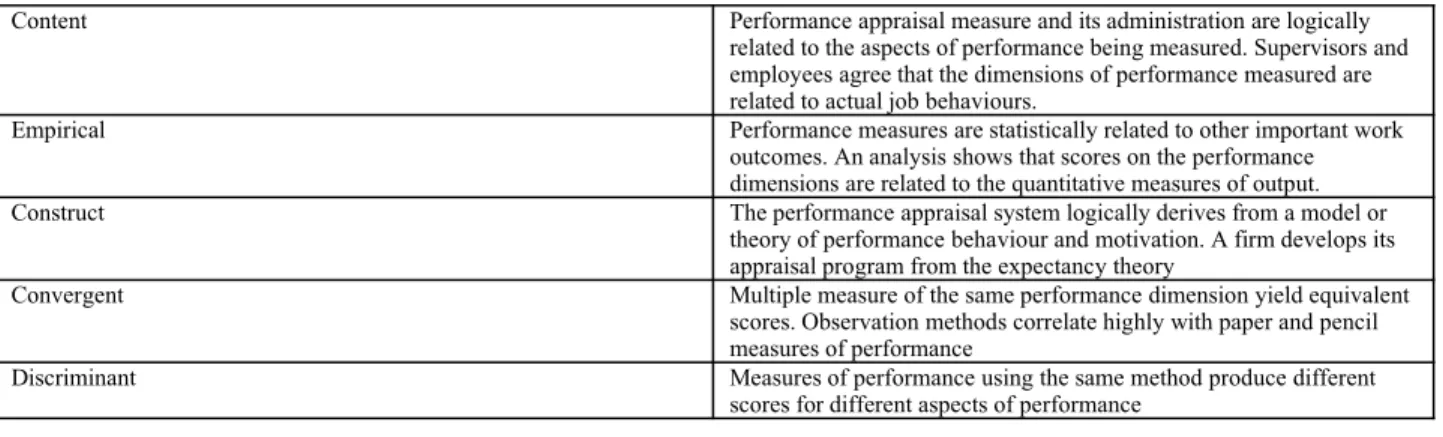
Content Performance appraisal measure and its administration are logically related to the aspects of performance being measured. Supervisors and employees agree that the dimensions of performance measured are related to actual job behaviours.
Empirical Performance measures are statistically related to other important work
outcomes. An analysis shows that scores on the performance dimensions are related to the quantitative measures of output.
Construct The performance appraisal system logically derives from a model or
theory of performance behaviour and motivation. A firm develops its appraisal program from the expectancy theory
Convergent Multiple measure of the same performance dimension yield equivalent
scores. Observation methods correlate highly with paper and pencil measures of performance
Discriminant Measures of performance using the same method produce different
scores for different aspects of performance
Ways to reduce reliability errors include:
Using multiple criteria.
Emphasise behaviour rather than traits.
Use several raters (360 degree performance appraisal).
Train the raters.
Designs of performance appraisal systems can be improved by conducting job analysis, and improving validity of performance methods.
Performance Appraisal Methods:
Absolute Standards:
Judges each employee against a fixed and inflexible set of performance criteria.
This system often results in upward biased ratings (leniency error) because supervisors prefer to give positive feedback.
Example:
Dimensions are primarily personality-based and do not assess actual job behaviours.
This method has serious validity problems.
Graphic Scales Rating Systems
Most popular systems in use today.
Criteria usually possesses content validity.
NAME……… DEPARTMENT……… JOB TITLE………
PERFORMANCE PERIOD……… SUPERVISORS NAME………
Circle a number which best describes the employee
Employee Charesteristic Excellent Good Average Below Average Poor
1. Dependability 5 4 3 2 1
2. Co-operativeness 5 4 3 2 1
3. Customer courtesy 5 4 3 2 1
This method highlights the differences in the performance of subordinates.
Supervisors are in a strong position to assess the strengths and weaknesses of each employee.
Does not eliminate threats to validity.
Often supervisors have a tendency to use only part of the rating system due to individual strictness, leniency, or similarity.
NAME……… SUPERVISOR……… DATE OF HIRING………
TIME IN POSITION………..
Please tick the YES or NO box beside each performance dimension
YES NO
Exhibits good manners (is polite and tactful)………
Firms try to avoid this problem by requiring supervisors to generate a fixed distribution of performance levels. This can create problems for employees who find this to be unfair.
Behaviour Anchored Rating Scale (BARS)
Provides concrete examples of behaviours for different levels of performance.
System emphasises work behaviour and how the work gets done instead of employee characteristics.
Design/Implementation of a BARS system is a participative procedure which outlines the input of the supervisors/employees rated by the system.
This analysis provides a pool of highly meaningful items describing effective/ineffective job behaviours.
Inventory control and management: includes all those behaviours the assistant demonstrates when working with store inventory
7 If the manager asks the assistant about the level of stocking for a product the assistant can immediately pinpoint the product on the computerised inventory report.
8 You could expect this assistant to ask another employee how to use the computerised inventory report. 9 This assistant would be unaware of reordering dates for items in inventory.
How BARS systems differ from other performance appraisal methods: Positive
BARS emphasise how the work is performed.
This reduces the chance of extraneous employee traits/peripheral job requirements to be evaluated.
Quality of feedback in BARS may exceed that of another. Negative
Takes a long time to develop.
Works best when job behaviours are always observable.
Developing BARS for jobs which require creativity, innovation, complex problem solving is more difficult.
Goal-Setting
The behavioural framework for a work-based theory of goal setting was articulated by Edwin Locke.
His theory proposes that clearly specified, difficult goals result in greater performance improvement than easy goals stated in general terms.
Goal-setting systems, increase work motivation/performance, reduce stress of conflicting/ confusing work expectations, and improve accuracy/validity of performance evaluation work.
Goal setting systems should have adequate/timely formal and informal feedback. Employees receive valued personal rewards which create job satisfaction and increased work motivation.
Management by Objective
This is simply an organisational application of goal setting.
Environmental Issues
Specify results expected.
Explain rewards which are available.
Goal-setting Process
Mutually established Employer-centered or framed as ‘do your best’
Goal Attributes Specific
Measurable
Achievable
Resource-based
Time-specific
Employee Intentions
Accept the goals Commit to the goals
Outcomes
Peter Drucker coined this term and advocates MBO as a process which develops self-control in managers since these individuals control the process that leads to positive organisation and employee outcomes.
He also pinpointed the importance of employee involvement.
Observing caution in the use of an MBO system:
1. Top management support, commitment, involvement must preclude MBO design and not change over time.
2. MBO must have a strong relationship with routine managerial characteristics. 3. MBO must emphasise organisational and personal development goals.
4. The firm must devote part of its resources to the effective training of personnel to administer and function under the MBO system.
5. MBO systems must be tailored to each department.
6. Managers must avoid over-emphasis on the # of goals (quality not quantity). 7. Benefits should far outweigh the costs.
8. Discussion and evaluation should be equally emphasised
9. MBO works best when it is flexible and goals can be adjusted to meet unforeseen circumstances.
Rewards and Reward Systems
Rewards strongly influence employee effort and performance (see equity theory).
There are two ways to classify rewards:
Intrinsic
Rewards associated with the work itself. These include being personally responsible for a meaningful portion of work, doing work which leads to personal development/confidence.
Jobs with high levels of intrinsic rewards include doctors, lawyers, and research scientists.
Extrinsic
Rewards given to an employee by the firm, and do not occur as the work itself unfolds.
Extrinsic rewards can be broken down further into;
Direct Compensation – Base salary, performance bonuses, share options, pensions. Indirect Compensation – Rewards given due to organisational level vs. performance – loans at low interest rates, personal services, protection.
Non-Financial Compensation – Preferred office furniture, assigned parking spaces, impressive titles, and insignias.
Distributing Rewards in Organisations
Common reasons used to distribute rewards:
Performance – When rewards are distributed on this basis performance becomes a motivator.
Effort – In the interest of minimising turnover/hiring costs many firms decide to reward effort. This does not do much good to improve performance.
Seniority – When seniority becomes a substitute for performance in the allocation of rewards, managers soon find it is encouraging tenacity vs. performance and achievement.
ANALYSE the mix of people, jobs, work methods
and external demands
PLAN goals, strategy, communication, and training
DEFINE the employees’ jobs in terms of content, authority, and
responsibility
ARTICULATE goal difficulty, clarity, number,
feedback
make FORMAL review of goal achievement and rewards to be obtained
make INFORMAL review of goal achievement, methods and probable rewards, and REVISION of goals and
methods if necessary
reach MUTUAL AGREEMENT about goals, work methods, goal measurements, and time frame The MBO
Equality – Everyone at a given organisational level receives the same base pay and pay raises. The belief is that doing this causes employees to support teamwork.
Power/Influence – Groups/individuals are able to increase their share of rewards at the expense of another.
The most organised way of developing an effective reward system is to develop a job classification scheme to rank jobs against each other based on compensation factors such as skill requirement, mental requirement, physical requirement, responsibility, and working conditions.
These factors help determine starting salaries, pay grades, and the number of levels of pay grades.
Comparison of Pay-practises
Cafeteria-style Fringe Benefits – Allows employees to select a package of fringe benefits.
Lump sum Pay Systems – Allows employees to decide how they receive their paycheque.
Skill-based Compensation – Rewards employees for learning new skills.
Accumulative time-off
All-salaried team – By paying all employees a salary, exec’s hope to improve loyalty, commitment, and self-esteem in the workforce.
Open Salary Information
Pay-secrecy exaggerates pay perceptions and creates the condition of chronic, perceived distributive injustice.
Making salary information available can fight this. This usually involves publishing ranges for pay raises, # of pay grades, organisational guidelines for the measure of performance levels, policies concerning bonuses and fringe benefits.
When methods used to determine pay raises are performance based, widely publicised, and well understood by employees, their perceptions of procedural justice rise.
The periodic use of job analysis and salary surveys demonstrates to employees that the company is serious about maintaining objective methods to ensure fairness.
Hiring, selection, training, promotion, performance appraisal, and termination practises are all subject to perceptions of procedural and distributive justice.
Guidelines for Improvement
Tie incentives in the reward system as closely as possible to actual performance on the job.
The incentives/benefits program should be adjusted or individual differences.
Incentive programs should match the type of work performed by employees and the structure of their firm.
The pay structure should be consistent with the culture of the firm.
Incentive systems should be monitored over time to ensure employees are being paired at the prevailing salary levels for their work, being fairly treated, and the program is being properly administered.
Group Based Reward Systems
Valued when company goals depend on teamwork/collaboration and employee effort.
Group based reward systems encourage both.
The Scanlon Plan
The first systematic cost-savings, group based reward system was the Scanlon Plan, developed in 1937. This plan tries to reduce labour costs below a historic base level.
The plan also promotes a work climate with better labour-management co-operation.
These programs are extremely powerful tools for lowering costs and building innovation into a company. Also increases employee satisfaction and reduces turnover.
Important Points to Consider
1. Work best when dependable histories of labour costs exist in the firm. 2. Seasonal product demand makes gainsharing establishment more difficult. 3. Market may have to absorb additional output if the reduction in costs leads to it. 4. Company should have a history of labour-management co-operation.
5. Easier to establish in smaller production units (50-300 employees)
6. Top management must be committed to the concept of productivity enhancement.
According to Ed Lawlen a well-designed team-based reward system can improve competitive advantage in six ways:
1. Attraction/Retention 2. Motivation/Performance 3. Skill Development 4. Organisational Culture
5. Reinforcement/Definition of Structure 6. Cost
The Rucker Plan
The measurement of productivity is called the value added, which is the difference between the sales income from goods produced and the cost of materials, labour, and outside services consumed.
The following steps are taken to establish a Rucker Plan:
1. Identify a base period that provides data that will be valid and useful for establishing standards. 2. Generate the following data using the base period standards:
Sales value of production (SVP)
Cost of Materials, supplies, service, etc. (COM) Cost of Labour (COL)
3. Using this data, establish the following standards: Value added (VA) = SVP-COM
Labour contribution to VA (LCVA) = COL/VA Economic productivity index (EPI) = 1.00/LCVA Expected value of production (EVP) = EPI x COL Actual value of production (AVP) = SVP-(COM+COL) Savings or loss determined by EVP-AVP
In a Rucker plan 75% of the bonus is paid monthly to employees and the remaining 25% is held in an escrow account until year-end.
Benefits to the Rucker Plan
1. It conforms to current economic thinking that stresses measurement of profit in terms of value added by factors of production.
2. Once employees understand and accept the Rucker plan they will have ideas for raising the labour value added.
3. It is less rigid that the Scanlon plan in its requirements for employee participation. 4. Lower level of hierarchical control results in shortened cycle time.
Group based rewards have a strong incentive to increase productivity:
The can raise the sales value of output by improving product designs and process effectiveness.
Can use concurrent product development to synchronise marketing, production, financial control, product engineering, and R&D.
They can push the firm ahead of rivals.
Using a plan creates team-based incentives to encourage and nurture material use improvements.
Creates excellent line-of-sight (i.e. effort/performance incentives.
A Rucker plan should only be established after the period of declining workforce productivity that follows delayering/downsizing has taken place.
The following guidelines must also be met:
1. Firm has returned to profitability, and no future wage freezes are planned. 2. Management team is stable.
3. Self-directed teams are working.
4. Company is not being positioned for sale or spin-off. 5. Outsourcing has been completed.
6. The firm is using service driven and market based measures of customer satisfaction.
Profit-Sharing Plans
The rational is that all employees contribute to the success of the firm should share in the process.
Usually popular in times of economic health.
These plans can create a sense of partnership between management and labour.
When organisations are successful with these plans, a strong organisational culture develops.
Work climates evolve, highlighting the importance of loyalty and achievement, this results in low absenteeism and turnover.
While these are tangible benefits, such plans require constant maintenance and high commitment from both managers and employees.
Module 5
Job Design
Before
Managers used the principles of “scientific management” to simplify and standardise work activities for employees. Work is broken down into elements which are then analysed into quantity and time necessary to complete them.
Jobs are simplified to the point where an employee does not need to think about his actions.
This approach to work design tried to ensure the maximum productivity of labour so that the corporation could achieve maximum economic efficiency.
The effects of such a system include, low skill requirement, limited social interaction, machine pacing, job activity repetition, low employee creativity and ingenuity, task specialisation, tools and methods for completing work are pre-specified.
All of the above leads to a decline in job involvement, company loyalty, product and service quality, and productivity.
After
Social pressures and lack of employee satisfaction with traditional methods for designing task behaviours/jobs has led to forms adopting new designs which improve quality of work life (QWL)
Employees satisfy important personal needs as well as improve performance.
QWL programs are valuable, but they must show a noticeable, positive effect on the bottom line as well as meet higher order needs of employees.
Job Enlargement – Increases the quantity of work activities in a job to decrease boredom and over-specialisation.
Job Rotation – Exposes employees to a variety of specialised jobs over time.
Cross-Training – Employees are trained in different specialised work activities.
Job Design and Herzbergs Two-factor Theory
Herzberg found that employees are motivated by work when the motivating factors of challenge, responsibility, pride, recognition, and opportunities for personal growth are present and
available.
He goes on to say that the absence of motivators lead to a loss of creativity, initiative, increased work apathy, however this does not imply that employees are dissatisfied but simply not motivated.
Serious erosion in job satisfaction is possible if motivators are absent and hygienes are scarce.
Job Range – Number of tasks an employee performs.
Job Depth – Amount of discretion a person has to select various procedures to accomplish work.
Criticisms of Herzbergs Theory
Researchers note that humans tend to blame external factors when they experience dissatisfaction and give themselves credit when job satisfaction is present.
The Psychology of Employee-Job Interaction
Job design cannot be properly achieved by using only technical data produced by the result of scientific management.
The psychological content must also be present.
Perceptions of job content precede job performance.
Components of Job Content
Job Content Factors
Skill Variety – The extent to which the job requires a number of different skills, talents, and abilities to accomplish task activities. Machine Maintenance
Department head Hospital nurse
Chief of surgery CEO
Prime minister
Professor Judge
Computer technician Assemble-line worker
Medical records clerk Rubbish collector JOB RANGE
HIGH
LOW
LOW JOB DEPTH HIGH
Core Job Dimensions (Job Content Factors)
Skill Variety Task Identity Task Significance Social Opportunities
Autonomy
Feedback
Critical Psychological States
Experienced meaningfulness of work
Experienced responsibility for work outcomes
Knowledge of results of work activities
Personal and Work Outcomes
High internal work motivation
High quality performance
High job satisfaction
Low absenteeism and turnover
Task Identity – The degree to which the job requires doing a complete task from beginning to end and experiencing a visible and identifiable outcome.
Task Significance – The degree to which the job has a substantial and lasting influence on the lives of employees and other people, both in the organisation and in society.
Autonomy – The degree to which the job gives the employee personal freedom and discretion to control work activities and schedules.
Feedback from the work itself – The degree to which the job itself provides direct and complete information on the effectiveness of employees work behaviour.
Social Opportunities – The extent to which the job allows the employee to have social contact with friends and requires interaction with others to complete the work.
The growth need strength has a moderating influence on the relationship between the employee’s job and his experienced work outcomes.
Making use of job design for individual employees:
Basic job design principles can improve motivation/performance.
Job Range – Job rotation, enlargement, and cross training.
The most sustainable improvements to job design emerge from principles described as vertical job loading: 1. Employees should be provided with direct feedback on their performance.
2. Employees should be given the opportunity to learn new skills. 3. Employees should be able to influence the scheduling of work. 4. Each job should be given some unique, differentiating qualities. 5. Employees should have control over job resources.
6. Personal accountability should be increased.
These changes require managers to better delegate authority.
Other approaches to job design include, reduced work week, job-sharing, telecommuting, and flextime.
Assessing Manager’s interest in Job Design
The dual goals of improved organisational effective and satisfaction of employees ensure a managers continued interest in job design.
Hackman offers four reasons why interest will continue to grow:
1. Work designs allow the relationship between people and their jobs.
2. Job design directly changes behaviour since it focuses on actions rather than feelings. 3. Job design offers opportunities to initiate other change.
4. Job design helps better satisfy employee needs.
Common obstacles in job design problems:
1. Technology.
2. Program start-up and maintenance costs. 3. The failure to consider employee preferences. 4. Managerial and union resistance.
The Team Approach to job design
Autonomous work groups represent a team approach to job design.
The basic building blocks in design of self-directed teams are:
Group tasks are assigned, in which the mission is identifiable and significant so the group finds the work to be meaningful.
Each group member possesses a variety of skills necessary to complete the task.
Group is given autonomy to make decisions in the way work is carried out.
Compensation is based on group rather than individual performance.
1. Creation of high performance norms.
2. Minimising or channelling group conflict to useful ends. 3. Creating satisfying interpersonal relationships.
4. Integrating characteristics of the technical work system. The responsibilities a self-directed team carry out are:
1. Training/Development
2. Quality Control
3. Performance Evaluation
4. Personnel Interviewing
Merging Self-Directed Teams and Empowerment Concepts:
Organisational foundations for employee empowerment/self directed teams can be found below in Libert’s “System 4” organisation.
The non-participative organisation (System 1) has: The participative organisation (System 4) has:
Leadership which does not value or instil confidence and trust.
Superiors and subordinates do not solicit each others opinions. Leadership that instils confidence and trust. Superiors and subordinatesfreely discuss problems. Motivation systems which operate only on lower-order needs.
Motivation may be based on threats of job loss. Motivational systems which tap the full hierarchy of needs and their related rewards. Communication which only flows downward and is subject to
distortion and inaccuracies. Communication which flows in all directions with clarity and accuracy. Subordinates who are not involved in goal setting. Subordinates who are highly involved in goal setting. Decision-making which is concentrated at the top of the organisation. Decision-making which occurs at all levels.
Control processes which are centralised. Control processes which are dispersed and emphasise self-control. Performance standards which are low and pursued passively. Performance standards which are ambitious and pursued with energy.
This design provides the rational for work force empowerment because it lays groundwork for a participative, and supportive work environment.
Such innovations coupled with the introduction of new technology/ production methods create pressure to overturn old work systems based on speculations and scientific management.
Preconditions for Worker Empowerment
3 Prerequisites:
1. Capability to become psychologically involved in participative activities. 2. Employees must have the motivation to act autonomously.
3. Capacity to see the relevance to participation to one’s own well being.
The two most important expressions of commitment organisations can show their employees are found in the guarantee of job security and use of team based reward systems such as profit sharing or gainsharing.
Employee empowerment spreads participative decision-making.
Participating in decision making by employees is a core element of job design. It has three features: 1. Psychological Involvement
2. Motivation to contribute 3. Acceptance of authority
Qualities of an organisation that uses participation effective:
Centralised, hierarchical control systems
Top Manager
Middle Manager Middle Manager
Top Manager
Supervisor Supervisor or foreman
Team
Decentralised System 4 control based on empowerment
Plan and schedule work Assign
Considerations for managers to ensure the effective use:
1. Employees must be trained to be effective members of self-directed teams. 2. Managers must believe in, and practise the principles of a System 4 organisation. 3. Managers must believe that employee have, or can acquire a high growth need strength. 4. Employees must view participation as a central feature of their orientation to work.
5. Employee must have the ability to attack problems which are best solved through participative means.
6. Employees must use common organisational terminology when solving problems participatively. 7. Managers/Employees must accept the fact that this is a facet of creating and sustaining
competitive advantage.
Alternatives to a Fully Participative Organisation
The Scanlon Plan – Benefits of which are greater employee participation, wider acceptance of change in work practices, increased output/efficiency, and better worker/management relations.
Limits to Participation in Organisations
Some organisations have good reasons for avoiding these innovations such as:
o Industry has high barriers to entry and customers are very loyal.
o Organisation already has lean staffing systems.
o Jobs are specialised and governed by standard rules/regulations.
o Heavily unionised organisations may find job redesign difficult.
Module 6
Types of Groups in Organisations
Work groups defined as two or more employees who interact with each other, perceive each other to share common interests/goals, come or are put together to accomplish a meaningful organisational activity.
Formal Group – A formal assignment mechanism allocates employees to various work groups.
Informal Group – Group of employee who come together voluntarily for a common purpose, which may or not be work-related.
Managers do not always encourage/approve of informal groups, as they believe the group may develop goals that may or may not be work-related.
Informal groups can function as ‘whistle-blowers’ about organisational work systems that may be unsafe.
To the extent that organisational work systems allow for regular satisfaction of individual needs, informal groups goals will often parallel/reinforce the goals of the organisation. Group members must experience procedural and distributive justice in company systems.
Project Teams and Effective Organisations:
Several firms have adopted cultures of excellence based on project teamwork.
General characteristics of such systems:
Life span of project team is kept short. Work unit
Perform quality control Train and develop workers Perform
peer appraisals