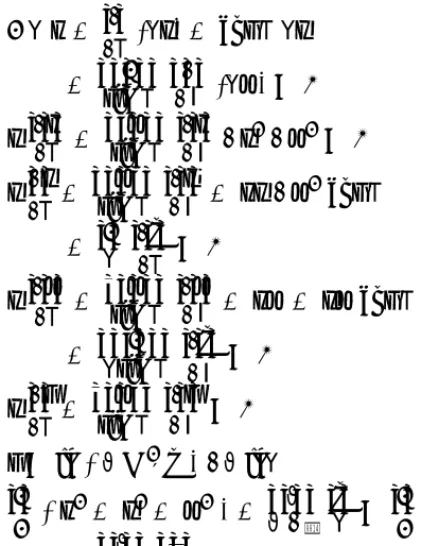
ANALYTICSOLUTION FOR HYPERSONIC FLOW PAST A
SLENDER ELLIPTIC CONE USING SECOND-ORDER
PERTURBATION APPROXIMATIONS
Asghar Baradaran Rahimi, Ali Omehtalb
Faculty of Engineering, Ferdowsi Univ. of Mashhad Mashhad, Iran, [email protected]
(Recived: June 2, 1999 - Accepted in Revised Form: May 4, 2000)
An approximate analytical solution is obtained for hypersonic flow past a slender Abstract
elliptic cone u sing second-order perturbation techniques in spherical coordinate systems. The analysis is based on perturbations of hypersonic flow past a circular cone aligned with the free stream, the pertu rbations stemming from the small cross-section eccentricity. By means of hypersonic approximations for the basic cone problem, closed-form second-order approximate solu tions for the pertu rbation equ ations are obtained within the framework of hypersonic small-distu rbance theory. R esu lts for the shock shape, shock-layer stru ctu re, and su rface pre ssu re ar e prese nted for a ll ranges of Mach nu mber s, toge ther wit h compa risons with experimental data. Also a complete vortical layer analysis is presented to prove the suitability of the surface boundary conditions.
Hypersonic, Elliptic Cone, Second-Order Perturbation, Surface Pressure, Vortical Key Words
Layer
é Ç« c Çw BM pB¯ °oh« ð½ º°n pA R±æ Sîow ± ¬B½o] ºAoM »L½o U »¦¼¦dU ¥e ð½
²k¼ña
° ³½q\U ½A /k½C»« SwkM º°o RB~Th« ©Tv¼w nj ° ¨°j ³]nj K½o U BU z¼Mn±UoQx°n pA ²jB TwA BM º± ¼M é « c w BM °oh« ð½ º°n pA o æ ³¦ªe ³½°Ap BM R±æ Sîow ± ¬B½o] »½q] RB{BzT A ºB®L« oM ¥¼¦dU K½o U pA ²jB TwA BM /k®½C»« j±]±M é « c w ða± q o« pA ZnBi pA »½q] RB{BzT A /j±{»« ¨B\¯A º°o½Aj J±ÇanB´Ça nj z¼Mn±UoQ R¿jBí« ºAoM ¨°j ³]nj pA »L½o U ¥e ,B®L« °oh« ³§Bv« ºAoM R±æ Sîow ± nBz ° , ±{ ³½¿ nBTiBw , ±{ S¼í ±« ºAoM ³\¼T¯ /k½C»« SwkM R±æ Sîow ± »½q] RB{BzT A ·½o ¯ ¥¼¦dU ° ³½q\U ¼®`ªµ /j±{»« ³½AnA »Mo\U [½BT¯ BM ³v½B « BM ²Aoªµ - fB« jkî ²j°kd« ¨BªU ºAoM - c w oM /k¯±{»« ³½AnA »d w ºpo« ½Ao{ ¬j±M KwB®« RBLYA ºAoM ¤Bñ¼Un°° ·½¿ ¥«B @
INTRODUCTION
A curious singularity appears at the surface of a circular cone inclined at a small angle t o an inviscid supersonic stream. This phenomenon was unknown to St one [1] who expanded t he flow quantities formally in ascending powers of the angle of inclination and found the first and second-order perturbations. H is results served a s t h e b a s i s f o r e xt e n s i ve n u m e r i c a l computation by Kopal [2]. The singularity was discove re d by F e rri [3] who gave a physical descript ion of the flow ne ar t he surface . H e deduced t hat streamlines crossing the shock wave at any circumferential location eventually
vor t ica l la ye r . T he y a lso sh o we d t h at t h e solut io n t o first orde r in angle of at t ack so obtained is uniformly valid everywhere in the flow field, but in the second-order expansion an additional non-uniformit y appe ars ne ar the leeward ray. They showed that this defect can be remove d by inspe ct ion and that de nsit y, radial component of velocity and e ntropy are onlysecond-order quantities which are singular on the surface of the cone.
The problem of supersonic flow over circular cone is only one of the occurrences of vortical singularities. Indeed, the y are pre sent in any co nica l flo w wit ho u t a xia l symme t r y. F o r su pe rsonic flo ws past bodie s wit hout axial symme t ry, t he e llipt ic con e is a basic body shape. Although numerous papers have been directed towards supersonic flows past elliptic cone s, t heir goals have bee n specific, and no general or comprehensive flow field calculations h a ve b e e n se t fo r t h . W o r k o f D o t y & R asmusse n [5] was t o part ially re me dy t his sit u a t io n a n d t o p r e se n t a n a p p r o xima t e analytical solution that illustrates the general flow fie ld features of hype rsonic flow past a slender elliptic cone with small eccentricity. The analyses were cast in the form of hype rsonic similarity theory and the first-order results were presented in appropriate similarity form. There is also the study by Jischke [6], but it does not deal with the vortical layer and the study by Lin et al.[7] is only an inne r solution for circular cone case.
I n t h is u n de r t a kin g, we st a r t wit h t h e small-perturbation equations for perturbed flow past an e llipt ic cone wit h ecce nt ricit y
e
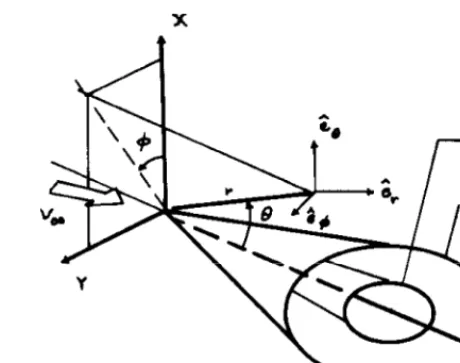
and e xa m in e t h e q u a n t it ie s e xp a n sio n s fo r second-order approximation. Using hypersonic similarit y the ory, an an alyt ic so lu t ion up t o se cond-order approximat ions are pre sente d. H e re the sh ape an d loca t io n o f shock a nd coe fficie nt of pressure on t he surface of theFigure 1.Spherical coordinate system.
con e for all M ach n umbe r s are ca lculat e d. These re sults are compare d with t he existing numerical and experimental results of Z akkay and Visich [8] and M art ellucci [9]. Also it is shown that the outer expansion of pressure for any orde r of
e
is uniformly valid and is not singular on the surface of the cone.FORMULATION OF THE PROBLEM
A spherical coordinate
Governing Equations
syst e m is chose n as shown in F igure 1. The velocity compone nts u*, v*, and w*are in the directions of increasing r,
q
, andf
, respectively. The pressure and de nsity are P* andr
*. The cone half-angle isd
. Dimensionless variables are defined asw = ____
w
*V
Èv= ___
v
* ,V
Èu= ___
u
* ,V
Ès = ________
(s
*- s
È)
C
vp = _____
p
* ,r
= ___
,r
ÈV
È2r
*r
È (1)where
V
È is the velocity at infinity.Substituting t he dimensionless variables into these equations yields:
2
r
u + __ (rv) + cot
Ìq rv
Ì
q
(2)
+ _____ ___ (rw) = 0
sin
1
q
Ì Ì
f
(3)
v ___ + _____ ___ - v
Ìu
2- w
2= 0
Ì
q
w
sin
q
Ì
u
Ì
f
v __ + _____ ___ + uv - w
Ìv
2cot
q
Ì
q
w
sin
q
Ì
v
Ì
f
(4)
+ __ ___ = 0
1
r
Ìp
Ì
q
v ___ + _____ ___ + uw + vw cot
Ìw
q
Ì
q
w
sin
q
Ì
w
Ì
f
(5)
+ ______ ___ = 0
rsin
1
q
Ì
p
Ì
f
(6)
v __ + _____ ___ = 0
Ìs
Ì
q
w
sin
q
Ì
s
Ì
f
(7)
s = ln (
g M
È2p ) -
g
lnr
__ ( u
1
2+ v
2+ w
2) + ____ __ = __
2
g
g -
1
p
r
1
2
(8)
+ ____ ___
g -
g
1
1
M
È2T he se e qua t io ns ar e n o t a ll in de p e n de nt . Indeed, any one except (2) can be eliminated. It is co nve n ie n t , howe ve r, in t h e subse que nt analysis, to consider all of them, and at certain points to particularize to a given set of five.
C o n s i d e r i n g
Body And Shock Geometry
Figure 2, the equation for perturbed cone and it s co n ical sh o ck wave at t ache d t o it for no angle of attack is assumed to have the form:
(9)
qc
= d
-
e cos 2f+ e 2 ( __ + __ cos 4f)
1
2
1
2
q
s=
b -
eg
1cos 2f+ __ (g
e
10 + g12 cos 4f) 2d
(10)
+ O (
e
3)
in which
d
specifies the semivertex angle of the b a sic cir c u la r c o n e a b o u t wh ic h a p e r t u r b a t io n analysis is to be performed,b
is the semivertex angle of the basic circular shock corresponding to the basic body with semivertex angled
, andFigure 2.Perturbed cone and shock.
the g factors repre sent the de viation of the shock eccentricity from t he body ecce ntricity a n d t h e y a r e t o be de t e r min e d fr o m t h e pe rt urbation analysis. The paramete r
e
is a measure of the eccentricity and is theappropriate perturbation parameter to be used in the subsequent analysis.
T h e
Expansions For The Flow Variables
velocity vector for conical flow is presented in spherical coordinates by
^ ^
^ (11)
Ø
= u(
q
,f
) er + v(q
,f
) eq + w(q
,f
) ef VThe F ourier re pre sent ation for t he body and shock shapes suggest that any quantities of the ve locity compone nts, pre ssure , and de nsit y represented here as q
(
q,f,e)
can be expanded in the following forms, valid outside the vortical layer adjacent to the body surface, for no angle of attack:q(q,f,e) = q0 (q) +
eq 1 (q) cos 2
f
+
(12)
e
2[q
10(q)+ q
12(q
) cos 4
f]+ O(
e
3)
The lowe st-orde r t e rms, wit h t he subscript n a u gh t , p e r t a in t o t h e basic circu la r-co ne solution, which is persumed known.
Su b st it u t i n g ( 12)
Perturbation Equations
equating coefficients of like powers of
e
gives the following syste ms of ordinary different ial equations:e
0:(13-a)
2
r
0u
0+ (r
0v
0)
¨+
r
0v
0cot
q
= 0
(13-b)
u0
¨= v0
(13-c)
r0v0v0
¨+
r0u0
v0
+ P0
¨= 0
(13-d)
S
¨0= 0
(13-d)
S0
= ln (g
M
È2P0) -
g
ln
r0
__ (u
1
02+ v
02) + ____ __ - __
2
g
g
-
1
P
0r
01
2
(13-f)
- _________ = 0
1
(g
-
1) M
È2e
1:2(
r0
u1
+ u0
r1
) + (
r0
v1
+ v0
r1
)
¨+
(14-a)
+(
r0v1
+ v0
r1
) cot
q
+ ______ = 0
2r
0w
1sin
q
(14-b)
u1
¨=v
1r
0(v
0v
1)
¨+
r
1v
0v
¨0+ r
0u
0v
1+ v
0(
r
0u
1+ +u
0(14-c)
r
1) + P
¨ 1= 0
(14-d)
w
¨ 1+ __w
u
0 1+ w
1cot
q
-_____ ____ = 0
v
02
sin
q
p
1r0
v
0(14-e)
S1
¨= 0
(14-f)
S1
= __ -
P
1g
___
P0
r
1r
0__(u
1
02+ v0
2) + ___(u0u1
+ v0v1) + ____ __
-2
r
0r1
g
g
-
1
P
1r1
(14-g)- __ _________ = 0
1
2
1
(g
-
1)M
È2e
2:2(r0
u
1m+ _
1r1
u
1+ u
0r1m
) + (r0
v
1m+
2
+ _
1r
1v1
+ v0
r1m)
¨+ (r0
v1m
+ _
r1
v1+
2
1 2
+v
0r1m
) cot
q
+ __ (________________)
m
2
4
r
0w
1m+2
r
1w
1sin
q
(15-a)
= 0
(15-b)
v1m
= u1m
¨+(m - 1)________________
w
1(2u
1+w
1sin
q
)
2v0
sin
q
r
0v
0v
1m¨+__(
1
r
0v
1+ v
0r
1) v
¨1+ (
r
0v
1m+
2
+ __
1
r
1v
1+ v
0r
1m)v
¨0+ (m - 1) ______+
2
r
0w
1v
1sin
q
+
r0
u
0v
1m+ __(r0
1
u
1+u
0r1
)v
1+ (r0
u
1m+
2
+ _
1r1u1
+ u0
r1m)v0
+ _______
r0w1
2cot
q+
2
(m - 1)
2
(15-c)
+ p1m
¨= 0
__[w
m
1m¨+ __ (__+ __) w1
¨+ _______ + __ w1m
2
1
2
v
1v0
r1
r0
w
12v0
sin
q
u
0v0
+ __ (__ + __ __) w
1
1+ w
1mcot
q
+ __ (__+
2
u
1v
0u
0v
0r
1r0
1
2
v
1v
0 (15-d)+ ___) w
1cot
q
- ________ ] = 0
r
1r
04P
1mr
0v
0sin
q
(15-e)
s1m
¨= (1 - m) ______
w
1s
1v0
sinq
S1m= ____ -
P
1mg
____ - _[(__)
2-g(___)
2]
P0
r
1mr0
1 4P
1P0
r
1r0
(15-f)_(u
1 02+ v
02) + ___[u
0u
1m+ _ (u
12+ v
12+
2
r
0r1m
1 4
(1 - m) w
12) + v
0v
1m] + ____ (u
0u
1 +v
0v
1)
r
12r
1m(15-g)
+ ____ ___ - __ - _________ =0
g
g
-
1
P1m
r1m
1
2
1
(g
-
1) M
È2with m = 0,2 in each case.
In e ach of t he systems of equations above all t he variable s are calculat e d in t erms of t he r a dia l ve lo cit y co mp o n e n t ( u ) a n d t h e n substituted into the continuity equation of the co rr e sp o ndin g syst e ms o f e qu at io n s. T h e following differential equations are obtained:
(16)
u0
¯+ u0
'cot
q
+ 2u0
= ___ (u0
v
02 ¯+ u0)
a0
2u1
¯+ cot
q
u1
'+ (2 - _____) u1
4
=
sin
2q
(17)
- ____ ______ +
-
H
1(q)
4F
1g
H
0(q)
u1m
¯+u
1m'cot
q+ (2 - _____) u1m
8m
= H
1m(q)sin
2q
+
-
H
1m(q)- _______ + _______
*
2m D
12I sin
2q
2m
I sin
2q
(18)
ß
b q[__ I(q)
2
Q
12(q)] dq
v
0where
I(q), H
0(q), A(q), B(q), C(q), Q12(q),H
(q), H
1m(q), are known functions of
q
and
D12
is a constant. The functions
-
H
1(q)and
-H
1m(q)are
in terms
of the variable
coefficients including u
1and u
1mwhich cab
b e n e gle ct e d wit h n o t m u ch o f lo ss o f
accuracy.
BOUNDARY CONDITIONS
T h e
Boundary Conditions At The Shock
shock jump conditions for flow properties across the shock are we ll-known R ankine-H ugoniot re lations. The dime nsio nle ss form of t he se relations are:
__ = _____________
1
,r
s(g-1) M
n2+ 2
(g+1)M
n2g
M
È2Ps
= 1 + _____(Mn
2g
2- 1)
g
+ 1
S
s=ln (
g
M
È2P
s) +
g
ln (__)
1
r
s___ . n
s= __ (___ .
Ø
n
s)
Ø
V
sV
È1
r
sØ
V
ÈV
È(19)
___
*
Ø
ns
= (___
*
Ø
ns
)
Ø
Vs
V
ÈØ
V
ÈV
Èwhe re
Ø
n
sis the unit out ward normal on t he shock given as:Ø
n
s= [1 -
e
2g
12_________]
1 - Cos4f
sin
2b
^
e
q+ ____ [-2
sinb
1
e
g
*
(20)
sin2
f+
e
2(__g
4
12- g
12_____) sin 4f]
^
e
fd
Cos
b
sinb
Since the location of the shock is unknown, using boundary conditions at the shock becomes very complicated. To circumvent this situation the shock angle is expanded in terms of powers of
e
and by using of a Taylor se rie s the flowva r ia b le s a r e t r a n sfe r r e d t o t h e b a s ic unperturbed shock (
e
= 0).Th e bo undary con dit io ns a t the sho ck a re obtained from these relations.
A t t h e b o d y
Surface Boundary Conditions
su rfa ce ,
q
=q
c , t he no rma l ve locity mu st vanish:(21)
Ø
V
c/
Ø
n
c= 0
By substituting the unit outward normal vector o n t he e llipt ic co n e surface and t he ve locit y e xp an sio ns in t o ( 21) a nd t ra nsfe r ring t h e boundary conditions to the basic circular cone su r fa ce le a d s t o t h e su r fa ce b o u n d a r y conditions:
(22)
v0(d) = v1(d) = v10(d) = v12(d) = 0
R igorously, we should have obt ained ( 22) by matching the oute r e xpansion with an inne r expansion for the vortical layer adjacent to the cone surface . Late r we will show that ( 22) is indeed proper.
APPROXIMATESOLUTION
F o r
Basic Cone Flow Approximations
hypersonic flow in the limit MÈ
ØÈ
and sinqØ
0 su ch t h a t t h e co mb in a t io n KÛ
MÈsinq
re mains finit e , t he basic cone flo w can be approximated accurately by:u
0(q) = ______ = 1 , v
u0
0(q) = _____ =
*(q)
v
Èv0
*(q)
v
È(23)
-
q(1 - __)
d
2, s
=
__
¡
____ + ___
q
2b
d
g+1
2
1
k
d2whe re Kd= MÈ
d
is the hypersonic similarity pa rame te r . A lso fro m basic co ne solutio n, following relations are obtained:(24)
N =
s
2/a0
2(b) , J = a0
2(d)/a
02(b)
A
First-Order Approximate Solution
a nd by su bst it ut ing t h is solu t io n in t o t h e diffe re nt ial e quat ion and int e grat ing t wice yields:
x1(q) = x1(b) + _____
x1
'(b)
ß
bqq
3dq
- ___
*
b
34F1
g
ß
b q{
q
3ß
bq[_____] dq}dq
H
0(q)
q
3with t h e assumpt ion o f
q
andb
be ing small, x1(q
) can be calculated and by the definition of z=q
/d
, first -order component s of velocity are obtained.The shock eccentricity fact or, g1, can now be determined from condition (22), as follows:
g1
= 6s
3/{__________ + __________ +
3Cos
-1(1/s)
(¡s
2- 1)
6(s
6+
s
2)
(g + 1)
(25) +
3
s
4-
s
2- 5}
T h e
Second-Order Approximate Solution
second-order solution not only provides a better approximations with respect to the first-order solution, it also shows the singularity in flow and vort ical laye r ne ar the body surface. Clearly, fr o m ( 15-b) a n d ( 15-e ) t h e se co n d-or de r co rr e ct io n t o b o t h t h e ra dial ve lo cit y a nd e ntropy is singular at the surface . It can be shown that the singularity in expressions for v1m & P1m are n ot re al an d th e se qu an t it ies are finite on the body surface. To show this and to get rid of the singularity in v1m and P 1m , Stone suggested the following change of variables
(26)
U
1m(q)=u
1m(q)+(m - 1)
ß
qbH(
q)dq
Subst it u t in g t h is n e w variable in t o ( 18) we obtain:
U
1m¯+cot
q
U
1m '+(2- _____) U
8m
1m=T
1m(q)
sin
2q
(27)where
T
1m(q) is a known function of
q.
Following the same discussion as in the case of the first-order solution, we assume:U
10(q) = x10(q) Cosq
fo r m = 0 a n d U 12(q
) =x1 2
(
q)
( 6 /5s in4q
- 1/ si n2q
) fo r m = 2.Substituting these solutions into (27), yields:
x
10(q)= x
10(b)+ sin
b
cos
2b
x
10¨(b)
*
ß
b q(_________) dq
1
+
ß
bq{__________
*
sin
q
cs
2q
1
sin
q
cos
2q
ß
b q[T
10(q)
sin
q
cos
q]dq
} dq
x12(q)= x12(b) + x12
¨(q) / sin
2b
ß
b qsin
3q
dq
-
ß
bq{sin
3q[T12(q) /sin
q]dq
}dq
To assume small angles in above relations, the following results yield:
U10(z) /d
2= ______+ __ x
x
10(b) 10¨(b)Ln (z/s)+
d
2s
d
Lnz
ß
s Z[zT10(z)]dz-
ß
s Z[zLnzT
10(z)]dzU
12(z)/d
2=-x
12(b)
/(d
4z
2)- x
12¨(b)
(z
4-s
4) /
(4b
3z
22) +1/(4z
2){z
4ß
s Z[T12(z)/z]dz
-(28)
-
ß
sZ
[z
3T12(z)]dz}
and therefore it can be written:
v
10(z)/
d =
s/z. _____ + 1/z
ß
s Z[zT
10(z)]dz
x12
¨(b)
d
v
12(z)/
d = _______ - _____ (z + __) + __ {
2 x
12(b)
d
4z
3x
12¨(b)
2
b
3s
4z
31
2
(29)
z
ß
sZ
[______]dz+ __
ß
s Z[z
3T12(z)]dz}
T12(z)
z
1
z
3The quantities x10¨ (
b
) and x12¨(b
) are calculated using boundary conditions at the shock and then g10 & g12 are obtained using (22).Knowing
Pressure Calculation On The Body
the e xte nt of pre ssure on the body surface is necessary for calculation of lift and drag forces for design and manufacture of flying object s. From the perturbation equations, expressions of pressure perturbations are obtained as follows:
P1m
= ____ (u0u1
r
0+ v0v1)
2- ___ F1
(u
0u1+
4a0
2r
02
v
0v
1) -
r0
[u
0u
1m+ v
0v
1m+ __ (u
1
12+ v
12-4
(31)
w1
2)] + ___ P0
F1
2-______
4
P
0S
1mg-1
The pressure coefficient, Cp , is defined by:
(32)
Cp = (P
*-P
È)/((1/2)
r
Èv
È2)
Thus we can write:
Cp = C p
0+
ÀC p
1Cos 2F
+
À2(C p
10+
(33)
Cp
12Cos 4F) + o(
À3)
where
Cp
0= 2 [P
0(d)- ______],
1
Cp
1= 2 P
1(d),gM
È2(34)
Cp
12=2 P12(d)
using the basic cone solution, we have:
(35)
___ = 1 + ________
Cp0
d
2s
2Ln
s
2(s
2- 1)
(36)
Cp1/d
2= 2gN _____ [__ - _____]
p0(d)
d
2g1
s
3u1(1)
Jd
2(37)
Cp1m
/d
2= _____ ______ ________
2 gN
J
p0
(d)
d
2p
1m(d)
d
2r0
(d)
As mentioned e arlie r since v0(
d
)= 0 the n S1m and U1m are singular on the surface. From (31) it seems that P1m is also singular on the surface. But noting the change of variable (26) it can be sh own t hat t h e sin gularit y in S1m an d U1m cancel each other out in (31) in a way that P1m is finit e o n t h e su rface . P aying at t e n tion t o (15-e), the e xpre ssionß
bqw
1s
1/v
0sin
q
dq
is t he ca use of singu la rit y in e nt ro p y. Aft e r sim p lifica t io n it ca n b e sh o wn t h a t t h e coefficient of this expression in S1m is 4(m-1)*
F1 a02(
q)
/gd
2 and in U1m is 4( 1-m) F1J/Ng
. Calculating these two coefficients by using (24), it is seen that on the surface they are equal with different signs. Therefore, P1mis finite on the body and Cp1m can be calculated from (37).VORTICALLAYER ANALYSIS
H e re through asymptotic matching, it will be demonstrated that the boundary conditions on the body as we re derived in sect ion (3-2) are indeed correct. New independent variables that are of orde r unit y in t he vor t ical laye r are defined according to
(38)
Q = (q - d)
À,
F = f
To exhibit the zero in the velocity we define:
(39)
V = v /
(q - d)
This makes V of O(1) in the region of interest. The ot her inde pendent variables are defined according to:
(40)
U = u , W = w , P = p , R =
r
T h e e xp a n sio n o f t h e in n e r va r ia ble s in ascending powers of
e
are according toq
( Q , F ,
À)
=
q
0+
Àq
1( Q , F )
+
À2 (41)q
2(Q,F)
where
q(Q,F,
À)
representsU
(Q,F,
À)
andV(Q,F,
À)
andW
(Q,F,
À)
andP
(Q,F,
À)
andR(Q,F,
À)
.The zeroth-order variables simply express the fact that the se quantitie s are not functions of
Q
,meaning that they do not change across the layer.The inner expansion is valid only in a thin layer near the body and cannot be expected to satisfy the shock conditions. Therefore, the boundary conditions are obtained by matching them with the oute r expansion. We apply the following matching principle:
m-t e rm in ne r e xp a nsion of ( p -t e rm o u t e r e xp a n sio n ) = p -t e r m o u t e r e xp a n sio n o f (42) (m-term inner expansion)
Three-term outer expansion of v is:
v(q)
= v
0(q)
+
Àv
1(q)
cos 2f
+
À2[v
10(q)
+
v
12(q)
cos 4f]
We write the functions in inner variables:
v(q)=v
0(d+Q(1/À))+
Àv
1(d+Q(1/À))
cos 2F
+
À2[v10(d+Q
(1/À))+v
12(d+Q(1/À))
cos 4F]
E xpanding this function in powe rs ofÀup t othree terms gives
v(q)=v
0(d)+ Àv1(d)
cos 2F
+
À2[v10(d)+
(43)
+ v
12(d)
cos 4F
]
Three-term inner expansion of v is :
v(q)
=
Q
(1/À)[V
0+
ÀV
1(Q,F)
+
+
À2V
2(Q,F)]writing the functions in outer variables:
v(q)
=
(q-d)
{V0
+
ÀV1[(q-d)
À,F]
+
+
À2V2[(q-d)
À,F]}
Expanding this function in powers of Àgives:
(44)
v(q)
= [Q
(1/À)]V
0+ 0 = 0
Equating (43) and (44) follows
v
0(d)
= v
1(d)
= v
10(d)
= v
12(d)
= 0
which is indeed the same as (22).
PRESENTATION OF RESULTS
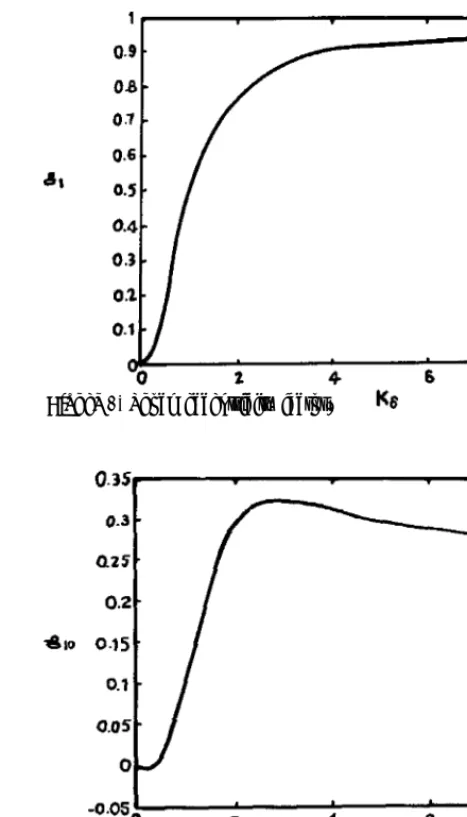
The shock eccentricity factors, g's , are plotted in F igu r e s 3 - 5 a s a fu n ct io n o f
k
d fo rg
= 7/5. FordØ
0, which corre sponds to the limit of linearized theory, the eccentricity factor tends to zero, gØ
0, that is, the shock tends to a circular Mach cone. For the limiting hypersonic flo w,dØÈ
, g a p p r o a ch e s t h e a symp t o t e g= 0.955, and the shock tends to embrace the elliptic cone body. Whenk
dØÈ
andgØ
1, then t h e bo dy, in a gr e e me n t wit h h yp e r so n icFigure 3.Shock eccentricity factor.
Figure 4.Shock eccentricity factor.
Figure 6.Radial perturbation velocity components.
Newtonian theory [10].
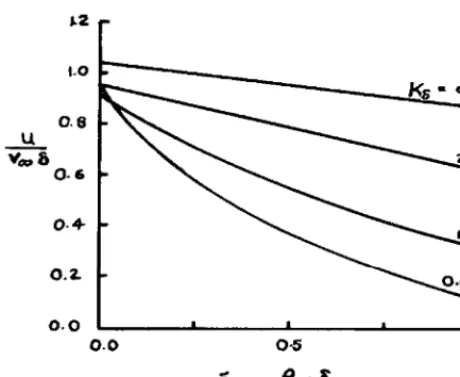
The radial velocity component is plotted in Figure 6. The hypersonic similarity form gives u as a fun ct io n o f z,
k
d, an dg
. Be ca use t he thickness of the shock layer varies as a function ofk
d, the shock layer is normalized by means of the variable-
q
= (z-1)/(s
-1). The body surface corresponds to-
q
= 0 and the shock surface to-
q
= 1. At t he body surface u is inse nsit ive t o variations ink
d, having approximately the value unity. At the shock surface, it is quite sensitive t o variat io ns ink
d. I n t he hype r sonic limitk
d=È
, u increases only slightly from the shock to the body.The polar velocity component v is shown in Figure 7 as a function of
-
q
and various values ofk
d.The variation of v across the shock laye r is analogous to the variation of u.Th e a zimu t ha l ve locit y co mp on e nt w is shown in Figure 8 as a function of
-
q
,g
=7/5, and various values ofk
d. At the shock, w1 increases ask
dincreases. Fork
d= 2, variation of w across the shock layer is very slight. At the body surface it decreases ask
dincrease s. The factor u(c)(d
)/u(0)(d
) is shown in Figure 9 as a function ofk
d andg
= 7/5. This is the ratio of the radial comp one nt of ve locity whe n theFigure 7.Polar perturbation velocity components.
Figure 8.Azimuthal perturbation velocity components.
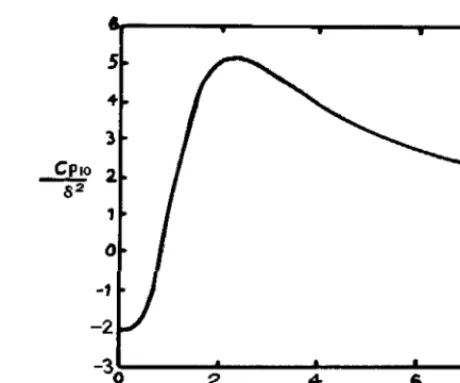
Figure 10.Pertu rbation pressure coefficient on the body surface.
variable coe fficients in E quat ions 16-18 have not be e n ne gle cte d t o whe n t he y have bee n neglected. In the hypersonic flow range, we can e xp e c t t h e a p p r o xim a t i o n o b t a in e d b y neglecting u(c), to be very accurate. In fact, this is true for
k
dÂ
1. Fork
d=1, the approximation is le ss accurate . We note,howe ver, t hat t he co r r e ct limit in g r e su lt s fo rk
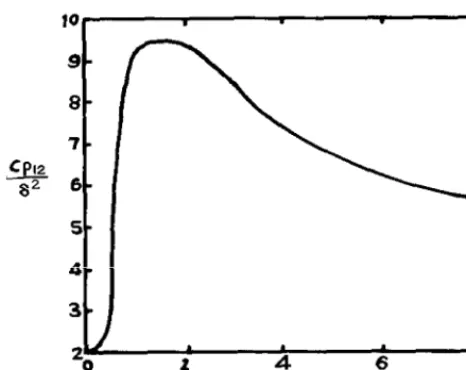
d= 0, wh ich correspond to the limiting case of line arized theory, are recovered.Figures 10, 11, and 12 show cp1/
d
2, cp10/d
2, and cp 12/d
2 plo tte d as a function ofk
d forg
=7/5. Surface pressure were measured on two diffe rent e lliptic cone models, at fre e stre am Mach number 3.09,by Z akkay and Visich [8]. The geometric properties of these models are as follows:Model II Model I
e
/d
=0.266e
/d
=0.155d
=16.28o=0.2841 radd
=16.64o=0.2904 rad/
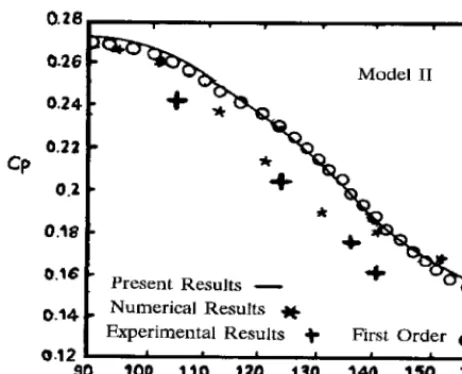
T he se t wo mo de ls h ave t h e same cr oss sectional areas for the same stat ion along the elliptic-cone axis. The e xpe rime ntal dat a are comp ar e d wit h t h e r e su lt s o f t h e p re se n t analysis and also with the analysis of Martellucci [9]. Figure 13 shows the pressure-distribution
Figure 11.Pertu rbation pressure coefficient on the body surface.
data on model I for Mach number MÈ=3.09 for which
d
= 0.900. The present results give good agreement with the data on the semi-major ray, but the data are lower otherwise. The results of Martellucci give a little better agreement with the data between the major and minor rays.Figure 14 shows the pre ssure -distribution da t a on mo de l II fo r MÈ= 3.09, fo r which
d
= 0.888. The a gre e me nt wit h t he pr e se nt analysis is fairly good near the major and minor rays, but poor in between. For this large value of eccentricity, higher-order perturbation terms are probably re qu ire d. M art e llucci' s r e sult shows somewhat better agreement with the data between the major and minor rays.CONCLUSIONS
Figure 12.Pertu rbation pressure coefficient on the body surface.
pr ove s t he e xist e n ce o f vo rt ical laye r a nd singularity of entropy and radial component of velocity and density on the body surface . This layer does not show itself in the zeroth-order and first-order perturbation analysis, since the integration of Equations 13-d and 14-e produces finite and const ant values of entropy. It is the second-order entropy that shows the singularity of this quantity on the body and that is because of the t erm
v
0(d) = 0 at the de nominat or of Equation 15-e. It is proved here that in spite of the existence of the vortical layer on the body, t h e se co n d-o r de r p r e ssu r e is fin it e a n d therefore, the pressure expansion would not be dive r ge n t . By p r o vin g t h e va lidit y o f t h e bo unda ry con dit ion s o n t he sur face in t he process of vortical layer analysis, our solution procedure he re renders the fact that an inner and outer expansions of the quantities are not ne e de d an d can be avo ide d. This is a gre at simp lifica t io n a n d cir cu m ve n t io n t o t h e ma t h e ma t ica lly r igo r o u s in n e r a n d o u t e r solutions of the same problem.LIST OF SYMBOLS
zeroth-order isentropic a0
speed of sound
Figure 13.Pressu re coefficient on body su rface Model I, M = 3.09 and d= 0.900.
function A(
q
), B(q
), C(q
)constant density specific heat cv
surface pressure coefficient cp
function D12
(q)
^ ^
^ unit vectors in spherical f
q, e r, e e
coordinate system constant
F1
shock eccentricity factor g
associated with elliptic cone functions
G11,G12,G13
function H(
q
)function of integration I(
q
)hypersonic similarity K(
d
)parameter Much number M
unit normal vector ^n
pressure in outer region p
pressure in inner region P
function Q(
q
)spherical coordinate r
density in inner region R
entropy S
function T(
q
)spherical velocity u, v, w
components in outer region velocity components in inner U, V, W
region function x(
q
)Figure 14.Pressure coefficient on body surface Model II, M = 3.09 and d = 0.888.
GREEKS
unperturbed shock angle
b
ratio of specific heats
g
semivertex angle of basic circular cone
d
measure of eccentricity
e
density ratio across the shock
x
spherical coordinates in outer region
q,f
spherical coordinates in inner region
Q,F
density
r
b
/d
s
SUBSCRIPTS
free stream condition
È
condition just downstream of shock s
zeroth-order 0
first-order 1
second-order 10
second-order 12
REFERENCES
1. St o ne , A. H ., "O n Su pe r son ic F lo w P a st a Sligh t ly Yawing Cone", M.I.T. J. of Math. and Phys., Vol. 27, (1948), 67-81.
2. Kopal, Z ., "Tables of Supersonic Flow Arou nd Yawing Cones", TR 3 Center of Analysis, D ept. of E lectrical Engineering, MIT, Cambridge, Massachusetts, (1949). 3. Ferri, A., "Su personic Flow Arou nd Circular Cones at
Angles of Attack", TN 2236, NASA, (1950).
4. Mu nso n, A. G ., " The Vo rtical Layer on an Inclined Cone", J. Fluid Mech., Vol. 20, Part 4, (1964), 625-643. 5. Doty, R. T. and Rasmussen, M. L., "Approximation for H yper son ic F low P a st and I nclined Cone", AI AA J . , Vol. 11, NO. 9, (1973).
6. Jischke, M. C., " Su personic Flow Past Conical Bodies wit h N ea r ly C ir cu lar Cr oss Sect io n", AI AA J . , Vol. 19, No. 2. (1981).
7. Shean-Chyun Lin, Yung-Tai Chou, Yu-Shan Lou, "The Inner-Expansion Analysis on An Inclined Circular Cone W it h Sm all Longit u dinal Cu rvatu r e", Pr o c e e di n g s o f t he Th i rd Int e rn a t i o na l Co n fe ren ce on Fl ui d Mechanics , Beijing, (1998).
8. Zakkay, V. and Visich, M., Jr., "Experimental Pressure D istribu tion on Conical E llipt ic Bodies at M = 3.09 and 6.0", Polyt echnic Institu t e of Brooklyn, PIBAL Report No. 467, March (1959).
9. M a rt e llu cci, A., "An E xt e n sio n o f t h e Lin e a r ize d Characteristics Method for Calculating the Supersonic Flow Around Elliptic Cones", J. Aero. Sci., Vol. 27, No. 9, (1960), 667-674,