*Corresponding author:Delia Arrieta Díaz ISSN: 0976-3031
Research Article
CONSTRUCTION AND VALIDATION OF AN INSTRUMENT FOR
MEASURING QUALITY OF WORK LIFE
Delia Arrieta Díaz*
Research Professor at the Faculty of Economics, Accounting and Business Administration of the
Juárez University of the State of Durango, Mexico
DOI: http://dx.doi.org/10.24327/ijrsr.2018.0902.1620
ARTICLE INFO ABSTRACT
The objective of this research was the elaboration and validation of an instrument to measure the Quality of Work Life (QWL), with the purpose of verifying the usefulness and validity of the instrument to be used in a research project called the Quality of Work Life in public, private and educational organizations. The designed instrument had 70 items that identified the perception of the workers with respect to 15 dimensions, responses were included with a Likert-type scale, 82 surveys were applied randomly in different organizations during 2017.The results of the validation were the following: content through the Panel of Experts; reliability with Conbrach alpha 0.952; Kendall coefficient of concordance 0.394; the validity of the construct with the test KMO 0.870 and the sphericity of Bartlett 0.000; A correlation analysis was performed and found relations in all the variables. The contribution of this article is a QWL instrument that can be applied to all organizations, since it is regularly associated with burnout and stress in workers in the health sector. It is concluded that the instrument meets the optimal validity to be used in future organizational research.
INTRODUCTION
Organizations are supported for the good functioning of the workers, however, for optimal performance of employees it is necessary to take into account both physical, emotional and psychological health for the achievement of competitiveness and productivity.
Workers rarely make a clear and precise analysis about work, most of the time they evaluate themselves based on their education, religion, beliefs, values, expectations and emotions; this leads us to a selective perception that is not very objective. With this perception, workers evaluate work background and determine if it is compatible or incompatible with their perspectives. The important thing is not the real and objective characteristics of the organization but the perception of the workers (Martínez, Ros, 2011).
Quality of Work Life (QWL) produces a positive or negative impact on motivation, and a satisfaction or dissatisfaction in the worker, which generates a functional or dysfunctional behavior of the employee in the organization, and directly influences the organization in terms of the competitiveness and productivity of both the position and the organization;as well as the quality
of the product, with its respective repercussion towards the attention of the internal and external clients.
The importance of this study lies in the fact that the result of the QWL is reflected in the physical and emotional health of the worker in relation to work accidents, work risks, occupational diseases and in job satisfaction; therefore, it has a direct impact on competitiveness and productivity.
The interest to study the QWL begins in the United States, in 1960. Later it has its peak in Europe with some ideological differences. The investigation of this topic has been approached from two theoretical-methodological perspectives: a) Quality of work background life b) The perspective of the quality of psychological life (Flores et al. 2013).
According to Chiavenato (2009), QWL term was designed by Louis Davis and refers to the concern for the general welfare and health of employees when they carry out their activities. Duran (2010) suggests that it is a change strategy in order to optimize organizations and processes.
QWL depends, according to García and Forero (2016), on the subjective and objective elements: the subjective ones are
International Journal of
Recent Scientific
Research
International Journal of Recent Scientific Research
Vol. 9, Issue, 2(F), pp. 24220-24225, February, 2018
Copyright © Delia Arrieta Díaz, 2018, this is an open-access article distributed under the terms of the Creative Commons Attribution License, which permits unrestricted use, distribution and reproduction in any medium, provided the original work is properly cited.
DOI: 10.24327/IJRSR
CODEN: IJRSFP (USA)
Article History:
Received 17th November, 2017 Received in revised form 12th December, 2017
Accepted 04th January, 2018 Published online 28th February, 2018
Key Words:
related to the worker's beliefs derived from the labor reality; on the other hand, the objective elements constitute the working background, such as working conditions, salary, health, and so on (Flores et al. 2013 ; Pérez, Zurita, 2014).
QWL can be considered as a philosophy since it has beliefs and values that integrate efforts to improve the productivity and morality of the workers of the organization, and it makes special mention in the dignity of the human being, in its intellectual potential (Camacaro, 2010, Durán, 2010)
Quality of work life, for García and Forero (2016), is the perception between the demands of work and the available means to achieve these demands, which can come directly from the worker or the organization, in addition to conditions of work, work background and the union between work life, and personal and family life (Uribe et al. 2011).
With the above, a definition of the QWL is deduced, it is multidimensional, for which it is necessary to take into account the objective and subjective factors considering that the perception according to the culture, education and development perspectives is predominant; impacting directly on competitiveness and productivity as well as customer service. It is also a factor that promotes physical, mental, emotional and psychological development of the worker, that results in work, personal, family and social life.
Approaches and theories / models
The explanation of human behavior must be required to understand conflicts and consequently carry out actions of prevention, development and resolution of conflicts involved in the facts and events of people. Potentialities and risks directly impact individuals and groups to have the ability to face decisions, make judgments, seek realization and sustainability for themselves and for the background (Orejuela, 2014).
Quality of work life (QWL) has been studied from two theoretical-methodological perspectives: Quality of work background life and Quality of psychological life. The first one seeks to improve the quality of work background life through the achievement of organizational objectives.
Work conditions and Organizational structure are evaluated, having as objective the productivity and effectiveness of the organization. On the other hand, the second one is more interested in the worker, and develops a microanalysis of the situations in which the worker participates directly; the subjective aspects of the working life are evaluated, having as objective the welfare and health of the worker (Segurado and Agullo, 2002).
For Koontz et al. (2012), QWL is an interdisciplinary field of consultation and action that encompasses industrial and organizational psychology, psychology, industrial engineering, organizational theory, motivation and leadership theory, as well as industrial relations. Administrators consider QWL as a means to treat productivity. Workers and union representatives have seen it as an opportunity to improve salaries, working conditions and productivity. For Chiavenato (2009), the QWL includes both the physical and background aspects, as well as the psychological aspects of the work center. He mentions the following models:
1. Model of Nadler and Lawler. They show that the QWL will improve regarding the following aspects
a. Participation of collaborators in decision-making; b) Restructuring of work for the improvement of tasks; c) Innovation of the reward system in a way that influences the organizational climate; d) Improvement of work background in terms of physical and physiological conditions, work schedule, and so on.
2. Model of Hackman and Oldhan. They point out that QWL is affected by the Position dimension, since it produces critical psychological states, in terms of the personal and work aspects. a. Variety of skills; b) Nature of task; c) Purpose of task; d) Autonomy; e) Feedback of one's work; f) Extrinsic feedback; g) Interrelationship
3. Model of Walton. He mentions that there are factors that can affect QWL: a) Fair and adequate compensation; b) Health and security conditions at work; c) Use and development of capacities; d) Opportunities for continuous and secure growth; e) Social integration in the organization; f) Constitutionalism; g) Work and space for total life; h) Social relevance of working life.
Table 1 Dimensions used by some researchers (2010-2016)
Dimensions Number Questionnaire /
Instrument Authors
Compensation and benefits, Conditions of work and background, Nature of the task, Development and labor security, Organizational democracy, Fundamental rights, Labor balance, and Social impact
8
Quality of life perceived by organizations (Gómez - Rada, 2011)
García, Forero (2016)
Management support, Workloads, Intrinsic motivation 4 QWL-35
questionnaire
Fernández et al. (2016) Management System, Relationship with partners, Relationship with heads, Motivation, Identity
and commitment, Work background conditions, Stress and burnout, Work-life balance, Satisfaction with the role it plays and potential motivation of the position, Subjective welfare derived from work, Remunerative Equity and Personality Characteristics
11 Inventory of work life. Da Silva (2006) Pérez, Zurita (2014)
Working conditions, Social climate of work, Organizational policy, Satisfaction and adaptation of the organization, Labor welfare, Personal values, Personal growth, Coping, Dreams, Identity, Violence, Collateral effects of work
14
Quality of work life questionnaire Blanch (2008a)
Uribe et al. (2011)
Objective: Physical background, Technological, Contractual, Productive
Subjective: Private background and Work life, Individual and professional activity,
Organization and Management function 10 Without name Granados (2011)
Socio-political, General well-being, Psychosocial, Background
4 Without name Duran (2010)
Subjective dimension: Needs satisfaction, Job satisfaction, Interpersonal relationships, Middle
management, Attitudes and values 5 Withoutname Camacaro (2010)
Determination and selection of the dimensions for this study of QWL, have been an important factor, since there is no rule or definition to select the amount needed to carry out the investigations. Ranges from 3 to 25 dimensions depend on research and authors. Table 1 shows some of the dimensions that have been studied by researchers in recent years.
The study of quality of work life is multifactorial since it is influenced by many variables that range from internal organizational factors to external factors such as personal and social factors.
Participants
The questionnaire was applied to 148 workers of different organizations, located in the City of Durango, State of Durango. However, according to the criteria of Little (1998), those surveys that had 4% of lost values were eliminated, that is, those that had 4 or more lost values were eliminated, taking this criterion into consideration, 82 surveys remained for the analysis. This study has the following characteristics and restrictions:
Inclusion characteristics: a) Institutions with official records; b) Institutions with more than 20 workers; c) Institutions located in the state of Durango; d) Private, public and educational institutions; e) Personnel must have labor relationship; f) Workers must agree to participate in the study; g) Personnel must have more than 6 months at work
Exclusion characteristics: a) Workers must not be present at the time of the study; b) Employees may refuse to answer the survey; c) Workers must have less than 6 months at work. Elimination characteristics: a) Institutions may deny permission for the application of the questionnaire; b) Those who may not fill out all the questionnaire.
Instrument
The questionnaire collects and allows to analyze the data on the dimensions of QWL, it was designed with the 15 following QWL Dimensions: Security and Working conditions(7 items); Occupational health (7 items); Morality (7 items); Remuneration (6 items); Organizational participation (7 items); Communication (7 items); Identity (7 items); Management and leadership (7 items); Position Design (7 items); Organizational justice (7 items); Job satisfaction (8 items); Intrinsic motivation (8 items); Extrinsic motivation(8 items); Motivation due to equity (8 items); Global perception (4 items); being a total of 70 items written in an affirmative and positive manner.
In order to analyze data, the Likert scale was used, each possible response was assigned a numerical value, Strongly agree = 5, Agree = 4, Somewhat agree = 3, Disagree = 2, Strongly disagree = 1, Indifferent = 0
Process
The questionnaire was applied with the authorization of the holder representative of the organization, and was applied to workers in the morning, in the afternoon and in the evening shifts in a random manner. All participants agreed to participate in the study. The questionnaire was applied by two doctors and a social worker who were previously instructed. Data was registered and analyzed in the SPSS program version 23.0
Expert Panel
For the analysis of content validation, Barraza (2010) cited in Maldonado et al. (2017) mentions that validation can be carried out through the foundation in a theory, the consultation of experts, the analysis of errors and the supervision of the total results. For this investigation, a Panel of Experts was requested to analyze the questionnaire, based on their work experience and academic knowledge, and make an analysis about the validity of the content so that they formulate their respective observations and suggestions. This Panel was formed by 10 university professors who had the following characteristics: 1) 5 PhD in Business Administration and 5 Masters in Business Administration; 2) All university professors were 50 years old as average; 3) They were 5 men and 5 women; 4) Three of the professors had experience in the public sector, Other three of them in the private sector and four of them in the education sector; 5) All of the professors had 15 years on seniority in the institution; 6) They had teaching specialties in Business Administration, Public Administration and Education, some of them in Human Resources; 7) All of them were professors of the Faculty of Economics, Accounting and Business Administration of the Juárez University of the State of Durango.
RESULTS
Cronbach alpha validation of the questionnaire. The reliability of the instrument was determined through the statistical validation of a pilot test, and 82 surveys were applied. Cronbach alpha was calculated to measure the homogeneity of the questions, obtaining a result of 0.952, which is acceptable and reliable as it is approaching the end to 1 (Tavakol and Dennick, 2011).
Moreover, George and Mallery (2003, p.231) suggest the following recommendations to evaluate the values of Cronbach alpha coefficients: a) Alpha coefficient> .9 is excellent; b) Alpha Coefficient > .8 is good; c) Alpha Coefficient > .7 is acceptable; d) Alpha Coefficient > .6 is questionable; e) Alpha Coefficient > .5 is poor; f) Alpha coefficient <.5 is unacceptable. So, according to George and Mallery (2003); the questionnaire used for this study has an excellent validity in the global, and the dimensions such as:Remuneration, Organizational participation, Identity, Position design, Job satisfaction, Intrinsic motivation, Motivation due to equity, and Global perception have good validity. In addition, Safety and working conditions, Occupational health, Organizational justice and Extrinsic motivation have acceptable validity; however, Morality, Communication, and, Management and Leadership have questionable validity. Table 2 shows the Cronbach alpha results by each dimension as well as the overall result.
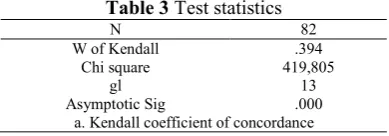
Kendall coefficient of concordance
expected at random (Siegel & Castellan, 1995 cited by Escobar-Pérez and Cuervo-Martínez, 2008).
Table 3, according to Kendall, corroborates that there is agreement by the criterion issued by the experts, with a value of the coefficient of Kendall of 0.394, and a high significance less than 0.05
Table 3 Test statistics
N 82
W of Kendall .394
Chi square 419,805
gl 13
Asymptotic Sig .000
a. Kendall coefficient of concordance
Construct Validity
Table 4 shows KMO results, Landero and González (2012) indicate that the KMO values relate the correlation coefficients below 0.5; they are considered inadequate between 0.5 and 0.6; they also indicate low dependence between 0.61 and 0.70, and median between 0.81 and 0.90, and greater than 0.91 very high. According to the statistics obtained from the sample adaptation, it is verified that the dependence is high, since the result obtained from KMO was 0.870; what indicates a high adequacy. There is more linear dependence between the set of values.
Table 4 Test of KMO and Bartlett
Kaiser-Meyer-Olkin measure of sampling adequacy .870
Bartlett's sphericity test
About. Chi squared 1171,957
gl 91
Sig. .000
a. It is based on correlations
Bernal, Martínez, Sánchez, (n.d.) and Landero and González (2012) point out that Bartlett's sphericity test maintains the null hypothesis (p>=0.05), indicating independence of the variables. If it is rejected (p <0.05) it is dependence between the variables. In this case, the result is 0.000 less than 0.05 which means that the principal component analysis can be carried out. Figure 1 shows the Correlational Matrix of the Dimensions; according to Lind, Marchal, Wathen (2012) it is the linear relationship between two variables, and can vary from -1 to 1; a
value close to zero indicates that there is little association between the variables, a value close to 1 indicates a direct or
positive association between the variables and a value close to -1 indicates an inverse association. According to the results, a strong positive association is found in Organizational participation and Extrinsic motivation (0.94);Job satisfaction and Remuneration (0.88);Morality and Extrinsic motivation (0.87).
Figure 1 Correlational matrix of the Dimensiones
DISCUSSION AND CONCLUSION
The Quality of Work Life instrument was validated through a Panel of Experts, who made the analysis and gave observations for the improvement of the instrument; Reliability was calculated based on the global Conbrach alpha, resulting 0.952. In addition, Morality, Communication and Management and leadership dimensions were the lowest with an average of 0.686, interpreting as questionable validity, and Remuneration was the highest with 0.854, classifying as good.
Table 2 Cronbach alpha resultsby each dimension
Dimension Number of
items
Number of Questions Cronbach
Alpha
Security and working conditions 7 3, 11, 16, 20, 29.45, 50 0.731
Occupational health 7 8, 18, 22, 31, 38, 13, 47 0.739
Morality 7 6, 17, 26, 32, 37, 43, 53 0.691
Remuneration 6 5, 19, 28, 34, 42, 68 0.854
Organizational participation 7 12, 14, 25, 33, 41, 52, 55 0.824
Communication 7 15, 23, 44, 51, 57, 61, 70 0.682
Identity 7 9, 14.27, 36, 46, 53, 58 0.815
Management and leadership 7 10, 23, 37, 49, 56, 62, 54 0.686
Position Design 7 4, 7, 21, 30, 48, 59, 63 0.814
Organizational justice 7 2, 39, 60, 64, 65, 67, 69 0.729
Work satisfaction 8 5, 19, 28, 35, 42, 48, 52.63 0.840
Intrinsic motivation 8 12 25, 33, 37, 41, 43, 53, 52 0.824
Extrinsic motivation 8 17, 19, 39, 42, 45, 49, 54, 62 0.706
Motivation due to equity 8 5, 12, 19, 28, 30, 48, 65.68 0.820
Global perception 4 1, 24, 40, 66 0.834
Cronbach Alpha of the instrument 0.952
In relation to Kendall coefficient of concordance, a value of 0.394 was obtained, which corroborates that there is agreement in the criterion issued. On the other hand, the validity of the construct was calculated with KMO test, obtaining 0.870 presenting a good data adequacy; and Bartlett's sphericity was 0.000 with a perfect significance analysis; the correlation between the variables was calculated, finding that they all have a relation. Mainly Satisfaction with Remuneration; Extrinsic motivation with Morality and Organizational participation; the lowest correlation was Communication with Health and Security; Management with Health and Remuneration; Satisfaction with Communication; Extrinsic motivation with Health; Intrinsic motivation with Health, and Motivation due to equity with Remuneration.
The results obtained provide convincing evidence that the instrument designed is valid and reliable to assess the perception of the quality of work life in organizations. It is suggested that the questionnaire be applied in a scheduled periodic manner in order to detect the perception of the QWL, and to establish corrective and preventive strategies of emotional, physical and psychological health of the workers.
It is important to consider that a greater understanding of the worker and his needs is necessary, in such a way that it is required to improve working conditions related to ergonomic, safe and hygienic, democratic, participation and social responsibility that meet the needs of growth and development of workers.
The proposed questionnaire offers a tool to evaluate the dimensions of the quality of work life, according to the reality of the Mexican organizations; leaving aside the standardized instruments that had been applied for years.
It was concluded that the instrument meets the optimal validity to be used in future research. It is suggested to validate the instrument in other population to improve its usefulness and applicability. With the results we can determine areas of opportunity in organizations to improve employee satisfaction.
References
Bernal, J., Martínez, M., Sánchez, J. (s / f).Modeling of the most important factors that characterize a site in the network.XII Days of ASEPUMA. Retrieved from https://doaj.org/article/c9ca70a6aed248d89a531034554e e68f
Camacaro , P. (2010). Conceptual Approach to the Quality of Life at Work, in Contributions to Social Sciences. Retrieved from www.eumed.net/rev/cccss/07/prc.htm Chiavenato, I. (2009). Management of human talent. Mexico:
McGraw Hill
Durán, M. (2010). Psychological well-being: stress and quality of life in the work context. National Journal of Administration, 1 (1): 71-84 Retrieved from htps: //dialnet.unirioja.es/servlet/article/code/3698512
Escobar-Pérez, J. and Cuervo-Martínez, A. (2008). Content validity and expert judgment: an approximation to its use. Advances in measurement, 6: 27-36 Recovered from
http://www.humanas.unal.edu.co/psicometria/files/7113/ 8574/5708/Articulo3_Juicio_de_expertos_27-36.pdf
Fernández, A., Cuairán, M., Curbelo, R. (2016). Quality of professional nursing life in the emergency room of a referral hospital. Global Nursing, 42Retrieved from http://scielo.isciii.es/pdf/eg/v15n42/administracion4.pdf Flores, N., Jenaro, C., Cruz, M., Vega, V., Pérez, M. (2013).
Burnout syndrome and quality of work life in health service professionals. Thinking Psychology, 9 (16):.21 Retrieved from https://revistas.ucc.edu.co/index.php/ pe/article/view/613/578
García, M. and Forero, C. (2016).Quality of working life and the willingness to organizational change in officials of companies in the city of Bogotá - Colombia. Colombian Act of Psychology, 19 (1): 79-90. DOI: 10.14718 /
ACP.2016.19.1.5 Retrieved from
www.scielo.org.co/pdf/acp/v19n1/es_v19n1a05.pd George, D. and Mallery , P. (2003). SPSS for Windows step
by step: A Simple Guide and Reference. 11.0 Update. Boston: Allyn & Bacon
Granados, I. (2011). Quality of Work Life: History, Dimensions and Benefits. Journal of Research in Psychology, 14 (2): 211-225.Retrieved from revistasinvestigacion.unmsm.edu.pe/index.php/psico/arti cle/view/2109/1827
Koontz, H., Weihrich, H., Cannice, M. (2012) .Administration. A global and business perspective. Mexico: McGraw Hill
Landero, R., González, M. (2012). Statistics with SPSS and research methodology. Mexico: Trillas
Lind, Marchal, Wathen (2012). Statistics applied to business and economy. China: McGraw Hill
Mercado, A., Gil, P. (2012). Characteristics Questionnaire Psychometric assessment burned by Mexican teachers work syndrome. Journal of Education, 359 :
260-273.Retrieved from
https://www.mecd.gob.es/dctm/revista-de-educacion/articulosre359/re35913.pdf?documentId=090 1e72b813d72d1
Maldonado, A., Ambrosio, M., Limones, M., Morales, C. (2016). Validation of the instrument "scale of aggression between peers" in two primary schools in the state of Durango. En Barraza (2016) (coord.).The best research articles published in the IUNAES VisiónEducativa Magazine (2009-2016) Recovered from
http://iunaes.mx/inicio/wp- content/uploads/2016/12/LIBRO-LAS-MEJORES-INVESTIGACIONES.pdf
Martínez, M., Ros, R. (2010 ).From the quality of work life to psychosocial risks: evaluation of the quality of working life. Actions and social research. 28: 5-55 DOI: https://doi.org/10.26754/ojs_ais/ais.201028480
Orejuela J. (2014). Psychology of organizations and work: Research bets. University of San Buenaventura Cali: Editorial Buenaventura
Pérez, D., Zurita, R. (2014). Quality of working life in public health workers in Chile. Health and Society. 5 (2): 172-180 Retrieved https://dialnet.unirioja.es/descarga/ articulo/4945412.pdf
Tavakol, M. and Dennick, R. (2011).Making sense of Cronbach's alpha. International Journal of Medical E ducation.2 : 53-55. DOI:10.5116 / ijme.4dfb.8dfd
Uribe, A., Garrido , J., Rodríguez, A. (2011). Influence of the type of hiring in the quality of working life: manifestations of organizational capitalism. Virtual Journal Universidad Católica del Norte. 33 : 101 - 116 Recovered from www.redalyc.org/articulo.oa?id = 194218961007
*******
How to cite this article: