Please cite this article as: M. Delkhosh, M. SaadatFoumani, P. Rostami, Application of Multi-objective Optimization for Optimization of Half-toroidal Continuously Variable Transmission, International Journal of Engineering (IJE), TRANSACTIONS C: Aspects Vol. 27, No. 9, (September 2014) 1449-1456
International Journal of Engineering
J o u r n a l H o m e p a g e : w w w . i j e . i rApplication of Multi-objective Optimization for Optimization of Half-toroidal
Continuously Variable Transmission
M. Delkhosh, M. SaadatFoumani*, P. Rostami
Department of Mechanical Engineering, Sharif University of Technology, Tehran, Iran
P A P E R I N F O
Paper history: Received 12 August 2013
Received in revised form 31 March 2014 Accepted 22 May 2014
Keywords:
Continuously Variable Transmission Half-toroidal
Fuel Consumption Fatigue Life
Multi-objective Optimization Importance Weight Global Criterion
A B S T R A C T
Among different goals defined in vehicle design process, fuel consumption (FC) is one of the most important objectives, which significantly has taken into account lately, both by the customers and vehicle manufacturers. One of the significant parameters which impacts the vehicle FC is the efficiency of vehicle's power train. In this paper, a half-toroidal continuously variable transmission (CVT) is considered as the vehicle power train. Its efficiency is sensitive to its geometry, and variation of its geometry can result the vehicle FC reduction. On the other hand, geometry variation affects its weight and fatigue life, which are considered as major contributing factors in the power train design. This paper aims to optimize half-toroidal CVT in order to minimize its weight, FC of the vehicle equipped with it, and provide the desired fatigue life. After introducing half-toroidal CVT, the method of calculating the mentioned objective functions is presented. A specific importance weight for each objective is considered. These weights are functions of their related objectives. A single objective optimization is implemented for each objective, and their optimal values are obtained. Then, these objectives are optimized simultaneously using Global Criterion method.
doi:10.5829/idosi.ije.2014.27.09c.15
NOMENCLATURE
R0 The curvature radius of the input and output disks n The number of the disks
R2 The radius of the roller nd The speed ratio of the final drive
R22 The curvature radius of the roller in the contact area a ,b Semi-axis of the elliptical contact area
R1,
R3
The distances between the disks’ rotation axis and the contact
point of them with the roller CD Aerodynamic drag coefficient of the vehicle
L The lead of the loading cam Rd The radius of the wheels
Sp Slip coefficient ni The number of cycles at the stress level ofσi
N
F The normal force acting on the CVT elements D The number of stress spectrum blocks to failure
m The vehicle mass wi The importance weight offi
A The vehicle frontal area Greek Symbols
P Power χin,χout Spin momentum coefficients
r
f The rolling resistance coefficient of the vehicle θ The half cone angle in half-toroidal CVT
T Torque
γ
The roller tilt angleN The number of cycles
μ μ
in,
out The effective friction coefficients in the contact areasc
S Allowable contact stress η Efficiency
N
Z Load cycle factor
σ
Stress*
X The optimum solution
1. INTRODUCTION
Optimization of vehicles’ power train has been known as one of the methods for decreasing the vehicles’ fuel consumption (FC) [1, 2]. Variation of the power train's geometry in order to increase its efficiency and consequently, to decrease the vehicle FC could have some impacts on its different parameters such as its weight and service life. Therefore, optimization of vehicles’ power train should be considered as a multi-objective optimization problem.
Among different modern power trains, continuously variable transmission (CVT) is one of the common power trains. Unlike conventional automatic power train, CVT changes the speed ratio between engine and wheels continuously. Therefore, the dependence between the engine’s revolution and the vehicle speed is lower than the case of employing conventional transmissions. In case of conventional transmissions, the engine operates in the domain in which its brake specific fuel consumption (bsfc) is minimal. However, the most efficient point is not achievable through use of this power train. On the contrary, this point is reachable in case of using CVT because of the lower dependence between the engine and the wheels [3, 4]. The efficiency of CVT is highly sensitive to its geometry. Therefore, its efficiency can be improved by proper design of its geometry.
These power trains have been optimized in different studies. Huibo et al. [5] optimized toroidal CVT in order to minimize its cavity radius and maximize its efficiency in the whole range of its speed ratio. In this optimization, the constraints were the oil film thickness and its contact strength. The optimization was carried out using sequential quadratic programming (SQP). Akbarzadeh et al. [6] optimized geometry of half toroidal CVT using Genetic Algorithm (GA). The objective function was sum of functions such as the normal force and efficiency. Delkhosh et al. [7] optimized half toroidal CVT in order to maximize its efficiency and found a geometry which maximized CVT efficiency in whole range of its operating condition. They [8] optimized full toroidal CVT in order to increase its efficiency and decrease its weight using Parameter Space Investigation (PSI) method. In the same line, they [3] embedded a fixed ratio (FR) mechanism between full toroidal CVT and the vehicle final drive and optimized CVT and FR with the aim of minimizing the vehicle FC in NEDC driving cycle. Also, they [9] optimized half and full-toroidal CVT in ECE driving cycle. The impact of vehicle weight on the optimal CVTs was also investigated by them.
As discussed above, variation of CVT geometry changes its efficiency, service life and weight. Therefore, its optimization should be carried out considering these parameters as the objective functions.
Although the study on this field seems to be necessary, there has been almost no research in this area up to now. In this paper, half toroidal CVT is introduced and the method of calculating its efficiency, fatigue life and weight and also FC of the vehicle equipped with this power train is described. Finally, by considering aforementioned parameters as objective functions and use of Global Criterion Method as a multi-objective optimization method, the CVT geometry is optimized.
2. CONTINUOUSLY VARIABLE TRANSMISSION
Continuously variable transmission (CVT) is a kind of power transmission, which creates a continuous range of the speed ratio. Although the efficiency of CVT is lower than the conventional power trains, owing to some beneficial aspects of these power trains, the usage of them has been considering a lot for years. One of the major preferences of these power trains is their ability to change the speed ratio continuously which causes the engine rpm to vary almost independent of the vehicle speed. Thus, engine can operate in its fuel-optimal rpm, in which its FC is minimal. Unlike the conventional transmissions, CVT’s efficiency is severely dependent on its geometry and also operating condition, which includes the input torque, speed and speed ratio. Toroidal CVT is a major kind of these power trains, which is divided into half-toroidal and full-toroidal ones. In these power trains, their input power is transmitted via rolling and sliding of the roller on the disks. An oil film in the contact area prevents metal to metal contact. As demonstrated in [10], half-toroidal CVT has higher efficiency compared to the full-toroidal one. A simple geometry of a half-toroidal traction drive which includes a roller, input disk and output one is shown in Figure 1. According to this figure, varying γ the values of R1 and R3 change and consequently the
transmission speed ratio is altered.
As discussed, there are three functions which play a major role in the costs of using half-toroidal CVT as the vehicle power train. These functions are discussed in the following.
2. 1. Fuel Consumption One of the most important parameters which impact the vehicle FC is the power train efficiency. The more the efficiency of the power train is, the fewer FC will be. In order to estimate FC of the vehicle equipped with half-toroidal CVT, calculation of CVT’s efficiency is crucial.
simulated using Hertz contact rule. In addition, the viscosity of the oil has been presented as a function of its temperature and pressure. Finally, the efficiency of CVT in this model is:
(
)
( )(
)
in in out
in out out μ +χ sin θ+γ P
η= = 1-Sp
P μ -χ sin θ-γ (1)
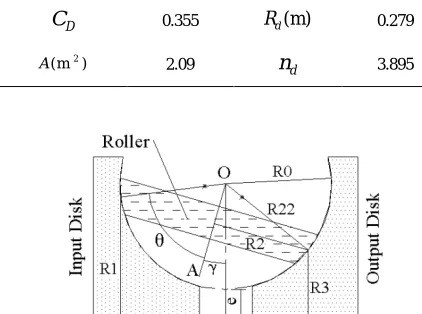
In order to calculate the vehicle FC, experimental data of the engine fuel consumption is needed. Figure 2 depicts the brake specific fuel consumption (bsfc) contours of the considered vehicle’s engine. These data are obtained from the engine manufacturer. The required characteristics of the vehicle for calculating its FC are shown in TABLE1. In this study, the vehicle motion is considered in ECE driving cycle. In order to calculate the vehicle FC, a method proposed in [3] is used, where the method has been validated comparing the experimental model.
2. 2. Stress and Fatigue Life Calculation The second function impacts the cost of using half-toroidal CVT is its fatigue life. Higher fatigue life leads to lower costs of CVT maintenance. Therefore, it is necessary to determine the fatigue life of CVT during driving cycle. Fatigue life of CVT totally depends on the contact stress between its elements. The contact stress on the roller and disks in the contact points is generally a high value and can rise up to 3GPa [10]. The stress in the contact area is a function of the normal force exerted on it (FN),
the contact points’ modulus of elasticity and Poisson’s ratio. These parameters specify the semi-axis of elliptical contact area, as well. This stress can be achieved using [11]:
N
1.5F
σ=
πab (2)
where the normal force is calculated by:
2 in
N
T F
Ln cos π
γ
= (3)
Obviously, the roller and the disks experience a repetitive stress which changes due to diverse operating conditions. Accordingly, calculating their fatigue life seems to be essential. In the driving cycle, in order to allow the engine to operate in the fuel-optimal rpm, CVT speed ratio changes frequently, and the different points of the disks experience various values of the contact stress, when CVT speed ratio changes by tilting the roller and varying γ. On the other hand, during CVT operation, any contact point of the roller experiences contact stress. Therefore, the roller contact points may be more critical than the disks’ contact points in terms of the contact stress exerted on them. Consequently, in order to determine CVT fatigue life, the fatigue life of its roller is studied.
During any rotation of the roller about its axis, a specific point on the roller experiences two various nonzero stresses during contact with the input and output disks. Therefore, the stress in the considered point varies according to Figure 3. In this figure, σin and
σout are the stress values on the roller during contact
with the input and output disks, respectively.
TABLE1. The characteristics of the considered vehicle Value Parameter
Value Parameter
1100
(kg)
m 0.013
r
f
0.279
(m)
d
R 0.355
D
C
3.895
d
n
2.09
2
(m )
A
Figure 1. A simple geometry of half-toroidal traction drive [7]
Figure 2. bsfc data of the considered vehicle’s engine
Figure 3. A schematic of stress variation for a specific point on the roller during rotation about its axis
10000 2000 3000 4000 5000
10 20 30 40 50 60
Speed (rpm)
P
o
w
er
(
k
W)
265
275
275
275
290
290
290
320
320
320
370
370
370
425
425 425
500
500 500
265
265
Time
σin
The value of cyclic contact stress in a specific point
of the roller can be calculated knowing the input torque and the speed ratio (see Equation (2)). The times of acting a definite stress on the specific contact point for a defined driving cycle can be obtained, by studying the roller in time deviation (
∆
t
) which is small enough. Knowing the value of the roller rotational speed during drive cycle, the times of facing the considered contact point with input or output disk can be determined. Therefore, times of applying contact stress on the considered contact point is obtained. The allowable contact stress (Sc) at 107 cycles can be chosen accordingto ANSI/AGMA 2001-D04 [12]. In order determine its value in other cycle numbers, the load cycle factor (ZN)
is needed. One of the conventional materials used in toroidal CVTs is case-hardened steel with HRC=60 hardness [13]. In this case, Sc is almost 1.9GPa and
ZN=1.249N-0.0138[12]. Thus, the number of cycles to
failure for specific stress level is achieved by:
1 0 0138 1 249 .
c i
i
. S N =
σ
(4)
In this paper, Miner’s rule is used to determine the expected fatigue life of the roller under cyclic stresses. The expected life of the roller is attained by:
1
i i
D n N
=
∑ (5)
The fatigue life of CVT can be shown in terms of the number of driving cycles or the distance (in kilometers) can be travelled using CVT.
2. 3. Weight Calculation The third function which affects the cost of using CVT is its weight. Higher weight of CVT increases the overall weight of the vehicle and therefore, increases the vehicle FC. The power train weight is more important in case of CVT transmissions. These power trains are commonly heavier than the conventional automatic transmissions [14].
In order to determine half-toroidal CVT weight, a simplification is carried out. In this investigation, in order to calculate the weight of a CVT power train, we calculate the sum of its primary elements including input and output disks and the rollers. The reason behind this simplification is that the other elements have smaller weight compared to these elements. Furthermore, the optimization parameters presented in the following sections don’t alter the ignored elements’ weight. Thus, these elements don’t affect the optimization results. CVT weight is calculated as a function of its density and geometrical parameters including R0, R22, e, θ and n. Since the equation which
presents its weight is a large equation, it is not presented here.
3. MULTI-OBJECTIVE OPTIMIZATION METHOD Engineering design often deals with multiple, possibly conflicting, objective functions or design criteria. On the other hand, we can say all design and engineering activities are fundamentally multi-objective in nature because of the existence of inherent tensions between some objectives which most of the time are conflicting. For example, one may want to maximize the performance of a system while minimizing its cost. Such design problems are the subject of multi-objective optimization [15]. There is general consensus that multi-objective optimization methods can be broadly decomposed into two categories: Scalarization approaches and Pareto approaches. In the first group of methods, the multi-objective problem is solved by translating it back to a single objective, scalar problem. The Pareto methods, on the other hand, keep the elements of the objective vector separate throughout the optimization process and typically use the concept of dominance to distinguish between inferior and non-inferior solutions. However, the end goal of all these methods is the same to provide designers and decision makers with a set of ‘optimal’ alternatives to choose from [16]. In the research reported here, scalarization method is used. A simple method of this group is to define a function which is sum of the weighted functions where the weight of each objective is determined with regard to its importance compared to other objective functions. However, as demonstrated in [17] and [18], it fails to provide acceptable results especially in non-convex optimization spaces. Moreover, the solution points’ distribution is highly sensitive to the importance weights of the objective functions [19]. In the present study, we use “Global Criterion Method” as one of the most common general scalarization methods. This method is introduced briefly as follows:
3. 1. Weighed Global Criterion Method Global criterion method is one of the scalarization methods for multi-objective optimization in which all objective functions are combined to form a single function. Although a global criterion may be a mathematical function with no correlation to preferences, a weighted global criterion is a type of utility function in which method parameters are used to model preferences. This method was firstly introduced by Rao [20]. In this method, the optimum solution (X ) is found by minimizing a preselected global criterion, F(X), such as the sum of the squares of the relative deviations of the individual objective functions from the feasible ideal solutions. Thus, X is found by: Minimizing
1
1
p p o
k
i i
i o
i i
f f ( X )
F (X) w
f
=
−
=
∑
m; where p is a constant value (an usual value of p is 2) and
∑
wi=1. For a fixed value ofp
, a single optimalpoint is achieved while Pareto optimal set is attainable by continuous variation of
p
[21].3. 2. Optimization In this section, the optimization goals introduced earlier are optimized simultaneously, employing the mentioned optimization method. In this paper, the importance weights in the optimization are dependent on objective functions as follows:
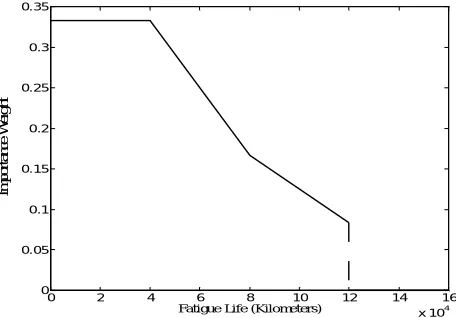
The importance weight of fatigue life function decreases with the growth of this function. It is on account of the fact that very large fatigue life of the power train is not necessary. On the contrary, by rising of the CVT weight, its importance weight will increase. The reason behind is that very massive power train for the considered vehicle cannot be feasible. The variations of the above weight factors versus their objective functions are shown in Figure 4 andFigure 5. As shown in Figure 4, the weight coefficient of the CVT fatigue life for the service life less than 40,000 km is equal to 1/3. This parameter decreases by increasing the service life, and for service life more than 120,000 km, it is equal to zero. This data is derived from the presented data of the vehicle manufacturer1 [22]. According to Figure 5, the importance weight factor of the CVT weight criteria remains 1/10 whenever the CVT weight values are less than 10 kg. Furthermore, as depicted in the diagram, this parameter shows an increase with the growth of CVT weight and reaches the maximum point at 1. Similar to the fatigue life data, these data is also derived from the published data of the vehicle manufacturer [22]. As stated by manufacturer, the power train weight must be less than 50kg. For more information, the weight of the manual transmission currently utilized as the vehicle power train is 25 kg. Since the sum of the weight parameters must be equal to 1, the weight coefficient of the vehicle's FC for any value of CVT fatigue life and weight can be calculated.
In order to accomplish the optimization procedure, the particle swarm optimization (PSO) method is employed. This method is illustrated in [7]. The reason of selecting PSO as the optimization method is its ability to optimize complex and non-differentiable functions, and its simplicity [22]. As described before, the optimization problem has two constraints: the first constraint is that the power train weight must be less than 50 kg, and the second constraint is on the maximum stress exerted on the disks and the roller during the identified driving cycle. Regarding the considered material for these elements, the maximal contact stress which CVT elements can endure is 2.37 GPa.
1
Saipa corporation
Figure 4. Variation of importance weight of the power train fatigue life
Figure 5. Variation of importance weight of the power train weight
While dealing with the solutions which violate the constraints, the penalty functions that is used will be the exterior penalty function [23]. The optimization parameters are those parameters which determine half-toroidal CVT geometry. Their ranges are shown in Table 2. The optimization problem is formulated as follows: Minimize fi(X); where;
f1(X) = vehicle FC
f2(X) = 1/Fatigue life
f3(X) = CVT weight
T
0, , ,
22
0 0
R e
X R
R R θ
=
Subject to
- Maximum contact stress-2.37GPa ≤0 - CVT weight ≤ 50kg
Since we want to increase fatigue life of CVT, its objective function is considered 1/Fatigue life. Minimization of this function means that the fatigue life is maximized.
0 2 4 6 8 10 12 14 16
x 104 0
0.05 0.1 0.15 0.2 0.25 0.3 0.35
Fatigue Life (Kilometers)
Im
p
o
rt
a
nc
e
W
e
ig
ht
0 10 20 30 40 50
0 0.1 0.2 0.3 0.4 0.5 0.6 0.7 0.8 0.9 1
CVT weight (kg)
Im
po
rt
an
ce
W
e
ig
TABLE 2.The optimization parameters and their range [7] Value Parameter
Value Parameter
[
0.1-0.9]
0
e R
[
20-80]
(mm)
0
R
[
50-80]
(deg)θ
[
0.3-0.9]
22
0
R R
TABLE 3. The optimal solution for each objective function, taken alone
Objective Vehicle FC
(L/100km)
(Fatigue
Life)-1
CVT Weight (kg)
Vehicle FC 9.54 6.22×10⁻³ 6
(Fatigue Life)-1 10 5.28×10⁻¹⁹ 47.82
CVT weight 10.2 7.3×10⁻⁸ 2.76
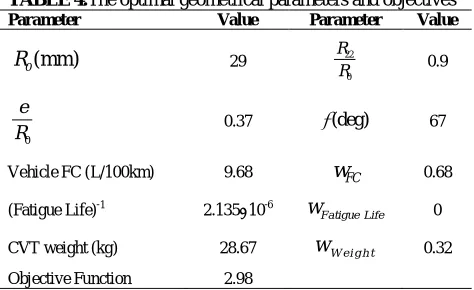
3. 3. Optimization Results The global criterion method was used and the results were achieved. As discussed above, the first stage of this method is to optimize each of the considered objectives by itself, subjecttothe mentioned constraints. The optimization results of this stage are shown in Table 3. Each row shows the optimization results of one of the objectives. At this row, added to the optimal value of the considered objective, the values of other objectives for this case are shown.
As shown in this table, for the case of optimizing the vehicle FC, fatigue life of CVT indicates a low value (160 kilometers) in terms of the distance which can be travelled by the CVT. For the case of optimizing the fatigue life, the vehicle FC will be 5% higher than its optimum value while CVT’s weight reaches a large value and approaches to the upper bound of the allowable range. Moreover, at the same time, the fatigue life is 1.88×10¹⁸km. According to Figure 4, this value is very larger than the required value. In the case of optimizing the CVT weight, the vehicle FC shows an increase and reaches the amount that is 7% higher than its optimum value, meanwhile the CVT’s fatigue life will be much more greater than its required value.
As a result, we can notice that through the process of optimization of each objective, other objectives are away from their optimal points. Moreover, in some cases, the optimized objective reaches the value which is beyond the required level. Therefore, multi-objective optimization with respect to the importance weight factors seems to be necessary.
As the next step, the multi-objective optimization method is implemented and the optimal values of the objective functions are achieved. This objective is
1 2 2 3
1
/ o
i i
o
i i
f f ( X )
F (X)
f
=
−
=
∑
.
TABLE 4.The optimal geometrical parameters and objectives
Parameter Value Parameter Value
(mm) 0
R 29 22
0
R
R 0.9
0
e
R 0.37 θ(deg) 67
Vehicle FC (L/100km) 9.68 wFC 0.68
(Fatigue Life)-1 2.135×10⁻⁶
F a tigue Life
w 0
CVT weight (kg) 28.67 wW e i g h t 0.32
Objective Function 2.98
This value added to the optimal geometries is shown in Table 4. In addition, the values of the objectives are shown in this table. According to this table, CVT fatigue life in terms of the travelled distance is about 465,000 kilometers. Therefore, regarding Figure 4, its importance weight is zero. This is because the proposed CVT meets the demanded service life totally, and therefore, this objective hasn’t affected the optimization objective function. Comparing the results shown in Table 4 with Table 3, it is concluded that the objectives achieved from multi-objective optimization are not the optimal values, but are acceptable ones. As shown in Table 3, the vehicle FC is only 1.5% larger than its optimum value. In this case, the optimal CVT’s weight is 28.67kg which comparing to a normal manual power transmission (25 kg) is acceptable. Meanwhile in that case, the fatigue life of CVT is larger than the required value.
4. CONCLUSION
5. REFERENCES
1. Ebrahimi, R. and Mercier, M., "Experimental study of performance of spark ignition engine with gasoline and natural gas", International Journal of Engineering, Transactions B: Applications, Vol. 24, (2010), 65-74.
2. Yousufuddin, S. and Mehdi, S.N., "Effect of ignition timing, equivalence ratio, and compression ratio on the performance and emission characteristics of a variable compression ratio si engine using ethanol unleaded gasoline blends", International Journal of Engineering Transactions B: Applications, Vol. 21, No. 1, (2008), 97-106.
3. Delkhosh, M. and Foumani, M.S., "Optimisation of full-toroidal continuously variable transmission in conjunction with fixed ratio mechanism using particle swarm optimisation", Vehicle System Dynamics, Vol. 51, No. 5, (2013), 671-683.
4. Delkhosh, M., Foumani, M.S. and Boroushaki, M., "Geometrical optimization of parallel infinitely variable transmission to decrease vehicle fuel consumption", Mechanics Based Design of Structures and Machines, Vol. 42, No. 4, (2014), 483-501.
5. He, H., Li, H., Qin, D. and He, P., "Optimization design for structural parameters of toroidal cvt for automobiles", Journal of Mechanical Engineering, Vol. 5, (2009), 47-60.
6. Akbarzadeh, S. and Zohoor, H., Sensitivity analysis of torque transmission efficiency of a half-toroidal CVT., SAE Technical Paper. (2006)
7. Delkhosh, M., Foumani, M.S., Boroushaki, M., Ekhtiari, M. and Dehghani, M., "Geometrical optimization of half toroidal continuously variable transmission using particle swarm optimization", Scientia Iranica, Vol. 18, No. 5, (2011), 1126-1132.
8. Delkhosh, M. and Foumani, M.S., "Multi-objective geometrical optimization of full toroidal CVT", International Journal of Automotive Technology, Vol. 14, No. 5, (2013), 707-715.
9. Delkhosh, M. and Foumani, M.S., "Modelling and optimization of toroidal continuously variable transmission in ece driving cycle", International Journal of Engineering, Vol. 26, No. 12, (2013), 1535-1542.
10. Carbone, G., Mangialardi, L. and Mantriota, G., "A comparison of the performances of full and half toroidal traction drives",
Mechanism and Machine Theory, Vol. 39, No. 9, (2004), 921-942.
11. Attia, N.A., Datong, Q., Wankai, S. and Huaying, L., "A parametric study on the contact stress of half toroidal
continuously variable transmission", Journal of Chongqing University, Vol. 2, No. 2, (2003).
12. Budynas R. and Nisbett K., "Shigley’s mechanical engineering design, 9th edition",McGraw-Hill Science/Engineering/Math, ., (2010).
13. Machida, M. and Murakami, Y., "Development of the half toroidal cvt powertors unit", NSK Tech. J, Vol. 9, No. 669, (2000), 15-26.
14. Dutta-Roy, T. and Zhang, N., "Effect of a half-toroidal continuously variable unit on the dynamics of a complete powertrain: A parametric free vibration analysis", Proceedings of the Institution of Mechanical Engineers, Part D: Journal of Automobile Engineering, Vol. 218, No. 5, (2004), 471-484.
15. De Weck, O.L., "Multiobjective optimization: History and promise", in Invited Keynote Paper, GL2-2, The Third China-Japan-Korea Joint Symposium on Optimization of Structural and Mechanical Systems, Kanazawa, Japan. Vol. 2, (2004).
16. deWeck O.L. and Kim I.Y., "Multiobjective optimization via the adaptive weighted sum method", 10th AIAA/ISSMO Multidisciplinary Analysis and Optimization Conference, Albany, New York,, (2004).
17. Statnikov, R.B. and Matusov, J.B., "Multicriteria optimization and engineering, Chapman and Hall, (1995).
18. Marler, R.T. and Arora, J.S., "Survey of multi-objective optimization methods for engineering", Structural and Multidisciplinary Optimization, Vol. 26, No. 6, (2004), 369-395.
19. Das, I. and Dennis, J.E., "A closer look at drawbacks of minimizing weighted sums of objectives for pareto set generation in multicriteria optimization problems", Structural Optimization, Vol. 14, No. 1, (1997), 63-69.
20. Rao, S.S. and Rao, S., "Engineering optimization: Theory and practice", John Wiley & Sons, (2009).
21. Yu, P.-L., "A class of solutions for group decision problems",
Management Science, Vol. 19, No. 8, (1973), 936-946.
22. Wu, J., Zhang, C.-H. and Cui, N.-X., "Pso algorithm-based parameter optimization for hev powertrain and its control strategy", International Journal of Automotive Technology, Vol. 9, No. 1, (2008), 53-59.
Application of Multi-objective Optimization for Optimization of Half-toroidal
Continuously Variable Transmission
M. Delkhosh, M. SaadatFoumani, P. Rostami
Department of Mechanical Engineering, Sharif University of Technology, Tehran, Iran
P A P E R I N F O
Paper history: Received 12 August 2013
Received in revised form 31 March 2014 Accepted 22 May 2014
Keywords:
Continuously Variable Transmission Half-toroidal
Fuel Consumption Fatigue Life
Multi-objective Optimization Importance Weight Global Criterion
هﺪﯿﮑﭼ
ﻪﮐ،ﺖﺳاوردﻮﺧﺖﺧﻮﺳفﺮﺼﻣراﺪﻘﻣﺎﻫرﺎﯿﻌﻣﻦﯾﺮﺘﻤﻬﻣزاﯽﮑﯾوردﻮﺧﯽﺣاﺮﻃﻪﺳوﺮﭘردهﺪﺷﯽﻓﺮﻌﻣ فاﺪﻫانﺎﯿﻣرد ﺖﺳايﺮﺘﺸﻣووردﻮﺧهﺪﻧزﺎﺳهوﺮﮔودﺮﻫﺮﻈﻧﺪﻣ
.
لﺎﻘﺘﻧاﻢﺘﺴﯿﺳهدزﺎﺑ،وردﻮﺧﺖﺧﻮﺳفﺮﺼﻣﺮﺑﺮﺛﻮﻣيﺎﻫﺮﺘﻣارﺎﭘزاﯽﮑﯾ
ﺖﺳاترﺪﻗ
.
رد ﻪﺘﺳﻮﯿﭘترﺪﻗلﺎﻘﺘﻧاﻢﺘﺴﯿﺳﻪﻟﺎﻘﻣﻦﯾا
)
CVT
(
ﺮﻈﻧردوردﻮﺧترﺪﻗلﺎﻘﺘﻧاﻢﺘﺴﯿﺳناﻮﻨﻋﻪﺑ،هﺮﺒﻨﭼﻒﺼﻧ
ﯽﻣﻪﺘﻓﺮﮔ دﻮﺷ
.
ﯽﻣنآﺮﯿﯿﻐﺗوﺖﺳاﻪﺘﺴﺑاونآﻪﺳﺪﻨﻫﻪﺑﻪﻋﻮﻤﺠﻣﻦﯾاهدزﺎﺑ ﺪﻣﺎﺠﻧاوردﻮﺧﺖﺧﻮﺳفﺮﺼﻣﺶﻫﺎﮐﻪﺑﺪﻧاﻮﺗ
.
ﺮﯿﺛﺎﺗﺰﯿﻧنآﯽﮕﺘﺴﺧﺮﻤﻋونزويورنآﻪﺳﺪﻨﻫﺮﯿﯿﻐﺗ،ﯽﻓﺮﻃزا ﯽﻣ
دراﺬﮔ
.
ﻪﻨﯿﻬﺑفﺪﻫ،ﻪﻟﺎﻘﻣﻦﯾارد يزﺎﺳ
CVT
ﻒﺼﻧ
ﺖﺳانآﯽﮕﺘﺴﺧﺮﻤﻋﻪﻨﯿﻣزردهﺪﻧزﺎﺳتﺎﺑﻮﻠﻄﻣﻦﯿﻣﺎﺗونآنزوﺶﻫﺎﮐ،وردﻮﺧﺖﺧﻮﺳفﺮﺼﻣﺶﻫﺎﮐﺖﻬﺟردهﺮﺒﻨﭼ
.
ﯽﻓﺮﻌﻣزاﺲﭘ
CVT
ﯽﻣﻪﺋاراهﺪﺷنﺎﯿﺑفﺪﻫﻊﺑاﻮﺗﻪﺒﺳﺎﺤﻣشور،هﺮﺒﻨﭼﻒﺼﻧ دﻮﺷ
.
ﮏﯾﻊﺑاﻮﺗﻦﯾازاماﺪﮐﺮﻫياﺮﺑ
ﻌﺗﯽﻧزوﺐﯾﺮﺿ ﯽﻣﻒﯾﺮ
درادﯽﮕﺘﺴﺑفﺪﻫﻊﺑﺎﺗراﺪﻘﻣﻪﺑنآراﺪﻘﻣﻪﮐدﻮﺷ
.
ﯽﻣﻪﻨﯿﻬﺑﯽﯾﺎﻬﻨﺗﻪﺑفﺪﻫﻊﺑاﻮﺗزاماﺪﮐﺮﻫ ﺪﻧﻮﺷ
ﯽﻣﺖﺳﺪﺑﺎﻬﻧآﻪﻨﯿﻬﺑﺮﯾدﺎﻘﻣو ﺪﯾآ
.
شورﮏﻤﮐﻪﺑنﺎﻣﺰﻤﻫترﻮﺻﻪﺑفﺪﻫﻊﺑاﻮﺗﻦﯾا،ﺖﯾﺎﻬﻧرد
Global Criterion
ﻪﻨﯿﻬﺑ ﯽﻣﯽﺑﺎﯾ ﺪﻧﻮﺷ
.
doi:10.5829/idosi.ije.2014.27.09c.15