University of Bolton
UBIR: University of Bolton Institutional Repository
Educational Cybernetics: Journal Articles
(Peer-Reviewed) Institute for Educational Cybernetics
2008
Personalized learning and the Ultraversity
experience
Stephen J. Powell
University of Bolton, [email protected]
Ian Tindal
Anglia Ruskin University
Richard Millwood
University of Bolton, [email protected]
This Article is brought to you for free and open access by the Institute for Educational Cybernetics at UBIR: University of Bolton Institutional Repository. It has been accepted for inclusion in Educational Cybernetics: Journal Articles (Peer-Reviewed) by an authorized administrator of UBIR: University of Bolton Institutional Repository. For more information, please [email protected].
Digital Commons Citation
Powell, Stephen J.; Tindal, Ian; and Millwood, Richard. "Personalized learning and the Ultraversity experience." (2008).Educational Cybernetics: Journal Articles (Peer-Reviewed).Paper 1.
Personalised Learning and the Ultraversity Experience
Stephen Powella∗
, Ian Tindalb
, and Richard Millwooda a
University of Bolton, UK; bAnglia Ruskin University, UK
This paper describes a model of personalised work-integrated learning that is collaborative in nature, uses emerging Internet technologies and is accessed fully online. The Ultraversity project was set up by Ultralab at Anglia Ruskin University to develop a fully online, three-year duration, undergraduate degree programme with an emphasis on action inquiry in the workplace. The course design aimed to provide a highly personalised and collaborative experience. Students engage in the processes of inquiry together as a cohort, making it possible to collaborate and support each other in the online communities. The focus of this paper is on three aspects of personalisation: students’ use of technological infrastructure to develop online communities; integration of study in the workplace; and the work-study-life balance. Students were surveyed and interviewed after completion through questionnaire, telephone and face-to-face meeting. Transcripts were analysed using interpretive phenomenological analysis. This grounded approach provided evidence of impact of the design on personalised learning. The course design made the assumption that blended learning was not necessary to ensure a rich learning experience and would be a barrier to those who could not attend, and this decision is vindicated by the accounts of participants. It was also confirmed that facilitated online communities can be used to support deep learning that is focussed on action inquiry in diverse and individual workplaces. The course was designed to impact on both the work practices of the individual and the wider institution. Participants reported this as a strength. Overall, the evidence presented shows that a course design that emphasises a high degree of trust in students' ability to self-manage learning can lead to a challenging, personalised and rewarding online student experience. Students demonstrated high levels of competence in managing work study and life. This assertion is further borne out by the high degree of success achieved in terms of outcomes, judged by the degree results obtained by the cohort studied.
Keywords: e-learning; community of practice; community of inquiry; personalization; online learning; action research
1 Introduction and background
The four-year Ultraversity project started in January 2003, it was devised to research new approaches to learning in Higher Education Institutions (HEIs) and to address the government priority for HEIs of widening participation and fair access (Higher Education Funding Council for England (HEFCE) Strategic Plan, 2005) based upon both national economic arguments as well as social justice values. The project was based upon the premise that conventional models of study at university fail to meet the needs of a significant number of potential students and their employers.
This view is supported by a 2006 publication by the Department for Education and Skills (DfES) on Widening Participation in Higher Education that identifies "gradual progress has been made in broadening the socio-economic make-up of the student population, but progress has been too slow and may be levelling off". Amongst other suggestions, the same report also encourages educational institutions and employers to "explore new 'Earn to Learn' models whereby employees’ higher-level skills needs can be met through combinations of earning and learning." In short, not enough progress is being made towards widening participation and achieving fair access to HE. If long-term goals are to be met; different approaches to HE will be required.
The authors of this paper would argue that for a significant group of students face-to-face (f2f) attendance can be perceived as too expensive and the removal of employees from the workplace for up to three years can be problematic. Alternatively, choosing to study part time whilst remaining at work is perceived by many as being too long term. In both cases study foci on many courses is often theoretical with little authentic practice based learning.
We believe that meeting the demands of these students requires approaches that are personalised. For Ultraversity this means giving students choices about what, how, and where they study. The design anticipated that there were students who needed to continue earning whilst learning and that the inability to do so had prevented them from realising their ambitions.
The traditional subject disciplinary approach to HE learning prepared students well for specific futures in an era where ‘a job for life’ or a career in academia was a common expectation of HE learners. A growing requirement is the ability to remain in the workplace whilst studying, to earn a living, and keep up-to-date with fast changing professional contexts.
Employers are becoming increasingly sophisticated in their expectation of training, Charles Jennings (2006), Global Head of Learning Reuters identifies an evolving need:
“What is in fact required in organisations is a change from training for skills to 'learning for performance'”.
Barnett (2005), argues in his conceptualising of today's University that "The knowledges to be found in the university may be growing at a rapid rate but they will—we now have to recognize—always fall short of mirroring all of the knowledges in modern society." When discussing teaching, he describes a significant change in the mindset required from “knowledge about the world” to "being-in-the-world” has to take primary place in the conceptualizations that inform university teaching."
Middlehurst and Woodfield (2007) report "Responding to the Internationalisation Agenda: Implications for Institutional Strategy" identifies changes in the international environment for higher education in the UK. Key points identified are the increasing demand from students for international higher education and the competition between institutions for this business. These are increasingly sophisticated students who are demanding modes of delivery more accessible than the traditional travel to study in another country model. Emerging communications technologies and the changing demands of students are shaping a global learning landscape for the 21st century. If UK Higher Education Institutions are to continue to meet the needs of today’s learners as well as the challenge set out by the Leitch (2006) report to secure the "economic and social health of the UK" they must explore approaches where technology is central to new models for learning. It is against this background that the Ultraversity project was conceived, its overarching ethos was to offer a university experience to some of those for whom current university provision did not fit. In this respect it subscribed to the values and ideals of the Ultralab research team (Millwood & Terrell 2005).
and isolated. Students engage in the processes of inquiry together as a cohort collaborating and supporting each other while studying their own work context.
2 Review
Harvey (2005) uses the term "Work-Integrated Learning" (work-based learning) when describing the Open University’s development of a generic learning framework that has the potential to be adapted to a wide range of subject specialisms. As its starting point, this approach has much in common with the Ultraversity model with the emphasis on the motivational imperative of self-direction, learning from experience, and problem or task-focused orientation for the adult learner, drawing on Knowles' (1984) theory of Andragogy.
By developing a generic framework for work-integrated learning, it is possible to use a wide variety of settings to enable the student to gain higher education credits through their work experience.
Treating the undergraduate as a 'student researcher' takes the above idea one step further in that it allows the learner a high level of discretion in identifying relevant theories and models and applying them to authentic learning opportunities in their workplace. The emphasis of this approach is on the students' ability to critically evaluate their activities in the work environment.
Treating the undergraduate as a 'student researcher' takes the above idea one step further in that it allows the learner a high level of discretion in identifying relevant theories and models and applying them to authentic learning opportunities in their workplace.
Another active area of research into personalisation of the learning experience is through computer-interpreted behaviour and includes work on IMS Learning Design and a long tradition of approaches under the term Adaptive Hypermedia.
Burgos, Koper, and Tattersall (2006) discusses personalisation in terms of adaptation identifying three agents in this process including the learner, the teacher, and the set of rules derived from other stakeholders. For them this approach to personalisation is seen as problematic from a resource and time standpoint as mediation between agents would necessarily be complex. IMS Learning Design offers the possibility of a technological solution to adapt the learning experience offered.
There is a clear attraction in this approach for a programme of learning based around a subject-discipline with content that is predetermined and where student study contexts are closely aligned. The complexity of research-driven learning makes it more difficult to design adaptive systems. The Ultraversity project has chosen not to pursue this route, instead achieving personalisation through a process of dialogue-based negotiation between learner and teacher.
Coats and Stevenson (2006) explain this as a process whereby " both teacher and student play an interactive role, in which teaching and learning are seen as complex and socially mediated". In the online context, Stephenson (2001) identified the particular challenge of aligning the expectations of learners with those of the teachers in terms of approaches to teaching, learning, and assessment to be taken when student and teacher don't meet face to face but communicate via the Internet.
3 Model of Personalised Work-integrated Learning
3.1 Overview
emphasis on the social, interactive and conversational nature of emerging web based services and tools, sometimes collectively referred to as ‘e-learning 2.0’ Downs (2005).
Negative publicity surrounding the failure of the UK eUniversity discouraged many UK institutions from seeking to deliver wholly on-line based courses (Middlehurst and Woodfield, 2007). As a result, blended learning with mixed modes of delivery became the safer option and has gained a high level of currency in many institutions. From the outset, the Ultraversity project made the deliberate choice to develop a fully online programme in order to reach an audience of students for whom blended and f2f approaches did not fit.
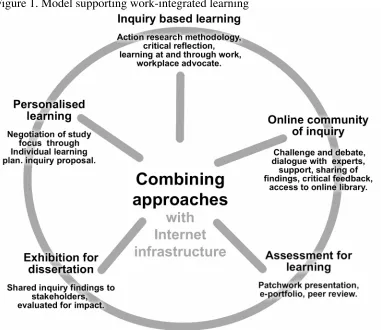
Figure 1. Model supporting work-integrated learning
Millwood, Powell, and Tindal (2008)
These approaches are explained in more detail in the following sections.
3.2 Personalised learning
The Ultraversity model for curriculum design consists of a series of ‘open’ module frameworks with generic outcomes. Learners identify subject knowledge that is relevant to their own context and needs. Through a process of negotiation with teaching staff they develop a set of learning activities recorded as Individual Learning Plans (ILPs) or inquiry proposals.
in the daily work of the learner and enable them to meet the requirements of the modules and assessment criteria.
The exit survey of the first cohort indicated that 86% of the students surveyed believed personalisation was a significant feature of their experience and 77% that their study was relevant to their needs.
“I felt that the Ultraversity programme was ideally suited to me because I run my own business and therefore I was able to tailor the work to not only benefit myself but also to target specific areas of my organisation.”
“The plans made it possible to tailor to my own needs. The title ‘Work Place’ degree says it all really, in every module we were encouraged to make it relevant to our situation and the Individual Learning Modules were constructed around this ideal. This made the tasks more relevant; I could see that the results would really make an impact, so I put even more effort into them. It didn’t seem selfish to study. The Learning Facilitators offered great support and encouragement, they allowed the researchers to learn from each other, and discuss difficult issues, in my opinion this was the best possible help. I learned a great deal from researchers in the online community, deep issues were discussed”
Harvey & Norman (2005) report similar findings "Students have described how they were highly motivated by the fact that their learning in the workplace was valued and could be used within their higher education award."
3.3 Inquiry based learning
This is based upon Action Research methodology that has an emphasis on critical reflection on an individual’s work practices and inquiry into their work context. This leads to action that is planned, implemented and evaluated with the intention of making a positive impact on their work – learning for performance. John Dewey, in declaring his pedagogic creed in 1897, made it clear how vital it is to take such a learner-centred view:
"In sum, I believe that the individual who is to be educated is a social individual and that society is an organic union of individuals. If we eliminate the social factor from the child we are left only with an abstraction; if we eliminate the individual factor from society, we are left only with an inert and lifeless mass. Education, therefore, must begin with a psychological insight into the child's capacities, interests, and habits."
John Dewey (1897)
This approach is also designed to enable students to effectively integrate study and workplace activities with the support of a ‘workplace advocate’ who is identified by the learner as someone who can help them with work place practicalities rather than as a mentor.
3.4 Online community
Garrison (2006) summarises the characteristics of a Community of Inquiry (CoI) as:
consider the dual role of both moderating and shaping the direction of the discourse. Both are essential for a successful community of inquiry.”
Wenger explains Community of Practice (CoP) as “The basic idea is that human knowing is fundamentally a social act”. More specifically, “Communities of practice are groups of people who share a concern or a passion for something they do and learn how to do it better as they interact regularly.” A process of negotiation and resultant ‘meaning making’ defines the community. This ongoing interaction changes the identity of the individual and their relationship to the group as a whole and its other members.
Drawing on the CoP model, Ultraversity developed a community of inquiry that placed less emphasis on the directional aspects of the instructional role and instead focusses on the importance of modelling desired behaviours such as critically reflecting on their own experiences. Labels for individuals such as teacher and student diminish in significance as all community members adopt different roles according to their knowledge, experience and changing identity. Individual's membership of different online and f2f communities allow for the opportunity of cross pollination of ideas and experiences.
The Ultraversity model provides access to module learning resources and participation in the online communities 365 days a year enabling students to have a high degree of control over the management of their learning both as individuals and collaboratively. This is in contrast to the restrictions typically enforced by Virtual Learning Environments (VLE) that enrol users onto a particular unit of learning and allow access to resources and activities over a limited period of time corresponding to the delivery pattern of a programme. The facilitation team intentionally created an environment where trust and critical friendship could grow and contribute to the development of the community, anticipating a successful environment for deep learning based on work undertaken in the Talking Heads Project (Chapman, Ramondt, Smiley 2005). Researchers (students and facilitators) work and learn together in an online community environment where social construction of knowledge is realised through collaboration and critical friendship between learners.
The course designers valued unstructured or ‘chance dialogue' (Powell, 2004) where learners initiated their own conversations, but also designed an experience that had opportunities for purposeful conversations initiated by teachers (Laurillard, 2002). This was achieved through the development of a facilitated online ‘community of inquiry’ where a rich experience of challenge and debate, support, sharing findings, critical feedback, access to online library, and conversations with invited experts could take place. The exit survey indicated that 62% believed that the level of collaboration was significant and some 35% that there was some collaboration with 3% believing there was no collaboration at all.
Experts join the communities to ‘host’ focused conversations that engage learners in critical dialogue. This is not a ‘lecture’ by an expert broadcasting their predetermined content to a captive audience, but an opportunity for learners to direct the conversation to meet their own needs:
“I found them quite helpful, I would look through the questions and answers and posed some myself, it was good to talk to an expert.”
3.5 Assessment for learning
rich media and technology such as video, audio, websites and weblogs. These multimedia supported their own choice of preferred modalities of expression supporting an assumption that this was a key personalisation issue. The online technology-rich model was evolved from the idea of Patchwork Text (Winter 2003), with its emphasis on a reflexive approach and the use of creative imagination, peer review and discussion.
“It's time we found an alternative to the student essay. For tutors across the country, it's marking time again and, reading essays, we realise that many of our students have yet again taken refuge in ‘surface learning’.” (Winter, 2003).
Student researchers assemble pieces of work for each module in their assessment e-portfolio with a ‘retrospective commentary’, which 'stitches' their artefacts together synthesising ideas and forming conclusions. This concluding activity should provide and an honest view of the learning journey including learning from failures, celebration of success and identifying new questions for future inquiries. The exit survey indicated that 88% of students believed that they had developed critical thinking skills that were transferable to different contexts. Students are encouraged and credited for experimenting with Internet technologies that support their inquiries and creative expression.
3.6 Exhibition for dissertation
Towards the end of the programme, learners are required to construct an exhibition of their findings primarily based upon the final year of their studies but drawing on the whole three-year experience. The exhibition is given to an informed audience identified by the learner, wherever possible in their place of work. Critical evaluation of the exhibition by the audience helps validate their findings.
Through this process learners demonstrate to themselves and stakeholders the progress they have made in terms of personal growth, and in their ability to perform in their work role. Initial findings indicate that students are engaging with the notion of being a lifetime learner. The exit survey indicates that 72% believe that study has had a positive impact on their career development with 49% reporting a positive impact on their salary already – that is before their degree was awarded. The exit survey indicated that 70% believed that impact on the workplace was significant.
"The module requirements were generic, but the personal application of those requirements meant that I could tailor them to suit my needs and those of others in my school."
The focus of individual students exhibition is analysed below and indicates the breadth of themes and workplace contexts in which the model developed can be applied to workplace learning. Students selected the topic for their inquiries based upon their self-identification of real workplace issues. A process of negotiation with learning facilitators then honed the focus on the inquiry and the activities to be undertaken.
The analysis also underlines the relevance of the topics they negotiated to their workplace.
3.7 Internet infrastructure
The Nesta Futurelab publication on Personalisation and Digital Technologies (2005), argues that "The logic of education systems should be reversed so that it is the system that conforms to the learner, rather than the learner to the system", and that in the formal context this is still largely unrecognised.
There is already a high degree of personalisation in the experience of 'lifewide learners', as Downes (2006) observes; despite the rapid increase in educational institutions adoption of Internet technologies, most people who inhabit the online world are in fact choosing to use a myriad of Web 2.0 technologies. These spaces enable them to generate and share their own content in ways that they chose to amongst their own ‘learning networks’.
Action Enquiry titles analysed by principal theme and workforce for 148 researchers in their final year, 2006
total in each workforce
What did they
study?
1 2 10 1 13 3 1 117
total in each theme
workforces themes
care charity early
years HE health LEA research school
4 assessment 1 3
3 behaviour 3
17 communication 3 1 3 10
2 community 1 1
2 CPD 2
8 environment 1 7
6 inclusion 1 5
28 learning 3 4 21
19 literacy 19
13 management 5 8
1 multicultural 1
2 numeracy 1 1
9 parents 3 1 5
17 pastoral 1 16
5 resources 1 4
7 special needs 7
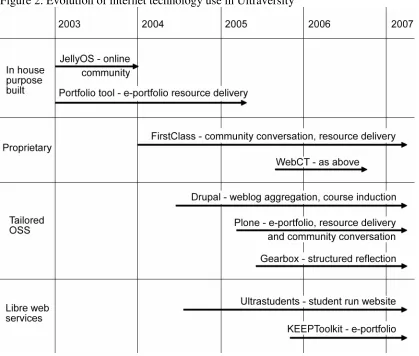
The trends and tensions outlined above can be seen playing out in the Ultraversity project since 2003 as displayed in Figure 2.
Figure 2. Evolution of internet technology use in Ultraversity
Initially there was a reliance upon in house purpose built tools and proprietary software. Although with the benefit of allowing for a high degree of control over the tool's development, the resource requirements were significant higher for the in house purpose built tools making this an unviable approach.
It was apparent that the next step was to harness the considerable potential resource savings offered by tailoring open source solutions (OSS) to our needs. An evaluation of options based upon technological, pedagogical and operational considerations identified Drupal as a web aggregator and as a vehicle for induction activities and the Plone content management platform for the realisation of our vision of a VLE. Plone was selected as ‘multi-layered’ technology providing a user interface with ‘low threshold and high ceiling’ (Papert, 1980) and symmetry of use in the tools available to all user groups. Individuals with relatively low levels of technological ability have the ability to easily master a rich set of creative online tools and to develop ‘virtual spaces’. Plone is supported by a strong open source community, which should ensure that it is a robust and long-lived platform.
Clearly there are advantages in terms of resource savings in using software developed and hosted by someone else. However there are also issues to overcome such as those posed by Quality Assurance (QA) and software interoperability. For example, it is essential that work submitted for assessment is in a format that is easily accessible to assessors and external examiners. It is a requirement that assessment products such as websites are not worked on after the deadline. If these processes cannot be automated through software interoperability, there is a significant amount of additional work to be undertaken.
An overarching consideration was the responsibility these tools placed on the student researchers to develop Web 2.0 technology skills and prepared them for a future of autonomy, continuing development and 'mash-up' - the combination of online tools to produce a coherent and linked set of information or functionality.
4 Methodology
4.1 Approach
The findings in this paper are based upon research using an adapted form of Interpretive Phenomenological Analysis (IPA). IPA was developed in the mid 1990s by Jonathan Smith (Smith 1997) and is itself a hybrid of systematic and naturalistic inquiry. In this approach, data collection and analysis goes through a number of detailed stages in order derive meaning from the text. The approach is informed by the philosophical stance of phenomenology and focuses on how an individual makes sense of experience. Interpretation is the key concept, both by 'subject' and researcher. Smith sums it up as:
“An attempt to unravel the meanings contained in accounts through a process of interpretative engagement with the text and transcripts.” (Smith, 1997:189)
4.2 Data collection
The authors’ experience as practitioner researchers developing and facilitating the course, was augmented by data drawn from an online questionnaire presented in July 2006. The questionnaire was completed by some 65 of a potential 142 respondents in July. Follow-up semi-structured interviews of 15 students carried out in September 2006 developed a richer understanding. These interviews were conducted using Skype and WireTap Pro software for recording, the recordings were then transcribed. This data was further augmented by semi-structured interviews with 19 graduates of the programme, these were carried out at the graduation ceremony in 26 November 2006 which were recorded on video and transcribed. Except for the initial online questionnaire, in each case, the questions were designed according to IPA methodology to be open ended and expansive in their opportunity for subjects to comment on the course freely.
4.3 Analysis
Discussions were carried out using Skype as medium for synchronous, verbal discussion and Google Docs and Spreadsheets to share concepts, analyses and conclusions.
The three authors met and discussed these assumptions in order to ensure these were articulated before analysis.
The authors then transcribed the data pasting each whole conversation into a Google spreadsheet. In this first stage analysis each author noted emerging themes as an individual.
Second stage analysis was carried out using Skype to discuss key titles emerging from our thematic notes in the spreadsheets - such titles were characterised by the team as 'floating to the top', capturing the essence of the transcript's meaning. Our goal was to find titles that were high-level enough to allow theoretical connections, but that were still grounded within the data.
Finally the titles were discussed and the authors undertook a process of developing 'superordinate concepts' to organise all the themes, using the raw data in transcripts to check back that the essence of these was accurate and grounded.
4.4 Limitations
In undertaking this approach and employing the IPA methods, the authors were conscious of a number of limitations inherent in the approach itself and in this particular exercise as outlined below. a) The selection of interviewees was based on volunteer students rather than a random sample, we did not seek students who had dropped out. Some justification for this can be found in our intention to conduct an Appreciative Inquiry, looking for what works rather than uncovering failure.
“The traditional approach to change is to look for the problem, do a diagnosis, and find a solution. The primary focus is on what is wrong or broken; since we look for problems, we find them. By paying attention to problems, we emphasize and amplify them. …Appreciative Inquiry suggests that we look for what works in an organization. The tangible result of the inquiry process is a series of statements that describe where the organization wants to be, based on the high moments of where they have been. Because the statements are grounded in real experience and history, people know how to repeat their success.” Hammond (1998)
b) The authors maintained a theoretical stance on the language analysed as being fair representation of 'inner states' - this view may be challenged particularly as the students were discussing issues with their tutors, and thus may have been anxious to please.
c) IPA can be critiqued in that the subjects' accounts rely on detailed experiences of participants, which in turn depend on the subjects' memory, ability to communicate and use of language. The students in this study were highly competent and articulate and the authors felt that their accounts were likely to be valid for these reasons.
5. Overarching themes
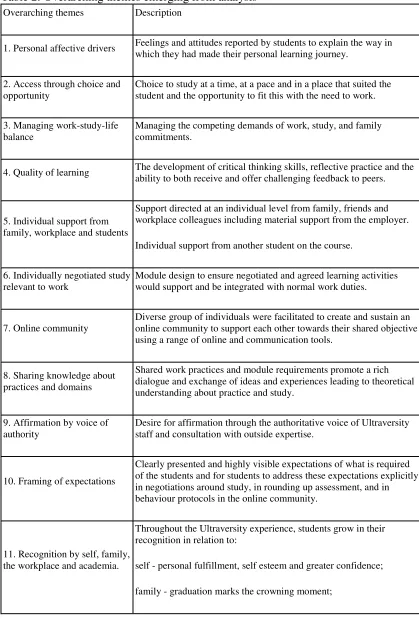
Table 2: Overarching themes emerging from analysis
Overarching themes Description
1. Personal affective drivers Feelings and attitudes reported by students to explain the way in which they had made their personal learning journey.
2. Access through choice and opportunity
Choice to study at a time, at a pace and in a place that suited the student and the opportunity to fit this with the need to work.
3. Managing work-study-life balance
Managing the competing demands of work, study, and family commitments.
4. Quality of learning The development of critical thinking skills, reflective practice and the ability to both receive and offer challenging feedback to peers.
5. Individual support from family, workplace and students
Support directed at an individual level from family, friends and workplace colleagues including material support from the employer.
Individual support from another student on the course.
6. Individually negotiated study relevant to work
Module design to ensure negotiated and agreed learning activities would support and be integrated with normal work duties.
7. Online community
Diverse group of individuals were facilitated to create and sustain an online community to support each other towards their shared objective using a range of online and communication tools.
8. Sharing knowledge about practices and domains
Shared work practices and module requirements promote a rich dialogue and exchange of ideas and experiences leading to theoretical understanding about practice and study.
9. Affirmation by voice of authority
Desire for affirmation through the authoritative voice of Ultraversity staff and consultation with outside expertise.
10. Framing of expectations
Clearly presented and highly visible expectations of what is required of the students and for students to address these expectations explicitly in negotiations around study, in rounding up assessment, and in behaviour protocols in the online community.
11. Recognition by self, family, the workplace and academia.
Throughout the Ultraversity experience, students grow in their recognition in relation to:
self - personal fulfillment, self esteem and greater confidence;
workplace - elevated status and career progression;
academia – graduateness and validation as an action researcher.
5.1 Discussion of selected themes from the Table of Overarching Themes
A detailed explanation and discussion of all of the themes is beyond the scope of this paper and they will be reported on at a later date. The focus of this paper is on two sets of personalisation related themes:
1. the integration of study in the workplace and the work-study-life balance (themes 2, 3, 5 and 6);
2. the students’ use of technological infrastructure to develop the online community (themes 7, 8, 9 and 10).
The discussion below does not set out to quantify the strength of the findings. However, research by Ormand Simpson at the Open University (2006) indicates that external sources of support are an important factor in students study and in descending order of importance students at the OU value support from families and friends; from tutors; from other students; from employers; and finally from the institution directly.
5.2 Integration of study in the workplace and the work-study-life balance
Themes 2, 3, 5 and 6 are strongly related to the way in which the course and the students' behaviour could offer a way to study when f2f university attendance had been ruled out. Even when learning is designed to integrate with work there are significant challenges - this section discusses how they have been met.
Theme 2. Access through choice and opportunity
Some students reported that the opportunity to integrate work and study, to continue to earn while they learn was a key factor in their access to HE.
"It was a long-term aim of mine to achieve a degree but there was no way I could afford to give up my job and go and study for 3 years full time. So when the flyer fell on the staff-room table, it was really you know the answer for me. It was the right route."
Theme 3. Managing work-study-life balance
Once the student had made the decision to embark on this kind of learning journey they needed to achieve a satisfactory integration of work, study and life. Evidence from the data indicated that the course design offered a means of resolving this equation. Students identified the importance of support from their family and time management strategies:
"Get the family on your side – you need their support first and foremost – however do not neglect the family. Keep a strict Ultraversity working time table – that way the family gets to spend some guaranteed time with you."
was possible for most students; the data indicates that strong commitment from all stakeholders is influential in the successful management of the competing demands of work, study, and family.
Theme 5. Personal support from family, workplace and students
Students found support received from family and workplace helped manage their learning journey. Factors mentioned that relate to workplace commitment included the permission to carry out research in the workplace, time to study, understanding and engagement from colleagues and financial support from the institution:
"It was a difficult journey really, but but manageable due, thanks to the support of my family and also my work colleagues. I was very well supported by the Head of the Centre throughout my degree and she actually paid for the training completely and was very supportive in any research I needed to carry out during the degree."
Asynchronous online community based learning was an important factor in enabling them to devise study patterns that fitted with family life. We found evidence that sharing and caring was a successful mechanism for social support with students empathising with each other, developing a sense of fellowship and deriving momentum from this.
"I also found out the online community was very good because it meant that we could find out we are all there together there are other people like myself who had children, who were out at work and they pushed me on."
Deep and trusting relationships developed between students, this level of bonding enabled challenging discussions and arguments; students found this application of critical thinking skills to be a valuable study support mechanism.
"Support from fellow researchers was really important, in my case there were a few of us ploughing our own furrow. We formed really close working relationships, we challenged each other, without those relationships I think the outcome of my degree might have been different. I needed the sharp questioning."
Theme 6. Personally negotiated study relevant to work
Individual students say they appreciated the opportunity to negotiate their approach to learning for each module and so tailor their study to fit their work context, they also discuss the importance of having a degree of choice over when to study. Students reported their studies were directly relevant to their workplace and had significant impact.
"I felt that the Ultraversity programme was ideally suited to me because I run my own business and therefore I was able to tailor the work to not only benefit myself but also to target specific areas of my organisation. The combination of having key submission dates for modules together with setting my own intermediate milestones worked well since I was able to flex my research around my work and family commitments whilst still ensuring that I achieved the module deadlines. The need to look closely at my strengths and weaknesses helped determine my learning requirements"
5.3 Students’ use of technological infrastructure to develop the online community
Theme 7. Online community
The Ultraversity online community comprised a diverse group of individuals who worked in different enterprises, with different roles, and individually selected focus of study. The envisaged role of the facilitator was to create and sustain an online community where all participants, students, facilitators and expert witnesses, would support each other towards the shared objective of creating a vibrant and effective online community of learners using a range of online and communications tools available to them. Active facilitation was a key element of effective online community.
"Learning facilitator support was excellent, from our designated learning facilitator and those in other cohorts, I would use mailboxes and just thought someone was there all the time. I thought it was really good"
As discussed earlier, technologies were chosen that would enable a high level of student control over the shape and nature of the learning environment. In addition, other technologies outside of the project offering were also encouraged.
Strong friendships and trust developed between community members through both informal social interactions and study related discussions between students and learning facilitators.
"I personally got a lot out of it. I mean, I like speaking to people in an online community and I like being able to help people. I chatted a lot online to people and emailed people and I felt I was able to support other people who perhaps were less confident in an online communities and I think, they appreciated that. I got a lot of positive feedback of that and we all learnt from each other and by opening up discussions in FirstClass, we got to know one another on a personal level"
"Oh yes, yes. We had lots of laughs, I mean, we shared sort of funny emails and we talked [about] what we did at work and the silly things the staff did at school to annoy us. We brought our own personal experiences in to it and all of that helped us to develop that deeper relationship which I felt, personally helped my learning experience but I think also helped other people who were perhaps less confident."
“I meant, I could see over the three years how peoples' confidence grew because we were such a friendly bunch of people and we got on so well together, we trusted each other. I definitely think that the interaction between all the members in our learning set was beneficial it was useful to bounce different ideas of people, it was useful to have some feedback from other students about the work we were doing and I don't think, I think without that interaction we would have found it very difficult to continue through to the end and to succeed as we have. I think the online community, it helped you, you didn't feel so isolated."
Ways of participation were multifaceted. Some students preferred to make their presence in communities with large memberships, whilst others preferred small learning sets where a deep level of trust between members was reported.
“I think there were many people online who... last year, if I hadn't had people in my learning set questioning what I xxx and giving me the opportunity to answer their criticisms with my own thoughts and feelings humm and in that way I think my overall performance improved because of it.”
The technologies used enable students to create their own spaces for interactions and both friendship and study groupings also develop on their own reflecting student preferences for the nature of interaction. Some prefer high levels of participation, others to focus purely on course related discussions.
"I found collaboration with other researchers a great strain and avoided it most of year 1 and 2. Fortunately in year 3 I got on well within my learning set so I was able to relax a bit and be more participative."
the Ultraversity communities. Students created their own supplementary community "Ultrastudents" using Yahoo groups and also including other technology such as blogs and wikis.
Theme 8. Sharing knowledge about practices and domains
For others, the expectation of collaboration through course requirements unlocked the value of online community learning and sharing knowledge about practices and domains of interest drawn from their work activities bringing theory to life when applied to the workplace.
The level 3 exhibitions provided a mechanism for students to explain to their workplace, what they had been studying and to engage their colleagues in challenging professional discussions. Organisational impact was reported with policies or strategies developed by students being adopted across their organisations.
"the great thing is learning from experience and taking that experience into...
... from everybody elses' views, when you go online and you gain gain experience from everybody elses' views that is that is
and work experience as well. You know, going to work and sharing your experience with colleagues as well. Did you find that that helped?
I did, yeah. To be able to compare my experiences with theirs and researchers online it really helped me to relearn what I already known, if you like, to confirm what I have already known and then cascade that information back down to other work colleagues as well to help them in their role
Initially, I felt strange putting questions and participating in the online community with virtual strangers and also sharing what was sometimes sensitive work related information. The main strengths are being able to compare different viewpoints especially with fellow researchers working in a similar environment."
Theme 9. Affirmation by Voice of Authority & Theme 10. Framing Expectations
Garrison, Anderson and Archer's Community of Inquiry (CoI) and Lave and Wenger's Community of Practice (CoP) discussed earlier provide valuable points of reference. Arguably, the Ultraversity community exhibits the characteristics of both types. For example, it is clear from this evidence that in terms of teaching presence students’ desire clearly presented and highly visible expectations of what is required (Theme 10. Framing expectations) as identified by Garrison, et al. In addition, there was evidence that students welcomed the hotseat expert witnesses bringing authority to discourse (Theme 9. Affirmation by voice of authority).
Learning facilitators provide formative feedback instilling confidence to the student that they are meeting the requirements of the modules.
"This [hotseat] was a wonderful way to obtain valuable experience from someone who had been there and done that – the contributions were so worthwhile and fears and problems with the particular subjects were alleviated"
However the role of the facilitator as a moderator and shaper of the direction of the discourse identified by Garrison; a teacher centric approach, does not accord with either the model developed for Ultraversity nor the reported student experience.
6 Conclusions
The evidence from our analysis and findings from the Ultraversity project is that a powerful motivational and creative force is there to be unlocked by creating a degree organisation and design that emancipates learners and permits a high level of personalisation. With this freedom comes responsibility and challenge to the student that was met in most cases with adaptability and positive action, supported by all the actors surrounding them.
The programme design enabled students from a wide variety of workplace contexts and work roles to study together as a part of an online community. A range of software was deployed to support this community. With explicit focus on this software as part of the course design, students proved capable of adapting and adopting this range of infrastructures and collectively implementing their own community spaces using publicly available online tools.
The evidence confirms that students can 'learn while they earn', i.e. studying full-time and working full-time and that it is effective to negotiate study to fit work.The precept that such learning could take place substantially in the workplace was supported; the extent of the integration with, and impact on, work practice was greater than anticipated.
Evidence from student researchers showed that it is possible to study fully online and manage the work/study/life balance. Multiple supporting roles were identified as essential components of this learning approach. These roles were fulfilled by those at home including family and friends, fellow students engaging in social discourse and critical review, online community facilitators and external experts.
The development team felt that the Ultraversity project was an important but potentially high risk exploration and they did not anticipate the amount of self-organisation and hard work exhibited by student researchers. The high levels of achievement in terms of degree results and career progression confirmed that the model is a potent source for innovation in higher education.
7 Further research
The data generated by this study deserves further analysis, and in particular the authors anticipate further findings in the themes not discussed here; Theme 4. Quality of learning and Theme 11. Recognition by self, family, the workplace and academia.
Suggested foci for future action research include:
1. develop the Ultraversity model to other contexts including study below undergraduate level and to MA and doctoral level;
2. approaches to non accredited organisational learning and development.
8 Acknowledgements
them and to Ken Allen, Alison Gee, Sarah Jones and Jane Down for conducting and transcribing the telephone interviews.
9 References
1. Barnett, R. (2006) Recapturing the Universal in the University. Educational Philosophy and Theory, Vol. 37, No. 6, 2005
2. Burgos, D., Tattersall, C., Koper, R., (2006) How to represent adaptation in eLearning with IMS Learning Design. Educational Technology Expertise Centre (OTEC) The Open University of The Netherlands Valkenburgerweg
3. Chapman and Ramondt (2005) Strong Community - Deep Learning: Exploring the Link, Innovations in Education and Teaching International Vol. 42, No. 3, August 2005, pp. 217–230, Routledge
4. Department for Education and Skills. (2006) Widening Participation in Higher Education. Ref: 04271-2006BKT-EN
5. Dewey, J. (1897) ‘My Pedagogic Creed’, School Journal vol. 54 (January 1897), pp. 77-80
6. Downes, S. (2006) Learning Networks and Connective Knowledge. The University of Georgia [online]. Available at: http://it.coe.uga.edu/itforum/paper92/paper92.html Last accessed 4th June, 2007
7. Fryer, B. (2004) Personalisation and Choice. Presentation at e-Agenda Summit, San Diego, USA. Report available at: http://www.stephenp.net/2004/12/17/e-agenda-summit/ Last accessed 4th June, 2007
8. Garrison, R (2006) Online Community of Inquiry Review: Social, Cognitive, and Teaching Presence Issues. http://www.communitiesofinquiry.com/documents/Community%20of%20Inquiry%20Issues.pdf Last accessed 4th June 2007.
9. Green, H., Facer, K., Rudd, T. (2005) Personalisation and Digital Technologies. Nesta.
10. Hammond, Sue. (1998) The Thin Book of Appreciative Inquiry. Thin Book Publishing Company, pages 6-7.
11. Harvey, M., Norman, L,. (2005) Developing a Distance-learning model for Work-integrated Learning. The Open University
12. Higher Education Funding Council For England. (2005) The HEFCE Strategic Plan, London.
13. Burgos, D., Tattersall, C. & Koper, R., (????), How to represent adaptation in eLearning with IMS Learning Design, Educational Technology Expertise Centre (OTEC) The Open University of The Netherlands 14. Jennings, C. (2006) Taking the Training out of Organisational Learning. Presentation at Informatology Conference, Reuters, London, UK.
15. Knowles M. (1984) Andragogy in action: Applying modern principles of adult education. San Francisco: Jossey Bass.(9)
16. Laurillard D (2002) Rethinking University Teaching: a framework for the effective use of educational technology (2nd edition) London; RoutledgeFalmer (0-415-25679-)
17. Leitch (2006) Prosperity for all in the global economy - world class skills, Her Majesty’s Stationery Office, London
18. Middlehurst, R., Woodfield, S. (2007) Higher Education Academy Research Report 05/06: Responding to the internationalisation agenda: implications for institutional strategy.
19. Millwood & Terrell (2005) Overview - New technology, learning and assessment in higher education, Innovations in Education and Teaching International Vol. 42, No. 3, August 2005, pp. 195–204, Routledge 20. Papert, S. (1980) Mindstorms: Children, Computers and. Powerful Ideas. New York: Basic Books.
22. Simpson, O. (2006) The Student Retention Business.
23. http://breeze.mdx.ac.uk/altc06ormond Last accesed 29th August 2007.
24. Smith, J.A., Jaman, M., & Osborn, M. (1999) Doing Interpretative Phenomenological Analysis. In M. Murray & K. Chamberlain (eds). Qualitative Health Psychology: Theories and Methods. London, Sage. 25. Winter, R., Parker, J. and Ovens, P. (2003) The patchwork text: a radical re-assessment of coursework assignments. Innovations in Education and Teaching International 40 (2): whole of special issue.
26. Wenger, E. (2007) Communities of practice - a brief introduction,