A b s t r a c t. The study presented in this paper was conducted under the conditions of a field experiment. Microbiological analy-ses were made at various stages of winter wheat plants develop-mentieheading, milk ripeness and full ripeness. The objective of the study was to acquire knowledge on the effect of cultivation of various lines of winter wheat on the numbers of bacteria and fungi with proteolytic capabilities, on protease and urease activity, and on the rate of the processes of ammonification and nitrification.
The results of conducted study demonstrated that the number of proteolytic bacteria and fungi, as well as the activity of protease and urease, and the intensity of ammonification and nitrification processes in soil depended on both the development stage and cul-tivated line of winter wheat.
K e y w o r d s: soil, bacteria, fungi, protease, urease, ammoni-fication, nitrification
INTRODUCTION
Soil is inhabited by huge number of microorganisms – bacteria, fungi, actinomycetes and algae. In the soil environ-ment microorganisms tend to concentrate in the plant roots zone and the humus horizon, due to the presence of available source of nutrients (Gajda, 2010).
In the root zone mutual interactions take place between plants and microorganisms (Singhet al., 2004; Stottmeister et al., 2003). Enzymes secreted out of and into cells are cata-lysts of biochemical processes in soil, and play an important role in the circulation of nutrients and mineralization of soil organic matter (Böhme and Böhme, 2006;Simon, 2002;
Trásar-Cepedaet al., 2000). Therefore, both the size of microbial
populations and their enzymatic activity are good indicators of changes caused by biotic and abiotic factors (Acosta-Martínezet al., 2007;Alkortaet al., 2003; Colombo, 2002;
Emmerling et al., 2002; Janvier et al., 2007). Soil micro-organisms play a highly important role in the transformation of nitrogen compounds, including the processes of ammoni-fication and nitriammoni-fication, among others (Nannipieri et al., 2003; Sorensen, 2001). The intensity of these processes, is considered to be a very important indicator of occurred dis-turbances in soil biological activity (Quilchano and Mara-non, 2002; Shi et al., 2004). The content of nitrate and ammonium ions constitutes an important link in the balance of nitrogen in the soil environment (Simon, 2002).
The study was aimed to determined the effect of culti-vation of new lines of winter wheat on populations of proteoly-tic bacteria and fungi, the activity of enzymes-protease and urease and the intensity of ammonification and nitrification processes in Luvisol.
MATERIAL AND METHODS
A field experiment for comparing of the effect of culti-vation of various lines of winter wheat on selected groups of soil microorganisms and their activity was set up the random blocks design, on Luvisols developed from loess formations, with the particle size distribution of medium loam, classified in the good wheat complex. Experiments were carried out in 2009-2010. The model of the experiment, established at the Felin Experimental Farm of the University of Life Sciences in Lublin, comprised 5 treatments in 4 replications. The ex-perimental treatments were as follows:
1. Common winter wheat (Triticum aestivum ssp. Vulgare): cv. Tonacja.
2. Line of durum winter wheat (Triticum durum Desf.): STH 716.
Int. Agrophys., 2012, 26, 33-38 doi: 10.2478/v10247-012-0005-y
Effect of new lines of winter wheat on microbiological activity in Luvisol
S. Jezierska-Tys
1*, L. Rachoñ
2, A. Rutkowska
3, and G. Szumi³o
21
Department of Agricultural Microbiology, University of Life Sciences, Leszczyñskiego 7, 20-069 Lublin, Poland
2
Department of Detailed Cultivation of Plants, University of Life Sciences, Akademicka 15, 20-069 Lublin, Poland
3Institute of Agrophysics, Polish Academy of Sciences, Doœwiadczalna 4, 20-290 Lublin, Poland
Received November 7, 2010; accepted January 24, 2011
© 2012 Institute of Agrophysics, Polish Academy of Sciences *Corresponding author’s e-mail: [email protected]
A
A
Agggrrroooppphhyhyysssiiicccsss
3. Line of durum winter wheat (Triticum durum Desf.): STH 717.
4. Line of spelt winter wheat (Triticum speltaL.): STH 3. 5. Line of spelt winter wheat (Triticum speltaL.): STH 715. The common winter wheat cultivar Tonacja (treatment 1) was constituted as the control treatment in the experiment.
As Table 1 shows the monthly rainfall and monthly mean air temperatures during the growing season. In the ex-periment NPK fertilization was used according to Polish cul-tivation requirements. The chemical prophylactic protection of wheat plants against the most common dicotyledonous weeds and pathogenic fungi was applied. Soil samples for analyses were taken from the arable horizon periodically on every experimental plot during the chosen wheat plants deve-lopment stages-heading, milk ripeness and full maturity.
Microbiological analyses of soil samples included: determination of number of proteolytic bacteria and fungi on the Frazier medium with gelatin (Rodina, 1968); the inten-sity of ammonification and nitrification processes according to Polish Standard PISO (2000)- the determination of N-NH4+concentration using the Nessler method, the determi-nation of N-NO3-concentration using the brucine method (Nowosielski, 1981); the measurement of protease activity using the Ladd and Butler (1972) method as modified by Alef and Nannipieri (1995), and urease activity using the Zantua and Bremner (1975) modified method.
Two-factor analyses of variance (ANOVA) were per-formed to examine the effect of the new winter wheat lines and the terms of analyses on the values of microbiological and biochemical parameters studied. Mean values calcula-ted for the examined parameters for the experimental treat-ments and the terms of analyses were compared using Tukey 95% intervals of confidence at significance level P= 0.05.
RESULTS AND DISCUSSION
Data presented in Fig. 1a show that the greatest numbers of proteolytic bacteria were found in the control soil (treatment 1) under winter wheat cv. Tonacja sampled du-ring the plant development stage of heading. Also, in the control soil sampled during the stage of full maturity of wheat plants the numbers of the microbial groups studied were the greatest. Analysis of the mean values calculated for the numbers of proteolytic bacteria for the particular treatments (Fig. 1b) reveals that treatment 1 (cv. Tonacja) was characterized by the highest value of that parameter. The lowest number of proteolytic bacteria was recorded in treatment 3 (line STH 717). This trend was supported by results obtained in analyses performed in the heading, milk ripeness and full ripeness stages of wheat plants develop-ment (Fig. 1a). In the other experidevelop-mental treatdevelop-ments the numbers of proteolytic bacteria oscillated around similar values, which were confirmed by the mean values obtained for these particular treatments (Fig. 1b).
Changes in the numbers of proteolytic fungi in soil under winter wheat during the period of the experiment are presented in Fig. 2a. The highest numbers of proteolytic fungi were observed in the soil under common winter wheat cv. Tonacja (treatment 1) sampled during the stage of milk ripeness of wheat plants (2nd term of analysis). The lowest numbers of proteolytic fungi were recorded in treatment 3 (line STH717) in the stages of heading and full maturity. Analysis of the mean value calculated for the population of fungi for the experimental treatments (Fig. 2b) revealed the lowest value of the parameter in treatments 3 (line STH717) and 5 (line STH715), and that value was significantly lower than that obtained in the control treatment (cv. Tonacja). In the other experimental treatments the numbers of proteolytic fungi oscillated around a similar value, though notably higher than that in treatments 3 and 5, which was confirmed by the mean values obtained for the other treatments.
The results of the study indicate that changes in the numbers of proteolytic bacteria and fungi in soil were strongly influenced by the wheat plants development stage. Similar results were reported by the other authorsieFr¹c and Jezierska-Tys (2008).
Analysis of the activity of soil enzymes related to the biological processes taking place in soil provides an information concerning the specific metabolic activity and the function of the assemblage of soil microorganisms. Measurements of the activity of soil enzymes can be utilised for the assessment of changes in soil quality under various land use conditions, also.
Proteolytic activity, the preliminary phase of minera-lization of organic nitrogen, is significant from the view-point of nitrogen nutrition of plants.
Changes in protease activity in the experimental treat-ments studied are presented in Fig. 3a. Analysis of the results indicated that over the whole vegetation period a variation in Month Rainfall(mm) Mean air temperatures(°C)
2009
September October November December
21.0 103.6 43.1 37.7
15.3 6.9 5.5 -1.7
2010
January February March April May June July August
35.6 34.6 18.6 24.5 156.7 65.6 101.0 132.8
-8.2 -2.0 3.2 9.4 14.5 18.0 21.6 20.6
T a b l e 1.Monthly rainfall and mean air temperatures during the
protease activity could be observed. The highest activity of the protease was found in soil under the winter wheat line STH715 (treatment 5) sampled during the development stages of milk and full ripeness. Analysis of the mean values for the particular experimental treatments confirmed the highest activity of protease in treatment 5. Also in the soil under wheat lines STH716 (treatment 2) and STH3
(treatment 4) the protease activity was significantly higher as compared to treatments 1 and 3. Analysis of mean values confirmed the lowest activity of protease in the treatment 3 (Fig. 3b). In the other experimental treatments with the wheat lines STH716 and STH3 measurements of proteolytic activity were on a similar level but significantly higher than proteolytic activity measured in treatments 1 and 3.
Fig. 1.Numbers (a) and mean numbers (b) of ‘proteolytic’ bacteria:– treatment 1,£– treatment 2,¯– treatment 3,r– treatment 4,
– treatment 5. Terms of analyses: I - heading stage, II - milk stage, III - full maturity stage of wheat plants development. Experimental treatments:1- Winter cultivar of common wheat (Triticum aestivum ssp. Vulgare): Tonacja, 2- Line of durum winter wheat (Triticum durumDesf.): STH 716, 3- Line of durum winter wheat (Triticum durumDesf.): STH 717, 4- Line of spelt winter wheat (Triticum spelta L.): STH 3, 5- Line of spelt winter wheat (Triticum speltaL.): STH 715. Vertical columns denote 0.95 confidence interval.
Fig. 2.Numbers (a) and mean numbers (b) of ‘proteolytic’ fungi. Explanations as in Fig. 1.
a b
Terms of analyses
cfu
10
6 kg
-1
dwt
of
soil
cfu
10
6kg
-1
dwt
of
soil
Terms of analyses
cfu
10
5 kg
-1
dwt
of
soil
cfu
10
5 kg
-1
dwt
of
soil
Treatments Treatments
The results obtained clearly indicate that proteolytic activity in the experimental treatments displayed a perma-nent increasing tendency over the duration of the experi-ment. This was probably related to the availability of organic matter in soil for proteolytic microorganisms. The enzyme urease belongs to the group of hydrolases. It is an enzyme that is characterized by high specificity, as it catalyses only one reaction – the decomposition of urea to ammonia and carbon dioxide.
The results of the study concerning urease activity are pre-sented in Fig. 4a. The highest activity of urease was observed in soil under wheat line STH715 (treatment 5) sampled during
the stage of full ripeness and the lowest in soil under wheat line STH716 sampled in the stage of milk ripeness (ment 2). Analysis of mean values for all experi(mental treat-ments (Fig. 4b) confirmed the highest urease activity in the soil under wheat line STH715 (treatment 5), while in the other four experimental treatments the activity of the enzyme was at a similar level, though significantly lower than in treatment 5. The data obtained indicated that changes in urease activity in soil were strongly affected by wheat plants development stages, and by the cultivated lines of winter wheat. Also Yanget al. (2008) observed the relation between the activity of urease in soil and plant development stage.
I II II I
Ter ms o f an aly s es 0, 00 0, 05 0, 10 0, 15 0, 20 0, 25 0, 30 m g ty ro z in e k g -1 *h -1
1 2 3 4 5
Trea tmen ts 0, 09 0, 10 0, 11 0, 12 0, 13 0, 14 0, 15 0, 16 0, 17 0, 18 m g ty ro z in e k g -1 *h -1
Fig. 3.Protease (a), mean proteolytic (b) activities. Explanations as in Fig. 1.
I II I II
Te rms of an aly s es 0 ,02 0 ,03 0 ,04 0 ,05 0 ,06 0 ,07 0 ,08 0 ,09 m g -4 *k g -1*h -1
Trea tme nts 0 ,044 0 ,046 0 ,048 0 ,050 0 ,052 0 ,054 0 ,056 0 ,058 0 ,060 0 ,062 0 ,064 m g -4 *k g -1*h -1
Fig. 4.Urease activity (a), mean activity of urease (b). Explanations as in Fig. 1.
mg N-NH 4 kg -1 h -1 mg N-NH 4 kg -1 h -1
Terms of analyses Terms of analyses
The high level of activity of the enzymes in the spring season may be attributed to atmospheric conditions which may have had a favourable effect on the biological activity of the soil. Other authorsegGianfreda and Ruggiero (2006) reported that the enzymatic activity of soil can be affected by natural environmental factors.
The end-products of proteolysis – amino acids – are substrates for further microbiological transformations that involve the released ammonia. Ammonium nitrogen, both formed in the process of ammonification and introduced into soil with mineral fertilizers, constitutes an easily available source of nitrogen for plants and auto- and heterotrophic bacteria. Under aerobic conditions, ammonium nitrogen is oxidized to nitrates by nitrifying bacteria.
Figure 5a presents the intensity of the process of ammonification in soil under winter wheat. Analysis of the data showed that in the stages of heading and milk ripeness
of wheat development the rate of the process of ammoni-fication in the soil was at a fairly uniform level in all expe-rimental treatments.
The highest intensity of ammonification was observed in the stage of full maturity in the soil under the common winter wheat cultivar Tonacja (treatment 1) and under the durum winter wheat line STH717 (treatment 3). Analysis of mean values for the particular experimental treatments also confirmed the highest intensity of the process in treatments 1 and 3. In the other three treatments the rate of ammonifica-tion was at a similar level, lower than in treatments 1 and 3.
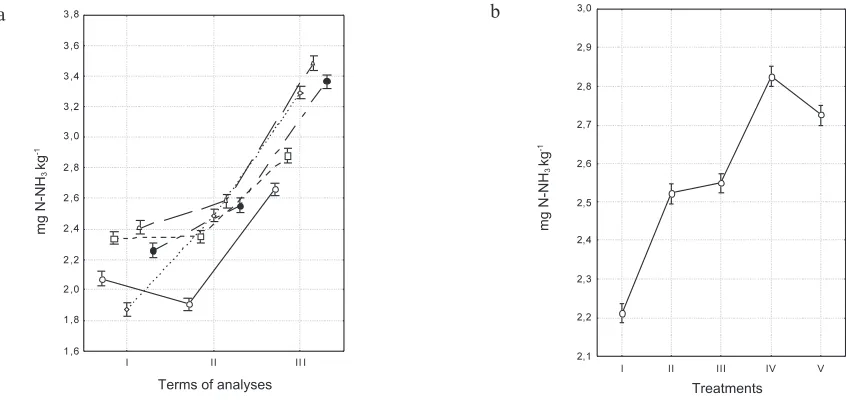
Data presented in Fig. 6a indicate that the highest intensity of the nitrification process was observed in soil under winter wheat line STH3 (treatment 4) in all plants development stages. Analysis of the mean values for the process confirmed that treatment 4 was characterized by the highest intensity of nitrification.
Fig. 5.Intensity (a) and analysis of mean values (b) of the process of ammonification. Explanations as in Fig. 1.
Fig. 6.Intensity (a) and analysis of mean values (b) of the process of nitrification. Explanations as in Fig. 1.
mg
N-NH
4
kg
-1
mg
N-NH
4
kg
-1
mg
N-NH
3
kg
-1
mg
N-NH
3
kg
-1
Terms of analyses
Terms of analyses Treatments
Treatments
a b
The obtained results for nitrification clearly indicated higher intensity of the process in soil under cultivated lines of winter wheat as compared to the control soil under common winter wheat cv. Tonacja (treatment 1) in all plants development stages.
CONCLUSIONS
1.The changes of the number of proteolytic bacteria and fungi number in Luvisol depended on both the wheat plants development stage and cultivated line of winter wheat.
2. The activity of protease and urease as well as the in-tensity of ammonification and nitrification processes dis-played a highe seasonal variability.
3. The highest protease activity was noted in soil under winter wheat lines STH716, STH3 and STH715 (treatments 2, 4, 5), and urease activity under the line STH715 (treat-ment 5).
4. No interference with the transformation of mineral nitrogen in the soil was observed. It was no significant in-fluence of winter wheat cultivars observed on transfor-mation processes of mineral nitrogen in experimental treatments.
REFERENCES
Acosta-Martínez V., Cruz L., Sotomayor-Ramírez D. and Pérez-Alegría L., 2007.Enzyme activities as affected by soil pro-perties and land use in a tropical watershed. Appl. Soil Ecol., 35, 35-45.
Alef K. and Nannipieri P., 1995.Protease activity. In: Methods in
Applied Soil Microbiology and Biochemistry (Eds K. Alef and P. Nannipieri). Academic Press, London, UK.
Alkorta I., Aizpurua A., Riga P., Albizu I., Amezaga I., and
Gar-bisu C., 2003.Soil enzyme activities as biological indicators
of soil health. Rev. Environ. Health, 18, 65-73.
Böhme L. and Böhme F., 2006.Soil microbiological and
bioche-mical properties affected by plant growth and different long-term fertilization. Eur. J. Soil Biol., 42, 1-12.
Colombo C., Palumbo G., Sannino F., and Gianfreda L., 2002.
Chemical and biochemical indicators of managed agricul-tural soils. 17th World Congress of Soil Science, Bangkok, Thailand.
Emmerling C., Schloter M., Hartmann A., and Kandeler E.,
2002.Functional diversity of soil organisms – a review of
recent research activities in Germany. J. Plant Nutr. Soil Sci., 165, 408-420.
Fr¹c M. and Jezierska-Tys S., 2008. Changes in microbiological
activity of a brown soil under winter wheat culture in various years of effect of dairy sewage sludge (in Polish). Annales UMCS, E, 63, 118-132.
Gajda A., 2010.Microbial activity and particulate organic matter
content in soils with different tillage system use. Int. Agro-phys., 24, 129-137.
Gianfreda L. and Ruggiero P., 2006.Enzyme Activities in Soil.
In: Nucleic Acids and Proteins in Soil (Eds P. Nannipieri, K. Smalla). Springer, Berlin, Germany.
Janvier C., Villeneuve F., Alabouvette C., Edel-Hermann V.,
Mateille T., and Steinberg C., 2007.Soil health through
soil disease suppression: Which strategy from descriptors to indicators? Soil Biol. Biochem., 39, 1-23.
Ladd J.N. and Butler J.H.A., 1972. Short-term assays of soil
pro-teolytic enzyme activities using proteins and dipeptide deri-vatives as substrates. Soil Biol. Biochem., 4, 19-30.
Nannipieri P.,Ascher J., Ceccherini M.T., Landi L.,
Pietra-mellara G., and Renella G., 2003.Microbial diversity and
soil functions. European J. Soil Sci., 54, 655-670.
Nowosielski O., 1981.Methods for the determination of
fertilisa-tion requirements (in Polish). PWRiL Press, Warsaw, Poland. Polish Standard, PN-ISO 14238, 2000. Soil quality. Biological
methods. Assaying of nitrogen mineralisation and nitrifi-cation in soils and of the effect of chemical compounds on the processes (in Polish). Warsaw, Poland.
Quilchano C. and Maranon T., 2002.Dehydrogenase activity in
Mediterranean forest soils. Biol. Fert. Soils, 35, 102-107.
Rodina A., 1968.Microbiological methods of water analysis (in
Polish). PWRiL Press, Warsaw, Poland.
Shi W., Miller B.E., Stark J.M., and Norton J.M., 2004.
Micro-bial nitrogen transformations in response to treated dairy waste in agricultural soils. Soil Soc. Am. J., 68, 1867-1874.
Simon J., 2002. Enzymology and bioenergetics of respiratory
nitrite ammonification. FEMS Microbiol., 26, 285-309.
Singh Brajesh K., Millard P., Whiteley A.S., and Murrell C.J.,
2004. Unravelling rhizosphere-microbial interactions:
op-portunities and limitations. TRENDS in Microbiol., 12(8), 386-393.
Sorensen P., 2001.Short-term nitrogen transformations in soil
amen-ded with animal manure. Soil Biol. Biochem., 33, 1211-1216.
Stottmeister U., Wießner A., Kuschk P., Kappelmeyer U., Kästner M., Bederski O., Müller R.A., and Moormann H.,
2003.Effects of plants and microorganisms in constructed
wetlands for wastewater treatment. Biotechnol. Advances, 22, 93-117.
Trásar-Cepeda C., Leiros M.C., and Gil-Sotres F., 2000.
Biochemical properties of acid soils under climax vegetation (Atlantic oakwood) in an area of the European temperate-humid zone (Galicia, NW Spain): specific parameters. Soil Biol. Biochem., 32, 747-755.
Yang L., Li T., Li F., Lemcoff J.H., and Cohen S., 2008.
Fertili-zation regulates soil enzymatic activity and fertility dyna-mics in cucumber field. Scientia Hort., 116, 21-26.
Zantua M.J. and Bremner J.M., 1975. Comparison of methods