International Journal of Engineering
J o u r n a l H o m e p a g e : w w w . i j e . i rEstimating Reliability in Mobile ad-hoc Networks Based on Monte Carlo Simulation
A. Pouyan*, M. YadollahzadehTabariSchool of Computer Engineering, Shahrood University of Technology, Shahrood, Iran
P A P E R I N F O
Paper history: Received 06 August 2013
Received in revised form 17 November 2013 Accepted 21 January 2014
Keywords:
Mobile ad-hoc Networks Reliability
Probability
Monte Carlo Simulation
A B S T R A C T
Each system has its own definition of reliability. Reliability in mobile ad-hoc networks (MANET) could be interpreted as, the probability of reaching a message from a source node to destination, successfully. The variability and volatility of the MANET configuration makes typical reliability methods (e.g. reliability block diagram) inappropriate. It is for the reason that no single structure or configuration represents all manifestations of a MANET. Thus, new methods should be developed to analyze the reliability of this new networking technology. In this paper, we first introduce a simple technique for calculating reliability in MANET which is appropriate for small size of the networks. It is shown that this way is time consuming and costly in a larger network domain. Then, a heuristic method based on a Monte Carlo simulation is presented, which has less overall time consuming even for large size of the network. For a better investigation, the effect of network size (number of nodes) and probability of link existence have been studied and evaluated on network reliability for the proposed method.
doi:10.5829/idosi.ije.2014.27.05b.09
1. INTRODUCTION1
Mobile ad-hoc network (MANET) is a dynamic and scalable type of network, which is free from constraints of infrastructure. There is no need to prepare an area with telephone or cellular towers before networking is enabled and there is no fixed coverage area which the mobile nodes must stay within. The ability to actively recreate a cohesive network configuration; while maintaining complete mobility provides the MANET advantage over other network schemes are limited based on function and infrastructure [1-4].
Currently, MANET is mostly employed in safety critical operations which depend on the reliable operation of the network. However, its descriptions are
synonymous for undefined and unpredictable
occurrence when considering the impacts to the reliability of the system [5, 6]. The mobility of the nodes along with the three roles which they may take (i.e. source, destination, intermediary) requires a modified approach that accommodates a dynamic network configuration. It is the unique characteristics of
*Corresponding Author Email: [email protected] (A.
Pouyan)
the MANET which make traditional network reliability methods inadequate [7].
In general, existing methods begin by identifying the links existed within the network to determine all possible paths between a source and a destination node. These methods are only applicable when the configuration of the MANET could be determined and is not also inclined to change over time. This assumption goes against the nature of a MANET. A new network configuration is formed with each link creation and termination. Further, these changes cannot be predicted or controlled deterministically. They can only be represented probabilistically. In order to capture the flexibility of a MANET in a reliability model, the mobility of each node must be accounted by describing the network configuration probabilistically (i.e. each link, and each network configuration has a probability of existence) [7-9].
The most famous key measure for determining reliability in MANET is two-terminal reliability (2TR), which is the probability of a communication path between a source and destination within the network. While assessing this measure in traditional wired networks has been extensively studied [10-12], doing such in a wireless network is especially challenging due
to the special properties of wireless devices, including limited power supplies, limited transmission range, and the ability of nodes to change their locations.
Chen and Lyu [13] extend the traditional reliability analysis from wired networks to wireless networks with imperfect components resembled by Common Object Request Broker Architectures (CORBA). They illustrated the process of handoff in a mobile cellular phone’s linkage from one cell tower to another, using Markov models. However, this method is not directly applicable in MANET, because, it does not model the mobility of the nodes. Recently most of the works around the reliability estimating in MANET have been done by ‘Cook&Ramirez-Marquez’[5-8] and another authors research indeed, inspired from these authors work. In [6] they assumed that the probability of link existence is constant in steady state. Then, they take a decomposition approach to computing reliability within a MANET which examines all possible node configurations for a smaller size of network. They also propose a Monte Carlo simulation to achieve the reliability measure for a full and large network.
The authors address the reliability analysis of a cluster-based MANET [5]. In this study, they assumed that in a cluster-based network we have a combination of cluster and back-bone network. They also assumed that this network reliability would be composition of reliability in sub-networks across form source node to destination. In addition, they show that probability of link existence in a subnet (λs) would be an approximation of division of nodes’ transmission range versus the coverage area of mobile subnet S.
In their another article [8], they analyzed parameters, affecting the reliability of an ad-hoc network and their relationships like nodes’ speed, network coverage, transmission range and network size. Furthermore, [14] mentioned that their purpose is to extend the work which had been done in [7]. Authors in this study exhibits central tendency. The two-terminal reliability of the MANET is also investigated as a function of the source node location. Morevere, analytical expressions for one and two hop connectivity are developed as well as an efficient simulation methodology for two-terminal reliability. A study is then performed to assess the effect of nodal density and network topology on network reliability.
In this study first, we plan to propose a Basic Way for estimating reliability in MANET based on enumeration method which is not commodious in Time Complexity term and then, a Monte Carlo based way which is stochastic in nature.
The reminder of paper would be as follow: in section 2 which is the main part of this paper both basic and Monte Carlo based way will be described with their details technical consideration. Related simulation result is expressed in section 3. Finally, we have brief conclusion in section 4.
2. RELIABILITY ESTIMATION
As we mentioned, reliability in MANET could be interpreted as a probability of reaching a message from source node to destination. This definition addresses the 2TR context, exactly. In MANET, the packet transmission process is probabilistic in nature and a structure of a network would be reliable if its nodes are reliable and we have a confidence level for probability of link existence. By this definition, network reliability would be a function of node’s reliability and probability of link existence between each pairs of nodes within the route between source and destination. We nominate the two-terminal reliability of network G as 2TR(G),which is expressed as Equation (1). λ and R symbolize the probability of link existence between nodes and reliability of each node, respectively.
n i i i
R f G
TR( ) ( , ) 1..
2 = l = (1)
We consider these assumptions for estimating reliability in MANET.
1. The location of the source node is known within the network topology.
2. The location of the destination and intermediate nodes are random.
3. Source and destination nodes are reliable in the case of sending and receiving data.
4. Nodes may connect if they are within the nominal transmission range, R of one another, which implies the route discovery and route maintenance are perfect and instantaneous. Likewise, nodes will not connect if be outside this range.
5. All nodes will be assumed to be the same type. 6. The capacity of every link is binary and
homogeneous.
7. The nominal capacity of all links is greater than or equal to the demand placed upon them by a node.
2. 1. Basic Way In this section, the Basic Way for
estimating network reliability will be explained. It is shown that, this way is appropriate only for the small size of network.
Suppose a connected network represented by G=(N,E), where N is the number of mobile nodes and E points to the links between each pair of nodes. Based on the previous discussion, for determining MANET reliability, the reliability of each node and the probability of link existence between each pair of nodes should be captured. The reliability associated with each node in network represented by Ri, where i=1…n and n=|N|.
of link existence between each other. For a given network, in each configuration, there may exist multiple routes between source and destination, in which all of its intermediate nodes are operational. Suppose m
operational intermediate nodes exist within the routei.
The probability of working an intermediate link is given by Equation (2).
1 . ) 1
(route i == = Rm m
-P l (2)
Then, if we have k operational route from source to destination, the nominal two-terminal reliability for a specific configuration of network would be as Equation (3).
å
= === k
i
i
route P c
TR
1
) 1 (
) (
2 (3)
This equation calculates, only the nominal reliability for a specific configuration of the network c. if C
configuration exist for anetwork (based on the nodes’ operational status), c=1…..C we should average from the reliability value of all available configurations. Then, the final 2TR can be expressed mathematically as Equation (4).
C route P TR
C c
k i
i
å å
= =
== = 1 1
) 1 (
2 (4)
2. 2. Steps and Implementation of Basic Way
For summarizing what is happened in our presented Basic Way, the steps done for this method are listed as below.
Step1:Considering all possible configurations based on intermediate nodes’ operational status.
Step2: Calculating probability of link existence between source and destination based on Equation (2). Step3:Computing nominal reliability value for each
configuration using Equation (3).
Step4:Applying Equation (4) for calculating final two-terminal reliability value.
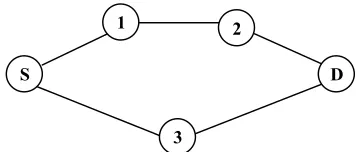
For a better illustration of Basic Way, suppose a network as Figure 1. As demonstrated in this figure, there exists three intermediate nodes form source to destination. For a network with three intermediate nodes, we should spot 8 different configurations and their related reliability. The reliability value for each configuration and the overal reliability value presented in Table 1. Suppose λ and R to be 0.7 and 0.9, respectively.
In Basic Way, the overall reliability time complexity would be O(2n) which has an exponential relationship with the number of nodes. It seems to be a considerable problem. This case seems to be more problematic for a larger network. For a better clarification of this problem, we listed time complexity associated with different network size in Table 2.
Usually, in most experimental MANET scenarios at least, 30-50 nodes exist. For those cases, computing reliability using the Basic Way seems to be impossible.
2. 2. Monte Carlo Simulation for Computing
Reliability One of the main problems in presented
Basic Way is the enumeration of all operational and non-operational routes and links. Certainly, this problem causes to an exponential increase in the time complexity. As we have seen, Basic Way can be used for a specific type of network. However, in reality, what we have needed is determining total reliability of a network with some generic information like number of nodes, nodes transmission range, area dimension.
Figure 1. A sample network with three intermediate nodes from source to destination
TABLE 1. 2TR for a network shown in Figure 1
C Node 1 Node 2 Node 3 2TR (C)
1 1 1 1 l3R2 +l2R 0.74
2 1 1 0 l3R2 0.30
3 1 0 1 l2R 0.44
4 1 0 0 - 0
5 0 1 1 l2R 0.44
6 0 1 0 - 0
7 0 0 1 l2R 0.44
8 0 0 0 - 0
2TR=0.3
TABLE 2. Time complexity of calculating 2TR for various numbers of intermediate nodes based on Basic Way
#of Intermediate Nodes Time Complexity
3
O(8)
5 O(32)
8 O(64)
10 O(1000)
15 O(32700)
D S
1
2
As in MANET, network configuration changes time by time, specifying reliability for a specific configuration of network would be meaning-less. In this case, we should have a stochastic vision for each node. Monte Carlo methods are used in stochastic problems by simulating the various sources of uncertainty affecting the output value, and then determining their average value over the range of resultant outcomes [15, 16]. This is usually done by the help of stochastic asset models. Totally, a Monte Carlo simulation algorithm encompasses following steps:
1. Defining domain of possible inputs.
2. Generating inputs, randomly from a probability distribution over the domain.
3. Performing a deterministic computation on inputs. 4. Aggregating the results.
First, we should approximate one of the main stochastic parameter in our problem which is probability of link existence, λ. In a mobile network, there is a direct relation between the nodes’ transmission range and probability of link existence. It means that the more transmission range nodes have the more probability of link existence between them. In addition, if we spot a fixed transmission range for nodes in a wider network with grater coverage area, probability of link existence will decrease. By these explanations, λ could be estimated using Equation (5); where Ri demonstrates
transmission range of each node and ai is one
dimension of coverage area. This equation indicate that by increasing in transmission range of each node versus coverage area, the probability of link existence converge to 1 which is its largest value.
i i
a R =
l (5)
Defining an equation for approximating nodes reliability (Ri) seems to be impossible, as it relates to too
many parameters which have less relation to each other. Battery power consumption, risk of intrusion, nodes’ speed, the navigation system of each node and etc are the examples of which affect a node’s reliability. So, we define a predefined value for it in implementation phase.
For this section, in Monte Carlo simulation we run a random process, T times. The final result would be an approximation of real enumeration result using averaging process.Suppose Opr(n) as a vector of size n. Opr(i)=1 if nodei be operational and equal to zero it would be a non-operational one. This vector is generated randomly in each of Monte Carlo simulation run. The value 0.9 supposed for all nodes’ reliability
and Opr(i)=1 if generated random value be lower than
that.
An n×n matrix nominated as Link determines link status between each pair of nodes. It is obvious that for existence a link between each pair of nodes, both of them should be operational. We generate this vector randomly in each run of our Monte Carlo simulation considering below rule.
if (opr(i)=1&opr(j)=1) &( a random number <=λ) then
Link(i,j)=Link(j,i)=1
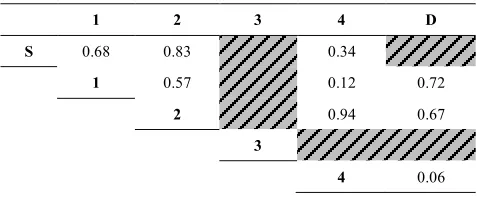
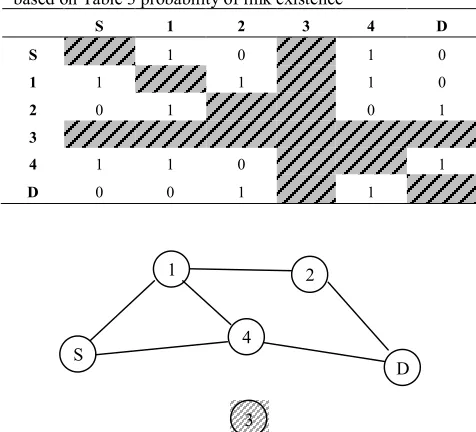
For a better clarifying of this process, we present a simple example here. For a network with six mobile nodes, first the vector Opr(6) would be generated which is shown in Table 3. The random value between 0.9 and 1 supposed for an un-reliable nodes. As can be seen only node3 is in unreliable status. In addition, there could be a link or not between each pair of reliable nodes. As is shown in Table 4, for each pair of nodes a random number between 0 to 1 has been generated. By assuming the threshold value 0.7 for probability of link
existence, the Link matrix would be like Table 5. Morevere, the network structure equivalent to Table 4
link matrix illustrated in Figure 2. As the probability of reliability associated to node 3 in Opr vector is 0.94, this node marked as an unreliable node and consequently it doesn’t participate in the process of matrix Link generation. It is shown with gray hachure cells.
After generation of matrix Link, for determining route existence between source and destination nodes, the well-known breadth first search (BFS) algorithm has been used. For simplicity, suppose node1 is the source
node and noden as destination.
TABLE 3. Sample generated Opr vector for a network with six nodes
Node S 1 2 3 4 D
Generated
Probability 0.5 0.7 0.33 0.94 0.88 0.34
Status * R R U R *
* Suppose to be reliable
TABLE 4. Sample generated probability of link existence for a six nodes’ network
1 2 3 4 D
S 0.68 0.83 0.34
1 0.57 0.12 0.72
2 0.94 0.67
3
TABLE 5. Produced Link matrix for a six nodes’ network based on Table 3 probability of link existence
S 1 2 3 4 D
S 1 0 1 0
1 1 1 1 0
2 0 1 0 1
3
4 1 1 0 1
D 0 0 1 1
Figure 2. Network structure based on Link matrix presented in Table 5
In each run of T if node1 be in non-operational
status, its entire associated vector in row and column is equalled to zero and then node2 ,node3 and etc supposed
to be the source node, respectively. This case could occur for the destination node (noden) too. In
non-operational case of noden, we can suppose noden-1 or noden-2 and etc as destination. In each run of T for BFS(Linkt) if visited(destination)==true it means that
we have a route from source to destination. In this case,
route(t)=1 else route(t)=0. After T times running of this scenario, the approximated reliability would be an average values of available routes which is expressed as Equation (6). We will investigate on the value of parameter T in simulation section.
T t route TR
T
t
å
= = 1
) (
2 (6)
The summarized steps of Monte Carlo simulation for estimating reliability would be like bellow:
Step1: Determining λ based on Equation (5) and Ri.
Step2: Generating Opr(n) based on Ri, randomly.
Step3: Generating matrix Link based on Opr vector and
λ.
Step4: Running BFS(Link) for calculating route(t). Step4: Running step(2-4) T times and average from the
result.
3. SIMULATION RESULTS
For this section, we evaluate the Monte Carlo way compared with Basic Way along the metrics of time
complexity and accuracy. Only for Monte Carlo way, we have spotted the impact of λ value, network size (number of nodes) and the value of T on reliability. For experiences related to Tables 6 and 7 and Figure 3 we suppose T has the value of 1000.
Tables 6 and 7 show the result of basic and Monte Carlo based way for the final 2TR and time complexity value, respectively. Note that, here, λ and R assumed to have the values 0.7 and 0.9, respectively and coverage area is constant in all cases. In addition, in Basic Way, each experimented network with each number of nodes is fully connected.
Table 6 indicate that the result of Monte Carlo based way would be a good approximation of Basic Way. In each network size ( #number of nodes ), the earned value for both exprimented way differ negligibley. As computing reliability for a network in Basic Way is a time consuming process (exponential along with number of nodes), we only continue the process to network with 7 nodes.
Table 7 shows that time complexity in Monte Carlo based way is much lower than the Basic Way for larger networks. The related value increases exponentially for the Basic Way which makes it unpractical even for the network with moderate size. This value has a steady and negligible rise in Monte Carlo simulation.
Figure 3 shows the impact of network size and probability of link existence (λ) on reliability. As illustrated in this figure, network with more probability of link existence would be more reliable and the maximum reliability which we achieved, is a bit lower than each node’s nominal reliability. Another important point from this figure is that, by increasing in the number of nodes in a fixed area, we have some type of convergence and because of increasing in probability of nodes neighboring, the same value of 2TR obtained for two different value of λ. This would be a direct cause of this fact that, in a denser network, probability of existence an operational node, neighboring to each nominal node would be more. In this case, probability of link existence has a lower impact on the overall reliability.
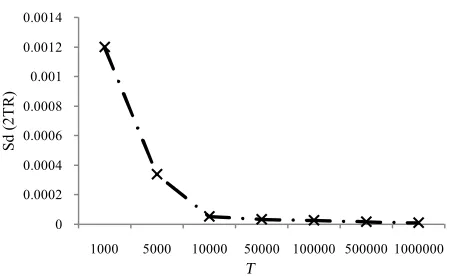
As, Monte Carlo is a stochastic process in nature, it is necessary to obtain its uncertainly in a simulation. The standard deviation associated to 2TR, estimated using Equation (7).
T TR TR
TR
) 2 1 ( 2
2
-=
s (7)
We expect that in larger values of T, mirror value of standard deviation obtained and this value would be more reliable with fewer fluctuations. Figure 4 shows the value of σ2TR for various amount of T. We have much lower and steady value of standard deviation while executing Monte Carlo simulation in greater value of T.
D S
1 2
4
TABLE 6. 2TR value for both basic and Monte Carlo based way
# Node Basic Way Monte Carlo Based Way
3 0.657 0.66
4 0.689 0.694
5 0.74 0.725
6 0.786 0.792
7 0.809 0.811
TABLE 7. Time complexity for both basic and Monte Carlo based way
# Node Basic Way Monte Carlo Based Way
3 8 12
10 1000 22
15 32,768 25
20 104,850 33
25 33,554,432 35
30 1,073,700,000 41
Figure 3. 2TR value for two different value of λ along network size
Figure 4. Standard deviation for different value of simulation iteration (T)
4. CONCLUSION
In this paper, we emphasised on estimating reliability in MANET. Managing reliability in this type of network is a cumbersome case because of the time by time and random movement of the nodes during network operation. Investigation shows that two major parameters affect the reliability in this type of network, probability of link existence (λ) and nodes reliability. Based on these facts, we introduced a fundamental method for computing network reliability by enumerating all possible configurations among nodes, considering their operational status. It seems that this method would be accurate, with an exponential time complexity. This makes this approach to be problematic for estimating reliability in larger networks. Consequently, we presented a Monte Carlo based method for estimating reliability in MANET. In each run of the proposed approach, only links between nodes, which both of them are operational, would be captured. Then, we perform BFS algorithm for specifying existence of route from source to destination. Results show that Monte Carlo based method leads to a good approximation of basic method with much lower time complexity.
5. REFERENCES
1. Ahmadi Livani, M., Alikhany, M. and Yadollahzadeh Tabari,
M., "Outlier Detection in Wireless Sensor Networks Using
Distributed Principal Component Analysis", Journal of AI and
Data MiningJournal of AI and Data Mining, Vol. 1, No. 1, (2013), 1-11.
2. Taghizadeh, S. and Mohammadi, S., "Lebrp-A Lightweight And
Energy Balancing Routing Protocol For Energy-Constrained
Wireless Ad-hoc Networks", International Journal of
Engineering-Transactions A: Basics, Vol. 27, No. 1, (2013), 33.
3. Tabari, M. Y., Hassanpour, H., Pouyan, A. and Saleki, S.,
"Proposing a light weight semi-distributed IDS for mobile ad-hoc network based on nodes' mode", in Telecommunications (IST), Sixth International Symposium on, IEEE. (2012), 948-953.
4. Hosseinirad, S., Alimohammadi, M., Basu, S. and Pouyan, A.,
"LEACH Routing Algorithm Optimization through Imperialist
Approach", International Journal of
Engineering-Transactions A: Basics, Vol. 27, No. 1, (2013), 39.
5. Cook, J. L. and Ramirez-Marquez, J. E., "Reliability analysis of
cluster-based ad-hoc networks", Reliability Engineering &
System Safety, Vol. 93, No. 10, (2008), 1512-1522.
6. Cook, J. L., "Reliability Of Mobile Ad-Hoc Wireless Networks",
Faculty of Stevens Institute of Technology in partial fulfilment of the requirements, Doctor of Philosophy, (2008),
7. Cook, J. L. and Ramirez-Marquez, J. E., "Two-terminal
reliability analyses for a mobile ad-hoc wireless network",
Reliability Engineering & System Safety, Vol. 92, No. 6, (2007), 821-829.
8. Cook, J. L. and Ramirez-Marquez, J. E., "Mobility and
reliability modeling for a mobile ad-hoc network", IIE
Transactions, Vol. 41, No. 1, (2008), 23-31.
0.3 0.4 0.5 0.6 0.7 0.8 0.9
5 10 15 20 25 30
2
TR
Network size (number of nodes)
λ=0.7
λ=0.4
0 0.0002 0.0004 0.0006 0.0008 0.001 0.0012 0.0014
1000 5000 10000 50000 100000 500000 1000000
Sd
(
2T
R)
9. Bhardwaj, D., Jain, S. and Singh, M. P., "Estimation Of Network Reliability For A Fully Connected Network With Unreliable Nodes And Unreliable Edges Using Neuro Optimization",
International Journal of Engineering-Transactions A: Basics, Vol. 22, No. 4, (2009), 317.
10. Fratta, L. and Montanari, U., "A Boolean algebra method for computing the terminal reliability in a communication network",
Circuit Theory, IEEE Transactions on, Vol. 20, No. 3, (1973), 203-211.
11. Fratta, L. and Montanari, U., "A recursive method based on case analysis for computing network terminal reliability",
Communications, IEEE Transactions on, Vol. 26, No. 8, (1978), 1166-1177.
12. Torrieri, D., "Calculation of node-pair reliability in large
networks with unreliable nodes", Reliability, IEEE
Transactions on, Vol. 43, No. 3, (1994), 375-377, 382.
13. Chen, X. and Lyu, M. R., "Reliability analysis for various
communication schemes in wireless CORBA", Reliability,
IEEE Transactions on, Vol. 54, No. 2, (2005), 232-242. 14. Chen, B., Phillips, A. and Matis, T. I., "Two-terminal reliability
of a mobile ad-hoc network under the asymptotic spatial
distribution of the random waypoint model", Reliability
Engineering & System Safety, Vol. 106, No., (2012), 72-79. 15. Boyle, P., Broadie, M. and Glasserman, P., "Monte Carlo
methods for security pricing", Journal of economic dynamics
and control, Vol. 21, No. 8, (1997), 1267-1321.
16. Rubinstein, R. Y., Samorodnitsky, G. and Shaked, M., "Antithetic variates, multivariate dependence and simulation of
stochastic systems", Management science, Vol. 31, No. 1,
(1985), 66-77.
Estimating Reliability in Mobile ad-hoc Networks Based on Monte
Carlo Simulation
TECHNICAL NOTE
A. Pouyan, M. YadollahzadehTabari
School of Computer Engineering, Shahrood University of Technology, Shahrood, Iran
P A P E R I N F O
Paper history: Received 06 August 2013
Received in revised form 17 November 2013 Accepted 21 January 2014
Keywords:
Mobile ad-hoc Networks Reliability
Probability
Monte Carlo Simulation
هﺪﯿﮑﭼ
ﺪﺷﺎﺑﯽﻣدﺎﻤﺘﻋاﺖﯿﻠﺑﺎﻗزادﻮﺧصﺎﺧﻒﯾﺮﻌﺗيارادﯽﻤﺘﺴﯿﺳﺮﻫ
.
،رﺎﯿﺳهﮋﯾويﺎﻫﻪﮑﺒﺷردﻪﻟﺄﺴﻣﻦﯾا ترﻮﺼﺑ
ﯽﻟﺎﻤﺘﺣا زا
دﻮﺷﯽﻣﺮﯿﺴﻔﺗﺪﺼﻘﻣردأﺪﺒﻣزاﯽﻟﺎﺳراﻪﺘﺴﺑﺰﯿﻣآﺖﯿﻘﻓﻮﻣﺖﻓﺎﯾرد
.
ﺳارﺎﯿﺳهﮋﯾويﺎﻫﻪﮑﺒﺷرﺎﺘﺧﺎﺳردﺮﯿﯿﻐﺗوعﻮﻨﺗ ﺘ
زاهدﺎﻔ
شور دزﺎﺳﯽﻣﺐﺳﺎﻨﻣﺎﻧﺎﻫﻪﮑﺒﺷﻦﯾارداردﺎﻤﺘﻋاﺖﯿﻠﺑﺎﻗﻪﺒﺳﺎﺤﻣﺺﺧﺎﺷيﺎﻫ
.
ﺐﯿﮐﺮﺗورﺎﺘﺧﺎﺳﭻﯿﻫﺰﯿﻧﺖﻠﻋﻦﯿﻤﻫﻪﺑ
دراﺪﻧاررﺎﯿﺳهﮋﯾوﻪﮑﺒﺷﮏﯾيﺎﻫﻪﺒﻨﺟمﺎﻤﺗﺶﯾﺎﻤﻧﯽﯾﺎﻧاﻮﺗﯽﺼﺨﺸﻣ
.
ﻪﻌﺳﻮﺗﻪﺠﯿﺘﻧرد شور
وﻪﺒﺳﺎﺤﻣﺖﻬﺟﺪﯾﺪﺟيﺎﻫ
ﺪﺷﺎﺑﯽﻣمزﻻﺎﻫﻪﮑﺒﺷﻦﯾارددﺎﻤﺘﻋاﺖﯿﻠﺑﺎﻓﻞﯿﻠﺤﺗ
.
ﻪﺋارادﺎﻤﺘﻋاﺖﯿﻠﺑﺎﻗﻪﺒﺳﺎﺤﻣﺖﻬﺟهدﺎﺳدﺮﺒﻫارﮏﯾاﺪﺘﺑاﺎﻣﻪﻟﺎﻘﻣﻦﯾارد
ﺪﺷﺎﺑﯽﻣﮏﭼﻮﮐهزاﺪﻧاﺎﺑﯽﯾﺎﻫﻪﮑﺒﺷياﺮﺑﺐﺳﺎﻨﻣﺎﻬﻨﺗﻪﮐدادﻢﯿﻫاﻮﺧ
.
ﻪﺒﺳﺎﺤﻣهﻮﯿﺷﻦﯾاﻪﮐدﻮﺷﯽﻣهدادنﺎﺸﻧﺶﻫوﮋﭘﻦﯾارد
ﺮﭘوﺮﺑنﺎﻣزرﺎﯿﺴﺑگرﺰﺑسﺎﯿﻘﻣﺎﺑيﺎﻫﻪﮑﺒﺷردهدﺎﻔﺘﺳاترﻮﺻرددﺎﻤﺘﻋاﺖﯿﻠﺑﺎﻗ ﺖﺳاﻪﻨﯾﺰﻫ
.
ﺪﻨﻤﺷﻮﻫدﺮﺒﻫارﮏﯾ،ﺲﭙﺳ
ﯽﻣگرﺰﺑﺰﯾﺎﺳﺎﺑﯽﯾﺎﻫﻪﮑﺒﺷردﯽﺘﺣﺮﺘﻤﮐﺐﺗاﺮﻣﻪﺑﯽﻧﺎﻣزرﺎﺑﺮﺳيارادﻪﮐدﻮﺷﯽﻣﻪﺋاراﻮﻟرﺎﮐﺖﻧﻮﻣيزﺎﺳﻪﯿﺒﺷسﺎﺳاﺮﺑ ﺪﺷﺎﺑ
.
ﻪﮑﺒﺷﺰﯾﺎﺳيﺎﻫﯽﮔﮋﯾوﺮﯿﺛﺄﺗ،ﺮﺘﺸﯿﺑﯽﺳرﺮﺑﺖﻬﺟ،ﻦﯿﻨﭽﻤﻫ
)
دﻮﺟﻮﻣيﺎﻫدﻮﻧداﺪﻌﺗ
(
ردﺎﻫدﻮﻧﻦﯿﺑلﺎﺼﺗادﻮﺟولﺎﻤﺘﺣاو
ﺰﯿﻣ دﻮﺷﯽﻣﻪﻌﻟﺎﻄﻣوﯽﺳرﺮﺑهﺪﺷﻪﺋارادﺮﺒﻫارسﺎﺳاﺮﺑﻪﮑﺒﺷدﺎﻤﺘﻋاﺖﯿﻠﺑﺎﻗنا
.
doi:10.5829/idosi.ije.2014.27.05b.09