• No results found

A Novel Design of Reversible Multiplier Circuit (TECHNICAL NOTE)

N/A
N/A
Protected

Academic year: 2020

Share "A Novel Design of Reversible Multiplier Circuit (TECHNICAL NOTE)"

Copied!
10
0
0

Loading.... (view fulltext now)

Full text

(1)

International Journal of Engineering

J o u r n a l H o m e p a g e : w w w . i j e . i r

A Novel Design of Reversible Multiplier Circuit

P. Moallem*a, M. Ehsanpourb

a Department of Electrical Engineering, University of Isfahan, Isfahan, Iran.

b Department of Computer, Falavarjan Branch, Islamic Azad University, Falavarjan, Isfahan, Iran

P A P E R I N F O

Paper history: Received 22 June 2012

Received in revised form 5 January 2013 Accepted 24 January 2013

Keywords:

Reversible Circuit Reversible Multiplier Reversible Gate Quantum Parameters

A B S T R A C T

Adders and multipliers are two main parts of arithmetic units of computer hardware and play important role in reversible computations. This paper introduces a novel reversible 4×4 multiplier circuit that is based on an advanced “Partial Product Generation Circuits” (PPGC) with Peres gates only without duplicating gates. Again, an optimized Peres full adder reversible gate is used in “Reversible Parallel Adder” (RPA) part with accompaniment with the carry save adder technique. Comparison of the proposed design with previous ones shows that the proposed reversible multiplier improves the quantum parameters. The proposed design shows lower quantum cost and depth with the help of a novel design in PPGC. The circuit cost of the proposed design is a little higher than the best compared design, but the proposed design shows the lowest total cost which is defined as sum of quantum cost and circuit cost. Moreover, the number of gates, garbage input and output has no change regarding to the best compared design. The proposed multiplier can be generalized as an n×n bit multiplication.

doi:10.5829/idosi.ije.2013.26.06c.03

NOMENCLATURE

ALU Arithmetic Logic Unit MKG Majid Keivan Gate

CC Circuit Cost NG New Gate

CPA Carry Propagating Adder NoG Number of Gates

CSA Carry Save Adder OV Output Vector

D Depth PA Parallel Adder

DSP Digital Signal Processor PFAG Peres Full Adder Gate

FA Full Adder PG Peres Gate

FG Feynman Gate PPGC Partial Product Generation Circuits

FRG Fredkin Gate QC Quantum Cost

Gin Garbage Input RPA Reversible Parallel Adder

Gout Garbage Outputs TC Total Cost

HA Half Adder TG Toffoli Gate

HNG Haghparast Navi Gate TSG Thapliyal Srinivas Gate

IV Input Vector VLSI Very Large Scale Integrated

1. INTRODUCTION 1

Power dissipation is one of the important parameters in the digital circuit design. A part of this energy loss is due to non-ideality of switches and other technological

*Corresponding Author Email:[email protected] (P. Moallem)

factors. Another part according to Landauer's principle [1] is due to irreversible logic computations that results in the energy dissipation as data loss. Irreversible circuits dissipate KTln2 joules of energy for every bit of information that is lost regardless of their implementation technologies, where K=1.38´10-23

(2)

and T is the absolute temperature at which the computation is performed.

Due to irreversible gates, the power loss is negligible for current logic technologies using adiabatic design. However, it is well known that Moore's law, which states that processing power will double every 18 months, will stop functioning in the years 2010-2020. This particular problem of VLSIdesigning was realized by Feynman and Bennet in 1970s [2].

In 1973, Bennet [3] showed that energy dissipation problem of VLSI circuits can be circumvented by using reversible logics that will not loose energy during internal calculations (However, energy may be lost for input and output operations). Furthermore, the reversible logics will finally need hardware for the implementation. Quantum gates are inherently reversible [4], so that quantum computation can be considered as a basis for reversible logic implementations.

An introduction on reversible logics and corresponding parameters are presented in the Appendix. Reversible circuits for different purposes e.g. HA (Half Adder), FA (Full Adder) [5-7] and multiplier [8-12] have been proposed recently. Among these reversible circuits, multiplier circuits are of special importance because they are widely used in every modern ALU (Arithmetic Logic Unit) of computer system and DSP (Digital Signal Processor). Consequently, optimized multipliers are on demand while designing an arithmetic unit [13].

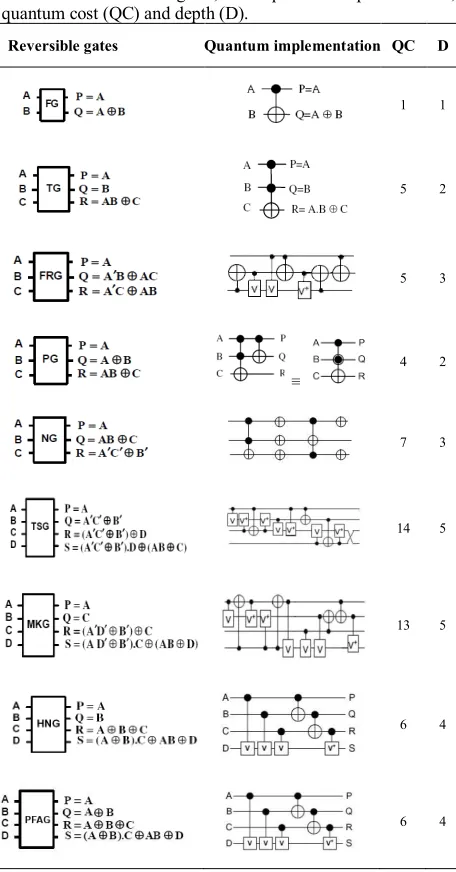
Several reversible logic gates have been proposed in the literature, including 2×2 Feynman gate (FG) [14], 3×3 Toffoli gate (TG) [15], 3×3 Fredkin gate (FRG) [16], 3x3 Peres gate (PG) [17], 3×3 New gate (NG) [18], 4×4 TSG gate [5], 4×4 MKG gate[6], 4×4 HNG gate[7] and 4×4 PFAG gate [11]. Significant aspect of these universal 4×4 reversible gates is that they can work singly as a reversible FA. Table 1 presents these reversible gates including their quantum implementation, cost and depth.

Among these reversible logic gates, several 4´4 reversible gates (e.g. TSG [5], MKG [6], HNG [7] and PFAG [11]) have been used in reversible multiplier designing to construct the FA.

In this paper, a novel reversible 4´4 multiplier is designed which improves the quantum parameters and can be generalized to construct fast reversible n´n bit multipliers. The proposed reversible PPGC (Partial Product Generation Circuits) has minimum quantum cost among all the reversible PPGC designs in reversible multiplier circuits literature.

The related works in reversible multiplier circuit's designs is presented in Section 2. Our proposed reversible multiplier circuit design is described in Section 3. The comparisons and discussion about the results of the proposed design and the previous ones are

described in Sections 4 and 5, and finally Section 6 concludes the paper.

TABLE 1. Reversible gates, their quantum implementation, quantum cost (QC) and depth (D).

Reversible gates Quantum implementation QC D

1 1

5 2

5 3

4 2

7 3

14 5

13 5

6 4

6 4

2. RELATED WORKS

The operation of a 4×4 parallel multiplier is depicted in Figure 1. It can be applied to any other n×n reversible multiplier. The existing parallel multiplier circuits have two important components: The PPGC and multi- operand parallel adder (PA). A parallel multiplier is reversible if its componenets; PPGC and PA both are reversible.

(3)

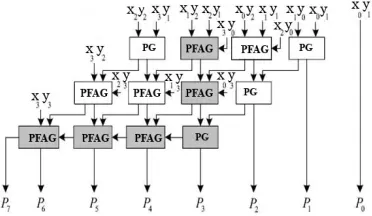
The parallel adder as shown in Figure 2 uses the FAs and HAs to produce final results. Some reversible gates including TSG, MKG, HNG and PFAG can be used as reversible FA.

Different designs of parallel reversible multipliers circuits are described in the literature. In the first design that was introduced in 2005, FRGs were used for designing of PPGC part of this circuit and TGs, NGs were used for RPA (Reversible Parallel Adder) design [8]. Another reversible multiplier circuit that was introduced in 2006 used parallel FRGs as PPGC and TSGs as FAs and HAs in RPA section [9]. Another reversible multiplier circuit which was introduced in 2008 is PPGC design that is base on use of PGs instead of FRGs (see Figure 3) [10]. This circuit uses PGs since it has less logical calculation and less quantum cost in compare to FRGs. The operation of RPA of such circuit can be planned with MKGs as FAs and HAs [10]. Other reversible multiplier circuit that was introduced in 2008 used PG as HA and HNG as FA in RPA section of the circuit which is resulted in more desired circuits than the previous one [7]. Another circuit suggested in 2009 applied PFAG instead of HNG. This yielded in similar results with HNG gate due to its similar quantum implementation [11].

It is worth to be noted that in reversible logics, fan-out of any gate fan-output is not allowed and every fan-output can be used only once. The 2×2 FG with one “0” input can be used as copying circuits to duplicate the fan-out.

Figure 1. Operation of a 4×4 multiplication

Figure 2. 4´4 reversible multiplier circuit in which output of PPGC are input of parallel adder

Figure 3. Reversible PPGC using 16 Peres gates

Figure 4. Reversible PPGC with TGs and PGs

(4)

3. THE PROPOSED MULTIPLIER CIRCUIT

As mentioned before, a reversible 4×4 multiplier circuit has two important parts: PPGC and RPA. The purpose of this paper is the design of reversible multiplier circuits with the aim of improving the quantum parameters without losing its efficiency.

3. 1. PPGC Implementation of the PPGC of the proposed reversible multiplier circuit is based on the PPGC described elsewhere [12]. Since the Peres gate (PG) quantum cost is less than Toffoli gate (TG), therefore we replace TGs with PGs. One sample of replacing TG with PG is shown by the dashed rectangle in Figure 4. Applying PGs instead of TGs (see Figure 5) results in the proposed PPGC which uses only PGs as shown in Figure 6.

This circuit has an intrinsic advantage over others. As it is made up of same gates, it is easy to implement. Again, PGs have less QC than the TGs (see Table 1). Thus, we have found that the proposed PPGC block with lowest QC can be achieved through PGs.

3. 2. RPA Circuit The basic cell in a reversible multiplier is a reversible FA which accepts three bits and one constant input. We use Peres FA gate (PFAG) [11] as a reversible FA that is shown in Figure 7. The PFAG can be implemented by two complex 4×4 reversible Peres gate as shown in Figure 8. Because of its complex functionality, it seems that the PFAG has a large QC of 8. But, implementation of the PFAG in 2009 [19] proved that it has QC of 6 and circuit depth of 4. As a result, its quantum cost is lower than other reversible FAs available in the literature and has the minimum QC reported for FA (see Figure 9). In order to decrease the circuit depth, the CSA (Carry Save Adder) technique can be used in implementing of the RPAs [20] of the proposed multiplier. As shown in Figure 1, in the reversible 4×4 multiplier, four operands must be added to produce the final product. We use the CSA tree to reduce the four operands to two. Thereafter, the CPA (Carry Propagating Adder) adds these two operands and produces the final 8-bit product (see Figure 10). However, this implementation leads the designer to take less depth than prior designs. Finally, we apply the reversible PFAG as a FA and PG as a HA to implement this part as shown in Figure 11. In this figure, the shaded blocks indicate the critical path of this circuit.

(A) (B)

Figure 5. Use of the Peres gate instead of the Toffoli gate. (A) TG, (B) PG

Figure 6. The proposed reversible PPGC with only PGs

Figure 7. Reversible PFAG as a reversible FA

Figure 8. Implementation of PFAG using Peres gates

Figure 9. Quantum implementation of PFAG

Figure 10. Four-operand Addition (Dot notation) [20]

(5)

4. QUANTUM PARAMETERS OF DIFFERENT DESIGNS

Some quantum parameters of the proposed multiplier as well as some other ones [8-12] are calculated in this section. As mentioned before, in reversible logics, fan-out of any gate fan-output is not allowed and every fan-output can be used only once. Therefore, FGs should be used for duplicating each bit of the operands in reversible PPGC [7-11]. It is worth to be noted that PPGC proposed in [12] used 12 FGs for duplicating gates but that design approach did not pay enough consideration to numbers of FGs. Actually, all conclusions of that paper were wrong because of those errors. Another design was suggested in 2010 [21] rebuild PPGC with 16FGs instead of 12 FGs (see Figure 12).

Here we use correct approach [21] and believe that for duplicating fan-out, 16 FGs is necessary which increase the quantum parameters. Since the quantum cost and depth of 2×2 FG is one, the number of gates, circuit cost and number of constant inputs, quantum cost and depth in [7-12] should be added with 16 FG, because of its PPGC part.

4. 1. Number of Gates One of the major constraints in designing a reversible logic circuit is the number of reversible gates. For an arbitrary circuit C with K gates g1,g2,....gk, the number of gates metric is defined as

NoG=k [22] .The NoG of the compared designs are shown in Table 2.

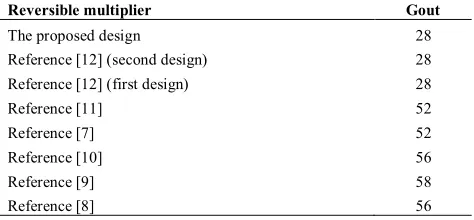
4. 2. Garbage Output Garbage output (Gout) refers to the output of the reversible gate that is not used as a primary output or as input to other gates. The garbage outputs of the compared designs are shown in Table 3.

Figure 12. The proposed reversible PPGC using PGs and FGs [21]

4.3. Quantum Cost and Total Cost Quantum cost (QC) is one of the other main factors in designing a reversible logic circuit. Again, in order to consider the effects of garbage output and number of gate as the accompaniment to quantum cost, the total cost (TC) of a circuit is defined as sum of number of gate, garbage outputs and quantum cost [19]. The quantum costs and total costs of the compared designs are shown in Table 4.

TABLE 2. Comparison of number of gates (NoG) of the proposed circuit with the literature

Reversible multiplier Calculations NoG

The proposed design 16(PG)+8(PFAG)+4(PG) 28 Reference [12]

(second design) (9TG+7PG)+ 8PFAG+4PG 28 Reference [12]

(first design) (9TG+7PG)+8HNG +4PG 28 Reference [11] (16PG+16FG)+8PFAG+4PG 44 Reference [7] (16PG+16FG)+8HNG+4PG 44 Reference [10] (16PG+16FG)+12MKG 44 Reference [9] (16FRG+16FG)+13TSG 45 Reference [8] (16FRG+16FG)+12NG+12TG 56

TABLE 3. Comparison of garbage outputs (Gout) of the proposed circuit with the compared circuits

Reversible multiplier Gout

The proposed design 28

Reference [12] (second design) 28

Reference [12] (first design) 28

Reference [11] 52

Reference [7] 52

Reference [10] 56

Reference [9] 58

Reference [8] 56

TABLE 4. Comparison of quantum costs (QC) and total costs (TC) of the proposed circuit with the literature

Reversible

multiplier Calculations QC TC

The proposed design

(16´4)(for PG)+(8´6) (for

PFAG)+(4´4) 128 184

Reference [12] (second design)

(9´5)(for TG)+(16´1)+(11´4)

(for PG)+(8´8)(for PFAG) 153 209 Reference [12]

(first design)

(9´5)(for TG)+(16´1)+(11´4)

(6)

4. 4. Circuit Depth Depth of circuits (D) is one of the other main factors in designing a reversible logic circuit. The circuit depths of the compared designs are shown in Table 5.

4. 5. Constant Garbage Input Number of constant garbage inputs (Gin) is one of the other main factors in designing a reversible logic circuit. For the compared designs, garbage inputs are shown in Table 6.

4. 6. Circuit Cost One of the factors of hardware complexity of reversible circuits is the number of XOR, AND, NOT logic in the output expressions which are defined as:

a = calculation of a two input XOR gate. b = calculation of a two input AND gate. d = calculation of a NOT gate.

The circuit costs (CC) (sometimes called total logic calculations or complexity) of the compared designs are shown in Table 7.

TABLE 5. Comparison of depths (D) of the proposed circuit with the literature

Reversible

multiplier Calculations D

The proposed design

2(for PG)+(4+4)(for PFAGs) +2(for

PG)+(4+4+4)(for PFAGs) 24 Reference [12]

(second design)

2(for TG and PG) + 2(for PG) + (4´4)

+ (2´4) 28

Reference [12] (first design)

2(for TG and PG) + 2(for PG) + (4´4)

+ (2´4) 28

Reference [11] 2(for FG)+2(for PG)+ 2(for PG)+(2´4)+(4´4)(for PFAG) 30

Reference [7] 2(for FG)+2(for PG)+ 2(for PG) +(2´4)+(4´4)(for HNG) 30

Reference [10] 2(for FG)+2(for PG)+(7´5)

(for MKG) 39

Reference [9] 2(for FG)+5(for FRG) +(7TSG) ´5)(for 42

Reference [8] 2(for FG)+5(for FRG ) +7(3+2)(for TG and NG) 42

TABLE 6. Comparison of garbage inputs (Gin) of the proposed circuit with the literature

Reversible multiplier Gin

The proposed design 28

Reference [12] (second design) 28 Reference [12] (first design) 28

Reference [11] 28+16=44

Reference [7] 28+16=44

Reference [10] 32+16=48

Reference [9] 34+16=50

Reference [8] 31+16=47

TABLE 7. Comparison of circuit cost (CC) of the proposed circuit with the literature

Reversible

multiplier Logic Calculations CC

The proposed design

16×(2a+1b)(for PG)+ 8×(5a+2b)(for PFAG) + 4×(2a+1b)(for PG)

80a+36b

Reference [12] (second design)

9×(1a+1b)(for TG)+ 7×(2a+1b)(for PG)+ 8×(5a+2b)(for PFAG)+ 4×(2a+1b)(for PG)

71a+36b

Reference [12] (first design)

9×(1a+1b)(for TG)+ 7×(2a+1b)(for PG)+ 8×(5a+2b)(for HNG)+ 4×(2a+1b)(for PG)

71a+36b

Reference [11] (80+16)a+36b 96a+36b Reference [7] (80+16)a+36b 96a+36b Reference [10] (92+16)a+52b+36d 108a+52b+36d Reference [9] (110+16)a+103b+71d 126a+103b+71d Reference [8] (80+16)a+100b+68d 96a+100b+68d

5. DISCUSSION

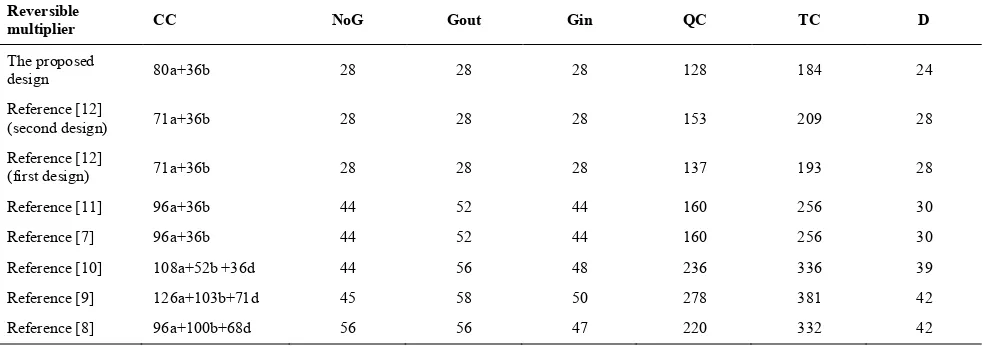
The quantum parameters of different multiplier circuits are shown in Table 8. Regarding to the previous multiplier circuits in [7-12], all quantum parameters of the proposed design is improved. However, in term of the number of reversible logic gates, garbage output and input, the proposed multiplier shows the same value as the multiplier circuit in [12].

In term of quantum cost and depth, our proposed circuit is the best, because of using the CSA in RPA part, and replacing the Toffoli gates with Peres gates in PPGC part of the original circuit [12]. On the other hand, the circuit cost of the proposed circuit is slightly worse than the reference [12], but at the same time, the total cost of the proposed circuit is the best.

6. CONCLUSSION

Reversible logic circuits are of particular interest in low power CMOS design, optical computing, DNA computing, bioinformatics, quantum computing and nanotechnology. Multiplier is a basic arithmetic cell in computer arithmetic units. Furthermore, reversible implementation of this unit is necessary for quantum computers. Targeting this purpose, various designs can be found in the literature.

(7)

TABLE 8. Comparison of different reversible multiplier circuits (a,b and c: number of XOR, AND, and NOT gates, respectively, CC:Circuit Cost, NoG:Number of Gate, Gout:Garbage output, Gin:Garbage input, QC:Quantum Cost, TC:Total Cost, D:Depth)

Reversible

multiplier CC NoG Gout Gin QC TC D

The proposed

design 80a+36b 28 28 28 128 184 24

Reference [12]

(second design) 71a+36b 28 28 28 153 209 28

Reference [12]

(first design) 71a+36b 28 28 28 137 193 28

Reference [11] 96a+36b 44 52 44 160 256 30

Reference [7] 96a+36b 44 52 44 160 256 30

Reference [10] 108a+52b +36d 44 56 48 236 336 39

Reference [9] 126a+103b+71d 45 58 50 278 381 42

Reference [8] 96a+100b+68d 56 56 47 220 332 42

Regarding to the best previous design, the proposed reversible multiplier decreases the quantum cost, total cost and depth, without increasing in the number of gate, number of garbage input and outputs. However, the circuit cost is increased slightly regarding to the best previous design.

As future works, some other reversible implementation of more complex arithmetic circuits such as function evaluations and multiplicative division circuits can be investigated using the proposed multiplier.

7. REFERENCES

1. Landuer, R., "Irreversibility and heat generation in the computing process", IBM Journal of Research and Development, Vol. 5, (1961), 183-191.

2. Demmer, M., Fonseca, R. and Koushanfa, F., "Richard Feynman: Simulating physics with computers", International Journal of Theoretical Physics, Vol. 21, No. 6-7, (1982), 467-488.

3. Bennet, C.H., "Logical reversibility of computation", IBM Journal of Research and Development,Vol. 17, No. 6,(1973), 525-532.

4. Nielson, M. and Chuang, I., "Quantum Computation and Quantum Information", Cambridge University Press, (2002).

5. Thapliyal, H. and Srinivas, M. B., "Novel reversible TSG gate and its application for designing reversible carry look ahead adder and other adder architectures", Proceedings of 10th Asia-Pacific Computer Systems Architecture Conference, (2005), 775-786.

6. Haghparast, M. and Navi, K., "A Novel Reversible Full Adder Circuit for Nanotechnology Based Systems", Journal of Applied Science, Vol. 7, No. 24, (2007), 3995-4000.

7. Haghparast, M., Jafarali Jassbi, S., Navi, K. and Hashemipour, O., "Design of a novel reversible multiplier circuit using HNG gate in nanotechnology", World Applied Sciences Journal, Vol. 3, No. 6, (2008), 974-978.

8. Thaplyal, H., Srinivas, M. B. and Arabnia, H. R., "A reversible version of 4´4 bit array multiplier with minimum gates and garbage outputs", International Conference on Embedded System and Applications (ESA'05), Las Vegag, USA, (2005), 106-114.

9. Thaplyal, H. and Srinivas, M. B., "Novel reversible multiplier architecture using reversible TSG gate", IEEE International Conferecne on Computer Systems and Applications, (2006), 100-103.

10. Shams, M., Haghparast, M., Navi, K., "Novel reversible multiplier circuit in nanotechnology", World Appllied Science Journal, Vol. 3, No. 5, (2008), 806-810.

11. Islam, M. S., Rahman, M. M., Begum, Z. and Hafiz, M. Z., "Low cost quantum realization of reversible multiplier circuit", Information Technology Journal, Vol. 8, No. 2, (2009), 208-213.

12. Mohammadi, M., Navi, K. and Eshghi, M., "Optimized reversible multiplier circuit", Journal of Circuits, Systems and Computers, Vol. 18, No. 2, (2009), 311-323.

13. Ehsanpour, M., Moallem, P., Vafaei, A., "Design of a Novel Reversible Multiplier Circuit Using Modified Full Adder", 2010 International Conferecne on Computer Design and Applications, Vol. 3 ,(2010), 230-234.

14. Feynman, R. P., "Quantum mechanical computers", Optical News, Vol. 11, No. 2, (1985), 11-20.

15. Toffoli, T., "Reversible computing", In Automata, Lnaguages and Programming, Spring-Verlog, (1985), 632-644.

16. Fredkin, E., Toffoli, T., "Conservative logic", International Journal of Theoretical Physics, Vol. 21, No. 3-4, (1982), 219-253.

17. Peres, A., "Reversible logic and quantum computers", Physical Review A, Vol. 32, No. 6, (1985) , 3266-3276.

18. Azad Khan, M. H., "Design of full adder with reversible gate", International Conference on Computer and Information Technology, Dhaka, Bangladesh, (2005), 515-519.

19. Banerjee, A., and Pathak, A., "An analysis of reversible multiplier circuits", arXiv preprint arXiv:0907.3357 (2009).

(8)

21. Zhou, R., Shi, Y., Cao, J. and Wang, H.,"Comment on Design of a novel reversible multiplier circuit using HNG gate in nanotechnology", World Appllied Science Journal, Vol. 10, No. 2, (2010), 161-165.

22. Gupta, P., Agrawal, A. and Jha, N. K., "An Algorithm for synthesis of reversible logic circuits", IEEE Transactions on Computer-aided Design of Integrated Circuits and Systems, Vol. 25, No. 11, (2006), 2317-2330.

23. Perkowski, M., Al Rabadi, A., Kerntopf, P., Buller, A., Chrzanowska-Jeske, M., Mishchenko, A., Azad Khan, M., Coppola, A., Yanushkevich, S., Shmerko, V. and Jozwiak, L., "A general decomposition for reversible logic", In Reed-Muller Workshop, (2001), 119-139.

24. Tayari, M. and Eshghi, M., "Design of 3-Input Reversible Programmable Logic Array", Journal of Circuits, Systems and Computers, Vol. 20, No. 2, (2011), 283-297.

25. Maslov, D. and Dueck, G. W., "Garbage in reversible design of multiple output functions", Procceding of 6th International Symposium on Representation and Metodology of future Computing, (2003), 162-170.

APPENDIX

An introduction to reversible logics and corresponding quantum parameters are presented in this appendix.

1. Introduction to Reversible Logics A reversible logic circuit comprises reversible gates. A gate that implements one to one mapping between n inputs and n outputs is called an n×n reversible logic gate that can be represented as:

) ,..., , ( O

) ,..., , ( I

2 1 V

2 1 V

n n

y y y

x x x

= =

(1)

where IV and OV are the input and output vector. The reversible logic gate must have the same number of inputs and outputs, and for each input pattern there must be a unique output pattern [3]. Reversible logic circuits avoid energy loss by “uncomputing” the computed information using recycling the energy in the system [3].

Synthesis of the quantum or reversible logic circuits in comparison to synthesis of the traditional irreversible

logic circuits has two restrictions that should be mentioned [23]:

- In the reversible logic, fan-out of any gate output is not allowed.

- Several authors assume that there should be no loops of gates and we followed this assumption in this paper.

Due to these restrictions, synthesis of the reversible circuits can be carried out from the inputs towards the outputs and vice versa [22]; so, there is a one-to-one mapping between input and output vector. In an n -output reversible gate, the -output vectors are permutations of the numbers 0 to 2n -1.

2. Parameters of Reversible Circuits There are some important parameters in designing an efficient reversible logic circuits including: the number of gates (NoG), quantum cost (QC), number of garbage outputs (Gout), number of constant garbage inputs (Gin), circuit cost (CC) (which is sometimes called the total logic calculations or hardware complexity) and depth of reversible circuits (D).

The number of gates as one of the comparison parameters is used to evaluate the implementation cost. The quantum cost of a reversible circuit is the number of (1´1) or (2´2) reversible gates used to implement the circuit. These elementary quantum gates with quantum cost equal to one is defined as follows [4]:

- Inverter (NOT): A single qubit (basic unit of information in quantum computer) is inverted. - Controlled - NOT (CNOT): The target qubit is

inverted if the control qubit is 1.

- Controlled - V: Performs the V operation known as the square root of NOT, since two consecutive V operations are equivalent to an inversion. - Controlled -V+: Performs the inverse of V.

(9)

A Novel Design of Reversible Multiplier Circuit

TEACHNICAL NOTE

P. Moallema, M. Ehsanpourb

a Department of Electrical Engineering, University of Isfahan, Isfahan, Iran.

b Department of Computer, Falavarjan Branch, Islamic Azad University, Falavarjan, Isfahan, Iran

P A P E R I N F O

Paper history: Received 22 June 2012

Received in revised form 5 January 2013 Accepted 24 January 2013

Keywords: Reversible Circuit Reversible Multiplier Reversible Gate Quantum Parameters هﺪﯿﮑﭼ ﻊﻤﺟ هﺪﻨﻨﮐ ﺎﻫ و بﺮﺿ هﺪﻨﻨﮐ ،ﺎﻫ ود ﺶﺨﺑ ﯽﻠﺻا يﺎﻫﺪﺣاو ﯽﺗﺎﺒﺳﺎﺤﻣ ﺖﺨﺳ راﺰﻓا ﺮﺗﻮﯿﭙﻣﺎﮐ بﻮﺴﺤﻣ هﺪﺷ و ﺶﻘﻧ هﺪﻤﻋ يا رد تﺎﺒﺳﺎﺤﻣ ﺖﺸﮔﺮﺑ ﺮﯾﺬﭘ ﺎﻔﯾا ﯽﻣ ﺪﻨﻨﮐ . ﻦﯾا ،ﻪﻟﺎﻘﻣ راﺪﻣ بﺮﺿ هﺪﻨﻨﮐ ﺖﺸﮔﺮﺑ ﺮﯾﺬﭘ 4 × 4 ﯽﻨﯾﻮﻧ ار ﯽﻓﺮﻌﻣ ﯽﻣ ﺪﻨﮐ ﻪﮐ رد ﯽﺣاﺮﻃ راﺪﻣ ﻟﻮﻣ ﺪ بﺮﻀﻠﺻﺎﺣ يﺎﻫ ،ﯽﺋﺰﺟ ﺎﻬﻨﺗ زا ﻪﭽﯾرد يﺎﻫ سﺮﭘ هدﺎﻔﺘﺳا هدﺮﮐ ﺖﺳا و يزﺎﯿﻧ ﻪﺑ ﻪﭽﯾرد يﺎﻫ ﯽﭙﮐ دراﺪﻧ . رد بﺮﺿ هﺪﻨﻨﮐ ،يدﺎﻬﻨﺸﯿﭘ زا هزاورد ﺖﺸﮔﺮﺑ ﺮﯾﺬﭘ مﺎﻤﺗ ﻊﻤﺟ هﺪﻨﻨﮐ سﺮﭘ ﻪﻨﯿﻬﺑ ،هﺪﺷ ﻪﺑ هاﺮﻤﻫ شور ﻊﻤﺟ ﺎﺑ هﺮﯿﺧذ ،ﯽﻠﻘﻧ رد ﺖﻤﺴﻗ ﻊﻤﺟ هﺪﻨﻨﮐ يزاﻮﻣ هدﺎﻔﺘﺳا هﺪﺷ ﺖﺳا . ﻪﺴﯾﺎﻘﻣ بﺮﺿ هﺪﻨﻨﮐ ﺑ ﺖﺸﮔﺮ ﺮﯾﺬﭘ يدﺎﻬﻨﺸﯿﭘ ﺎﺑ ﺮﮕﯾد حﺮﻃ ﺎﻫ نﺎﺸﻧ ﯽﻣ ﺪﻫد ﻪﮐ يﺎﻫﺮﺘﻣارﺎﭘ ﯽﻣﻮﺘﻧاﻮﮐ دﻮﺒﻬﺑ ﻪﺘﻓﺎﯾ ﺖﺳا . حﺮﻃ ،يدﺎﻬﻨﺸﯿﭘ ﻦﯾﺮﺘﻤﮐ راﺪﻘﻣ ﻪﻨﯾﺰﻫ ﯽﻣﻮﺘﻧاﻮﮐ و ﻖﻤﻋ ار ﻪﺑ ﮏﻤﮐ ﯽﺣاﺮﻃ ﯽﻨﯾﻮﻧ رد ﺖﻤﺴﻗ راﺪﻣ ﺪﻟﻮﻣ ﻞﺻﺎﺣ بﺮﺿ يﺎﻫ ﯽﯾﺰﺟ نﺎﺸﻧ ﯽﻣ ﺪﻫد . ﻪﻨﯾﺰﻫ يراﺪﻣ حﺮﻃ يدﺎﻬﻨﺸﯿﭘ ﻪﺑ ﺖﺒﺴﻧ ﻦﯾﺮﺘﻬﺑ حﺮﻃ درﻮﻣ ﻪﺴﯾﺎﻘﻣ ﯽﮐﺪﻧا ﺶﯾاﺰﻓا ،ﻪﺘﻓﺎﯾ ﺎﻣا زا ﻪﻄﻘﻧ ﺮﻈﻧ ﻪﻨﯾﺰﻫ ﻞﮐ ﻪﮐ ﻪﺑ ترﻮﺻ عﻮﻤﺠﻣ ﻪﻨﯾﺰﻫ ﯽﻣﻮﺘﻧاﻮﮐ و ﻪﻨﯾﺰﻫ يراﺪﻣ ﻒﯾﺮﻌﺗ ﯽﻣ ،دﻮﺷ ﻦﯾﺮﺘﻤﮐ راﺪﻘﻣ ار نﺎﺸﻧ ﯽﻣ ﺪﻫد . هوﻼﻋ ﺮﺑ ،ﻦﯾا رد حﺮﻃ ،يدﺎﻬﻨﺸﯿﭘ داﺪﻌﺗ ،ﻪﭽﯾرد ﯽﺟوﺮﺧ ﻪﻓﺎﺿا و يدورو ،ﻪﻓﺎﺿا ﺖﺒﺴﻧ ﻪﺑ ﻦﯾﺮﺘﻬﺑ حﺮﻃ درﻮﻣ ،ﻪﺴﯾﺎﻘﻣ ﯽﺸﯾاﺰﻓا ﻓﺎﯿﻧ ﻪﺘ ﺖﺳا . بﺮﺿ هﺪﻨﻨﮐ ،يدﺎﻬﻨﺸﯿﭘ ياﺮﺑ ﮏﯾ بﺮﺿ هﺪﻨﻨﮐ

n×n

(10)

Figure

TABLE 1. Reversible gates, their quantum implementation, quantum cost (QC) and depth (D)
Figure 4. Reversible PPGC with TGs and PGs
Figure 6.  The proposed reversible PPGC with only PGs
TABLE 3. Comparison of garbage outputs (Gout) of the proposed circuit with the compared circuits
+3

References

Related documents

Case Presentation: We present the case of a 55-year old man who presented with jaundice and severe hepatic injury approximately 6 months after starting bupropion for

International Journal of Scientific Research in Computer Science, Engineering and Information Technology CSEIT1833559 | Received 01 April 2018 | Accepted 10 April 2018 | March April 2018

1. Our style is economical techniques for knowledge decipherment and verification at the bottom station. We tend to extend the secure knowledge cryptography theme and devise

In this chapter we discuss the discrete time stochastic dynamics and the optimal filter for nonlinear systems which is based on the Bayes’ formula update of the probability

I then predict that by employing a code of ethics, I can activate the social norm of promise keeping which discourages those in a tournament from engaging in sabotage, while still

Many traffic surveys were done with the aim to estimate frequency of platoons, number of heavy vehicles for each platoons, minimum, mean, maximum values of

Ogletree, August Elena, "Evaluating the Teacher-Intern-Professor Model in a Professional Development School Partnership Setting using a Bayesian Approach to Mix