International Journal of Engineering
J o u r n a l H o m e p a g e : w w w . i j e . i rSimulation of Cold Rolling Process Using Smoothed Particle Hydrodynamics (SPH)
B. Hoseinpour, N. Amanifard*, A. Basti
Department of Mechanical Engineering, University of Guilan, P.O. Box 3756, Rasht, Iran.
P A P E R I N F O
Paper history:
Received 11 June 2012
Recivede in revised form 10 December 2012 Accepted 13 December 2012
Keywords:
Smoothed Particle Hydrodynamic (SPH) Cold Rolling
Elastic-plastic Model Numerical
A B S T R A C T
A mesh-free 2-D numerical approach was examined for cold rolling process to gain a more simpler and faster way to simulate such complicated case. Regarding the wide range of gained reports about the simplicity and computationally efficient characters of the smoothed particle hydrodynamics (SPH) method, the computational simulation stands on SPH technique in current numerical study. In this paper, the computational efforts not only confirm the advantages of using the SPH, but also reveal some improvements in simulation efficiencies. The rolling test was performed for an aluminum strip: Al 6061. In this way, the rolls assumed to behave as rigid bodies and, the aluminum strip assumed to behave as an elastic-plastic continuum. In order to achieve the required assurance of the employed technique, the computed stress distribution patterns were compared with those reported from a finite element study. The comparison reveals good agreements of the two computed results. Moreover, as the final test case, the effect of some parameters that have been reported to play the main role in case; roll diameter, percentage of thickness reduction of the strip, and the rolling speed has been studied. Regarding all parts of the current work, it may be concluded that the SPH can be sufficient tool to gain a rapid and simple simulation for such complicated cases.
doi:10.5829/idosi.ije.2013.26.05b.08
1. INTRODUCTION 1
A wide range of metal forming processes such as extrusion, rolling, drawing and forging are used to produce metal products. The rolling process plays an important role in manufacturing process for making different parts with a variety of dimensions. In General, in about 30% of metal products in the world, the cold rolling process is used. The main advantage of rolling technique with respect to other thickness-reduction processes, such as strip drawing, is that it exerts a tri-axial compression stress to ductility. This may cause a larger reduction per unit mass. In this procedure, the internal raw material, especially steels and aluminum, transform into desirable shape with the aid of at least two rolls. Based on work hardening on metal, rolling is categorized into hot and cold rolling. The work hardening happens only in cold rolling.
In the most of the numerical studies of metal forming, the Finite-element approaches are the main available tool. In literature, some studies were focused nonlinear finite element for cold rolling to eliminate
1 *Corresponding Author Email: [email protected] (N.
Amanifard)
(MCSPH) is used to model shock wave and elastic-plastic deformations of solids [7].
A new algorithm of smoothed particle hydrodynamics (SPH) was proposed to simulate high velocity impact and elastic-plastic deformation [8]. A modified SPH method is also improved for fluid-structure interaction (FSI) problems combined with solid-rigid contacts [9].
SPH is a robust mesh-free method that its high capability is proved in metal forming, extrusion and forging using LS-DYNA software [10] and cutting [11].
Some software's such as DEFORM take the advantage of finite element method [12] to simulate rolling process. In comparison, the SPH is less examined than the FEM. It seems that SPH is a young mesh-free method even it doesn't have the restrictions of mesh-based method.
The purpose of this paper is to develop and examine the efficiency of the SPH in of the complicated metal forming process. It is noticeable that the simulation of rolling by SPH has not been reported in the technical literature.
The current work focuses on a 2-D simulation of the cold rolling by SPH. The radial return plasticity model proposed by Wilkins [13] was also used to gain a more reliable mechanical simulation. The unloading condition was set as one of the most concerned conditions in rolling process. Simultaneously, the variability some factors such as diameter, angular velocity and thickness has been examined to achieve a more realistic study. To set such conditions, some special treatments in SPH must be performed.
2. SPH FORMULATION
Smoothed Particle Hydrodynamic (SPH) is a mesh free method which is based on interpolation theory in which the interpolation function is called Kernel.
For more details, referred to Monaghan et al. [14] is recommended. Referring to Monaghan et al. [15], the preferred form of continuity equation is:
ab a ab b b b a
a mV w
dt
d =
å
Ñr r r
(1)
where, ρ, V and, m are density, velocity and mass, respectively. b is the neighbor index of the particle a. The advantage of this form of the continuity equation
b b
m r becomes constant, and consequently, 0
= ×
ÑV is satisfied.
The SPH momentum equation used for elastic and fracture problems is:
i j a ab b n ij ab ab b ij b a ij a b i a g x w f R m dt dv + ¶ ¶ ÷ ÷ ø ö ç ç è æ + P + +
=
å
2 2r s r s
(2)
where, va, pa are the velocity and density of particle a and mb is the mass of particle b. The term Pab
produces a shear and bulk viscosity (for more details see [15, 16]).
Wab=w(rab,h) is the interpolation kernel with smoothing length h and rab=|ra-rb| is the defined distance between particle a and b. In this paper, cubic spline kernel is used which have following form (
h r
q= ):
( ) ï ï ï î ï ï ï í ì > = < < -= > ÷ ø ö ç è
æ - +
= 2 0 ) , ( 2 1 2 14 5 ) , ( 1 4 3 2 3 1 7 10 ) , ( 3 2 3 2 2 q for h r w q for q h h r w q for q q h h r w p p (3) ij
s is the stress tensor which can be calculated as:
ij S ij p
ij =- d +
s (4)
where, P is the pressure and S is deviatoric stress. The evaluation equation for the deviatoric stress S is:
kj ik jk ik ij ij s R R s dt
ds ij kk
+ + ÷ ø ö ç è æ -= m e d e
3 1
2 (5)
where, m is shear modulus and the pressure is determined as follows:
(
0)
2 0 r-r
=c
P (6)
Here, c0 is the speed of sound and ρ0 is the reference density.
The plasticity model used is radial return which was proposed by wilkins [13]. Initial response of deviatoric stress is assumed to be elastic. In the applied model:
ij tr
ij s
s =a (7)
where, ij tr
S and Sij are trial and final deviatoric stresses at the end of time step, respectively. α is proportionality constant coefficient defined as:
tr p sd s e m
a=1-3 (8)
tr
s is the effective stress in von-misses yield criterion. In the equivalent plastic strain:
H G d y n tr p + -= 3 s s e (9)
where, sny is the final yield stress and H is the hardening modulus. The plastic strain is sum of dep of each time step as:
p p
p e de
3. SPH MODELING OF THE ROLLING PROCESS
A plain strain rolling simulation is performed on Al 6061. Figure 1 shows a general view of process and parameters such as bite angle (α), neutral plan, deformed and undeform thickness of strip.
The initial particles positions of the rolls and the strip is shown in Figure 2. An alternating digital tree (ADT) algorithm was used to search nearest neighbor particles within the distance of 3h (h is smoothing length and h = 1.5 rab). A time step of 1e-6 Sec was used to ensure numerical stability [7]. Table 1, shows the material properties used in this study. The geometric properties of test case are to values introduced in Table 2.
TABLE 1. Properties of Al 6061
Roll diameter (mm) 60
Angular velocity (rad/s) 33.42
Initial thickness (mm) 3.17
Reduction (%) 27.44
Coefficient of friction 0.13
Figure 1. The Schematic cold rolling process configuration.
Figure 2. Initial particle position of the rolls and the strip.
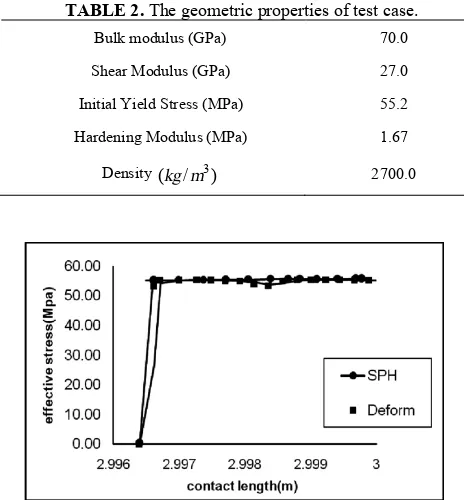
TABLE 2. The geometric properties of test case.
Bulk modulus (GPa) 70.0
Shear Modulus (GPa) 27.0
Initial Yield Stress (MPa) 55.2
Hardening Modulus (MPa) 1.67
Density (kg/m3) 2700.0
Figure 3. Stress distribution comparison of SPH and
DEFORM.
4. THE NUMERICAL VALIDATIONS
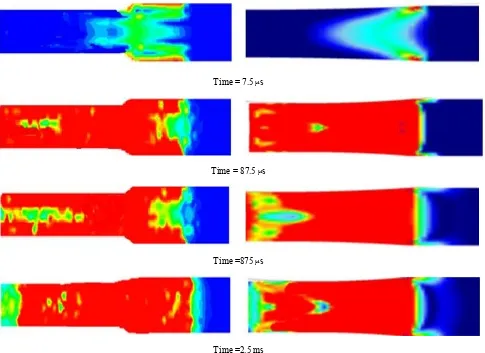
The numerical simulation is validated by a 2D rolling model simulated in commercial finite element software, DEFORM-2D. It can be observed in Figure 3 that the stress distribution of SPH and DEFORM are fairly in agreement. The stress contours obtained from the two techniques, in different time- steps are compared with each other in Figure 4. This figure indicates that stress starts from the first contact point of roll and strips (at bite angle) and gradually spreads through the surface close to rolls and strip's center.
5. THE FINAL NUMERICAL TESTS
Unloading or deduction of load exerted on work piece is achieved by removing work piece from rolls gap in actual process. In mesh based methods, unloading is complicated because at the end of each increment, each element of work piece must be checked for passing rolls’ gap. In contrast, simulation of rolling using SPH is not conditional and such control is not required. This is because of interface information transfer nature of the SPH, which stands on the simple interchange of particles by transferring of pressure to neighbor particles even between two materials.
Time = 7.5 µs
Time = 87.5 µs
Time =875 µs
Time =2.5 ms
Figure 4. Stress distribution using SPH (left) and DEFORM model (right) at 17.5 µs, 87.5 µs, 875 µs and 2.5 mµs. The colors is set
as: At left side, red is 53.0 Mpa, green 26.5 Mpa, light blue 15.9 Mpa and dark blue corresponding 0.0, for the right side the same colors are set for 55.2 Mpa, 27.6 Mpa, 16.6 Mpa and 0.0 for dark blue, respectively.
5. 1. Diameter Augmentation of roll diameter exerts more pressure on sheet and let plastic deformation of metal strip starts earlier. Reduction of diameter (diameter = 40mm) causes the pressure on the strip to decrease (see Figure 5). Because of this deduction, plastic deformation starts with more delay and the gradient of elastic part of stress reduces (see Figure 6).
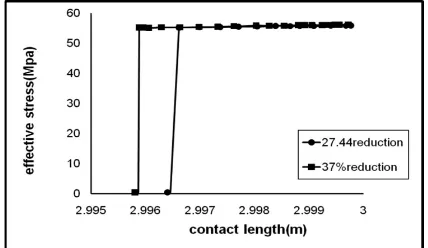
5. 2. Thickness Reduction More reduction in thickness may causes more complicated and coarse grid system and consequently may cause a significant CPU time in the mesh-based methods. Alternatively, in the SPH this difficulty reduces to minor CPU time increases. Figure 7 shows a comparison of pressure distribution of rolling in two cases of thickness reduction. More reduction of thickness (37%) means more deformation of the work piece; therefore, more pressure is needed for deformation. Figure 7 also depicts larger deformations cause larger gradient.
More reduction of thickness in mesh based methods causes more distortion in elements and this seems to be a significant deficiency of these methods. So, re-meshing or use of lateral methods would be crucial. SPH is a particle method and ability to overcome this problem is the superiority of this method.
Figure 5. Comparison of pressure distribution of rolling in reduction of the diameter.
Figure 6. Comparison of stress distribution of rolling in
reduction of diameter.
Figure 7. Comparison of pressure distribution of rolling in
reduction of the thickness.
Figure 8. Comparison of stress distribution of rolling in
reduction of thickness
Figure 9. Comparison of pressure distribution of rolling in
reduction of angular velocity.
Figure 10. Comparison of stress distribution of rolling in
reduction of angular velocity
6. CONCLUSIONS
In this paper, stress and pressure distribution on the plain strain rolling was investigated. The results of simulation of stress distribution using SPH and DEFORM were in relatively agreement with each other. The objectives, such as reduction of diameter, thickness and angular velocity showed that the reduction of the angular velocity could not affect the pressure, but the reduction of diameter and the thickness had decreasing and increasing effects on the pressure, respectively. In addition, the reduction of the angular velocity and the diameter caused initiation of plastic deformation after a little while. In contrast, thickness-reduction augments the gradient of elastic deformation in stress.
The SPH approach in comparison with mesh based method was less time-consuming because of its flexible mesh free nature. In mesh based methods, unloading is complicated due to mesh distortion and in contrast, simulation of rolling using SPH is not conditional and such control are not required. This described superiority proves capability of using the SPH approach in deformation case studies.
Finally, by the advances mentioned above, and by preparing a more flexible and fast solver the physical variable conditions were studied to show the capability of setting a wide range test protocol.
7. REFERENCES
1. Chen, J., Chandrashekhara, K., Mahimkar, C., Lekakh, S. and Richards, V., "Void closure prediction in cold rolling using finite element analysis and neural network", Journal of Materials Processing Technology, Vol. 211, No. 2, (2011), 245-255. 2. Poursina, M., Dehkordi, N. T., Fattahi, A. and Mirmohammadi,
H., "Application of genetic algorithms to optimization of rolling schedules based on damage mechanics", Simulation Modelling Practice and Theory, Vol. 22, (2012), 61-73.
3. Gudur, P. and Dixit, U., "A neural network-assisted finite element analysis of cold flat rolling", Engineering Applications of Artificial Intelligence, Vol. 21, No. 1, (2008), 43-52. 4. Montmitonnet, P., "Hot and cold strip rolling processes",
Computer Methods in Applied Mechanics and Engineering, Vol. 195, No. 48, (2006), 6604-6625.
5. Gingold, R. A. and Monaghan, J. J., "Smoothed particle hydrodynamics-theory and application to non-spherical stars",
Monthly Notices of the Royal Astronomical Society, Vol. 181, (1977), 375-389.
6. Lucy, L. B., "A numerical approach to the testing of the fission hypothesis", The Astronomical Journal, Vol. 82, (1977), 1013-1024.
7. Amanifard, N. and Namini, V. H., "A modified compressible smoothed particle hydrodynamics (mcsph) method and its application on the numerical simulation of low and high velocity impacts", International Journal of Engineering-Transactions A: Basics, Vol. 25, No. 1, (2011), 45.
8. Farahani, M., Amanifard, N. and Hosseini, S., "A high-velocity impact simulation using sph-projection method", International Journal of Engineering, Transaction B: Applications, Vol. 22, No. 4, (2009), 359-368.
9. Hosseini, S. and Amanifard, N., "Presenting a modified sph algorithm for numerical studies of fluid-structure interaction problems", International Journal of Engineering-Transactions B: Applications, Vol. 20, (2007), 167-178.
10. Cleary, P., Prakash, M. and Ha, J., "Novel applications of smoothed particle hydrodynamics (sph) in metal forming",
Journal of Materials Processing Technology, Vol. 177, No. 1, (2006), 41-48.
11. Limido, J., Espinosa, C., Salaün, M. and Lacome, J.-L., "Sph method applied to high speed cutting modelling", International Journal of Mechanical Sciences, Vol. 49, No. 7, (2007), 898-908.
12. Duan, X. and Sheppard, T., "The influence of the constitutive equation on the simulation of a hot rolling process", Journal of Materials Processing Technology, Vol. 150, No. 1, (2004), 100-106.
13. Wilkins, J-L., "Calculation of elastic-plastic flow methods of computational physics", New York, Academic press, Vol. 8, (1964).
14. Monaghan, J. J., "Simulating free surface flows with sph",
Journal of Computational Physics, Vol. 110, No. 2, (1994), 399-406.
15. Monaghan, J. J., "Smoothed particle hydrodynamics", Annual Review of Astronomy and Astrophysics, Vol. 30, (1992), 543-574.
Simulation of Cold Rolling Process Using Smoothed Particle Hydrodynamics (SPH)
B. Hoseinpour, N. Amanifard*, A. Basti
Department of Mechanical Engineering, University of Guilan, P.O. Box 3756, Rasht, Iran.
P A P E R I N F O
Paper history:
Received 11 June 2012
Recivede in revised form 10 December 2012 Accepted 13 December 2012
Keywords:
Smoothed Particle Hydrodynamic (SPH) Cold Rolling
Elastic-plastic Model Numerical
هﺪﯿﮑﭼ
نوﺪﺑيدﺪﻋشورﮏﯾناﻮﻨﻋﻪﺑراﻮﻤﻫتارذﮏﯿﻣﺎﻨﯾدورﺪﯿﻫشوريﺎﻫيزﺎﺳهدﺎﺳوهﺪﺷشراﺰﮔيﺎﻬﯿﯾﺎﻧاﻮﺗسﺎﺳاﺮﺑ
ﻘﺗﮏﯾ،ﻞﮑﺷﺮﯿﯿﻐﺗيﺎﻫﺪﻨﯾآﺮﻓردﻪﮑﺒﺷ
ﺖﺳاهﺪﺷﻪﺘﻓﺮﮔﺮﻄﻧرددﺮﺳدرﻮﻧﺪﻨﯾآﺮﻓرديﺪﻌﺑودﺐﯾﺮ
.
ندﻮﻣزآوهدﺎﻔﺘﺳاﺎﺑ
راﻮﻤﻫتارذﮏﯿﻣﺎﻨﯾدورﺪﯿﻫشور
(SPH)
شوردﻮﺧرديدرﻮﻣيﺎﻫﺖﻓﺮﺸﯿﭘﺚﻋﺎﺑﺎﻬﻨﺗﻪﻧدﺮﺳدرﻮﻧﺪﻨﯾآﺮﻓدرﻮﻣرد
SPH
دادﺖﺳدﻪﺑﺚﺤﺑدرﻮﻣﮏﯾﺰﯿﻓدرﻮﻣردﺰﯿﻧياﻪﺟﻮﺗرﻮﺧرد ﯽﮑﯾﺰﯿﻓﻖﯾﺎﻘﺣﻪﮑﻠﺑﺪﯾدﺮﮔ
.
ﮏﯾ
ﯽﻣﻮﯿﻨﯿﻣﻮﻟآراﻮﻧ
6061
ﺪﺷﻪﺘﻓﺮﮔﺮﻈﻧرددرﻮﻧﻪﻌﻟﺎﻄﻣياﺮﺑ
.
ﻪﮐﺪﺷﺎﻨﺑﻦﯾاﺮﺑضﺮﻓوﺪﺷﻪﺘﻓﺮﮔﺮﻈﻧردﺐﻠﺻدرﻮﻧﮏﺴﯾدطﺎﺒﺗراﻦﯾارد
ﮏﯿﺘﺳﻻافﺎﻄﻌﻧاﺖﯿﻠﺑﺎﻗراﻮﻧ
–
ﺪﺷﺎﺑﻪﺘﺷادﮏﯿﺘﺳﻼﭘ
.
ﺎﺑﺶﻨﺗﯽﺗﺎﺒﺳﺎﺤﻣﺞﯾﺎﺘﻧهﺪﺷهدﺮﺑرﺎﮐﻪﺑشورزانﺎﻨﯿﻤﻃاﻞﯿﻧياﺮﺑ
ئاﺰﺟاشورزاﻞﺻﺎﺣﺞﯾﺎﺘﻧ
ﺖﺳاﯽﻟﻮﺒﻗﻞﺑﺎﻗﺖﻘﺑﺎﻄﻣزاﯽﮐﺎﺣﺞﯾﺎﺘﻧوﺖﺳاهﺪﺷﻪﺴﯾﺎﻘﻣدوﺪﺤﻣ
.
ﺮﺛاﯽﯾﺎﻬﻧﺞﯾﺎﺘﻧياﺮﺑ
راﺮﻗﯽﺳرﺮﺑدرﻮﻣﺶﺧﺮﭼﺖﻋﺮﺳوﯽﻣﻮﯿﻨﯿﻣﻮﻟآراﻮﻧﺖﻣﺎﺨﺿﺶﻫﺎﮐﺪﺻرد،ﮏﺴﯾدﺮﻄﻗﺪﻨﻧﺎﻣﺮﺛﻮﻣيﺎﻫﺮﺘﻣارﺎﭘزاﯽﻀﻌﺑ
ﺖﻓﺮﮔ
.
ﻪﮑﻠﺑ،ﺖﺳاﻪﺘﻓﺎﯾﯽﺒﺴﻧﻪﻌﺳﻮﺗهدﺎﻔﺘﺳادرﻮﻣشورﺎﻬﻨﺗﻪﻧتﺎﻌﻟﺎﻄﻣﻦﯾارد
وﻞﻬﺳﺎﺘﺒﺴﻧﺐﯾﺮﻘﺗﮏﯾياﺮﺑيﺎﻬﯿﯾﺎﻧاﻮﺗ
ﺪﯾدﺮﮔﻞﺻﺎﺣﺰﯿﻧهﺪﯿﭽﯿﭘﻞﮑﺷﺮﯿﯿﻐﺗيﺎﻫهﺪﯾﺪﭘردﻖﯿﻗد
.