JAN ALBERT VANLAAR
Rijksuniversiteit Groningen
Abstract: The distinction between consti-tutive and regulative rules is applied to rules for critical discussion that have to do with the use of ambiguous expressions. This leads to a distinction between rule violating falla-cies, by which one abandons a critical dis-cussion, and norm violating fallacies, which are in a way admissible within a critical dis-cussion. According to the formal model for critical discussion, proposed in this paper, fallacies of the norm violating type arc not prohibited. Instead, it provides discussants with devices to discuss fallacies and fallacy criticisms.
Resume: On applique la distinction en-tre des regles constitutives et regulatives aux regles d'une discussion critique qui se rapporte it I'usage d'expressions ambigues. Ceci mene it une distinction entre les sophismes qui contreviennent
a
des regles, dont la transgression entralne la fin d'une discussion critique. et des sophismes qui contreviennent it des normes, dont la transgression est d'une certaine fayon acceptable dans un diseours critique. Selon Ie modele formel d'une discussion critique qu'on propose, les transgressions sophistiques des normes sont recevables. D'ailleurs, ce modele donne aux interlocuteurs des moyens de discuter des sophismes et des critiques de ceux-ci.Keywords: rules for critical discussion, regulative rule, constitutive rule, rule violating fallacy, norm violating fallacy, point of order, ambiguity criticism, equivocation criti-cism, disqualified sentence, formal dialectics
1. Introduction
When playing soccer I have to compensate for my lack of skill and technique by making body checks and nasty tackles, which are offences against the rules. Now and then I am punished by a warning, or the other party gets compensated by obtaining a free kick. Although I am violating important and indispensable rules, my offences and the ensuing punishments are still part of what is properly called soccer. I am playing it in an incorrect way. Ifthe rules are violated in a more drastic way however, for instance by closing the goal with an extra net in front of it, or by putting a second ball into the game, these actions are no longer part of what is properly called soccer. I am then not playing soccer anymore.
Having a discussion resembles playing soccer, in my view, in having these two kinds of rules. Consequently, in an adequate explication ofthe concept of having a discussion we should distinguish between on the one hand performing speech acts which are still discussion moves, but which are liable to some serious charge, and on the other hand performing speech acts by which one abandons what could really be called a discussion.
Starting from this distinction, this paper examines the use of ambiguities in discussions. Which uses of ambiguity are still part of a critical discussion and can therefore be criticized within such a discussion, and which uses are not part of a critical discussion and can consequently not be criticized within a critical discus-sion?
To answer these questions, I shall first underscore the view that raisingfallacy criticisms is an integral part of dialectics. Then I shall indicate what is wrong with contextual ambiguities but at the same time emphasize that it is very difficult, ifnot impossible, for real and imperfect discussants to steer clear of using contextuaIly ambiguous expressions. This then is a reason for considering a reasonable proce-dure that constitutes a model for discussion that accomodates ambiguity. In the main part of the paper, I shall sketch such a procedure in an informal way. Incor-porating fallacy criticisms gives rise to a classification of different types of falla-cies, which will be provided at the end. In an appendix, a more formal description can be found of the type of dialogue presented in this paper.
2. Capturing points of order: Ambiguous!, Equivocation!
According to pragma-dialectics, discussions should ideally be regulated by a cer-tain procedure for critical discussion. This procedure consists of rules which promote discussion moves that contribute to the main goal of a critical discussion, resolving a conflict of opinion, and moreover prohibit discussion moves that ob-struct or hinder this goal. In case of a discussion aimed at resolving a difference of opinions, rule violations can and should be criticized as obstructing the goal of the discussion, that is, they should be considered as fallacious (van Eemeren & Grootendorst 1992, 104).
Suppose now that a proponent offers an argument that contains an expression that is ambiguous in the context of use, and consequently that it is not obvious what the intended interpretation is. Then the opponent can analyze the ambiguity and criticize the proponent for violating a rule for critical discussion. Rule 10 for critical discussion, which is at stake here, runs as follows: 'A party must not use formulations that are insufficiently clear or confusingly ambiguous and he must interpret the other party's formulations as carefully and accurately as possible' (van Eemeren & Grootendorst 1992, p. 196). The proponent's contribution to the dialogue is not in accordance with the procedure for critical discussion and should therefore be withdrawn from the dialogue and possibly replaced by a non-ambigu-ous one. With the procedure as a regulative ideal, one is able to criticize bad dis-cussion moves as fallacious. The pragma-dialectical procedure, however, does not regulate raising these fallacy criticisms. The reason probably is that the proce-dure describes ideal discussion behavior, and does not deal with how the rules are to be applied to non-ideal behavior, to rule-violations. I
In interesting cases of ambiguity, theorists cannot determine whether in fact a fallacy has been committed or not. But they can view the situation from a dialec-tical perspective and investigate discussion moves in which one party accuses the other party of committing the fallacy of equivocation.
Mackenzie elaborated on this idea of making points of order. He proposed a formal dialectical system in which the opponent has a device to criticize an equivo-cal argument (l988).l Moreover, he proposed a formal dialectiequivo-cal system that is made up of two parts. There is an inner system DC of rules that state which moves are DC-legal. If some party violates a DC-rule, there is a system of DC+ rules by which this violation can be criticized (1981, p. 172-176).4
Krabbe took up the issue from the angle of dialogue profiles (1996). Given a certain history of a discussion up to a point, the discussant whose move it is can choose from a set of alternatives. Some of these options concern topic points, other concern points of order. Among the options, Krabbe mentions active criti-cisms and fallacy criticriti-cisms. The purport of an active criticism is that an argument offered by the other party is wrong, mistaken or insufficient. The purport of a fallacy criticism is that the argument is inadmissible. Only fallacy criticisms are considered points of order by Krabbe.
In my view, including the option of making points of order contributes to the normative force and the empirical adequacy of models for critical discussion. Raising a point of order, for instance some kind of ambiguity criticism, can itself be seen as a contribution to the resolution of the dispute, and in that light as a good or a bad contribution. An ambiguity criticism is good ifit detects a real ambiguity, forces the speaker to retract the ambiguous assertion, and gets the topical discus-sion in an efficient way back on a right track. So, good ambiguity criticisms contribute to conflict resolution. And an ambiguity criticism that is inappropriate, for instance because there is no ambiguity that is of any consequence to the course of the dialogue, is a bad contribution, precisely because it is an unfruitful digres-sion that is a detour and because it can lead to a premature closure of the discus-sion. In section 5, I shall maintain that, when the issue of ambiguity arises, discussants can react in an adequate way by choosing from two different but related types of fallacy criticism. They need to be able to criticize something as a fallacy of ambiguity, and in addition they can criticize something as a fallacy of equivocation.
order (Hamblin, Mackenzie), active criticisms (Finocchiaro 1980) and fallacy criti-cisms (Krabbe 1996) as integral parts of dialectics.
My point is two-sided. On the one hand, I want to maintain that ambiguity is worthy of being criticized as fallacious. On the other hand, I also want to maintain that, in a way, ambiguity is admissible in a critical discussion.
3. Ideally, discussants do not use contextually ambiguous sentences.
In order to be able to construct reasonable rules for using or criticizing ambigui-ties, we have to know what is or is not wrong with using ambiguous expressions in a discussion aimed at conflict resolution. It is my contention that using contex-tual ambiguity in an argument resembles a failure to argue ex concessis.
It is a commonplace to say that ambiguity per se is not wrong at all. We are quite often able to communicate successfully while using sentences that are am-biguous in the sense that they mean one thing in the current context of use, and would mean quite a different thing if used in another context. This kind of ambigu-ity does not concern us here. In line with, for instance, Walton (1996, 22), we focus on ambiguity of a contextual nature: the use of semantically ambiguous sentences whose ambiguity is not easily resolved by the context of use.
This paper is restricted to a simple kind of discussion, where there is a propo-nent who is committed to one main thesis and an oppopropo-nent who doubts whether this thesis is acceptable. The proponent attempts to persuade the opponent of the view that, given her other commitments, she is committed to the proposition ex-pressed in the main thesis. The opponent attempts to persuade the proponent of the view that her doubt regarding the main thesis is consistent with her overall position.
To enable each other to make a serious attempt at persuasion, the discussants should cooperate by making their position clear, that is by making clear to what they are actually committed. The proponent has to know to what the opponent is committed in order to be able to figure out what arguments might have success. The opponent has to know to what thesis the proponent is committed, or by what arguments the proponent is trying to persuade her, in order to know whether she can coherently refuse to accept the thesis or the reasons that are given. The scope of this paper is further restricted by considering only the proponent's use of ambi-guities.s
The propositional content of a commitment is communicated by sentences. Now suppose that the proponent makes an assertion by uttering a sentence S in some context, that the opponent is in this context disposed to distinguish more than one reading of S, that these readings are not ruled out by the semantics and that the opponent is in this context not able to choose one of these readings as the right one. In that case S is ambiguous for the opponent.6 If the opponent is maximally
informa-tion about the posiinforma-tion of the speaker, but does probably not provide a sufficient basis for the opponent to develop a critical position. The speaker's choice of a sentence S as a vehicle to express a proposition in this context does not match the listener's disposition to interpret S in this context. If S functions as part of an argument, the proponent's choice of words resembles a failure to argue ex conces-sis. Just as in the case of a failure to argue ex concessis, making an assertion by a sentence that is ambiguous for the opponent is a failure to adjust the argument to the position of the opponent: the proponent does not tailor the argument to the semantic dispositions of the opponent.
The most likely way to get such a defect repaired is by asking for a disambiguation of the argument. A sentence S is a less ambiguous reformulation of sentence T in context C if and only if all propositions expressed by S in Care also expressed by T in C, and if there is at least one proposition expressed by T in C that is not expressed by S in C. This definition is a modified version ofNaess's definition of what he named in Norwegian 'en presisering' (Naess, 1966,39). But we will consider these reformulations from a functional perspective, according to which S is a disambiguating reformulation ofT in C if it is presented by a discussant as having the function of being a less ambiguous reformulation ofT in C (whether S really is less ambiguous or not).7If a request for a disambiguating reformulation is answered in an appropriate way, then the position of the speaker becomes clearer to the listener.
Suppose the proponent makes an assertion by uttering 'Stopping before a traf-fic light is obligatory' and the opponent distinguishes in this context between two distinct propositions that can in this context be expressed non-ambiguously as 'Stopping before a traffic light is morally obligatory' and 'Stopping before a traffic light is legally obligatory' . According to the opponent then, the proponent commit-ted himselfto either the first or to the second proposition. If the proponent makes his intention clear by using one of these disambiguating reformulations, the oppo-nent's uncertainty with regard to the propooppo-nent's position disappears.
As an ambiguity is often difficult to detect and as it is even more difficult to give an adequate analysis of it, there is a chance that the opponent does not see the weakness (or fallaciousness) of the proponent's argument or is not able to re-spond adequately. There are two specific risks involved.
First, an unidentified ambiguity can lead to a misunderstanding, where the speaker thinks she made it clear by uttering sentence S that she expressed one proposition, and the listener supposes that another proposition is naturally ex-pressed by the speaker's use of S. This again can lead to pseudo-agreement or pseudo-disagreement (Naess 1966, 83-96).
all reasons are acceptable to the opponent and there is at least one other reading in which the warrant is acceptable to the opponent, and (3) the argument fails, what-ever reading the proponent would choose, either because a warrant is in the end not acceptable to the opponent, or one of the reasons offered in the argument is in the end not acceptable to the opponent. In Walton's terms, the argument has either bite or bearing, but not both (Walton 1996, 19). If the ambiguity goes unnoticed, there is the risk that the opponent is misled by the appearance of soundness and fails to detect good opportunities to criticize the argument and for that reason loses the discussion needlessly.
Using an ambiguous sentence can lead to misunderstanding or to a situation where the opponent does not see the opportunities to criticize the argument. If a sentence used by the proponent is contextually ambiguous, I say the proponent has committed the fallacy of ambiguity. So, according to my usage, committing a fallacy of equivocation entails committing a fallacy of ambiguity, but not vice-versa.
So ideally, discussants in a critical discussion do not use any contextually am-biguous sentences. However, the harmful effects of using amam-biguous or equivo-cal arguments are not in all situations equally serious. Suppose the proponent asserts an ambiguous sentence S. Then the proponent's use of S does not match the opponent's dispositions to interpret S. But suppose further that the opponent had not yet made her semantic dispositions overt. After that, the opponent points at the ambiguity and the proponent repairs his position by using disambiguating reformulations. In such a situation, the discussants are at every stage working up to resolution. Although the discussion started with some unc1earness, this is cleared up during the discussion. If no other obstacles arise, every move brings the discussants closer towards conflict resolution. Such discussion fragments are in my view part of a critical discussion.
But suppose that it was already clear in the discussion that, in the opponent's view, S is ambiguous.s Then in a way, S is disqualified in this discussion as contextually ambiguous: it is an overt fact that the opponent perceives S as am-biguous. If the proponent nonetheless asserts S, this move brings them further away from conflict resolution. Such a move is, in my view, not a part of a critical discussion.
4. Unfortunately, we do use ambiguous expressions.
persuasion strategy for the proponent after disambiguating the occurrences of S. So, if the proponent has an adequate picture of the opponent's semantic disposi-tions, even then it is possible that he commits a fallacy of equivocation uninten-tionally, due to a wrong picture ofthe opponent's (normal) commitments.9
As it is not in all situations feasible for the proponent to have an adequate picture of the opponent's position, it is not reasonable to prohibit and exclude the use of contex-tually ambiguous sentences.
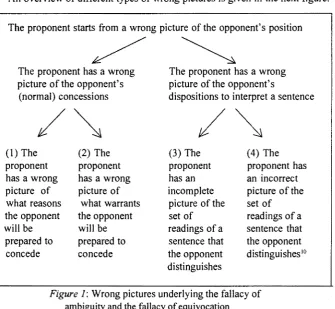
An overview of different types of wrong pictures is given in the next figure.
The proponent starts from a wrong picture of the opponent's position
/~
The proponent has a wrong The proponent has a wrong picture of the opponent's picture of the opponent's(normal) concessions dispositions to interpret a sentence
/~
/
~
(1) The (2) The (3) The (4) The proponent proponent proponent proponent has has a wrong has a wrong has an an incorrect picture of picture of incomplete picture of the what reasons what warrants picture of the set of the opponent the opponent set of readings of a will be will be readings of a sentence that prepared to prepared to sentence that the opponent concede concede the opponent distinguishes 10
distinguishes
Figure 1: Wrong pictures underlying the fallacy of ambiguity and the fallacy of equivocation
The following examples illustrate that, for different reasons, we are not always able to avoid the use of contextually ambiguous sentences. An arrested person, W.B., describes the course of events of the night on which he was arrested for two offences. He supposedly drove a car, while his license was suspended and after he had drunk too much beer:11
was. So I decided to bring my car to a safe place - a parking lot a little further on. I wasn't allowed to drive, and because of that I did, while walking, push the car, with its motor running, in the direction of the parking lot. I was arrested and I had drunk some beer. (Dutch jurisdiction: NJ 1991/29)
Now, I imagine that the following discussions took place, the first one while W.B. pushed his car to the parking lot, the second one while the issue was discussed in court.
Discussion 1:
Police officer, who hadjust arrived: Your license, please.
WB.: Well, there is no license. But I am not driving a car, so I will not get convicted.
Officer: You are right that you are not driving a car, but only in the stricter sense of 'driving'. Your thesis, however, only follows from a premise that states that you are not driving a car in the legal sense, which is a wider sense.
Discussion 2:
WB. 's defending counsel: W.B. should not be convicted, for he did not drive a car and only if he did drive a car, are there grounds to convict him.
Judge: W.B. did not drive a car in the stricter sense, but he did drive a car in the wider sense. And 'to drive', as it occurs in the relevant articles, is to be taken in the wider, encompassing sense.
Presumably, in discussion 1, W.B. starts from the wrong supposition that the police officer sees just one reading of the sentence 'I am not driving a car'. W.B. reckons only with a stricter sense of driving. Further, W.B. wrongly supposed that the police officer would accept the warrant 'if W.B. is not driving a car (in this strict sense) then W.B. will not get convicted'. So this is an example of a situation (type 3) where a proponent starts from an incomplete picture of the opponent's dispositions to interpret a sentence, as well as of a situation (type 2) where a proponent starts from a wrong picture of what warrants the opponent is prepared to concede.
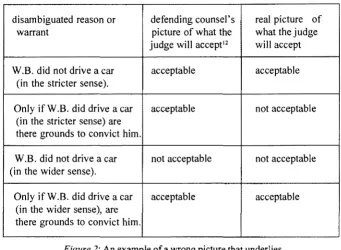
The second discussion illustrates the situation where the defending counsel probably suspects there is an ambiguity, but wrongly thinks there is a disambiguation of his argument in which the reason along with the warrant is acceptable to the judge. The next figure shows that this constitutes an example of the situation (type 2) where the proponent has a wrong picture of what warrants the opponent is prepared to concede.
ambigu-disambiguated reason or defending counsel's real picture of warrant picture of what the what the judge
judge will acceptl2 will accept
W.B. did not drive a car acceptable acceptable (in the stricter sense).
Only if W.B. did drive a car acceptable not acceptable (in the stricter sense) are
there grounds to convict him.
W.B. did not drive a car not acceptable not acceptable (in the wider sense).
Only if W.B. did drive a car acceptable acceptable (in the wider sense), are
there grounds to convict him.
Figure 2: An example of a wrong picture that underlies the act of committing the fallacy of equivocation.
ity or fallacies of equivocation, it is not reasonable to exclude the use of contextual ambiguities from persuasion dialogues. Besides, our imperfections indicate the need for a dialectical procedure for making a point of order against the use of ambiguity.
5. An optimal procedure for sub-optimal situations
In the model I propose, named Ambiguity Dialectics (AD), there is a distinction between norms for critical discussion and rules for critical discussion.13 Norms for critical discussion indicate an optimal way of resolving disputes and are regu-lative (Searle 1970,33) for AD-discussions. In AD there is only one norm: 'Do not make assertions by uttering contextually ambiguous sentences!' .14 The AD-rules
are the constitutive rules (Searle 1970, 33) for AD-discussions. When in a dia-logue an AD-rule is violated, the diadia-logue cannot be called an AD-discussion in the proper sense. However, it is possible to violate the AD-norm within an AD-discus-sion. In my view, the informal notion of a serious and critical discussion or a persuasion dialogue is best modeled by something like AD, having both restrictive norms and more permissive rules.
which a nonn is violated. As the discussions under consideration are asymmetric, and only the proponent is able to assert topical points, only the opponent of the main thesis needs a device to criticize ambiguous assertions or ambiguous argu-ments.15 The AD-rules should, among other things, promote efficient ways to discuss points of order, active criticisms or fallacy criticisms.
According to the AD-rules, the opponent is able to raise afallacy criticism (as I will call it) only by making a statement of an assertive nature: you have made this particular move and by doing it you violated the norm!, by which she takes on a burden of proof. So, although the discussion is asymmetric in the sense that one party remains proponent of the main thesis while the other party remains the opponent of the main thesis, it must be possible for a shift of roles to occur after which the opponent of the main thesis becomes the proponent of a fallacy criti-cism. From now on I shall refer to the critic ofthe main thesis as "White" and its proponent as "Black".
Desiderata of the procedure are that ambiguous assertions (relative to the op-ponent) are withdrawn and replaced by non-ambiguous ones, that inappropriate fallacy criticisms are withdrawn, and that requests for disambiguations are used as sparsely as possible.
Opponents need to be able to criticize an ambiguous assertion by raising an ambiguity criticism. Raising such a criticism is an effective reaction to the threat of misunderstanding and to alleged instances of the fallacy of equivocation. A standard way to criticize specific uses of ambiguity is by raising an equivocation criticism. This is an effective reaction to an alleged fallacy of equivocation, but is a device too heavy for most threats of misunderstanding. Equivocation criticism is therefore less basic than ambiguity criticism.
A standard formulation of ambiguity criticism could be the following:
You have made an assertion using sentence S while in this context Scan express n different propositions.'6
Ambiguity criticism:
You have made an assertion using sentence S while in this context of use S can express n different propositions, and these propositions can, for this context, be adequately formulated as SI""'S"
Black should be able to investigate whether in this context S is ambiguous between SI""Sn by testing whether the semantics of their language really admits all Sj' s as proper disambiguating reformulations in this context. Since this is not a study in semantics, I imagine that the discussants have some sort of utterance meaning machine at their disposal by which they can perform an utterance mean-ing testmean-ing procedure. 17 This is inspired by other types oftesting procedures (van
Eemeren en Grootendorst 1992, 158). The machine enables the discussants to test whether White's linguistic analysis is coherent with the linguistic conventions of the language White and Black have adopted.
I presuppose that at least for some combinations of supposedly ambiguous sentences S, disambiguating reformulations SI"",Sn and contexts C, it can be lin-guistically determined whether or not each Sj expresses a proposition in C that S does also express in C. These linguistic data should constrain the discussants' options. It is also realistic to assume, however, that there are combinations of supposedly ambiguous sentences, disambiguating reformulations and contexts, for which the shared language does not give a clear result. In such a case S is ambiguous in a more subtle way. The 'W.B.' example illustrates the case where the language does not determine whether or not a term (and consequently sen-tences in which the term occurs) is ambiguous between two senses, but where the discussants have to decide by other means how to continue the discussion. IS
The utterance meaning machine is supposed to work as follows. Black puts a combination ofS (the focus of White's fallacy criticism), SI"",Sn (the disambiguated reformulations offered by White) and information about the context of use into the machine. The machine answers 'negative' or 'positive'. The negative outcome means that two or more Sj'S mean in this context exactly the same, or that some Sj in this context does not express anything that S expresses in this context. The positive outcome means just that the outcome is not negative. This is the outcome, for example, if (1) every Sj in this context means something else and every Sj expresses a proposition in this context that S in this context also expresses, or if (2) there is at least one Sj for which it holds that the language does not determine whether or not it expresses a proposition that S does in C, while there is no S for
J
to the position of White, also when it comes to semantic issues, but that the common language restricts White's freedom with regard to semantic issues.
After an ambiguity criticism, Black is allowed, and after a positive test-out-come even obliged, to accept the criticism. Black accepts it by offering a disambiguated argument, that is, Black's complete argument, as given until that stage of the discussion, in which each occurrence of S is disambiguated.
One way for Black to disambiguate his argument is by replacing each occur-rence of S by either S, or ... or So' White has determined what formulations are appropriate, Black decides what assertions to make with them. This way Black repairs his violation of the norm and the discussion is back on track (as viewed by the discussants themselves). White should, as she is herself responsible for the adequacy ofthe formulations SI""'So' not be allowed to raise an ambiguity criti-cism to one of these S.'s. This restricts her freedom to criticize formulations as I ambiguous.
Yet another way for Black to disambiguate his argument is by replacing occur-rences of S by disambiguated reformulations S' " ... ,8' m that do not all occur in
White's fallacy criticism. In this case, Black accepts that there is some ambiguity, but gives a (partly) different semantic analysis ofit. This option for Black is needed, since White may distinguish semantically appropriate readings of S, but not all admissible readings that Black considers relevant for his defense.
After such a move the sentences S'; that were not offered by White as adequate disambiguating reformulations of S must themselves be liable to ambiguity criti-cisms. Furthermore, the combination of Sand S' " ... ,8' m' together with the current
context, must be liable to an utterance meaning testing procedure performed by White. When the outcome is positive, White must accept the reformulations as proper disambiguations 19 (although she may still challenge the acceptability of
rea-sons and warrants after a substitution takes place). When the outcome is negative Black must replace all occurrences of S by S"""Sn' the disambiguating reformulations chosen by White,
I propose the following standard formulation for the fallacy of equivocation criticism:
You have made an assertion using sentence S, while in this context S can express n different propositions, and these propositions can be, for this context, adequately formulated as SI"",Sn' and furthermore, I shall win the discussion whatever disambiguated argument you will come up with.
criti-cism. If White concedes Black's main thesis at some point after her equivocation criticism, her criticism is regarded as withdrawn. Black accepts an equivocation criticism only by retracting his thesis.
After White has raised an ambiguity or equivocation criticism and until she retracts this criticism of sentence S, Black should not be allowed to make an assertion by uttering sentence S. During these stages, S is a disqualified sentence. Until now, we considered a procedure for how to behave in case a norm has been violated. Within an AD discussion, there can be no such procedure for viola-tions of the rules, for they constitute such discussions. But probably there is a reasonable procedure for rule-violations within other types of dialogue (Walton & Krabbe 1995, Chapter 3).
6. Is ambiguity fallacious or not?
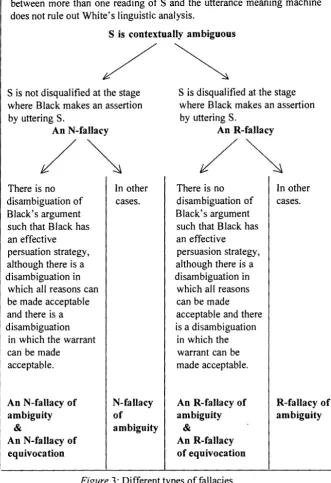
In AD, the norms are part of a procedure for resolving conflicts in an optimal way. In a pragma-dialectical sense, violations of AD-norms are therefore fallacies. I shall call these Norm Violating Fallacies or N-fallacies. These moves deserve to be actively criticized as an obstacle to the resolution of the initial conflict of opin-ions, although they are a proper part of a discussion. N-fallacies are not ruled out by the rules of AD. I call violations of AD-rules Rule Violating Fallacies, or R-fallacies. These are more serious obstacles to conflict resolution. By committing
an R-fallacy, the perpetrator has abandoned the confines of a critical discussion altogether.20
Black makes an assertion by uttering sentence S. White can distinguish between more than one reading of S and the utterance meaning machine does not rule out White's linguistic analysis.
S is contextually ambiguous
/~
S is not disqualified at the stagewhere Black makes an assertion by uttering S.
An N-faJlacy
/~
There is no disambiguation of Black's argument such that Black has an effective persuation strategy, although there is a disambiguation in
which all reasons can be made acceptable and there is a disambiguation
in which the warrant can be made
acceptable.
An N-fallacy of ambiguity
&
An N-faJlacy of equivocation
In other cases.
N-fallacy of
ambiguity
S is disqualified at the stage where Black makes an assertion by uttering S.
An R-fallacy
/~
There is no disambiguation of Black's argument
such that Black has an effective persuasion strategy, although there is a disambiguation in
which all reasons can be made acceptable and there is a disambiguation
in which the warrant can be made acceptable.
An R-fallacy of ambiguity
&
An R-fallacy of equivocation
In other cases.
R-fallacy of ambiguity
Appendix: Towards a formal model of ambiguity dialectics
In this appendix I give an incomplete sketch of a formal model that states reason-able dialectical rights and obligations for discussants. The model AD is a close relative of the family of models for persuasion dialogues that is presented in Walton & Krabbe (1995). In the description of AD, I have made ample use of notations and ideas from these models. The models to be found there are richer in that they regulate incurring and retracting different kinds of commitments. AD is richer in that it contains rules concerning the use and criticism of ambiguous sentences and in incorporating criticism ofN-fallacies.
AD has also features of pragma-dialectics. in that it makes use ofthe idea of a norm for critical discussion. Pragma-dialectics is richer in that it concerns more important norms for critical discussion. AD is richer in that it incorporates the norm for language use into a more permissive dialectical model in which fallacies or norm-violations can be discussed.
Norms of discussion
There is only one norm in AD, the one stated in section 5. To improve the model, other norms should be incorporated.
Norm: Do not make assertions by uttering sentences that are contextually am-biguous!
The norm has a strategic flavor, for what is or is not a contextually ambiguous sentence is, according to the present perspective, determined during the dialogue. If a sentence is or gets disqualified at a certain stage, while it is not reinstated at a later stage ofthe discussion as not-disqualified, then this sentence is at all stages of the discussion contextually ambiguous.
Locution Rules of AD
In the locution rules it is stated what language the discussants use, what speech acts they can perform with sentences ofthis language and what a move in an AD-discussion looks like.
1: The language that is used in the discussion is the language of sentential logic, named L. The set of sentences of L is defined by using an infinite set of atomic sentence letters, PI' P2, Pl' ... , the logical connectors, A, v, ...,. ~, B. and
parentheses, ) and (. All atomic sentence letters are sentences ofL. Suppose S and T are sentences of L, then so are (SAT). (SvT), ...,S, (S~ T) and (SB T).
Nothing else is a sentence of L. In order to refer to arbitrary sentences of L. use will be made of the letters S, S', T, T'. SI' S2 .... ' TI, T2, .. , S'I' S'2"'"
2: The following types of locutions or speech acts are permitted during the dia-logue.
Elementary arguments:
J,
T
or equivalently, T,&' .. &T"soT,
or more shortly, !!soT.
Disambiguated basic arguments at stage i: (see definition below)
Concessions: c(S)
Challenges: S??
Fallacy criticisms:
Ambiguity criticisms: (S)Amb(Sr"S,),
where S, SI,,,,,Sn are atomic sentence letters.
Equivocation criticisms: (S)Amb(SI, .... S,) & I'll win the ensuing dialogue,
where S, SI'""Sn are atomic sentence letters.
Retractions: nc(S).
nc((S)Amb(S" .... S,)),
nc((S)Amb(SI' .... S,) & I'll win the ensuing dialogue)
By 'disambiguated basic argument at stage i' the following is meant. The rules of
AD are such that White is allowed to challenge one of the elements
Q
of anel-ementary arguments T,&. .. &TioT The elements of an elementary argument are
the reasons ~ and the associated warrant (T/, ... I\T,)-?T. After such a challenge
Black has a prima!acie obligation to offer an elementary argument for the chal-lenged element. So, when at a stage Black has offered a few elementary argu-ments, they can be combined into one complex of elementary arguments. Such a complex is named a basic argument by Walton and Krabbe (1995, p. 129), and is defined by me in a slightly different way.
a. Elementary arguments T,&. .. &TnsoT are basic arguments.
b. If ~ is a basic argument with premises T1, .... ,Tj' .... ,Tn and conclusion T, and if
,!,
T.
I
over T, or over the added associated warrant (T,/\ ... /\ T )~ T in the following
J 0
manner
,!,
T, & ... & Tn & (T,/\ ... /\T)~T
is again a basic argument.
c. Nothing is a basic argument that cannot be constructed by the above two rules. If White criticizes Black of having used some contextually ambiguous atomic sentence, she does this by presenting the allegedly ambiguous atomic sentence S and some disambiguating reformulations SI""'So' A disambiguated basic ar-gument at stage i is formed by the basic arar-gument, constituted by all elementary arguments that Black has offered until stage i, in which all occurrences ofS are replaced by occurrences of SI""'S" or by occurrences of even other atomic sentences S' I, ... ,S'",.
3: A move is made lip of either:
• a challenge. possibly combined with some concessions, or
• an elementary argument, or
• a fallacy criticism, or
• an utterance meaning testing procedure, possibly combined with a disambiguated basic argument. or
• a disambiguated basic argument, or
• a retraction of a fallacy criticism, or
• a concession of the main thesis. possibly combined with a retraction of an equivocation criticism, or
• a retraction of the main thesis.
Commitment Rules
I: Each party has a commitment store, which indicates the party's obligations at a certain stage of the discussion. A commitment store is a set with sentences of L or fallacy criticisms as its elements.
2: At the start of the discussion Black's commitment store contains exactly one sentence, which is the main thesis throughout the discussion. White's commit-ment store may be empty, but may also contain sentences of L.
3: If White uses the expression c(S) at a stage i, then from the next stage on, White's commitment store also contains S.
4: If Black uses an elementary argument T,&. ... T"soT at stage i, then from stage i+l Black's commitment store contains T, and .... and T", and also the warrant assoc iated with the elementary argument (T/, .... I\T,)~ T.
5: If White raises a fallacy criticism at stage i (S)Amb(Sr"S,) or (S)Amb(Sj""S,)
& I'll win the ensuing dialogue, then from the next stage on, White's commit-ment store contains this fallacy criticism.
6: If White raises a fallacy criticism against S. then S is disqualified until White retracts this fallacy criticism.
7: If Black uses a disambiguated basic argument at stage i, then Black's commit-ment store is emptied and filled again with all basic reasons of the disambiguated basic argument together with all warrants associated with the elementary argu-ments that make up the disambiguated basic argument.
8: If a party retracts a sentence S or a fallacy criticism F at stage i, then from the next stage on, S or F is no longer an element of this party's commitments store.
Structural Rules
I: The parties make moves alternately.
2: White makes the first move in which she challenges Black's main thesis. 3: Ifin the preceding move White challenged Black's assertion T, then Black has to
offer an elementary argument, ruoT.
4: ruoTmay be used only if some earlier move contained T??
5: If the preceding move contained an elementary argument ruoT, White must either challenge one element Q (a reason or a warrant) of the argument ruoT, challenge one element Q (a reason or a warrant) of the argument ruoT and concede some other elements of ruoT. raise a fallacy criticism. or concede the main thesis.
6: A challenge T/? by White is allowed only if Tj is not a concession of White,
T,
has not been challenged before, T; is in Black's commitment store and T; is an element of the argument offered by Black in the preceding move.
7: If S is an atomic sentence that occurs within an argument offered by Black at stagej, then White is allowed to utter (S)Amb(SI'''''S,) or to utter (S)Amb(S" ... ,S,)
& I'll win the ensuing dialogue at stage j+ 1, unless S has been proposed by White as a disambiguated reformulation in some fallacy criticism at stage i, i<j. 8: If the preceding move contains (S)AmbfS" .... S,). or (S)Amb(S" ... S,) & I'll
a) perform an utterance meaning testing procedure, that is, checking whether in this context of use each of the S's is a formulation of an ,
interpretation of S that is admissible from a linguistic point of view, or b) offer a disambiguated basic argument.21
9: If the outcome of an utterance meaning testing procedure performed by Black is negative, then White must retract the fallacy criticism. If the outcome is posi-tive, then Black is obliged to present a disambiguated basic argument in the same move.
10: If Black offers a disambiguated argument in which he uses disambiguated formulations S"""'S'm' that were not proposed by White in her fallacy criticism (S)Amb(S" ... ,S,) or in (S)Amb(S"".,S,)&I'Il win the ensuing dialogue, then White may perform an utterance meaning testing procedure that has as an input the allegedly ambiguous sentence S, the set of disambiguated formulations S' " ... ,S'm and the current context of use C. If the outcome is positive, Black repeats his disambiguated argument, if the outcome is negative, Black is obliged to offer a new disambiguated basic argument, in which all occurrences of S are replaced by using only S"""SI/'
11: If an earlier stage contained an utterance meaning testing procedure with as input S, S".",S" and C, then it is not allowed to perform this test with exactly this input again.
12: If Black uses some atomic sentence S; in a disambiguated basic argument and
S; does not occur in a fallacy criticism by White, then White has the right to raise a fallacy criticism towards Sj'
13: If the preceding move contains an equivocation criticism, and Black offers a disambiguated basic argument, then this move is regarded as a challenge to the second conjunct of White's criticism, because by that Black starts a discus-sion, such that if White concedes the main thesis, she immediately has to re-tract her equivocation criticism.
14: If Black offers a disambiguated argument then White may challenge a basic reason of this complex argument, or one of the warrants that are associated with the elementary arguments that make up the disambiguated argument. 15: If White wins the discussion after she raised an equivocation criticism, then
the equivocation criticism is regarded as sustained.22
16: If White raises a fallacy criticism at stage i+ 1 and retracts it at a later stage j, then Black is allowed to repeat at stage j+ I his argument offered at stage i. 17: If White has uttered an equivocation criticism, has not yet retracted it and
utters e(T), where T is the main thesis, then she has to retract the equivocation criticism immediately.
18: It is not allowed to use disqualified sentences in elementary or disambiguated basic arguments.
20: At every stage, White is allowed to utter e(T), where T is the main thesis of the discussion.
Win-and-Loss Rules
1: If Black utters ne(T), T being the main thesis, then Black has lost the discussion, and White has won the discussion.
2: If White utters e(T), T being the main thesis, then White has lost the discussion, and Black has won the discussion.
Notes
I Pragma-dialectics has much to say about applying the rules to real discussions, but this is not
considered part of the ideal model for critical discussion. However, in 1984 and 2000 van Eemeren and Grootendorst propose a rule that states rights and obligations concerning requests for usage declaratives. These requests seem to be related to fallacy eriticisms.
2 Hamblin named contributions that pertain directly to the issue under consideration topic points. 3 The opponent may yriticize it by making a distinction between different readings of her own concessions. However, there is no real burden of proof associated with this criticism.
4 Mackenzie, however, does not relate this to the theory of fallacies. 5 In footnote 15 I shall give a motivation for this.
6 The informal notion of the ambiguity ofS should not depend on the awareness or actual behavior
of the opponent, but on something that can only be indicated vaguely: for instance, the oppo-nent's actual behavior towards S if she reflects thoroughly on her position or ifher attention were directed to the need for making the distinction (M. Black 1990, 182). In the appendix, a more formal and restricted explication of ambiguity is given.
1 To translate 'en presisering' by 'disambiguating reformulation' is a suggestion found in Barth and Krabbe, who themselves use the term 'clarifying reformulation' (1982, 21).
g This could be part of the shared background knowledge of the discussants; the discussants could
have reached an agreement on it in the opening stage of the discussion; or the opponent could have expressed it during their present discussion. In the sketch of a formal model to be found in the appendix, I will only consider this last possibility.
9 Although in such a case the proponent is aware of committing a fallacy of ambiguity.
10 In such a case the proponent has an incorrect picture of the opponent's semantic dispositions, aceording to which the opponent sees just one reading, while the opponent actually sees a few readings but not the reading the proponent had in mind.
II The translation is mine. The first dialogue fragment below was constructed by me, the second
dialogue fragment resembles to some degree what happened in court.
12 This is a somewhat strong presupposition. It would suffice if the lawyer thinks there is a reasonable chance that this is an adequate picture of the judge's position.
13 In van Eemeren & Grootendorst (2000) there is a distinction between rules for critical
discus-sion and rules of conduct. It seems especially to be directed to two different levels of generality of norms for critical discussion (as they are called in this paper).
14 In order to make the model more complete, other norms should be incorporated.
proponent, then the proponent can freely make use of a more precise formulated reason and see whether the opponent concedes or challenges it. So there is no urgent need for the proponent to criticize an ambiguous concession.
16 The focus of an ambiguity criticism or equivocation criticism in AD is an atomic sentence S, that may occur as a reason or thesis on its own, or as a constituent sentence of a logically more complex reason or thesis.
17 Our brain resembles such a machine, except that the outcome of the machine is overt and decisive for the commitments of the discussants.
18 Using the pragma-dialectical notion of an opening stage this situation can be described as follows. The discussants have in the opening stage determined for some pairs of sentences, but not for all, that one ofthem is or is not a proper disambiguating reformulation of the other.
19 Linguistic indeterminacy on the issue of synonymy will again lead to a positive outcome and
will in this situation be in favor of Black.
20 The points of order dealt with in this paper can be related to Krabbe's distinction in the following way. An ambiguity or equivocation criticism can be seen as an active criticism relative to the rules and as a fallacy criticism relative to the norm (Krabbe 1996, 134-135).
21 This still leaves Black two options: using White's linguistic analysis or using an alternative
analysis.
22 In AD it is possible that an ambiguity criticism is retracted or sustained, after which the
discussion continues. Raising this fallacy criticism has direct procedural consequences, as for whether some sentence S is disqualified or not. In AD it is not possible for the discussion to continue after an equivocation criticism has been sustained (but in some cases it is possible ifit is retracted), for in a move in which it is sustained the discussion ends. However, the result of such an elementary kind of discussion is not only that party X won or lost the discussion, but also that, for at least these discussants, and for these kinds of issues, sentence S is disqualified or not. The result of a successful equivocation criticism can have consequences for other, related discussions.
References
Barth, E.M. and E.C.W. Krabbe. 1982. From Axiom to Dialogue: A Philosophical Study of Logics and Argumentation. Berlin, New York: de Gruyter.
Black, M. 1990. Perplexities. New York: Cornell University Press,
Eemeren, F .H. van and R. Grootendorst. 1984. Speech acts in argumentative discus-sions: A theoretical model for the analysis of discussions directed towards solving coriflicts of opinion. Dordrecht: Fods.
Eemeren, F.H. van and R. Grootendorst. 1992. Argumentation, Communication and Fallacies. Hillsdale NJ.: Lawrence Erlbaum.
Eemeren, F.H. van and R. Grootendorst. 2000. Kritische discussie, Amsterdam: Boom. Finocchiaro, M,A. 1980. Calileo and the Art of Reasoning. Rhetorical Foundations of
Logic and Scientific Method. Dordrecht: D. Reidel Publishing Company. Hamblin,
c.L.
1970. Fallacies. Virginia: Vale Press.Krabbe, E.C. W. 1996. "Can we ever pin one down to a formal fallacy?" In 1. van Benthem, F.R van Eemeren, R. Grootendorst and F. Veltman (eds.), Logic and Argumentation,
129-142. Amsterdam: Koninklijke Nederlandse Akademie van Wetenschappen. Mackenzie, J.D. 1988. "Distinguo! The response to equivocation," Argumentation 2:
Mackenzie, J.D. 1981. "The dialectics of Logic," Logique et analyse 24: 159-177.
Naess, A. 1966. Communication and Argument: Elements of applied semantics. Oslo:
Universitetsforlaget.
Searle, J.R. 1970. Speech Acts: An essay in the philosophy of language. Cambridge:
Cambridge University Press.
Walton, D. 1996. Fallacies Arisingfrom Ambiguity. Dordrecht: Kluwer Academic
Pub-lishers.
Walton, D. and E.C.W. Krabbe. 1995. Commitment in Dialogue. Basic Concepts of
Interpersonal Reasoning. New York: SUNY.