VOLUME NO.3(2013),ISSUE NO.04(APRIL) ISSN2231-5756
A Monthly Double-Blind Peer Reviewed (Refereed/Juried) Open Access International e-Journal - Included in the International Serial Directories
Indexed & Listed at:
VOLUME NO.3(2013),ISSUE NO.04(APRIL) ISSN2231-5756
INTERNATIONAL JOURNAL OF RESEARCH IN COMMERCE, IT & MANAGEMENT
CONTENTS
CONTENTS
CONTENTS
CONTENTS
Sr.No.
TITLE & NAME OF THE AUTHOR (S)
Page No. 1. ISLAMIC FINANCE AWARENESS IN PUBLIC AND FINANCIAL SECTOR
GHULAM MUSTAFA SHAMI, DR. MUHAMMAD RAMZAN & AFAQ RASOOL
1 2. GREEN MARKETING: THE INDIAN CORPORATE SCENARIO
RAVINDER PAL SINGH
5 3. EXCHANGE RATE MANAGEMENT: A CRITICAL LOOK INTO SEVERAL ALTERNATIVES
PURNASHREE DAS & SUJIT SIKIDAR
9 4. AN EMPIRICAL STUDY OF SERVQUAL, CUSTOMER SATISFACTION AND LOYALTY IN INDIAN BANKING SECTOR
RAVINDRA KUMAR KUSHWAHA, DR. MADAN MOHAN & DEBASHISH MANDAL
13 5. CHINA’S CURRENCY POLICY: WINNERS AND LOSERS OF AN INDIRECT EXPORT SUBSIDY
GHULAM MUSTAFA SHAMI, DR. MUHAMMAD RAMZAN & AFAQ RASOOL
19 6. SALES STYLES OF EXECUTIVES SELLING TWO AND FOUR WHEELERS
DR. NAVPREET SINGH SIDHU
23 7. FINANCIAL AND TAXATION ISSUES OF MICRO FINANCE BILL 2012: A MOVE TOWARDS RESPONSIBLE MICROFINANCE IN INDIA
DR DHARUV PAL SINGH
29 8. STUDENTS’ CRITERIA IN SELECTING A BUSINESS SCHOOL
DR. JEEMON JOSEPH
33 9. CONSUMER BEHAVIOR IN ELECTRONIC BANKING: AN EMPIRICAL STUDY
DHARMESH MOTWANI & DR. DEVENDRA SHRIMALI
38 10. A NEW NOTION PROXIMITY FOR DATA PUBLISHING WITH PRIVACY PRESERVATION
S. BOOPATHY & P. SUMATHI
41 11. A STUDY ON ATTITUDE TOWARDS KNOWLEDGE SHARING AMONG KNOWLEDGE WORKERS IN EDUCATIONAL INSTITUTIONS IN MYSORE CITY
NITHYA GANGADHAR & SINDU KOPPA
47 12. MARKOV CHAINS USED TO DETERMINE THE MODEL OF STOCK VALUE AND COMPARED WITH P/E MODEL
ROYA DARABI & ZEINAB JAVADIYAN KOTENAIE
56 13. APPLICATION OF PERT TECHNIQUE IN HEALTH PROGRAMME MONITORING AND CONTROL
DR. SUSMIT JAIN
63 14. ESTIMATION OF TECHNICAL EFFICIENCIES OF INDIAN MICROFINANCE INSTITUTIONS USING STOCHASTIC FRONTIER ANALYSIS
B.CHANDRASEKHAR
69 15. EFFECTIVE RETENTION STRATEGIES IN WORKING ENVIRONMENT
C. KAVITHA
76 16. A COMPARATIVE STUDY OF QUALITY OF WORK LIFE OF WOMEN EMPLOYEES WITH REFERENCE TO PRIVATE AND PUBLIC BANKS IN
KANCHIPURAM DISTRICT
A. VANITHA
78
17. MANAGEMENT OF DISTANCE EDUCATION SYSTEM THROUGH ORGANIZATIONAL NETWORK
MEENAKSHI CHAHAL
86 18. A STUDY ON CONSTRUCTION OF OPTIMAL PORTFOLIO USING SHARPE’S SINGLE INDEX MODEL
ARUN KUMAR .S.S & MANJUNATHA.K
88 19. A STUDY ON EMPLOYEE ENGAGEMENT OF SELECT PLANT MANUFACTURING COMPANIES OF RAJASTHAN
VEDIKA SHARMA & SHUBHASHREE SHARMA
99 20. RELIABLE AND DISPERSED DATA SECURITY MECHANISM FOR CLOUD ENVIRONMENT
C. PRIYANGA & A. RAMACHANDRAN
104 21. CONSTRUCTION OF OPTIMUM PORTFOLIO WITH SPECIAL REFERENCE TO BSE 30 COMPANIES IN INDIA
DR. KUSHALAPPA. S & AKHILA
108 22. INVESTIGATING QUALITY OF EDUCATION IN BUSINESS AND ECONOMICS PROGRAMS OF ADDIS ABABA UNIVERSITY (AAU) AND BAHIRDAR
UNIVERSITY (BDU)
BIRUK SOLOMON HAILE
112
23. FACTORS AFFECTING APPLICABILITY OF SECURITY CONTROLS IN COMPUTERIZED ACCOUNTING SYSTEMS
AMANKWA, ERIC
120 24. THE EFFECT OF POVERTY ON HOUSEHOLDS’ VULNERABILITY TO HIV/AIDS INFECTION: THE CASE OF BAHIR DAR CITY IN NORTH-WESTERN
ETHIOPIA
GETACHEW YIRGA & SURAFEL MELAK
128
25. STRATEGIC RESPONSES TO CHANGES IN THE EXTERNAL ENVIRONMENT: A CASE OF EAST AFRICAN BREWERIES LIMITED
PATRICIA GACHAMBI MWANGI, MARTIN MUTWIRI MURIUKI & NEBAT GALO MUGENDA
134 26. DEMOGRAPHIC VARIABLES AND THE LEVEL OF OCCUPATIONAL STRESS AMONG THE TEACHERS OF GOVERNMENT HIGHER SECONDARY SCHOOLS
IN MADURAI DISTRICT
DR. S. S. JEYARAJ
139
27. HUMAN RESOURCE INFORMATION SYSTEM
DR. NEHA TOMAR SINGH
149 28. THE EFFECTS OF CORPORATE GOVERNANCE ON COMPANY PERFORMANCE: EVIDENCE FROM SRI LANKAN FINANCIAL SERVICES INDUSTRY
RAVIVATHANI THURAISINGAM
154 29. A STUDY ON FINANCIAL HEALTH OF TEXTILE INDUSTRY IN INDIA: Z – SCORE APPROACH
SANJAY S. JOSHI
159 30. REGULATORY FRAME WORK OF GOOD CORPORATE GOVERNANCE WITH REFERENCE TO INDIAN CORPORATE GOVERNANCE MECHANISMS
G. VARA KUMAR & SHAIK MAHABOOB SYED
165
VOLUME NO.3(2013),ISSUE NO.04(APRIL) ISSN2231-5756
CHIEF PATRON
CHIEF PATRON
CHIEF PATRON
CHIEF PATRON
PROF. K. K. AGGARWAL
Chancellor, Lingaya’s University, Delhi
Founder Vice-Chancellor, Guru Gobind Singh Indraprastha University, Delhi
Ex. Pro Vice-Chancellor, Guru Jambheshwar University, Hisar
FOUNDER
FOUNDER
FOUNDER
FOUNDER PATRON
PATRON
PATRON
PATRON
LATE SH. RAM BHAJAN AGGARWAL
Former State Minister for Home & Tourism, Government of Haryana
Former Vice-President, Dadri Education Society, Charkhi Dadri
Former President, Chinar Syntex Ltd. (Textile Mills), Bhiwani
CO
CO
CO
CO----ORDINATOR
ORDINATOR
ORDINATOR
ORDINATOR
AMITA
Faculty, Government M. S., Mohali
ADVISORS
ADVISORS
ADVISORS
ADVISORS
DR. PRIYA RANJAN TRIVEDI
Chancellor, The Global Open University, Nagaland
PROF. M. S. SENAM RAJU
Director A. C. D., School of Management Studies, I.G.N.O.U., New Delhi
PROF. M. N. SHARMA
Chairman, M.B.A., Haryana College of Technology & Management, Kaithal
PROF. S. L. MAHANDRU
Principal (Retd.), Maharaja Agrasen College, Jagadhri
EDITOR
EDITOR
EDITOR
EDITOR
PROF. R. K. SHARMA
Professor, Bharti Vidyapeeth University Institute of Management & Research, New Delhi
CO
CO
CO
CO----EDITOR
EDITOR
EDITOR
EDITOR
DR. BHAVET
Faculty, Shree Ram Institute of Business & Management, Urjani
EDITORIAL ADVISORY BOARD
EDITORIAL ADVISORY BOARD
EDITORIAL ADVISORY BOARD
EDITORIAL ADVISORY BOARD
DR. RAJESH MODI
Faculty, Yanbu Industrial College, Kingdom of Saudi Arabia
PROF. SANJIV MITTAL
University School of Management Studies, Guru Gobind Singh I. P. University, Delhi
PROF. ANIL K. SAINI
Chairperson (CRC), Guru Gobind Singh I. P. University, Delhi
DR. SAMBHAVNA
VOLUME NO.3(2013),ISSUE NO.04(APRIL) ISSN2231-5756
INTERNATIONAL JOURNAL OF RESEARCH IN COMMERCE, IT & MANAGEMENT
DR. MOHENDER KUMAR GUPTA
Associate Professor, P. J. L. N. Government College, Faridabad
DR. SHIVAKUMAR DEENE
Asst. Professor, Dept. of Commerce, School of Business Studies, Central University of Karnataka, Gulbarga
ASSOCIATE EDITORS
ASSOCIATE EDITORS
ASSOCIATE EDITORS
ASSOCIATE EDITORS
PROF. NAWAB ALI KHAN
Department of Commerce, Aligarh Muslim University, Aligarh, U.P.
PROF. ABHAY BANSAL
Head, Department of Information Technology, Amity School of Engineering & Technology, Amity
University, Noida
PROF. A. SURYANARAYANA
Department of Business Management, Osmania University, Hyderabad
DR. SAMBHAV GARG
Faculty, Shree Ram Institute of Business & Management, Urjani
PROF. V. SELVAM
SSL, VIT University, Vellore
DR. PARDEEP AHLAWAT
Associate Professor, Institute of Management Studies & Research, Maharshi Dayanand University, Rohtak
DR. S. TABASSUM SULTANA
Associate Professor, Department of Business Management, Matrusri Institute of P.G. Studies, Hyderabad
SURJEET SINGH
Asst. Professor, Department of Computer Science, G. M. N. (P.G.) College, Ambala Cantt.
TECHNICAL ADVISOR
TECHNICAL ADVISOR
TECHNICAL ADVISOR
TECHNICAL ADVISOR
AMITA
Faculty, Government M. S., Mohali
FINANCIAL ADVISORS
FINANCIAL ADVISORS
FINANCIAL ADVISORS
FINANCIAL ADVISORS
DICKIN GOYAL
Advocate & Tax Adviser, Panchkula
NEENA
Investment Consultant, Chambaghat, Solan, Himachal Pradesh
LEGAL ADVISORS
LEGAL ADVISORS
LEGAL ADVISORS
LEGAL ADVISORS
JITENDER S. CHAHAL
Advocate, Punjab & Haryana High Court, Chandigarh U.T.
CHANDER BHUSHAN SHARMA
Advocate & Consultant, District Courts, Yamunanagar at Jagadhri
SUPERINTENDENT
SUPERINTENDENT
SUPERINTENDENT
SUPERINTENDENT
SURENDER KUMAR POONIA
VOLUME NO.3(2013),ISSUE NO.04(APRIL) ISSN2231-5756
CALL FOR MANUSCRIPTS
CALL FOR MANUSCRIPTS
CALL FOR MANUSCRIPTS
CALL FOR MANUSCRIPTS
Weinvite unpublished novel, original, empirical and high quality research work pertaining to recent developments & practices in the area of Computer, Business, Finance, Marketing, Human Resource Management, General Management, Banking, Education, Insurance, Corporate Governance and emerging paradigms in allied subjects like Accounting Education; Accounting Information Systems; Accounting Theory & Practice; Auditing; Behavioral Accounting; Behavioral Economics; Corporate Finance; Cost Accounting; Econometrics; Economic Development; Economic History; Financial Institutions & Markets; Financial Services; Fiscal Policy; Government & Non Profit Accounting; Industrial Organization; International Economics & Trade; International Finance; Macro Economics; Micro Economics; Monetary Policy; Portfolio & Security Analysis; Public Policy Economics; Real Estate; Regional Economics; Tax Accounting; Advertising & Promotion Management; Business Education; Management Information Systems (MIS); Business Law, Public Responsibility & Ethics; Communication; Direct Marketing; E-Commerce; Global Business; Health Care Administration; Labor Relations & Human Resource Management; Marketing Research; Marketing Theory & Applications; Non-Profit Organizations; Office Administration/Management; Operations Research/Statistics; Organizational Behavior & Theory; Organizational Development; Production/Operations; Public Administration; Purchasing/Materials Management; Retailing; Sales/Selling; Services; Small Business Entrepreneurship; Strategic Management Policy; Technology/Innovation; Tourism, Hospitality & Leisure; Transportation/Physical Distribution; Algorithms; Artificial Intelligence; Compilers & Translation; Computer Aided Design (CAD); Computer Aided Manufacturing; Computer Graphics; Computer Organization & Architecture; Database Structures & Systems; Digital Logic; Discrete Structures; Internet; Management Information Systems; Modeling & Simulation; Multimedia; Neural Systems/Neural Networks; Numerical Analysis/Scientific Computing; Object Oriented Programming; Operating Systems; Programming Languages; Robotics; Symbolic & Formal Logic and Web Design. The above mentioned tracks are only indicative, and not exhaustive.
Anybody can submit the soft copy of his/her manuscript anytime in M.S. Word format after preparing the same as per our submission guidelines duly available on our website under the heading guidelines for submission, at the email address: [email protected].
GUIDELINES FOR SUBM
GUIDELINES FOR SUBM
GUIDELINES FOR SUBM
GUIDELINES FOR SUBMISSION OF MANUSCRIPT
ISSION OF MANUSCRIPT
ISSION OF MANUSCRIPT
ISSION OF MANUSCRIPT
1. COVERING LETTER FOR SUBMISSION:
DATED: _____________
THE EDITOR IJRCM
Subject: SUBMISSION OF MANUSCRIPT IN THE AREA OF.
(e.g. Finance/Marketing/HRM/General Management/Economics/Psychology/Law/Computer/IT/Engineering/Mathematics/other, please specify)
DEAR SIR/MADAM
Please find my submission of manuscript entitled ‘___________________________________________’ for possible publication in your journals.
I hereby affirm that the contents of this manuscript are original. Furthermore, it has neither been published elsewhere in any language fully or partly, nor is it under review for publication elsewhere.
I affirm that all the author (s) have seen and agreed to the submitted version of the manuscript and their inclusion of name (s) as co-author (s).
Also, if my/our manuscript is accepted, I/We agree to comply with the formalities as given on the website of the journal & you are free to publish our contribution in any of your journals.
NAME OF CORRESPONDING AUTHOR:
Designation:
Affiliation with full address, contact numbers & Pin Code: Residential address with Pin Code:
Mobile Number (s): Landline Number (s): E-mail Address: Alternate E-mail Address:
NOTES:
a) The whole manuscript is required to be in ONE MS WORD FILE only (pdf. version is liable to be rejected without any consideration), which will start from
the covering letter, inside the manuscript.
b) The sender is required to mentionthe following in the SUBJECT COLUMN of the mail:
New Manuscript for Review in the area of (Finance/Marketing/HRM/General Management/Economics/Psychology/Law/Computer/IT/
Engineering/Mathematics/other, please specify)
c) There is no need to give any text in the body of mail, except the cases where the author wishes to give any specific message w.r.t. to the manuscript. d) The total size of the file containing the manuscript is required to be below 500 KB.
e) Abstract alone will not be considered for review, and the author is required to submit the complete manuscript in the first instance.
f) The journal gives acknowledgement w.r.t. the receipt of every email and in case of non-receipt of acknowledgment from the journal, w.r.t. the submission
of manuscript, within two days of submission, the corresponding author is required to demand for the same by sending separate mail to the journal.
2. MANUSCRIPT TITLE: The title of the paper should be in a 12 point Calibri Font. It should be bold typed, centered and fully capitalised.
3. AUTHOR NAME (S) & AFFILIATIONS: The author (s) full name, designation, affiliation (s), address, mobile/landline numbers, and email/alternate email address should be in italic & 11-point Calibri Font. It must be centered underneath the title.
4. ABSTRACT: Abstract should be in fully italicized text, not exceeding 250 words. The abstract must be informative and explain the background, aims, methods,
VOLUME NO.3(2013),ISSUE NO.04(APRIL) ISSN2231-5756
INTERNATIONAL JOURNAL OF RESEARCH IN COMMERCE, IT & MANAGEMENT
5. KEYWORDS: Abstract must be followed by a list of keywords, subject to the maximum of five. These should be arranged in alphabetic order separated bycommas and full stops at the end.
6. MANUSCRIPT: Manuscript must be in BRITISH ENGLISH prepared on a standard A4 size PORTRAIT SETTING PAPER. It must be prepared on a single space and
single column with 1” margin set for top, bottom, left and right. It should be typed in 8 point Calibri Font with page numbers at the bottom and centre of every page. It should be free from grammatical, spelling and punctuation errors and must be thoroughly edited.
7. HEADINGS: All the headings should be in a 10 point Calibri Font. These must be bold-faced, aligned left and fully capitalised. Leave a blank line before each
heading.
8. SUB-HEADINGS: All the sub-headings should be in a 8 point Calibri Font. These must be bold-faced, aligned left and fully capitalised.
9. MAIN TEXT: The main text should follow the following sequence:
INTRODUCTION
REVIEW OF LITERATURE
NEED/IMPORTANCE OF THE STUDY
STATEMENT OF THE PROBLEM
OBJECTIVES
HYPOTHESES
RESEARCH METHODOLOGY
RESULTS & DISCUSSION
FINDINGS
RECOMMENDATIONS/SUGGESTIONS
CONCLUSIONS
SCOPE FOR FURTHER RESEARCH
ACKNOWLEDGMENTS
REFERENCES
APPENDIX/ANNEXURE
It should be in a 8 point Calibri Font, single spaced and justified. The manuscript should preferably not exceed 5000 WORDS.
10. FIGURES &TABLES: These should be simple, crystal clear, centered, separately numbered & self explained, and titles must be above the table/figure. Sources of data should be mentioned below the table/figure. It should be ensured that the tables/figures are referred to from the main text.
11. EQUATIONS:These should be consecutively numbered in parentheses, horizontally centered with equation number placed at the right.
12. REFERENCES: The list of all references should be alphabetically arranged. The author (s) should mention only the actually utilised references in the preparation
of manuscript and they are supposed to follow Harvard Style of Referencing. The author (s) are supposed to follow the references as per the following:
•
All works cited in the text (including sources for tables and figures) should be listed alphabetically.•
Use (ed.) for one editor, and (ed.s) for multiple editors.•
When listing two or more works by one author, use --- (20xx), such as after Kohl (1997), use --- (2001), etc, in chronologically ascending order.•
Indicate (opening and closing) page numbers for articles in journals and for chapters in books.•
The title of books and journals should be in italics. Double quotation marks are used for titles of journal articles, book chapters, dissertations, reports, workingpapers, unpublished material, etc.
•
For titles in a language other than English, provide an English translation in parentheses.•
The location of endnotes within the text should be indicated by superscript numbers.PLEASE USE THE FOLLOWING FOR STYLE AND PUNCTUATION IN REFERENCES: BOOKS
•
Bowersox, Donald J., Closs, David J., (1996), "Logistical Management." Tata McGraw, Hill, New Delhi.•
Hunker, H.L. and A.J. Wright (1963), "Factors of Industrial Location in Ohio" Ohio State University, Nigeria. CONTRIBUTIONS TO BOOKS•
Sharma T., Kwatra, G. (2008) Effectiveness of Social Advertising: A Study of Selected Campaigns, Corporate Social Responsibility, Edited by David Crowther &Nicholas Capaldi, Ashgate Research Companion to Corporate Social Responsibility, Chapter 15, pp 287-303. JOURNAL AND OTHER ARTICLES
•
Schemenner, R.W., Huber, J.C. and Cook, R.L. (1987), "Geographic Differences and the Location of New Manufacturing Facilities," Journal of Urban Economics,Vol. 21, No. 1, pp. 83-104. CONFERENCE PAPERS
•
Garg, Sambhav (2011): "Business Ethics" Paper presented at the Annual International Conference for the All India Management Association, New Delhi, India,19–22 June.
UNPUBLISHED DISSERTATIONS AND THESES
•
Kumar S. (2011): "Customer Value: A Comparative Study of Rural and Urban Customers," Thesis, Kurukshetra University, Kurukshetra.ONLINE RESOURCES
•
Always indicate the date that the source was accessed, as online resources are frequently updated or removed.WEBSITES
VOLUME NO.3(2013),ISSUE NO.04(APRIL) ISSN2231-5756
A STUDY ON ATTITUDE TOWARDS KNOWLEDGE SHARING AMONG KNOWLEDGE WORKERS IN
EDUCATIONAL INSTITUTIONS IN MYSORE CITY
NITHYA GANGADHAR
ASST. PROFESSOR
JSS CENTRE FOR MANAGEMENT STUDIES
JSS TECHINAL INSTITUTIONS CAMPUS
SRI JAYACHAMARAJENDRA COLLEGE OF ENGINEERING
MYSORE
SINDU KOPPA
ASST. PROFESSOR
JSS CENTRE FOR MANAGEMENT STUDIES
JSS TECHINAL INSTITUTIONS CAMPUS
SRI JAYACHAMARAJENDRA COLLEGE OF ENGINEERING
MYSORE
ABSTRACT
As the world moves towards a ‘Knowledge-Based Economy’, Knowledge today is regarded as a factor of production together with land, labor and capital. Academicians have shown inhibition to share. In many cases, they even discourage such sharing. So, Knowledge Sharing must be seen in relation to the overall development of the intellectual and moral aspects of the teaching profession. Against this background, the proposed paper intends to focus on the knowledge processing aspect with greater emphasis on knowledge sharing in educational institutes. The study is proposed to be conducted to understand general attitude of knowledge workers towards knowledge sharing, knowledge workers barriers to share knowledge and knowledge workers views towards strategies to encourage knowledge sharing. The study being empirical, adopts structured questionnaire based survey method to collect primary data through convenient sampling technique among knowledge workers in the B-Schools and Engineering colleges in the Mysore city. Educational institutions are placed in the critical role of knowledge production. The knowledge so produced by individuals should be translated into organizational knowledge. This requires knowledge sharing. The paper hopes to provide useful insights into how knowledge is being shared and the strategies for promoting knowledge sharing.
KEYWORDS
Knowledge Management, Knowledge Sharing, Knowledge Workers, Attitudes, Educational Institutes, Academicians.
1.
INTRODUCTION
s the 21st century unfolds, many people regard the strategic management of knowledge resources as one of the key factors for sustainable competitive advantage. In particular, knowledge sharing is perceived to be the most essential process for knowledge management. Successful knowledge intensive firms, gain competitive advantage from the human and social capital, which make up their unique trading assets1 Human capital includes individual tacit and explicit knowledge2 brought into the organization through its knowledge workers. The success of economies in the future is going to be based on how companies or organizations acquire, use and leverage knowledge effectively, Bircham-Connoly, Corner and Bowden(2005)3
In a growing global economy managing knowledge effectively has become a source of competitive advantage. Companies are adopting integrated approaches to identify, manage, share and capitalize on the know-how, experience and intellectual capital of employees. During the past decade, many companies invested heavily in electronic Knowledge Management Systems hoping to increase their ability to manage the vast array of knowledge hidden within the many nooks and crannies of organizational life. However, experienced users of electronic Knowledge Management systems now realize that managing knowledge is a much more complicated process.
Also the dynamism of a new economy requires information professionals to not only quickly create knowledge but also to acquire and apply knowledge through knowledge sharing. As more information and knowledge is created and exchanged, knowledge is increasingly becoming "the" resource, rather than "a" resource for wealth generation, Cheng, Ho and Lau(2009)4 . In the "resource based" view, knowledge is considered to be the most strategically important resource. The
effective management of this resource is consequently one of the most important challenges facing today's organisations. Therefore, organisations can start to effectively manage this resource when they understand the concept of knowledge. Hence, due to the lack of theories on this subject and the intangible nature of knowledge more research needs to be done on this important resource
It is an open secret that today’s business organizations greatly depend upon maximizing resources, eliminating redundancy and automating process to meet the business goals. Further it is also clear that Knowledge Sharing has become as essential part of Knowledge Management.
The effective use of knowledge is a key ingredient in all successful organizations, no matter what business they are doing, what services they may provide. Using knowledge correctly in an organization requires an understanding that the mere availability of simple, disconnected bits of information is not knowledge and cannot adequately address these enterprise imperatives. While Knowledge Management must focus on supporting the sharing of knowledge between individuals, this cannot be done in isolation. Instead Knowledge Management projects must recognize the importance of providing effective platforms for this dissemination of knowledge.
An important process of Knowledge Management in organizational setting is the transfer of knowledge to locations where it is needed and can be used. An important aspect of transfer is that of Knowledge Sharing. Knowledge Sharing involved organizational members willingly contributing their knowledge to organizational memory, according to Kayworth and Leidner (2004)5.
A number of organisations have adapted and applied formal knowledge management over the past decade as practitioners and academics have identified effective knowledge management as a crucial factor for success in higher education, Aulawi et al. 2009. Within the overall knowledge management domain, a critical area that needs more attention is Knowledge Sharing. Effective knowledge management strategies must emphasise the role of Knowledge Sharing to achieve maximum results for academic institutions. Knowledge Sharing is considered as the most important process in knowledge management and it seems necessary for academic institutions to do more research on it. As faculty members play an important role in higher education (doing research, publishing, teaching, providing consultation and conducting other professional activities) identifying factors influencing their Knowledge Sharing behaviour was considered in this study.
DEFINITION OF KNOWLEDGE SHARING
Knowledge Sharing is defined as the extent to which knowledge is being shared, Shapira, Youtie, Yogeesvaran and Jaafar(2005)6. Knowledge Sharing refers to the “process of capturing knowledge or moving knowledge from a source unit to a recipient unit”( Bircham - Connoly, Corner and Bowden, 2005)7. Knowledge
VOLUME NO.3(2013),ISSUE NO.04(APRIL) ISSN2231-5756
INTERNATIONAL JOURNAL OF RESEARCH IN COMMERCE, IT & MANAGEMENT
Sharing is “a process whereby a resource is given by one part and received by another and for sharing to occur, there must be exchange” (Sharratt and Usoro, 2003)8. Knowledge Sharing refers to the exchange of knowledge between at least two parties in a reciprocal process allowing reshape and sense-making of the knowledge in the new context (Willem, 2003)9.
TYPES OF KNOWLEDGE
According to the literature on the studies of knowledge, knowledge can be classified as explicit or tacit. Polyani(2000)10 defines Explicit Knowledge as knowledge that is formal, systematic, and can be codified into records such as databases and libraries. Choi and Lee define explicit knowledge as knowledge that can be documented, created, written down, transferred verbally or through some medium of communication such as emails, telephone or information systems. Another definition by Barth summarizes explicit knowledge as knowledge that can be processed by information systems, codified or recorded, archived and protected by organizations.
Tacit Knowledge, on the other hand, is informal knowledge that is embedded in mental processes, is obtained through experience and work practices, and can be transferred by observing and applying it, Choi and Lee(2003)11. Barth (2002) defines tacit knowledge as knowledge that exists in people’s mind and is quite difficult to transfer. Polyani defines tacit knowledge as knowledge that is highly personal and is embedded in a person’s daily work practice (cited by Nonaka, 1994).
FACTORS INFLUENCING KNOWLEDGE SHARING
There are many factors that influence Knowledge Sharing. These factors can be divided into positive and negative factors. The negative factors are also referred to as ‘barriers’ in past research on Knowledge Sharing. A study done in Singapore found that Knowledge Sharing is influenced by cultural factors, motivation to share knowledge, management support, trust, teamwork spirit, and the degree to which knowledge is considered as a source of power, Neo (2002)12. The success of Knowledge Sharing may also be influenced by the need to have a reward mechanism, good leadership, trust, and corporate culture that promotes Knowledge Sharing, Lee (2004)13. Kristina (2006) on her research on Knowledge Sharing among Multinational Corporations also found that perceived interpersonal trust and shared cognitive ground are important determinants of cross border Knowledge Sharing. Nesan (2005) on the other hand found that Knowledge Sharing behaviours are strongly influenced by work practices that are borne by the respective organizational behaviours.
Sharrat and Usoro14 found that Knowledge Sharing is influenced by the organizational structure (centralized and decentralized), technical infrastructure, trust, motivation and sense of community. Flexible organizations usually are better prepared to implement Knowledge Sharing strategies as compared to more bureaucratic organizational structures. Willem (2003) in her doctorate dissertation found that Knowledge Sharing is highly influenced by trust, opportunistic behaviour and politicking. Some employees also see Knowledge Sharing as a threat to future career advancement. This view, which is known as ‘kiasu mentality’, was found to be inherent in a study done by Chua (2002) in Singapore15.
IMPORTANCE OF KNOWLEDGE SHARING
Knowledge sharing is a means to an end. As such, it describes the process by which individuals and groups communicate their knowledge unconsciously or deliberately to their mutual benefit. The benefit could be the general enhancement of culture or community wellbeing, or it could be wealth creation on the part of the provider and the solution of problems for the recipient. We should never view knowledge sharing, or its more impersonalised counterpart, knowledge dissemination, as an end in itself: it is always a process geared to the benefit of one party or both. Knowledge sharing is the primary, most basic knowledge practice - without a sharing ethos, much of KM promise fails. Knowledge Management (KM) is getting the right information to the right people at the right time, and helping people create knowledge and share and act upon information in ways that will measurably improve the potential and performance of the individual.
2.
LITERATURE REVIEW
A review of the literature revealed that there is no well-defined knowledge sharing theories. Most of the views on Knowledge Sharing are embedded in knowledge management theories, Sharrat and Usoro15. Apart from the lack of solid theories, there is also a dearth of empirical evidence, (Willem 2003)9 about the relationship between knowledge sharing, knowledge management and knowledge economy.
In the last few years there has been substantial research conducted in the area of ‘Knowledge Management’. What is knowledge management? How is ‘Knowledge Sharing’ connected to Knowledge Management? How is Knowledge Management and Knowledge Sharing connected to the overall subject or discipline of knowledge-based economy? Research conducted by the Economic Planning Unit Malaysia and the Georgia Institute of Technology (United States), derived a conceptual framework relating to the concept of knowledge management, knowledge sharing, and knowledge based economy, Shapira, P, Youtie, J, Yogeesvaran, K and Jaafar, Z. (2005)6. According to this research, knowledge can be viewed as input stock variables that are further decomposed into:
a) Knowledge enablers – which refers to inputs such as human capabilities (quality of human resources), leadership (top level management commitment), info-structure (technological infrastructure), and environment (policies related to knowledge management). These knowledge enablers are vital inputs for the development of a knowledge-based economy.
b) Knowledge processing – this refers to the management aspect of knowledge. In any organization, knowledge processing refers to the part where knowledge is generated, acquired, shared and utilized. This part is seen as the most vital aspect of knowledge management since this is where the actual knowledge is made and put to use.
c) Knowledge outcome – this part refers to the end result of any knowledge management efforts in an organization. Ultimately a knowledge-based organization must meet certain knowledge outcomes that are measurable, such as performance improvement (higher profits, productivity, sales etc), development of new innovation, and improvement of existing process.
Research concerning the factors affecting knowledge sharing has identified a number of different variables, from "hard" issues such as technologies and tools, Van den Hoof and De Ridder (2005)16 to "soft" issues such as motivation Gao (2004)17 and trust18. This review presents the empirical literature that studied factors influencing knowledge sharing behaviour in organisations and academic institutions in general, and the literature which focused on attitude, intention and intrinsic motivation in particular.
Osterloh and Frey19 asserted that effective knowledge creation and transfer is closely related to motivation management. They analyzed various organisational and motivational devices with respect to their suitability to generate and transfer knowledge. In doing so, they noted that certain organisational forms have the capacity to crowd out intrinsic motivation and therefore are detrimental to the effective transfer of knowledge.
Lin and Lee investigated the applicability of the Theory of Planned Behaviour in explaining senior managers' intentions to encourage knowledge sharing. The analytical results demonstrated that the main determinants of actual company knowledge sharing behaviour were the encouraging intentions of senior managers. Additionally, senior managers' attitudes (correlation value=0.43), subjective norms (0.45) and perceived behavioural control (0.22) were found to positively influence intentions to encourage knowledge sharing.
Bock, Kim and Lee (2005)20 examined factors that are believed to influence individuals’ knowledge-sharing intentions. They employed the Theory of Reasoned Action and augment it with extrinsic motivators, social-psychological forces and organisational climate factor that are believed to influence individuals' knowledge sharing intentions. The researchers also found that the attitude towards knowledge sharing (correlation value= 0.232) and subjective norms (0.266) influence individual’s intention to engage in knowledge sharing behaviour, along with organisational climate (0.142)
Wasko and Faraj(2003)21 examined why individuals in electronic networks of practice contribute knowledge to others, primarily strangers, when the contributor
does not have any immediate benefits and free-riders are able to acquire the same knowledge as everyone else. The results of their study indicated that individuals contribute their knowledge when they believe that participation enhances the professional reputation, when they have necessary expertise to share and when they become part of the structural network. An interesting finding of this study was that individuals contribute regardless of expectations of reciprocity or high levels of commitment to the network.
VOLUME NO.3(2013),ISSUE NO.04(APRIL) ISSN2231-5756
results showed that motivational factors such as reciprocal benefits (correlation value= 0.35), knowledge self efficacy (0.27), and enjoyment in helping others (0.21) were significantly associated with employee knowledge sharing attitudes. Also the result confirmed that reciprocal benefits (correlation value= 0.25), knowledge self-efficacy (0.42), and enjoyment in helping others (0.24) positively influence employee knowledge sharing intentions. However, expected organisational rewards did not significantly influence employee attitudes and behaviour intentions regarding Knowledge Sharing.
Research on knowledge sharing in higher education institutions has been considered by some researchers. Lou, Yang and Shih studied the behaviour of instructors from information management departments with regard to knowledge sharing at technological universities. The influence of self-motivation and incentive mechanism on instructors’ individual knowledge sharing and the obstacles encountered while Knowledge Sharing were investigated in this study. The results showed that information management instructors may encounter some barriers when sharing knowledge with others; they showed negative consensus on issues such as individual job security, academic promotion and intellectual property rights, making colleagues unwilling to share knowledge; the relationship among colleagues is very distant; and department heads do not take Knowledge Sharing seriously.
Among the positive consensus items are: instructors agreed that the research workload is too heavy to share knowledge with others; and the university’s information software that facilitate knowledge sharing is too old to use. In addition, the four aspects of knowledge sharing between instructors such as (a) the behaviour of instructors’ Knowledge Sharing in teaching, research, educational and student counselling; (b) the motives of instructors’ knowledge sharing; (c) the incentives of instructors’ Knowledge Sharing; and (d) the situations of instructors’ knowledge sharing were correlated with their demographic moderators which include gender, seniority of teaching, marital status, educational background, type of institute, institute location, administrative duties and age. Also, the motives and behaviour of Knowledge Sharing are found to be significantly positively correlated, so that the higher the motives of Knowledge Sharing, the more that the behaviour of knowledge sharing occurs.
Kim and Ju identified and analyzed major factors (perception, trust, openness in communication, collaboration, reward systems and communication channel) for knowledge-sharing among faculty members in a higher educational institution in order to examine how those factors influence campus wide knowledge-sharing. The study also investigated the way in which those factors are interrelated. Results showed that perception is the most influential factor and reward systems are the second-most influential factor for faculty Knowledge Sharing. Respondents did not consider other factors such as trust, openness in communication, collaboration, and communication channels based on IT infrastructure to be main factors. These factors did not show statistically significant effect on faculty Knowledge Sharing.
BARRIERS THAT INHIBIT KNOWLEDGE SHARING (KS)
There are several literature which discuss whether Knowledge Management in general and also knowledge sharing practices should be people driven or technology driven. The management disciplines supports the view that knowledge sharing can be successful only if it is people driven and the practices followed in an organization. However, technology also plays an important role without which most knowledge sharing practices would be less effective and applications less timely.
It has been widely acknowledged and agreed that the main challenge of companies sharing practices is to protect and maximize the value derived from the tacit knowledge held by the employees, customers and external stakeholders. The effectiveness of the knowledge driven work is directly related to the creation of new knowledge and the sharing of useful existing knowledge through the interaction between tacit and explicit knowledge (Nonaka & Takeuchi, 1995)22;( Spender 1996)23; (Sveiby 1997)24.
Barriers that inhibit Knowledge Sharing can be divided into barriers at the firm (or organizational level) and at the individual level. One of the main barriers that have been outlined repeatedly in the literature on Knowledge Management is culture. Knowledge Sharing fails in organizations because firms tend to change their organization’s culture to fit Knowledge Sharing strategies and practices, Riege(2005)25
. Organizations should come up with Knowledge Sharing strategies that fit the existing organization’s culture. Knowledge Sharing is also viewed separately as a different activity and not part of the organization’s objectives, McDermott, R and O’Dell (2001)26. At the individual level, Riege noted that barriers to Knowledge Sharing include lack of communication skills and social networks, differences in culture, lack of time and lack of trust. At the firm level, Riege identifies the following Knowledge Sharing barriers:
a) Firms are reluctant to promote Knowledge Sharing due to lack of economic viability b) Firms, especially smaller organizations, do not have adequate infrastructure or resources c) The physical environment is not conducive to engage and promote Knowledge Sharing activities
d) Existing IT systems are not good enough and sometimes there exists mismatches between the organizational needs and what is provided.
Pauline and Mason in an empirical research on barriers of Knowledge Management in New Zealand found that barriers are mainly internal to the organization. Organizational culture, leadership and management practices and lack of awareness and vision about Knowledge Management were the main barriers inhibiting Knowledge Management implementation.
Colomar and Sarnoff in a case study at Burson Marsteller, a professional services firm, found the “knowledge is power” mentality among the staff a major hurdle hindering effective KS. Staff was found to resist sharing insights and ideas due to lack of time and fear of losing value within the organization.
KS STRATEGIES
A review of the literature on KS strategies found the following commonly used strategies:
a) Communities of Practice – this refers to ‘groups of people who do some sort of work together (online or in person) to help each other by sharing tips, ideas and best practices, Faul & Kemly 27
b) Knowledge Networks – this refers to ‘a more formal and structured team-based collaboration that focuses on domains of knowledge that are critical to the organization.
c) Retrospect – this refers to ‘an in-depth discussion that happens after completion of an event, project or an activity, to basically capture lessons learnt during the entire activity, Faul, M and Kemly(2004) 28. At the end of the session, a documented review of the project process is created. The main idea
behind this meeting is to share feedback with decision-makers, improve support from the team, and ultimately enhance team building.
d) Storytelling – this refers to a storytelling session whereby the person who attends an event or training session is given the opportunity to disseminate the information/knowledge gained to others within the organization
Other strategies used are built-in HR practices that encourage Knowledge Sharing within the organization such as: a) Rotation policies among staff
b) Training and learning opportunities c) Mentoring
d) Having policies that recognize and reward individuals as well as teams that share knowledge within the organization e) Integrating the web site with Knowledge sharing systems and emails that employees always use
f) Having a computerized information system to store and retrieve knowledge/information.
From the above review of the literature on Knowledge sharing, the following objectives are considered for the present study.
3.
OBJECTIVES
Knowledge is seen as an important input in most organizations since it allows the development and creation of competitive advantage. This research has focussed on the knowledge processing aspect with greater emphasis on knowledge sharing in educational institute, which is the key element in the implementation of knowledge management. This research hopes to provide useful insights into how knowledge is being shared in Colleges in Mysore city. Specifically, this research was carried out with the following objectives:
a) To know the general attitude towards knowledge sharing among knowledge workers in educational institutions in Mysore City. b) To identify the barriers in knowledge sharing.
VOLUME NO.3(2013),ISSUE NO.04(APRIL) ISSN2231-5756
INTERNATIONAL JOURNAL OF RESEARCH IN COMMERCE, IT & MANAGEMENT
4.
METHODOLOGY
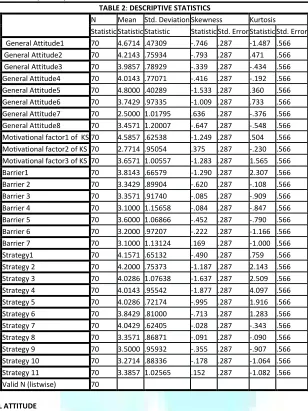
A questionnaire survey method was used to seek response from the academicians from 5 MBA and engineering colleges. The instrument was designed to understand the general attitude, the motivation to share, barriers that inhibit sharing and also the strategies to improve sharing knowledge. Five point Likert scale anchored to one (strongly disagree) and five (strongly agree) were employed. The General attitude towards knowledge sharing was measured with 7 items, the motivation to share was measured with 3 items, barriers that inhibit sharing was measured with 7 items and the strategies to improve sharing knowledge was measured with 11 items. All these items were adapted from sources outlined in the review of literature. Table 2 summarizes the mean scores and standard deviation of each of these items.
DATA AND SAMPLE
The questionnaire was administered to the academicians in the B-Schools and Engineering colleges in the Mysore city. From each college a sample of 5-10 academic staff was received for this research. The sample of the study comprised 8 colleges in Mysore city. A total of 100 self-administered questionnaires were distributed to all academicians in the respective institution. 70 participants successfully responded, giving a response rate of 70%.
SAMPLING METHOD
The study uses convenience sampling. Convenience sampling is a non-probability sampling technique where subjects are selected because of their convenient accessibility and proximity to the researcher.
QUESTIONNAIRE DESIGN
The questionnaire was divided into two sections namely section A and B. Section A comprised questions eliciting demographic characteristics. Section B comprised 36 questions designed to ascertain the views of the academic staff on the significance of knowledge sharing, motivation to share, strategies to encourage knowledge sharing, and barriers in knowledge sharing.
DATA ANALYSIS METHOD
The data was subjected to factor analytic method. Cronbachs’ alpha was calculated to test the reliability of the measurements before subjecting the factor scores obtained from the factor analysis. Given the methodology the following chapter discusses the analysis and interpretation thereon.
5.
RESULTS AND DISCUSSION
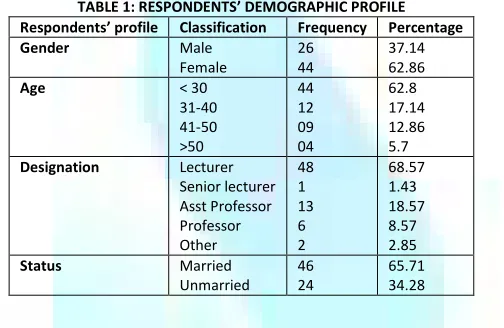
TABLE 1: RESPONDENTS’ DEMOGRAPHIC PROFILE Respondents’ profile Classification Frequency Percentage Gender Male
Female
26 44
37.14 62.86
Age < 30
31-40 41-50 >50
44 12 09 04
62.8 17.14 12.86 5.7
Designation Lecturer Senior lecturer Asst Professor Professor Other
48 1 13 6 2
68.57 1.43 18.57 8.57 2.85
Status Married Unmarried
46 24
65.71 34.28
Preliminary Analysis
DESCRIPTIVE ANALYSIS
The details of mean, standard deviation, Skewness and Kurtosis for each measurement item are shown in the table below. Observation of the Kurtosis and Skewness reveals that all the variable items in Kurtosis and Skewness are less than 10 and 3 points respectively, and thus the data confirms normality assumptions.
VOLUME NO.3(2013),ISSUE NO.04(APRIL) ISSN2231-5756
TABLE 2: DESCRIPTIVE STATISTICS
N Mean Std. Deviation Skewness Kurtosis Statistic Statistic Statistic Statistic Std. Error Statistic Std. Error General Attitude1 70 4.6714 .47309 -.746 .287 -1.487 .566 General Attitude2 70 4.2143 .75934 -.793 .287 .471 .566 General Attitude3 70 3.9857 .78929 -.339 .287 -.434 .566 General Attitude4 70 4.0143 .77071 -.416 .287 -.192 .566 General Attitude5 70 4.8000 .40289 -1.533 .287 .360 .566 General Attitude6 70 3.7429 .97335 -1.009 .287 .733 .566 General Attitude7 70 2.5000 1.01795 .636 .287 -.376 .566 General Attitude8 70 3.4571 1.20007 -.647 .287 -.548 .566 Motivational factor1 of KS 70 4.5857 .62538 -1.249 .287 .504 .566 Motivational factor2 of KS 70 2.7714 .95054 .375 .287 -.230 .566 Motivational factor3 of KS 70 3.6571 1.00557 -1.283 .287 1.565 .566 Barrier1 70 3.8143 .66579 -1.290 .287 2.307 .566
Barrier 2 70 3.3429 .89904 -.620 .287 -.108 .566
Barrier 3 70 3.3571 .91740 -.085 .287 -.909 .566
Barrier 4 70 3.1000 1.15658 -.084 .287 -.847 .566 Barrier 5 70 3.6000 1.06866 -.452 .287 -.790 .566 Barrier 6 70 3.2000 .97207 -.222 .287 -1.166 .566 Barrier 7 70 3.1000 1.13124 .169 .287 -1.000 .566
Strategy1 70 4.1571 .65132 -.490 .287 .759 .566
Strategy 2 70 4.2000 .75373 -1.187 .287 2.143 .566 Strategy 3 70 4.0286 1.07638 -1.637 .287 2.509 .566 Strategy 4 70 4.0143 .95542 -1.877 .287 4.097 .566 Strategy 5 70 4.0286 .72174 -.995 .287 1.916 .566 Strategy 6 70 3.8429 .81000 -.713 .287 1.283 .566 Strategy 7 70 4.0429 .62405 -.028 .287 -.343 .566 Strategy 8 70 3.3571 .86871 -.091 .287 -.090 .566 Strategy 9 70 3.5000 .95932 -.355 .287 -.907 .566 Strategy 10 70 3.2714 .88336 -.178 .287 -1.064 .566 Strategy 11 70 3.3857 1.02565 .152 .287 -1.082 .566 Valid N (listwise) 70
FACTOR ANALYSIS
FACTOR ANALYSIS FOR GENERAL ATTITUDE
Factor analysis is conducted on the items of variable i.e., general attitude the KMO is found to be 0.635, which is above the required value of 0.5, hence this sample is adequate for further factor analysis. The total variance explained is 62.19% and the component matrix shows one factor. The factor which is called as General attitude (GA 1, 2, 4, 5) has reliability with Cronbach’s alpha of 0.779 was extracted and the results are as shown in the tables below.
TABLE 3: KMO AND BARTLETT'S TEST
Kaiser-Meyer-Olkin Measure of Sampling Adequacy. .635 Bartlett's Test of Sphericity Approx. Chi-Square 107.831
Df 15
Sig. .000
TABLE 4: TOTAL VARIANCE EXPLAINED
Component
Initial Eigen values Extraction Sums of Squared Loadings Total % of VarianceCumulative %Total % of Variance Cumulative %
1 2.54742.457 42.457 2.547 42.457 42.457
2 1.18419.740 62.197 1.184 19.740 62.197
3 .857 14.283 76.480
4 .722 12.032 88.512
5 .462 7.700 96.212
VOLUME NO.3(2013),ISSUE NO.04(APRIL) ISSN2231-5756
INTERNATIONAL JOURNAL OF RESEARCH IN COMMERCE, IT & MANAGEMENT
TABLE 5:ROTATED COMPONENT MATRIXA
Component
1 2
GA1 .711
GA2 .817
GA3 .723
GA4 .842
GA7 .754
GA8 .818
Extraction Method: Principal Component Analysis. Rotation Method: Varimax with Kaiser Normalization. a. Rotation converged in 3 iterations.
TABLE 6: ITEM-TOTAL STATISTICS OF GENERAL ATTITUDE
Scale Mean if Item Deleted Scale Variance if Item DeletedCorrected Item-Total CorrelationCronbach's Alpha
GA112.2143 3.736 .490 .779
GA212.6714 2.775 .595
GA312.9000 2.758 .563
GA412.8714 2.461 .745
FACTOR ANALYSIS FOR BARRIERS
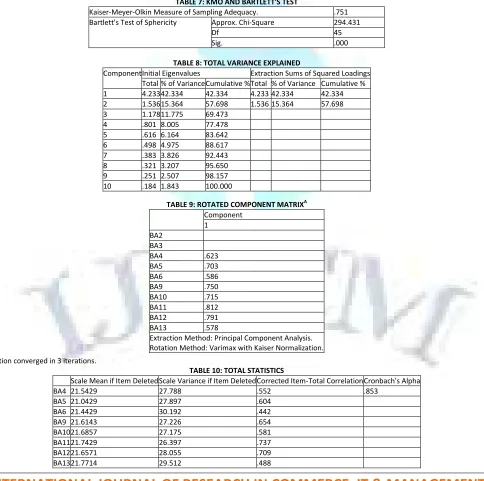
Factor analysis is conducted on the items of variable Barriers to knowledge sharing and the KMO is found to be 0.751, which is above the required value of 0.5, hence this sample is adequate for further factor analysis. The total variance explained is 57.69% and the rotated component matrix shows two factors. One factor which can be called as Barriers-A (BA 2, 3), The other factor which can be called as ‘Barriers-B (BA 4, 5, 6, 7, 10 ,11 ,12 ,13) and has reliability with Cronbach’s alpha of 0.853 were extracted and the results are as shown below
TABLE 7: KMO AND BARTLETT'S TEST
Kaiser-Meyer-Olkin Measure of Sampling Adequacy. .751 Bartlett's Test of Sphericity Approx. Chi-Square 294.431
Df 45
Sig. .000
TABLE 8: TOTAL VARIANCE EXPLAINED
TABLE 9: ROTATED COMPONENT MATRIXA
A. Rotation converged in 3 iterations.
TABLE 10: TOTAL STATISTICS
ComponentInitial Eigenvalues Extraction Sums of Squared Loadings Total % of VarianceCumulative %Total % of Variance Cumulative %
1 4.23342.334 42.334 4.233 42.334 42.334
2 1.53615.364 57.698 1.536 15.364 57.698
3 1.17811.775 69.473
4 .801 8.005 77.478
5 .616 6.164 83.642
6 .498 4.975 88.617
7 .383 3.826 92.443
8 .321 3.207 95.650
9 .251 2.507 98.157
10 .184 1.843 100.000
Component 1
BA2 BA3
BA4 .623
BA5 .703
BA6 .586
BA9 .750
BA10 .715
BA11 .812
BA12 .791
BA13 .578
Extraction Method: Principal Component Analysis. Rotation Method: Varimax with Kaiser Normalization.
Scale Mean if Item Deleted Scale Variance if Item DeletedCorrected Item-Total CorrelationCronbach's Alpha
BA4 21.5429 27.788 .552 .853
BA5 21.0429 27.897 .604
BA6 21.4429 30.192 .442
BA9 21.6143 27.226 .654
BA1021.6857 27.175 .581
BA1121.7429 26.397 .737
BA1221.6571 28.055 .709
VOLUME NO.3(2013),ISSUE NO.04(APRIL) ISSN2231-5756
FACTOR ANALYSIS FOR STRATEGIES TO ENCOURAGE KNOWLEDGE SHARING
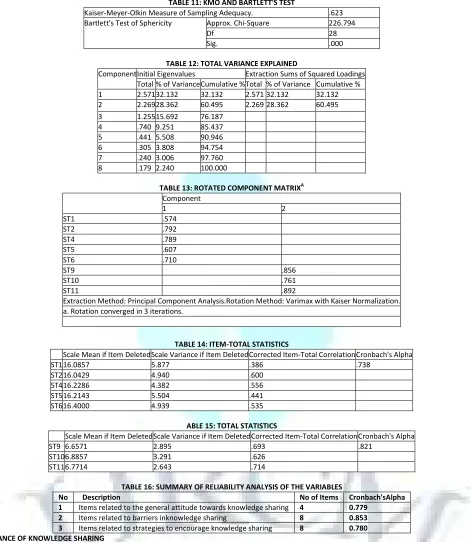
Factor analysis is conducted on the items of strategies to encourage knowledge sharing and the KMO is found to be 0.623, which is above the required value of 0.5, hence this sample is adequate for further factor analysis. The total variance explained is 60.49% and the rotated component matrix shows two factors. One factor which can be called as A’ (BA 1 2, 4, 5, 6) has reliability with Cronbach’s alpha of 0.738 and the other factor which can be called as ‘Strategies-B’ (BA 9, 10 ,11) has reliability with Cronbach’s alpha of 0.821 were extracted and the results are as shown in the tables below.
TABLE 11: KMO AND BARTLETT'S TEST
Kaiser-Meyer-Olkin Measure of Sampling Adequacy. .623 Bartlett's Test of Sphericity Approx. Chi-Square 226.794
Df 28
Sig. .000
TABLE 12: TOTAL VARIANCE EXPLAINED
ComponentInitial Eigenvalues Extraction Sums of Squared Loadings Total % of VarianceCumulative %Total % of Variance Cumulative %
1 2.57132.132 32.132 2.571 32.132 32.132
2 2.26928.362 60.495 2.269 28.362 60.495
3 1.25515.692 76.187
4 .740 9.251 85.437
5 .441 5.508 90.946
6 .305 3.808 94.754
7 .240 3.006 97.760
8 .179 2.240 100.000
TABLE 13: ROTATED COMPONENT MATRIXA
TABLE 14: ITEM-TOTAL STATISTICS
Scale Mean if Item DeletedScale Variance if Item DeletedCorrected Item-Total CorrelationCronbach's Alpha
ST116.0857 5.877 .386 .738
ST216.0429 4.940 .600
ST416.2286 4.382 .556
ST516.2143 5.504 .441
ST616.4000 4.939 .535
ABLE 15: TOTAL STATISTICS
Scale Mean if Item DeletedScale Variance if Item DeletedCorrected Item-Total CorrelationCronbach's Alpha
ST9 6.6571 2.895 .693 .821
ST106.8857 3.291 .626
ST116.7714 2.643 .714
TABLE 16: SUMMARY OF RELIABILITY ANALYSIS OF THE VARIABLES
No Description No of Items Cronbach'sAlpha 1 Items related to the general attitude towards knowledge sharing 4 0.779
2 Items related to barriers inknowledge sharing 8 0.853
3 Items related to strategies to encourage knowledge sharing 8 0.780 IMPORTANCE OF KNOWLEDGE SHARING
One of the objectives of the research was to ascertain the degree to which knowledge sharing was considered important by the respondents. Survey found 80% of respondents stating ‘strongly agree’ and 20 percent stating ‘agree’ to the statement. None of the respondents disagreed or strongly disagreed with the statement. The results of the analysis are shown in the below Table.
TABLE 17: SIGNIFICANCE OF KS FOR THE SUCCESS AND GROWTH OF A BUSINESS SCHOOL
Frequency Percentage Strongly Agree 56 80
Agree 14 20
Total 70 100
Is the importance of knowledge sharing clearly communicated?
Respondents were also asked to respond to whether the importance of knowledge sharing is clearly communicated in their university/college. Around 61 percent said they ‘agree’ or ‘strongly agree’ with the statement, as compared to 14 percent who were undecided. A large number of respondents (25 percent)
Component
1 2
ST1 .574
ST2 .792
ST4 .789
ST5 .607
ST6 .710
ST9 .856
ST10 .761
ST11 .892
VOLUME NO.3(2013),ISSUE NO.04(APRIL) ISSN2231-5756
INTERNATIONAL JOURNAL OF RESEARCH IN COMMERCE, IT & MANAGEMENT
‘disagree’ or ‘strongly disagree’ to the statement that importance of knowledge sharing is not clearly communicated in the college/university. Results are depicted in Table below
TABLE 18: COMMUNICATION OF IMPORTANCE OF KNOWLEDGE SHARING IN THE COLLEGE/UNIVERSITY Frequency Percentage
Strongly Agree 12 17.1
Agree 31 44.3
Neutral 10 14.3
Disagree 11 15.7
Strongly Disagree 6 8.6
Total 70 100
Is the importance of knowledge sharing clearly communicated?
6.
FINDINGS
GENERAL ATTITUDE TOWARDS KNOWLEDGE SHARING
Respondents were asked to indicate the degree to which they were willing to share the knowledge and also the degree to which their colleagues were willing to share the knowledge. In Table below, the first two statements relate to knowledge donating and the last two statements relate to knowledge receiving. It can be observed that the self-serving biases are apparent from the views expressed by the respondents. They have given a better rating when it comes to their willingness to share knowledge and a lower rating to when it comes to sharing of knowledge by their colleagues.
TABLE 19: VIEWS ON KNOWLEDGE RECEIVING AND KNOWLEDGE SHARING
SA A N D SD
I am willing to share information, knowledge with my colleagues 47
(67.1)
17
(32.9) I am willing to share my lecture notes, power point slides and other resources with my colleagues 27
(38.6) 33 (47.1) 8 (11.4) 2 (2.9)
My colleagues share information, knowledge with me 19
(27.1) 33 (47.1) 16 (22.9) 2 (2.9) My colleagues share their lecture notes, power point slides and other resources with me 19
(27.1) 35 (50) 14 (20) 2 (2.9)
BARRIERS TO KNOWLEDGE SHARING
Table below shows respondents’ views on the barriers to knowledge sharing. On a Likert’s five point scale a value of 5 was assigned to ‘strongly agree’; as such, a mean score represents high intensity of that variable in terms of barriers. The barriers have been arranged in ascending order of the mean value. It can be seen that strongest barriers are identified as Lack of interaction between those who need knowledge and those who can provide knowledge, no proper system to identify the colleagues to share my knowledge, support by the management, and status fear among the staff.
TABLE 20 : MEAN SCORE OF BARRIERS TO SHARE KNOWLEDGE
Barriers Scores
There is lack of interaction between those who need knowledge and those who can provide knowledge 3.6
There is no system to identify the colleagues with whom I need to share my knowledge 3.2
Existing university/college culture does not provide sufficient support for sharing knowledge 3.1
Staff is reluctant to seek knowledge from their seniors because of the status fear 3.028
It is difficult to convince colleagues on the value and the benefits of the knowledge that I may possess 2.985
There is a general lack of trust among staff in my university/college 2.95
Staff in my university/college do not share knowledge because of the fear of it being misused by taking unjust credit for it 2.9
Knowledge sharing does not happen because of fear of negative consequences to self-image, status, or career 2.87 STRATEGIES FOR PROMOTING KNOWLEDGE SHARING
Respondents’ views were sought on the ways to promote knowledge sharing. Their responses, arranged in descending order, are given in Table below. A very strong case was observed for promoting knowledge sharing through regular emphasis by the top management of the university. This means that people would be more willing to share their knowledge if they felt that the top management wants it. It can also be observed from this table that there is a strong case for linking knowledge sharing with rewards and performance appraisal. We also find that respondents feel that there is a lack of knowledge sharing strategies, a lack of knowledge repositories, and also a lack of awareness on the benefit of knowledge sharing in their organizations.
TABLE 21: STRATEGIES TO ENCOURAGE KNOWLEDGE SHARING
Promotion of Knowledge sharing
Mean Scores
% of ‘SA’ and ‘A’
Knowledge sharing can become a culture in the organization if top management regularly displays and reinforces the theme that ‘knowledge is the lifeblood of an organization’.
4.2 91.3
Technology plays a significant role inpromoting Knowledge sharing 4.157 88.5
Knowledge sharing can be encouraged if it is linked with the performance appraisal of the staff. 4.028 87.4
The university/college should use its newsletter or other similar tools to disseminate knowledge and encourage knowledge sharing among the Staff
4.014 89.8
Knowledge sharing can be encouraged if it is clearly linked with rewards. 3.84 71.5
There is growing awareness on the benefit of knowledge sharing in my organization. 3.50 60.0
There exists a knowledge sharing strategy in my organization. 3.38 44.2
There exists knowledge repositories (database) in my organization. 3.27 47.2
SUMMARY OF FINDINGS
• All the respondents agree that Knowledge sharing is important and is significant for the success and growth of the organisation.
• It can be seen that 61.4% of respondents strongly agree/agree that Importance of knowledge sharing is clearly communicated in the college/university, whereas 39.6% of respondents are neutral/disagree to this statement.
• It can be observed that the self-serving biases are apparent from the views expressed by the respondents. They have given a better rating when it comes to their willingness to share knowledge and a lower rating to when it comes to sharing of knowledge by their colleagues.
VOLUME NO.3(2013),ISSUE NO.04(APRIL) ISSN2231-5756
i. Lack of interaction between those who need knowledge and those who can provide knowledge, ii. no proper system to identify the colleagues to share my knowledge
iii. support by the management and iv. status fear among the staff
• It is observed that 91.3% of respondents have strongly agreed/agreed that Knowledge sharing can become a culture in the organization if top management regularly displays and reinforces the theme that ‘knowledge is the lifeblood of an organization’, 87.4% of employees strongly agreed/agreed that Knowledge sharing can be encouraged if it is linked with the performance appraisal of the staff.
• Though 88.5 have agreed that Technology plays a significant role in promoting Knowledge sharing, only 44.23% of employees agreed that there exists a knowledge sharing strategy in their organization and 47.2% respondents agreed that there exists knowledge repositories (database) in their organization
7.
CONCLUSION
Institutions of higher learning are placed in the critical role of knowledge production. The knowledge so produced by individuals should be translated into organizational knowledge. This requires knowledge sharing. It is very significant, as most academicians have agreed, in order to remain highly effective. Based on this research, knowledge sharing should be continuously promoted and barriers should be overcome. The strategies for promoting knowledge sharing may be organisation-specific. However, a strong support was found for linking knowledge sharing with rewards and performance appraisal. Support from the top management in encouraging academicians. More efforts must be made and awareness must be created to ensure that people understand the benefits of knowledge sharing.
Basically, teaching staff could enhance their knowledge sharing practices if their infrastructure is upgraded. There is a need to change their system from mechanistic to organic approach. Databases must be upgraded to encompass more relevant and variety of business database. Sharing of knowledge could also be enhanced if the administers play a positive role by encouraging their teaching staff to share knowledge by organizing open discussions, forums, seminars and colloquiums.
8.
LIMITATIONS OF THE STUDY
• This study is limited to the influence of three factors (attitude, barriers and strategies) on knowledge sharing behaviour. • Knowledge workers had lack of time to interact and share their views.
• The respondents’ views seemed to be inconsistent in the same institution.
9.
SCOPE FOR FURTHER RESEARCH
• Further research may be conducted to determine other factors such as trust, communication, individual factors (intention and intrinsic motivation) and collaboration on knowledge sharing behaviour of the academicians.
• Future studies may be done with a broader sample.
• Further research can be conducted taking demographic data into demographic data into consideration
10.
REFERENCES
1. Alvesson.M, 2001 “Knowledge work: ambuity, image and identity”Human Relations, 54:7,863-886.
2. Nelson R and Winter,S.G(1982). An evolutionary theory of economic chang, Cambridge, Mass: Harvard University Press.
3. Bircham-Connoly, Corner and Bowden, Knowledge Sharing Among Academic Staff: A Case Study of Business Schools in Klang Valley, Malaysia, 2005 4. Cheng, Ho and Lau , Knowledge sharing behaviour influences: a case of Library and Information Science faculties in Iran, Malaysian Journal of Library &
Information Science, Vol. 16, no. 1, April 2011: 1-14, 2009
5. Kayworth and Leidner, Knowledge Sharing Culture in Malaysian Public Institution of Higher Education: An Overview, Proceedings of the Postgraduate Annual Research Semina , 2004
6. Shapira, P, Youtie, J, Yogeesvaran, K and Jaafar, Z.,‘Knowledge Economy Measurement: Methods, Results and Insights from the Malaysian Knowledge Content Study’, Proceedings of the Triple Helix 5 Conference on New Indicators for the Knowledge Economy, Turin, Italy 2005
7. Bircham-Connolly, H, Corner, J and Bowden, S , ‘An Empirical Study of the Impact of Question Structure on Receipient Attitude During Knowledge Sharing’, Electronic Journal of Knowledge Management, Vol 32, Issue 1, pp 1-10.2005
8. Sharrat, M. and Usoro, A. (2003), ‘Understanding Knowledge-Sharing in Online Communities of Practice’, Electronic Journal on Knowledge Management, Vol 1, Issue 2, pp.187-196., 2003
9. Willem, A. (2003), ‘ The Role of Organization Specific Integration Mechanisms in Inter-Unit Knowledge Sharing’, PhD Dissertation at Vlerick Leuven Gent Management School, Ghent University, Belgium, available online at http://72.14.203.104/search?q=cache:AwAf_ok1x7UJ:www.ofenhandwerk.com/ oklc/pdf2003
10. Polyani, The Knowledge in Knowledge Management, 2000 edition (book)
11. Choi and Lee,” ‘An empirical investigation of KM styles and their effect on corporate performance’, Information and Management”, Vol.40, Issue 5, pp.403-417. 2003
12. Neo, 2002 cited in Chaudhry, 2005, p 3
13. Lee, Y.L, ‘ A study of influencing factors of KS intention of employees in IT organizations –A case study of WALTON, Unpublished Masters dissertation, National Sun Yat Sen University, Taiwan, . (2004)
14. Sharrat and Usoro, Understanding Knowledge-Sharing in Online Communities of Practice 15. cited in Chaudhry, 2005, p 3
16. Van den Hoof and De Ridder; Kim and Lee 2005; 17. Gao 2004; Aulawi et al. 2009; Choi, Kang and Lee 2008
18. Ardichvili, Page and Wentling 2003; Hinds and Pfeiffer 2003; Cheng, Ho and Lau 2009; Taylor and Murthy 2009 19. Osterloh and Frey, Motivation, Knowledge Transfer, and Organizational Forms
20. G.-W. Bock, R.W. Zmud, Y.-G. Kim, J.-N. Lee , Behavioral intention formation in knowledge sharing: Examining the roles of extrinsic motivators, social-psychological forces, and organizational climate (2005)
21. Wasko & Faraj, 2005, “Why Should I Share INFS 834 Article Review
22. Nonaka & Takeuchi, 1995; The Knowledge-creating company; Oxford university Press; Oxford.
23. Spender J C 1996, “Making Knowledge – the basis of the dynamic theory of the firm”; Strategic Management Journal, Vol 17;Special Winter issue. PP 45- 62.
24. Sveiby K E (1997) , The New Organizational Wealth, Barrett – Koehler Publisher, San Francisco, CA. 25. Riege ,Three-dozen knowledge-sharing barriers managers must consider,2005
26. McDermott, R and O’Dell, c. , ‘Overcoming culturebarriers to sharing knowledge’, Journal of Knowledge Management, Vol.5, No.1, pp.76-85.2001 27. Faul & Kemly, Knowledge sharing in UNFPA, 2003
VOLUME NO.3(2013),ISSUE NO.04(APRIL) ISSN2231-5756
INTERNATIONAL JOURNAL OF RESEARCH IN COMMERCE, IT & MANAGEMENT
REQUEST FOR FEEDBACK
Dear Readers
At the very outset, International Journal of Research in Commerce, IT and Management (IJRCM)
acknowledges & appreciates your efforts in showing interest in our present issue under your kind perusal.
I would like to request you to supply your critical comments and suggestions about the material published
in this issue as well as on the journal as a whole, on our E-mail i.e.
for further
improvements in the interest of research.
If you have any queries please feel free to contact us on our E-mail
.
I am sure that your feedback and deliberations would make future issues better – a result of our joint
effort.
Looking forward an appropriate consideration.
With sincere regards
<