A Monthly Double-Blind Peer Reviewed (Refereed/Juried) Open Access International e-Journal - Included in the International Serial Directories
Indexed & Listed at:
Ulrich's Periodicals Directory ©, ProQuest, U.S.A., EBSCO Publishing, U.S.A., Cabell’s Directories of Publishing Opportunities, U.S.A., Open J-Gage, India [link of the same is duly available at Inflibnet of University Grants Commission (U.G.C.)],
VOLUME NO.3(2013),ISSUE NO.06(JUNE) ISSN 2231-5756
INTERNATIONAL JOURNAL OF RESEARCH IN COMMERCE, IT & MANAGEMENT
CONTENTS
CONTENTS
CONTENTS
CONTENTS
Sr.
No.
TITLE & NAME OF THE AUTHOR (S)
Page No. 1. ISSUES AND SUGGESTIONS FOR THE IMPLEMENTATION OF THE INDIA’S RIGHT TO INFORMATION ACT 2005 IN LIGHT OF THE LATIN AMERICAN
COUNTRIES’ EXPERIENCE
DR. PRATIBHA J.MISHRA
1
2. AN EMPIRICAL STUDY ON JOB STRESS IN PRIVATE SECTOR BANKS OF UTTARAKHAND REGION
MEERA SHARMA & LT. COL. DR. R. L. RAINA
7
3. FOREIGN DIRECT INVESTMENT IN INDIA: AN OVERVIEW
DR. MOHAMMAD SAIF AHMAD
14
4. REFLECTIONS ON VILLAGE PEOPLE’S SOCIO - ECONOMIC CONDITIONS BEFORE AND AFTER NREGS: A DETAILED STUDY OF ARIYALUR DISTRICT, TAMIL NADU
DR. P. ILANGO & G. SUNDHARAMOORTHI
19
5. THE CAUSAL EFFECTS OF EDUCATION ON TECHNOLOGY IMPLEMENTATION – EVIDENCE FROM INDIAN IT INDUSTRY
S.M.LALITHA & DR. A. SATYA NANDINI
25
6. A STUDY ON ONLINE SHOPPING BEHAVIOUR OF TEACHERS WORKING IN SELF-FINANCING COLLEGES IN NAMAKKAL DISTRICT WITH SPECIAL REFERENCE TO K.S.R COLLEGE OF ARTS AND SCIENCE, TIRUCHENGODE, NAMAKKAL DISTRICT
SARAVANAN. R., YOGANANDAN. G. & RUBY. N
31
7. AN OVERVIEW OF RESEARCH IN COMMERCE AND MANAGEMENT IN SHIVAJI UNIVERSITY
DR. GURUNATH J. FAGARE & DR. PRAVEEN CHOUGALE
38
8. VARIABLE SELECTION IN REGRESSION MODELS
M.SUDARSANA RAO, M.SUNITHA & M.VENKATARAMANAIH
46
9. CUSTOMER ATTITUDE TOWARDS SERVICES AND AMENITIES PROVIDED BY STAR HOTELS: A STUDY WITH REFERENCE TO MADURAI CITY
DR. JACQUELINE GIGI VIJAYAKUMAR
50
10. QUALITY AND SUSTAINABILITY OF JOINT LIABILITY GROUPS AND MICROFINANCE INSTITUTIONS: A CASE STUDY OF CASHPOR MICROCREDIT SERVICES
DR. MANESH CHOUBEY
56
11. INDIAN MUTUAL FUND MARKET: AN OVERVIEW
JITENDRA KUMAR & DR. ANINDITA ADHIKARY
63
12. SMART APPROACHES FOR PROVIDING THE SPD’S (SECURITY, PRIVACY & DATA INTEGRITY) SERVICE IN CLOUD COMPUTING
M.SRINIVASAN & J.SUJATHA
67
13. A COMPARATIVE STUDY ON ETHICAL DECISION-MAKING OF PURCHASING PROFESSIONALS IN TAIWAN AND CHINA
YI-HUI HO
70
14. THE INTERNAL AUDIT FUNCTION EFFECTIVENESS IN THE JORDANIAN INDUSTRIAL SECTOR
DR. YUSUF ALI KHALAF AL-HROOT
75
15. STUDY ON ROLE OF EFFECTIVE LEADERSHIP ON SELLING VARIOUS INSURANCE POLICIES OF ICICI PRUDENTIAL: A CASE STUDY OF SUBHASH MARG BRANCH, DARYAGANJ
SUBHRANSU SEKHAR JENA
80
16. AN EMPIRICAL STUDY ON WEAK-FORM OF MARKET EFFICIENCY OF NATIONAL STOCK EXCHANGE
DR. VIJAY GONDALIYA
89
17. THE GOLDEN ROUTE TO LIQUIDITY: A PERFORMANCE ANALYSIS OF GOLD LOAN COMPANIES
DR. NIBEDITA ROY
94
18. STUDY ON THE MANAGEMENT OF CURRENT LIABILITIES OF NEPA LIMITED
DR. ADARSH ARORA
99
19. QUALITY OF MEDICAL SERVICES: A COMPARATIVE STUDY OF PRIVATE AND GOVERNMENT HOSPITALS IN SANGLI DISTRICT
SACHIN H.LAD
105
20. DIVIDEND POLICY AND BANK PERFORMANCE: THE CASE OF ETHIOPIAN PRIVATE COMMERCIAL BANKS
NEBYU ADAMU ABEBE & TILAHUN AEMIRO TEHULU
109
21. CUSTOMER KNOWLEDGE: A TOOL FOR THE GROWTH OF E-LEARNING INDUSTRY
DR. MERAJ NAEM, MOHD TARIQUE KHAN & ZEEBA KAMIL
115
22. THE EFFECTS OF ORGANIZED RETAIL SECTOR ON CONSUMER SATISFACTION: A CASE STUDY IN MYSORE CITY
ASHWINI.K.J & DR. NAVITHA THIMMAIAH
122
23. PERCEIVED BENEFITS AND RISKS OF ELECTRONIC DIVIDEND AS A PAYMENT MEDIUM IN THE NIGERIA COMMERCIAL BANKS
OLADEJO, MORUF. O & FASINA, H T
127
24. INDO - CANADIAN TRADE RELATION IN THE MATH OF POST REFORM PERIOD
ANITHA C.V & DR. NAVITHA THIMMAIAH
133
25. IMPACT OF BOARD STRUCTURE ON CORPORATE FINANCIAL PERFORMANCE
AKINYOMI OLADELE JOHN
140
26. WORK LIFE BALANCE: A SOURCE OF JOB SATISFACTION: A STUDY ON THE VIEW OF WOMEN EMPLOYEES IN INFORMATION TECHNOLOGY (IT) SECTOR
NIRMALA.N
145
27. SCHOOL LEADERSHIP DEVELOPMENT PRACTICES: FOCUS ON SECONDARY SCHOOL PRINCIPALS IN EAST SHOWA, ETHIOPIA
FEKADU CHERINET ABIE
148
28. EMOTIONAL INTELLIGENCE OF THE MANAGERS IN THE BANKING SECTOR IN SRI LANKA
U.W.M.R. SAMPATH KAPPAGODA
153
29. IMPACT OF CORPORATE SOCIAL RESPONSIBILITY PRACTICES ON MEDIUM SCALE ENTERPRISES
RAJESH MEENA
157
30. IMPACT OF CASHLITE POLICY ON ECONOMIC ACTIVITIES IN NIGERIAN ECONOMY: AN EMPIRICAL ANALYSIS
DR. A. P. OLANNYE & A.O ODITA
162
INTERNATIONAL JOURNAL OF RESEARCH IN COMMERCE, IT & MANAGEMENT
CHIEF PATRON
CHIEF PATRON
CHIEF PATRON
CHIEF PATRON
PROF. K. K. AGGARWAL
Chairman, Malaviya National Institute of Technology, Jaipur
(An institute of National Importance & fully funded by Ministry of Human Resource Development, Government of India)
Chancellor, K. R. Mangalam University, Gurgaon
Chancellor, Lingaya’s University, Faridabad
Founder Vice-Chancellor (1998-2008), Guru Gobind Singh Indraprastha University, Delhi
Ex. Pro Vice-Chancellor, Guru Jambheshwar University, Hisar
FOUNDER
FOUNDER
FOUNDER
FOUNDER PATRON
PATRON
PATRON
PATRON
LATE SH. RAM BHAJAN AGGARWAL
Former State Minister for Home & Tourism, Government of Haryana
Former Vice-President, Dadri Education Society, Charkhi Dadri
Former President, Chinar Syntex Ltd. (Textile Mills), Bhiwani
CO
CO
CO
CO----ORDINATOR
ORDINATOR
ORDINATOR
ORDINATOR
AMITA
Faculty, Government M. S., Mohali
ADVISORS
ADVISORS
ADVISORS
ADVISORS
DR. PRIYA RANJAN TRIVEDI
Chancellor, The Global Open University, Nagaland
PROF. M. S. SENAM RAJU
Director A. C. D., School of Management Studies, I.G.N.O.U., New Delhi
PROF. M. N. SHARMA
Chairman, M.B.A., Haryana College of Technology & Management, Kaithal
PROF. S. L. MAHANDRU
Principal (Retd.), Maharaja Agrasen College, Jagadhri
EDITOR
EDITOR
EDITOR
EDITOR
PROF. R. K. SHARMA
Professor, Bharti Vidyapeeth University Institute of Management & Research, New Delhi
CO
CO
CO
CO----EDITOR
EDITOR
EDITOR
EDITOR
DR. BHAVET
Faculty, Shree Ram Institute of Business & Management, Urjani
EDITORIAL ADVISORY BOARD
EDITORIAL ADVISORY BOARD
EDITORIAL ADVISORY BOARD
EDITORIAL ADVISORY BOARD
DR. RAJESH MODI
Faculty, Yanbu Industrial College, Kingdom of Saudi Arabia
PROF. SANJIV MITTAL
University School of Management Studies, Guru Gobind Singh I. P. University, Delhi
PROF. ANIL K. SAINI
VOLUME NO.3(2013),ISSUE NO.06(JUNE) ISSN 2231-5756
INTERNATIONAL JOURNAL OF RESEARCH IN COMMERCE, IT & MANAGEMENT
DR. SAMBHAVNA
Faculty, I.I.T.M., Delhi
DR. MOHENDER KUMAR GUPTA
Associate Professor, P. J. L. N. Government College, Faridabad
DR. SHIVAKUMAR DEENE
Asst. Professor, Dept. of Commerce, School of Business Studies, Central University of Karnataka, Gulbarga
ASSOCIATE EDITORS
ASSOCIATE EDITORS
ASSOCIATE EDITORS
ASSOCIATE EDITORS
PROF. NAWAB ALI KHAN
Department of Commerce, Aligarh Muslim University, Aligarh, U.P.
PROF. ABHAY BANSAL
Head, Department of Information Technology, Amity School of Engineering & Technology, Amity
University, Noida
PROF. A. SURYANARAYANA
Department of Business Management, Osmania University, Hyderabad
DR. SAMBHAV GARG
Faculty, Shree Ram Institute of Business & Management, Urjani
PROF. V. SELVAM
SSL, VIT University, Vellore
DR. PARDEEP AHLAWAT
Associate Professor, Institute of Management Studies & Research, Maharshi Dayanand University, Rohtak
DR. S. TABASSUM SULTANA
Associate Professor, Department of Business Management, Matrusri Institute of P.G. Studies, Hyderabad
SURJEET SINGH
Asst. Professor, Department of Computer Science, G. M. N. (P.G.) College, Ambala Cantt.
TECHNICAL ADVISOR
TECHNICAL ADVISOR
TECHNICAL ADVISOR
TECHNICAL ADVISOR
AMITA
Faculty, Government M. S., Mohali
FINANCIAL ADVISORS
FINANCIAL ADVISORS
FINANCIAL ADVISORS
FINANCIAL ADVISORS
DICKIN GOYAL
Advocate & Tax Adviser, Panchkula
NEENA
Investment Consultant, Chambaghat, Solan, Himachal Pradesh
LEGAL ADVISORS
LEGAL ADVISORS
LEGAL ADVISORS
LEGAL ADVISORS
JITENDER S. CHAHAL
Advocate, Punjab & Haryana High Court, Chandigarh U.T.
CHANDER BHUSHAN SHARMA
Advocate & Consultant, District Courts, Yamunanagar at Jagadhri
SUPERINTENDENT
SUPERINTENDENT
SUPERINTENDENT
SUPERINTENDENT
INTERNATIONAL JOURNAL OF RESEARCH IN COMMERCE, IT & MANAGEMENT
CALL FOR MANUSCRIPTS
CALL FOR MANUSCRIPTS
CALL FOR MANUSCRIPTS
CALL FOR MANUSCRIPTS
We invite unpublished novel, original, empirical and high quality research work pertaining to recent developments & practices in the areas of Computer Science & Applications; Commerce; Business; Finance; Marketing; Human Resource Management; General Management; Banking; Economics; Tourism Administration & Management; Education; Law; Library & Information Science; Defence & Strategic Studies; Electronic Science; Corporate Governance; Industrial Relations; and emerging paradigms in allied subjects like Accounting; Accounting Information Systems; Accounting Theory & Practice; Auditing; Behavioral Accounting; Behavioral Economics; Corporate Finance; Cost Accounting; Econometrics; Economic Development; Economic History; Financial Institutions & Markets; Financial Services; Fiscal Policy; Government & Non Profit Accounting; Industrial Organization; International Economics & Trade; International Finance; Macro Economics; Micro Economics; Rural Economics; Co-operation; Demography: Development Planning; Development Studies; Econometrics; Applied Economics; Development Economics; Business Economics; Monetary Policy; Public Policy Economics; Real Estate; Regional Economics; Political Science; Continuing Education; Labour Welfare; Philosophy; Psychology; Sociology; Tax Accounting; Advertising & Promotion Management; Management Information Systems (MIS); Business Law; Public Responsibility & Ethics; Communication; Direct Marketing; E-Commerce; Global Business; Health Care Administration; Labour Relations & Human Resource Management; Marketing Research; Marketing Theory & Applications; Non-Profit Organizations; Office Administration/Management; Operations Research/Statistics; Organizational Behavior & Theory; Organizational Development; Production/Operations; International Relations; Human Rights & Duties; Public Administration; Population Studies; Purchasing/Materials Management; Retailing; Sales/Selling; Services; Small Business Entrepreneurship; Strategic Management Policy; Technology/Innovation; Tourism & Hospitality; Transportation Distribution; Algorithms; Artificial Intelligence; Compilers & Translation; Computer Aided Design (CAD); Computer Aided Manufacturing; Computer Graphics; Computer Organization & Architecture; Database Structures & Systems; Discrete Structures; Internet; Management Information Systems; Modeling & Simulation; Neural Systems/Neural Networks; Numerical Analysis/Scientific Computing; Object Oriented Programming; Operating Systems; Programming Languages; Robotics; Symbolic & Formal Logic; Web Design and emerging paradigms in allied subjects.
Anybody can submit the soft copy of unpublished novel; original; empirical and high quality research work/manuscriptanytime in M.S. Word format
after preparing the same as per our GUIDELINES FOR SUBMISSION; at our email address i.e. [email protected] or online by clicking the link online submission as given on our website (FOR ONLINE SUBMISSION, CLICK HERE).
GUIDELINES FOR SUBMISSION OF MANUSCRIPT
GUIDELINES FOR SUBMISSION OF MANUSCRIPT
GUIDELINES FOR SUBMISSION OF MANUSCRIPT
GUIDELINES FOR SUBMISSION OF MANUSCRIPT
1. COVERING LETTER FOR SUBMISSION:
DATED: _____________ THE EDITOR
IJRCM
Subject: SUBMISSION OF MANUSCRIPT IN THE AREA OF.
(e.g. Finance/Marketing/HRM/General Management/Economics/Psychology/Law/Computer/IT/Engineering/Mathematics/other, please specify)
DEAR SIR/MADAM
Please find my submission of manuscript entitled ‘___________________________________________’ for possible publication in your journals.
I hereby affirm that the contents of this manuscript are original. Furthermore, it has neither been published elsewhere in any language fully or partly, nor is it under review for publication elsewhere.
I affirm that all the author (s) have seen and agreed to the submitted version of the manuscript and their inclusion of name (s) as co-author (s).
Also, if my/our manuscript is accepted, I/We agree to comply with the formalities as given on the website of the journal & you are free to publish our contribution in any of your journals.
NAME OF CORRESPONDING AUTHOR: Designation:
Affiliation with full address, contact numbers & Pin Code: Residential address with Pin Code:
Mobile Number (s): Landline Number (s): E-mail Address: Alternate E-mail Address:
NOTES:
a) The whole manuscript is required to be in ONE MS WORD FILE only (pdf. version is liable to be rejected without any consideration), which will start from the covering letter, inside the manuscript.
b) The sender is required to mentionthe following in the SUBJECT COLUMN of the mail:
New Manuscript for Review in the area of (Finance/Marketing/HRM/General Management/Economics/Psychology/Law/Computer/IT/ Engineering/Mathematics/other, please specify)
c) There is no need to give any text in the body of mail, except the cases where the author wishes to give any specific message w.r.t. to the manuscript. d) The total size of the file containing the manuscript is required to be below 500 KB.
e) Abstract alone will not be considered for review, and the author is required to submit the complete manuscript in the first instance.
f) The journal gives acknowledgement w.r.t. the receipt of every email and in case of non-receipt of acknowledgment from the journal, w.r.t. the submission of manuscript, within two days of submission, the corresponding author is required to demand for the same by sending separate mail to the journal.
2. MANUSCRIPT TITLE: The title of the paper should be in a 12 point Calibri Font. It should be bold typed, centered and fully capitalised.
3. AUTHOR NAME (S) & AFFILIATIONS: The author (s) full name, designation, affiliation (s), address, mobile/landline numbers, and email/alternate email address should be in italic & 11-point Calibri Font. It must be centered underneath the title.
VOLUME NO.3(2013),ISSUE NO.06(JUNE) ISSN 2231-5756
INTERNATIONAL JOURNAL OF RESEARCH IN COMMERCE, IT & MANAGEMENT
5. KEYWORDS: Abstract must be followed by a list of keywords, subject to the maximum of five. These should be arranged in alphabetic order separated bycommas and full stops at the end.
6. MANUSCRIPT: Manuscript must be in BRITISH ENGLISH prepared on a standard A4 size PORTRAIT SETTING PAPER. It must be prepared on a single space and single column with 1” margin set for top, bottom, left and right. It should be typed in 8 point Calibri Font with page numbers at the bottom and centre of every page. It should be free from grammatical, spelling and punctuation errors and must be thoroughly edited.
7. HEADINGS: All the headings should be in a 10 point Calibri Font. These must be bold-faced, aligned left and fully capitalised. Leave a blank line before each heading.
8. SUB-HEADINGS: All the sub-headings should be in a 8 point Calibri Font. These must be bold-faced, aligned left and fully capitalised.
9. MAIN TEXT: The main text should follow the following sequence:
INTRODUCTION
REVIEW OF LITERATURE
NEED/IMPORTANCE OF THE STUDY
STATEMENT OF THE PROBLEM
OBJECTIVES
HYPOTHESES
RESEARCH METHODOLOGY
RESULTS & DISCUSSION
FINDINGS
RECOMMENDATIONS/SUGGESTIONS
CONCLUSIONS
SCOPE FOR FURTHER RESEARCH
ACKNOWLEDGMENTS
REFERENCES
APPENDIX/ANNEXURE
It should be in a 8 point Calibri Font, single spaced and justified. The manuscript should preferably not exceed 5000 WORDS.
10. FIGURES &TABLES: These should be simple, crystal clear, centered, separately numbered & self explained, and titles must be above the table/figure. Sources of data should be mentioned below the table/figure. It should be ensured that the tables/figures are referred to from the main text.
11. EQUATIONS:These should be consecutively numbered in parentheses, horizontally centered with equation number placed at the right.
12. REFERENCES: The list of all references should be alphabetically arranged. The author (s) should mention only the actually utilised references in the preparation of manuscript and they are supposed to follow Harvard Style of Referencing. The author (s) are supposed to follow the references as per the following:
•
All works cited in the text (including sources for tables and figures) should be listed alphabetically.•
Use (ed.) for one editor, and (ed.s) for multiple editors.•
When listing two or more works by one author, use --- (20xx), such as after Kohl (1997), use --- (2001), etc, in chronologically ascending order.•
Indicate (opening and closing) page numbers for articles in journals and for chapters in books.•
The title of books and journals should be in italics. Double quotation marks are used for titles of journal articles, book chapters, dissertations, reports, working papers, unpublished material, etc.•
For titles in a language other than English, provide an English translation in parentheses.•
The location of endnotes within the text should be indicated by superscript numbers.PLEASE USE THE FOLLOWING FOR STYLE AND PUNCTUATION IN REFERENCES: BOOKS
•
Bowersox, Donald J., Closs, David J., (1996), "Logistical Management." Tata McGraw, Hill, New Delhi.•
Hunker, H.L. and A.J. Wright (1963), "Factors of Industrial Location in Ohio" Ohio State University, Nigeria.CONTRIBUTIONS TO BOOKS
•
Sharma T., Kwatra, G. (2008) Effectiveness of Social Advertising: A Study of Selected Campaigns, Corporate Social Responsibility, Edited by David Crowther & Nicholas Capaldi, Ashgate Research Companion to Corporate Social Responsibility, Chapter 15, pp 287-303.JOURNAL AND OTHER ARTICLES
•
Schemenner, R.W., Huber, J.C. and Cook, R.L. (1987), "Geographic Differences and the Location of New Manufacturing Facilities," Journal of Urban Economics, Vol. 21, No. 1, pp. 83-104.CONFERENCE PAPERS
•
Garg, Sambhav (2011): "Business Ethics" Paper presented at the Annual International Conference for the All India Management Association, New Delhi, India, 19–22 June.UNPUBLISHED DISSERTATIONS AND THESES
•
Kumar S. (2011): "Customer Value: A Comparative Study of Rural and Urban Customers," Thesis, Kurukshetra University, Kurukshetra.ONLINE RESOURCES
•
Always indicate the date that the source was accessed, as online resources are frequently updated or removed.WEBSITES
INTERNATIONAL JOURNAL OF RESEARCH IN COMMERCE, IT & MANAGEMENT
THE EFFECTS OF ORGANIZED RETAIL SECTOR ON CONSUMER SATISFACTION: A CASE STUDY IN MYSORE
CITY
ASHWINI.K.J
RESEARCH SCHOLAR
DOS IN ECONOMICS & CO-OPERATION
UNIVERSITY OF MYSORE
MANASAGANGOTRI
DR. NAVITHA THIMMAIAH
ASST. PROFESSOR
DOS IN ECONOMICS & CO-OPERATION
UNIVERSITY OF MYSORE
MANASAGANGOTRI
ABSTRACT
In recent days Retail scenario has grown rapidly and is reaching its zenith. Retailing in India is becoming increasingly important and organized retailing is poised to grow at an exponential rate. Consumers are now enjoying a wide verity of products and services to choose from retailers. Retailers provide genuine value to consumer so that they will be able to establish themselves in the long run. Consumers are emerging as the emperors of retailing in India with their discerning buying attitudes and their ever increasing purchasing power. The present paper is an attempt to know about factors influencing on consumer satisfaction in retail sector through their preference for retail sector, choice for various commodities, price advantages, displays, quality of products, offers and discounts and services provided in retail sector etc. Suitable statistical and econometric techniques like pie chart, correlation, regression, chi-square test and logit model have been used for data analysis. It was found that the consumers are more satisfied with quality of product available in the organized retail sector. And also, the advertisement and offers play a vital role in increasing consumer satisfaction in organized retail sector.
KEYWORDS
Consumer Satisfaction, Discounts, Offers, Organized Retailing, Price Advantage.
INTRODUCTION
n recent days Retail scenario has grown rapidly and is reaching its zenith. The Indian retail industry is the fifth largest in the world. Retail development in India is unique, as it co-exists in both organized and unorganized sector with over twelve million retail outlets of various size and formats. The term Retail- originates from a French word retailer, which means to cut a piece off or to break bulk. Retailer is someone who cuts off or sheds a small piece from something. Retailing is buying in large quantity from a whole seller or directly from manufacturers and selling the goods or services to consumer for personal consumption. Retail industry is one of the fastest growing industries in India, especially over the last few years. According to the 8th Annual Global Retail Development Index (GRDI) of AT Kearney, Indian retail industry is the most promising emerging market for investment. In 2007, the retail trade in India had a share of 8-10% in the GDP (Gross Domestic Product) of the country. In 2009, it rose to 12%. It is also expected to reach 22% by 2010 with an employment of around 8%, being determined by strong income growth, changing life styles and favorable demographic patterns. Over 12 million outlets operate in the country and only 4% of them are larger than 500 sq ft (46 m2) in size. Organized retailing refers to trading activities undertaken by licensed retailers, that is, those who are registered for sales tax, income tax, etc. These include the corporate-backed hypermarkets and retail chains, and also the privately owned large retail businesses. Unorganized retailing, on the other hand, refers to the traditional formats of low-cost retailing, for example, the local kirana shops, owner managed general stores, paan/beedi shops, convenience stores, hand cart and pavement vendors, etc.
In the present era, customer is the center point of all the marketing activities. The objective of the marketers has shifted from maximization of profits to maximization of customer satisfaction. Customer behavior is unpredictable, so marketer has to implement different strategy to keep the customer loyalty. According to Manju Rani Malik, there are three major motivating aspects regarding goods and services which convince the customer to visit organized retail outlets they are: variety of product, branded products and availability of all necessary goods. The major motivating aspect regarding prices is reasonable when compared with quality of product and also location where customers choose the shop that is close to their residence or workplace. The Indian retail sector is highly fragmented with 97% of its business being run by the unorganized retailers. In this paper attempt is made to study the factors affecting on consumer satisfaction in organized retail sector in Mysore city.
Consumer satisfaction is a measure of how products and services supplied by a company meet or surpass customer expectation. Customer satisfaction is also defined as “the number of customers or percentage of total customer, whose reported experience with a firm, its products, or its services (ratings) exceeds specified satisfaction goals”. (Retail Management by Barry and Joel, P-137).
REVIEW OF LITERATURE
Parasuraman et al (1985) identified 10 criteria as service quality determinants i.e., Access, communication, competence, courtesy, credibility, reliability, responsiveness, security, tangibles and understanding or knowing the customer. Later, they simplified them into five dimensions namely tangibles, reliability, responsiveness, assurance and empathy.
Dr.M.Anbalagan and V.Gunasekaran (2007) find that the Indian consumers are influenced by the factors like media explosion; increase in the disposable income especially the earnings of younger people, standard of living, change in expenditure pattern and the increase in the number of working women. The consumer landscape is changing very fast. A consumer today looks forward to an exciting list of choices, new categories and new shopping options and has increasing disposable incomes to fulfill their aspirations.
Anuradha Kalhan (2007) in his small sample survey of the impact of mall on small shops and hawkers in Mumbai points to a decline in sales of groceries, fruits and vegetables, processed foods, garments, shoes, electronic and electrical goods in these retail outlets, ultimately threatening 50 % of them with closure or a major decline in business. Only 14% of sample of small shops and hawkers has so far been able to respond to the competitive threat of the malls with the institution of fresh sales promotion initiatives.
Jyotsna Diwan Mehta (2009) has observed that India is a fast developing nation. Since the population is very high, we have the highest level of growth in the retail sector. Indian retail scenario has awakened to the new challenges and about $ 35 billion is expected to be invested in next half decade.
According to T.R. Renuka Murthy and Devaraju (2010), the retail outlets in India are mainly dominated by unorganized sectors. Most of today’s customers are moving or shifting from traditional retail landscape to modern retail formats. Retailing has become common part of everyday life. They are enjoying and buying goods from these outlets and are happy with the services and products that are being offered and provided by these retail outlets.
VOLUME NO.3(2013),ISSUE NO.06(JUNE) ISSN 2231-5756
INTERNATIONAL JOURNAL OF RESEARCH IN COMMERCE, IT & MANAGEMENT
A.M. Suresh and R. Shashikala (2010) opine that the Indian retail sector has got its own problems and challenges. There is a big gap between customer expectation and their perception of quality (using SERVQUAL instrument – Cronbach’s co-efficient). The conclusion is that the retail sector has to improve quality in all the aspects of services to achieve consumer satisfaction.
Dr. J S Prasad and Dr. A R Aryasri (2010) in their study focus on the phenomenal changes and developments happening in retailing in view of the burgeoning consumerism. Riding on economic growth and widespread consumerism, the Indian consumer market and retail trade has become siamese twins and growing in tandem. With the rising affluent middle class society, changing consumption patterns, rise in number of dual income nuclear families and the youth driven culture are some of the factors fuelling the new wave of consumerism.
Dr. Avinash Kapoor and Dr. Chinmaya Kulshrestha (2010) explored whether the customer’s shopping motivation gets affected by in store environment; how does an in store environment influence the customers evaluation of utilitarian and hedonic benefits; and finally what are the consequences of overall shopping value?. In sum, the paper emphasized that store environment impacts consumer perceptions of utilitarian and hedonic benefits offered by the store, and may influence different types of shoppers in unique ways.
Dr.Raj Kamal and PankajAgarwal (2010) highlight that at present, all over the world retail sectors are facing more competition and as a consequence find it more and more difficult to differentiate their stores on the basis of product, place, people, price and promotion. Since the beginning of the 1970’s, with Kotler’s pioneering work, the topic of atmospheric effects on consumer behavior has gained popularity. The elements of retail sectors such as display, variety of product, and visual merchandising are having immediate effects on the buying decision making process of customers.
Shweta Arora, Priya Rathi and Vaishali Malhotra (2010) concluded that India’s organized and unorganized retail sectors can co-exist and flourish. The growth in the Indian organized retail market is mainly due to the change in the consumer’s behavior. Due to increased income, changing lifestyles and patterns of demography the consumer wants to shop at a place where he can get food, entertainment, and shopping all under one roof. And even the retailers also take all pains to satisfy the consumer by taking care of choice of the consumers and have the product which is demanded by them and at a same time maintain a good relationship to retain them and consequently convert them into their loyal customer.
Mrs Dhivya Sathish and Mr D Venkatramaraju (2011) feel that the world is under the roof of modernization in all aspects of lifestyle, business and economy, science and technology, consumer behavior and many more. The roof of modernization has also encapsulated the retail industry that is getting modernized everyday with new store concepts and ideas. It is understood that the retail concepts are well modernized and becoming important to understand the clear-cut expectation of the shoppers while selecting a retail outlet for shopping and their level of choices in selecting the same. The study tried to unveil the areas of shopper’s expectations, choices and its relationship with various other parameters through a structured and customized market research technique.
According to Manju Rani Malik (2011) retail industry is the largest industry in India, with an employment of around 8% and contributing to over 10% of the country’s GDP. Retail industry in India is expected to rise 25% yearly being driven by strong income growth, changing life styles and favorable demographic patterns. The study explored the components of retail customer satisfaction and also investigates relationship between each of the retail customer satisfaction components and customers satisfaction level. As the majority of the respondents belong to the younger generation and women, their needs should be taken to account while deciding the marketing strategy. Location, variety of products and reasonable price are the major motivating factors that influence the customer to visit the retail outlets again. Organized retailers are suggested to offer convenient location, sufficient parking space and such an atmosphere ambience so that customers can have a pleasurable shopping experience.
Hemant Syal (2011) concludes that retailing is the interface between the producer and the individual consumer for buying for personal consumption. India has the highest shop density in the world in retail market and it is ranked second in the global retail development index out of 30 by AT Kearney. For few years, foreign retailers have the role of facilitator for standardizing the agribusiness and to unify customer’s preference across the country. The competition will help to increase the quality of service of the existing local retailers and customer satisfaction in Indian society.
Subhadip Mukherjee (2011) in his paper found the determinants of the relative share of organized and unorganized retail sector of a country. A multiple regression model has been used in his study to find the determinants. The result from the analysis revealed that GDP, women’s participation rate, foreign investment freedom and urbanization rate of a country, positively influenced the growth of the relative share of organized retail sector. This may have enormous socio economic effect on the nature of business competition with several outcomes for ever dominating unorganized retailers.
OBJECTIVES OF THE STUDY
• To analyze the factors influencing consumer satisfaction in organized retailing.
SCOPE OF THE STUDY
The study tried to identify the significant factors which influence customer satisfaction in organized retailing in Mysore city. It considers some of the factors like preference for retail sector, choice for various commodities, price advantages, displays, quality of product, offers and discount and services provided in retail sector etc. and tried to analyze the influence of these factors on consumer satisfaction. Due to time constraint only limited numbers of respondents i.e., 100 were questioned.
METHODOLOGY
The study is based on primary data and it was carried out in Mysore. Interviews were conducted by using questionnaires, 100 respondents were selected randomly among the customers of the retail shops, immediately after the completion of the shopping experience in a mall.
BINARY DEPENDENT VARIABLE MODELS
In this model, the dependent variable, may take on only two values— might be a dummy variable representing the occurrence of an event, or a choice between two alternatives. For example, modeling consumer satisfaction of an individual in the sample (whether satisfied or not). The individuals differ in age, gender, educational attainment, taste, average monthly income and other observable characteristics. The goal is to quantify the relationship between the individual characteristics and the probability of being satisfied.
There are three types of models to estimate binary or ordered variables; Probit, Logit and Glogit models. The present study employs logit model, because when dependent variable is expressed in binary the logit model is more appropriate.
Satisfied=β0+ β1Age+ β2Sex+β3 income + β4add+β5 offer+ β6prices+β7quality+Vi
INTERNATIONAL JOURNAL OF RESEARCH IN COMMERCE, IT & MANAGEMENT
LOGISTIC REGRESSION
FACTORS INFLUENCING CONSUMER SATISFACTION IN ORGANIZED RETAILING
FIGURE 1 TABLE 1
From the above figure and table it is clear that the variety of product (97%) and quality of product (87%) are the two factors highly influencing consumer satisfaction.
TABLE: 2 LOGISTIC REGRESSION (LOGIT MODEL)
From the above results it is clear that there is significant impact of factors on consumer satisfaction. The factors like average income, advertisement, offer, gender and price of a product are not statistically significant, but have positive impact on consumer satisfactions. Only consumers age and product quality are statistically significant at 10% and 1% level of significance.
CROSS TABULATION
CONSUMER SATISFACTION AND AGE OF CONSUMER
Cross tabulations were considered to analyze the inter-relationship between consumer satisfaction and its determinants like age, gender, income, advertisement, offer, prices and quality.
CROSS TABULATION
TABLE 1 CHI-SQUARE TESTS
Value df Asymp. Sig. (2-sided) Pearson Chi-Square 52.652a 35 .028
Likelihood Ratio 42.594 35 .177 Linear-by-Linear Association .353 1 .552 N of Valid Cases 100
H0: There is no significant influence of age on consumer satisfaction.
H1: There is significant influence of age on consumer satisfaction.
From the above results it is clear that influence of consumers’ age on satisfaction is statistically significant at 5% level of significance. So, we reject the null hypothesis and accept the alternative hypothesis that is there is a significant influence of consumer’s age on satisfaction level. Also there is negative relationship between the age and consumer satisfaction, as consumer age increases satisfaction decreases.
0 10 20 30 40 50 60
ra
te
o
f
im
p
a
ct
variables
Factors influencing on consumer
satisfaction in organised retailing
not satisfied satisfied
Variables Satisfaction Non-satisfaction Advertisement &Display 43(43%) 57(57%)
Offers & Discounts 22(22%) 78(78%)
Variety of Product 03(3%) 97(97%)
Prices 21(21%) 79(79%)
Quality of Product 13(13%) 87(87%)
Used to Branded 31(31%) 69(69%)
VOLUME NO.3(2013),ISSUE NO.06(JUNE) ISSN 2231-5756
INTERNATIONAL JOURNAL OF RESEARCH IN COMMERCE, IT & MANAGEMENT
CONSUMER SATISFACTION AND QUALITY OF PRODUCT CROSS TABULATION
TABLE 2
H0: There is no significant influence of product quality on consumer satisfaction.
H1: There is significant influence of product quality on consumer satisfaction.
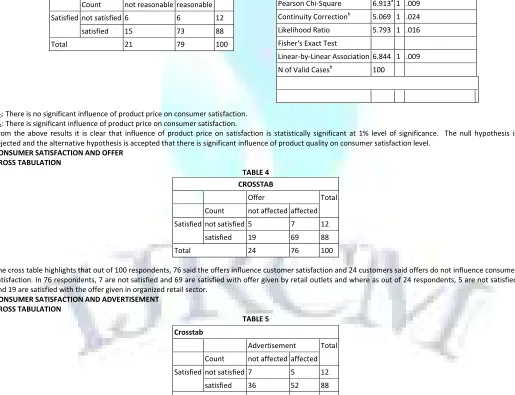
From the above results it is clear that influence of product quality on satisfaction is statistically significant at 1% level of significance. The null hypothesis is rejected and the alternative hypothesis is accepted i.e., there is a significant influence of product quality on consumer satisfaction level. There is positive relationship between the quality of product and consumer satisfaction, as product quality increases consumer satisfaction increases.
CONSUMER SATISFACTION AND PRICE OF PRODUCT CROSS TABULATION
TABLE 3
H0: There is no significant influence of product price on consumer satisfaction.
H1: There is significant influence of product price on consumer satisfaction.
From the above results it is clear that influence of product price on satisfaction is statistically significant at 1% level of significance. The null hypothesis is rejected and the alternative hypothesis is accepted that there is significant influence of product quality on consumer satisfaction level.
CONSUMER SATISFACTION AND OFFER CROSS TABULATION
TABLE 4
The cross table highlights that out of 100 respondents, 76 said the offers influence customer satisfaction and 24 customers said offers do not influence consumer satisfaction. In 76 respondents, 7 are not satisfied and 69 are satisfied with offer given by retail outlets and where as out of 24 respondents, 5 are not satisfied and 19 are satisfied with the offer given in organized retail sector.
CONSUMER SATISFACTION AND ADVERTISEMENT CROSS TABULATION
TABLE 5
The cross table indicates that out of 100 respondents, 57 visit the organized retail due to advertisement and 43 are not influenced by advertisement. In 57 respondents, 5 are not satisfied and 52 are satisfied. Out of 43 respondents, 7 are not satisfied and 36 are satisfied with advertisement of organized retail sector.
Quality of product Total count no quality more quality Satisfied not satisfied 6 6 12
satisfied 7 81 88 Total 13 87 100
CHI-SQUARE TESTS
Value df Asymp. Sig. (2-sided) Pearson Chi-Square 16.506a 1 .000
Continuity Correctionb 12.998 1 .000 Likelihood Ratio 11.774 1 .001 Fisher's Exact Test
Linear-by-Linear Association 16.341 1 .000 N of Valid Casesb 100
CROSSTAB
Price of product Total Count not reasonable reasonable Satisfied not satisfied 6 6 12
satisfied 15 73 88 Total 21 79 100
CHI-SQUARE TESTS
Value df Asymp. Sig. (2-sided) Pearson Chi-Square 6.913a 1 .009
Continuity Correctionb 5.069 1 .024 Likelihood Ratio 5.793 1 .016 Fisher's Exact Test
Linear-by-Linear Association 6.844 1 .009 N of Valid Casesb 100
CROSSTAB
Offer Total Count not affected affected Satisfied not satisfied 5 7 12
satisfied 19 69 88 Total 24 76 100
Crosstab
Advertisement Total Count not affected affected Satisfied not satisfied 7 5 12
INTERNATIONAL JOURNAL OF RESEARCH IN COMMERCE, IT & MANAGEMENT
CONSUMER SATISFACTION AND GENDER CROSS TABULATION
TABLE 6
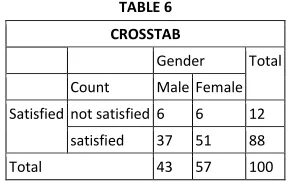
The table reveals that out of 100 respondents, 57 are females and 43 males. In 57 female respondents, 6 are not satisfied and 51 female are satisfied. Out of 43 males, 37 are satisfied and 6 are not satisfied in the service provided in organized retail sector.
CONCLUSION
Now a day’s most of the customers prefer purchasing products from organized retail outlets than unorganized outlets. Satisfaction of consumers in retail sector is an important criterion for a marketer to understand for further strategic decision. It was observed that most of the consumers are satisfied with the quality of service, price and variety of goods provided by organized retail outlets. The retail outlets should provide more attractive offers and discounts so that they can satisfy their customers. From the above analysis it is found that quality of product and age of consumers which are statistically significant factors influence more on consumer satisfaction in organized retail sector. Most of youngsters and female consumers are more attracted towards the retail sector. It is concluded that the major features of retail outlets that influence the customers and make it a place of attraction are variety of products, price, quality of product, getting every goods under one roof. In modern days consumer is considered as the emperor of the retail sector. So, the organized retailer should give more importance to those factors which influence consumer satisfaction and their buying decision.
REFERENCES
BOOKS
1. Damodar N. Gujarati and Sangeetha, (2007), “Basic Econometrics”, 4th edition, Tata Mc, Grow Hill publishing company Lim. pp: 608-628.
2. Michael Levy, Barton A Weitz and Ajay Pandit ,(2008) , “Retailing management” ,(6th edition) –Tata Mc, Grow Hill publishing company Lim, pp:113-147
JOURNALS AND OTHER ARTICALS:
3. A.M. Suresh and R. Shashikala ,(2010) , “Customer service quality Gap in Food Retailing: An Empirical Study in Bangalore” , Journal of Management ,Vol:1, No:2, pp:49- 61.
4. Dr. Avinash Kapoor and Dr. Chinmaya Kulshrestha, (2010) “Retail Store Dilemma: How to predict consumer behavior”, BVIME, Management Edge, Vol: 3, No: 1.
5. Dr. J.S. Prasad and Dr. A.R. Aryasri,(2010), “A study on role of consumerism in modern retailing in India”, BVIME, Management Edge, Vol:3, No:2,pp:15-25. T.R.Renuka Murthy and Devaraju, (Aug-2010), ‘customer satisfaction : Comparative Study in Retail Marketing’ , Southern Economist –vol-49 No:8, pp:49 - 51
6. Dr. PinakiRanjan Bhattacharyya and SourarLaha ,(Jan 2010) , “ Responisble Factors for Decline of An Organized Retail Sector : A case study of somabayika In west Bengal” ,Indian Journal of Marketing , Vol:40, No:1, pp: 53 - 60
7. Dr. ShashiSinghal, (2009), “Advertising In Multiplexes: Brand Theater”, Indian Journal of Marketing, Vol: 39, No: 11, pp -15-18.
8. Mrs. Dhivya Sathish and Mr. D. Venkatramaraju,(2011), “ Buyers expectations and choice or retail outlets”, M- infiniti – Journal of Management, Vol:3, issues-2,pp:9-13. .
9. N.Venkatesnaran and Dr. V. Mahalakshmi ,(Oct-2009) , “Role of Retailing and Growth of Hypermarkets in India”, Indian Journal of Marketing, Vol-39,No-10, pp: 3-11.
10. Naveen Tariq Wani and Samreena Tariq Wani,(2011), “A study of comparative customer satisfaction with special reference to retail outlets of Big bazaar and Reliance Mart in Pune city”, Pravas Management Review. Vol: 10, No:2, pp:47-55.
11. T.R.Renuka Murthy and Devaraju, (Aug-2010), “customer satisfaction: Comparative Study in Retail Marketing”, Southern Economist –vol-49 No: 8, pp: 49 – 51.
CROSSTAB
Gender Total Count Male Female Satisfied not satisfied 6 6 12
VOLUME NO.3(2013),ISSUE NO.06(JUNE) ISSN 2231-5756
INTERNATIONAL JOURNAL OF RESEARCH IN COMMERCE, IT & MANAGEMENT
REQUEST FOR FEEDBACK
Dear Readers
At the very outset, International Journal of Research in Commerce, IT and Management (IJRCM)
acknowledges & appreciates your efforts in showing interest in our present issue under your kind perusal.
I would like to request you to supply your critical comments and suggestions about the material published
in this issue as well as on the journal as a whole, on our E-mail i.e.
for further
improvements in the interest of research.
If you have any queries please feel free to contact us on our E-mail
.
I am sure that your feedback and deliberations would make future issues better – a result of our joint
effort.
Looking forward an appropriate consideration.
With sincere regards
Thanking you profoundly
Academically yours
Sd/-