Please cite this article as: N. Aghajani-Delavar, E. Mehdizadeh, S.A. Torabi, R. Tavakkoli-Moghaddam, Design of a New Mathematical Model for Integrated Dynamic Cellular Manufacturing Systems and Production Planning, International Journal of Engineering (IJE), TRANSACTIONS B: Applications Vol. 28, No. 5, (May 2015) 746-755
International Journal of Engineering
J o u r n a l H o m e p a g e : w w w . i j e . i rDesign of a New Mathematical Model for Integrated Dynamic Cellular
Manufacturing Systems and Production Planning
N. Aghajani-Delavar a, E. Mehdizadeh a*, S. A. Torabi b, R. Tavakkoli-Moghaddam b,c
a Department of Industrial Engineering, Faculty of Industrial and Mechanical Engineering, Qazvin Branch, Islamic Azad University, Qazvin, Iran b School of Industrial Engineering, College of Engineering, University of Tehran, Tehran, Iran
c Research Center for Organizational Processes Improvement, Sari, Iran
P A P E R I N F O
Paper history: Received 08 April 2014
Received in revised form 04 September 2014 Accepted 17 January 2015
Keywords:
Cellular Manufacturing System Cell Formation
Production Planning Genetic Algorithm
A B S T R A C T
This paper presents a new mathematical model for integrated dynamic cellular manufacturing systems and production planning that minimizes machine purchasing, intra-cell material handling, cell reconfiguration and setup costs. The proposed model forms the manufacturing cells and determines the quantity of machine and movements during each period of time. This problem is NP-hard, so a meta-heuristic algorithm based on genetic algorithm (GA) is developed to solve it. Experimental results confirm the efficiency and the effectiveness of the proposed GA to provide good solutions, especially for medium and large-sized problems.
doi: 10.5829/idosi.ije.2015.28.05b.13
1. INTRODUCTION1
Production planning problem consists of deciding how to transform raw material into final goods as to satisfy demand at minimum cost [1]. Most production environments include changes in input parameters, such as demand over time. In such a case, the concept of production planning is to manage production resources and balance them between successive time periods with the goal of minimizing production costs. Cellular manufacturing systems (CMSs) are one of the well-known and efficient alternatives for production environments with high diversity and high volume of products. The most important aim of CMSs is to minimize the material handling costs in the shop floor. Word competition and necessity of fast response to marketing demand forces most companies to use methods that have the flexibility and efficiency in productivity of production with large circulation and small to medium batches. In fact, group technologies try
1* Corresponding Author’s Email: [email protected] (E. Mehdizadeh)
to divide production systems into several sub systems and controllable groups. One of the most important aspects of group technology is the creation of cellular manufacturing system that its similar parts are placed in the part family, and dissimilar machines required for processing these parts are placed in one cell. The most developed application of group technology in production field is cellular manufacturing.
Nowadays, production industries are under intense pressure of the global competitive markets. Shorter life cycle of production becomes shorter cycle of supplying products for numerous and various markets and customers. Requirements force producers to improve efficiency and productivity of their activities and production process. In fact, they should improve their production systems. In other words, they should change their production systems to enable them to produce their production with possible minimum cost and maximum quality in minimum time for on time delivery to customers. This system should be able to adapt itself to the changes in demand and design of production without any further investment. The aim of production
planning is effective use of resources. The activity that helps us achieve this aim with considering production needs and effective use of virtual potential is named planning. Production planning is usually done in a specific period of time, namely, planning period. If one can assume sum of demand to be constant, the production planning problem is known static. Otherwise, if demand is not constant and is absolutely different from a period to another one, the corresponding planning model is a dynamic model. Production costs can be divided into two sections of the variable costs and fixed costs. Fixed costs are those costs which amounts are fixed and change within specific limit with the increase and decrease of the production number. The most obvious example for this kind of cost is set up cost. Variable costs are those costs that change with the number of production and includes direct labor, material, fuel, etc.
Different manufacturing production planning and inventory control problems have been studied
extensively by many production management
researchers. Defersha and Chen [2] described features such as production flexibility and manufacturing cell formation were usually not considered in developing production cellular manufacturing production.
In order to be successful in today’s competitive manufacturing environment, managers have to look for new approaches to facilities planning. It is estimated that over $250 billion is spent annually in the United States alone on facilities planning and re-planning. Balakrishnan and Cheng[3] considered that between 20% and 50% of the total costs associted with manufacturing are related to material handling and effective planning can reduce these costs by 10–30%. Paydar and Saidi-Mehrabad [4] presented a linear fractional programming model with the objective of maximizing the grouping efficacy while the number of cells is unknown. The innovations of this paper are as follows:
· The movement in each cell is done in the batching form and the intra-cell handling cost for each batch of the type of parts is definite separately.
· The integration of production planning and CMS is shown with adding the set-up cost to other costs related to CMSs.
· In this model, the intra-cell handling constraint is also shown.
The rest of this paper is organized as follows: the literature related to the integrated CMS and production planning is reviewed in Section 2. A new integrated model of the CMS and production planning is proposed in Section 3. Genetic algorithm implementation is described in Section 4. Performance of the proposed model is verified using a number of numerical examples in Section 5 and the conclusion is given in Section 6.
2. LITRATURE REVIEW
A comprehensive literature review regarding DCMSs can be found in the work of Safaei, et al. [5]. Production planning in CMSs was discussed by Olorunniwo [6]. A variety of efficient methods are developed to investigate and solve the cellular manufacturing problems. These include the traditional mathematical programming as presented by Heragu and Chen [7] and simulation studies as addressed by Shang and Tadikamalla [8] and Shinn [9]. Schaller et al. [10] proposed an approach with two-stages named CF/PP for integrating the cell formation and production planning in a cellular manufacturing system. In the first stage, a list of potential cells is identified which minimize the production costs and holding/backorder costs over the planning horizon. In the second step, using all the above information such as part-related costs, equipment capacities and also the list of the obtained potential cells in the first stage, the “best” set of cells are selected and a production plan is simultaneously identified for each part over the planning horizon
Chen and Cao [11] proposed an integrated model for production planning and CMS minimizing the inter-cell material handling cost, fixed-charge cost of setting up manufacturing cells, cost of holding the finished items over the planning horizon, cost of setting up the system to process different parts in different time periods, and machine operating costs. They developed a heuristic method to solve the presented problem, in which the proposed model was first transformed into an equivalent problem of the reduced size with an embedded sub-optimization problem and then, a tabu- search procedure was used to search for the optimal solution of the transformed problem.
Defersha and Chen [12] proposed a mathematical programing model to design CMSs. The model includes a dynamic cell configuration, alternative routings, sequence of operations, multiple units of identical machines, machine capacity, workload balancing among cells, operation cost, subcontracting cost, tool utilization cost, setup cost, and other practical constraints. In a similar study, they also proposed a comprehensive mathematical model for the design of DCMS based on tooling requirements of the parts and tooling available on the machines. This model incorporates a dynamic cell configuration, alternative routings, lot splitting, sequence of operations, multiple units of identical machines, machine capacity, workload balancing among cells, operation cost, subcontracting part processing cost, tool consumption cost, cell size limits, and machine adjacency constraints.
two conflicting objectives; namely, optimization of labor allocation, maximization of cell utilization.
The CMS scheduling is an NP-hard problem [14], which is one of the most difficult and state-of-the-art problems in combinatorial optimization. Due to the complexity of these optimization problems, especially cellular production scheduling, a number of heuristic methods can be used to find acceptable results. As the problem's dimensions are enlarged, traditional methods have practically lost their effectiveness due to being time consuming. Sequencing and scheduling are the decisions which are so important in production and service industries. Today effective sequencing and scheduling is the key requirement for survival among the rivals. Scheduling determines the priorities or puts the tasks in order to supply the requirements, limitations or the assigned objectives. Since time has always been considered as a main limitation, the tasks must be well scheduled so that the optimized use of this source could be insured. With the development of industries, the problem of the source limitations had worsened. Currently time is one of the critical resources in production and service providing activities along with the machines, human resources, and facilities. Correct scheduling of the abovementioned resource will lead to an increase in effectiveness, consumptions and consequently higher profitability.
Many researchers have participated in developing some methods of scheduling. Most of these methods are defined for the productive environments, because production planning is one of those fields in which methods of scheduling are widely employed. As in the productive environments, the machines are the resources and the tasks are the elements that need these resources. In the service providing environments, the service providers and the customers are the resources and the elements, respectively. Leung et al. [15] addressed the uniform parallel scheduling with orders of different products in a flexible environment. The main objective of this problem is to minimize the total weighted completion time. They proposed a number of heuristic methods to obtain near-optimal solutions.
3. PROBLEM FORMULATION
This section presents a new integrated model for production planning and CMS, which is a pure integer linear programming model.
3. 1. Assumptions The main assumptions are as follows:
1. Parts are moved in a batch within cell. The intra-cell batch handling cost is known, constant and independent from the distance.
2. Time-capacity of each machine-type and the capabilities are known and constant over the planning horizon.
3. The processing time for all operations of a part-type is known.
4. The lower and upper bounds of cell sizes are constant and known.
5. The number of cells is known and constant over the planning horizon.
6. The relocation cost of each machine-type from one cell to another one is known between periods. All machine-types can be moved to any cell. The sum of installing and uninstalling costs is the relocation cost .If a new machine is added to the system, we have only the installation cost. On the other hand, if a machine is removed from the system, we have only the un-installation cost.
7. The set-up cost is known for each part.
8. The batch sizes are constant for all parts and in each period.
9. The independent demand of parts changes from a period to another period.
3. 2. Input Parameters The input parameters consist of:
1) Demand 2) Operation time
3) Machine available time 4) Intra-cell movement cost 5) Machine purchase cost 6) Machine install cost 7) Machine removal cost 8) Setup cost
9) Cell capacity 10) Batch size
11) Large positive number
According to above assumptions, symbols and decision variables are as follows:
3. 3. Descriptions and Symbols t: Time period index (t=1, …, T)
p: Part-type index (p=1, …, P)
o: Operations index (o=1, …, O)
m: Machine index (m=1, …, M)
c: Cell index (c=1, …, C)
3. 4. Parameters
dpt: Demand of part-type p in time period t.
Lop: Processing time of part-type p
Sp: Set-up cost of part-type p
km
: Purchase price of machine m
Dm: Available capacity of machine
m
rm-: Removal cost of machine m
wp: Unit cost of moving part-type p in batches : Minimum number of machines in cell c
: Maximum number of machines in cell c
A: Large positive number
Batch: Batch size
3. 5. Decision Variables
3. 5. 1. Integer Variable nmct: Number of machine-type
m in cell c during period t
ymct+: Number of machine-type
m installed in cell c
during period t
ymct-: Number of machine-type
m removed from cell c
during period t
3. 5. 2. Binary Variable
ï î ï í ì = Otherwise 0 t period at c cell in placed is m type machine of unit one If 1 mct r î í ì = Otherwise 0 t period during processed is p part type If 1 pt z ï î ï í ì = Otherwise 0 t period during c cell in done is processed be to p part of o operation If 1 opct X ï î ï í ì = Otherwise 0 t period during c cell in done is handled cell intra be to p part of o operation If 1 opct b
3. 6. Mathematical Model Consider a CM including several machines to process different part-types. Each part-type may need some or all of the machines for processing. In addition, suppose the manufacturing system in a number of time periods t, where t=1,…,T
and T>1. A day, week or month is defined as a time period. Forecast and work orders determine demands for various part-types. A mathematical programming model is developed to solve this cellular manufacturing production planning problem. Owing to the above problem features, the mathematical programming model becomes a pure integer programming model. The objective function of this model is to minimize machine purchasing, intra cell material handling, cell reconfiguration, and set up costs.
3. 7. Model Objective Function The objective function given in Equation (1) comprises several cost terms. The first term of the objective function is the machine purchase cost. The second term of the
objective function is the intra cell material handling cost. The third term is cell reconfiguration cost and the last term in the function is the set up cost.
å å å å
å å å
å å å
å å
+ + + + = + + --t p o c
pt opct p t c m m mct
t c m m mct m mct t p p pt
batch d b w n k y r y r z s z ) ( ) ( min (1) ) , ( ; 0 1
, mt
n n c t mc c
mct-
å
³ "å
- (2))
,
,
(
;
o
p
t
z
X
ptc opct
=
"
å
(3))
,
(
;
c
t
UB
n
LB
c£
å
m mct£
c"
) , (
; c t
n D X L
d m mct
p o pt op opct £ "
å å
(5))
,
,
(
;
1,
y
y
m
c
t
n
n
mct=
mct+
mct+-
mct-"
- (6)
)
,
,
,
(
;
1
,1
b
o
p
c
t
X
X
opct+
o+ pct-
opct£
"
(7)ï î ï í ì = > = 0 0 0 1 pt pt pt d If d If z (8) ) , , (
;
m
c
t
n
r
mct £ mct " (9))
,
,
(
;
.
r
m
c
t
A
n
mct£
mct"
(10){ }
0,1; ( , , , , ) ,,
,b r z o p mct
Xopct opct mct ptÎ " (11)
{
0,1,2,...}
; ( , , ) ,,y y mct
nmct mct+ mct- Î " (12)
Minimization of this cost function is subjected to certain conditions. Capacity limitations of the machines are expressed in Equation (2). Equation(4) implies that the number of type k machines used in any time period is greater than or equal to that in the previous period. This means that the model is not going to remove extra machines of any type if that number of type of machines happens to be more than the required number in a certain time period. The presence of extra machines in the system increases system flexibility and reliability by providing alternative routes during machine breakdown.
One constraint (3) is to ensure that, if operation j of part-type i will be processed in one of the cells in time period k, then the corresponding binary variable for system set up must be 1. Normally, there is an upper limit to the number of machines in each cell due to the limitations in available physical space. Additionally, there should be at least one machine in each cell; c
LB
c
otherwise the cells disappear. Equation (5) specifies the lower and upper bounds of cell sizes. Equation (6) states that the number of type k machines in the current period in a particular cell is equal to the number of machines in the previous period, plus the number of machines being moved in, and minus the number of machines being moved out of the cell. Equation (7) specifies the intra cell material handling. Equation (8) specifies the corresponding binary variable for system set up. Equations (9) and (10) set the value equal to 1 if at least one unit of type k machine is placed in cell c during period t; and otherwise it is set equal to 0,. Equations (11) and (12) represent the binary variables and non-negative integer variables, respectively.
4. GENETIC ALGORITHM
The genetic algorithm (GA) is a search technique based on the concept of the natural selection and evolution [16] and is a population-based algorithm that uses analogies to natural, biological, and genetic concepts including chromosome, mutation, crossover, and natural selection. Basically, it consists of making a population of solutions evolved by mutation and reproduction processes. The best fitted solutions of the population survive while the worse fitted are replaced. After a large number of generations, it is expected that the final population will be composed of highly adaptable individuals, or in an optimization application, high quality solutions of the problem at hand. The basic steps of a canonical GA are as follows:
Step1. Initialize the population and go to Step 2.
Step2. Select individuals for recombination and go to Step 3.
Step3. Recombine individuals generating new ones and go to Step 4.
Step4. Mutate the new individuals and go to Step 5.
Step5. If the stopping criterion is satisfied, STOP; otherwise, replace old individuals with the new ones, restructure the population tree and return to Step 2. In Step 1, the initial population is created. In our work this population is composed of randomly generated solutions. Step 2 deals with selecting individuals among the population to recombine. Normally this selection takes the fitness of the individuals or the quality of the solutions into account (regarding the objective function that in this case is the make span). As our proposed algorithm works with a hierarchically structured population, the selection is somewhat different. In Step 3, the selected individuals are recombined and generating new individuals. This means that new information is added to the population. In this step, we use the crossover operator as the backbone of the GA. In Step 4, some individuals are submitted to a mutation process in order to preserve the diversity of the whole population. The mutation must be very light or
important information can be lost. Finally, in Step 5, the search stops if predetermined stopping criterion is satisfied. Otherwise, the new individuals generated in Steps 3 and 4 are replaced with some individuals of the population and the procedure will be repeated. In general, the solutions to be replaced are chosen according to their quality, and the worst fitted individuals are replaced by the new ones.
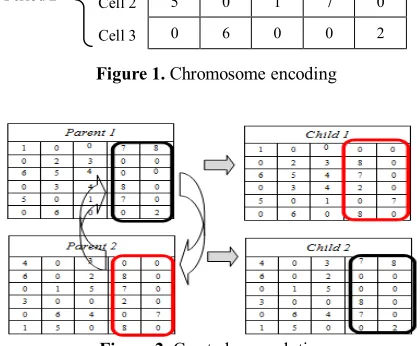
4. 1. Solution Representation The first step in the proposed GA is to consider a chromosome representation or solution structure. We use the presented structure in Figure 1 to represent the solution of the extended model. The chromosome representation in this study represents each job in the schedule as a gene in a chromosome; in which each chromosome consists of ((k+c)×f) genes. An example to depict this definition is provided in Figure 1 (for 2 periods, 3 cells and 8 machines). In Figure 1, the coding representation shows 3 cells, 2 periods and 8 machines. Each row represents which machine is used for the required operation in each cell and each period. This results in a reduction in the problem size by 3 times. The 3-dimention structure is ny (i.e., ), in which we have four matrices for this structure. The first matrix is for machine f in cell c and period k, the second matrix is for the added machines to the cell in each period, whereas the third matrix describes the removed machines from the cell in each period, and finally the fourth matrix is the machine assignment matrix. The first three matrices contain integer numbers; however, the last one is 0 and 1. In this problem, we have two more 3-dimention structures (i.e., xb with ). One structure determines the jobs done on each part in each cell and each period, and the other one shows the intra-cell material handling movements.These matrices are solely composed of 0 and 1. It should be noted that these matrices were initially 4-dimention structures and we reduced them into 3-dimention structures in the presented coding representation.
4. 2. Create Publication This procedure creates the initial population (Pop), which must be a wide set of disperse and good solutions. Several strategies can be applied to get a population with these properties. The solutions to be included in the population can be created, for instance, by using a random procedure to achieve a certain level of diversity. In this paper, an initial population of the desired size is generated randomly. For example, when there are five parts, the algorithm generates 10 solutions randomly. In fact, our desired size was depending on the problem size.
4. 3. Fitness Each solution has a fitness function value, which is related to the objective function value (OFV) of the solution. However, the population can
have feasible and infeasible solutions. An option to manage the infeasibility is to use both cost and feasibility. This can be written as fitness cost feasibility. Feasibility is equal to 1 if the solution is feasible; otherwise it is zero. Therefore, the fitness is not a single value; but it consists of two values, namely the cost and the feasibility of the solution.
Figure 1. Chromosome encoding
Figure 2. Created new solution
4. 4. Parent Selection Strategy The parent selection is important in regulating the bias in the reproduction process. The parent selection strategy means how to choose chromosomes in the current population that will create offspring for the next generation. Generally, it is better to give more chance to the best solutions in the current generation to be selected as parents in order to create offspring. The most common method for the selection mechanism is the “roulette wheel” sampling, in which each chromosome is assumed as a slice of a circular roulette wheel where the size of the slice is proportional to the chromosome's fitness. The wheel is spun Pop_ size times. On each spin, the chromosome under the wheel's marker is selected to be in the pool of parents for the next generation.
4. 5. Crossover Operator The combination method, namely "improved solutions" method is applied on every solution. It detects the feasibility of solutions from the exploration method and enhancing these solutions and those solutions obtained from the combination method. The solutions to be combined and the crossing points are to be selected randomly. There are several types of available crossover operators, some
of which are single point, two points, uniform, and arithmetic crossover operators. In this study, we use a single point crossover. For example, consider a problem with 10 parts and 3 cells. To create a new solution, we exchange element positioning at the right hand of the cut point in a solution. Figure 2 shows a typical example to create a new solution.
4. 6. Mutation Operators The most important task of the mutation operator is to maintain the exploration of the population in the successive generations and to intensificate the solution space. In this paper, a mutation operator, called swap mutation, is considered to swap any two randomly chosen genes in a chromosome [17]. The “mutation strength” is defined as an indication of the maximum number of swap moves performed. If the strength of the mutation is chosen to be one, then it performs a single swap move considering a given probability P(M). Thus, the strength of the mutation shows the number of successive swaps on an individual chromosome.
5. EXPERIMENTAL RESULTS
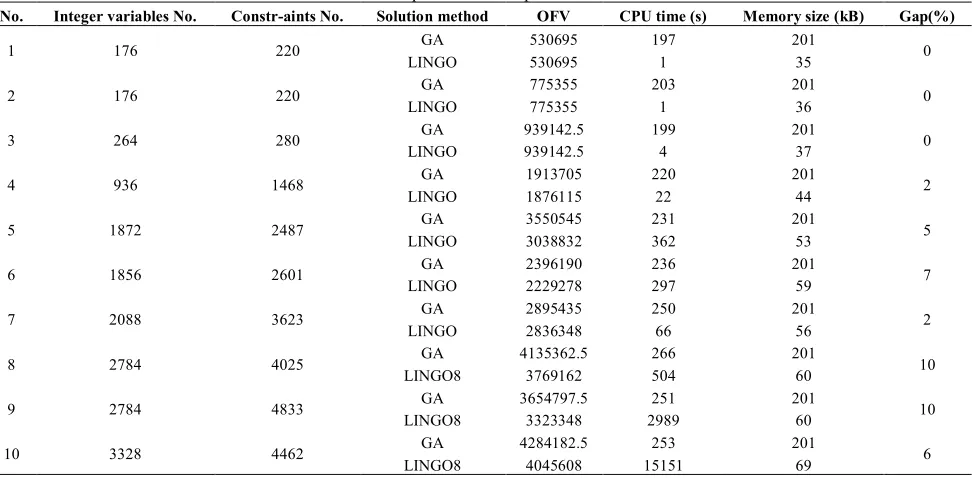
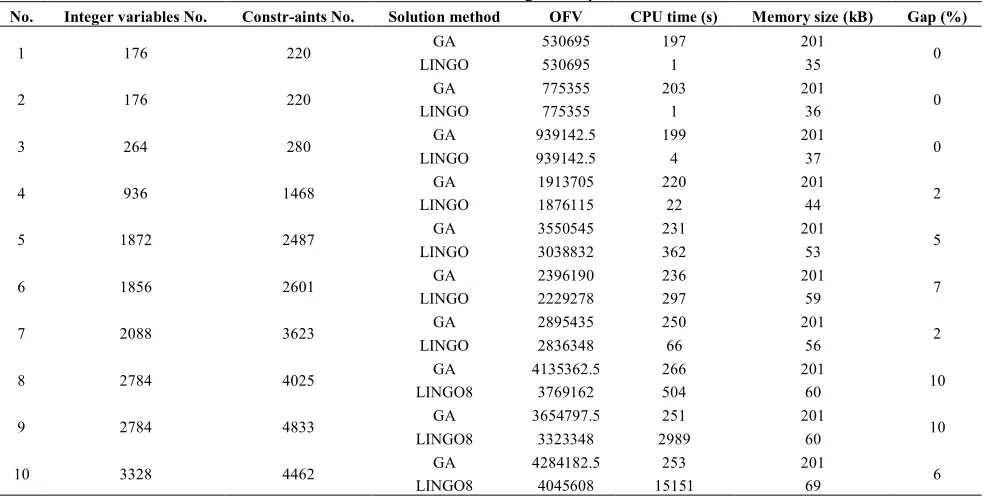
In this paper, all test problems are conducted on a PC with a 1.8 GHz single core processor and 768 MB of RAM. The GAs are coded in Delphi 7. At first, we compare the obtained objective values from the proposed GA and Lingo software in small-sized problems. The solutions are shown in Table 1. We compute the difference percentages between our results with those of Lingo solution, as well as contrasts in memory sizes and CPU times. We can see that the results of the problem solution by the proposed GA and Lingo software are the same in small-sized problems, showing the efficiency of the proposed GA. Secondly, the results from Lingo 8 software are compared with the results obtained by the GA in large-scale problems in Table 2. The Lingo software cannot solve large-sized problems in an acceptable time; however, the proposed GA makes a proper solution in more reasonable time. The growth of solution time for the proposed GA and Lingo software are compared in Figure 3. The calculation of the optimal value especially in large size problems is difficult because CMS planning model solution is complicated. Therefore, the solutions obtained by the Lingo 8 software are near optimal. So, we define a lower bound and then solve it by the proposed GA. The lower bound for large-sized problems is as Equations (13) to (21). Moreover, for each instance, we do not know the global optimal cost because of the non-linear nature of the problem, and the prohibitive required computation time. Therefore, we also compare the total cost obtained for each instance by the GA, with an associated lower bound (LB) for the
1 0 0 7 8
0 2 3 0 0
6 5 4 0 0
0 3 4 8 0
5 0 1 7 0
0 6 0 0 2
Period 1
Period 2
Cell 1
Cell 2
Cell 3
Cell 1 Cell 2
optimal total cost to evaluate the quality of the solutions obtained by the GA on an empirical basis.
å å å å
å å å
å å å
å å
+
+ + +
= + + -
-t p o c
pt opct p t c m m mct
t c m m mct m mct t p p pt
batch d b w n
k
y r y r z
s z
) (
) (
min
(13)
)
,
,
(
;
o
p
t
z
X
ptc opct
=
"
å
(14)) , (
; c t
n D X L
d m mct
p o pt op opct £ "
å å
(15))
,
,
,
(
;
1
,1
b
o
p
c
t
X
X
opct+
o+ pct-
opct£
"
(16)ï î ï í ì
= > =
0 0
0 1
pt pt pt
d If
d If
z (17)
) , , (
;
m
c
t
n
r
mct £ mct " (18))
,
,
(
;
.
r
m
c
t
A
n
mct£
mct"
(19){ }
0,1; ( , , , , ) ,,
,b r z o p mc t
Xopct opct mct ptÎ " (20)
{
0,1,2,...}
; ( , , ) ,,y y mc t
nmct mct+ mct- Î "
(21)
6. CONCLSION
This paper has presented the mathematical model to minimize intra-cell material handling, machine purchasing, cell reconfiguration, and setup costs.
According to the researches done, this problem is the type of NP-hard solution which can not be obtained by an optimization software once the dimensions of the problem increase. The approaches (e.g., branch &bound and dynamic planning) have computational time and saving limitations. So, the use of a metaheuristic algorithm will be effective. The conclusions drawn are as follows:
· In more developed problems, the computational time by Lingo will be increased while this increase will be minor when using a heuristic algorithm.
· Increasing production variations moves the industry toward using cellular manufacturing for its benefits. So, using the conventional methods in planning for the variation of the productions grows. But the use of conventional methods in planning cellular manufacturing systems does not have good performance and there is a need to pay attention to the heuristic methods.
Here are some suggestions for the future works:
· Some of the parameters of this problem can be considered as fuzzy parameters, so that this system can be converted to fuzzy cellular manufacturing systems.
· Multiple routes were not considered in this problem, considering of which may bring the problem closer to the real conditions. So that investigations on this subject can be valuable.
· Inventory cost could not be considered in this paper; however, it can be considered in the future studies.
TABLE 1. Comparison of the optimal and GA solutions
No. Integer variables No. Constr-aints No. Solution method OFV CPU time (s) Memory size (kB) Gap(%)
1 176 220 GA 530695 197 201 0
LINGO 530695 1 35
2 176 220 GA 775355 203 201 0
LINGO 775355 1 36
3 264 280 GA 939142.5 199 201 0
LINGO 939142.5 4 37
4 936 1468 GA 1913705 220 201 2
LINGO 1876115 22 44
5 1872 2487 GA 3550545 231 201 5
LINGO 3038832 362 53
6 1856 2601 GA 2396190 236 201 7
LINGO 2229278 297 59
7 2088 3623 GA 2895435 250 201 2
LINGO 2836348 66 56
8 2784 4025 GA 4135362.5 266 201 10
LINGO8 3769162 504 60
9 2784 4833 GA 3654797.5 251 201 10
LINGO8 3323348 2989 60
10 3328 4462 GA 4284182.5 253 201 6
TABLE 2. Solutions for large-scale problems
No. Integer variables No. Constr-aints No. Solution method OFV CPU time (s) Memory size (kB) Gap (%)
1 176 220 GA 530695 197 201 0
LINGO 530695 1 35
2 176 220 GA 775355 203 201 0
LINGO 775355 1 36
3 264 280 GA 939142.5 199 201 0
LINGO 939142.5 4 37
4 936 1468 GA 1913705 220 201 2
LINGO 1876115 22 44
5 1872 2487 GA 3550545 231 201 5
LINGO 3038832 362 53
6 1856 2601 GA 2396190 236 201 7
LINGO 2229278 297 59
7 2088 3623 GA 2895435 250 201 2
LINGO 2836348 66 56
8 2784 4025 GA 4135362.5 266 201 10
LINGO8 3769162 504 60
9 2784 4833 GA 3654797.5 251 201 10
LINGO8 3323348 2989 60
10 3328 4462 GA 4284182.5 253 201 6
LINGO8 4045608 15151 69
Figure 3. Diagram of the computational time with respect to the problem size
7. REFERENCES
1. Mehdizadeh, E. and Fatehi Kivi, A., " Three meta-heuristic algorithms for the single-item capacitated lot-sizing problem",
International Journal of Engineering, Transaction B, Vol. 27, No. 8, (2014), 1223-1232.
2. Defersha, F.M. and Chen, M., "Machine cell formation using a mathematical model and a genetic-algorithm-based heuristic",
International Journal of Production Research, Vol. 44, No. 12, (2006), 2421-2444.
3. Balakrishnan, J. and Cheng, C.H., "Multi-period planning and uncertainty issues in cellular manufacturing: A review and future directions", European Journal of Operational Research, Vol. 177, No. 1, (2007), 281-309.
4. Paydar, M.M. and Saidi-Mehrabad, M., "A hybrid genetic-variable neighborhood search algorithm for the cell formation problem based on grouping efficacy", Computers & Operations Research, Vol. 40, No. 4, (2013), 980-990.
5. Safaei, N., Saidi-Mehrabad, M. and Jabal-Ameli, M., "A hybrid simulated annealing for solving an extended model of dynamic
cellular manufacturing system", European Journal of Operational Research, Vol. 185, No. 2, (2008), 563-592. 6. Olorunniwo, F., "Changes in production planning and control
systems with implementation of cellular manufacturing",
Production and Inventory Management Journal, Vol. 37, (1996), 65-70.
7. Heragu, S.S. and Chen, J.-S., "Optimal solution of cellular manufacturing system design: Benders' decomposition approach", European Journal of Operational Research, Vol. 107, No. 1, (1998), 175-192.
8. Shang, J.S. and Tadikamalla, P.R., "Multi criteria design and control of a cellular manufacturing system through simulation and optimisation", International Journal of Production Research, Vol. 36, (1998), 1515-1529.
9. Shinn, A. and Williams, T., "A stitch in time: A simulation of cellular manufacturing", Production and Inventory Management Journal, Vol. 39, (1998), 72-77.
10. Schaller, J.E., Erengüç, S.S. and Vakharia, A.J., "A methodology for integrating cell formation and production planning in cellular manufacturing", Annals of Operations Research, Vol. 77, (1998), 1-21.
11. Chen, M. and Cao, D., "Coordinating production planning in cellular manufacturing environment using tabu search",
Computers & Industrial Engineering, Vol. 46, No. 3, (2004), 571-588.
12. Defersha, F.M. and Chen, M., "A comprehensive mathematical model for the design of cellular manufacturing systems",
International Journal of Production Economics, Vol. 103, No. 2, (2006), 767-783.
13. Tavakkoli-Moghaddam, R., Makui, A., Khazaei, M. and Ghodratnama, A., "Solving a new bi-objective model for a cell formation problem considering labor allocation by multi-objective particle swarm optimization", International Journal of Engineering-Transactions A: Basics, Vol. 24, No. 3, (2011), 249-258.
14. Zhang, Z., "Modeling complexity of cellular manufacturing systems", Applied Mathematical Modelling, Vol. 35, No. 9, (2011), 4189-4195.
0 2000 4000 6000 8000 10000 12000 14000 16000
1 2 3 4 5 6 7 8 9 10
Ti
me
Example
15. Leung, J.Y.-T., Li, H., Pinedo, M. and Zhang, J., "Minimizing total weighted completion time when scheduling orders in a flexible environment with uniform machines", Information Processing Letters, Vol. 103, No. 3, (2007), 119-129.
16. Tavakkoli-Moghaddam, R. and Mehdizadeh, E., "A new ILP model for identical parallel-machine scheduling with family setup times minimizing the total weighted flow time by a genetic
algorithm", International Journal of Engineering Transactions A Basics, Vol. 20, No. 2, (2007), 183-194.
17. Torabi, S.A., Ghomi, S.F. and Karimi, B., "A hybrid genetic algorithm for the finite horizon economic lot and delivery scheduling in supply chains", European Journal of Operational Research, Vol. 173, No. 1, (2006), 173-189.
Design of a New Mathematical Model for Integrated Dynamic Cellular
Manufacturing Systems and Production Planning
N. Aghajani-Delavar a, E. Mehdizadeh a, S. A. Torabi b, R. Tavakkoli-Moghaddam b,c
a Department of Industrial Engineering, Faculty of Industrial and Mechanical Engineering, Qazvin Branch, Islamic Azad University, Qazvin, Iran b School of Industrial Engineering, College of Engineering, University of Tehran, Tehran, Iran
c Research Center for Organizational Processes Improvement, Sari, Iran
P A P E R I N F O
Paper history: Received 08 April 2014
Received in revised form 04 September 2014 Accepted 17 January 2015
Keywords:
Cellular Manufacturing System Cell Formation
Production Planning Genetic Algorithm
هﺪﯿﮑﭼ
ﻞﻗاﺪﺣنآفﺪﻫﻪﮐدﻮﺷﯽﻣﻪﺋاراﺪﯿﻟﻮﺗيﺰﯾرﻪﻣﺎﻧﺮﺑوﯽﻟﻮﻠﺳﺪﯿﻟﻮﺗﻢﺘﺴﯿﺳياﺮﺑﻪﭼرﺎﭙﮑﯾﯽﺿﺎﯾرلﺪﻣﮏﯾﻪﻟﺎﻘﻣﻦﯾارد ﯽﻣﺎﻫﻦﯿﺷﺎﻣيزاﺪﻧاهاروﺎﻫلﻮﻠﺳدﺪﺠﻣيﺪﻨﺑهﺮﮑﯿﭘ،ﯽﻟﻮﻠﺳنوردداﻮﻣﻞﻘﻧوﻞﻤﺣ،ﺎﻫﻦﯿﺷﺎﻣﺪﯾﺮﺧيﺎﻫﻪﻨﯾﺰﻫيزﺎﺳ ﺪﺷﺎﺑ . ﻣ فﺪﻫﺎﺑﯽﻧﺎﻣزهرودﺮﻫردﺎﻫﯽﯾﺎﺠﺑﺎﺟوﺎﻫﻦﯿﺷﺎﻣداﺪﻌﺗوﺪﻫدﯽﻣﻞﮑﺷاريﺪﯿﻟﻮﺗيﺎﻫلﻮﻠﺳ،يدﺎﻬﻨﺸﯿﭘلﺪ
ﺪﻨﮐﯽﻣﻦﯿﯿﻌﺗاررﻮﮐﺬﻣيﺎﻫﻪﻨﯾﺰﻫندﺮﮐﻞﻗاﺪﺣ .
ﻪﻠﺌﺴﻣﻦﯾا
NP-hard
يرﺎﮑﺘﺑااﺮﻓﻢﺘﯾرﻮﮕﻟاﮏﯾ،نآﻞﺣياﺮﺑوﺪﺷﺎﺑﯽﻣ
دﻮﺷﯽﻣدﺎﻬﻨﺸﯿﭘﮏﯿﺘﻧژﻢﺘﯾرﻮﮕﻟاسﺎﺳاﺮﺑ .
ﺎﺒﺳﺎﺤﻣﺞﯾﺎﺘﻧ باﻮﺟﻪﺑﯽﺑﺎﯿﺘﺳدياﺮﺑيدﺎﻬﻨﺸﯿﭘﻢﺘﯾرﻮﮕﻟاﯽﺸﺨﺑﺮﺛاوﯽﯾارﺎﮐﯽﺗ
ﺪﻨﻫدﯽﻣنﺎﺸﻧارگرﺰﺑوﻂﺳﻮﺘﻣدﺎﻌﺑاﺎﺑﻞﺋﺎﺴﻣياﺮﺑًﺎﺻﻮﺼﺧﺐﺳﺎﻨﻣيﺎﻫ .