Assessment of the Nexus between Internal Control System and Working
Capital Management
1Ozor, D. C., 2Onyeanu, E., 3Ugwoke, R., 4Ugwoke, V. O.
Department of Accountancy, Faculty of Business Administration, University of Nigeria, Enugu Campus Email: [email protected]
1. INTRODUCTION:
The term internal control has largely replaced the term internal check (Bridge and Moss, 2003). Internal check referred to those methods and procedures used by the accounting and finance divisions of a business to minimize clerical errors and protect assets, especially cash against theft or loss. The change in terminology was the result of an expanding perception of the objectives and activities implied by internal control. In 1936, the American Institute of Certified Public Accountants (AICPA) defined internal control as those measures and methods adopted within the organisation itself to safeguard the cash or other assets of the company and to check the clerical accuracy of the bookkeeping.
In 1949, the AICPA defined internal control as the plan of organisation and all of the coordinate methods and measures adopted by a business to safeguard its assets, check the accuracy and reliability of its accounting data, promote operational efficiency and encourage adherence to prescribed managerial policies. However, in 1987, the Treadway Commission recommended that internal control structures be designed to prevent or detect fraudulent financial reporting (Bridge and Moss, 2003).
Every organisation works at two levels within two systems. One is the operating system, which is designed to accomplish stated objectives, such as producing 100 items while meeting standards of cost, quality and schedule. The other is the control system, which is overlaid on the operating system. It is made up of the procedures, rules, and instructions that are designed to make sure that the operating system's objectives will be met (Sawyer, 2006). The definitions of internal control are sufficiently exact to avoid misunderstanding and are also comprehensive enough to encompass most performance objectives that are applicable to all organisations, and to accommodate existing definitions.
The Working Group established in terms of the Cadbury Report's recommendations to investigate certain aspects of corporate governance, also used this definition in the United Kingdom. According to Puttick and van Esch (2008) internal control are those methods and procedures adopted by the management of an entity to assist in achieving management 's objective of ensuring that the business of the entity is properly conducted in an orderly and efficient manner. Internal controls are the policies and procedures that enable management to know what is going on and to cause things to happen in accordance with their intentions (Swanson, 2009).
Internal control comprises the organisational plan and all of the coordinate methods and measures adopted within a business to safeguard its assets, check the accuracy and reliability of its accounting data, promote operational efficiency, and encourage adherence to prescribed managerial policies (Sawyer and Dittenhofer, 2006). According to Knechel (2001), internal control is defined as a process that is designed by management in order to provide reasonable assurance that the organisation's objectives are being met. Nair (2000) outlines internal control as a process that is put
Abstract: Internal control systems are affected by an entity's board of directors management and other personnel and are designed to provide reasonable assurance regarding the achievement of objectives of organisations. Thus, a good internal control system will ensure that organisational resources are properly secured and well utilized. Against this backdrop, this paper examined the relationship between effective internal control system and efficient management of working capital in manufacturing firms in Nigeria, and ascertains the effect internal control system has on manufacturing firms’ efficiency ratio in Nigeria. The insightful role of the internal control systems of manufacturing firms could be observed in the result of this study which revealed that a significant relationship exists between internal control system and efficient management of working capital of manufacturing firms in Nigeria (R = 0.935; p-value = 0.00 < 0.05). We recommend that there should be a link achievement of the
organization’s internal control objectives to individual performance objectives. Each person within the organization should be held accountable for the achievement of assigned internal control objectives. This will increase the relationship between internal control system and efficient management of working capital of manufacturing firms in Nigeria.
in place by management and stakeholders and is designed to provide reasonable assurances that the institution's objectives are being achieved effectively and efficiently in compliance with applicable legal prescripts, and that there is reliable and accurate financial reporting and Venables and Impey (2001) described internal control as the regulation of activities in an organisation through systems designed and implemented to facilitate the achievement of management objectives.
2. LITERATURE REVIEW:
2.1 Internal Control and the Organisation
Woolf (2007) states that many organisations produce and keep up to date charts that depict the organisational hierarchy in linear terms, such charts have the advantage of indicating most departmental functions as well as identifying the staff responsible for executing them. Robertson (2002) states that the Committee of Sponsoring Organisation (COSO) report defines internal control as a process, affected by an entity’s board of directors, management and other staff, and designed to provide reasonable assurance regarding the achievement of objectives in the following three categories: reliability of financial reporting; compliance with applicable laws and regulations and effectiveness and efficiency of operations From the above it is clear that in today's complex organisation environment, the role of internal control is of such importance that an organisation (especially an administrative unit) cannot operate effectively unless it has the four fundamental concepts of COSO in place (Robertson, 2002). Those concepts are process; people; reasonable assurance and category objectives.
Internal control is designed to achieve certain objectives. In the operations category, some examples of objectives are good business reputation and safeguarding assets in the context of their effective and efficient use. For an organisation to be successful, management must achieve the goals and objectives of the organisation. To achieve those goals and objectives, management needs to establish internal controls and link communication systems to all interrelated components of internal control (Robertson, 2002).
A system is a set of interrelated components where the idea of synergy comes into play. This means that the sum of the whole is greater than the sum of each individual component. Synergy can be illustrated by using as an example the series of parts that go into making a motorcycle. When stripped down, each part is a non-functioning component, and when put together to form a motorcycle, the parts become a form of transport with far greater potential in terms of ability than each of the separate parts.
Since internal control consists of those systems, procedures and activities that are used within an organisation to detect or prevent errors and to safeguard assets, it is clear that most internal controls are designed and used to prevent mistakes from occurring. It should be remembered that controls only work if employees follow them, and that almost all internal controls can be circumvented or nullified by negligence or complicity. For example, if a manager decides to steal, the natural control under his supervision can easily be bypassed (Milton, 2009).
There is a direct relationship between objectives and components of internal control system. The objectives of the internal control system are what an entity strives to achieve and the components represent what is needed to achieve the objectives. For example, financial data is part of the information and communication component that is needed to manage business operations, to develop reliable financial statements and to determine whether the entity complies with applicable laws.
2.2. Effectiveness of Internal Control System
Glance (2006) provided that internal control system refers to “the local government process and procedure that is been established with the aim of objective achievement.” Similarly, the internal control system also serves as a process that guides an organization towards achieving its established objectives (Aguolu, 2009). From the above definition of internal control system, it can understand clearly that it all about the provision that will assist to the achievement of objectives. Therefore, for the purpose of this study effective internal control system refers to the effective control measures established by an organization with the aim of safeguarding their assets ensure the reliability of records both financial and non-financial as well as compliance with relevant policies and procedure that will ensure the achievement of organizational objective.
At the same time effective internal control system are fundamental drivers toward earnings quality (Church and Schneider, 2008). In the same vein, effective internal control system has an essential role to play in a firm’s success (Jokipii, 2010) in line with the above issue; effective internal control system could also play an important role in the effectiveness of internal auditors particularly at government. All of government should improve the effectiveness of internal control system, internal audit function and organization commitment because they improve good governance (Eko and Hariyanto, 2011) in addition, such effective internal control system can provide information to management about the entity's progress, or lack of progress toward the achievement of their objectives (Verdina, 2011).
Al-Twaijry et al (2004) also found that effectiveness of internal control system helps external auditors to rely on the work of internal auditors and thereby improve their effectiveness. Therefore, internal control systems are integral component of the management processes of a public sector which should be establish in order to provide reasonable assurance that the operations are carried out efficiently and effectively. Effective internal controls systems are essential to the effectiveness of local governments operation because it deals with the activities or procedures that are designed to provide reasonable assurance that operations are performing according to plan and these can also influence the effectiveness of internal audit. COSO also provides the basic principles representing the fundamental concepts of effective internal control in five components of the framework (Candreva, 2006).
3. DATA AND METHODOLOGY:
Primary data was utilized in this study. Primary data was obtained through survey using oral interview and questionnaire. The population of this study is made up of the staff of quoted manufacturing firms in the South East of Nigeria who are up to supervisory level. This included those who have responsibility for ensuring effective internal control in the organisation as they get works done through others. The number however is infinite and an appropriate sample size was determined. Thus, the total sample size for this study was two hundred and forty-six (246).
3.1 Model specification
This study’s main constructs is to examine the Effect of Internal Control System on Management of Organisational Resources of Manufacturing Firms in Nigeria. The questionnaires used were measured through the use of Likert- scale questionnaire. The basic scale design therefore consisted of a Likert- scale with five scale points (Onwumere, 2005). For presentation and data analysis, tables and percentages were used to summarize the data gathered.
The Chi-square statistics was used to test hypotheses one to three to ascertain the effect of internal control system on management of organisational resources of manufacturing firms in Nigeria. Also, the Pearson Product Moments Correlation Coefficient was used to test Hypothesis four and the simple regression analysis for Hypothesis five. The regression and correlation formula is represented below.
The model for hypothesis four and five is hereby stated. For hypothesis four which states that there is no significant relationship between internal control system and efficient management of working capital of manufacturing firms in Nigeria.
The linear representation is as follows:
EFM = f(INCS) - - - (1)
where;
EFM = Efficient management of working capital
INCS = Internal Control System
f = Function.
4. RESULTS AND ANALYSIS: 4.1 Presentation of Survey Data
Table 1: Relationship between effective internal control system and efficient management of working capital of manufacturing firms in Nigeria
No Statement SA % A % SD % D % I % Total % 21 To what extent do you agree that
the organization have subgrant agreements which provide for
advance payments and/or
reimbursement of cost?
72 32 113 50 8 4 14 6 18 8 225 100
22 To what extent do you agree that advance payments have been made to the organization:
No Statement SA % A % SD % D % I % Total % a) Are funds maintained in
a bank with sufficient
federal deposit
insurance?
b) Is there an
understanding of the terms of the advance (i.e. to be used before costs can be submitted for reimbursement)? Source: Field Survey, 2015
Note: SA = Strongly Agree; A = Agree; SD = Strongly Disagree; D = Disagree, I = Indifferent
Table 1 reveals responses on the relationship between effective internal control system and efficient management of working capital of manufacturing firms in Nigeria. As revealed that seventy-two (72) respondents representing 32% of respondents strongly agreed that their organization have sub-grant agreements which provide for advance payments and/or reimbursement of cost. One hundred and thirteen (113) respondents representing 50% of respondents agreed that their organization have sub-grant agreements which provide for advance payments and/or reimbursement of cost. Also eight (8) respondents representing 4% of respondents strongly disagreed that their organization has sub-grant agreements which provide for advance payments and/or reimbursement of cost. Fourteen (14) respondents representing 6% of respondents disagreed that their organization has sub-grant agreements which provide for advance payments and/or reimbursement of cost. Lastly, eighteen (18) respondents representing 8% of respondents were indifferent that their organization has sub-grant agreements which provide for advance payments and/or reimbursement of cost.
As revealed from Table 1, ninety-one (91) respondents representing 40% of respondents strongly agreed that advance payments made to their organization are refunds maintained in a bank with sufficient federal deposit insurance and there is an understanding of the terms of the advance. One hundred and twelve (112) respondents representing 50% of respondents agreed that advance payments made to their organization are refunds maintained in a bank with sufficient federal deposit insurance and there is an understanding of the terms of the advance. Also two (2) respondents representing 1% of respondent strongly disagreed that advance payments made to their organization are refunds maintained in a bank with sufficient federal deposit insurance and there is an understanding of the terms of the advance. Thirteen (13) respondents representing 6% of respondents disagreed that advance payments made to their organization are refunds maintained in a bank with sufficient federal deposit insurance and there is an understanding of the terms of the advance. Lastly, seven (7) respondents representing 3% of respondents were indifferent that advance payments made to their organization are refunds maintained in a bank with sufficient federal deposit insurance and there is an understanding of the terms of the advance.
4.2 Test of Hypotheses
This section deals with the test of our study hypotheses. Four steps were utilized in the exercise. The steps involved first, restating the hypotheses in Null and Alternate forms; second, stating the decision rules; third, interpreting the results of the estimated models; and fourthly, using the decision criteria to accept or reject the null/ alternate hypotheses as relevant.
Step One: Restatement of Hypothesis in Null and Alternate Form
Ho: There is no significant relationship between internal control systems and efficient management of working capital of manufacturing firms in Nigeria
Ha: There is a significant relationship between internal control system and efficient management of working capital of manufacturing firms in Nigeria
Step Two: Decision Rule
1. Accept Ha and reject Ho where p-value less than 0.05. 2. Accept Ho and reject Ha where p-value greater than 0.05
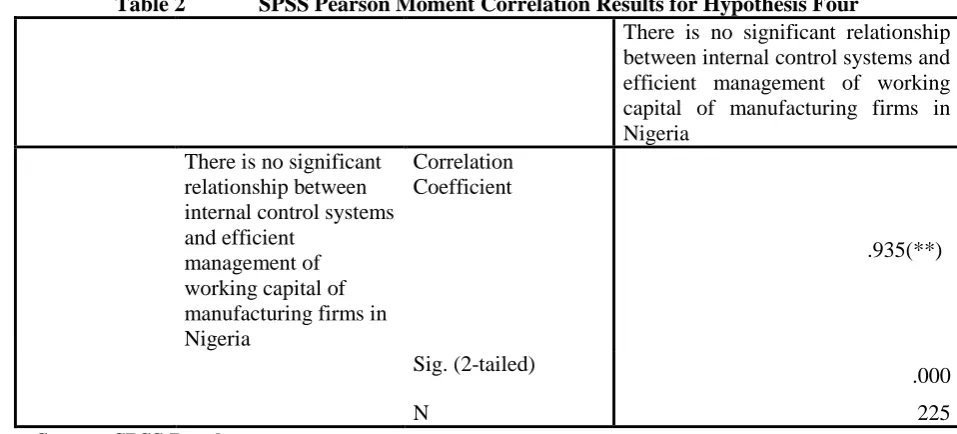
Table 2 SPSS Pearson Moment Correlation Results for Hypothesis Four
There is no significant relationship between internal control systems and efficient management of working capital of manufacturing firms in Nigeria
There is no significant
relationship between internal control systems and efficient
management of working capital of manufacturing firms in Nigeria
Correlation Coefficient
.935(**)
Sig. (2-tailed)
.000
N 225
Source: SPSS Results
From Table 2, the result reveals that from the perception of respondents that there is a significant relationship between internal control systems and efficient management of working capital of manufacturing firms in Nigeria (correlation coefficient (R) = 0.935). This was further supported by p-value = 0.00 < 0.05.
Step Four: Decision
The alternate hypothesis is accepted while the null hypothesis rejected, thus indicating that there is a significant relationship between internal control systems and efficient management of working capital of manufacturing firms in Nigeria.
5. CONCLUSION AND RECOMMENDATIONS:
Internal control systems are affected by an entity's board of directors management and other personnel and are designed to provide reasonable assurance regarding the achievement of objectives of organisations. Thus, a good internal control system will ensure that organisational resources are properly secured and well utilized. The goal of this study is to examine the relationship between effective internal control system and efficient management of working capital in manufacturing firms in Nigeria, and ascertain the effect internal control system has on manufacturing firms’ efficiency ratio in Nigeria. Since internal controls are an integral part of any organization’s financial and business policies and procedures (International Organization of Supreme Audit Institutions (INTOSAI), 2004). Internal controls must thus consist of all the measures taken by the organization for the purpose of; protecting its resources against waste, fraud and inefficiency; ensuring accuracy and reliability of accounting and operating data; ensuring compliance with the policies of the organization; evaluating the level of performance in all organizational units of the organization, (Kaplan, 2008; Cunningham, 2004; INTOSAI, 2004). This will assist at ensuring proper management of organisational resources as observed from the findings of this study. Also, internal control system lead to the promotion of adherence to laws, regulations, contracts and management directives and the development and maintenance of reliable financial and management data, and accurately present that data in timely reports. This insightful role of the internal control systems of manufacturing firms could be observed in the result of this study that there is a significant relationship between internal control system and efficient management of working capital of manufacturing firms in Nigeria (R = 0.935; p-value = 0.00 < 0.05). We recommend that there should be a link achievement of the organization’s internal control objectives to individual performance objectives. Each person within the organization should be held accountable for the achievement of assigned internal control objectives. This will increase the relationship between internal control system and efficient management of working capital of manufacturing firms in Nigeria.
REFERENCES:
1. Aguolu, O. (2009). Designing an Effective Internal Audit Group. Association of Accountancy Bodies in West Africa, 1(4), 60-76.
3. Bridge, M. & Moss, I. (2003). COSO back in the limelight (available from: http:www.pwc.com/extweb/indissue.nsf/docid and Accessed: 12/04/14
4. Candreva, P. J. (2006). Controlling internal controls. Public Administration Review, 66(3), 463-465.
5. Changchit, C., Holsapple, C. W. & Madden, D. L. (2001). Supporting Managers’ Internal Control Evaluations: An Expert System and Experimental Results. Decision Support Systems, 30, 437–449.
6. Church, B. K. & Schneider, A. (2008).The effect of auditors’ internal control opinions on loan decisions. Journal of Accounting and Public Policy, 27, 1–18.
7. Eko, S. & Hariyanto, E. (2011). Relationship between Internal Control, Internal Audit, and Organization Commitment with Good Governance: IndonesianCase. Managerial Auditing Journal, 32(5): 6-13,
8. Feng, M., Li, C. & McVay, S. (2009). Internal control and management guidance. Journal of Accounting and Economics, 48, 190–209.
9. International Organization of Supreme Audit Institutions (INTOSAI) (2004). Guidelines for internal control standards for the public Sector (Retrieved on 26/12/14 from http://www.intosai.org)
10. Jokipii, A. (2010). Determinants and consequences of internal control in firms: a contingency theory based analysis. Journal of Management Governance, 14, 115–144.
11. Kaplan P.A (2008). The Complete Text. Publishing UK: Professional Accountant
12. Knechel, W.R. (2001). Auditing assurance and risk. 2nd edition. USA: South- Western College Publishing. 13. Milton, S.F. (2009). An Internal Auditor’s Manual and Guide. USA: Prentice- Hall.
14. Nair, J. (2000). The Structuring of the Treasury Regulations. The IPFA Journal, 1(3), September 15. Onwumere J.U. J, (2005). Business and economic research methods. Lagos: Don Vinton Limited
16. Puttick, G. & Van Esch, S. (2008). The Principles and Practice of Auditing. 7th edition. Kenwyn: Juta & Co. Ltd.
17. Robertson, J.C. (2002). Fraud examination for managers and auditors. USA: Viesca Books Rumelt, 1997. 18. Sawyer, L. B. (2006). Sawyer's Internal Auditing (4th edition ed.): The Institute of Internal Auditors.
19. Swanson, D. (2009). Competency Framework for Internal Auditing in Nederland. Amsterdam: Instituut van InternalAuditors Nederland.
20. Venables H. and Impey L. (2001) Management Control of Inter-firm Transactional Relationships: the Case of Industrial Renovation and Maintenance. Accounting, Organizations and Society. 25(1): 51-77.
21. Verdina, G. (2011). Risk management as a tool for securing Internal Control in the process of study program implementation at Higher Education Institutions. Economics and management, 16, 987- 991.