Architectural Optimization & Design of Embedded
Systems based on AADL Performance Analysis
Roberto Varona-Gómez
1,*, Eugenio Villar
1, Ana Isabel Rodríguez
2, Francisco Ferrero
2, Elena Alaña
21University of Cantabria, 39005, Santander, Spain 2
GM V Aerospace and Defence S.A.U., 28760, Tres Cantos, Spain
Abstract
Due to the increasing co mple xity o f e mbedded systems, new design methodologies have to be adopted, since traditional techniques are no longer efficient. Model-based engineering enables the designer to confront these concerns using the architecture description of the system as the ma in a xis during the design cycle. Defining the architecture of the system before its imple mentation enables the analysis of constraints imposed on the system fro m the beginning of the design cycle until the fina l imple mentation. AADL has been proposed for designing and analyzing SW and HW architectures for real-t ime mission-critica l e mbedded systems. Although the Behavioural Annex improves its simulation semantics, AADL is a language for analyzing architectures and not for simu lating them. AADS is an AADL simu lation tool that supports the performance analysis of the AADL specification throughout the refine ment process from the init ial system architecture until the complete, detailed application and execution platform are developed. In this way, AADS enables the verification of the in itia l timing constraints during the complete design process. AADS supports the performance analysis of the AADL specification, enriched with behaviour specifications. AADS-T is Ravenscar Co mputational Model (RCM ) compliant as part of the TASTE toolset and has been used to assist in co-design.Keywords
AADL, Perfo rmance Analysis, Simulat ion, Ravenscar Co mputational Mode, HW/SW Co-Design, AADS, POSIX, SCoPE1. Introduction
Nowadays, embedded systems must support the deployment of heterogeneous applications within heterogeneous architectures. In most cases, the execution platform is not fixed and must be designed and optimized in conjunction with the application SW. Therefo re, early estimation of the system performance on the e xecutive platform, under real-time constraints, is desirable. This analysis requires a unified model of the application and the architecture, and e ffective means to define the mapping of application functions onto architecture resources and services.
Architecture Ana lysis and Design Language (AADL) [1-3] p ro v id es such a mo de llin g fra me wo rk. It was developed as a standard of the Society of Auto mot ive Eng inee rs (SA E) to enable the descript ion of task and co mmun ic at ion a rch itectu res fo r rea l-t ime , e mb edded, fault-tolerant, secure, safety-crit ical, SW-intensive systems. Ho weve r, AA DL does not support the e xp ress ion of behaviour in detail. At most, it is possible to specify the
* Corresponding author:
[email protected] (Roberto Varona-Gómez) Published online at http://journal.sapub.org/ajca
Copyright © 2012 Scientific & Academic Publishing. All Rights Reserved
non-determin istic behaviour of a thread as a set of subprogram ca lls, and application behaviour re lies main ly on source code written in source languages. The behavioural annex[4] has introduced high-level co mposition concepts and a richer state representation than the standard AADL mode auto mata[48]. The behaviour is specified using extended automata that may trigger a transition by an event, a Boolean e xpression, etc. A transition may trigger one or more actions such as assignment of values to variables, sending data, events, etc. The annex main ly declares states and transitions with guards and an action part. Guards and actions can access ports and data subcomponents declared in the AADL co mponent to which they are attached.
synchronization. There a re t wo variants of the ASSERT software process: Hard Rea l-Time Un ified Modeling Language (HRT-UM L) and AADL trac ks. The ASSERT Set of Tools fo r Eng ineering (TASTE)[7] toolset is an open source toolset supporting the latter.
The LEON2[8] processor was designed by the European Space Agency (ESA) as a 32-bit synthesizable processor core based on the SPARC V8 arch itecture. The core is highly configurable, and particularly suitable for System-on-Ch ip (SOC) designs.
There is a common ly recognized need for new development fra me works that enable designers to perform efficient e xp loration of design alternatives and analyze system properties throughout the design cycle. So me system properties can be obtained by static analysis. Many other properties can only be obtained through simulation. In any case, system simu lation is needed for performance analysis under real e xecution condit ions. System simu lation and performance analysis can validate the correct dimensioning of the system and detect locks, missed deadlines and other potential proble ms ra ised by the comple x interaction a mong components that can be found in a rea l system. The ea rlier all these problems are detected, the lower the cost of correcting them[9].
Evolutionary prototyping is now becoming a well-accepted development approach in Model-Driven Engineering (M DE)[10]. The design flo w is based on a central model that is refined unless it is satisfactory. Progra ms can be generated from this model and constitute intermediate versions of the product. The last refined model corresponds to the final system. A prototyping-based design process is beneficial for the earliest possible verificat ion of the impact of deployment decisions, or the use of a particular HW/SW co mponent in the system.
This document deals with AADS[12] an AADL simu lation and performance analysis fra mework, including a behavioural annex co mpatible with the RCM. The tool can support prototype-based design allowing the functional and non-functional (e xecution times, power consumption, etc.) verification of the system while it is being re fined until the final imp le mentation. Based on SystemC, the fra me work supports the seamless integration of HW component and an easy optimization of the e xecutive platform. SystemC has become a re levant standard language for modeling and simulat ion of HW/SW e mbedded systems[11].
HW/SW partit ioning is a phase of co-design in wh ich the partition of the specification into two parts is achieved. One part will be imp le mented in HW and the other part will be imple mented in SW. HW/SW partition ing is the process of deciding, fo r each subsystem, whether the required functionality is more advantageously imp le mented in HW or SW to achieve a part ition that will give us the required performance with in the overall system require ments (in size, we ight, power, cost, etc.). Partit ioning into HW and SW affects overall system cost and performance[45]. There are two part itioning approaches: Starting first with all the
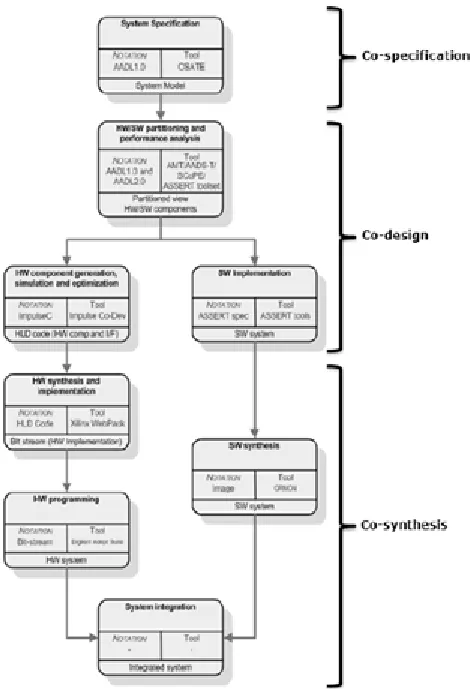
functionality in SW and moving parts, which a re time-c rit ical and cannot be allocated to SW, into HW (this is known as SW centric part itioning) o r starting first with a ll the functionality in HW and moving parts into the SW imple mentation (this is known as HW centric pa rtitioning). AADS e xtracts the necessary information for the SCoPE tool to perform a simulat ion at system level fro m the AADL models. The simulat ion and performance analysis results will guide the system designer through the selection of the most adequate partition solution (see Figure 1).
The contents of the paper are as follows. The following two sections make a su mmary of AADL and SCoPE respectively. The ne xt section rev iews the re lated work. In the next two sections, AADS and AADS-T are described, with a brief description about performing the simulat ion on a LEON2 p rocessor. Ne xt , we e xp lain the Case Study: How AADS-T has been used in the ESTEC 22810/ 09/ NL/JK HW-SW CODESIGN project[46] to assist in HW/SW partitioning. Then we state the conclusions and fina lly, we include acknowledgements and referenced documents.
Figure 1. AADS and SCoPE in the HW/SW co-design process
2. AADL
and system component abstractions to specify and analyze real-t ime e mbedded systems, comple x systems of systems, and specialized performance capability systems, and to map software onto computational hardware e le ments. The AADL is especially e ffective for mode l-based analysis and specification of co mple x real-time e mbedded systems.
In AADL, a co mponent is characterized by its identity (a unique name and runtime essence), possible interfaces with other components, distinguishing properties (critical characteristics of a co mponent within its architectural context), and subcomponents and their interactions. In addition to interfaces and internal structural ele ments, other abstractions can be defined for a co mponent and system architecture. Fo r e xa mple , abstract flows of in formation or control can be identified, associated with specific components and interconnections, and analyzed. These additional ele ments can be included through core AADL language capabilit ies (e.g. defining new co mponent properties) or the specification of a supplemental annex language.
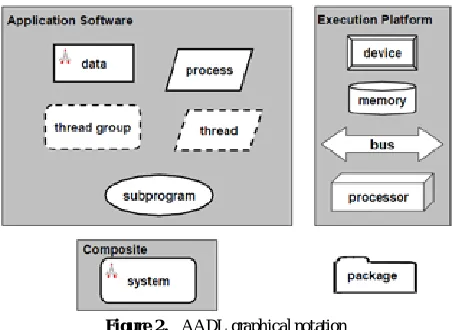
The component abstractions of the AADL are separated into three categories: Applicat ion software, e xecution platform (hardware ) and co mposite. Application software can be a thread (act ive co mponent that can execute concurrently and be organized into thread groups), thread group (component abstraction for logically organizing thread, data, and thread group components within a process), process (protected address space whose boundaries are enforced at runtime), data (data types and static data in source text ) and subprogram (concepts such as call-return and calls-on methods, modelled using a subprogram co mponent that represents a callable piece of source code). Execution p latform (hardwa re) can be a processor (schedules and executes threads), me mory (stores code and data), device (represents sensors, actuators, or other components that interface with the e xternal environment) and bus (interconnects processors, me mory, and devices). Co mposite can be a system (design ele ments that enable the integration of other co mponents into distinct units within the architecture). System components are composites that can consist of other systems as well as of software or hardware co mponents.
The AADL standard includes runtime se mantics for mechanis ms of e xchange and control of data, including message passing, event passing, synchronized access to shared components, thread scheduling protocols, timing require ments and re mote procedure calls. In addit ion, dynamic reconfiguration of runtime arch itectures can be specified using operational modes and mode transitions.
The AADL can be used to model and analyze systems already in use and design and integrate new systems. The AADL can be used in the analysis of partially defined architectural patterns (with limited architectural detail) as well as in fu ll-scale analysis of a co mp lete system model e xtracted fro m the source code (with co mpletely quantified system property values).
AADL supports the early prediction and analysis of
critica l system qualit ies, such as performance, schedulability, and re liab ility. Fo r e xa mp le, in specifying and analyzing schedulability, AADL-supported thread components include the pre -declared e xecution property options of periodic , aperiodic (event-driven), background (dispatched once and executed until co mplet ion), and sporadic (paced by an upper rate bound) events. These thread characteristics are defined as part of the thread declaration and can be readily ana lyzed.
Within the core language, property sets can be declared that include new properties for co mponents and other modelling ele ments (e.g. ports and connections). By utilizing the e xtension capabilities of the language, additional models and properties can also be included. For e xa mple , a re liability anne x can be used that defines reliability mode ls and properties of components facilitating a Markov or fault tree analysis of the arch itecture. This analysis would assess architecture’s compliance with specific re liability require ments.
Collective ly, these AADL propert ies and e xtensions can be used to incorporate new and focused analyses at the architectural design level. These analyses facilitate trade off assessments among alternative design options early in a development or upgrade process.
Figure 2. AADL graphical notation
AADL co mponents interact exclusively through defined interfaces. A component interface consists of directional flow through data ports for un-queued state data, event data ports for queued message data, event ports for asynchronous events, synchronous subprogram ca lls and e xplicit access to data components.
Interactions among components are specified e xplic itly. For e xa mp le, data co mmunication a mong co mponents is specified through connection declarations. These can be mid-fra me (immediate) co mmunication o r phase-delayed (delayed) co mmun ication. The semantics of these connections assures deterministic transfer of data streams. Deterministic transfer means that a thread always receives data with the same time de lay; if the receiv ing thread is over- or under-sa mpling the data stream, it a lways does so at a constant rate.
time, deadlines, space require ments, arrival rates, and characteristics of data and event streams. In addition, properties identify source (code and data that imple ment the application co mponent being modelled in the AADL) and constraints (for binding threads to processors, source code, and data onto me mo ry). The constraints can limit binding to specific processor or me mo ry types (e.g., to a processor with DSP support) as well as prevent co-location of application co mponents to support fault tolerance.
3. SCoPE
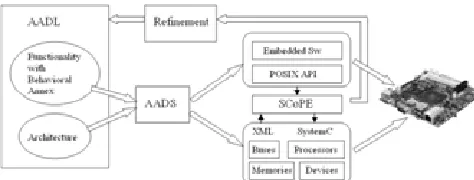
The SCoPE[24] tool provides the technology to perform MPSoC HW/SW co-simu lation with Network on Ch ip (No C). It enables the e xplo ration of the design space to choose the right processors and HW/SW partit ion for embedded systems. It a lso allo ws the simu lation of different nodes connected through a NoC in order to analyse the behaviour of la rge systems. Co mmonly, these tools are based on slow ISSs. The differentiat ing feature o f this technique is that SCoPE obtains the performance estimations at source code level. This level o f abstraction enables the simulat ion time to be reduced significantly while ma intaining good accuracy.
SCoPE is a C++ libra ry that without modification e xtends standard language SystemC to perform co-simu lation. On the one hand, it simulates C/C++ software code based on two different operating system interfaces (POSIX and Mic roC/ OS). On the other hand, it co-simu lates these pieces of code with hardwa re described in SystemC.
An engineer with this tool can simulate specific software over a custom platform and obtain estimat ions of: number of thread and context switches, running time and use of CPU, instructions executed and cache misses, energy and power (of core and instruction cache).
This library models the detailed behaviour of the RTOS including concurrency (a mong tasks in the same processor), paralle lism (a mong tasks in different processors), scheduling and synchronization. Although the SystemC kernel e xecutes processes following a non pre-e mptive scheduling policy without priorities, SCoPE models pre-e mption under diffe rent scheduling policies based on priorities.
SCoPE integrates a POSIX-based API that enables the e xecution of a la rge nu mber of software applications that follows this standard. POSIX is the ma in operating system interface nowadays, but it is not the only one. Thus, SCoPE has been improved to support extensions for other types of interfaces. An e xa mple is the integration with the MicroC/ OS interface. This is a de monstration of the scalability of the tool, in terms of software support.
The design of e mbedded systems requires not only software handling but also hardware communication. For this reason SCoPE inc ludes a set of more than a hundred driver facilities to imp le ment this co mmunicat ion. One of
the most e xtensively used operating systems in this sector is Linu x, so these driver facilit ies are based on the Linux kernel version 2.6. Furthermore , SCoPE is able to simulate the loading of ke rnel modules and the handling of hardwa re interruptions and their corresponding scheduling.
SystemC is the language used for the modelling of the hardware platform due to the easiness of imple mentation (C++ e xtension) and its simu lation kernel. For the purpose of simulating diffe rent platforms SCoPE incorporates some generic hardware modules: A bus based on TLM2 used for the communicat ion with peripherals and the trans mission of hardware interruptions, a DMA for copying large amounts of data, simple me mory fo r the simulation of cache and DMA traffic, a hard ware interface for simp le custom hardware connection, a network interface that works as a net card for the No C and an e xte rnal network simu lator to imple ment the NoC connected to SCoPE.
System simu lation comprises Multi-computation and Modular structure. Multi-co mputation: One of the advantages of this tool is the possibility of interconnection among independent nodes and simu lating the interaction among them. Modular structure: Each RTOS co mponent is an independent object that does not share any data with the others. Furthermore, each process is isolated from the rest of the system, thus a process with global variables can be replicated in many nodes without data collision proble ms. That is, each process has a separate me mory space.
Figure 3. Block diagram of SCoPE
4. Related Work
Simu lation and performance ana lysis of AADL models represent an important stage in MDE. Different approaches address this issue.
ADeS is one of the most powerful simu lation tools yet it requires the environment in which the system evolves[15] to be taken into account.
violations of timing require ments. M. Yassin Chkouri et al. propose in[18] a translation fro m AADL models to BIP models to enable simu lation. Ocarina[10] is a tool suite that uses code generation facilities in Ada and C to analy ze the AADL model. ADAPT[19] translates an AADL architectural model into a dependability evaluation model in the form o f a Genera lized Stochastic Petri Net (GSPN). T. Abdoul et al.[20] p roduce an IF timed automata model which is the entry point of the validation process, processing it with the IFx fra mework. E. Jahie r et a l.[21] translate the architecture into a non-deterministic synchronous model to wh ich the SW co mponents in Scade or Lustre can be integrated, to simu late it with Lurette. Annex D of the AADL standard gives guidelines to translate AADL SW co mponents into source code (C, Ada).
S. Gu i et al.[22] use the linear hybrid automata in the design phase statically to abstract the semantics of the SW components of AADL e xp lic itly.
M. Brun et al.[23] translate to OIL configuration code and to C code which is co mpatible with the OSEK/ VDX RTOS.
Several authors have considered the behavioural annex in their research on AADL. So me of their papers were written in the in itia l stage of the behavioural annex so they were intended to evaluate, promote and disseminate it. P. Dissaux et al.[29] present a proposal for a behavioural anne x to the AADL standard. They expla in how to imp le ment the behavioural annex with the Stood tool, a graphical AADL editor that can import and export AADL te xtual specifications. R. Bed in et a l.[30] eva luate the behavioural annex through a flight software design in the Arch iDyn project. This requires new synchronization primit ives for AADL runtime and support using edition and analysis tools for the behavioural annex. J. P. Bodeveix et al.[31] propose an AADL behavioural annex and a technique to perform compositional rea l-t ime verification of AADL models through the use of a method which translates environ mental constraints into behaviour.
Other papers, such as the latter one, include the behavioural annex in their verification process of AADL models. B. Bertho mieu et al. describe in[32] a formal verification tool chain for AADL with its behavioural annex available in the Topcased environment. They translate the AADL model to Fiac re and verify the behaviour with a Time Petri Net Analyzer (Tina).
C. Ponsard et al. e xp lore in[33] the interplay of require ments and architecture in a model-based perspective by defining a mapping and a constructive process taking into account specifics of e mbedded systems, especially the importance of non functional requirements. To generate the behavioural part of a system they first generate a fin ite state mach ine and then an AADL mode-transition.
A way to approach AADL and its behavioural annex is translation to another language. To allow simu lation M. Yassin Chkouri et a l. propose in[34] a translation fro m AADL models to BIP models. They take into account behaviour specifications allowing state variables,
initia lization, states and transitions sections to be defined and translating them into BIP. DUA LLY[35] is an automated fra me work that allows arch itectural language interoperability through automated model transformation techniques. I. Malavolta et al. analy ze the feasibility of integrating AADL and OSATE in DUA LLY. They map AADL behavioural anne x sections of states, composite states and transitions.
Several authors have considered ASSERT and the RCM in their research. So me of their papers deal with the ASSERT Virtual Machine (VM), the execution platform on which ASSERT applications run, based on the RCM. J. A. de la Puente et al.[36] and J. Za mo rano et al.[37] are good e xa mples of this.
M. Bordin et al.[38] propose some guidelines to generate RCM-co mpliant Ada code fro m HRT-UM L. S. Ma zzini et al.[39] e xp la in a MDE methodology for the development of high-integrity real-time systems. However using UML does not enable a low-level description of the system. Moreover, the diffe rent vie ws of the system use different forma lis ms, so one must modify all v iews on each change of the system to get a coherent model, hindering rapid prototyping.
J. Kwon et al.[40] propose Ravenscar-Java, a high-integrity profile for rea l-t ime Java. Ho wever we think that Java is not a good high-integrity progra mming language due to its object-oriented programming features, its automatic garbage collection, and the proposed limitat ions to the extension of real-time mu lti-thread ing that cause confusion.
Ocarina[10] is a tool suite that uses code generation facilit ies in Ada and C to analyze AADL models. The code generated is compatible with the RCM .
In[50] M.B. Abdelhalim, S.E.-D. Hab ib develop a new high-level hardware/software partitioning methodology. In[51] K. La mpka et a l. present a co mpositional and hybrid approach for the performance analysis of d istributed real-t ime systems.
After analyzing the related work, it appears that no approach uses SystemC, wh ich is a recognized standard for modelling HW/SW platforms, with its great potential for integration of processors, buses, me mories and specific platform HW. The afore mentioned solutions cannot model the HW platform so they do not permit HW/SW co-design. Apart from[23] none of the approaches models AADL over a RTOS. Our solution ma kes HW/SW co-design easier because of the use of SystemC.
SCoPE is a C++ library that e xtends standard language SystemC[25] without modifying it. It simu lates C/C++ SW code based on two different operating system interfaces (POSIX[26-27] and Micro C/OS). Moreover, it co-simu lates these pieces of code with HW described in SystemC. SCoPE generates a file with this SystemC description of the model. SCoPE has proven to be an effic ient tool for design space exploration[49].
so it supports many different RTOS.
In previous work[42-44] we have talked about AADS, nevertheless, in this paper we show the complete methodology with a co mple x industrial case study.
5. AADS
AADS is an AADL simu lation tool written in Java, which was developed as a plug-in[13] of Eclipse[14]. AADS enables the modelling of a subset of AADL for purposes of imp le mentation and simulat ion. The starting point of the simu lator is a functional AADL specification without detailed code. For each component, the corresponding timing constraints are defined. Th is init ial AADL specificat ion supports the verification of the g lobal performance constraints of the system based on the specific timing constraints of the different co mponents. The AADL model is parsed using AADS and a model suitable for simu lation with SCoPE is produced, in orde r to check whether the AADL constraints are fulfilled. As the design process advances and, on the one hand, the actual functionality is attached to the SW co mponents using the corresponding source code and, on the other, the functionality is mapped onto specific platform resources, a more accurate performance estimat ion is achieved. These refined properties will be added to the AADL mode l and a new model is generated by AADS. By co mparing the init ial timing constraints with these refined, t iming estimat ions, it is possible to verify the non functional correctness of the design process at any refine ment step.
AADL enables the specificat ion of both the architecture and functionality of an e mbedded rea l-time system. AADS translates both to SystemC (see Figure 4). It parses the AADL model so the functionality is translated to an equivalent POSIX model and the architecture is represented in XM L[28]. The equivalent POSIX model and the architecture can be imp le mented easily as an embedded system.
The functionality of an e mbedded real-time system is translated as follows:
Thre ads. An AADL thread is a concurrent schedulable unit of sequential e xecution through source code and mu ltip le threads represent concurrent e xecution paths. A POSIX thread is an execution thread in a progra m and an application can have mult iple e xecution threads running concurrently. An AADL thread translates seamlessly into a POSIX thread.
In POSIX, a thread attribute object must be defined and initia lized with the default value for all of the indiv idual attributes used by a given imp le mentation. AADS determines how the other scheduling attributes of the created thread are to be set, that is that the scheduling policy and associated attributes are to be set to the corresponding values. Thus AADS can now call the POSIX function to create a new thread with the specified attributes. The specified routine is then launched as a starting routine.
Figure 4. Translation, refinement and implementation with AADS
Periodic threads. A thread is periodic if repeated dispatches occur during a specific time interval. An AADL periodic thread has its Dispatch_Protocol property set to Period ic and its Period property set, for e xa mp le, to 20 ms.
These two properties are translated putting the source code of the POSIX thread into an infinite loop. At the beginning of the loop the current time is obtained. At the end of the loop the current thread is suspended until e ither the time value of the cloc k reaches the absolute time specified (the current time plus the period), or a signal is delivered to the ca lling thread and its action is to invoke a signal-catching function, or the thread is terminated. By doing this it wa its to repeat the loop for e xactly the time specified in the Pe riod property.
Port connections translate into message queues, signals and global variables:
Message queues. An AADL event data port models message communicat ion with queuing of messages at the recipient. Message arrival may cause dispatch of the recipient and allow the rec ipient to process one or mo re messages. POSIX message queues allow threads to e xchange data in the form of messages. Messages placed in the queue are stored until the recip ient retrieves them. An AADL event data port connection between threads translates into a POSIX message queue between threads.
The attributes of the message queue must be set. The value of the ma ximu m nu mber of messages is taken from the AADL property Queue_Size of the destination port if it e xists. The AADL property Queue_Processing_Protocol is set to FIFO as corresponds to a message queue. The message queue is created to both send and receive messages in non-blocking mode. The thread corresponding to the AADL source/destination thread of the event data port connection should add/receive a message of the specified length to/from the message queue specified with the priority indicated.
thread has previously registered a signal handler, that routine is executed. Otherwise, the default signal handler is e xecuted. An AADL event port connection between threads translates into the sending of POSIX signals between threads.
The signals used are the user-definable real-time signals. The structure type of an object used to represent sets of signals must be used with the POSIX functions that initia lize and empty a signal set, add a signal to a signal set and exa mine and change blocked signals before creating the thread. The source/destination POSIX thread that corresponds to the AADL source/destination thread of the event port connection sends/waits for the signal (ze ro timeout for no blocking if there is no signal received).
Gl obal vari ables
An AADL data port acts as an interface for typed state data transmission among components without queuing. Data ports are represented by typed variables in source text. A global variable is a variab le that is accessible in every scope. Global variables are used extensively to pass informat ion between sections of code that do not share a calle r/called relat ion such as concurrent threads. An AADL data port connection between threads translates into a global variable between threads.
The data type of this global variable is derived fro m the type of ports connected. The source/destination thread that corresponds to the AADL source/destination thread of the data port connection, can write/read a value in/fro m that global variab le.
The AADL p roperties are translated as followed :
Scheduling_Policy and Pri ority of thre ads. An AADL property set called UC with two properties POSIX_Scheduling_Policy and Priority has been defined. The first is an enumeration of the values SCHED_FIFO, SCHED_RR, SCHED_SPORADIC and SCHED_OTHER, and the second is an integer fro m 0 to 32. The first is obviously used to set the scheduling policy of the treads. The second is used with the appropriate minimu m va lue for the scheduling policy specified to set the scheduling parameter attributes of the threads.
Compute_ Execution_ Ti me (min, max). The min imu m time causes a call to a function that consumes that processing time to assure that at least that time is consumed. This function is adjusted at the beginning of the application to assure that the exact time is consumed. Thus the minimu m e xecution t ime is the time established by this property for this thread.
The ma ximu m time requires the creation of a t imer that is set with this time until the ne xt e xp iration of the timer. Therefore, the time r e xp ires in a ma ximu m time nanoseconds from when the call is made. When this timer e xpires, one of the last real-time signals is sent and a function called. This function lowers the priority of the thread and waits for a while before restoring the initial priority of the thread using the same method. When the priority of the thread is low, the scheduler avoids executing the thread and other threads can be processed. Thus we
assure that the ma ximu m e xecution time is the one of this property for this thread.
Names. Property Activate_Entrypoint of a thread is the name o f the C++ function that contains the source code of that thread. Thus, this is the name of the function e xecuted as a starting routine when creating the thread. Source_Text of a thread is the na me of the C++ file containing the source code of that thread.
Initialize / Finalize_ Entrypoint. The na me of the routine called at the start/end of the start routine of the corresponding thread is derived fro m this property.
Initialize / Finalize_ Exec ution_Ti me (min, max). The minimu m time causes the call to a function that consumes that processing time to assure that at least that time is consumed. It checks the ma ximu m t ime, to see if this amount of time has elapsed and return if it has been.
The issues related to the subprograms are the fo llo wing:
Subprogr am. An AADL subprogram co mponent abstraction represents sequentially e xecutable source text, a callab le co mponent, with or without parameters, that operates on data or provides server functions to components that call it. A routine is a portion of code within a larger program, which performs a specific task and is relat ively independent of the rema ining code. An AADL subprogram translates into a routine.
Subprogr am calls. In AADL there are t wo types of subprogram calls: Ca ll sequences and remote calls. The local ca ll fro m a thread or fro m another subprogram within the same thread to a subprogram is made in AADL through the sub-clause call and is translated into direct calls fro m the thread start routine or fro m the routine respectively.
The re mote c lient-server call fro m a subprogram in a thread to another subprogram in another thread is made through the sub-clause call and the property Actual_Subprogram_ Call. This re mote call translates into a call fro m one routine to another.
Subprogr am par ameters. A para meter represents call and return data values or references to data passed into and out of a subprogram, so it can be by value or by refe rence. In AADL the data values are in or out parameters and references are requires data access. Connections must be established between the ports of the thread (or the subprogram) and the ports of the subprogram. The data type of the AADL out parameter, if any, determines the data type of the routine; if there is no out parameter the type is void. Thus, the AADL para meters translate into para meters of the subprogram by value or reference. The translation permits data exchange a mong subprograms.
AADL data are managed as follows:
of a global variable, a message, etc. The name of the data type can be infe rred fro m the na me of the AADL data. This translation takes into account the property Source_Data_Size. In the case of data types, it specifies the ma ximu m size required to hold a value of an instance of the data type.
Simple Data. A simple AADL data subcomponent of a thread or a process gives rise to a simple global variable. The name and type can be infe rred fro m the na me and the AADL data type.
Composite Data. Co mposite AADL data are data that have one or more subprograms as features and/or one or more datum as subcomponents. These data generate a C++ class of data with its methods and/or me mber data. The name of the c lass can be inferred fro m the na me of the AADL data. The na mes and types of the methods and me mbe rs can be inferred fro m the AADL subprograms and data. The composite data subcomponents of a thread or a process give rise to a global variable whose type is that class. The name can be inferred fro m the na me of the AADL data.
The AADL behavioural anne x imp roves the specification of a component’s behaviour. AADS parses the AADL model so the annex behaviour_specification sections are translated to an equivalent POSIX model.
The behavioural anne x describes a transition system (an e xtended automaton) using optional sections:
State variables. The state variables section declares typed identifiers. Types are data c lassifiers o f the AADL model. AADS t ranslates these state variables declaring variables with their corresponding type in the C++ source code of the thread or subprogram itself.
Initialization. The state variables must be init ialized in the initia lizat ion section using a sequence of assignments. AADS translates this initialization by init ializing the variables with their corresponding value where they we re declared.
States
The states section declares automaton states which can be qualified as in itia l, co mplete, return, urgent or co mposite. AADS uses this section to know which states have been defined.
Transitions
The transitions section defines system transitions fro m a source state to a destination state. The transition can be guarded with events or Boolean conditions. An action part can be attached to the transition. It can perform subprogram calls, message sending or assignments. AADS translates the transitions section into switch and case statements to transit fro m one state to another. It starts in the in itia l state and moves to the ne xt state when the guard of the transition is true. Thus the guard of the transition translated by AADS acts as a condition to e xecute the sentence/s of the state and to change the state. This sentence/s is the action of the transition translated by AADS. If there is no guard there is no condition to check. The guard can be an expression as simp le as on i < 5, so AADS will translate it d irect ly.
Depending on the content of the guard and the action of the transition, AADS t ranslates them into the corresponding sentences of source code:
Sending / recei ving messages. Messages are sent / received through event or event data ports. If p is an input port: p? de-queues an event port variable, p? x de-queues a datum on an event data port in the variable x. If p is an output port: p! calls Raise_Event on an event port, p!d writes data d in the event data port and calls Raise_Event.
In the first case the guard of a transition is p1? x (where p1 is an in event data port) and the action of that transition is p2!(x+1) (where p2 is an out event data port). AADS translates this case, checking whether a variable arrives at the POSIX message queue associated with port p1. Then the variable is sent through the POSIX message queue associated with port p2, in this case after adding 1 to it .
In the second case the guard of a transition is p1? (p1 is an in event port) and the action of that transition is p2! (p2 is an out event port). AADS translates this case, checking whether the corresponding POSIX signal associated with port p1 has been rece ived. Then the corresponding POSIX signal associated with port p2 is sent.
Subprogr ams. A behaviour e xp ressed by the annex can be attached to a subprogram imp le mentation. The behaviour can refer to the subprogram para meters and to variables. The automaton specifying the subprogram imple mentation has one or more return states indicating the return to the calle r. While the AADL control flows define the call sequences produced by a subprogram, the annex enables the e xpression of dependencies between the control flows and state variables or parameters. A subprogram specification can exp ress other calls or notification of events.
In the first case the guard of a transition is p1? (p1 is an in event port) and the action of that transition is subp! (subp is a subprogram). AADS t ranslates this case checking whether the corresponding POSIX signal associated with port p1 has been received. If the signal has been received then the corresponding previously defined subprogram is called.
Para meters can be passed to called subprograms. The action of that transition could be subp!(5->x,2->y) where x and y are two in para meters of the subprogram subp. Then AADS translates it into a call to the subprogram with those two para meters as subp(5,2).
Using the AADL behavioural anne x, it is possible to indicate in the action of a transition that the out para meter of a subprogram is the in parameter modified in some way. It could be po!(pi+1), where po is the out parameter and pi the in parameter. AADS translates this case, creating the source code in the subprogram that sums one to the in parameter and assigns the result to the out parameter.
Contr ol struc tures. Control structures support conditional e xecution o f a lternative act ions (if, else, end if), conditional repetition of actions (while), and applicat ion of actions over all e le ments of a data co mponent array, port queue content, or integer range (for). The For structure represents an ordered ite ration over a ll ele ments. Within for structures the element can be referenced by ele ment_variable_identifier, which acts as a local variab le with the na me scope of for structure.
In the case that the action of a transition contains a conditional structure of the type: if (logica l value e xpression) behaviour_actions[else behaviour_actions] end if, AADS translates it producing the source code with the analogous if else structure in C++, adapting the differences between them.
The same can be said about for and while structures of the type: for (ele ment variable identifie r in values) {behaviour_actions} and while (logical value e xp ression) {behaviour_actions}. AADS translates them producing the source code with the analogous for and while structure in C++, adapting the differences between them.
Arrays. To declare collections of data which are considered to be ordered the notion of mult iplicity is used. AADS translates multip lic ity into a C++ array of data. The type of the array is the same in both AADL and C++.
The HW arch itecture is structured through the XML file generated by AADS. It is used as part of the configuration parameters of SCoPE and is divided into: HW_Platform, SW_Platform and Application.
HW_Platfor m. Any AADL imple mentation of a processor, me mo ry, bus or device must be specified with its category and name in the HW_Co mponents subsection of HW_Platform. The AADL p roperty Assign_Byte_Time is used to set the frequency parameter in the XM L file . For me mo ries we use the properties Read_Time and Write_Time . These properties have their values in time units (ns, ms and so on) and must be transformed into MHz. To know the me m_size of a me mo ry, both Word_Count and Word_Size AADL properties are required. Finally the me m_type of a me mo ry is derived fro m Me mory_Protocol in the AADL model. If the co mponent is a processor, proc_type must be specified.
The HW_Architecture and Co mputing_groups subsections of HW_Platform a re ne xt in the XM L file. To know the start_addr of a me mory we ta ke the AADL property Base_Address. The component and name are inferred fro m the AADL model. HW co mponents are grouped by buses as they are connected to them in AADL through the connections bus access and the features required bus access.
SW_Platfor m. This section has two subsections: SW_Co mponents and SW_Architecture. This section takes into account the buses that are defined to make the equivalent nodes. In this section the operating systems are specified.
Application. This section has two subsections: Functionality and Allocation. Filling the Functionality
section is straightforward fro m the AADL model using the property of a thread Activate_Entrypoint for the function and Source_Text fo r the file. The na me is the sa me as the one of the thread. For the Allocation section we need to know the property of a thread Actual_Processor_Binding, and find out wh ich bus the processor is bound to and then find out wh ich node that bus corresponds to. The AADL name of the thread is used for the name and the component.
6. AADS-T
AADS-T is a version of AADS that admits AADL models that include the AADL Behavioural Anne x and generates a source code compatible with the Ravenscar Co mputational Model.
The real-time behaviour specification of A SSERT models is based on the RCM, a model of concurrency for high-integrity systems that enables forma l analysis of the temporal properties of a system using response-time analysis techniques. The model inc ludes a static set of concurrent threads of execution, co mmunicat ing by means of shared protected data with mutually e xc lusive read and write access, and a restricted form of condit ional synchronization. The mode l is simple enough to be imple mented by a simp le, s mall-size rea l-t ime ke rnel, thus easing the way to the eventual cert ification o f real-time systems based on it.
Twelve p roperties must be fulfilled to be RCM-co mpliant; the source code generated by AADS-T obeys all of them. These properties are stated in an internal document of the project titled R1-4 Evaluation of Co mp liance with the ASSERT Process, written by J. A. de la Puente and J. Zamo rano.
Basic elements. There are two ma in ele ments in the RCM: Threads and protected objects (PO). A thread is the basic unit of e xecution, which can be e xecuted concurrently with other threads on a single processor. POs are an abstraction of shared data, synchronization, and interrupt handling.
There are a static number of threads and POs. Therefore, threads and POs can only be created at system init ialization time.
RCM 1 A real-t ime system consists of: A static set of N threads, { }, i 1..N; and a static set of M POs, { }, i 1..M. The set may be e mpty (M = 0), in which case the system is said to have only independent threads.
In the source code generated by AADS-T a ll the threads and POs are created calling pthread_create and as objects of the corresponding classes respectively at system initia lization time .
Properties of thre ads. A thread is a concurrent unit of e xecution with the follo wing properties:
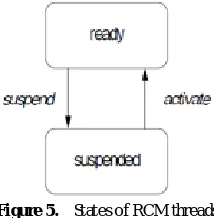
RCM 2 Threads are non-terminating. They e xh ibit an endless repetitive behaviour, a lternating between the following states (see Figure 5): Suspended (a suspended
=
Τ
τ
i∈
=
thread is not eligible for e xecution) and Ready (a ready task can be executed when the processor is allocated to it).
Figure 5. States of RCM threads
RCM 3 Threads have a single activation point. An activation point is a point in the e xecutable code of a thread at which its state changes from Suspended to Ready. When activated, a thread becomes ready and then e xecutes a piece of sequential code (thread activity), afte r which it becomes suspended awaiting the next activation.
Threads of the source code generated by AADS-T use
while(true) to be non-terminating. They are suspended after e xecuting the sequential code in a clock _nanosleep and when sleeping time has passed they become ready at their single activation point.
RCM 4 The activ ity of a thread is a sequence of code with a bounded and known worst-case execution time (WCET). The W CET of thread is .
AADS-T utilizes the AADL property
Compute_Execution_Time to know the WCET of a thread.
The source code generated checks that this WCET is not e xceeded.
This property implies that a thread does not execute any operation that could result in its becoming suspended other than the suspension immediately befo re the activation point, and nether do the threads created by AADS-T.
RCM 5 A thread can be activated only by one of the following two kinds of events. One is by a timing event which is issued periodically by the environment. In this case the thread is said to be periodic or time-d riven with period .
The other is a synchronization event issued when the barrie r of a synchronization PO is opened (see RCM 8 below). In this case, the thread is said to be sporadic. The synchronization event must have a minimu m inter-arriva l t ime associated to it, i.e. a minimu m e lapsed time interval between two consecutive occurrences of the event, .
AADS-T uses the AADL properties Period and
Device_Dispatch_Protocol to know the period and the type of a thread respectively. It accepts only periodic and
sporadic threads and not aperiodic or back ground threads. The difference between the codes generated is that a sporadic thread waits for an event from an event or
eventdataport connection after invoking a synchronization operation in the activation point. In both cases
clock _nanosleep waits a time .
Properties of pr otecte d objects. A PO is an object which encapsulates a set of data and a set of associated operations (protected operations). The value of the data ma kes up the state of the object. The state can only be read or changed by invoking one of the operations of the PO. If is a PO: .S denotes its state, .S S, where S is an appropriate data doma in; . denotes the -th operation of . Notice that a PO must have at least one operation; otherwise its state is inaccessible. The notation will be used to denote that invokes one or more operations of . Similarly, . means that
calls the operation . .
AADS-T generates an object of the corresponding class which is a PO in the source code for each AADL data, event and eventdata port connection. Classes generated by AADS-T have the appropriate data me mbers to achieve the communicat ion of data and/or events between threads. Each class has a constructor and me mbe r functions read and write to initia lize and access data me mbers.
POs have the follo wing properties:
RCM 6 On ly one thread can be e xecuting an operation of a given PO at any given time, i.e. protected operations are mutually e xc lusive. Consequently, if a thread invokes a protected operation at a time when another thread is a lready e xecuting an operation of the same object, it has to wait. When the protected operation that was being executed is completed, the wait ing thread is allowed to execute the operation it had invoked. Notice that a thread that is wa iting to begin a protected operation is not considered to be suspended. In consequence, a thread activity can invoke protected operations without violating RCM 4.
Each c lass produced by AADS-T defines a mutex that is locked when a me mbe r function is called and unlocked when it ends, ensuring compliance with mutual e xc lusion.
RCM 7 All protected operations have a bounded and known WCET. The WCET of the protected operation .
is . Again, this property imp lies that no operations that could result in a thread being suspended can be invoked fro m a protected operation.
AADS-T uses the ad hoc defined AADL properties
PO_read_WCET and PO_write_WCET fo r each port connection to know the WCET o f each me mber function. The source code generated checks if these WCETs are e xceeded. Moreover, no me mber function calls any suspending operation.
RCM 8 A PO can have at most one synchronization operation that has an associated barrier, wh ich is a Boolean variable that is part of the object state. When the value of the barrier is true, the barrie r is said to be open, and otherwise it is said to be closed.
The behaviour associated with synchronized operations is as follows: When a thread invokes a synchronization operation, if the barrier is open the execution proceeds as with an ordinary protected operation; but if the barrier is closed, the thread is suspended. At most one thread can be
i
τ
C
ii
τ
i
T
i
τ
i
T
i
T
θ
θ
θ
∈
θ
P
kk
θ
θ
τ
→
τ
θ
τ
→
θ
Pτ
θ
Pi
θ
k
suspended at a barrier at any given time. A thread that is suspended at a barrier is resumed whenever the barrier becomes true (as the result of the execution of another protected operation by some other thread).
Invoking a synchronization operation is a potentially suspending operation, and thus cannot be done within a thread activity; this can only be used to imp le ment the activation events of sporadic threads.
In the source code produced by AADS-T only the objects corresponding to event and eventdata port connections have a synchronization me mber function because a sporadic thread is dispatched by an event as stated above. Only sporadic threads invoke the synchronization. The barrier is initia lized as false in the constructor, then set to true in the write me mbe r function, then checked to see whether it is false in the synchronization to suspend the thread on a
nanosleep, and finally set to false after resuming it.
Scheduling. The RCM is associated with an instance of the fixed-priority pre-e mptive scheduling (FPPS) method, together with the immediate ce iling p riority inheritance protocol (ICPP). The scheduling model is defined by the following properties:
RCM 9 Each thread has a basic priority, P
, where is the set of the integer numbers. The basic priority of a thread is fixed, i.e. it is never changed.
AADS-T uses the ad hoc AADL property Priority to create a thread at system initia lization time with
sched_priority at that priority, which is never changed.
RCM 10 Each PO has a ceiling priority which is the ma ximu m of the basic priorit ies of all the threads invoking any of its operations: =ma x . As basic priorities of a ll threads are fixed, so too are the ce iling priorities of a ll POs.
RCM 11 At every instant of time, each thread has an active prio rity. The act ive priority of a thread is the ma ximu m of the basic priority of the thread and the ceiling priority of a ll POs that contain an operation that is currently being executed by the thread. Therefore, whenever a thread invokes a protected operation, it immediate ly inherits the ceiling prio rity of the enclosing PO.
In the source code generated by AADS-T the function
pthread_mutexattr_setprotocol is used with the value
PTHREAD_PRIO_PROTEC T and the function
pthread_mutexattr_setprioceiling with the ma ximu m of the priorities of the two threads commun icating through a port connection. This is done when initia lizing the mutex of the object corresponding to that connection at system initia lization time guaranteeing the fulfillment of RCM 10 and RCM 11.
RCM 12 Ready threads are conceptually grouped into ready queues. There is a ready queue for each priority level in P. Threads are added to and re moved fro m p riority queues according to the following rules: When a suspended thread becomes ready, it is added at the tail of the priority
queue for its active priority. When the processor is idle, the thread which is at the head of the non-empty ready queue with the highest priority is dispatched for e xecution and re moved fro m the queue. Whenever there is a non-empty ready queue with a higher priority than the priority of the currently running thread, the thread is pre-e mpted fro m the processor and it is added at the head of the ready queue for its active priority. Not ice that according to the prev ious rule, the thread at the head of the ready queue that caused the pre-e mption is dispatched for e xecution immed iately afterwards.
AADS-T ad mits only SCHED_FIFO for the ad hoc AADL p roperty POSIX_Scheduling_Policy of a thread, to set so sched_policy in the source code.
The above model specifies a concurrent system with a predictable, analy zable te mporal behaviour. Since the e xecution time of threads is bounded (RCM 4, RCM 7) and the scheduling method is FPPS with ICPP, we ll-known response-time analysis techniques can be applied to statically guarantee that the system satisfies its temporal require ments.
7. Experimental Results
7.1. Case Study
The proposed method imple mented in AADS-T was tested assisting in the HW/SW part itioning of the case study shown in Figure 6. It is a space application of digital image processing that consists of different co mponents: HW Controlle r, Image Processing, Image Filter, Control, Start-up, Housekeeping, Monitoring, Image Processing Management, Event Generat ion, Connection test and Stub Simu lating Ground. HW Controller is in charge of rece iving images (bit map images) fro m the Ca mera Simu lator as we ll as sending the filtered images back to Ground. Image Processing receives the image fro m HW Controller pixe l by pixe l, inc luding the padding when it is needed, forwa rding them to Image Filter to process them. Image Processing also receives the pixe ls already filtered by Image Filter which are subsequently sent to the HW Controller co mponent. Image Filter is in charge of filtering the pixe ls received according to the filter selected. Control manages the Image Application Soft ware based on OBSW co mmands in order to store image statistics, to configure image filtering function and to control the image processing status. Start-up simu lates the initialization routine and starts the next OBSW functionalit ies. Housekeeping periodically reports the number of images correctly filtered. Monitoring checks the status of the Image Processing Application Soft ware and if the status is set to erroneous, an event is sent to Stub Simu lating Ground through Event Generation. Image Processing Management selects the filter to be applied and starts/stops the application. Event Generation simu lates the OBSW event reporting service to inform g round about all asynchronous events occurring on-board. Connection test
i
τ
P
i∈
Z
⊂ Z
i
θ
CP
ii
lets operators test the OBSW application presence and state. Stub Simu lating Ground requests the OBSW to perform the alive-test by sending the corresponding telecommand.
Figure 7 is the AADL graphica l notation of the Case study with the me mories (two DRAMs, one fo r the FPGA and another for the LEON2), processors (FPGA and LEON2), buses (RS232, FPGA me mo ry bus, and LEON2
me mo ry bus), threads, event ports and eventdata ports generated with OSATE v1.5.8.
AADL provides many benefits for HW/SW co-design. It contains constructs for modeling both HW and SW components. This language supports early and repeated analyses of system architecture with respect to performance-critica l properties through an extendable notation, a tool fra mewo rk and precisely defined semantics.
Figure 6. Case study functional description
AADS e xt racts fro m the AADL models the necessary informat ion for the SCoPE tool to perform a simulat ion at system level. The simulation results will guide the system designer through the selection of the most adequate partition solution.
7.2. LEON2 Modelling in SCoPE
SCoPE has been modified to include the LEON2 processor at 50 Mh z, 15.4 MIPS and 30.64 nJ of energy consumed per instruction in its processors.xml
configuration file . It was necessary to specify the data and instruction cache sizes too. A size of 8192, a size o f line of 8 and an associativity of 1, considering an instruction size of 4 (32 bits), was considered for both. Another configuration file of SCoPE, meminst.x ml, was modified to include the operation codes of the LEON2.
The GNU cross-compile r for LEON2 used is the GNAT for the LEON 2.1.0 C co mpile r so the source code produced by AADS-T has to comply with certain characteristics. The options POSIX_ THREADS, POSIX_THREAD_PRIORITY_ SCHEDULIN G, POS IX_THREAD_PRIO_PROTEC T, LEO N_2 and POSIX_TIMERS have to be activated. The function clock _nanosleep must be explic itly decla red.
7.3. Architec tur al Design
The partitioning process is performed fo llo wing a SW centric approach. Firstly, it is assumed that all system functions are SW co mponents. If this assumption is not fulfilled due to the vio lation of the design criteria , new partitions are proposed in order to accommodate system functions to other platform resources. In this case, different allocations of system functions to platform resources are possible. The decision about which parts are mapped to HW is based on the analysis of which imp le mentation best meets the design criteria (derived fro m the require ment analysis results) in terms of performance and functional behavior. The informat ion about how a co mponent will be imple mented (HW or SW) is added as an AADL property, Actual_Processor_Binding. The part itioning is generated by the ASSERT Model Transformat ion (AMT) tool developed by GM V.
In the context of a SW centric approach, initia lly all system functions will be mapped onto the same processing node, whose imp le mentation is a LEON2 microprocessor. We considered a situation where it is necessary to re-allocate system functions from SW to HW (i.e . mapping fro m processing elements whose technological imp le mentation is a microprocessor to other processing ele ments such as DSP, PLD, FPGA, etc): The system performance might indicate that the CPU e xceeds the ma ximu m performance limits imposed in the require ments.
HW/SW models we re generated in AADL by AMT and in SystemC with AADS-T/SCoPE, to perform the HW/SW partitioning. The system-level performance tool (AADS-T/SCoPE) was used to analyze the system
performance and non-functional require ments such as use of CPU, timing or energy consumption for a g iven HW/SW partition. After system performance analysis, some HW/SW partitions were proposed and evaluated.
The files produced by AADS-T were co mpiled with SCoPE to simu late the model and the results obtained were used to compare the diffe rent partitions. The simu lation e xecuted the source code of the threads and the protected objects enabled communicat ion a mong the threads.
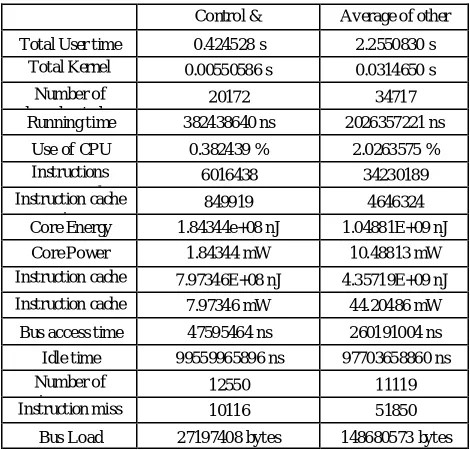
In the following table we can see the comparison between the sixteen magnitudes evaluated by SCoPE in the average of the simulations carried out with fifty-six evaluated partitions, and the one which a llocates the components Control and Image_processing to HW. In nearly all the magnitudes the selected partition obtains the best performance results.
Table 1. Comparison between simulations' metrics of the selected partition and the average of the others
Control &
I P i
Average of other i i
Total User time 0.424528 s 2.2550830 s
Total Kernel 0.00550586 s 0.0314650 s
Number of
h d i h
20172 34717
Running time 382438640 ns 2026357221 ns
Use of CPU 0.382439 % 2.0263575 %
Instructions d
6016438 34230189
Instruction cache i
849919 4646324
Core Energy 1.84344e+08 nJ 1.04881E+09 nJ
Core Power 1.84344 mW 10.48813 mW
Instruction cache 7.97346E+08 nJ 4.35719E+09 nJ
Instruction cache 7.97346 mW 44.20486 mW
Bus access time 47595464 ns 260191004 ns
Idle time 99559965896 ns 97703658860 ns Number of
i
12550 11119
Instruction miss 10116 51850
Bus Load 27197408 bytes 148680573 bytes
Figure 8. Use of CPU (%) of the partitions
In order to check how the perfo rmance analysis results vary depending on the WCET, the AADL mode l was manually modified setting very strict WCET (close to the deadlines). In this case study the deadlines of the threads were 20 % of the periods. So the WCET were 20 % of the values fro m the interval o f 40 ms to 100 s wh ich we re the
97.6006 %. The selected partition that allocates the components Control and Image Processing to HW, consumed 0.382439 % with the in itia l W CET values. With the WCET close to the deadlines, the Use of CPU was only 14.32543 %. As the components which consume most of the resources had been moved to HW, the processor provided a complete ly different result. When all components were mapped to SW, the usage of CPU was 97.6 %. As CPU load requires a workload margin, this scheme is not valid. There fore, partitioning is required.
The in itia l constrain imposed on the system was a Use of CPU less than 75 % in the worst case. This worst case is when the WCET of the threads were close to the deadlines. In this case the only HW/SW partition that complies with the initial constraint is selected, namely the one that allocates the co mponents Control and Image Processing to HW.
Allocating the co mponents Control and Image Processing to HW leads to a significant reduction in use of CPU due to the improve ment in the co mmunications between the two components. This shows that performance analysis enables the discovery of situations that would be difficult to e xpose without such a powerful tool.
8. Conclusions
This document describes the simu lation of AADL compatible with RCM using the AADS simulation tool. AADS supports the refine ment of AADL mode ls, including the Behavioural Annex, through performance analysis done with SCoPE, a fter translating those models.
The generation of the RCM-co mp liant SystemC model fro m the AADL specification is not straightforward. Nevertheless, the SystemC model generated by AADS is able to capture the fundamental dynamic p roperties of the initia l system specification. In this way, AADS supports design space e xploration by re fine ment o f the AADL functionality and its imple mentation on an optimized platform.
The system-level performance tool (AADS-T/SCoPE) is used to analyze the system performance and non-functional require ments such as use of CPU, timing o r energy consumption for a given HW/SW partit ion. AADS-T a ids the performance of the HW/SW partitioning of a system by analyzing HW/SW models.
Future work includes incorporation of AADS features that appear in V2.0 of the AADL standard.
ACKNOWLEDGEMENTS
This work has been developed in the University of Cantabria and has been partially supported by the Spanish MICyT through the ITEA 05015 SPICES pro ject[47], the TEC2008-04107 project, and the ESTEC 22810/ 09/ NL/JK HW-SW CODESIGN project contracted to GM V Aerospace and Defence S.A.U.
The authors would like to ac knowledge the a id rece ived in this work fro m Juan Antonio de la Puente and Juan Zamo rano of UPM, as we ll as fro m the colleagues in the SPICES p roject and in the M icroelectronics Engineering Group (GIM).
REFERENCES
[1] SAE: AADL. June 2006, document AS5506/1. www.sae.org/technical/standards/AS5506/1.
[2] P. H. Feiler, D. P. Gluch, J. J. Hudak: The AADL: An Introduction. CM U. Pittsburgh. (2006).
[3] P. H. Feiler, J. J. Hudak: Developing AADL M odels for Control Systems: Practitioner’s Guide. CMU. 2006.
[4] SAE. Annex Behavior V1.6 A S5506, 2007. [5] www.assert-project.net 2008 ESA/ESTEC.
[6] A. Burns et al.: The Ravenscar tasking profile for high integrity RT programs. Ada-Europe’98. Springer-Verlag. [7] M . Perrotin et al.: The TASTE toolset: Turning human
designed heterogeneous systems into computer built homogeneous software. ERTS2 2010, Toulouse, France. [8] LEON2-FT ESA M icroelectronics 2009 www.esa.int/TEC/
M icroelectronics/SEM UD70CYTE_0.html
[9] A.D. Pimentel et al.: A systematic approach to exploring embedded system architectures at multiple abstraction levels, IEEE Transactions on Computers, 2006.
[10] J. Hugues, B. Zalila, L. Pautet, F. Kordon: From the prototype to the final embedded system using the Ocarina AADL tool suite. ACM TECS, 2008. NY, USA.
[11] H. Posadas et al.: RTOS modeling in SystemC for real-time embedded SW simulation: A POSIX model. Design Automation for Embedded Systems. Springer. 2005.
[12] AADS UC 2011. www.teisa.unican.es/AADS
[13] P. H. Feiler, A. Greenhouse: OSATE Plug-in Development Guide. CM U. Pittsburgh. (2006).
[14] The Eclipse Foundation 2009. www.eclipse.org
[15] J.-F. Tilman, R. Sezestre, A. Schyn: Simulation of system architectures with AADL. ERTS2008, Toulouse.
[16] F. Singhoff, A. Plantec: AADL modeling and analysis of hierarchical schedulers. SIGAda’07, Fairfax, VA, USA. [17] O. Sokolsky, I. Lee, D. Clark: Schedulability Analysis of
AADL models. IPDPS 2006. Rhodes Island, Greece.
[18] M . Yassin Chkouri, A. Robert, M . Bozga, J. Sifakis: Translating AADL into BIP – Application of Real-time Systems. ACESM B 2008. Toulouse, France.
[19] A. E. Rugina et al.: The ADAPT tool: From AADL architectural models to stochastic Petri Nets through model transformation. EDCC. 2008. Kaunas, Lithuania.
[21] E. Jahier et al.: Virtual execution of AADL models via a translation into synchronous programs. EM SOFT’07. 2007. Salzburg, Austria.
[22] S. Gui et al.: Formal schedulability analysis and simulation for AADL. ICESS2008. Chengdu, China.
[23] M . Brun, J. Delatour, Y. Trinquet: Code generation from AADL to a RTOS: an experimentation feedback on the use of model transformation. ICECCS. 2008. U. K.
[24] SCoPE UC 2011. www.teisa.unican.es/scope
[25] David C. Black, Jack Donovan: SystemC: From the ground up. Kluwer Academic Publishers. Boston (2004).
[26] M . González: POSIX tiempo real. UC, Santander 2004. [27] The Open Group: The Single UNIX Specification, V. 2,
1997. www.opengroup.org/onlinepubs/007908799.
[28] W3C: Extensible M arkup Language (XM L) W3C Recommendation (2006). www.w3.org/TR/REC-xml/
[29] P. Dissaux, J. P. Bodeveix, M . Filali, P. Gaufillet, F. Vernadat: AADL behavioural annex. DASIA 2006. Berlin. [30] R. Bedin, J. P. Bodeveix, M . Filali, J. F. Rolland, D.
Chemouil, D. Thomas: The AADL behavior annex – experiments and roadmap. ICECCS 2007. New Zealand. [31] J. P. Bodeveix, M . Filali, M . Rached, D. Chemouil, P.
Gaufillet: Experimenting an AADL behavioural annex and a verification method. DASIA 2006. Berlin, Germany. [32] B. Berthomieu, J. P. Bodeveix, C. Chaudet, S. Dal Zilio, M .
Filali, F. Vernadat: Formal Verification of AADL Specifications in the Topcased Environment. Ada-Europe 2009. Brest, France.
[33] C. Ponsard, M . Delehaye: Towards a model-driven approach for mapping requirements on AADL architectures. ICECCS 2009. Potsdam, Germany.
[34] M . Yassin Chkouri, A. Robert, M . Bozga, J. Sifakis: Translating AADL into BIP – Application of Real-time Systems. ACESM B 2008. Toulouse, France.
[35] I. M alavolta, H. M uccini, P. Pelliccione: Integrating AADL within a multi-domain modelling framework. ICECCS 2009. Potsdam, Germany.
[36] J. A. de la Puente et al.: The ASSERT VM : A Predictable
Platform for Real-Time Systems. IFAC08. Korea.
[37] J. Zamorano et al.: The ASSERT VM kernel: Support for
preservation of temporal properties. DASIA 2008. Spain.
[38] M . Bordin et al.: Automated M odel-based Generation of Ravenscar-compliant Source Code. ECRTS05. Spain. [39] S. M azzini et al.: An M DE M ethodology for the
Development of High-Integrity RT Systems. DATE09. Nice. [40] J. Kwon et al.: Ravenscar-Java: a High-Integrity Profile for
Real-Time Java. ACM -ISCOPE, 2002. Washington. [41] SAX: Simple API for XM L. (2004). www.saxproject.org [42] R. Varona Gómez, E. Villar: AADL Simulation and
Performance Analysis in SystemC. ICECCS 2009. Germany. [43] R. Varona Gómez, E. Villar: AADS+: AADL Simulation
including the Behavioral Annex. ICECCS 2010. Oxford. [44] R. Varona Gómez, E. Villar, A. Rodríguez: Ravenscar
Computational M odel compliant AADL Simulation on LEON2. ISSE 2011. Orlando.
[45] Hardware/Software Codesign Overview RASSP Education & Facilitation Program M odule 14, RASSP, 1999.
[46] http://hwswcodesign.gmv.com [47] http://www.spices-itea.org
[48] R. Bedin, J. F. Rolland, M . Filali, J. P. Bodeveix: Assessment of the AADL Behavioral Annex. FAC2007. Toulouse.
[49] C. Silvano, W. Fornaciari, E. Villar: M ulti-objective Design Space Exploration of M ultiprocessor SoC Architectures. Springer 2011.
[50] M .B. Abdelhalim, S.E.-D. Habib: An integrated high-level hardware/software partitioning methodology. Design Automation for Embedded Systems. Springer 2011.