Available Online at www.ijpret.com 104
INTERNATIONAL JOURNAL OF PURE AND
APPLIED RESEARCH IN ENGINEERING AND
TECHNOLOGY
A PATH FOR HORIZING YOUR INNOVATIVE WORK
OPTIMIZATION OF CUTTING PARAMETERS FOR TURNING INCONEL 718 WITH
CARBIDE INSERT
LAHANE SB1, BORSE SC2
1. PG Student, Department of Mechanical Engineering, DIEMS, M.S, INDIA
2. Assistant Professor, Department of Mechanical Engineering , DIEMS, M.S, INDIA
Accepted Date: 24/10/2014; Published Date: 01/12/2014
\
Abstract: Superalloy, Inconel 718 is used for manufacturing components in most of the advanced and critical application due to its superior properties .Surface quality of machined component play a vital role in function characteristics and life of product .Due to its peculiar characteristics machining of superalloy Inconel 718 is difficult and costly .The present work is an attempt to make use of taguchi optimization technique to optimize cutting parameters during high speed turning of Inconel 718 using tungsten carbide cutting tool .Taguchi method is a powerful design of experiment tool for engineering optimization of a process .It is an important tool to identify the critical parmeters. Anaysis of variance is used to study the effect of process parameters and established correlation among the cutting speed, feed and depth of cut with respect to Ra and tool wear. The result are further confirmed by experiments.
Keywords: CNC, Ra, Taguchi method
Corresponding Author: MR. S. B. LAHANE
Access Online On:
www.ijpret.com
How to Cite This Article:
Lahane SB,Borse SC; IJPRET, 2014; Volume 3 (4): 104-114
Available Online at www.ijpret.com 105
INTRODUCTION
Turning processes comprise a very big portion of metal cutting process in industry. For the determination of ideal machinability properties, those parameters such as mechanical material properties, machine tool rigidity, feed rate, depth of cut, cutting speed and cutting tool geometry play an important role in machining . Cutting speed is the main parameters that affect machinability properties of the material . Although Inconel 718 can be machined by using cemented carbide tools at low cutting speeds, it must be machined by ceramic tools at higher cutting speeds. But the problem of machining inconel 718 is one of ever increasing magnitude due to extreme toughness and work hardening characteristics of the alloy.
Nickel-based alloys account for 80% of the super alloy, with the remainder being iron and cobalt based. Approximately 45–50% of the total material requirements for a gas turbine engine are met using nickel alloys. The properties that make nickel-based super alloys posses high yield strength (retained to approximately 750 ◦C), high ultimate tensile strength, high fatigue strength, retention of corrosion and oxidation resistance up to elevated temperatures and good creep resistance. Nickel and nickel-based alloys especially Inconel 718 is widely used in many industries, owing to its unique properties such as high oxidation resistance, corrosion resistance even at very high temperatures, and retains a high
Taguchi Proposed that the engineering optimization of a process should be carried out in a three steps approach ; system design parameters design and tolerance design Taguchi method is a powerful design of experiment tool for engineering optimization of a process. The application in which the concept of S/N ratio is the useful are the improvement of quality through variability reduction and improvement of measurement .The S/N ratio characteristics can be divided into three categories when the characteristic is continuous;
Smaller the better characteristics;
S/ N =
1 larger the better characteristics;
S/N =
2 Nominal the best characteristics;
S/N =
Available Online at www.ijpret.com 106
Literature Review
It is essential to understand the past and present status of the machining of Inconel 718 process to suggest future areas of work. Extensive literature survey has been carried out to find the state of machining of inconel 718.
Liao and Shiue (1996) The wear surfaces of cutting tool are investigated in detail using micro analysis and more evidences are given and a new carbide tool wear mechanism in cutting of inconel 718 is proposed .The tool material are K20 and P20 carbides respectively with the cutting geometry of The feed rate and the depth of cut were 0.10 mm/rev and 1.5 mm, respectively. The cutting speed was either 35 or 15 m/min. On the wear surface of the K20 carbide, they observed a sticking layer very close to the cutting edge. Built-up edge (BUE) was formed at a cutting speed of 35 m/min with chipping of the cutting edge. When P20 carbide was used, the sticking layer also could be found, but comparatively, the wear was more irregular, the flank wear length was larger and the groove was deep
M .Rahman (1997) In their study there were a total four input parameters namely SCWA, cutting speed, feed rate and depth of cut .It was been absorbed that tool life is significantly increase in the side. Tool life is significantly increased with an increase in the SCEAs from -50 to 150 then to 450. for speed of 30m/min and a feed rate of 0.2mm/rev, the tool life of the EH20Z-UP insert decreased by 64.3% when the SCEA was changed from 450 to 50. On the whole the inserts performed best at a SCEA of 450.
D Dudzinski (2004) focused mainly on the developments towards dry and high speed machining of inconel 718. He has used different types of cutting tools and has concluded that cemented carbide tool are largely used for machining nickel based alloys at very low cutting speed at 20 -30 m/min the K20 grade appears to be the best for cutting inconel 718 higher cutting speed certainly upto 100 m/min under dry condition may be achived wuth coated carbide tools. The use of coolent is undesirable for environment hence new concept has been introduced to minmised coolent lubrication the objective of this paper is to find the suitable tool an appropriate coating to define the better geometrical tool configuration.
Available Online at www.ijpret.com 107
D Dudzinski (2007) results of orthonal cutting test are first presented in terms of cutting force and gear patterns for each test the feed translation was two mm for specimen dia. Of about 260 mm , then only the first stage of toole wear was invested flanks wear crater wear and notch wear were observed with the help of SEM.
R S Pawade (2008) in this paper an experimental insvestigation to access the effect of machining process and cutting edge geometry related parameter on surface integrity in high speed inconel 718.the following conclusion has been drawn from the inestigation that the machining condition of speed 475 m.min and lowest feed rate 0.05mmrev and low to moderate depth of cut 0.5/ 0.75 mm.
D Thakur ( 2008) the experiment result show that the taguchi parameter desing is an effective way of determine of optimal cutting parameter for the cutting force and feed force evolution the anoma analysis shows that the cutting parameter is more significant from the mean effective it has been found that feed and depth of cut are less significant as the slope is small.
Thakur et al. (2009) did experiments on machining of Inconel 718 on latationship he and proposed investigations of high speed turning on Inconel 718 using Taguchi optimization technique for cutting force, cutting temperature, and tool life in high speed turning of Inconel 718 using cemented tungsten carbide (K20) cutting tool. A correlation between cutting speed, feed, and depth of cut with respect to cutting force, cutting temperature also demonstrated in order to identify the optimum combination of cutting parameters.
V Dhana lakshmi (2010)the he mainly studies on wear analysis if ceramic cutting tool the experiment result indicate that the cutting speed is the moist signifficient factor to overall performance the co realation with cutting speed and feed with tool wear and surface are obtained by variable linear regration it has been found that the less tool wear and good surface finish are obtained using ceramic tool when finished turning inconel at low speed the optimum cutting condition for good surface finish is 100 mm/min. and 0.1 mm/rev the tool failure are obtained when cutting speed of 200m/mim and feed rate of 0.15mm/rev and has concluded that performance is better at low cutting speed.
Available Online at www.ijpret.com 108 718 under dry cutting condition. Increaseing the cutting speed and depth of cut affected the tool life and promoted wear progression..
Colak (2012) deals with experimental investigation on machinability of Inconel 718 in conventional and alternative high pressure cooling conditions The experiment results have proven that the tool flank wear and cutting forces considerably decrease with the delivery of high pressure coolant to the cutting zone. Moreover, ANOVA results also indicate that high pressure cooling has a significant beneficial effect on cutting tool life
Tran Minh-Duc (2013) In his study, an attempt has been conducted to investigate the effects of cutting parameters on tool wear and surface roughness during hard turning of Inconel 718 material. By taking into account the Analysis of Variance (ANOVA) in accordance to Central Composite Design (CCD); the mathematical model of the flank wear and surface roughness are developed with transformation of the natural logarithm. when machining at higher cutting speed, around 50-75m/min, the surface roughness is significantly improved due to the disappearance of built-up-edge. However, due to the hard particles of the Inconel 718 material against the cutting tool, the abrasive wear increases rapidly at high cutting speed, more than 90m/min. As evidenced from this paper, in order to achieve a high surface quality with low cutting tool wear, a cutting speed in the range of 50- 70 m/min is highly recommended for the hardened Inconel 718 using PVD coated cutting tool
Chinmaya and Manas (2014) proposes and experimental investigation and optimization of the various machining parameters for electrical discharge machine process on inconel 718 using multobjective particle.They propsed a model shows that the interactive and complex effects of various important process variable.The propsed model can be used for selecting ideal process states for achieving improved machinging condition for Inconel 718 alloy while machining in EDM process
Experimental Procedure
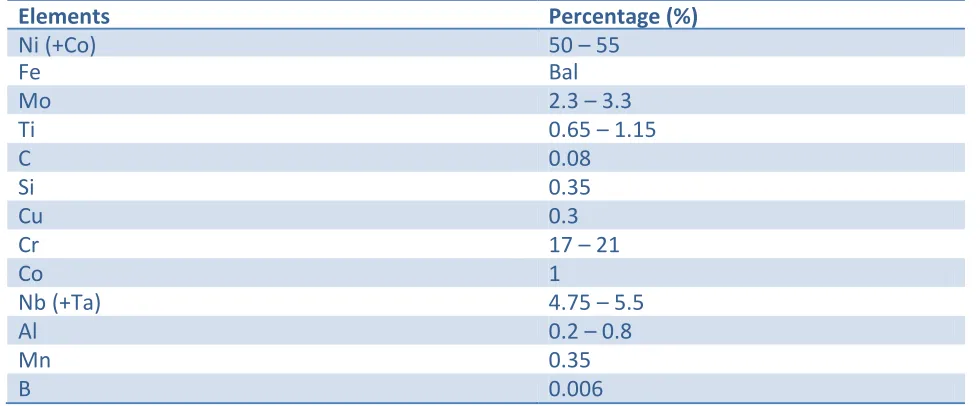
The work material used was Inconel 718 Machining test were carried out on Hass CNC. The cutting tool mainly used for this experiment was the carbide insert. Table 1 shows the chemical compostion of the raw material.
Available Online at www.ijpret.com 109
Table 1 composition of element present in inconel 718
Elements Percentage (%)
Ni (+Co) 50 – 55
Fe Bal
Mo 2.3 – 3.3
Ti 0.65 – 1.15
C 0.08
Si 0.35
Cu 0.3
Cr 17 – 21
Co 1
Nb (+Ta) 4.75 – 5.5
Al 0.2 – 0.8
Mn 0.35
B 0.006
Table 2 Parameters and their level
Parameters Levels
1 2 3
Cutting sped , Vc (m/min) 55 65 75
Feed, f (mm/rev) 0.5 1 1.5
Depth of cut, d (mm) 0.2 0.4 0.8
The response characteristic ,surface roughness was chosen as output parameters to understand and effect of cutting parameters on the surface roughness and mrr during high speed cutting of inconel 718
Design of experiment
Available Online at www.ijpret.com 110
RESULT AND DISCUSSIONS
Surface roughness and tool wear
Surface roughness is an important task in determining how a real entity will intermingle with the environment. Surface roughness was measured using standard roughness tester.
The main wear mechanisms in carbide cutting tool are abrasion, adhesion, diffusion plastic deformation and fracture the cutting tool are subjected to high localized stress ,high temp. flank wear accurs on the relief face of the cutting tool
Table 3 Experimental result
Expt No
Cutting Speed m/min
Feed (mm/rev)
Depth of cut (mm)
Surface Roughness (Ra,
Flank wear (mm)
1 65 0.5 0.4 0.12 0.16
2 65 1.5 0.4 0.94 0.14
3 65 0.5 0.2 0.14 0.17
4 75 1.5 0.4 0.96 0.14
5 55 1.5 0.8 0.94 0.15
6 75 1 0.4 0.42 0.17
7 75 0.5 0.4 0.14 0.16
8 75 0.5 0.8 0.12 0.15
9 75 1.5 0.2 0.92 0.16
10 75 1 0.2 0.44 0.148
11 55 1.5 0.2 0.96 0.12
12 65 0.5 0.8 0.14 0.11
13 55 1 0.8 0.42 0.174
14 55 0.5 0.4 0.12 0.13
15 65 1 0.8 0.42 0.15
16 65 1.5 0.2 0.94 0.16
17 55 1 0.4 0.46 0.15
18 75 0.5 0.2 0.12 0.125
19 55 1 0.2 0.44 0.138
20 55 1.5 0.4 0.96 0.109
Available Online at www.ijpret.com 111
22 75 1.5 0.8 0.94 0.17
23 65 1 0.4 0.42 0.101
24 55 0.5 0.2 0.14 0.122
25 75 1 0.8 0.44 o.13
26 65 1 0.2 0.42 0.127
27 65 1.5 0.8 0.86 0.17
Table 4 shows the ANOVA for surface roughness. The purpose of the ANOVO is to determine the process parameters which significantly affect the performance characteristic .It has absorbed that the depth of cut has insignificant effect on surface roughness It has found that cutting speed and feed has significant effect on Ra.Based on ANOVA analysis ,the optimum cutting parameters for surface roughness are the cutting speed at level ,feed rate at level and depth of cut at level
Table 4 Result Of ANOVA for Surface Roughness
Source DOF Sum of square
Adj sum square
Adj mean
square
Fitness value Probability
Speed 2 0.806 0.806 0.403 3.75 0.210
Feed 2 467.743 467.743 233.872 2177.02 0.00
Doc 2 0.509 0.509 0.254 2.37 0.297
Residual error
2 0.215 0.215 0.107
Total 8 469.273
Regration analysis
A various regration analysis was performed to know the effectiveness an application of the experimental result . to arry out the regration analysis MINITAB stastical software is used an imperical equation is derived between the roughness and cutting parameter .
The obtain equation is as follows
Available Online at www.ijpret.com 112
Taguchi optimization analysis of surface roughness
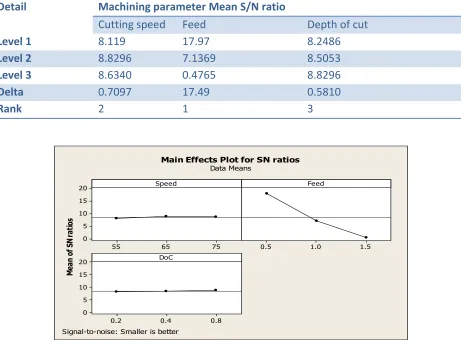
Taguchi recomendates analyzing means of S/N ratio using conceptual approach that involves graphical method for study the effect the surface roughness are analysed usin statistical software the mean S/N ratio for each level of the machining parameter were calculated based upon the data present in table the optimal performance for the surface roughness of turning process was obtain at a cutting speed (65 m/ min) feed (0.5mm/rev) DoC (0.8 mm) ranking of machining parameter are also calcuted based of difference in S/N ratio. The rank indicate the dominet the machining parameter that effects surface roughness figure show that the plot for surface roughness which indicate that the surface roughness decreases with increases of cutting speed. and very low influenc on the depth of cut since delta value is very low..
Table 5 Response Table for Signal to Noise Ratios Smaller is better
Detail Machining parameter Mean S/N ratio
Cutting speed Feed Depth of cut
Level 1 8.119 17.97 8.2486
Level 2 8.8296 7.1369 8.5053
Level 3 8.6340 0.4765 8.8296
Delta 0.7097 17.49 0.5810
Rank 2 1 3
75 65 55 20 15 10 5 0 1.5 1.0 0.5 0.8 0.4 0.2 20 15 10 5 0 Speed M ea n of S N ra tio s Feed DoC
Main Effects Plot for SN ratios Data Means
Signal-to-noise: Smaller is better
Available Online at www.ijpret.com 113
Fig 2 Flank wear obtained at different cutting condition
CONCLUSION
In these work full factorial design of experiment was conducted and taguchi optimization analysis were carried out for selecting the optimum machining parameter
1 Based on the taguchi design of experiments and analysis the feed and cutting speed is the main factor that has highest influence on surface roughness.
2 Optimum machining parameter for minimum surface roughness was determined. 3 The effect of speed, feed, DOC on tool wear were determined
REFERENCES
1. Journal of Materials Processing Technology 205, (2008), pp. 439–450.
Available Online at www.ijpret.com 114 3. Ezugwu E. O., “Improvements in the machining of aero-engine alloys using self-propelled rotary tooling technique”, Journal of Materials Processing Technology 185, (2007), pp. 60–71.
4. Hong J. K, Park J. H., Parka N. K., “Microstructures and mechanical properties of Inconel 718 welds by CO2 laser welding”.
5. Krain, H. R, Sharman A. R, Ridgway K., “Optimisation of tool life and productivity when End milling Inconel 71”, Journal of Materials Processing Technology 189, (2007), pp.153–161.
6. Krzysztof Jemielniak, “Finish turning of Inconel 718”.
7. Li H. Z., Zeng H. and Chen X. Q., “An Experimental study of tool wear and cutting force fariation in the end milling of Inconel 718 with coated carbide inserts”.
8. Liao Y. S., Shiu R. H., “Carbide tool wear mechanism in turning of Inconel 718 superalloy”, Wear, 193, (1996), pp. 16–24.
9. Mathew A., Kuttolamadom, Sina Hamzehlouia, “Effect of machining feed on surface roughness in cutting 6061 Aluminum” SAE International, 2010-01-0218.