ISSN 2449-8955
5(3) 2015
Volume 5
Number 3
September-December 2015
European Journal
of Biological Research
formerly
Journal of Biology and Earth Sciences
MNiSW points 2015:
11
Index Copernicus 2014:
96.49
European Journal of Biological Research, Volume 5, Issue 3, September-December 2015
European Journal of Biological Research ISSN 2449-8955
Editor-in-Chief
Tomasz M. Karpiński
Poznań University of Medical Sciences, Poznań, Poland
Co-Editors (Thematic Editors)
Artur Adamczak – biological sciences
Institute of Natural Fibres and Medicinal Plants, Poznań, Poland
Anna K. Szkaradkiewicz – medical sciences
Poznań University of Medical Sciences, Poznań, Poland
Statistical Editor
Paweł Zaprawa, Lublin, Poland
Language Editor
Dominik Piechocki, London, UK
Scientific Editorial Board
Tamara Bayanova, Apatity, Russia
Alexander Ereskovsky, Marseille, France
Agnieszka Gałuszka, Kielce, Poland
Vittorio Gentile, Naples, Italy
Stanisław Hałas, Lublin, Poland
Fadi Hage Chehade, Beirut, Lebanon
Afaf M. Hamada, Stockholm, Sweden
Sven Herzog, Tharandt, Germany
Liviu Holonec, Cluj-Napoca, Romania
Miłosz A. Huber, Lublin, Poland
Shri Mohan Jain, Helsinki, Finland
Wouter Kalle, Wagga Wagga, Australia
Tomasz Klepka, Lublin, Poland
Nikolaos Labrou, Athens, Greece
Igor Loskutov, Sankt Petersburg, Russia
Ákos Máthé, Sopron, Hungary
Ahmed El-Mekabaty, Mansoura, Egypt
Artem V. Mokrushin, Apatity, Russia
Shahid M. Mukhtar, Birmingham, USA
Robert Pal, Pécs, Hungary
Amal K. Paul, Kolkata, India
Rajiv Ranjan, Narkatia Ganj, India
Antonio Tiezzi, Viterbo, Italy
Timotej Verbovšek, Ljubljana, Slovenia
Vladimir K. Zhirov, Apatity, Russia
List of Peer-Reviewers
http://www.journals.tmkarpinski.com/index.php/ejbr/pages /view/reviewers
Author Guidelines
http://www.journals.tmkarpinski.com/index.php/ejbr/about /submissions
More information
www.journals.tmkarpinski.com/index.php/ejbr
DISCLAIMER
The Publisher and Editors cannot be held responsible for errors and any consequences arising from the use of information contained in this journal; the views and opinions expressed do not necessarily reflect those of the Publisher and Editors, neither does the publication of advertisements constitute any endorsement by the Publisher and Editors of the products advertised.
Cover: http://openwalls.com/image?id=20115, Licence Creative Commons
Attribution 3.0 Unported (CC BY 3.0)
Copyright: © The Author(s) 2015. European Journal of Biological Research © 2015 T.M.Karpiński. All articles and abstracts are open-access, distributed under the terms of the Creative Commons Attribution Non-Commercial 4.0 International License, which permits unrestricted, non-commercial use, distribution and reproduction in any medium, provided the work is properly cited.
European Journal of Biological Research, Volume 5, Issue 3, September-December 2015
Contents
42-51
52-57
58-69
70-77
78-85
86-103
Is the soil K/Na ratio the first defense line against salinity?
Mohamed Kamel, Sabah Hammad
Effect of phytocercaricide on certain enzyme activity in parasitic cercaria larva of Fasciola gigantica
Kumari Sunita, Pradeep Kumar, V. K. Singh, Dinesh Kumar Singh
Overview on vegetation characteristics of selected populations in the Eastern Desert of Egypt
Mohamed Kamel, A. Badr, H. Zaki
Characterization of lipase enzyme produced by hydrocarbons utilizing fungus Aspergillus terreus
Ghada Abd-Elmonsef Mahmoud, Mostafa Mohmed Koutb, Fatthy Mohmed Morsy, Magdy Mohamed Bagy
Dichlorvos toxicity on fish - a review
Sanjoy Deka, Rita Mahanta
Geographic variation in phytochemical constituents and allelopathic potential of Pinus halepensis barks
ISSN 2449-8955 of Biological Research European Journal Research Article
European Journal of Biological Research 2015; 5 (3): 42-51
Is the soil K/Na ratio the first defense line against salinity?
Mohamed Kamel*, Sabah Hammad
Botany Department, Faculty of Science, South Valley University, Qena, Egypt
* Corresponding author: Mohamed Kamel, Botany Department, Faculty of Science, South Valley University, Qena, 83523, Egypt; e-mail: [email protected]
ABSTRACT
The current work carried out to observe the preli-minary responses at the first hours of salt stress and to investigate the ability of K+ and Ca2+ as compatible inorganic solutes to overcome the Na+ injury. Seedlings of broad bean (Vicia faba, cv. Giza 40) were translocated to water culture containing 100, 200, 300, 400 and 500 mM NaCl. The flasks divided to two main groups. The first under salinity only and the second group was treated with 5% KCl and 5% CaCl2. Plants were harvested after 6 hours and 24 hour of stress. After 6 hours, the first shock of salt stress, the stressed plants lose their control upon the salt absorption or exclusion. The plants increased their content of sodium. Then sodium concentrations decreased greatly after 24 hours especially in roots. Leaves tended to accumulate K+ more than roots. The K/Na ratio increased gradu-ally in all the treated plants. The availability of K+ in the medium increased the value on K/Na ratio in the different organs of the plants treated with K+ and Ca2+ and decreased the accumulated inor- ganic solutes in the different organs of stressed plants.
Keywords: K/Na ratio, Osmotic adjustment, Salinity,
Salt shock, Salt stress, Vicia faba.
1. INTRODUCTION
One of the greatest problems in agriculture and crop production is the soil salinity and water deficit. An attempt to meet world food demands accompanied with decline in availability in fresh water has resulted in using water of poor quality for crop irrigation. Considering the need for increasing the crop yield, as well as the decline of good quality irrigation water, crop salt tolerance assessment can be a useful tool [1].
Faba bean is one of the major cool season grain legume crops produced worldwide. Legumes are either sensitive or moderately tolerant to salinity but variability in salinity tolerance among legumes has also been reported. Vicia faba (L.) is modera-tely sensitive to salinity, registering 50% growth reduction at 6.7 dS m−1 salinity.
Several researchers have studied the effects of salinity and drought stresses on crop production [2, 3] and the responses of plants to overcome these environmental stresses [4-7].
Salt stress has three fold effects: it reduces water potential, causes ion imbalance or disturbance in ion homeostasis and toxicity [8]. Since salt stress involves both osmotic and ionic stress [9-12]. Salt stress affects all the major processes such as growth, photosynthesis, protein synthesis, energy and lipid metabolism [13, 14].
Received: 02 June 2015; Revised submission: 25 July 2015; Accepted: 28 July 2015
Copyright: © The Author(s) 2015. European Journal of Biological Research © T.M.Karpiński 2015.
This is an open-access article distributed under the terms of the Creative Commons Attribution License, which permits unrestricted use, distribution, and reproduction in any medium, provided the original work is properly cited.
43 | Kamel and Hammad Is the soil K/Na ratio the first defense line against salinity?
European Journal of Biological Research 2015; 5 (3): 42-51
There are two main mechanisms to overcome the drought and salinity stresses. The first is the quickly response through the re-osmotic adjustment depending upon inorganic solutes [15-19]. The solu-te particle number is the main reason which causes stress. The second way to overcome stress is depended mainly upon organic solutes [4]. The later way need long time for compound synthesis and transforma-tions to compatible solutes as proline, glycinebetaine, etc.
Accumulation of ions in the leaves under salt stress causes a rapid reduction in net photosynthe- sis and growth. Excess of Na+ and Cl- creates ionic imbalances that may impair the selectivity of root membranes and induce K+ deficiency. Membranes are vulnerable targets of stress-induced cellular damage and the extent of membrane damage is commonly used as a measure of tolerance to various stresses in plants [20].
Changes in water relations of plants that are stressed by salinity, can be seen in certain studies confirm that, many plants undergo osmotic regula-tion when they are exposed to salt stress by increa-sing the negativity of the osmotic potential of the leaf sap [21-25].
The understanding of the first responses under salt stresses may be helpful to put a strategy, which can help stressed plants; to overcome the stress resulted from the irrigation with saline waters. The current work, as one of a series of investigations are carrying to manufacture an osmo-regulator fertilizer, carried out to observe the preliminary responses at the first hours of salt stress. Investigate the ability of K+ and Ca2+ as compatible inorganic solutes to avoid the accumulation of Na+ and consequently decreasing the injury results from high sodicity.
2. MATERIALS AND METHODS
Seeds of broad bean (Vicia faba, cv. Giza 40) were germinated in plastic pots containing sawdust. The seedlings were irrigated with tap water for two weeks. Then the plants were translocated to water culture in conical flasks containing 100, 200, 300, 400 and 500 mM NaCl, five seedlings in each flask. The flasks divided to two main groups. The first contained the previous concentrations of NaCl. Each conical flask of the second group was treated with 5 ml of 5% KCl and 5 ml of 5% CaCl2. The main
two groups were subdivided to four groups, with three replicates for each concentration. One group of NaCl treated plants and another of NaClK+Ca treated plants were harvested after 6 hours of stress. The different organs of the plants were separated and dried in oven at 75 ºC for 24 hours. The other two groups were harvested after 24 hours.The dry roots, stems and leaves samples were grounded into fine powder and the soluble solutes extracted in distilled water according to the method described by El-Sharkawi and Michel [26]. Chloride was determined volumetrically according to Jackson [27]. Sodium and potassium was measured by flame photometry according to Williams and Twine [28]. Calcium and magnesium was determined volumetrically by the versene method as described by Johnson and Ulrich [29]. The ionic fractions; K/Na, Ca/Na were also computed. The data was analyzed in one way ANOVA to determine the least significant diffe-rence (LSD) using statistical package for social sciences version 20 (SPSS).
3. RESULTS
After 6 hours of NaCl stress at 100, 200, 300, 400 and 500 mM the plants increased their content of sodium. The accumulation of sodium was higher in roots especially at 100 mM where reached up to 55 mg g-1. There was no gradient inside plants parallel with the external gradient. The sodium concentration decreased greatly after 24 hours espe-cially in roots. At 100 mM NaCl stress the sodium concentration in roots declined from 55 to 6 mg g-1. The availability of K+ and Ca2+ in the medium affec-ted the sodium uptake. The sodium concentration decreased markedly after 6 hours of stress. The lowest Na+ concentration was recognized after 24 hours in the medium supported by K+ and Ca2+ (Figure 1). Na+ accumulated in the roots more than the other organs.
44 | Kamel and Hammad Is the soil K/Na ratio the first defense line against salinity?
European Journal of Biological Research 2015; 5 (3): 42-51
treated with Ca2+ and K+, after 24 hours. The higher concentration of sodium was estimated in the roots while the potassium in the leaves. Under salt stress,
the plants decreased their content of Na+ from the range 15-55 mg at the first 6 hours to 5-21 mg after 24 hour.
Fig. 1. Sodium concentration mg g-1 dry wt inside the different organs of Vicia faba plants under different levels of salt stresses and treatments.
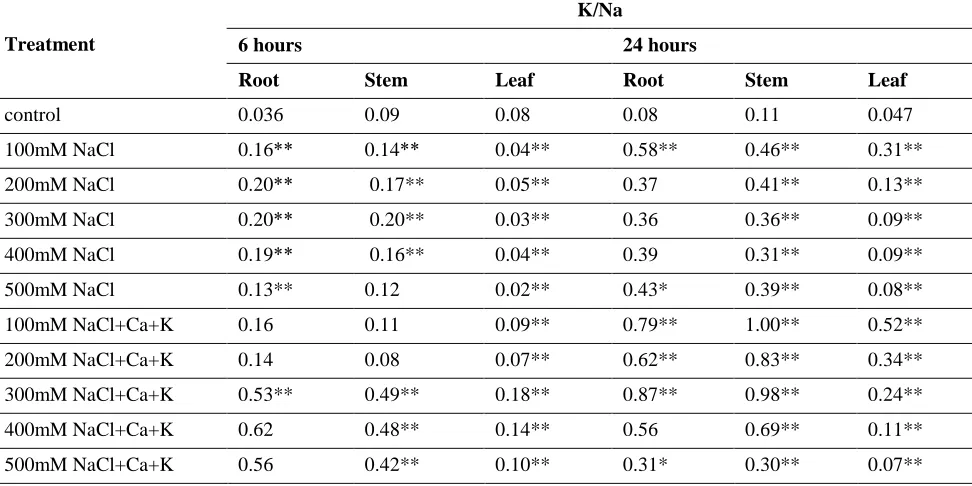
The K/Na ratio decreased gradually from the roots to the leaves in all the treated plants (Table 1). It is also noticed that this ratio decreased gradually with salt stress increasing. The availability of K+ in the medium increased the value on K/Na ratio in the different organs of the plants treated with K+ and Ca2+. After 24 hours, the K/Na ratio increased greatly due to the preference of plants to accumulate potassium or avoid the sodium absorption. It increa-sed between three folds and ten folds compared with the values computed after six hours. The lowest K/Na ratio (0.02) was computed in the plants survived less than 500 mM NaCl stress at the first 6 hours. With time the plants decreased the sodium uptake and increased the absorption of potassium. Therefore, the K/Na ratio increased from 0.02 to 0.08 in the leaves.
At the first 6 hours of salt stress the plants accumulated amounts of calcium and magnesium. The non-treated plants accumulated calcium more than the treated plants with K+ and Ca2+ in their media (Figure 3). The accumulated Ca2+ decreased strongly after 24 hour of salt stress and the plants tended to maintain a constant content of calcium and magnesium.
At the first six hours the plants accumulated more magnesium but the amount of Mg2+ decreased with time. Magnesium accumulated more than cal-cium after 24 hour. There was a tendency of the plants to distribute Mg2+ through the plant organs evenly (Figure 4).
45 | Kamel and Hammad Is the soil K/Na ratio the first defense line against salinity?
European Journal of Biological Research 2015; 5 (3): 42-51
accumulate chloride ions to overcome the external salt stress. After 24 hour, the Cl- transferred to shoots. The non-treated stressed plants accumulated more chlorides than those treated with potassium
and calcium. The increase of chloride was paralleled with the external salt stress. The roots had usually the highest concentration of chlorides compared with stems and leaves.
Table 1. The computed K/Na ratio inside the different organs of Vicia faba plants under different levels of salt stresses
and treatments. K/Na 24 hours 6 hours Leaf Stem Root Leaf Stem Root Treatment 0.047 0.11 0.08 0.08 0.09 0.036 control 0.31** 0.46** 0.58** 0.04** 0.14** 0.16** 100mM NaCl 0.13** 0.41** 0.37 0.05** 0.17** 0.20** 200mM NaCl 0.09** 0.36** 0.36 0.03** 0.20** 0.20** 300mM NaCl 0.09** 0.31** 0.39 0.04** 0.16** 0.19** 400mM NaCl 0.08** 0.39** 0.43* 0.02** 0.12 0.13** 500mM NaCl 0.52** 1.00** 0.79** 0.09** 0.11 0.16 100mM NaCl+Ca+K 0.34** 0.83** 0.62** 0.07** 0.08 0.14 200mM NaCl+Ca+K 0.24** 0.98** 0.87** 0.18** 0.49** 0.53** 300mM NaCl+Ca+K 0.11** 0.69** 0.56 0.14** 0.48** 0.62 400mM NaCl+Ca+K 0.07** 0.30** 0.31* 0.10** 0.42** 0.56 500mM NaCl+Ca+K
**the mean difference is significant at 0.01 level. *the mean difference is significant at 0.05 level.
Table 2. The computed Ca/Na ratio inside the different organs of Vicia faba plants under different levels of salt stresses
and treatments. Ca/Na 24 hours 6 hours Leaf Stem Root Leaf Stem Root Treatment 0.153 0.18 0.15 0.14 0.086 0,067 Control 1.07** 1.29** 0.89** 0.20** 1.30** 0.80* 100mM NaCl 0.33** 0.55 0.48** 0.63** 1.21** 1.01** 200mM NaCl 0.24** 0.52 0.32 0.49** 1.05** 0.91** 300mM NaCl 0.16 0.38 0.19 0.25** 0.79** 0.68** 400mM NaCl 0.24**. 0.91** 0.44 0.20** 0.36** 0.35* 500mM NaCl 2.10** 2.94** 1.82** 0.42** 0.72** 0.80** 100mM NaCl+Ca+K 1.69** 2.07** 1.12** 0.36** 0.93** 0.67** 200mM NaCl+Ca+K 1.45** 4.89** 2.45** 0.96** 1.34** 1.33** 300mM NaCl+Ca+K 0.44** 1.76** 1.24** 0.50** 1.22** 2.33** 400mM NaCl+Ca+K 0.42** 0.73* 0.89** 0.23** 0.72** 0.86** 500mM NaCl+Ca+K
46 | Kamel and Hammad Is the soil K/Na ratio the first defense line against salinity?
European Journal of Biological Research 2015; 5 (3): 42-51
Fig. 2. Potassium concentration mg g-1 dry wt inside the different organs of Vicia faba plants under different levels of salt stresses and treatments.
47 | Kamel and Hammad Is the soil K/Na ratio the first defense line against salinity?
European Journal of Biological Research 2015; 5 (3): 42-51
Fig. 4. Magnesium concentration mg g-1 dry wt inside the different organs of Vicia faba plants under different levels of salt stresses and treatments.
48 | Kamel and Hammad Is the soil K/Na ratio the first defense line against salinity?
European Journal of Biological Research 2015; 5 (3): 42-51
The plants accumulated more calcium in the stems to alleviate the sodium toxicity. Therefore, the stems had the highest Ca/Na ratio between the different organs. The availability of calcium in the external medium enhanced the absorption of Ca2+ and increased the concentration of calcium ions inside the treated stressed plants (Table 2).
4. DISCUSSION
4.1. The response of plants against external salt stress after six hours
The first response of faba bean to what is so called salt shock was the higher accumulation of sodium at the first 6 hours especially in roots [30]. This salt shock loses the plants their control on solutes absorption. Therefore, the plants accumu-lated more solutes at the first six hours [31]. The plants tried to accumulate the divalent cations, Ca2+ and Mg2+ as compatible solutes to avoid the high accumulation of sodium ions [32]. Although the high accumulated amounts of Ca2+ and Mg2+ at the low concentration of Na+, Ca2+ and Mg2+ concen-trations decreased at higher salt stresses. On the other hand, K+ increased gradually with the increase of external stress. The stressed plants increased the Ca2+/ Na+ ratio in the stems to avoid sodium injury, while the K+/Na+ ratio increased in the leaves [33]. Cl- as a main anion increased in the roots gradually with the increased of external stress [34] and [35]. The addition of calcium and potassium to the external medium decreased the accumulation on inorganic solutes inside different organs.
4.2. The response of plants against external salt stress after 24 hours
With the time, the stressed plants rearranged their defenses against external salt stress. The plants tended to exclude sodium ions. Except K+, both Na+ and Ca+2 and Mg+2 decreased considerably after 24 hours of stress. This reflects the tendency of plants to exclude the high accumulated ions resulted from the first shock of salt stress [36]. The stressed plants started their defense against unfavorable external conditions and preferred to accumulate K+ which enhance the protein synthesis. The plants with time depended on organic solutes. The preference of
potassium absorption increased the K/Na ratio after 24 hours of stress. The high K/Na ratio is considered as good indicator for salt tolerance [37]. Ca/Na ratio tended to increase in root but decreased in stem and leaves. It is clear that Ca ameliorates the sodium harm effect but K is helpful for biological synthesis [32]. The chloride transported to the the stems and leaves.
4.3. The role of potassium and calcium against external stress
The treatment with 5% K+ and 5% Ca2+ decreased the absorption of Na+ by roots and consequently the accumulation of Na inside plant organs [38]. At the beginning of salt stress, the addi-tion of potassium and calcium decreased the con-centration of Na+ inside the different organs. this means that the increase in the external K/Na ratio decreased the absorption of Na+ [39]. This effect increased with time, therefore the lowest concentra-tion of Na+ was estimated after 24 hour in the plants treated with K+ and Ca+2. The tendency of plants to accumulate K+ under salt stress only was lower when compared with the decrease of Na+ concen-tration inside plants under the effect K+ and Ca+2 treatment. This explains that the increase of the external K/Na ratio decreases the rate of Na+ more than the internal osmotic adjustment and before the Na+ exclusion by roots. In the same time, the little increase of potassium enhanced the biological synthesis inside plants. This clear why the plants tended to accumulate K+ in the leaves [40]. After the salt shock the plants tended to fix their con-centration of the bivalent cations (Ca+2 and Mg+2) whether the external medium treated with potassium and calcium or not. The main anion Cl- accumulated regularly paralleled with the increase of salinity especially in the roots.
49 | Kamel and Hammad Is the soil K/Na ratio the first defense line against salinity?
European Journal of Biological Research 2015; 5 (3): 42-51
stresses undergo the stress to some time. Therefore, they increased their K/Na ratio after 24 hour of stress. The availability of Ca+2 in the external me-dium was helpful for the increase of Ca/Na ratio inside plant tissues. It is clear that calcium has an ameliorative effect against Na injury. Therefore, the plants increased the Ca/Na ratio after 24 hour in the presence of calcium in the external medium sometimes up to 4.89 (Table 2).
It can be concluded that the first shock of salt stress loses the stressed plant their control upon the salt absorption or exclusion. After 24 hours, the plants rearranged their defenses against salt stress and decreased the ionic concentration inside different plant tissues. The addition of Ca+2 and K+ improved the salt tolerance and decrea- sed the rate of ionic accumulation considerably at the first moment of salt stress. The external K/Na ratio affected the rate of inorganic solutes absorp-tion.
AUTHORS’ CONTRIBUTION
MK: designed the research plan and organized the study, recorded the experimental data, wrote the introduction, results and discussion, revised the manuscript. SH: participated in all the experiments, analyzed the data statistically, wrote the references coordinated the figures and tables. The final manu-script has been read and approved by the authors.
TRANSPARENCY DECLARATION
The authors declare no conflicts of interest.
REFERENCES
1. Matijević L, Romić D, Maurović N, Romić M. Saline irrigation water affects element uptake by bean plant (Vicia faba L.). Eur Chem Bull. 2012; 1(12): 498-502.
2. Mahajan Sh, Tuteja N. Cold, salinity and drought stresses: An overview. Arch Biochem Biophys. 2005; 444: 139-158.
3. Jaleel CA, Gopi R, Manivannan P, Panneerselvam R. Responses of antioxidant defense system of
Catharanthus roseus (L.) G. Don. to paclobutrazol
treatment under salinity. Acta Physiol Plant. 2007; 29: 205-209.
4. Wyn Jones RG, Pritchard J. Stresses, membranes and cell walls. In: Plants under stress: Biochemistry, physiology and ecology and their application to plant improvement. Jones HG, Flowers TJ, Jones MB (Eds.) Cambridge University Press. 1989: 95-114
5. Koyro HW. Effect of salinity on growth, photo-synthesis, water relations and solute composition of the potential cash crop halophyte Plantago
coronopus (L.). Env Exp Bot. 2006; 56: 136-146.
6. Heidari F, Zehtab Salmasi S, Javanshir A, Aliari H, Dadpoor MR. The effects of application micro-elements and plant density on yield and essential oil of peppermint (Mentha piperita L.). Iran J Med Arom Plant. 2008; 24: 1-9.
7. Keshavarzi MHB. The effect of different NaCl concentration on germination and early seedling growth of Artemisia annua L. Int J Agri Res Rev. 2012; 2: 135-140.
8. Rabie GH, Almadini AM. Role of bioinoculants in development of salt-tolerance of Vicia faba plants under salinity stress. Afr J Biotechnol. 2005; 4(3): 210-222.
9. Hayashi H, Murata N. Genetically engineered enhancement of salt tolerance in higher plants. In: Sato Murata N (Ed.), Stress response of photo-synthetic organisms: molecular mechanisms and molecular regulation. Elsevier, Amsterdam. 1998: 133-148.
10. Munns R. Comparative physiology of salt and water stress, Plant Cell Environ. 2002; 20: 239-250.
11. Benlloch-González M, Fournier J, Ramos J, Benlloch M. Strategies underlying salt tolerance in halophytes are present in Cynara cardunculus. Plant Sci. 2005; 168(3): 653-659.
12. Katerji N. Hoorn JW, Hamdy A, Mastrorilli M, Nachit M, Oweis T. Salt tolerance analysis of chickpea, faba bean and durum wheat varieties:II. Durum wheat. Agr Water Manag. 2005; 72: 177-194.
13. Ramoliya P, Patel H, Pandey AN. Effect of salinization of soil on growth and macro- and micro-nutrient accumulation in seedlings of Salvadora
persica (Salvadoraceae). Forest Ecol Manag. 2004;
202(1-3): 181-193.
14. Parida SK, Das AB. Salt tolerance and salinity effects on plants. Ecotoxicol Environ Saf. 2005; 60(3): 324-349.
50 | Kamel and Hammad Is the soil K/Na ratio the first defense line against salinity?
European Journal of Biological Research 2015; 5 (3): 42-51
and crop stress. Marcel Dekker, Inc., New York. 1999: 97-124.
16. Rubinigg M, Posthumus F, Ferschke M, Elzenga JTM, Stulen I. Effects of NaCl salinity on 15N-nitreate fluxes and specific root length in the halophyte Plantago martima L. Plant Soil. 2003; 250: 201-213.
17. Neocleous D, Vasilakakis M. Effects of NaCl stress on red raspberry (Rubus idaeus L. and Autumn bliss L.). Scientia Horticulturae-Amsterdam. 2007; 112: 282-289.
18. Hajlaouia H, EL Ayebb N, Garrecc JP, Dendend M. Differential effects of salt stress on osmotic adjustment and solutes allocation on the basis of root and leaf tissue senescence of two silage maize (Zea
mays L.) varieties. Ind Crop Prod. 2010; 31:
122-130.
19. AlDesuquy HS, Baka ZA, EL-Shehaby OA, Ghanem HE. Efficacy of seawater salinity on osmotic adjustment and solutes allocation in wheat (Triticum aestivum) flag leaf during grain filling. IJPPB. 2012; 4: 33-45.
20. Gadallah MAA. Effects of proline and glycine-betaine on Vicia faba responses to salt stress. Biol Plantarum. 1999; 42(2): 249-257.
21. Rodriguez P, Amico JD, Morales D, Blanco MJS, Alarcon JJ. Effects of salinity on growth, shoot water relations and root hydraulic conductivity in tomato plants. J Agri Sci. 1997; 128: 439-444.
22. Gama PBS, Inanaga S, Tanaka K, Nakazawa R. Physiological response of common bean (Phaseolus
vulgaris L.) seedlings to salinity stress. Afr J
Biotechnol. 2007; 6(2): 79-88.
23. Gama PBS, Tanaka K, Eneji A, Eltayeb AE, Elsiddig K. Salt induced stress effects on biomass, photosynthetic rate and reactive oxygen species scavenging enzyme accumulation in common bean. J Plant Nutr. 2009; 32(5): 837-854.
24. Kaymakanova M, Stoeva N. Physiological reaction of bean plants (Phaseolus vulgares L.) to salinity stress. Gen Appl Plant Physiol., 2008; 34(3-4):177-188.
25. Kaymakanova M, Stoeva N, Mincheva T. Salinity and its effect on physiological response of bean (Phaseolus vulgares L.). J Cent Eur Agri, 2008; 9 (4): 749–756
26. El-Sharkawi HM, Michel BE. Effects of soil water matric potential and air humidity on CO2 and water
vapour exchange in two grasses. Photosynthetica. 1977; 11: 176-182.
27. Jackson ML. Soil chemical analysis. Prentice-Hall. Inc., Englewood Cliffs. N.J. 1958.
28. Williams CH, Twine ME. Flame photometric method for sodium, potassium and calcium. In: Modern methods of plants analysis. Paech K, Tracey MV (Eds.). Springer-Verlag, Berlin; Vol. V, 1960.
29. Johnson CM, Ulrich A. Analytical methods for use in plant analysis. U.S. Dept. Agric. Calif. Univ. Agric. Inform. Bull. 1959.
30. Mousa MAA, Al-Qurashi AD, Bakhashwain AAS. Ions Concentration and their Ratio in Roots and Shoots of Tomato Genotypes associated with Salinity Tolerance at Early Growth Stage. Int J Plant Animal Env Sci. 2014; 4(3): 586-600.
31. Shavrukov Y. Salt stress or salt shock: which genes are we studying? J Exp Bot. 2013; 64(1): 119-127.
32. Barakat NAM Ameliorative effects of Ca2+ on the growth, metabolism, cationic status and cell wall degrading enzymes of induced salinity stress Vicia
faba L. J. Stress Physiol Biochem. 2011; 7(4):
369-386.
33. Wu GQ, Wang SM. Calcium regulates K+/Na+ homeostasis in rice (Oryza sativa L.) under saline conditions. Plant Soil Environ. 2012; 58 (3): 121-127.
34. Mezni M, Albouchi A, Bizid E. Effect of salinity on sodium and chloride uptake, proline and soluble carbohydrate contents in three alfalfa varieties. IOSR-JAVS. 2012; 1(6): 1-6.
35. Gholizadeh S, Nemati I, Moradi F. Effect of supplemental calcium and potassium on organic and inorganic solutes and antioxidant enzymes activity in NaCl stressed alfalfa seedlings. Int J Agric Crop Sci. 2012; 4(7): 377-385.
36. Fortmeier R, Schubert S. Salt tolerance of maize (Zea mays L.): the role of sodium exclusion. Plant Cell Environ. 1995; 18(9): 1041-1047.
37. Kamel M, El-Tayeb MA. K+/Na+ soil-plant inter-actions during low salt stress and their role in osmotic adjustment in faba beans. Span J Agric Res. 2004; 2(2): 257-265
38. Kamel M. Improving the tolerance of Vicia faba against environmental salinity resulted from the irrigation with sea water by using KNO3 and
(NH4)2SO4 as chemical osmoregulators. Acta Biol
Colom. 2012; 17: 295-308.
51 | Kamel and Hammad Is the soil K/Na ratio the first defense line against salinity?
European Journal of Biological Research 2015; 5 (3): 42-51
40. Shilpi M, Narendra T. Cold, salinity and drought stresses: an overview. Arch Biochem Biophys. 2005; 444: 139-158.
41. Dawood MG, Abdelhamid MT, Schmidhalter U. Potassium fertiliser enhances the salt-tolerance of
common bean (Phaseolus vulgaris L.). J Hortic Sci Biotech. 2014; 89(2): 185-192.
ISSN 2449-8955 of Biological Research European Journal Research Article
European Journal of Biological Research 2015; 5 (3): 52-57
Effect of phytocercaricide on certain enzyme activity
in parasitic cercaria larva of
Fasciola gigantica
Kumari Sunita
1, Pradeep Kumar
2, V. K. Singh
1, D. K. Singh
1*
1
Malacology Laboratory, Department of Zoology, D.D.U Gorakhpur University Gorakhpur, India
2
Department of Zoology, S.G.N Govt. PG College Muhammadabad Gohana Mau, India
* Corresponding author: Prof. D.K. Singh, Malacology Laboratory, Department of Zoology, D.D.U Gorakhpur University Gorakhpur 273009 (U.P), India; Tel.: +91-551 2202187 (Off), Mobile: +91-9454211574;
e-mail: [email protected]
ABSTRACT
Fasciolosis is one of the common public health problems worldwide, and cause a great economic loss to us. The life cycle of the Fasciola can be interrupted by killing the vector snail or Fasciola larva redia/cercaria inside the snail body. Binary combinations of different plant derived cercari- cidal were more effective against the cercaria larva of Fasciola gigantica. Treatment with binary combination 20% and 60% of 4h LC50 of citral (Ci), ferulic acid (Fe), umbelliferone (Um), azadirachtin (Az) and allicin (Al) caused no significant change in the activity of acetylcholinesterase (AChE) in the nervous tissues of exposed L. acuminata. Significant inhibition in the AChE activity was noted in whole cercaria larva. AChE activity in the nervous tissues of snail exposed to 60% of 4h LC50 of Al+Um was 94.50% of control. AChE and cytochrome oxidase activity was mea-sured to reduced 0.89% and 2.37% of control in whole cercaria larva exposed to 60% of 4h LC50 of Az+Al.
Keywords: Binary combination of cercaricides;
Cercaria larva; Acetylcholinesterase; Cytochrome oxidase.
1. INTRODUCTION
Fasciolosis is one of the most significant zoonotic diseases caused by Fasciola gigantica and
F. hepatica [1]. Fasciola is a digenetic trematode
including two hosts; a mammalian host and a molluscan intermediate host [2]. Life cycle of
Fasciola includes fresh water snails of family
Lymnaeidae as an intermediate host [3]. Human infestation of fasciolosis is characterized by fever, eosinophilia, abdominal pain and, exceptionally, acute pancreatitis [4, 5]. In northern India snail
Lymnaea acuminata is the intermediate host of the Fasciola species [6-8]. Human fasciolosis in India
has been reported in state of Assam, Bihar, Maha-rastra, Uttar Pradesh, Arunchal Pradesh and West Bengal [9-13]. The massive use of chemical drugs to control parasite has led to the alarming develop-ment of parasite resistance in all livestock species [14]. Natural products are eco-friendly and easily biodegradables less hazed to aquatic environment. Control of snail population below a threshold level
Received: 20 May 2015; Revised submission: 27 July 2015; Accepted: 03 August 2015
Copyright: © The Author(s) 2015. European Journal of Biological Research © T.M.Karpiński 2015.
This is an open-access article distributed under the terms of the Creative Commons Attribution License, which permits unrestricted use, distribution, and reproduction in any medium, provided the original work is properly cited.
53 | Sunita et al. Effect of phytocercaricide on certain enzyme activity in parasitic cercaria larva of Fasciola gigantica
European Journal of Biological Research 2015; 5 (3): 52-57
is one of the important methods for effective control of fasciolosis [15, 16]. Use of plant derived larvi-cides drugs are currently used as the most effective tool for the treatment of fasciolosis. The Zingiber
officinale (citral), Ferula asafoetida (ferulic acid,
umbelliferone), Azadirachta indica (azadirachtin) and Allium sativum (allicin) are the potent larvici-des [17]. Sunita et al. [7] has reported that plant products citral, ferulic acid, umbelliferone azadi-rachtin and allicin are potent larvicide against
Fasciola larvae. The mechanism of action of their
active components causing larval death is not exactly known. The aim of the present study is to evaluate the effect of sub-lethal treatment of different binary combination of citral, ferulic acid, umbelliferone, azadirachtin and allicin on acetyl-cholinesterase (AChE) and cytochrome oxidase activity in the intermediate host snail L. acuminata and cercaria larva of F. gigantica.
2. MATERIALS AND METHODS
2.1. Active larvicidal components
Citral, ferulic acid, umbelliferone, azadi-rachtin were purchased from Sigma chemical Co. (U.S.A). Allicin was prepared by the method of Mohammad and Woodward [18] as modified by Singh and Singh [19].
2.2. Binary Combination of larvicidal component
Binary combinations (1:1 ratio) of citral (Ci), ferulic acid (Fe), umbelliferone (Um), azadirachtin (Az) and allicin (Al) that is Ci+Fe, Ci+Um, Ci+Az, Ci+Al, Fe+Um, Fe+Az, Fe+Al, Az+Um, Az+Al and Al+Um were used for the treatment of snails.
2.3. Animals
2.3.1. In vivo treatment
Adult L. acuminata (2.6 ± 0.20 cm in length) were collected locally. Cercarias shedding infected and uninfected snails were separated in two groups. The snails were allowed to acclimatize in laboratory condition for 24h and then treated with sublethal concentration, 20% and 60% 4h LC50 of binary combination of active larvicides; Ci+Fe, Ci+Um,
Ci+Az, Ci+Al, Fe+Um, Fe+Az, Fe+Al, Az+Um, Az+Al and Al+Um. Selections of these concentra-tions were based on earlier observation of Sunita et al. [7]. Six Batches were set up for each concen-tration. Control group (for each batch) contained only dechlorinated tap water without any treatment. The treated animals were removed from the aquaria after 4h and rinsed with water.
2.3.2. AChE activity
Infected snails were exposed to 20% and 60% of 4h LC50 of binary combinations (1:1 ratio) of active components. Snails were washed with fresh water and dissected out. Cercaria larva as well as brain of the infected snails was taken for the estimation of acetylcholinesterase (AChE) and cyto-chrome oxidase. The brain of snails were removed separately and placed on ice cubes, afterwards it was placed on filter paper to remove the adherent water and weight. AChE activity was estimated in treated as well as control group of animals by the method of Ellman et al. [20] as modified by Singh et al. [21]. Snail nervous tissue was homogenized in 50 mg/mL of 0.1M phosphate buffer pH 8.0 for 5 min in an ice bath and centrifuged at 10,00 × g for 30 min at 40C. The supernatant was used as an enzyme source 0.05 mL of the supernatant was pipette to a 1.0 mm path length cuvette. To this added 0.1 mL (5×10⁻⁴M) of freshly prepared acetyl thiocholine iodide chromomeric agent DTNB reagent 1.45 mL of 0.05 M phosphate buffer pH 8.0 was used. The change in optical density 412 nm was monitored for 3 min at 250C. Enzyme activity has been expressed µ mole ‛SH’ hydrolysed/ min/ mg protein.
AChE activity in the nervous tissue of withdrawn after 4h snail from treatments were measured in withdrawal snails after 4h exposed of 60% of 4hLC50 of binary combination for next 6h fresh water.
2.3.3. Fractionation of cercaria tissue
benza-54 | Sunita et al. Effect of phytocercaricide on certain enzyme activity in parasitic cercaria larva of Fasciola gigantica
European Journal of Biological Research 2015; 5 (3): 52-57
midine was added (10 mL), followed by sonication at 50% duty cycle/output control 4 in a bath Ultra-sonicssonicator, (Plainview, NY, U.S.A). Sonication was performed for 3×3 min at 40C. Each homo-genate was used as enzyme source for AChE activity estimation.
2.3.4. Cytochrome oxidase
Activity of cytochrome oxides was measured according to Cooperstein and Lazarow [22] as modified by Singh and Agarwal [23]. 1×10⁶ cercaria larva of Fasciola gigantica were homogenized in 1.0 mL of 1/30 mol.1 phosphate buffer, pH 7.4 for 5 min (10,000 × g) for 30 min at 40C supernatants were used an enzyme source. Enzyme activity at
250C was measured in a reduced cytochrome solution (1.7×10⁻⁵ mol/L) were taken into cuvette and 0.2 ml of cercaria larva homogenate was added. The reactants were mixed by inverting the cuvette several times and absorption at 550 nm was monitored for 3 min. A few grains of potassium ferricyanide were added (to oxidase cytochrome c completely) and the extinction was redetermined. Enzyme activity has been expressed as the average enzyme per min and per mg protein.
2.4. Statistical Analysis
Each result was six time replicated estimation (measurement in six different pool of nervous tissue). The values were expressed as mean ± SE.
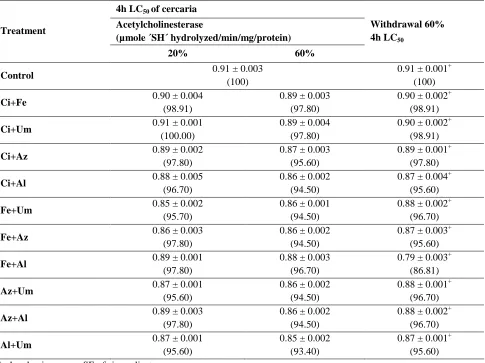
Table 1. Inhibition of AChE activity (µ mole SH hydrolyzed/mg protein/min) in the nervous tissue of L. acuminata
exposed to 20% and 60% of 4h LC50 of active cercaricides.
4h LC50 of cercaria Acetylcholinesterase
(µmole ´SH´ hydrolyzed/min/mg/protein) Treatment
20% 60%
Withdrawal 60% 4h LC50
Control 0.91 ± 0.003
(100)
0.91 ± 0.001+ (100)
Ci+Fe 0.90 ± 0.004
(98.91)
0.89 ± 0.003 (97.80)
0.90 ± 0.002+ (98.91)
Ci+Um 0.91 ± 0.001
(100.00)
0.89 ± 0.004 (97.80)
0.90 ± 0.002+ (98.91)
Ci+Az 0.89 ± 0.002
(97.80)
0.87 ± 0.003 (95.60)
0.89 ± 0.001+ (97.80)
Ci+Al 0.88 ± 0.005
(96.70)
0.86 ± 0.002 (94.50)
0.87 ± 0.004+ (95.60)
Fe+Um 0.85 ± 0.002
(95.70)
0.86 ± 0.001 (94.50)
0.88 ± 0.002+ (96.70)
Fe+Az 0.86 ± 0.003
(97.80)
0.86 ± 0.002 (94.50)
0.87 ± 0.003+ (95.60)
Fe+Al 0.89 ± 0.001
(97.80)
0.88 ± 0.003 (96.70)
0.79 ± 0.003+ (86.81)
Az+Um 0.87 ± 0.001
(95.60)
0.86 ± 0.002 (94.50)
0.88 ± 0.001+ (96.70)
Az+Al 0.89 ± 0.003
(97.80)
0.86 ± 0.002 (94.50)
0.88 ± 0.002+ (96.70)
Al+Um 0.87 ± 0.001
(95.60)
0.85 ± 0.002 (93.40)
0.87 ± 0.001+ (95.60) Each value is mean ± SE of six replicates.
Value is parentheses are per cent change with control taken as 100%.
Concentration (w/v) has been expressed as final concentration in aquarium water.
Significant (p<0.05) when‘t’ test was applied in between treated and control group and (+) in between 60% of 4h LC50 and
55 | Sunita et al. Effect of phytocercaricide on certain enzyme activity in parasitic cercaria larva of Fasciola gigantica
European Journal of Biological Research 2015; 5 (3): 52-57
Table 2. Inhibition of AChE activity (µ mole SH hydrolyzed/mg protein/min) and Cytochrome (enzyme activity/min/mg
protein) oxidase in the cercaria larva of F. gigantica exposed to 20% and 60% of 4h LC50 of active cercaricides.
4h LC50 of cercaria larva
Treatment Acetylcholinesterase (µmole ´SH´ hydrolyzed/min/mg/protein)
Cytochrome oxidase (enzyme activity/min/mg protein)
20% 60% 20% 60%
Control 1.12±0.001
(100)
14.72±0.002 (100)
Ci+Fe 0.038±0.003
* (3.39) 0.036±0.003* (3.21) 0.58±0.002* (3.94) 0.56±0.005* (380)
Ci+Um 0.039±0.001
* ( 3.30) 0.034±0.002* (3.03) 0.56±0.001* (3.80) 0.53±0.006* (3.60)
Ci+Az 0.031±0.002
* (2.76) 0.029±0.001* (2.58) 0.54±0.001* (3.66) 0.52±0.003* (3.53)
Ci+Al 0.020±0.004
* (1.78) 0.018±0.002* (1.60) 0.57±0.003* (3.87) 0.54±0.001* (3.66)
Fe+Um 0.022±0.003
* (1.96) 0.017±0.004* (1.51) 0.52±0.003* (3.53) 0.50±0.004* (3.39)
Fe+Az 0.023±0.004
*
(2.5)
0.020±0.002* (1.78)
0.51 ±0.002* (3.46)
0.48±0.003* (3.26)
Fe+Al 0.013±0.001
* (1.16) 0.011±0.003* (0.98) 0.40±0.004* (2.71) 0.38±0.002* (2.58)
Az+Um 0.016±0.002
* (1.42) 0.014±0.001* (1.25) 0.50±0.003* (3.39) 0.49±0.004* (3.32)
Az+Al 0.012±0.001
* (1.07) 0.010±0.001* (0.89) 0.38±0.004* (2.58) 0.35±0.001* (2.37)
Al+Um 0.017±0.003
* (1.51) 0.015±0.002* (1.33) 0.42±0.002* (2.85) 0.39±0.003* (2.64) Each value is mean ± SE of six replicates.
Value is parentheses are per cent change with control taken as 100%.
Concentration (w/v) has been expressed as final concentration in aquarium water. (*) Significant (P<0.05) when‘t’ test was applied in between treated and control group.
Student t-test was applied to determination the significant (p<0.05) different between treated and control animals [24].
3. RESULTS
Treatment with 60% of 4h LC50 of different binary combinations of citral, ferulic acid, umbelli-ferne, azadirachtin and allicin caused significant (P<0.05) inhibition in the activity of acetylcholin-esterase in the nervous tissues of L. acuminata (Table 1).
In control group, acetylcholinesterase and cytochrome oxidase activity in whole cercaria larvae was 1.12 µmole ´SH´ hydrolyzed/min/mg/protein and 14.72 min/mg protein (Table 2). Treatment with binary combination of 20%and 60% of 4h LC50
of larvicides caused significant (p<0.05) inhibition in AChE activity in the cercaria larva. Maximum inhibition up to 2.37% and 0.89% of control in cyto-chrome oxidase and AChE activity was noted in the whole cercaria exposed to 60% of 4h LC50 of Az+Al (Table 2).
4. DISCUSSION
56 | Sunita et al. Effect of phytocercaricide on certain enzyme activity in parasitic cercaria larva of Fasciola gigantica
European Journal of Biological Research 2015; 5 (3): 52-57
the motor activity of Schistosoma mansoni [26, 27]. Presence of cholinergic system has been established at several developmental stage of the parasite, i.e. in cercaria, schistosomula and adult worms [26, 28].
Although snail treatment with 20% and 60% of 4h LC50 of citral, ferulic acid, umbelliferone, azadirachtin and allicin against cercaria larva caused significant change in AChE activity in the snail nervous system, yet their was no mort. It indicates that concentration toxic to cercaria larva is safe to their host snail, as there was no snail death. Cercaria is the infective transmission stage, which leave the first intermediate host snail, in order to infect a second intermediate host cattle or human. This cercaria is short-lived; because they do not feed, conditions encountered will determined the amount of time they stay alive until their energy reserves are used up [29].
Cytochrome oxidase is an important enzyme of electron transport system, responsible for active movement of cercaria larva but is generally absent in adults [30, 31]. Tails have more cytochrome oxidase activity [32] to meet the energy demands of specialized organ. There is a significant decrease in the cytochrome oxidase activity in the treated cercaria. It indicates that along with AChE, inhi-bition of cytochrome oxidase in cercaria larva is responsible for death of cercaria. Earlier, it has been suggested that if snail population is maintained below a certain threshold level, the incidence of fasciolosis can be reduces [17, 33]. This is very common practice used in campaign to reduce the fasciolosis. Snail is one of the important compo-nents of an aquatic ecosystem; it is ideal bio-indica-tors of healthy aquatic ecosystem. Present study clearly indicate that incidence of fasciolosis can be reduced without killing the snails. These combina-tions can kill directly the target larva of F. gigantica in snail body. Binary combinations are more effec-tive larvicide than their single component treatments [17]. Treatment of snails by binary combination of plant derived larvicidal component is more effective method for control of fasciolosis.
5. CONCLUSION
It can be concluded from the present study that redia and cercaria of F. gigantica inside the body of intermediate host snail L. acuminata can be
killed by different binary combination of active larvicidal component. Mortality of cercaria by the different binary formulations is due to the inhibition of AChE and cytochrome oxidase. Moreover, were no significant change in AChE activity of treated snails. The effective concentration in the binary combinations of each larvicidal component is lower and will be safe to the intermediate host snail and other aquatic animals.
AUTHORS’ CONTRIBUTION
All authors are involved in conception and design, drafting the research article, red and approved the final manuscript.
TRANSPARENCY DECLARATION
The authors declare that they have no competing interests.
REFERENCES
1. WHO. Report of the WHO informal meeting on use of triclabendazole in fascioliosis control. WHO Headquarters, Geneva, 2007.
2. Mas-Coma S, Bargues MD, Valero MA. Fascioliasis and other plant-borne trematode zoonoses. Int J Parasitol. 2005; 35: 1255-1278.
3. Imani-Baran A, Yakchali M, Malekzadeh VR, Paktarmani R. Molecular study for detecting the prevalence of F. gigantica in field- collected snails of Radix gedrosiana (Palmonata: Lymnaeidae) in Northwestern Iran. Vet Parasitol. 2012; 189(2-4): 374-377.
4. Saba R, Korkmaz, M, Inan D, Mamikoglu L, Turhan O, Gunseren F, Cevikol C, Kabaalioglu A. Human fascioliasis. Clin Microbiol Infect. 2004; 10: 385-397.
5. Echenique-Elizondo M, Amondarain J, Liron de Robles. Fascioliasis: an exceptional cause of acute pancreatitis. J Pancreas. 2005; 6: 36-39.
6. Agarwal RA, Singh DK. Harmful Gastropods and their control. Acta Hydrochim Hydrobiol. 1988; 16: 113-138.
57 | Sunita et al. Effect of phytocercaricide on certain enzyme activity in parasitic cercaria larva of Fasciola gigantica
European Journal of Biological Research 2015; 5 (3): 52-57
8. Kumar P, Sunita K, Singh VK, Singh DK. Biochemical changes in the ovotestis of Lymnaea
acuminata fed to different bait formulations of
molluscicides and binary attractants. Int J Trad Nat Med. 2014; 4(1): 14-25.
9. Narain K, Biswas D, Rajguru SK, Mahanta J. Human disto matosis due to Fasciola hepatica infection in Assam, India. J Commun Dis. 1997; 29: 161-165.
10. Vatsal DK, Kapoor S, Venkatesh V, Vatsal P, Husain N. Ectopic fascioliasis in the dorsal spine: Case report. Neurosurg. 2006; 59(3): E706-E707.
11. Gandhi V, Jain P, Rathod V, Nagral. Endoscopic ultrasound in billiary fasciolosis. Indian J Gastro-enterol. 2010; 29: 128.
12. Elhence V, Mehta B, Gupta R.K. Fascio liasis: A case fro m central Uttar Pradesh. Indian J Gastro-enterol. 2001; 20(4):164.
13. Ramachandran J, Ajjamp ur SSR., Chandramo han A, Varhese GM. Case o f human fascioliasis in Ind ian: Tip of the iceberg. J Postgrad Med. 2012; 58(2): 150-152.
14. Waller PJ. Anthelmintic resistance. Vet Parasitol. 1997; 72: 391-412.
15. Singh A, Singh DK, Misra, TN, Agarwal RA. Molluscicides of plant origin. Biol Agricult Horticult. 1996; 13: 205-252.
16. Jaiswal P, Singh, DK. Molluscicidal activity of Nutmeg and Mace (Myristeca fragrans Houtt) against the vector snail Lymnaea acuminata. J Herbs Spices Med Plants. 2009; 15: 177-186.
17. Sunita K, Singh DK. Fascioliasis control: In vivo and in vitro phytotherapy of vector snail to kill
Fasciola larva. J Parasitol Res. 2011; 2011: 1-7.
18. Mohammad S, Woodward SC. Characterization of a potent inhibitor of platelet aggregation and release reaction isolated from Allium sativum (garlic). Thromb Res. 1986; 44: 793-796.
19. Singh VK, Singh DK. Characterization of allicin as a molluscicidal agent in Allium sativum (Garlic). Biol Agricult Horticult. 1995; 12: 119-131.
20. Ellman GL, Courtney KD, Andres VT, Featherstone RM. A few and rapid colorimetric determination of Acetylcholinesterase activity. Biochem Pharmacol. 1961; 7: 88-95.
21. Singh DK, Singh O, Agarwal RA. Comparative study of cholinesterase in two snails Pila globosa and Lymnaea acuminata. J Econ Entomol. 1982; 74: 568-571.
22. Cooperstein SJ, Lazarow A. Amicrospectrophoto-metric method for the determination of cytochrome oxidase. J Biol Chem. 1951; 189: 665-760.
23. Singh DK, Agarwal RA. Action site of cyper-methrin, a synthetic pyrethriid in the snail Lymnaea
acuminata. Acta Hydrochim Hyrobiol. 1991; 19(4):
425-430.
24. Sokal RR, Rohlf FJ. Introduction of biostatistics. W.H. Freeman, San Francisco, Co, USA, 1996.
25. Day TA, Orr N, Bennett JL, Pax RA. Voltage-gated currents in muscle cell of Schistosoma mansoni. Parasitology. 1993; 106: 471-477.
26. Bueding E. Acetylcholinesterase activity of
Schisto-soma mansoni. Br J Pharmacol Chemother. 1952; 7:
563-566.
27. Fetter RH, Vande JA, Bennett JL. Characterization and localization of ouabain receptors in Schistosoma
mansoni. Mol Biochem Parasitol. 1980; 1: 209-219.
28. Tarrab-Hazdai R, Levi-Schaffer F, Smolarsky M, Arnon R. Acetylcholinesterase of Schistosoma
mansoni: antigenic cross-reactivity with Electro-phorus electricus and its functional implications.
Eur J Immunol. 1984; 14: 205-209.
29. Lawson JR, Wilson RA. The survival of cercaria of Schistosoma mansoni in relation to water temperature and glycogen utilization. Parasitology. 1980; 81: 337-448.
30. Tielens AGM. Biochemistry of trematodes In: Fried B, Graczyk TK (Eds.), Advances in trematode biology. CRC Press, Boca Raton. 1997: 309-343.
31. Schmidt GD, Roberts LS. Trematoda: from function, and classification of Digeneans Foundation of Parasitology. MC Graw-Hill, New York, NY, USA, 6th edn, 2000.
32. Skelly PJ, Stein LD. Shoemaker C Expression of
Schistosoma mansoni genes involved in anaerobic
and oxidative glucose metabolism during the cercaria to adult transformation. Mol Biochem Parasitol. 1993; 60: 93-104.
ISSN 2449-8955 of Biological Research European Journal Research Article
European Journal of Biological Research 2015; 5 (3): 58-69
Overview on vegetation characteristics of selected
populations in the Eastern Desert of Egypt
Mohamed Kamel
1*, A. Badr
2, H. Zaki
11
Botany Department, Faculty of Science, South Valley University, Qena, Egypt 2
Botany and Microbiology Department, Faculty of Science, Helwan University, Egypt
* Corresponding author: Mohamed Kamel, Botany Department, Faculty of Science, South Valley University, Qena, 83523, Egypt; e-mail: [email protected]
ABSTRACT
The current study dealt with the distribution of main plant communities and vegetation grouping in relation to soil characteristics in 22 locations across the Eastern Desert of Egypt. A total of 63 species (20 annuals and 43 perennials) representing 50 genera and 22 different families were recorded. Statistical multivariate analysis divided the vege-tation to four groups (A, B, C and D). Group A survives in the south eastern corner of the eastern desert and dominated by several acacias. The per-centage of silt and the concentration of magnesium were the factors most affecting the distribution of groups. Group B occupied the middle part of the eastern desert, its vegetation was associated with gravels on soil surface which cover and protect the clay from high temperature and consequently maintain the clay water content. Group C spread from south to north at the west boundaries of the eastern desert. The western boundary lies near the Nile valley where the soil expected amount of moisture and the eastern side near the Red Sea where the air is moist. The high role of phosphate upon the distribution of this group may due to the dependence of plants on the organic solutes to catch
the available moisture as bound water to survive the severe desert conditions. Group D occupied the northern part where the temperature is lower and near Lake Naser in the south. This group depends on inorganic solutes to maintain the plant turgidity to remain alive.
Keywords: Egypt, Eastern Desert, Chorology life
form, Multivariate analysis, Vegetation.
1. INTRODUCTION
The Eastern Desert of Egypt occupies the area extending from the Nile Valley eastward to the Gulf of Suez and Red Sea which is about 223000 km2, i.e. 22% of the total area of Egypt. It consists essentially of high back bone of high rugged mountains running parallel to and at a relatively short distance from the coast. These mountains are flanked to the north and west by intensively dissected sedimentary plateau[1].It is traversed by numerous canyon-like depressions (wadis) running to the Red Sea or to the Nile Valley.
From the early beginnings of the last century, some scholars studied the vegetation of the Eastern Desert. Correlation of soil variables and vegetation
Received: 02 June 2015; Revised submission: 26 July 2015; Accepted: 31 July 2015
Copyright: © The Author(s) 2015. European Journal of Biological Research © T.M.Karpiński 2015.
This is an open-access article distributed under the terms of the Creative Commons Attribution License, which permits unrestricted use, distribution, and reproduction in any medium, provided the original work is properly cited.
59 | Kamel et al. Overview on vegetation characteristics of selected populations in the Eastern Desert of Egypt
European Journal of Biological Research 2015; 5 (3): 58-69
was addressed by several studies of [2-4] that had reported striking gradients referring to soil condi-tions. The vegetation characteristics are usually affected by the physical and chemical components of the soil. The effect of soil texture, water content, electrical conductivity and inorganic solutes on the vegetation characteristics and species distribution were investigated [4, 5]. The most familiar inor-ganic solutes in nature are Na+, K+, Ca2+, Mg2+, and Cl- [6, 7]. Other studies dealing with vegetation in relation to different ecological aspect were reported by [3, 8-12].
Salama et al. [7] found an increase in the number of Saharo-Arabian species, high percentages of therophytes and chamaephytes along the deltaic part of Wadi Qena controlled by percentage of magnesium and potassium. Salama et al.[13] found that the Saharo-Arabian element forms were the major component of the floristic structure in the inland wadis of the Eastern Desert because the study area lies within the Saharo-Arabian region. In contrast, the monoregional Sudano-Zambezian element was poorly represented and the distribution of vegetation in their study area was mainly controlled by gravel, pH, SO4, chlorides, K, Mg, and TSS. Sheded et al. [4] found that the most freq- uent life forms in the Red Sea coast and the Eastern Desert (from Safaga to south Qusseir) are chamaephytes and the chorological analysis showed that the Saharo-Sindian chorotypes are the dominant members.
Abd El-Ghani et al. [14] studied the vege-tation and soil characteristics of Citrullus
colo-cynthis with other four common desert climbing
plants. Citrullus colocynthis was indicated to have a wide geographical range of distribution in Egypt and was linked to a main group with Zilla spinosa,
Acacia tortilis subsp. tortilis, and Pulicaria undu-late with a high presence value (60%). The
pre-vious researches were carried in a limited areas, therefore, the current study is carried in wide scale to draw a general view about the main vegetation groups in the eastern desert in relation to soil variables. However, the studied locations were selected in sites where Citrullus colosynthesis grows in order to measure its genetic variation and record its associated species (Badr et al. in prepa-ration).
2. MATERIALS AND METHODS
Twenty two locations were selected to study through the years of 2011-2013 in the Eastern Desert of Egypt. The geographical distribution of the selected sites is illustrated in Figure 1.
Fig. 1. A map of Egypt illustrating the distribution of the
studied locations.
Five quadrats in every location were sur-veyed. The area of the used quadrats was(25 x 25 m). The recorded taxa were classified according to the life-form system as proposed by Raunkiaer [15]. The presence value of the recorded species was expressed as the number of species occurrence proportionated to the total number of stands. The number of species within each life form category was expressed as a percentage of total number of species in the study area. The different recorded species identified taxonomically according to Cope and Hosni [16], Boulos [17-20] and El-Hadidi and Fayed [21]. Phytogeographical analysis is carried out according to Zohary [22, 23], Abd El-Ghani[24]and Hassan [8]. Numbers of species per genus, and per family were calculated. In order to obtain an effective analysis of the vegetation and related environmental factors, both classification and ordination techniques were employed.
60 | Kamel et al. Overview on vegetation characteristics of selected populations in the Eastern Desert of Egypt
European Journal of Biological Research 2015; 5 (3): 58-69
(Metter Toledo) according to Jackson [25]. Calcium and magnesium were determined titrimetrically according to Upadhyay and Sharma [26]. Sodium and potassium were determined using the flame photometer technique [25]. Phosphates were deter-mined colourimetrically as phospho-molybdate according to Woods and Mellon [27]. Estimation of chlorides was carried out by titration methods using 0.005 N silver nitrate [28].
2.1. Statistical and vegetation analysis
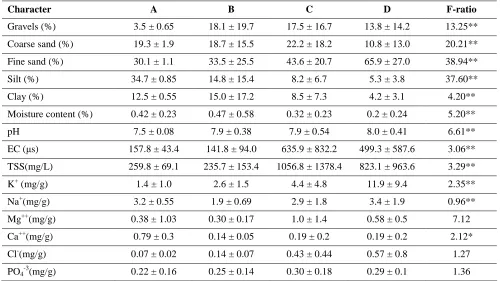
The soil parameters were analyzed using ANOVA in order to determine significant variation among populations. The correlation coefficient was obtained using SPSS program version 20 [29]. For the vegetation analysis, the two way indicator species analysis TWINISPAN [30] and for ordi-nation, the indirect gradient analysis was under-taken using detrended correspondence analysis DCA [31]. The relationship between plant species variation and environmental variation was assessed using canonical correspondence analysis (CCA). The computer program CANOCO version 4.5 [32] was used for all ordination analyses. In the present study, DCA estimated the compositional gradient in the vegetation data to be larger than 4.0 SD-units for the first axis, thus, Canonical Correspon- dence Analysis (CCA) is the appropriate ordination method to perform direct gradient analysis [33]. The CCA was performed using 13 environmental variables after exclusion of electric conductivity (EC) and total soluble salts (TSS) due to their high inflation factors. All the default settings were used for CCA, and a Monte Carlo permutation test [34] was used to test for of the eigenvalues of the first canonical axis. Intraset correlations from the CCA were used to assess the importance of the environmental variables.
3. RESULTS AND DISCUSSION
A total of 63 plant species were recorded in the studied sites, these included 43 perennials and 20 annuals and belong to 50 genera from 22 different families (Table 1). The low number of recorded species reflects the severe droughty environmental conditions, especially southward direction but also because the sites were restricted to
locations where Citrullus colosynthesis grows. The most characteristic families, as shown in Table 1, were Fabaceae (17 species represent 27% of the total number), Asteraceae (7 species, 11%), Zygo-phyllaceae and Poaceae (6 species, 10% each). The most dominating species were Zilla spinosa,
Zygophyllum coccineum and Salsola cyclophylla
which had the highest presence values within the examined populations. These results agree with Salama and Fayed[9];who recognized Zilla spinosa and Salsola imbricata in one community in Wadi Barramiya. Zilla spinosa has also been often recorded in the wadis of the Eastern Desert west of Qusseir province, Wadi Gimal, Wadi Qena, Wadi El-Matuli and Wadi El-Qarn and also in Sinai region, [7, 11, 13, 14, 35].
The recorded species have been attributed to five different life forms (Figure 2). Chamaephytes represented 30.2% (19 species), phanerophytes 28.6% (18 species) and therophytes 22.2% (14 species). The high number of chamaephytes as dwarf plants is suitable life form to resist drought, salinity, sand accumulation and grazing [36].
Fig. 2. Life-form spectrum of the species recorded in the
22 examined locations.
61 | Kamel et al. Overview on vegetation characteristics of selected populations in the Eastern Desert of Egypt
European Journal of Biological Research 2015; 5 (3): 58-69
Similarly, high percentages of phanerophytes and chamaephytes were observed by Salama et al. [13] in a study on the Qeft-Quseir Road. Sheded [39] reported that the most frequent life forms in the South Eastern Desert of Egypt are the chamaephytes and therophytes. On the other hand, the low
representation of therophytes may be due to the extreme aridity and high salinity [35, 38]. The annual component of vegetation is associated with drought [40], grazing [41] or digging [42] that remove perennials on a small or large scale. These authors are reporting on different types of habitats.
Table 1. Floristic composition, presence value, life forms and chorology of the recorded species.
Species P (%) Duration Life form Chorology Family: Fabaceae
1) Acacia ehrenbergiana Hayne 9.1 Per. Ph. SSI+SZ
2) Acacia seyal Delile 4.5 Per. Ph. SA+SZ
3) Acacia tortilis (Forssk.) Hayne subsp. raddiana
(Savi) Brenan 40.9 Per. Ph. SSI+SZ
4) Acacia tortilis (Forssk.) Hayne subsp. tortilis 9.1 Per. Ph. SSI+SZ
5) Alhagi graecorum Boiss. 13.6 Per. H. PAL
6) Astragalus vogelii (Webb) Bornm. 22.7 Ann. Th. SSI+SZ
7) Crotalaria aegyptiaca Benth 4.5 Per. H. SZ
8) Ifloga spicata (Forssk.) Sch.Bip. 4.5 Ann. Th. ME+IT+SSI
9) Indigofera spiniflora Boiss. 4.5 Per. Ph. SA+SZ
10) Lotus cytisoides L. 13.6 Ann. H. SSI+SZ
11) Prosopis juliflora (Sw.) DC. 4.5 Per. Ph. SA
12) Retama raetam (Forssk.) Webb and Berthel. 9.1 Per. Ph. SA + IT
13) Senna alexandrina Mill. 4.5 Per. Ch. SSI+SZ
14) Senna italica Mill. 4.5 Per. Ch. SSI+SZ
15) Senna holosericea (Fresen.) Greuter 4.5 Per. Ch. SSI+SZ
16) Senna occidentalis (L.) Link 4.5 Ann. Ph. SZ
17) Tephrosia purpurea (L.) Pers subsp. apollinea
(Delile) Hosni and El-Karemy 4.5 Ann. Ch. SSI+SZ
Family: Asteraceae
18) Artemisia judaica L. 4.5 Per. Ch. SA
19) Cotula cinerea Delile 31.8 Ann. Th. SSI
20) Lactuca serriola L. 4.5 Ann. Th. ME+IT+ES
21) Launaea nudicaulis (L.) Hook. f. 4.5 Per. H. SA+IT
22) Pluchea dioscoridis (L.) DC. 4.5 Per. Ph. SSI+SZ
23) Pulicaria arabica (L.) Cass. 13.6 Per. Ch. ME+IT
24) Pulicaria undulata (L.) C. A. Mey. 40.9 Per. Ch. SSI+SZ
Family: Poaceae
25) Crypsis schoenoides (L.) Lam. 4.5 Ann. Th. COSM
26) Cymbopogon schoenanthus (L.) Spreng. 9.1 Per. G. SSI+SZ
27) Cynodon dactylon (L.) Pers. 9.1 Per. G. PAN
28) Echinochloa colona (L.) Link 4.5 Ann. Th. PAN