Internetworking
Indonesia
Journal
olume 2
umber 2
Fall 20
10
ISSN: 1
942-9
703
IIJ © 20
10
www
.Int
erne
tw
or
kingIndonesia.or
g
Editors’ Introduction 1
The Effect of IPv6 Packet Size on the Implementation
3
of CRC Extension Header
by Supriyanto, Iznan H. Hasbullah & Rahmat Budiarto
A Modified Weighted Clustering Algorithm for Stable Clustering 9
using Mobility Prediction Scheme
by S. Muthuramalingam, R. Viveka, B. Steffi Diana & R. Rajaram
Mengamankan Single Identity Number (SIN) Menggunakan QR Code 17
dan Sidik Jari
by Fridh Zurriyadi Ridwan, Hariyo Santoso & Wiseto Agung
EnsoTracker: Mouse Controller Device using Head Movement 21
by Gunawan, Tri Kurniawan Wijaya, Indra Maryati & Edwin Seno Dwihapsoro
UTAUT Model for Understanding Learning Management System 27
by I Gusti Nyoman Sedana & St. Wisnu Wijaya
The Indonesian Journal of ICT and Internet Development
Internetworking Indonesia Journal
The Indonesian Journal of ICT and Internet DevelopmentISSN: 1942-9703
Manuscript Language: The Internetworking Indonesia Journal accepts and publishes papers in Bahasa Indonesia and English.
Manuscript Submission:
Manuscripts should be submitted according to the IEEE Guide for authors, and will be refereed in the standard way. •
Manuscript pages should not exceed 7 pages of the IEEE 2-column format. It should be submitted as a Microsoft-Word file, •
using the IIJ Template document which can be found at the www.InternetworkingIndonesia.org website.
Manuscripts submitted to the IIJ must not have been previously published or committed to another publisher under a copy-•
right transfer agreement, and must not be under consideration by another journal.
Papers previously published at conferences can be submitted to the IIJ, but must be revised so that it has significant differences •
from the conference version.
Authors of accepted papers are responsible for the Camera Ready Copy formatted using the same IIJ Template format. •
Authors are advised that no revisions of the manuscript can be made after acceptance by the Editor for publication. The ben-•
efits of this procedure are many, with speed and accuracy being the most obvious. Please email your papers (or questions) to:
Submission Guidelines: Please review the descriptions below and identify the submission type best suited to your paper.
Research Papers
• : Research papers report on results emanating from research projects, both theoretical and practical in nature.
Short papers
• : Short research papers provide an introduction to new developments or advances regarding on-going work.
Policy Viewpoints
• : Policy Viewpoints explore competing perspectives in the Indonesian policy debate that are informed by aca-demic research.
Teaching Innovation
• : Teaching Innovation papers explore creative uses of information technology tools and the Internet to im-prove learning and education in Indonesia.
Book Reviews
• : A review of a book, or other book-length document, such as a government report or foundation report. Prof. Edy Tri Baskoro, PhD (ITB, Indonesia)
Mark Baugher, MA (Cisco Systems, USA) Lakshminath Dondeti, PhD (Qualcomm, USA) Paul England, PhD (Microsoft Research, USA) Prof. Svein Knapskog, PhD (NTNU, Norway)
Prof. Merlyna Lim, PhD (Arizona State University, USA)
Prof. Bambang Parmanto, PhD (University of Pittsburgh, USA) Prof. Wishnu Prasetya, PhD (Utrecht University, The Netherlands) Graeme Proudler, PhD (HP Laboratories, UK)
Prof. Jennifer Seberry, PhD (University of Wollongong, Australia) Prof. Willy Susilo, PhD (University of Wollongong, Australia) Prof. David Taniar, PhD (Monash University, Australia) Thomas Hardjono, PhD
(MIT Kerberos Consortium, MIT, USA)
Budi Rahardjo, PhD (ITB, Indonesia)
Kuncoro Wastuwibowo, MSc (PT. Telkom, Indonesia)
Internetworking Indonesia Journal is a semi-annual peer-reviewed electronic journal devoted to the timely study of Information &
Com-munication Technology (ICT) and Internet development in Indonesia. The journal follows the open-access philosophy and seeks high-quality manuscripts on the challenges and opportunities presented by information technology and the Internet in Indonesia.
Editorial Advisory Board Co-Editors
Journal mailing address: Internetworking Indonesia Journal, PO Box 397110 MIT Station, Cambridge, MA 02139, USA.
Technical Editorial Board Sulfikar Amir, PhD (NTU, Singapore)
Moch Arif Bijaksana, MSc (IT Telkom, Indonesia) Teddy Surya Gunawan, PhD (IIUM, Malaysia) Dwi Handoko, PhD (BPPT, Indonesia) Mira Kartiwi, PhD (IIUM, Malaysia) Bobby Nazief, PhD (UI, Indonesia)
Anto Satriyo Nugroho, PhD (BPPT, Indonesia)
Yanuar Nugroho, PhD (Manchester University, UK) Bernardi Pranggono, PhD (University of Leeds, UK) Bambang Prastowo, PhD (UGM, Indonesia) Bambang Riyanto, PhD (ITB, Indonesia) Andriyan Bayu Suksmono, PhD (ITB, Indonesia) Henri Uranus, PhD (UPH, Indonesia)
ELCOME to the Fall/Winter 2010 issue of the
Internetworking Indonesia Journal. We are pleased to bring you this regular issue of the IIJ which contains a broad range of papers, include those written by graduate students. As described in the goals of the IIJ, among others the journal seeks to be a publishing venue for graduate students (such as Masters/S2 and PhD/S3 students) as well as working academics in the broad field of ICT and Internet development. This includes graduate students from Indonesian universities and those studying abroad.
Consistent with another goal of the IIJ, the current issue of the journal has papers written in Bahasa Indonesia. From the outset the IIJ has sought to promote the culture of writing and of excellent authorship in Indonesia. It is for this reason that the IIJ is “bilingual” in that it accepts and publishes papers in both English and Bahasa Indonesia. We believe that by publishing papers in Bahasa Indonesia, we provide students and other authors the opportunity to develop formal writing skills for technical papers in Bahasa Indonesia.
The first paper in the current issue deals with the use of a cyclic redundancy check code (CRC code) in the extension header of an IPv6 packet. The paper proposes the introduction of a new IPv6 header extension whose contents would be a CRC code computed over the relevant fields of the packet. One aim of this approach is to obviate the need for error detection at the underlying Data Link layer of the intermediate nodes. The paper reports a number of results from tests using a simple IP network topology. Although introducing this new extension header costs additional computation at the sender and receiver, the authors claim that overall benefits is derived by from the intermediate nodes (routers) not needing to perform error detection at their Data Link layer prior to routing/forwarding packets.
Mobile ad hoc networks (MANET) is the topic of the second paper. More specifically, the paper deals with the issue of cluster-head selection in a stable manner. The dynamic nature of the members of a wireless ad hoc network poses a number of interesting questions, including that of reliable routing. With each node in an ad hoc network acting also as wireless router, the nodes need to have the ability to self-organize into a given network architecture, such as a cluster network architecture. This in-turn necessitates the selection of certain nodes to become cluster-heads. This paper proposes a new approach to the selection of such cluster-heads. The approach is based on the well-known weighted clustering algorithm (WCA), and introduces a mobility prediction scheme which looks not only at the mobility of a given node
The editors can be reached individually at the following email addresses. Thomas Hardjono is at [email protected], Budi Rahardjo is at [email protected], while Kuncoro Wastuwibowo is at [email protected].
but also at the relative mobility of its neighbors. The prediction algorithm uses the node link expiration time as the basis for the prediction scheme.
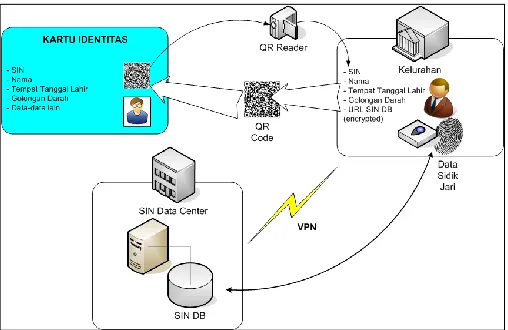
The third paper, written in Bahasa Indonesia, focuses on the security issues around the planned use (by the Indonesian government) of the 16-digit Single identity Number (SIN) for every resident of Indonesia. The aim of the SIN is, among others, to expedite access by residents to government services by replacing non-digital credentials and other identity documents. The paper looks at the possible use of a two-dimensional bar code called the Quick Response (QR) code to conveniently represent the SIN. This barcode would then be easily readable (eg. at local government offices) by using code-reader devices that are attachable to PC computers or mobile phones. The paper also considers the use of biometric scans to authenticate the user as the legitimate holder of a given SIN. Finally, the paper offers some broad suggestions regarding the implementation of such a SIN-based system, including the creation of the SIN values and its associated card, and the verification of the card and SIN at the point of service.
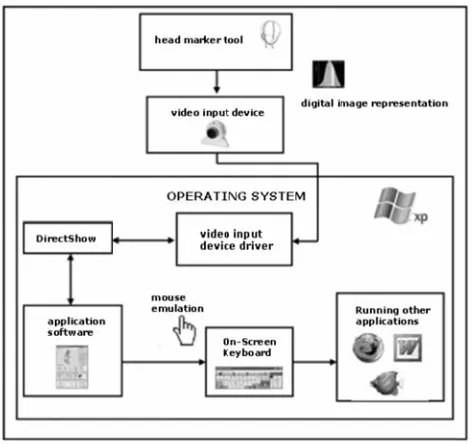
Providing affordable computer-accessibility to sufferers of quadriplegia is the topic of the fourth paper. For handicapped persons in developing nations, the cost of devices and related equipment represents a major issue. As such, this paper looks into the possible development of affordable devices using cheap off-the-shelf components. The particular device in this case is a mouse controller, which can be operated by detecting the user’s head movement.
The fifth paper, which is also written in Bahasa Indonesia, addresses quite a different topic from the previous papers, namely that of a learning management system. Following the unified theory of acceptance and use of technology, the paper reports some research results from experiments conducted at the Sanata Dharma University using the Exelsa system. The research found that performance expectancy, social influence and facilitating conditions represented significant factors influencing the behavioral intention of the students employing the Exelsa system.
The last paper is one written by a graduate student on the topic attribute oriented induction and its influence in the design of databases within data mining. The paper provides an illustration of the steps required to arrive at database tables from concept hierarchies as the point of departure. The paper provides a basic algorithm to convert a non-rule based concept hierarchy into database tables.
Thomas Hardjono Budi Rahardjo Kuncoro Wastuwibowo
Editors’ Introduction
2 INTERNETWORKING INDONESIA JOURNAL Vol. 2/No. 2 (2010)
Abstract—The traditional TCP/IP stack requires verification and regeneration of the CRC code in every router to detect transmission errors. For IPv6 packet transmission over high speed networks, this task is redundant because of the very rare transmission error and thus introduces unnecessary latency. The CRC Extension Header (CEH) was proposed to eliminate the unnecessary duplication of error detection. Since IPv6 packets are transmitted over Ethernet, the packet size ranges from 1280 up to 1500 bytes. In the near future, the size will increase with the advance of underlying technology such as 100 Gigabit Ethernet. This paper studies the effect of various IPv6 packet sizes with the implementation of CEH on the processing time and network latency. Experiments were done by transmitting various IPv6 packet sizes over high speed networks. The results showed that higher packet sizes increases processing time and network latency.
Index Terms—Routing, TCP/IP, IPv6, error correction.
I. INTRODUCTION
OUTERSin a computer network have the important role in the packet forwarding process in order to ensure that each packet reaches its correct destination. An IPv6 packet transmitted through the Internet has to pass through many routers along the network. A router can be defined as three of the five layers of the TCP/IP stack, namely the Physical layer, the Data Link layer and the Network layer. In general, a router needs to decide to which node a packet has to be forwarded next after the IPv6 header processing are done. The decision is made in the Network layer of the router. However, before the packet reaches the Network layer, it must pass through the error detection process in the Data Link layer. The Data Link layer always verifies the CRC code attached with the frame received to ensure that the frame from the previous hop is free from transmission error. Only the correct frame will be
Manuscript received October 26, 2010. This work was supported by the Ministry of National Education of the Republic of Indonesia.
Supriyanto is with the Electrical Engineering Department, University of Sultan Ageng Tirtayasa, Cilegon, Banten, Indonesia (e-mail: supriyanto@ ft-untirta.ac.id).
Iznan H. Hasbullah is with the National IPv6 Centre (NAv6) Universiti Sains Malaysia, Penang, Malaysia. (e-mail: [email protected]).
Rahmat Budiarto is with the School of Computer Sciences, Universiti Sains Malaysia, Penang, Malaysia (e-mail: [email protected]).
delivered up to the Network layer for forwarding and hop limit updating.
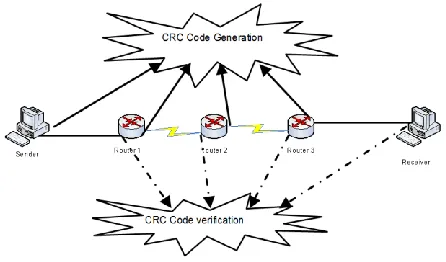
The Network layer within a router on an IPv6 network does a simpler task compared to the network layer of a IPv4 router. In an IPv6 router there are no error detection processing (header checksum checking) and fragmentation. In addition, the size of an IPv6 header is fixed. This means that IPv6 packets are processed faster on router. However, the Data Link layer of the router not only needs to perform CRC calculation for the received frame but also for each frame that needs to be forwarded to the next hop. On a large network that with numerous routers this double CRC calculation will be repeated in every router, as shown in Figure 1.
Figure 1: CRC Code Generation and Verification
Figure 1 shows a small network with three routers as intermediate nodes. In this network, there will be eight CRC calculations: four CRC code generations and four CRC code verifications. For IPv6 packet transmission over high speed networks which has an extremely small probability of transmission error, those repeated tasks are unnecessary. This is more so in the case of a reliable medium such as fiber optic which is not influenced by either the magnetic field or electric field. Errors within this kind of medium will be infinitesimal that practically we can say it has a near zero probability of occurring.
The IPv6 protocol has been designed with features that provide better performance than the former IPv4 protocol,
The Effect of IPv6 Packet Size on
Implementation of CRC Extension Header
Supriyanto Electrical Engineering
Department
University of Sultan Ageng Tirtayasa (UNTIRTA) Indonesia
Iznan H. Hasbullah National Advanced IPv6 Centre
Universiti Sains Malaysia (USM) Malaysia
Rahmat Budiarto School of Computer Sciences
Universiti Sains Malaysia (USM) Malaysia
4 INTERNETWORKING INDONESIA JOURNAL SUPRIYANTO ET AL.
ISSN: 1942-9703 / © 2010 IIJ
including the extensibility of IPv6 extension header. IPv6 allows the definition of a new extension header in the future without impacting the existing infrastructure. In this paper we propose a CRC Extension Header (CEH) as a new IPv6 extension to perform error control within the Network layer and eliminating error control from Data Link layer [1]. In the near future, the IPv6 packet size will be increased [2]. Implementation of a CEH for a larger packet size is still debatable. This paper attempts to understand the effect of varying IPv6 packet sizes on the implementation the IPv6 packet transmission over high speed networks.
II. OVERVIEW OF CRCEXTENSION HEADER
The CEH is a new extension header that is proposed to reduce the bottleneck in IPv6 packet transmission over high speed networks by eliminating the CRC verification and regeneration in each and every router, as shown in Figure 1. This idea is entirely different from the existing method that conducts error detection and correction in the Data Link layer of a router. This new mechanism does not require the Data Link layer to verify and regenerate the CRC code for error detection. However, the concept of CEH does not eliminate overall CRC code generation and verification during IPv6 packet transmission. Generation of CRC code is done in the sender’s machine while the verification of CRC code will be done at Network layer of the destination node by processing the CEH inside the received IPv6 packet. Routers are only required to process IPv6 packet at their Network layer in the usual manner, which consists simply of a forwarding decision and hop limit updating.
There are three major rationales of the idea of the CEH: Firstly, we would like to optimally utilize one of the advantages of IPv6 features, specifically the IPv6 extension header. IPv6 offers the opportunity to develop new extension headers for IPv6 packet transmission improvement in the future. Furthermore, it is not limited to 40 bytes only. In addition, applying a new extension header within an existing network will not disturb current IPv6 network operations. Secondly, within new high speed networks medium — such as fiber optic — the probability of transmission errors occurring is very small. This allows the error detection function in higher layer to be bypassed. Thus, the duplication of CRC calculation could be eliminated from the Data Link layer. Thirdly, the high transfer rate of current underlying technology, especially gigabit Ethernet, allows the transmission rates of more than 100 Gbps. Eliminating the error detection process in the intermediate nodes will decrease round trip delay from the sender to receiver. Hence, low latency of IPv6 packet transmission over high speed networks could be achieved.
Since all the existing extension headers already have specific functions, designing a CEH cannot make use of any existing extension header. Therefore we need to define a new one. The aim is to still utilize the advantages of the current error control but at the same time avoid its weaknesses. The approach uses the widely deployed CRC-32 error detection
mechanism to detect transmission errors. To obtain an optimal result, we select an appropriate generator polynomial to be implemented in the CEH [3]. In terms of error correction, the CEH applies retransmission procedure to overcome erroneous packets, such as Automatic Repeat reQuest (ARQ). Details of the CEH format and mechanism design will be presented in the next section.
A. Format of IPv6 with CEH
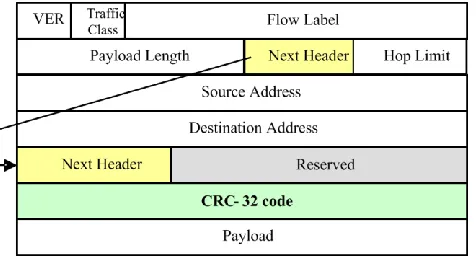
Currently, there is no standard format for IPv6 extension headers. The existing IPv6 extension headers have different formats compared to one another. Thus, the format of the CEH follows the draft of the generic IPv6 extension header (GIEH) proposed in [4]. The CEH is placed after the destination address field of the IPv6 header, as shown in Figure 2. It has three main fields: the Next Header field, the Reserved field and CRC-32 code field. The next header is an 8-bit indicator to point to other extension headers following the CEH or upper layer data. As a new extension header, the CEH has not obtained specific number from Internet Assigned Numbers Authority (IANA). The Reserved field is allocated for future use instead of specific extension header type. The CRC-32 code field is the important field for the CEH. It contains the CRC code generated by the sender machine. This code is used only by the destination node for verification.
Figure 2: IPv6 Packet with CRC Extension Header
B. CEH Generation
The CRC-32 code field is the most important field of the CEH. CEH generation is determined by CRC-32 code generation. The code is generated from entire IPv6 packet excluding hop limit field. The CRC-32 code generation requires a generator polynomial [5]. The generator polynomial used in the CEH was selected from three candidates, namely the generator polynomial standardized in IEEE802.3 [6], the generator polynomial proposed by Guy Castagnoli [7] and the generator polynomial proposed by Philip Koopman [8]. The test conducted showed that Castagnoli’s CRC-32C is the most suitable generator polynomial implement for the CEH [3].
sender generates a CRC-32 code and then inserts the code into the CRC-32 code field of the CEH. When the CEH is created in an IPv6 packet, the extension header field is first initialized to zero except for the next header field. A complete IPv6 packet includes a main header with next header value indicating the type of CEH, an extension header which is CEH and a payload. The packet is now ready for transmission along the network path until it reaches its destination.
Figure 3: CEH Generation
C. CEH Verification
The verification of CEH will be done at the final destination by following the algorithm depicted in Figure 4 [3]. Once the receiver receives an IPv6 packet from previous node, it will check the next header field of the packet. When the value indicates there is a CEH inside the packet, it extracts the CEH and generates a new CRC-32 code from the entire IPv6 packet (omitting the hop limit field). The CRC-32 code generated by the receiver will be compared to the CRC-32 code found inside the IPv6 packet, which is located within the CRC-32 code field of the CRC extension header. If both CRC-32 code the same, then there is no transmission error in the IPv6 packet received. The receiver then forwards the packet into higher layer. Otherwise it will discard the packet and wait for retransmission.
Figure 4: CEH Verification
III. EXPERIMENTS
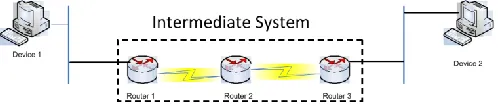
The CEH is a new concept for error detection for the entire IPv6 packet which is done at the Network layer. To verify the acceptability of the new concept we performed an experiment using the network topology depicted in Figure 5. The experiment has two scenarios: the transmission of IPv6 packets with the CEH for error detection in Network layer and the transmission of IPv6 packets with Frame Check Sequence (FCS) for error detection in Data Link layer. The first experiment simulates the new concept, while the later simulates the existing system. The two scenarios yielded an adequate data to justify the performance gain of the new error detection approach compared to the current error detection.
Figure 5: Network Topology for IPv6 Packet Transmission
The topology in Figure 5 has five nodes: Device 1 as a sender, Router 1, Router 2, Router 3 and Device 2 are the receivers. All nodes are PC computers equipped with Core 2 Duo processors that were configured as a mini IPv6 network. The sender is an end system installed with an IPv6 packet generator program written in JAVA that is able to generate both IPv6 packet with the CEH and IPv6 packet without the CEH. Router 1, 2 and 3 represent the intermediate system of the network whose task is to forward the packets.
In the first experiment, the routers simply forwarded the IPv6 packets with the CEH rather than checking each and every packet for error detection. In the second experiment the intermediate system performs error checking for each packet before forwarding the packet to next node in the path. The last node is the receiver which is a PC installed with the same program as the sender to verify all packets received.
The sender generates an IPv6 packet by adding the IPv6 main header to a TCP segment received from the upper layer. The Network layer then generates the CRC-32 code from both the IPv6 header and the payload using algorithm in Figure 3. The CRC code obtained is then inserted as the CRC extension header into the IPv6 packet. In the first scenario the Data Link layer just adds the link layer header. There is no trailer in the Data Link layer frame that usually performs the error detection task. The frame without frame check sequence (FCS) generated by the sender is then transmitted through the experiment network.
6 INTERNETWORKING INDONESIA JOURNAL SUPRIYANTO ET AL.
ISSN: 1942-9703 / © 2010 IIJ
path (forwarding process). The egress frame also does not have a Data Link layer trailer. It simply obtains the link layer header.
The only node that will verify the IPv6 packet is the destination node (receiver), as indicated by destination address field of the IPv6 packet. The verification follows algorithm in Figure 4 to check whether the packet received is free from error. Thus, the receiver node’s task is to receive the packet in Data Link layer, release the Data Link layer header without computing the CRC code, and then to deliver the packet to the Network layer for verification.
In the second experiment which is a simulation of the current error detection mechanism, the sender generates an IPv6 packet without the extension header. The packet is then encapsulated by Data Link layer by adding Data Link layer header and trailer. We refer to this frame as the IPv6 packet with FCS. Each intermediate node will receive the packet and process it as usual. They process the Data Link layer header including CRC code computation to detect transmission errors for the corresponding hop. Only the packets that are verified as free from error will be delivered up to Network layer for forwarding process without processing any extension header. Before the IPv6 packet is forwarded to the next hop, the packet will be encapsulated again in Data Link layer of the outgoing port of the router including CRC code regeneration. The receiver node in the second experiment captures the IPv6 packet that was addressed to it and then verifies the packet for error detection. The correct packet will be passed to Network layer. Otherwise, it will discard the erroneous packet and wait for retransmission.
In order to know the effects of IPv6 packet size with the implementation of the CEH, we measure two main metrics: processing time and error detection capability. Processing time is the packet processing time in each node including the CRC-32 code computation, packet generation and packet verification. Here it is very important to know the network latency, which is the most important aspect of network performance with various packet sizes. With regards to error detection capability, it is also important to know the new error detection capabilities to detect transmission error on varying sizes of IPv6 packets.
IV. RESULTS AND DISCUSSION
The sender’s processing time is the time required to generate an IPv6 packet with the CEH using the algorithm in Figure 3. While the receiver’s processing time is the time required to verify the IPv6 packet received and the CEH verification using the algorithm in Figure 4. Experiments of IPv6 packets with the CEH, using varying packet sizes from 64 bytes to 1500 bytes yielded the results as shown in Table 1. The table shows the relationship between the sender’s processing time and packets size of the two error detection mechanisms on TCP/IP, namely the transmission of IPv6 packets with the CEH as a proposed mechanism and the IPv6 packet transmission with FCS (existing system) as a comparison. This is done to learn about the impact of packet
sizes on the performance of the two error detection mechanisms.
Table 1: Correlation between Processing Time and Packet Size at the Sender
Size 64 128 256 512 1024 1280 1492 Average CEH 0.689 0.718 0.772 0.883 1.039 1.067 1.133 0.900 FCS 0.682 0.686 0.778 0.788 0.834 0.876 0.909 0.793 Δ 0.007 0.132 0.006 0.105 0.205 0.191 0.224 0.107
Both the IPv6 packet with CEH and the packet with FCS require a certain amount of time to process at the sender as well as at the receiver. The processing time of the packet at the sender increases with the increase in packet size. This is because CRC code generation was done byte-per-byte of the packet. Thus more bits in a packet means longer time to perform processing of the IPv6 packet. Table 1 also shows that the average of processing time for all packet sizes for the transmission of IPv6 packet with CEH is 13.5% higher than the transmission of IPv6 packet with FCS. This is due to the fact that the IPv6 packet with CEH generation at the Network layer (shown in Figure 3) is more complex compared to FCS generation at the Data Link layer. The process to generate the CRC code from the whole IPv6 packet requires firstly the exclusion of the hop limit and then secondly the insertion of the CRC code as the extension header. In contrast the FCS generation simply divides the whole frame with the generator polynomial and followed by appending the CRC code in the last part of the frame.
Similar to the sender, the receiver’s processing time of the IPv6 packet which is listed in Table 2 showed that the processing time is affected by the packet size. The larger the packet, the higher it’s processing time. On average the receiver’s processing time of IPv6 packet transmission with CEH is 16.3% higher than IPv6 packet transmission with FCS. Note that the percentage value is higher than in the sender. This is because the average processing time for both IPv6 with CEH and IPv6 with FCS at the receiver is less. In other words, the processing time of IPv6 packet at the receiver is faster than at the sender.
Table 2: Correlation between Processing Time and Packet Size at the Receiver
Size 64 128 256 512 1024 1280 1492 Average CEH 0.568 0.568 0.583 0.600 0.642 0.662 0.670 0.613 FCS 0.495 0.491 0.512 0.514 0.548 0.566 0.565 0.527 Δ 0.073 0.077 0.071 0.086 0.094 0.096 0.085 0.086
The processing times of IPv6 packets with the CEH as listed in Table 1 and Table 2 is based on the algorithm in Figure 3 and Figure 4. Even though the process of generating the CEH at the sender and at the receiver is similar, the sender has to generate the IPv6 packet first before it can generate the CEH. In contrast the receiver simply has to receive IPv6 packets without needing to generate any packets.
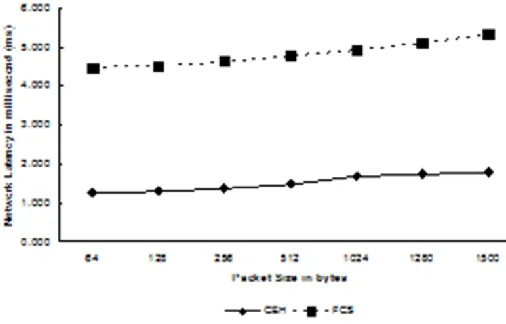
exploiting the CEH as an error detection method in the Network layer has eliminated the need for CRC code calculation and regeneration in every router. This resulted in the faster processing of IPv6 packets in every router in the network, where a router only processes the packets at the Network layer (routing and forwarding). Hence, although processing time at the end systems (sender and receiver) is higher, the total network latency of IPv6 with CEH transmission is visibly lower than IPv6 with FCS. Figure 6 shows the correlation between network latency in milliseconds (ms) and packet sizes in bytes. In the figure, network latency of the IPv6 packet with CEH transmission is 68 % lower than IPv6 with FCS. The network latency as shown in Figure 6 increases when the packet size increases. Compared to FCS, the increasing network latency of IPv6 with the CEH is lower as shown by the two graphs in Figure 6.
Figure 6: Network Latency
Another measurement is the error detection capability. Error detection capability of an error control mechanism is the ability to catch transmission errors during transmission from the sender to the receiver. Recent high speed network technologies have made the occurrence of transmission errors very rare. Employing more error detection tools is inefficient and also redundant. However, we cannot eliminate the tools entirely because if an error occurred during the communications then data will be corrupted. Proposing to exploit the CEH as an error detection tool is the correct way. It can reduce the redundant error control process but at the same time it does not ignore the error.
Error is unpredictable. Thus an error control mechanism should be able to detect the error inside the packet transmitted and correct it. In order to know ability of CEH to detect transmission errors, we send erroneous IPv6 packet with the CEH. The result illustrated that all erroneous IPv6 packets sent are successfully detected by the receiver.
V. CONCLUSION
In this paper we have proposed a new concept of handling transmission errors by exploiting the IPv6 extension header. The new concept utilizes the CRC extension header (CEH) as an error control method at the Network layer and eliminates error control at the Data Link layer of the intermediate nodes. Typically, the extension header is generated by the sender and is processed by the receiver. Thus, the CEH that contains the CRC code is also processed by the receiver.
Using the CEH as a new IPv6 extension header for error detection at the Network layer increases the processing time of IPv6 packets both at the sender and at the receiver. The increase in processing time is influenced by the packet size. The higher the packet size the longer it will take to process the packet. However, our proposed new concept has eliminated error detection routine at the Data Link layer.
Elimination of error detection at the Data Link layer means eliminating CRC code computation and regeneration in each and every router. This reduces the total network latency on IPv6 packet transmission. The results show that overall network latency decrease by 68% compared with normal latency. It also reduces the Data Link layer frame size due to the elimination of 4 bytes of frame check sequence field. The proposed error control mechanism also shows good ability to detect transmission error inside the transmitted packet. The experiment showed that all IPv6 packets sent with errors are successfully detected by the receiver.
REFERENCES
[1] Supriyanto, Raja Kumar Murugesan, Rahmat Budiarto, Sureswaran Ramadass, CRC Extension Header (CEH): A New Model to Handle Transmission Error for IPv6 Packets over Fiber Optic Links,
Proceedings of IEEE Symposium on Industrial Electronics and Applications (ISIEA 2009), October 4-6, 2009, pp. 569 – 573.
[2] Supriyanto, Iznan H. Hasbullah, Rahmat Budiarto, Exploiting IPv6 Extension Header to Handle Transmission Error for IPv6 Packets Over High Speed Networks, Proceedings of International Conference on Advanced Computer Science and Information System, 7 – 8 December 2009.
[3] Supriyanto, Abidah M. Taib, Rahmat Budiarto. Selecting a Cyclic Redundancy Check (CRC) Generator Polynomial for CEH (CRC Extension Header), Proceedings of International Conference on Quality in Research, Jakarta. 3 – 6 August 2009,ISSN 114-1284 pp. 245 – 250 [4] S. Krishnan, et. al, An uniform format for IPv6 extension headers,
Internet Draft IETF, 2008. http://ietfreport.isoc.org/idref/draft-krishnan-ipv6-exthdr/
[5] A.S. Tanenbaum, Computer Networks, Fourth Edition, Prentice Hall of India. New Delhi, 2006.
[6] ANSI/IEEE Standard for Local Area Networks, Carrier Sense Multiple Access with Collision Detection (CSMA/CD) Access Method and Physical Layer Specifications. 1984.
http://standards.ieee.org/getieee802/802.3.html.
[7] Castagnoli, G., Brauer, S. & Herrmann, M. Optimization of cyclic redundancy-check codes with 24 and 32 parity bits.IEEE Transactions on Communications, 1993, pp. 883-892.
[8] Koopman, P. 32-bit cyclic redundancy codes for Internet applications,
Proceedings. International Conference on Dependable Systems and Networks (DSN). 2002.
8 INTERNETWORKING INDONESIA JOURNAL SUPRIYANTO ET AL.
ISSN: 1942-9703 / © 2010 IIJ Supriyanto received the B.Eng. degree in
Electrical Engineering from Brawijaya University Malang, Indonesia in 1999, and and M.Sc in Computer Science from Universiti Sains Malaysia (USM) in 2010. Currently, he is a lecturer and also department secretary in the Electrical Engineering Department at the University of Sultan Ageng Tirtayasa (UNTIRTA). He is a researcher in the Computer Network Laboratory at the university. His research interest includes computer networks especially, IPv6, IPTV over overlay network and wireless communication.
Iznan H. Hasbullah graduated with the B.Sc degree in electrical engineering in 1998 from Rensselaer Polytechnic Institute, Troy, New York. He is currently a Research Officer with National Advanced IPv6 Centre (NAv6) at University Sains Malaysia, Pulau Pinang. He is the Domain Head of HD Video Conference for IPv6 group under Next Generation Multimedia & Telemedicine Cluster at NAv6. Prior to joining NAv6 in 2009, he was an R&D Consultant with MLABS System Berhad (MLABS) seconded to JMCS Sdn. Bhd. to spearhead a project titled High Definition Video Conferencing for IPv6 Networks. He held the post of Chief Technology Officer (CTO) while with JMCS Sdn. Bhd. He was involved in two network security audit exercise commissioned by Malaysian Communications and Multimedia Commission (MCMC) in the year 2003 and 2004. He was also part of a team that brought Advance Military Mobile Conferencing System (AMMCS) to the Maritime Langkawi International Maritime & Aerospace Exhibition (LIMA'03) in 2003. His area of expertise includes multimedia conferencing application for computer supported cooperative work (CSCW), software architecture, Graphical User Interface (GUI), Component Object Modeling (COM), Microsoft Foundation Classes (MFC) and C++ Language.
Abstract—This paper proposes an idea for selecting stable cluster heads using a modified Weighted Clustering Algorithm and combining it with Link Expiration Time calculation. The mobile ad hoc network consists of nodes that move freely and communicate with each other. One way to support efficient communication between nodes is to partition ad hoc networks into clusters. Many clustering schemes have been proposed to form clusters. The WCA has improved performance compared with other previous clustering algorithms. However, the high mobility of nodes will lead to high frequency of re-affiliation which will increase the network overhead. To solve this problem, we propose a time-based WCA which can enhance the stability of cluster formation followed by stable cluster head selection. Then duration of nodes that are alive is considered. Meanwhile for forthcoming nodes the duration of link between them and the Cluster head is calculated. This is the Link Expiration time and it is calculated based on the three factors, namely position, speed and direction of nodes. If the calculated link expiration time is greater than the threshold value it is allowed to join the respective cluster. This is done to form stable clusters and to reduce the re-affiliation frequency.
Index Terms—Adhoc Networks, Stable clustering, Weighted clustering algorithm, re affiliation, mobility prediction, link expiration time.
I. INTRODUCTION
N recent years, the development in wireless communication, and the widespread use of mobile and handheld devices, has resulted in the increasing popularity of mobile ad hoc networks (MANET). A mobile ad hoc network is a collection of wireless mobile nodes that dynamically form a network without the need for any pre-existing network infrastructure. Every node in the network is serving as a router, which means that every node is able to forward data to other nodes in the same transmission range. When wireless nodes are in an area that is not covered by any existing infrastructure, one of the possible solutions to achieve the ubiquitous computing is to enable wireless nodes to operate in the ad hoc mode and self-organize themselves into cluster based network architecture.
S. Muthuramalingam can be reached at [email protected]. R. Viveka can be reached at [email protected]. B. Steffi Diana can be reached at
[email protected]. R. Rajaram can be reached at [email protected]@tce.edu.
Ad-hoc networks do not use specialized routers for path discovery and traffic routing develops the wireless backbone architecture. This means that certain nodes must be selected to form the backbone. One of the general approaches to build up a cluster based network architecture is to design an algorithm to self-organize themselves into cluster based network architecture. This is achieved by partitioning ad hoc networks into clusters. Certain nodes, known as cluster-heads, would be responsible for the formation of cluster and maintenance of the topology of the network, and also for the resource allocation to all the nodes belonging to their clusters. The clustering algorithm is usually performed in two phases: clustering formation and clustering maintenance [3]. In the clustering formation phase, the election of a cluster-head among the nodes in the network is conducted. The functions of cluster heads are the coordination of the clustering process and relaying routers in data packet delivery. After electing cluster-heads, some of nodes move out from the current cluster and are attached to another cluster. Other cluster-heads are downed. This leads to the second phase, namely, clustering maintenance. In light of this, this paper aims to avoid excessive computation in the cluster maintenance, and current cluster structure should be preserved as much as possible.
In this paper, we propose an enhancement on a weighted clustering algorithm [1, 5] (WCA) by maintaining stable clusters. In WCA, a node is selected to be the cluster-head when it has the minimum weighted sum of four indices: the number of potential members, the sum of the distances to other nodes is its radio distance, the node‟s average moving speed and the battery life of the node. However, only the individual nodes‟ mobility is measured in WCA, whereas the relative mobility of a node and its neighbors is more important to the cluster stability. The ignorance of the relative mobility will lead to the situation that the high mobility of nodes causes a high frequency of re-affiliations, which will increase the network overhead. To solve this problem, we propose an enhanced weight-based clustering algorithm using mobility prediction scheme (MWCAMP). This can enhance the stability of the network by taking the relative mobility of a node and its neighbors into consideration for the clustering formation [1, 2, 5] and maintenance, by predicting the mobility of a node using the link expiration time [12].
The remainder of this paper is organized as follows. In Section 2, we review the several relevant clustering algorithms proposed previously and their limitations. Section 3 presents
A Modified Weighted Clustering Algorithm for
Stable Clustering using Mobility Prediction Scheme
S. Muthuramalingam, R. Viveka, B. Steffi Diana and R. Rajaram Department of Information Technology, Thiagarajar College of Engineering,
Madurai, India
10 INTERNETWORKING INDONESIA JOURNAL MUTHURAMALINGAM ET AL.
the proposed algorithm for ad hoc networks. Section 4 discusses the proposed algorithm. Section 5 discusses the simulation results and analysis. Finally, Section 6 concludes this paper.
II. RELATED WORKS AND CURRENT MOTIVATION
Recently a number of clustering algorithms have been proposed to choose cluster-heads based on the speed and direction, mobility, energy, position, and the number of neighbors of a given node. These efforts present advantages but also have some drawbacks, such as the high computational overhead for both clustering algorithm execution and update operations.
The Highest Degree Algorithm is also known as connectivity-based algorithm [3]. This algorithm is based on the degree of nodes assumed to be the number of neighbors of a given node. Whenever the election procedure is needed, nodes broadcast their Identifier (ID) which is assumed to be unique in the same network. According to the number of received IDs every node computes its degree and the one having the maximum degree (no of adjacent nodes) becomes cluster-head (CH). Major drawbacks of this algorithm include the situation where the degree of a node changes very frequently, and thus the CHs are not likely to play their role as cluster-heads for very long. In addition, as the number of ordinary nodes in a cluster is increased, the throughput drops and system performance degrades. All these drawbacks occur because this approach does not have any restrictions on the upper bound on the number of nodes in a cluster.
The Lowest-Identifier (LID) is also known as identifier-based clustering algorithm [4]. This approach chooses the node with the lowest ID as a cluster-head. The system performance is better than Highest-Degree in terms of throughput. Major drawbacks of this algorithm are its bias towards nodes with smaller IDs which may lead to the battery drainage of certain nodes, and it does not attempt to balance the load uniformly across all the nodes.
The Distributed Clustering Algorithm (DCA) [6, 7] and Distributed Mobility Adaptive Clustering Algorithm (DMAC). In this approach, each node is assigned weights (a real number above zero) based on its suitability of being a cluster-head. A node is chosen to be a cluster-head if its weight is higher than any of its neighbor‟s weight; otherwise, it joins a neighboring cluster-head. The smaller weighted node ID is chosen in case of a tie. The DCA makes an assumption that the network topology does not change during the execution of the algorithm. To verify the performance of the system, the nodes were assigned weights which varied linearly with their speeds but with negative slope. Results proved that the number of updates required is smaller than the Highest-Degree and Lowest-ID heuristics. Since node weights were varied in each simulation cycle, computing the cluster-heads becomes very expensive and there are no optimizations on the system parameters such as throughput and power control.
The Weighted Clustering Algorithm (WCA) [5] obtains 1-hop clusters with one cluster-head. The election of the
cluster-head is based on the weight of each node. It takes four factors into consideration and makes the selection of cluster-head and maintenance of cluster more reasonable. The four factors are node degree (number of neighbors), distance summation to all its neighboring nodes, mobility and remaining battery power. Although WCA has proved better performance than all the previous algorithms, it has a drawback in needing to know the weights of all the nodes before starting the clustering process and in draining the CHs rapidly. As a result, the overhead induced by WCA is very high.
III. PROPOSED WORK
In this section, we present the proposed Enhanced Weighted Clustering Algorithm using mobility prediction scheme (MWCAMP). MWCAMP consists of the clustering formation and clustering maintenance phases. Before describing our clustering algorithm in detail, we make the following assumptions:
I. The network topology is static during the execution of the clustering algorithm.
II. Each mobile node joins exactly one cluster-head.
A. Phase-I: Clustering Formation
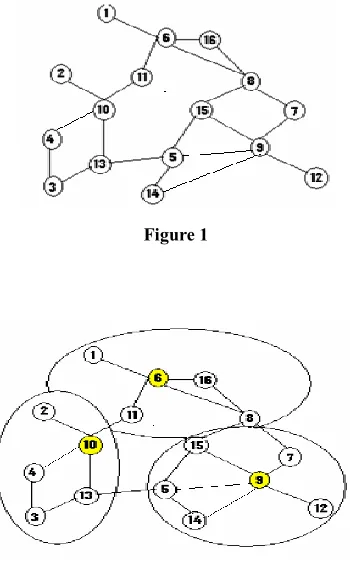
In WCA, the goal is to minimize the value of the sum of all the cluster heads‟ weighted costs. Here a node is selected as cluster head when it minimize a function of four criteria such as degree (the number of direct link to its neighbors), sum of distance between cluster head and other nodes, mobility of nodes and battery power of the nodes. WCA has high re-affiliation frequency [7, 8] which will increase the communication overhead. Thus, we present an enhanced algorithm to reduce the amount of re-affiliation frequency corresponding to the number of nodes that is not „„proper‟‟ in current cluster. It corresponds to nodes that detach from current cluster and move to another cluster. In order to reduce the re-affiliation frequency, we should decrease the number of improper nodes. When the idea reflects on the cluster head election, the key is to choose „„stable‟‟ nodes as cluster heads as possible. The stability of a node is relative to its neighbors.
In WCA, the running average speed for every node till current time T, it is computed [9, 10] as
1
2 2 2
1 1
1
1
((
)
(
) )
T
i t t t t
t
M
X
X
Y Y
T
The stability [13] of node “i”is computed from two aspects: I.
i: The relative average speed of i and its neighbors. The larger
i is, the more unstable the node is, comparing to its neighbors.II. NCi: The change of node‟s neighbors. The value of
i
NC can indicate the change of topology surrounding node i.
We also use a combined function of
iand NCito computeSi. Another improvement of our algorithm is that we compute the average relative distances instead of the sum of distances.The proposed MWCAMP described as follows
1 i 2 3 4
i i i i
w
w
w D
w M
w P
where
I.
i is the degree of each node i(i.e., nodes within its transmission range)II.
D
i is the average relative distances each node i with all its neighbors.III.
M
i is the relative mobility of node i IV.P
i is the battery power of node i.where w1, w2, w3 and w4 are the weighting factors for the corresponding system parameters.
Figure 1
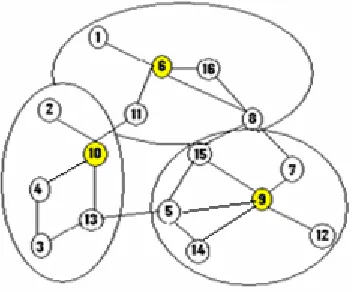
Figure 2
B. Phase-II: Clustering Maintenance Using Mobility prediction
The mobility of nodes coupled with the transient nature of wireless media often results in a highly dynamic network topology. Due to mobility some nodes will detach from the current cluster and attach itself to some other cluster. The process of joining a new cluster is known as re-affiliation. If the re-affiliation fails, the whole network will recall the cluster head election routine. One disadvantage of WCA is high re-affiliation frequency. High frequency of re-re-affiliation will increase the communication overhead. Thus, reducing the amount of re-affiliation is necessary in ad hoc networks. To prevent this we go for mobility prediction schemes. The impact of mobility prediction schemes on the temporal stability of the clusters obtained using a mobility-aware clustering framework. We propose a simple framework for a mobility prediction-based clustering to enhance the cluster stability.
One way to predict the mobility of nodes is using the Link Expiration Time [13]. The impact of mobility prediction schemes on the stability of the clusters obtained using a mobility-aware clustering framework. Compute the Link Expiration Time (LET) to predict the duration of a wireless link between two nodes in the network. The approach assumes that the direction and speed of motion of the mobile nodes does not change during the prediction interval.
C. Link Expiration Time (LET)
The Link Expiration Time (LET) is a simple prediction scheme that determines the duration of a wireless link between two mobile nodes. Dynamic clustering in ad hoc networks has also been extensively studied in the literature. Several distributed clustering algorithms for MANETs have been proposed. While some schemes try to balance the energy consumption for mobile nodes, others aim to minimize the clustering-related maintenance costs. Combined metrics based clustering schemes take a number of metrics into account for cluster configuration. The Weighted Clustering Algorithm (WCA) [5] is one such scheme, where four parameters are considered for the cluster head election procedure, which are representative of the degree, the sum of the distances to other nodes in its radio distance, mobility, and battery power of the mobile nodes. Here we propose an enhanced WCA which can enhance the stability of the network. Such a scheme can be tuned flexibly the parameters to suit to different scenarios. To calculate the duration of link between two mobile nodes, we assume that their location, speed and direction of movement remain constant.
Here let:
Location of node i and node j at time t be given by (xi , yi) and (xj ,yj).
Vi and V j be the speeds,
θi and θj be the directions of the nodes i and j
12 INTERNETWORKING INDONESIA JOURNAL MUTHURAMALINGAM ET AL.
If the transmission range of the nodes is r, then the link expiration time Dt is given by the formula given below
2 2 2 2 2 2
( ) ( ) ( )
( )
t
ab cd a c r ad bc
D
a c
where
cos cos i i j j
a v v
i j
b x x
sin
sin
i i j j
c v
v
i j
d y y
The LET gives an upper bound on the estimate of the residence time of a node in a cluster. In the proposed clustering framework, when LET-based prediction is used, a node is allowed to join a cluster only if the predicted LET of the link between the node and the cluster head is greater than the cluster‟s admission criteria Tj [13, 14]. For every node N that detach from current cluster we check whether the node is a Cluster Head (or ) Cluster member.
I. If it is a Cluster Head then call for cluster head election within the particular cluster and form a new cluster.
II. If it is a Cluster member then calculate Link Expiration Time with Cluster Head of each cluster and the node that re-affiliate must be within transmission range of cluster head where transmission range is fixed.
Check whether LET is greater than threshold value (Tj), Here Tj is average of all LET, and if it is greater then the Node is eligible to join the particular cluster which shares greater LET.
Figure 3
Figure 4
IV. ENHANCED WEIGHTED CLUSTERING
ALGORITHM USING MOBILITY PREDICTION
Consider Node Ni in transmission range r, positions of node Ni be ( Xi Yi ), Nj be nodes that detach from current cluster, where 1 ≤ i ≤ n , 1 ≤ j ≤ n and 1 ≤ k ≤ n.
1: calculate degree of node Ni
i
( )
C
ijwhere Cij =1, if nodes Ni and Nj are connected else Cij =0 .
(WhereCij be connection between node Ni and Nj, Where 1 ≤ i ≤ n , 1 ≤ j ≤ n).
2: calculate relative sum of distance
D
ifrom nodesN
i to its members,
{
( ,
)}
j i
i j
i
N N i
dist N N
D
where 1 ≤ i ≤ n, Nj is the node the establish link with the node Ni.
3:
M
i is the running average speed for every nodeN
i till current time Tis calculated using formula1
2 2 2
1 1
1
1
((
)
(
) )
T
i t t t t
t
M
X
X
Y Y
T
4: For every node
N
i, compute the average speedA
i using formula1
j i
i i
N N
i
A
M
Where 1 ≤ i ≤ n, Nj is the node that establish link with the node Ni
5:compute the speed-difference
i asi
M
iA
i
where 1 ≤ i ≤ n.6: For every node Nicompute the neighbor change NCiat time
t.
}
{
}
{
}
{
}
{
2 1
2 1
t t
t t
i i
i i
i
N
N
N
N
NC
7: Compute the stability factor Si as
1
i11i i
s
a NC
where a is an adjustable integer which is decided by the stability of the node.
8: Thus we can get the improved parameter
M
iasi i
b
M
S
where b is an integer decided by the speed of node. Both a and b are constant to make Si more reasonable, avoiding to be too
large or less.
9: Calculate weight value
1 i 2 3 4
i i i i
w
w
w D
w M
w P
where Pi is the battery power of node, and w1= 0.7, w2= 0.05,
w3= 0.05, and w4= 0.2.
10: The node with minimum weight value is elected as Cluster Head. That is
)} (
min{ i i
i w N
CH .
11: Now cluster members are added to the cluster head. The nodes that establish link with that cluster head are called
cluster members and they are grouped together to form a cluster. Thus cluster is formed by
[ { | }] { }
where
{ }
are previously formed cluster, where 1=k=n. Repeat step 1 to 8 until every node is a member of cluster.
12: For every node N that detach from current cluster we check whether the node is a Cluster Head (or Cluster member).
I. If it is a Cluster Head then call for cluster head election within the particular cluster and form a new cluster.
II. If it is a Cluster member then calculate LET (Link Expiration Time) with Cluster Head CHi of each cluster Ci and Nj must be within transmission range of CHi .where transmission range is fixed.
LET i be the duration of the link between the two nodes is given by the formula given above in phase II and III.
13: Admission Criteria:
Check whether LET is greater than threshold value (Tj). If it is greater then the Node Nj is eligible to join the particular cluster Cj which shares greater LET (where Tj is average of all LET calculated).Repeat steps 10 and 11 for every node detach from current cluster. Else END.
V. EXPERIMENTAL SETUP AND RESULTS
In this section, we present the performance of the proposed WCA simulated by NS2.We simulate a system of N nodes on an 1500 m × 1500 m area. The value of N is varied between 10 and 70 and transmission range is 500m. The nodes move randomly in all directions with a maximum speed varied between 20m/s and 50 m/s. The power for each node is varied between 40 to 100 units. Because the mobility of node is an important parameter in our case, the corresponding weight is chosen to be high. The values of the weights used in our simulation are: w1 = 0.7, w2 = 0.05, w3 = 0.05 and w4 = 0.2. Note that the values may be adjusted according to the system requirements.
14 INTERNETWORKING INDONESIA JOURNAL MUTHURAMALINGAM ET AL.
Figure 5: Average re-affiliation frequency vs node number
Figure 6: Comparison between WCA and our proposed work on basis of no of clusters formed.
Figure 5 depicts the average re-affiliation count versus the total number of nodes in the network where maximum speed is 50m/s and the transmission range is 500m. Here the nodes are organized into clusters and cluster head is elected. In previously designed clustering framework using weighted clustering algorithm, re-affiliation time for a given number of nodes are determined and plotted. In our enhanced weighted
clustering algorithm, nodes form into clusters and elect cluster head and the node which detach from current cluster are joined by predicting their mobility using link expiration time. Here future prediction (mobility) is done on basis of direction and speed of nodes and so re-affiliation frequency is reduced. As the number of nodes increased, the increasing rate of re-affiliation slowed down. According to the result, MWCAMP gives less re-affiliation than WCA especially for the high node density. Thus we form a stable cluster with MWCAMP.
Here the number of clusters formed for a given number of nodes is plotted. The number clusters formed should be reduced. Here no of clusters formed are comparatively reduced.
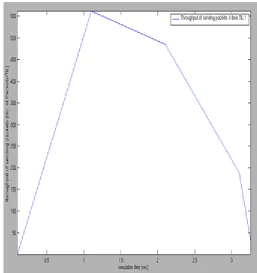
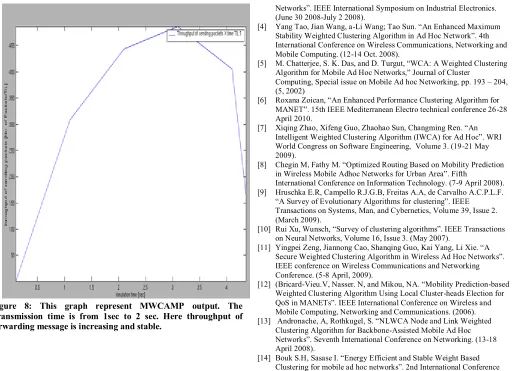
Comparison between WCA and our proposed work on basis of throughput and simulation time is given in figure 7 and 8. Figure 7 represents the throughput of forwarding message in WCA. Figure 8 represents the throughput of forwarding message in our proposed work MWCAMP.
Figure 8: This graph represent MWCAMP output. The Transmission time is from 1sec to 2 sec. Here throughput of forwarding message is increasing and stable.
VI. CONCLUSION
In this paper we have presented an enhanced weight based clustering algorithm using mobility prediction (MWCAMP) that can be applied in MANETs to improve upon their stability and to reduce re-affiliation of the nodes. MWCAMP mainly focuses on reducing the instability caused by high-speed moving nodes, by taking relative mobility of node and its neighbors into consideration. Since WCA support stable cluster head election and the disadvantage is re-affiliation of nodes which is reduced by mobility prediction, it results in stable clustering. The performance of the proposed MWCAMP demonstrated that it outperforms WCA in terms of re-affiliation count.
REFERENCES
[1] Chang Li, Yafeng Wang, Fan Huang, Dacheng Yang. “A Novel Enhanced Weighted Clustering Algorithm for Mobile Networks”. 5th International Conference on Wireless Communications, Networking and Mobile Computing. (24-26 Sept 2009).
[2] Likun Zou, Qishan Zhang, Jianwei Liu. “An Improved Weight-Based Clustering Algorithm in MANETs”.4th International Conference on Wireless Communications, Networking and Mobile Computing. (12-14 Oct. 2008).
[3] Hussein A.H, Abu Salem A.O, Yousef S. “A flexible weighted clustering algorithm based on battery power for Mobile Ad hoc
Networks”. IEEE International Symposium on Industrial Electronics. (June 30 2008-July 2 2008).
[4] Yang Tao, Jian Wang, a-Li Wang; Tao Sun. “An Enhanced Maximum Stability Weighted Clustering Algorithm in Ad Hoc Network”. 4th International Conference on Wireless Communications, Networking and Mobile Computing. (12-14 Oct. 2008).
[5] M. Chatterjee, S. K. Das, and D. Turgut, “WCA: A Weighted Clustering Algorithm for Mobile Ad Hoc Networks,” Journal of Cluster
Computing, Special issue on Mobile Ad hoc Networking, pp. 193 – 204, (5, 2002)
[6] Roxana Zoican, “An Enhanced Performance Clustering Algorithm for MANET”. 15th IEEE Mediterranean Electro technical conference 26-28 April 2010.
[7] Xiqing Zhao, Xifeng Guo, Zhaohao Sun, Changming Ren. “An Intelligent Weighted Clustering Algorithm (IWCA) for Ad Hoc”. WRI World Congress on Software Engineering, Volume 3. (19-21 May 2009).
[8] Chegin M, Fathy M. “Optimized Routing Based on Mobility Prediction in Wireless Mobile Adhoc Networks for Urban Area”. Fifth
International Conference on Information Technology. (7-9 April 2008). [9] Hruschka E.R, Campello R.J.G.B, Freitas A.A, de Carvalho A.C.P.L.F.
“A Survey of Evolutionary Algorithms for clustering”. IEEE Transactions on Systems, Man, and Cybernetics, Volume 39, Issue 2. (March 2009).
[10] Rui Xu, Wunsch, “Survey of clustering algorithms”. IEEE Transactions on Neural Networks, Volume 16, Issue 3. (May 2007).
[11] Yingpei Zeng, Jiannong Cao, Shanqing Guo, Kai Yang, Li Xie. “A Secure Weighted Clustering Algorithm in Wireless Ad Hoc Networks”. IEEE conference on Wireless Communications and Networking Conference. (5-8 April, 2009).
[12] (Bricard-Vieu.V, Nasser. N, and Mikou, NA. “Mobility Prediction-based Weighted Clustering Algorithm Using Local Cluster-heads Election for QoS in MANETs”. IEEE International Conference on Wireless and Mobile Computing, Networking and Communications. (2006). [13] Andronache, A, Rothkugel, S. “NLWCA Node and Link Weighted
Clustering Algorithm for Backbone-Assisted Mobile Ad Hoc Networks”. Seventh International Conference on Networking. (13-18 April 2008).
[14] Bouk S.H, Sasase I. “Energy Efficient and Stable Weight Based Clustering for mobile ad hoc networks”. 2nd International Conference on Signal Processing and Communication Systems. (15-17 Dec. 2008).
16 INTERNETWORKING INDONESIA JOURNAL MUTHURAMALINGAM ET AL.