Available Online at www.ijpret.com 211
INTERNATIONAL JOURNAL OF PURE AND
APPLIED RESEARCH IN ENGINEERING AND
TECHNOLOGY
A PATH FOR HORIZING YOUR INNOVATIVE WORK
A METHODOLOGY FOR IDENTIFYING THE DIFFERENT CAUSES OF DELAY IN
BUILDING CONSTRUCTION PROJECTS
NITIN B. VIDHATE1, DR. USHADEVI PATIL2
1. PG Student of Civil Engg. Dept, Dr. D.Y.Patil Institute of Engineering and Technology, Ambi, Pune, Maharashtra, INDIA. 2. Professor of civil Engg. Dept, Dr. D.Y.Patil Institute of Engineering and Technology,Ambi, Pune, Maharashtra, INDIA.
Accepted Date: 05/03/2015; Published Date: 01/05/2015
\
Abstract: In Construction, delay could be defined as the late completion of work compared
to the planned schedule or contract schedule. In Construction delay could be minimized only when their causes are identified. The aim of this study is to identify different causes of construction delay, effects of delay and methods to minimizing construction delay. The present study works on identification of different causes of delay in building construction projects in Maharashtra. Literature review and interviews were carried out on construction project on west zone of Maharashtra. This paper presents the framework of causes of delay in building projects. Total 40 causes were identified under 7 different groups. The aim of this paper suggests the methodology to work out the important causes of delay in building projects.
Keywords: Building construction projects, Causes of delay, Relative importance index
Corresponding Author: MR. NITIN B. VIDHATE
Access Online On:
www.ijpret.com
How to Cite This Article:
Nitin B, Vidhate, IJPRET, 2015; Volume 3 (9): 211-218
Available Online at www.ijpret.com 212 INTRODUCTION
According to Assaf and Al-Hejji (2006), delay can be defined as the time over-run either beyond completion date specified in a contract or beyond the date that the parties agrees upon for the delivery of a projects [8].In construction, delay happen due to improper planning, management and scheduling. Delay can also happen due to miscommunication between contractor, consultant and engineer in either simple or complex construction projects. Therefore, It is essential to evaluate actual causes of delay in order to minimize and avoid the delays in construction industry.
II.OBJECTIVES
The main objectives of this study include the following.
1) To identify the important causes of delay for building construction project in Maharashtra.
2) To suggest the methodology to work out important causes of delay in building construction projects.
III.RELATED STUDIES
In 2006,Assaf and Al-Hejji evaluated 73 different causes of delay during the research work. They conducted survey of different types of construction projects in Saudi Arabia to identify the different causes of delay and their importance with the help of project parties involved in construction projects like owner, consultant and contractor. According to their research the most common cause of delay identified through all three parties was “change order” [8].
In 1997, Chan and kumaraswamy evaluated five common factors of delays that affects during construction projects like unforeseen site condition, slow decision making, poor risk management and supervision, client-initiated variations and necessary variations of works [4].
In 2000, Al-momoni identified causes of delay in 130 public projects in Jordon. From the research the main causes of delays were design, user change, weather, site conditions, economic condition, late deliveries and increase in quality [2].
Available Online at www.ijpret.com 213
In 2003, Sugiharto Alwi and Keith Hampson conducted survey to determine most important causes of delays within building projects in Indonesia. From literature they evaluated causes of delay related to people, professional management, design, documentation, material, execution and external causes of delay. With the help of questionnaires, survey was conducted between large contractors and small contractors on projects that had completed within the last five years. The interviewees included project manager, site managers, supervisor, foremen, labours. Data collected was analyzed using importance index and ranking was done by spearman's rank correlation coefficient [3].
IV. RESEARCH METHODOLOGY
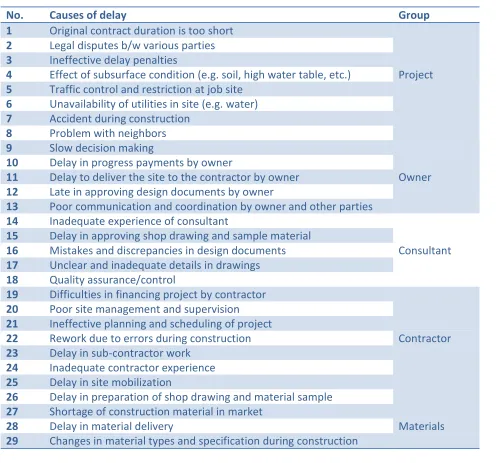
The research methodology divided into two phases included a literature search and interviews. The first phase included review was conducted through various research paper, books, internet and international project management journals. From the out of this phase 40 causes of delay from building construction projects are identified. These causes were categorized into seven major groups as: project related, owner related, consultant related, contractor related, material related, labour and equipment related and external factor depending upon their nature and mode of occurrence. Classification frame work of causes is given in table 1
The second phase includes the preparation, distribution and analysis of three types of questionnaire based on relative importance index and spearman rank correlation factor. The questionnaire divides into three types like causes of construction delay, effect of construction delay and methods of minimizing construction delay. One copy questionnaire survey is received from respondent as shown in appendix 1.
A. Data analysis approach
Relative important index technique: In 2002, Odeh and Battaineh evaluated the ranking of different factors based on relative importance index [7].
Where
i = Response category index
Wi = The weight assigned to ith response= 1,2,3,4,5 respectively
Available Online at www.ijpret.com 214
The same method is to be adopted in this study within the various groups involved in building construction project. The five point scale ranged from 1 to 5 likert’s scale used. For finding causes of delay ranged from 1 (strongly disagree) to 5 (strongly agree), for effect of construction delay ranged from 1 (never) to 5 (always), for methods of minimizing construction delay ranged from 1 (very low effective) to 5 (very high effective).
B. Data accuracy check approach
Spearman’s rank correlation factor: The spearman’s rank correlation was commonly used to examine the degree of agreement between rankings of groups involved in building construction projects. The spearman’s rank correlation is non-parametric test. Non-parametric test also referred to as distribution-free test. These tests do not require the assumption of normality or the assumption of homogeneity of variance. Thy also compare medians rather than means and, as a result, if the data include one or two outlier, their influence is excluded [6]. In order to evaluate the agreement in ranking of important variables between consultant, contractor, owner. The spearman’s rank correlation test was conducted.
In this paper, it is used to show the agreement between different projects groups. The correlation coefficient varies between the different project groups. The correlation coefficient varies between +1 to −1, where +1 indicates perfect positive relationships and while −1 indicates perfect negative relationships. It also states that sample estimates of correlation close to unity indicate good correlation and value near to zero indicates no correlation [5].
The spearman’s rank correlation coefficient was evaluated as follows
r
where “d” is the different between the rank indicated by group present in building projects for an individual variables
n= no. of delay causes (n=40)
I. CONCLUSION
Available Online at www.ijpret.com 215
shortage of construction material in market, mistakes in design document, and shortage of labour and equipment.Causes of delay raise the cost of construction project and overrun the time of completion. In building construction project mainly proper material procurement, use of appropriate construction methods and project planning and scheduling methods are most effective. Future study to distribute questionnaires into various groups like owner, consultant, contractor through which analyze the data with the help of relative important index and degree of co-relation with the help of spearman’s rank correlation.
Table 1. Classification of delay
No. Causes of delay Group
1 Original contract duration is too short
Project
2 Legal disputes b/w various parties
3 Ineffective delay penalties
4 Effect of subsurface condition (e.g. soil, high water table, etc.)
5 Traffic control and restriction at job site
6 Unavailability of utilities in site (e.g. water)
7 Accident during construction
8 Problem with neighbors
9 Slow decision making
Owner
10 Delay in progress payments by owner
11 Delay to deliver the site to the contractor by owner
12 Late in approving design documents by owner
13 Poor communication and coordination by owner and other parties
14 Inadequate experience of consultant
Consultant
15 Delay in approving shop drawing and sample material
16 Mistakes and discrepancies in design documents
17 Unclear and inadequate details in drawings
18 Quality assurance/control
19 Difficulties in financing project by contractor
Contractor
20 Poor site management and supervision
21 Ineffective planning and scheduling of project
22 Rework due to errors during construction
23 Delay in sub-contractor work
24 Inadequate contractor experience
25 Delay in site mobilization
26 Delay in preparation of shop drawing and material sample
27 Shortage of construction material in market
Materials
28 Delay in material delivery
Available Online at www.ijpret.com 216
30 Shortage of labor, equipment
Labour& Equipment
31 Unqualified workforce
32 Low productivity level of labors
33 Equipment availability and failure
34 Weather effect (hot, rain, etc.)
External
35 Environmental restrictions
36 Changes in government regulations and law
37 Slow permit by government/municipality
38 Delay in performing final inspection and certification by third party
39 Lack of communication b/w parties
40 Worker strike
Available Online at www.ijpret.com 217 REFERENCES
1. Aibinu, A. A. and Jagboro, G.O. “The Effects of Construction Delays on Project Delivery in Nigerian Construction Industry”. International Journal of Project Management, Volume 20, Issue 8, Pages 593-599, November 2002.
2. Al-Momani, H.A, "Construction delay: a quantitative analysis."International Journal of Project Management,pp.51–59,2000.
Available Online at www.ijpret.com 218
4. Chan, D. W. M. and Kumaraswamy, M. M, “A Comparative Study of Causes of Time Overruns in Hong Kong Construction Projects”. International Journal of Project Management, Vol. 15, No. 1, pp.55-63,1997.
5. Desai Megha and Dr. Bhatt Rajiv, “A Methodology for raking of causes of delay for residential construction project in Indian context”. International journal of emerging technology and advanced engineering,volume3,issue3,pp.396-404, march 2013
6. Frank D.K. Fugar and Adwoa. Agyakwah-Baah, "Delay in building construction projects in Ghana."Australasian journals of construction economics and building, 10(1/2,pp.103-116),2010.
7. Odeh, A.M. and Battaineh, H.T, “Causes of Construction Delay: Traditional Contracts.” International Journal of Project Management, Elsevier.20:pp.67-73,2002