6466 MEDICAL DEVICEREGULATION - RECENT DEVELOPMENTS AND
CHALLENGES IN INDIA
Kaushik Devaraju, Balamuralidhara V*, T. M. Pramod Kumar, Sidharth Malhotra
JSS College of Pharmacy, JSS Academy of Higher Education and Research, Mysuru
*Corresponding author E-mail: [email protected]
ARTICLE INFO ABSTRACT
Key Words
Notified Bodies, State Licensing Authority (SLA), Central Licensing Authority
(CLA),Subject Expert Committee (SEC).
.
The global medical device market is growing very fast from last decade and India had shown tremendous growth in this market and it is expected to grow in upcoming years. The new rules have been formulated to promote domestic manufacturing and to regulate import and manufacturing in the region. Currently, multinational companies occupy approximately 75 present of sales in the Indian medical device market. The new regulations follow the GHTF (Global Harmonisation Task Force) guidelines and are in consonance with these rules risk-based classification. In addition, inspections by notified bodies have been introduced in the new medical devices rules. This article explains medical device classification, rules, manufacturer registration procedures, dossier filing procedures and marketing application approval processes and some of the challenges faced by the manufacturer.
INTRODUCTION
India is one of the top 20 markets for medical devices in the world, valued at EUR 4.6 billion (approximately $5.4 billion) and the fourth largest medical device market in Asia. The medical device industry in India alone is expected to reach EUR 8.6 billion (approximately $10.1 billion) in 2020, having a reported Compound Annual Growth Rate (CAGR) of 11% between 2008 and 2015 with an estimated 10-year CAGR of 15%. The major segments for growth are equipment and instruments, consumables and disposables, implants, and patient aids. India’s medical device market is currently 70% import dependent with the instrument and diagnostic imaging equipment segments accounting for 66% of the overall market. Only 38% of devices
manufactured in India are exported from India; therefore, there is a very low level of export competency. To curb these challenges and to overcome the import market, the Ministry of Health and Family Welfare of India drafted Medical Devices Rules, 2017. The new rules are well defined and provide a 360 degree focus to boost manufacturing capabilities, reduce import product dependence, and increase market size.1-4 This market has witnessed continuous transformation over the past two decades. Before the New Economic Policy (1991), it was dominant in domestic manufacturing circles. Later, it transformed into an import-driven market. Prior to 2006, the medical device sector in India was unregulated; that era ended in 2006, when the Central Drugs Standard
Journal of Global Trends in Pharmaceutical Sciences
6467 Control Organization (CDSCO) notified
15 medical devices for which registration is required.5 Previously Device Medical devices and IVDs are regulated by the Drug Controller General of India (DCGI) within the Central Drugs Standard Control Organization (CDSCO), part of the Ministry of Health and Family Welfare. The regulatory framework for medical devices is based on drug regulations under the Drugs and Cosmetics Act of 1940, and Drugs and Cosmetics Rules of 1945.In solidarity with the Make in India program, the CDSCO published the new Medical Device Rules, 2017, which came into force on Jan. 1, 2018.
Definition of Medical Devices
(A) Substances used for in vitro diagnosis and surgical dressings, surgical bandages, surgical staples, surgical sutures, ligatures, blood and blood component collection bag with or without anticoagulant covered under sub-clause (i)
(B) Substances including mechanical contraceptives (condoms, intrauterine devices, and tubal rings), disinfectants and insecticides notified in the Official Gazette under sub-clause (ii)
(C) Devices notified from time to time under sub-clause (iv), of clause (b) of section 3 of the Act.
Notified body
Medical devices, under the new rules, are classified into Class A, B, C and D based on associated risks. The notified bodies will be accredited by the National Accreditation Board for Certification Bodies (NABCB). The NABCB will, before accrediting them, assess their competence in terms of human resources and other requirements. These bodies will undertake verification and assessment of quality management system of medical device manufacturers. The regulations stipulate that chosen notified bodies can charge Rs 20,000 per man-day for audit of
site and product assessment. The fee excludes travel expenses which shall not be more than Rs 12,000 per auditor or visit. The man-day calculation is based on number of products assessed, risk class and employee count.7 (1) Any institute, organisation or body corporate may seek accreditation, after notification ofthese rules, as a Notified Body by applying to the National Accreditation Body referred to in rule 11 in such form and manner as may be determined by the National Accreditation Body from time to time.
(2) The Notified Body accredited under sub-rule (1) shall be competent to carry out audit of manufacturing sites of Class A and Class B medical devices to verify conformance with the Quality Management System and other applicable standards as specified under these rules in respect of such medical devices as and when so advised by the State Licensing Authority.
(3) Any Notified Body accredited under sub-rule (1) shall, if it intends to carry out audit of a manufacturing site of Class A or Class B of medical devices in accordance with sub-rule (2), register with the Central Licensing Authority.
(4) Any Notified Body under sub-rule (3), with an experience of at least two years, may apply to the Central Licensing Authority for registration as a Notified Body for carrying out audit of Class C and Class D medical devices, provided it has personnel with requisite qualification and experience.
6468 (6) The Central Licensing Authority, on
being satisfied, shall register the Notified Body and issue a registration certificate in Form MD-2.
(7) The Registration Certificate shall remain valid in perpetuity, unless, it is suspended or cancelled, provided the registration certificate holder deposits a registration retention fee as specified in the Second Schedule every five years from the date of its issue.
(8) If the registration certificate holder fails to pay the required registration certificate retention fee on or before due date as referred to in sub-rule (7), the registration certificate holder shall, in addition to the retention fee, be liable to pay a late fee calculated at the rate of two per cent. of the registration certificate retention fee for every month or part thereof within ninety days, and in the event of non-payment of such fee during that period, the registration certificate shall be deemed to have been cancelled.
(9) The Notified Body shall perform the functions as specified in Part II of the Third Schedule.
(10) The Central Licensing Authority, may, in cases where the requirement specified for registration of Notified Body have not been complied with, reject the application and shall inform the applicant of the reasons for such rejection.
(11) An applicant who is aggrieved by the decision of the Central Licensing Authority under sub-rule (10), may file an appeal within forty five days from the date of receipt of such rejection before the Central Government, which may after such enquiry and after giving an opportunity of being heard to the appellant, dispose of the appeal within a period of sixty days
Duties of Notified Body.— A registered Notified Body, referred to in rule 13, shall carry out its duties and functions, in respect of Class A or Class B medical devices as specified in Part II of the Third Schedule.
Central Medical Device testing laboratory
As per the Medical Devices Rule, 2017, The Central Government may, by notification, establish Central medical devices testing laboratory for the purpose of,—
(a) Testing and evaluation of medical devices; or
(b) Functioning as an appellate laboratory; or
(c) To carry out any other function as may be specifically assigned to it.
Government of India have designated the laboratories specified in column of the Table below having facilities for carrying out test and evaluation of medical devices, as Central Medical Device Testing Laboratory Role of State Government and the Central Government
The State Drugs Controller serves as the State Licensing Authority (SLA) and shall be the competent authority for enforcement of the rules relating to the manufacture of Class A or Class B medical devices and the sale, stocking and exhibition of medical devices and other related functions. Class C and D high-risk devices are regulated by the Central Licensing Authority (CLA), which oversees the clinical investigation and clinical performance evaluation of medical devices and has other related functions. If the manufacturer intends to manufacture a predicate medical device, the manufacturer must receive approval from the CLA before applying to the SLA.9
SUGAM Portal
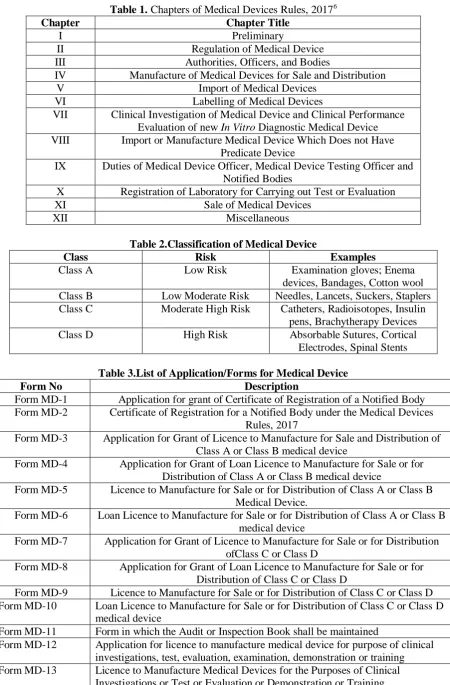
6469 Table 1. Chapters of Medical Devices Rules, 20176
Chapter Chapter Title
I Preliminary
II Regulation of Medical Device
III Authorities, Officers, and Bodies
IV Manufacture of Medical Devices for Sale and Distribution
V Import of Medical Devices
VI Labelling of Medical Devices
VII Clinical Investigation of Medical Device and Clinical Performance Evaluation of new In Vitro Diagnostic Medical Device
VIII Import or Manufacture Medical Device Which Does not Have
Predicate Device
IX Duties of Medical Device Officer, Medical Device Testing Officer and Notified Bodies
X Registration of Laboratory for Carrying out Test or Evaluation
XI Sale of Medical Devices
XII Miscellaneous
Table 2.Classification of Medical Device
Class Risk Examples
Class A Low Risk Examination gloves; Enema
devices, Bandages, Cotton wool
Class B Low Moderate Risk Needles, Lancets, Suckers, Staplers
Class C Moderate High Risk Catheters, Radioisotopes, Insulin
pens, Brachytherapy Devices
Class D High Risk Absorbable Sutures, Cortical
Electrodes, Spinal Stents
Table 3.List of Application/Forms for Medical Device
Form No Description
Form MD-1 Application for grant of Certificate of Registration of a Notified Body Form MD-2 Certificate of Registration for a Notified Body under the Medical Devices
Rules, 2017
Form MD-3 Application for Grant of Licence to Manufacture for Sale and Distribution of Class A or Class B medical device
Form MD-4 Application for Grant of Loan Licence to Manufacture for Sale or for Distribution of Class A or Class B medical device
Form MD-5 Licence to Manufacture for Sale or for Distribution of Class A or Class B Medical Device.
Form MD-6 Loan Licence to Manufacture for Sale or for Distribution of Class A or Class B medical device
Form MD-7 Application for Grant of Licence to Manufacture for Sale or for Distribution ofClass C or Class D
Form MD-8 Application for Grant of Loan Licence to Manufacture for Sale or for Distribution of Class C or Class D
Form MD-9 Licence to Manufacture for Sale or for Distribution of Class C or Class D Form MD-10 Loan Licence to Manufacture for Sale or for Distribution of Class C or Class D
medical device
Form MD-11 Form in which the Audit or Inspection Book shall be maintained
Form MD-12 Application for licence to manufacture medical device for purpose of clinical investigations, test, evaluation, examination, demonstration or training Form MD-13 Licence to Manufacture Medical Devices for the Purposes of Clinical
6470 Form MD-14 Application for issue of import licence to import medical device
Form MD-15 Licence to Import Medical Device
Form MD-16 Application for Licence to Import Medical Devices for the Purposes of Clinical Investigations or Test or Evaluation or Demonstration or Training
Form MD-17 Licence to Import Medical Devices for the Purposes of Clinical Investigations or Test or Evaluation or Demonstration or Training
Form MD-18 Application for licence to import investigational medical devices for the purposes by a government hospital or statutory medical institution for the treatment of patients
Form MD-19 Licence to import investigational medical device by a government hospital or statutory medical institution for the treatment of patients
Form MD-20 Application for permission to import small quantity of medical devices for personal use
Form MD-21 Permission to import of small quantity of medical devices for personal use Form MD-22 Application for Grant of permission to conduct clinical investigation of an
investigational medical device
Form MD-23 Permission to conduct Clinical Investigation
Form MD-24 Application for grant of permission to conduct clinical performance evaluation of new in vitro diagnostic medical device
Form MD-25 Permission to conduct clinical performance evaluation of new in vitro
diagnostic medical device
Form MD-26 Application for grant of permission to import / manufacture for sale or for distribution of medical device which does not have predicate medical device Form MD-27 Permission to import or manufacture for sale or for distribution of medical
device which does not have predicate medical device
Form MD-28 Application for grant of permission to Import or Manufacture for sale or for distribution of new in vitro diagnostic medical device
Form MD-29 Permission to Import or Manufacture New In Vitro Diagnostic Medical Device
Form MD-30 Memorandum to the Central Medical Device Testing Laboratory
Form MD-31 Certificate of test or evaluation by the Central Medical Device Testing Laboratory
Form MD-32 Report of Test or Evaluation of Medical Devices by Medical Device Testing Officer
Form MD-33 Application from a purchaser for test or evaluation of a Medical Device under section 26 of the Drugs and Cosmetics Act, 1940 (23 of 1940)
Form MD-34 Order under clause (c) of sub-section (1) of section of the Drugs and Cosmetics Act,1940, (23 of 1940) requiring a person not to dispose of stock in his
possession
Form MD-35 Receipt for stock of medical devices for record, register, document or material objectseized under clause (c) or clause (cc) of sub-section (1) of Section 22 of the Drugs andCosmetics Act (23 of 1940)
Form MD-36 Intimation of Person from Whom Sample is taken
Form MD-37 Receipt for Sample of medical device(s) taken where fair price tendered thereof undersub-section (1) of Section 23 of the Drugs and Cosmetics Act, 1940 is refused
Form MD-38 Memorandum to Medical Device Testing Officer
Form MD-39 Application for grant of registration to Medical Device Testing Laboratory for carry out Test or Evaluation of a medical device on behalf of manufacturer Form MD-40 Certificate of registration to Medical Device Testing Laboratory for carry out
6471 Table 4.Notified Bodies that have been registered with CDSCO8
1 M/s Intertek India Pvt. Ltd. E-20, Block B1, Mohan Cooperative, Industrial Area New Delhi (India) - 110044 Telephone No.: 011-41595475, 9310412823 Fax: 011-41595460 E-Mail:
2 M/s TUV Rheinland India Pvt. Ltd. 82/A West Wing, 3rd Main Road 82/A West Wing, 3rd Main Road Electronic City (India) - 560100 Telephone No.: 080- 46498030 Fax: 08046498042
E-Mail: [email protected]
3 M/s TUV Sud South Asia Pvt. Ltd. TUV SUD House, Off Saki Vihar Road, Saki Naka Andheri (East), Mumbai-400072. Telephone No.: 022-49035508 Fax: 022-49035508 E-mail:
4 M/S, Dnv GI Business Assurance India Private Ltd., Equinox Business Park, Tower 3, 6th Floor, BKC, LBS Road, Kurla West, Mumbai- 400070 (India), Telephone No.:022-61768909
Fax- 022-61768950 E-Mail- [email protected]
Table 5.Central Medical Device Testing Laboratory
Sl.No Name of Laboratory Category of Medical Device
The National Institute of Biologicals, Noida In-Vitro Diagnostics for human Immunodeficiency virus, Hepatitis B Surface Antigen and Hepatitis C Virus, Blood Grouping sera, Glucose Test Strip, Fully Automated Analyser Based
Glucose Reagent The Central Drugs Testing laboratory, Chennai Condoms
The Central Drugs Laboratory, Kolkata Surgical Dressings, Surgical Cotton, Surgical Bandages, Disinfectant The Regional Drugs Testing Laboratory
(RDTL), Guwahati
Disposable Hypodermic Syringes, Disposable Hypodermic Needle,
Disposable Perfusion Sets, I.V. Cannulae The Central Drugs Testing Laboratory,
Mumbai
6472 Procedure to Apply for Import of Medical Device
Table 6.Timeline to obtain Manufacturing/ Import Licence for Medical Device
Table 7.List of Documents Required for Manufacturer Registration and for Importation of Medical Devices
Class A In Vitro and Other Than
In Vitro
Class B, Class C, and Class D In
Vitro and Other Than In Vitro
Device Other Than Predicate
For importation
For Manufacturing Device description Intended use
Specifications including variants & accessories Material of construction Working principle and use of novel technology if any
Labels, package inserts, user manual, wherever applicable
Summary of serious ADR in India/other countries Site/plant master file
Constitution details of domestic manufacturer or authorized agent Site or plant master file
Device Master File Essential principle checklist for
demonstrating conformity for safety and performance Test licence for testing and generation quality control data
Data analysis Design input/output documents Mechanical and electrical test results Reliability test results
Validation of software
Performance test results
Biocompatibility test results
Notarized copy of overseas manufacturing site and Free Sale Certificate (FSC) Notarized copy of QMS or full Quality Assurance certificate
Self-attested copy of whole sale license or
manufacturing licence Copy of latest
inspection/audit report carried out by Notified Bodies/NRA
Class/Timelines Class A Class B Class C Class D
Manufacturing Licence 45 Days 140 Days 150 Days 150 Days
6473 Firm details
Signed undertaking agreement
Essential principles checklist
Analytical performance Summary for in vitro device
Signed undertaking agreement stating manufacturing site is compliant with fifth schedule
In-vitro performance evaluation report for in vitro device
Risk management data
Animal
performance data Pilot and pivotal clinical investigation data
Regulatory status and restrictions in use Proposed instructions for use
Table 8. Labelling of medical devices. Name of the Medical Device
Details necessary for the user to identify the device and its use Name of manufacturer and address of manufacturing premises
Correct statement about the net quantity in terms of weight, measure, volume, number of units Month and year of manufacture and expiry
Label shall bear the shelf life of the product
To provide, wherever required, an indication that the device contains medicinal or biological substance
To provide, a distinctive batch number or lot number preceded by the word “Lot No.” or “Lot” or “Batch No.” or “B. No.”;
To indicate, wherever required, any special storage or handling conditions applicable to the device To indicate, if the device is supplied as a sterile product, its sterile state and the sterilisation method. To give, if considered relevant, warnings or precautions to draw the attention of the user of medical device.
To label the device appropriately, if the device is intended for single use
To overprint on the label of the device, the words “Physician’s Sample—Not to be sold”, if a medical device is intended for distribution to the medical professional as a free sample.
To provide, except for imported devices, the manufacturing licence number by preceding the words “Manufacturing Licence Number” or “Mfg. Lic. No.” or “M. L”;
To provide on the label, in case of imported devices, by way of stickering, where such details are not already printed, the import licence number, name and address of the importer, address of the actual manufacturing premises and the date of manufacture
Provided that the label may bear symbols recognised by the Bureau of Indian Standards or International Organisation for Standardisation (ISO)
6474 Table 9: List of List of Notified devices and devices proposed to be notified11
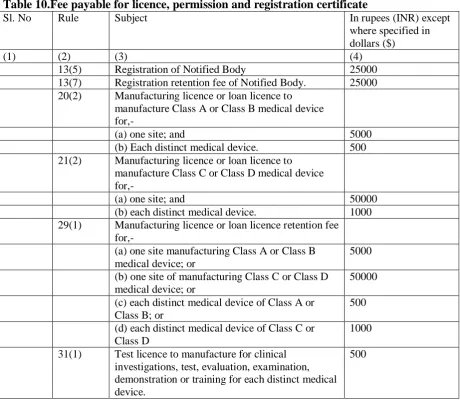
Table 10.Fee payable for licence, permission and registration certificate
Sl. No Rule Subject In rupees (INR) except
where specified in dollars ($)
(1) (2) (3) (4)
13(5) Registration of Notified Body 25000
13(7) Registration retention fee of Notified Body. 25000
20(2) Manufacturing licence or loan licence to manufacture Class A or Class B medical device for,-
(a) one site; and 5000
(b) Each distinct medical device. 500
21(2) Manufacturing licence or loan licence to manufacture Class C or Class D medical device for,-
(a) one site; and 50000
(b) each distinct medical device. 1000
29(1) Manufacturing licence or loan licence retention fee for,-
(a) one site manufacturing Class A or Class B medical device; or
5000
(b) one site of manufacturing Class C or Class D medical device; or
50000
(c) each distinct medical device of Class A or Class B; or
500
(d) each distinct medical device of Class C or Class D
1000
31(1) Test licence to manufacture for clinical investigations, test, evaluation, examination, demonstration or training for each distinct medical device.
500
Sl.No Name of Devices
1 Disposable Hypodermic Syringes
2 Disposable Hypodermic Needles
3 Disposable perfusion Sets
4 In vitro Diagnostic Devices for HIV, HBsAg and
HCV
5 Cardiac Stents
6 Drug Eluting Stents
7 Catheters
8 Intra Ocular Lenses
9 I.V. Cannulae
10 Bone Cements
11 Heart Valves
12 Scalp Vein Set
13 Orthopaedic Implants
14 Internal Prosthetic Replacements
15 Nebulizer
16 Blood Pressure monitoring Devices
17 Digital Thermometer
6475 34(2) Import licence for Class A medical device other
than in vitro diagnostic medical device for,-
(a) one site; and $1000
(b) each distinct medical device. $50
34(2) Import licence for Class B medical device other than in vitro diagnostic medical device for,-
(a) one site; and $2000
(b) each distinct medical device $1000
34(2) Import licence for Class A or Class B in vitro diagnostic medical device for,-
(a) one site; and $1000
(b) each distinct in vitro diagnostic medical device $10 34(2) Import licence for Class C or Class D medical
device other than in vitro diagnostic medical device for,-
(a) one site; and $3000
(b) each distinct medical device $1500
34(2) Import licence for Class C or Class D in vitro diagnostic medical device for,-
(a) one site; and $3000
(b) each distinct in vitro diagnostic medical device.
$500
35(2) Inspection of the overseas manufacturing site. $6000
37 Import licence retention fee for,-
(a) one overseas site manufacturing Class A medical device other than in vitro diagnostic medical device; or
$1000
(b) one overseas site manufacturing Class B medical device other than in vitro diagnostic medical device; or
$2000
(c) one overseas site manufacturing Class C or Class D medical device other than in vitro diagnostic medical device; or
$3000
(d) each distinct medical device of Class A other than in vitro diagnostic medical device; or
$50
(e) each distinct medical device of Class B other than in vitro diagnostic medical device; or
$1000
(f) each distinct medical device of Class C or Class D other than in vitro diagnostic medical device
$1500
(g) one overseas site manufacturing Class A or Class B in vitro diagnostic medical device;
$1000
(h) one overseas site manufacturing Class C or Class D medical device other than in vitro diagnostic medical device;
$3000
(i) each distinct in vitro diagnostic medical device of Class A or Class B in vitro diagnostic medical device;
$10
(j) each distinct in vitro diagnostic medical device of Class C or Class D in vitro diagnostic medical device;
$500
40(2) Fee for Import licence for test, evaluation or demonstration or training for each distinct medical device
6476 42(1) Fee for Import of investigational medical device
by Government hospital or statutory medical institution for treatment of patient of each distinct medical device
500
51(2)(a) Permission to conduct pilot clinical investigation. 100000 51(2)(b) Permission to conduct pivotal clinical
investigation.
100000
59(2) Permission to conduct clinical performance evaluation.
25000
63(1) Permission to import or manufacture a medical device which does not have its predicate device
50000
64(1) Permission to import or manufacture new in vitro diagnostic medical device.
25000
81(1) Registration of medical device testing laboratory to carry out testing or evaluation of a medical device on behalf of manufacturer.
20000
84 Registration retention fee for medical device testing laboratory
20000
91 Certificate to export of each distinct medical device.
1000
SUGAM portal used for application and grant of licence or permission for the following:
1) Blood Bank License.
2) NOC to manufacture unapproved drugs for the purpose of export. 3) Conduct BA/BE studies.
4) NOC to obtain test license for unapproved or new drugs.
5) Registration for import of cosmetics.
6) Indigenous manufacture and Import of Medical device and In- Vitro Diagnostics.
7) Registration for global clinical trial.
8) Pay Online any fee as required for all above applications in a Secure and convenient manner and Save time.
9) Import of drugs for the purpose of test or analysis.
10) Import of drugs for personnel use, 11) Registration for import of drugs. 12) Indigenous manufacture and
Import of Biologicals including rDNA.
13) Registration of Ethics committee.
Benefits of the System:
SUGAM portal provides the single window for all its stakeholders to access the services provided by the portal by implementing role based access control and actions. It has consolidated the entire Drug Regulatory framework at centre and provides a centralized dashboard for the monitoring the various regulatory clearances all over the country.
SUGAM portal provides high level of transparency to its stakeholders as status of the submitted applications can be tracked from applicant dashboard.
SUGAM enables ease of business by providing the integrated workflow right from making an application for grant of permission/ license, online payment, online review process, query management and grant of permission/license online.
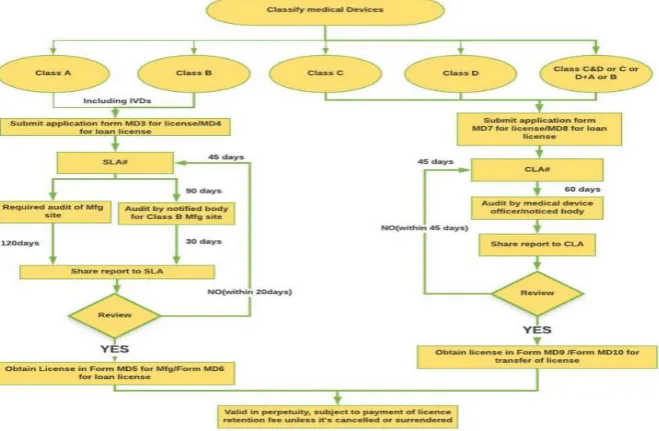
6477 Medical device Regulatory Review
Process in India
Medical Device review process is presented in Figure. The review process map illustrates the main steps in the review process and identifies the key milestone dates for monitoring and analysing timelines for review.
Importor Manufacture of Medical Device which does not have Predicate
Device
An application for grant of permission for such medical device after completion of its clinical investigation under Chapter VII shall be made to the Central Licensing Authority in Form MD-26 either by an authorised agent in case of import or a manufacturer, as the case may be, which shall be accompanied with fee as specified in the Second Schedule along with information specified in Part IV of the Fourth Schedule. The Central Licensing Authority, after being satisfied with the information furnished along with application under sub-rule (1), may grant permission to import or manufacture medical device which does not have predicate medical device in Form MD-27, or may reject the application for reasons to be recorded in writing, within a period of one hundred and twenty days or such extended period, not exceeding a further period of thirty days, from the date of application.
Challenges
Medical devices incorporating software and standalone medical device software are not covered in the new rule. Manufacturers of medical devices containing software should be required to ensure software and any software-driven functions are reliable and perform per the intended use.
Starting on January 1st, 2022,
medical devices that are approved for import, sale, or distribution in India must bear two different types of unique identifiers: the device
identifier and the production
identifier. The device identifier is a global trade item number and the production identifier is the device’s serial number, lot/batch number,
software version, and/or
manufacturing and/or expiration date. Much more information should be provided in the rule in order to comply.
Time taken for the approval of medical device is 150 days in case of Class B, C and D devices. The timelines can be reduced with faster approval processes it is submitted electronically.
CONCLUSION
The Medical Device Rules, 2017have many attractive features that encourage the medical device sector in India. By introducing a single online portal, the registration process has been streamlined. The government audit facility included in the new rules will enforce and ensure higher quality products enter the medical device market in India. An audit by the notified bodies will further increase the manufacturing quality of devices. The role of state licensing authority and central licensing authority is visibly outlined in the rule which in turn will help the manufacturer while filing the application. There are few areas which can be overlooked by the authorities like Medical devices incorporating software and standalone medical device software, and the timelines required for the approval of Class B, C and D can be reduced.
Source of Support: Nil.
Conflict of Interest: None declared
REFERENCES:
sciences-health-care/Medical-6478 Devices-Making-in-India.pdf.
Accessed13 November 2017. 2. SKP Business Consulting LLP.
The Medical Device Industry in India.
http://www.skpgroup.com/data/res ource/skp_the_medical_device_in dustry_in_india_.pdf. Accessed 13 November 2017.
3. Herold, D. and Vardahn, V. Make in India Mittelstand! Opportunities in the Medical Equipment Market India. 7 April 2017.http://www.makeinindiamitt
elstand.de/wp-content/uploads/2015/09/Opportu nities-in-the-Medical-Equipment-Market-India.pdf. Accessed 13 November 2017.
4. Saminathan J, Rashi Patel, Current Regulatory Challenges and approaches in Registering In-Vitro Diagnostics(IVD’s) in India
Available at
https://www.jbclinpharm.org/articl es/current-regulatory-challenges- and-approaches-in-registering-in-vitro-diagnostics-ivds-in-india.pdf 5. Harish Reddy Arkala, Freyr,
Medical Devices Regulatory Priorities In India Available athttps://www.meddeviceonline.c
om/doc/medical-devices-regulatory-priorities-in-india-0001
6. M D
Rule-17.Pdf,https://cdscoonline.gov.in/ CDSCO/Industry
7. ArunSreenivasan, CDSCO move to choose notified bodies for medical devices hits wall as low fee structure drives away firms
Available at:
http://www.pharmabiz.com/NewsD etails.aspx?aid=108171&sid=1 8. http://www.cdsco.gov.in/writeread
data/List%20of%20Notified%20B ody.pdf
9. Yadav V, Kumar D, Mathewson N. A New Regulatory Paradigm for Medical Devices in India. :15. 10. Raghotham S, Balamuralidhara V,
Sidharth Malhotra. ‘SUGAM’ Pathway for Pharmaceutical Products in India: An Easy Approach. Research J. Pharm. and Tech 2018; 11(10): 4635-4639 11. http://www.cdsco.nic.in/writereadd