Available Online at www.ijpret.com 91
APPLIED RESEARCH IN ENGINEERING AND
TECHNOLOGY
A PATH FOR HORIZING YOUR INNOVATIVE WORK
A CLOUD NETWORK-BASED POWER MANAGEMENT TECHNOLOGY FOR SMART
HOME SYSTEMS*
MISS. MADHURI NILKANTH BHOLE,MR. PRASHANT WANKHADE
Electronics and Telecommunication Department, Electronics and Telecommunication Department, Airoli, Navi
Mumbai, Maharashtra, India
Accepted Date: 15/03/2016; Published Date: 01/05/2016
\
Abstract: With the fast development of network infrastructure, connecting to the Internet at any time and any place has been made easy and possible. On the other hand, as our world is suffering energy crisis on oil and natural resources shortages, how to make efficient use of limited power energy has remained a major problem to be conquered so far. Research aimed to facilitate the life of human being as well as to use the limited power energy more efficiently. The IPS modules are placed in conjunction with the electrical appliances that are to be controlled from a far-end place. In addition, an embedded system based home gateway that can be connected with the Internet is set up in which the electrical appliances are located. Moreover, the acquired power consumption information or the status is stored in a database server in the Cloud. With the proposed structure, authorized users or system managers can log into the web server which is connected with the database, monitoring the power status and take actions on the appliances remotely.
Keywords: Cloud computing; Power management; Remote control; Client/Server
Architecture.
Corresponding Author: MISS. MADHURI NILKANTH BHOLE
Access Online On:
www.ijpret.com
How to Cite This Article:
Madhuri Nilkanth Bhole, IJPRET, 2016; Volume 4 (9): 91-98
Available Online at www.ijpret.com 92 INTRODUCTION
A. General
With the fast development of network infrastructure, connecting to the Internet at any time and any place has been made easy and possible. On the other hand, as our world is suffering energy crisis on oil and natural resources shortages, how to make efficient use of limited power energy has remained a major problem to be conquered so far. Aimed to facilitate the life of human being as well as to use the limited power energy more efficiently, we propose in this paper a technology that can perform remote control and monitoring of electrical appliances on the Internet.
To do this, an intelligent power socket (IPS) module that is able to control and monitoring the power of electricity is realized in this research. The IPS modules are placed in conjunction with the electrical appliances that are to be controlled from a far-end place. In addition, an embedded system based home gateway that can be connected with the Internet is set up in which the electrical appliances are located. Moreover, the acquired power consumption information or the status of the appliances is stored in a database server in the Cloud. With the proposed structure, authorized users or system managers can log into the web server which is connected with the database, monitoring the power status and take actions on the appliances remotely. The control command from the far- end place, i.e., from the web server on the Internet, is first sent to the home gateway and then transmitted to the IPS modules through the Zigbee wireless communication protocol so that the remote control of appliances can be achieved.
B. Cloud Computing
Cloud Computing refers to both the applications delivered as services over the Internet and the hardware and systems software in the datacenters that provide those services.
C. Cloud Characteristics
• On-demand self-service
• Broad network access
• Resource pooling
Available Online at www.ijpret.com 93
• Measured service
II. Hardware and software parts
A. Hardware parts
In this project, hardware used are:
1. ARM LPC2148
2. Wattmeter
3. Regulator
4. LCD
5. SIM 900
1. ARM LPC2148
TheLPC2141/42/44/46/48 microcontrollers are based on a 16-bit/32-bit
ARM7TDMI-S CPU with real-time emulation and embedded trace support, which combine microcontroller with embedded high speed flash memory ranging from 32 kB to 512 kB. A 128-bit wide memory interface and unique accelerator architecture enable 32-128-bit code execution at the maximum clock rate. For critical code size applications, the alternative 16-bit Thumb mode reduces code by more than 30 % with minimal performance penalty.
Features
• 16-bit/32-bit microcontroller in a tiny LQFP64 package
• 8 kB to 40 kB of on-chip static RAM and 32 kB to 512kB of on-chip flash memory. 128-bit
wide interface/accelerator enables high-speed 60 MHz operation.
• In-System Programming/In-Application Programming (ISP/IAP) via on-chip boot loader
software. Single flash sector or full chip erase in 400 ms and programming of 256 bytes in 1 ms.
• Embedded ICE RT and Embedded Trace interfaces offer real-time debugging with the
Available Online at www.ijpret.com 94
2. Wattmeter
The wattmeter is an instrument for measuring the electric power (or the supply rate of electrical energy) in watts of any given circuit. In this project the wattmeter is used is also called as power energy monitoring. This is the readymade module with IC ADE7755.
FEATURES
• High accuracy, surpasses 50 Hz/60 Hz IEC 687/IEC 1036
• Less than 0.1% error over a dynamic range of 500 to 1
• Supplies active power on the frequency outputs, F1 and F2
• High frequency output CF is intended for calibration and supplies instantaneous active
power
• Synchronous CF and F1/F2 outputs
3.Regulator
In this project regulator nothing but the chopping circuit for control the intensity. This is made up of rectifier IC, opto coupler, and controller.
4.LCD
Liquid crystal Display (LCD) displays temperature of the measured element, which is calculated by the microcontroller. CMOS technology makes the device ideal for application in hand held, portable and other battery instruction with low power consumption. In this project I used the 16*2 character. That means it has 16 column and 2 rows. Each character in LCD is displayed by 5*7 dot pixel.
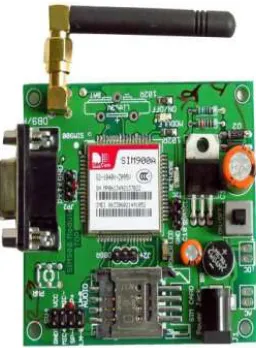
5.SIM900 (GPRS Modem)
Available Online at www.ijpret.com 95
• Quad-Band 850/ 900/ 1800/ 1900 MHz
• Dimensions: 24* 24 * 3 mm
• Weight: 3.4g
• SIM application toolkit
• Supply voltage range 3.4 ... 4.5 V
• Low power consumption
Figure no. 2 SIM 900 module
B. Software
1. VB.Net
Available Online at www.ijpret.com 96
application development (RAD) of graphical user interface (GUI) applications, access to databases using DAO, RDO, or ADO, and creation of ActiveX controls and objects.Visual Basic was designed to be easy to learn and use. The language not only allows programmers to easily create simple GUI applications, but also has the flexibility to develop fairly complex applications as well. Programming in VB is a combination of visually arranging components or controls on a form, specifying attributes and actions of those components, and writing additional lines of code for more functionality.
2. keil
Keil was founded in 1982 by Günter and Reinhard Keil, initially as a German. In April 1985 the company was converted to Keil Elektronik Gmbhto market add-on products for the development tools provided by many of the silicon vendors. Keil implemented the first C compiler designed from the ground-up specifically for the 8051 microcontroller.
III. Connection between PC and Hardware
Actual works:
There is one PC which is connected to the internet. And above hardware in another section. Suppose the bulb glow with high intensity, then to control the intensity we send the command from PC which is connected to the internet. So, that regulator regulates the intensity. In that way, we can save the power.
To connect the PC and hardware, web server is required. PC can communicate with the web server through HTTP protocol an application layer protocol which is based on TCP/IP protocol in internet hierarchy, monitoring the status and take the action on individual appliance.
IV.RESULT
I have completed hardware parts of project, that means interfacing between ARM board and other parts such as GPRS module, LCD, wattmeter, regulator.
Circuit diagram is:
After completing hardware parts I have done following parts:
1. Learning about the visual basic language
Available Online at www.ijpret.com 97
4. Here I use the bulb which is connected to the regulator
5. Then monitor the status then I got this graph
Proposed work:
Explanation:
• When SIM card is inserted in GPRS module, it is directly connected to the PC due to the
feature of SIM application toolkit
• SIM application toolkit means consist of a set of commands programmed into the SIM
which define how the SIM should interact directly with the outside world
• So, we get this graph. In this graph, y axis is power (w) and x axis is time By using this
software i,e.VB.net intensity of bulb is monitored in term of power (w)
V. CONCLUSION AND FUTURE WORKS
Due to the fast development of network infrastructure, connecting to the Internet at any time and any place has been made easy and possible. On the other hand, as our world is suffering energy crisis on oil and natural resources shortages, how to make efficient use of limited power energy hence here I develop the IPS module. To do this, an intelligent power socket
(IPS) module that is able to control and monitoring the power of electricity
Future works:
1. After monitoring the status I can control the intensity of the device.
2. Also I can drop the intensity of the electrical appliances.
3. It may be possible to connect the multiple devices, so we can produce smart home.
ACKNOWLEDGEMENT
Available Online at www.ijpret.com 98
His suggestion and recommendations from time to time helped me immensely. He continuously encouraged me while doing the project work and throughout the preparation of report.
I would also like to thank the committee members and other staff members of college. Further I would like to thank my friends and family member for providing unrelenting encouragement throughout the preparation of the report.
REFERENCES
Journal Papers,
1. Lih-jen kau et al.(2012) “A Cloud Network-based Power Management Technology for Smart
Home Systems,” IEEE International Conference on Systems, Man, and Cybernetics October 14-17, 2012
2. Leibo Liu et al. (2014) “An Uneven-Dual-Core Processor Based Mobile Platform for
Facilitating the Collaboration among Various Embedded Electronic Devices”. IEEE Transactions on Consumer Electronics, Vol. 60, No. 1, February 2014
3. Bashar Alohali et al.(2014) “A Secure Scheme for a Smart House Based on Cloud of Things
(CoT)”.6th computer science and electronics engineering. conference
4. Nagender Kumar Suryadevara (2014) “WSN-Based Smart Sensors and Actuator for Power
Management in Intelligent Buildings”, IEEE/ASME TRANSACTIONS ON MECHATRONICS
5. Hyung-Chul Jo et al.(2013) “Smart Heating and Air Conditioning Scheduling Method
Incorporating Customer Convenience for Home Energy Management System” ,IEEE Transactions on Consumer Electronics, Vol. 59 No. 2, May 2013
6. Shyan-Ming Yuan et al. (2013) “Automatic Rack Cabinet Management System for Data
Center”, 2013 IEEE 17th International Symposium on Consumer Electronics (ISCE)
Websites,