Volume 4 • Issue 2 • October 2018
ISSN 2206-4346
www.anjsbes.net.au
A Review on the Rapid Growth and Popularity of
Franchising: Conceptual Study
Rudolph Patrick T. Muteswa
Department of Management and Entrepreneurship, Human Resources Management and Management Specialist, New Marlborough Harare Private, Zimbabwe
1. Introduction
1.1. Franchising global trends
Franchising provides an opportunity for entrepreneurs without industry experience, educational qualifications, management competency, and interpersonal skills to start their own business and become profitable or successful. Many industries are now using franchising as a type of business ownership, namely, restaurants, clothing retailers, child care nurseries, furniture stores, private schools, private professional colleges, hotels, jewellery shops, supermarkets, butcheries, law firms, hardwares, pharmacies, stationery shops, medical clinics, automobile dealerships, and many other businesses (Scarborough and Zimmerer, 2006). Franchising has become a major export industry for most developed countries such as the United States of America, the United Kingdom, Switzerland, Sweden, Australia, Canada, France, and Japan as more growth opportunities increase in foreign markets. New emerging markets have created an opportunity to accelerate sales, profits and return on investments for most franchisors. These new emerging markets have become attractive to franchisors because of the high disposable incomes, consistent economic growth rates of these economies, high urbanization, high demand for consumer goods, growing retail, and services (Alon and Mckee, 2006). In developed countries, namely, the United States of America, the concept of franchising began in the early 1900s, and it only became a global business model in the 1960s (Alon and Mckee, 2006). Today high economic growth potential developing countries, namely, Zimbabwe have experienced an accelerated rate of franchising due to the rapid increase in the number of entrepreneurs planning to expand their businesses both nationally and globally, high urbanization, government new investment promotion incentives, increased growth in the services industry, and finally the high demand for
Abstract
The main objective of this study focused on reviewing the rapid growth and popularity of franchising and how it has become of utmost importance to entrepreneurs across the world today. This study reviewed literature related to the introduction and global trends in franchising, definition of franchising and its history, types of franchising, benefits of franchising to entrepreneurs, characteristics of a good franchisor and a franchisee, recommendations about franchising to entrepreneurs. Nowadays, franchising is now a lucrative type of business ownership and a way to grow the business quickly both nationally and internationally especially for many retail and service businesses. Franchise systems provide franchisees with an opportunity to start their own business using an established powerful brand name, guaranteed market, inexpensive marketing costs thus offering them a good chance to succeed as entrepreneurs.
consumer goods (Kong, 2017, Barringer and Ireland, 2008, Alon and Mckee, 2006). Recently, the franchising boom has been accelerated by push factors, namely, market saturation, high competition, and reduced profits in most local markets (Alon and Mckee, 2006). In addition, franchising has been mainly pushed by the economic growth of emerging markets such as China, Russia, Brazil, South Africa, India, Thailand, Nigeria, Vietnam, Mexico, Turkey, Ghana, Bulgaria, Singapore, Romania, and Turkey (Alon and Mckee, 2006). China is one of the most attractive international franchising destinations in the world with a population of over 1.3 billion people, an ever-increasing economic growth rate for the past 20 years which has led to global franchise enterprises such as KFC and Burger King opening outlets there (Alon, 2008). According to the China Chain Store and Franchise Association (CCFA) which represents the retail and franchise industry of China it has 800 members with a total of 160 000 outlets and during the financial year of 2008 the retail or franchise industry outlets managed to earn total sales revenue that was over USD $200 billion (China Chain Store and Franchise Association, 2015). In addition, some of the members of the CCFA encompass leading well known Chinese retailers and franchise enterprises including top international brands that operate in the great People’s Republic of China. Retail giants that include B&Q, Tesco, Walmart, and many others operate in China while on the other hand in the franchising industry there are international brands such as KFC, Super 8, and many others (China Chain Store and Franchise Association, 2015).
According to Ribeiro (2008), the Brazilian Franchise Association during 2005-2006 franchise units increased by 11% and earned a total sales revenue that was over USD $18,5 billion. By 2008 Brazil had an estimated 1 013 franchise networks that had 62 500 outlets or more, and 11% of them were owned by foreign-based franchise enterprises. This puts the Latin American economic giant as one of the best international franchise destinations in the world (Ribeiro, 2008). The Brazilian economy experienced a rapid increase in the number of franchise enterprises. According to the Global Agricultural Network Report (2015) in the year 2014 the Russian food service industry had a total number of 203 franchises which indicated an increase of 11.5% from the previous year of 2013. The Russian food service franchise industry in 2015 had about 6, 500 franchise outlets that employ around 44, 300 employees and the number of new outlets continue to increase due to the rapid popularity of fast food among young - middle age group consumers of Russia (Global Agricultural Network Report, 2015). In addition, according to Hee (2015) Singapore had 30, 000 franchise outlets, Vietnam by 2013 had only 130 franchise brands in the country while Malaysia had 6, 000 outlets which help to point out that new emerging Asian markets such as Vietnam, Singapore, and Malaysia are attractive investment destinations in the franchise sector as they have huge potential to grow which therefore makes franchising a popular entrepreneurial entry point globally (Hee, 2015).
2. Literature Review
2.1. Definition of franchising and history
right to use the beer brewerer’s trade name hence franchising earlier existed in Germany and the trade name Spaten currently exists today in Germany (Libaya, 2015).
By 1880 United States of America based Isaac Singer produced his Singer sewing machines that sew 900 stitches per minute which he sold using the franchising business model, and these sewing machines were also considered to be more advanced by customers than the sewing machines that existed back in those days (Libaya, 2015). Isaac Singer sold his Singer sewing machines at a premium price which most Americans could not afford leading to him and his partners to come up with an installment payment plan for people who wanted to buy his machines. Isaac Singer and his partners began to look for businesses located in various geographical areas who had an interest in acquiring the rights to sell his Singer machines while on the other hand these various businesses were required to pay an initial license fee in order for them to become licensed to gain the rights to sell the machines. This franchise arrangement led to Isaac Singer generating more sales revenue to finance his business activities, and it also led to the first successful franchise arrangement in the world (Libaya, 2015). Coca Cola was started by a pharmacist named John Pemberton on the 8th of May in 1886 (Ferretti,
2011). The main aim of Coca Cola was to offer consumers a good soft drink in the market and in 1899 due to bottling technology developments it offered franchise rights to two franchisees, namely; Messrs Thomas and Whitehead in 1899 (Abell, 2013). The two franchisees agreed with Coca Cola that they would be given labels, bottles and advertising material regularly. John Thomas Lupton acquired Whitehead’s franchise rights since the later could no longer afford to raise the much-needed capital funding to establish new bottling plants (Abell, 2013). Thus, over the years Messrs Thomas and John Lupton began to sell sub-franchises around the United States of America leading to the rise in franchise arrangements in the United States of America beverage industry and beverage firms such as Pepsi-Cola began to do the same (Abell, 2013).
In the 1950s-1960s there was a franchising boom in both the United States of America and Western Europe which resulted in the “Business Format Franchise” being established. The “Business Format Franchise” recognized the franchise system as a unique form of business where the franchisor could sell their business formula or method to franchisees to earn consistent revenue, enjoy rapid expansion of their franchise enterprise brands at a low-cost and risk (Seaman, 2017). According to Seaman (2017) in 1955 Eddie Gold who founded hamburger restaurant business concept Wimpy sold worldwide franchise rights outside the United States of America to J. Lyons & Co. Thus, in the United Kingdom J. Lyons & Co became the first users of the ‘Business Franchise Format’ in the hamburger restaurant chain Wimpy (Seaman, 2017). Raymond Crouch followed suit in 1958 after acquiring the Master Franchise License for carpet and upholstery cleaning from United States of America, Chicago-based Service Master Industries Inc (Abell, 2013).
2.2. Types of franchising
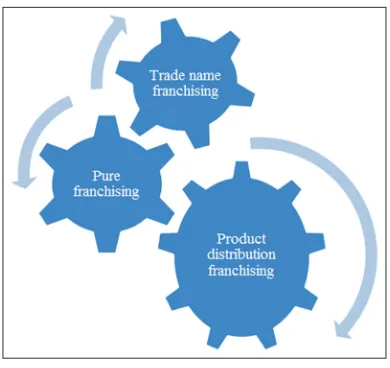
There are three types of franchises, and these are depicted in Figure 1.
2.2.1. Trade name franchising
According to Figure 1, trade name franchising is when the franchisee buys the license to use the trade name of the franchisor while at the same time not having any obligation to exclusively sell products or services that are manufactured or distributed by the franchisor which uses their brand name. For example, a franchisee can buy a trade name franchising from XWYZ Hardware for a fee, and in the hardware store, the franchisee can stock supplies from other manufacturers (McDonell, Mcphee and Associates, 2009; Khanka, 2012)
2.2.2. Product distribution franchising
2012; McDonell, Mcphee and Associates, 2009). In some cases, the franchisor does not require the franchisee to pay a fee, but it will only sell their products to the franchisee at a certain markup price that will be able to cover for their fees and royalties they could have charged the dealerships or distributors (Khanka, 2012; McDonell, Mcphee and Associates, 2009). Under this type of franchising, the franchisor is not involved in the day-to-day running of the franchised business operations but only more concerned about managing the reputation of their products hence they allow them to use their trademark in their marketing activities (Khanka, 2012; McDonell, Mcphee and Associates, 2009).
2.2.3. A business format (pure or comprehensive) franchising
In general, a business format franchising enables the franchisee to buy a franchise license to use the trademark and the business format also known as the way of doing things. The way to do things includes standards of operations, physical location site, business layout specifications, management support, marketing support, employee coaching and training program, a quality management system, and many other support services. The franchisor earns most of their profit income from license fees and royalties paid by the franchisees (Khanka, 2012; McDonell, Mcphee and Associates, 2009).
2.3. Benefits of franchising to entrepreneurs
The advantages of franchising are many, and these include the following:
Provision of the functional business modeloccurswhen an entrepreneur buys a franchise they buy a business with already tested and proven business performance standards. It is a quicker way for entrepreneurs to start managing a business effectively and profitably than doing it on their own (Olutu and Awoseila, 2011). A franchise business provides entrepreneurs with the set standards of operation, which usually takes years of experience to learn if there were starting their own businesses (Olutu and Awoseila, 2011). For example, Wimpy has been operating in the United Kingdom and other European countries’ hamburger restaurant industry since 1955, and this shows that it is a proven business method (Seaman, 2017).
Reduces the possibility of business failure since most franchise systems and processes have been tried and tested for many years by the franchisors. When an entrepreneur buys a franchise, they reduce their possibility of failing since the business they would be starting has a guaranteed market and successfully tested business system (Mendelsohn, 1998).
Provision of technical advice and management training is one of the common characteristic of franchise systems. Most franchisors offer management training to their franchisees, and in some
Figure 1: Three types of franchising
cases, the franchise business outlet branch managers are hired by the franchisor themselves, not the franchisee (Mendelsohn, 1998). One of the most common causes of small business failure is the lack of management competency of the business owners’, and as a result, this has led to the provision of management training or the hiring of management employees of the franchise business outlets by franchisors (Scarborough and Zimmerer, 2006).
Immediate brand name recognition in the market is one of the advantages of franchising. Some franchise businesses have become powerful brand names hence when an entrepreneur purchases a franchise in their name they instantly start enjoying the benefits of a successful brand name (Holmes, 2003). A popular brand name attracts customers to buy the franchisees’ products or services easily than they would if the entrepreneur had started their own business with a new brand name (Stowe, 2016; Holmes, 2003). The brand symbol, trade mark, physical building location or interior layout and staff enable customers to easily recognize the brand name of the franchisor (Holmes, 2003).
Well established successful marketing programs are offered by franchise enterprises. When an entrepreneur purchases a franchise, they buy an already well-known brand name in the market (Holmes, 2003). Often the franchisor does the marketing activities on behalf of the franchisees to maintain the quality and uniformity of advertising programs while at the same time enjoying marketing costs discounts (Holmes, 2003). However, in other franchise agreements, the franchisee is required to spend a certain portion of their monthly sales on advertising or in certain cases combine their contributions with other franchisees to develop a specific advertising program that can be conducted locally, regionally or nationally (Holmes, 2003).
Uniform methods of operation are one of the key characteristic of franchises. A franchise offers the entrepreneur the advantage of uniformity in terms of the way operations are managed at all its franchise outlets. This is due to the fact that when the business is launched a set method of operation is provided by the franchisor and every franchisee is supposed to strictly follow (Salar and Salar, 2014; Verbieren et al., 2017). Hence, the quality standards of all franchisees becomes uniform since the same interior layout design, customer service and quality control processes in Washington DC or New York in the United States of America are similar to the ones being practiced in Rio de Janeiro in Brazil especially if it is an international franchise such as Starbucks or Pizza Hut (Grossmann, 2017; Barringer and Ireland, 2008).
Provision of financial supportis another good advantage of franchises. Some franchisors offer financial support to a certain limited extent to franchisees in the form of loans or leases. This financial assistance is provided to enable the franchisee to buy the required business equipment, stock or even to pay the franchise license initial fees even though generally franchisors do not offer full-scale business capital funding to franchisees (Goodman, 2013; Scarborough and Zimmerer, 2006). Most franchisors that provide direct loans to franchisees are fully aware of the fact that they will be able to recover their monies with interest when the franchise outlet starts running over a certain period of time through royalties and fees (Goodman, 2013; Scarborough and Zimmerer, 2006). Some established franchises that offer financial support to franchisees in the form of loans only help the franchisees to develop strong long term relationships with financial institutions in order for the franchisees’ to easily access loans that enable them to access start-up capital to pay for license fees, equipment, leases, building designs, inventory, and motor vehicles (Salar and Salar, 2014; Scarborough and Zimmerer, 2006).
Enjoyment of economies of scale is one of the advantages as franchisors often control all their purchases of materials and other services for all their franchisees. Therefore, when the franchise buys its stock it buys in bulk hence it is offered discounted prices and reduced transport costs which in turn lower the franchises operating costs (Mendelsohn, 1998). These reduced costs filter down to the franchisees’ as they end up having reduced expenses of running their franchise businesses hence this leads to them enjoying increased profit income (Mendelsohn, 1998).
Strategic business location selectionis another advantage associated with franchises.One of the most important indicators of business success in this 21st century for franchise businesses is location.
choose prime locations for their franchise outlets through using specialists. For example, McDonald’s and Burger King are well-known for choosing strategic locations for their franchise outlets which are close to customers to provide them with easy access and security (Talwakar, 2015).
2.4. Characteristics of a good franchisee
The characteristics that help identify a good franchisee to franchisors before they sign a franchise agreement or when they are considering selling the rights to operate multiple units to an existing franchisee include the following:
Strong work ethic and discipline (Soontiens and Lacroix, 2009).
High respect for the franchisor’s set policies and procedures hence they ensure they comply with them (Maillet, 2013).
They view the franchisor as a partner that is there to assist them to grow their business and help them satisfy customers (Maillet, 2013; Stowe, 2016).
They possess industry work experience and relevant educational qualifications (Soontiens and Lacroix, 2009).
Good franchisees ensure that they have the needed full initial capital investment, initial franchise license fees and royalty fees when they sign the franchise agreement (Soontiens and Lacroix, 2009).
They have traceable work or business references and maintain a good credit history (Soontiens and Lacroix, 2009).
Consistently generate good business or product ideas for the franchisor so that the franchise enterprise can continue to improve and be able to better serve its customers’ needs or wants at a profit despite the fact that the ideas can be accepted or rejected (Maillet, 2013).
They help maintain the reputation of the franchisor by strictly following the set methods of operation and quality control processes on an ongoing basis (Maillet, 2013).
A good franchisee ensures that they regularly pay all their royalties and other financial contributions required by the franchisor so that they do not breach the terms of the franchise agreement (Maillet, 2013).
2.5. Characteristics of a good franchisor
There are numerous characteristics that help entrepreneurs or potential franchisees to identify a good franchisor and these include:
They fully disclose all the important information in their terms and conditions statement before the franchisee signs the franchise agreement and they also maintain honesty all the time (Rapske, 2015; Stowe, 2016).
Good franchisors ensure that they choose prime locations for their franchise outlets so that franchisees are able to easily attract customer traffic and offer convenience to the target customer which leads to high profits being enjoyed (Talwakar, 2015; Spaeder, 2017).
A good franchisor offers capital assistance to franchisees even though it can be limited for instance loans to pay franchise initial license fees, purchase stock or building leases. Some good franchisors build relationships with financial institutions to help franchisees seek full capital loan assistance (Stowe, 2016; Goodman, 2013).
They highly value any form of feedback from customers or franchisees’. For instance, they tend to place suggestion boxes across all their franchise businesses to collect all the different ideas of all their franchisees to innovate based on customers’ current needs and wants (Stowe, 2016; Rapske, 2015).
Maintain high respect and good mutual relationships with franchisees. Good franchisors value the hard work franchisees perform to maintain the franchise enterprise’s brand name and set standards of operations (Stowe, 2016).
3. Research Method
This study was a literature review conceptual study on why there is a rapid growth and popularity of franchising and the data for the literature review were obtained through reviewing secondary data. According to Kinnear and Taylor (1996), secondary data are already published data collected for purposes other than the specific research needs at hand. Secondary data are most useful in the spheres of formulating the decision problem, suggesting methods and types of data for meeting information needs and serving as a source of primary data (Kinnear and Taylor, 1996). The secondary data sources that were used to review the literature review in the study included the following: Published academic journal articles, trade publications, global research reports, management and entrepreneurship textbooks, online magazines, and company websites (Martin et al., 2002).
4. Findings
The reviewing of the literature pointed out that there is an accelerated increase in the number of global entrepreneurs and this has been exacerbated by franchising as many new entrepreneurs seem to be favoring its ease of formation and the proven business format it offers (Scarborough and Zimmerer, 2006). Another significant study finding during the review of the literature highlighted that franchising today has led to the growth of the export industry of many developed economies, namely, the United States of America, Germany, The United Kingdom, Switzerland, Sweden, Australia, Canada, France, and Japan. This is due to the accelerated growth of new emerging foreign markets in Asia (China, India, Singapore, Malaysia, South Korea, Thailand, Vietnam, and many others), Africa (Zimbabwe, South Africa, Uganda, Nigeria, Botswana, Zambia, Tanzania, Namibia, Kenya, and many others), Latin America (Brazil, Mexico, Argentina, Chile, and many others), and Eastern Europe (Russia, Bulgaria, Belarus, Romania, and many others) (Alon and Mckee, 2006; Ojo, 2008; Kong, 2017; Barringer and Ireland, 2008; Alon and Mckee, 2006). The study findings from the review of the literature clearly highlighted that in most developing countries and new emerging markets push factors, namely, high urbanization, government new investment promotion incentives, market saturation, high competition, and many other factors had led to the accelerated growth of franchising in these countries (Alon and Mckee, 2006; Ojo, 2008).
5. Theoretical and Practitioner Implications
There were numerous theoretical implications identified in the study based on the literature review findings. The implications included the following:
Based on the study findings entrepreneurs before entering into any form of franchise purchase agreement they should first ensure that they analyze the operating history of the potential franchisor, namely, sales revenue figures, profitability, quality of services or products, and marketing strategies. A franchisor with strong sales revenue income and high profitability clearly indicates that the franchise system has an effective business format and well-established market or brand name.
Another implication for the increased growth in the export industry in developing countries and new emerging markets as a result of franchising is that franchisors that intend to expand their operations beyond their national borders or increase their sales revenue must ensure that they implement extensive, effective marketing programs (such as online marketing, media advertising, public relations, and sales promotions) to boost their brand awareness in the targeted foreign markets or countries (Alon and Mckee, 2006; Ojo, 2008).
Entrepreneurs when they purchase franchises they should ensure that they buy franchise outlets that are strategically located where there is high customer traffic, good security, easy car parking, and supporting businesses to help avoid business failure (Spaeder, 2017; Talwakar, 2015).
Literature review findings of the study seem to clearly point out that most entrepreneurs prefer franchise businesses due to their proven business formula and established markets. It is strongly recommended that entrepreneurs should be aware that franchise businesses are not immune to business failure and they also require the appropriate management skills and competency in order for them to operate profitably. The hiring of competent and qualified employees is critical when running franchise businesses (Webber, 2013).
It is important for entrepreneurs to first take into full consideration the level of independence they are allowed in a franchise agreement to make their own decisions and or implement significant business operational changes before they sign the franchise purchase agreement. In general the franchisee simply has to follow the management instructions written in the franchise agreement handbook which often covers issues such as business operating hours, quality control processes, customer service training, management accounting support, codes of ethics, policies and procedures, dress codes, privacy or secrecy contracts, inventory management, and so on (Mendelsohn, 1998). Thus, any efforts by the franchisee’s to implement their own ideas will be a breach of the franchise agreement as they may end up changing the set standards of operations (Mendelsohn, 1998). In general, due to the fact that the franchisee has to adhere to the agreed methods of operations stipulated by the franchisor they do not have the independence to make their own decisions and entrepreneurs who view themselves to be autonomous and enjoy being in control of their day-to-day activities are strongly recommended to start their own businesses or find franchise agreements that allow them to have some form of independence (Webber, 2013; Mendelsohn, 1998).
6. Conclusion
Therefore, based on the study literature findings it can be concluded that franchising has now become a popular form of starting up a small business and is now preferred by most entrepreneurs. The literature findings have also clearly assisted in concluding that a good franchisor assists franchisees with training support and provides prime locations for franchise outlets. In addition, good franchisees pay their initial license fees regularly, adhere to the strict franchise outlet operations manual rules and maintain high-quality customer service. In conclusion, the study findings have identified that it is important for entrepreneurs to ask themselves questions before signing a franchise agreement as they will be legally obliged to follow the franchisor’s rules and regulations when they are operating their franchise business.
References
Alon, I. (2008), The evolution of business: Restaurant franchising in China. Home China Currents, 7(2). Available from: http://www.chinacenter.net/2008/china_currents/7-2/the-evolution-of-business-restaurant-franchising-in-china. [Last retrieved on 2015 Sep 14].
Alon, I., McKee, D. (2006), Service Franchising: A Global Perspective. New York: Springer Science, Business Media Inc. p93.
Barringer, B.R., Ireland, R.D. (2008), Entrepreneurship: Successfully Launching New Ventures. 2nd ed. New Jersey: Pearson Prentice-Hall. p440-460.
China Chain Store and Franchise Association. (2015), Current and Upcoming Trade Shows and Trade Events by China Chain Store and Franchise Association (CCFA). Available from: http://www.chinaexhibition.com/ china_trade_shows_organizer/211-China_Chain_Store_and_Franchise_Association_%28CCFA%29.html. [Last retrieved on 2017 May 18].
Ferrell, O., Hirt, G. (2000), Business: A Changing World. 3rd ed. New York: McGraw-Hill Incorporation. p152, 301-345.
Ferretti, E. (2011), Food’s Five Biggest Secret Recipes, and How They Are Kept Safe. Available from: http://www. foxnews.com/leisure/2011/04/05/foods-biggest-secret-recipes-kept-safe. [Last retrieved on 2017 Aug 26]. Global Agricultural Network Report. (2015), Franchise Restaurants Doing Well Despite Slowing Economy.
Available from: http://www.gain.fas.usda.gov/Recent%20GAIN%20Publications/Franchise%20 Restaurants%20 Doing%20Well%20Despite%20Slowing%20Economy_Moscow%20ATO_Russian%20 Federation_5-18-2015.pdf. [Last retrieved on 2017 May 24].
Goodman, M. (2013), Franchisors Offer Their Own Financing Programs. Available from: https://www.entrepreneur. com/article/225195. [Last retrieved on 2017 Jun 04].
Grossmann, R. (2017), The Pros and Cons of Franchising Your Business. Available from: https://www.entrepreneur. com/article/289095. [Last retrieved on 2017 Jun 05].
Hee, R. (2015), Asia’s Appetite for Franchising Exceeds Expectations in Singapore (Hong Kong Trade Development Council Research). Hong Kong: HKTDC. Available from: http://www.economists-pick-research.hktdc.com/ business-news/article/International-Market-News/Asia-s-Appetite-for-Franchising-Exceeds-Expectations-in-Singapore/imn/en/1/1X000000/1X0A0XMN.htm. [Last retrieved on 2017 Jun 05].
Holmes, D.E. (2003), The Advantages and Disadvantages of Franchising. p1-8. Available from: http://www.holmes-lofstrom.com/z_pdf/articles/franchisors/FranAdvantages.pdf. [Last retrieved on 2017 Jun 04].
Khanka, S. (2012), Entrepreneurial Development for B.Com, M.Com. and MBA Students of all Indian Universities. New Delhi: S. Chand & Company Ltd. p730-731.
Kinnear, T., Taylor, J. (1996), Marketing Research: An Applied Approach. 5th ed. New York: McGraw-Hill. p175. Kong, A. (2017), Franchising Trends, Opportunities and Challenges across Asia. P2. Available from: http://
www.wipo.int/edocs/mdocs/sme/en/wipo_smes_sin_07/wipo_smes_sin_07_1_b.pdf. [Last retrieved on 2017 Jun 04].
Libaya, J. (2015), The History of Franchising as We Know It. Available from: http://www.articles.bplans.com/the-history-of-franchising-as-we-know-it. [Last retrieved on 2017 Jun 06].
Maillet, W. (2013), Top Ten Qualities of a Successful Franchisee. Canadian Franchise: The Magazine for Franchisee. Available from: http://www.canadianfranchisemagazine.com/expert-advice/top-ten-qualities-of-a-successful-franchisee. [Last retrieved on 2017 Jun 06].
Martins, J.H., Loubser, M., van Wyk, H. (2002), Marketing Research: A South African Perspective. Pretoria: UNISA Press. p253-307.
McDonell Mcphee and Associates. (2009), Types of Franchising. Available from: http://www.franchiseconsulting. net.au/Franchise-articles/Franchise-articles/3-Basic-types-of-a-Franchise.asp. [Last retrieved on 2017 Jun 06]. Mendelsohn, M. (1998), The Franchisee’s Guide. 6th ed. London: Franchise Council of Australia. p27-34.
Ojo, O. (2008), Franchising: Hybrid organizational arrangement for firm growth and national development. Lex ET Scientia International Journal, 2, 113-116. Available from: https://www.ceeol.com/content-files/docu-ment-266883.pdf. [Last retrieved 2016 May 27].
Olutu, A., Awoseila, F. (2011), Reinventing business growth through franchising in developing economies: A study of the Nigerian fast food sector. International Journal of Marketing Studies, 3(1), 163-164. Available from: http://www.ccsenet.org/journal/index.php/ijms/article/view/9284/6850. [Last retrieved on 2016 May 27]. Rapske, R. (2015), Traits of a Successful Franchise Owner. Available from: http://www.thefranchisegenie.com/
traits-of-a-successful-franchise-owner. [Last retrieved on 2017 Jun 04].
Ribeiro, C.C. (2008), Franchising in Brazil (International Franchise Association). Rio de Jainero: International Franchise Association. Available from: http://www.franchise.org/franchising-in-brazil. [Last accessed on 2017 Jun 04].
Behavioral Sciences, 122, 517-518. Available from: http://www.ac.els-cdn.com/S1877042814014025/1-s2.0-S1877042814014025-main.pdf?_tid=69cf20e0-4975-11e7-97be-00000aacb35e&acdnat=1496615609_1b5c4 2a02a68ff1a003f4f8f316f32dcp515-p519. [Last retrieved on 2016 May 27].
Scarborough, N., Zimmerer, T. (2006), Effective Small Business Management. 8th ed. New Jersey: Pearson Prentice Hall. p99-125.
Seaman, R. (2017), History of Franchising. Available from: http://www.theukfranchisedirectory.net/page/history-of-franchising.php. [Last retrieved on 2016 Oct 10].
Soontiens, W., Lacroix, A. (2009), Personality traits of franchisees-McDonald’s restaurants in Australia. Problems and Perspectives in Management, 7(1), 239-240. Available from: http://www.businessperspectives.org/jour-nals_free/ppm/2009/PPM_EN_2009_01c_Soontiens.pdf. [Last retrieved on 2017 May 11].
Spaeder, K. (2017), How to Find The Best Location. Available from: https://www.entrepreneur.com/article/73784. [Last retrieved on 2016 Oct 10].
Stowe, S. (2016), 15 Top Characteristics of a Great Franchisor. Available from: http://www.franchisebusiness.com. au/news/15-top-characteristics-of-a-great-franchisor. [Last retrieved on 2017 Jun 06].
Talwakar, P. (2015), Why are McDonald’s and Burger King Usually Located Near Each Other? Fast Food Location Game Theory. Available from: http://www.mindyourdecisions.com/blog/2012/10/23/why-are-mcdonalds-and-burger-king-usually-located-near-each-other-fast-food-location-game-theory/#.Vfd_JX0WK1s. [Last retrieved on 2017 Jun 07].
Verbieren, S., Cools, M., van den Abbeele, A. (2017), Franchising: A Literature Review on Management and Control Issues. p12. Available from: https://www.lirias.kuleuven.be/bitstream/123456789/211308/2/verb. [Last retrieved on 2017 Jun 07].
Webber, R. (2013), An Introduction to Franchising. Hampshire: Palgrave MacMillan. p36-41.