Emerging Identities
In earlier chapters, you read about the concept of identity. Your identity is the set of characteristics and values you use to express who you are. Different groups within a country can have their own identities, as can individuals. We recognize that some people may dress differently or follow different religions, speak different languages, and hold different perspectives or points of view. These are all ways of expressing an identity.
Key
CONCEPT
▲
In what ways did the Métis have an impact on the
development of Western Canada?
Chapter
INQUIRY
Citizenship and Identity
One important result of contact between First Nations and Europeans was the emergence of the Métis[may-TEE]. The Métis population grew quickly, spreading across the land. By the mid-1800s, it was in Red River, Manitoba, however, that the largest number of Métis lived. The different groups of Métis who lived in Red River came together as a solid community with a shared identity. They considered themselves citizens of a Métis Nation, distinct from the Europeans, Canadiens, and First Nations.
Brainstorm reasons why you think it is important to respect another person’s or community’s identity. What could happen if we do not?
Think
AHEAD
▲
Points of View and Perspectives on
Métis Identity ]
Different people described the Métis in different ways. As you read the following comments, think about how each one describes the identity of the Métis people.
They
one and all look upon themselves as members of an independent tribe of natives, entitled to a property in the soil, to a flag of their own,
and to protection from the British government.
—William McGillivray, fur trader, 1818
We may be a small community … but we are men, free and spirited men, and we will not allow even the Dominion of
Canada to trample on our rights.
—Louis Riel, Métis leader, 1869
They are the ambassadors between East and West.
—Lord Dufferin, Governor General of Canada, 1872
Identity
is multi-layered. While I paint flowers to express and celebrate my Métis-ness … I also have other reasons that don’t necessarily have anything to do with me being Métis.
They have more to do with a broader sense of myself as a member of the human race desiring to contribute something positive to the world.
—Christi Belcourt, Métis artist from Lac Sainte-Anne, Alberta, 2002
We are Indian, we are white We are rejected by them both Although we are so lost between
We continue in our growth As a Métis
—Joel Anderson, 10-year-old Métis from Manitoba, 1982
Source: Entry on “Métis” in The Canadian Encyclopedia(Toronto: McClelland & Stewart, 1988), p. 1345.
Whether we are in class, at home, or out with friends, we are often asked to share our thoughts on different topics. The Skill Check feature
in this chapter,
Develop an Opinion, shows you how to do this. This skill
is important to your studies because it will help you become a critical thinker. The project at the end of the chapter will ask you to form and state your opinion on Métis leader Louis Riel.
Honing
Your Skills
Source: Hope MacLean, Indians, Inuit, and Métis(Toronto: Gage Publishing Ltd., 1982), p. 101.
Source: Alexander Morris, The Treaties of Canada with the Indians(Toronto: Belfords
& Clarke, 1880), pp. 293–295.
Source: Jennifer Brown, Strangers in Blood(Vancouver: University of British Columbia Press, 1980).
W
hen we see and experience the world around us, we form opinions about the people, places, and events in it. An opinionis a person’s thoughts or beliefs on something. We are all individuals, and our identity, values, and knowledge influence our opinions. This Skill Check feature will show you how to put careful thought into forming and stating your opinion.S
KILL
C
HECK
:
Develop
an Opinion
Explain the Issue ]
An issue is a question to which there are many answers, but none of the answers is right or wrong. Here is one issue: • Should school cafeterias stop selling
junk foods to students?
State Your Position
Take time to consider what you already know about the issue. Ask yourself: Do I have enough information about this issue to know how I truly feel about it? If your answer is no, then you should do more research. After you have gained a better understanding of the issue, you are ready to state your point of view. Write your opinion as a position statement; for example: school
cafeterias should stop selling junk foods to students and instead offer healthy choices such as fruit and salads.
Research for
Evidence
The goal of an opinion piece is to get the reader to agree with your point of view. This is a lot easier if you include good reasons for your opinion.
Research to find
• facts(Junk foods can be harmful.) • examples(Chocolate bars and pop, for
example, can cause tooth decay.) • figures and data(A survey of students
in my school found that 70 per cent would prefer healthy foods at lunch.) • observations(When I eat unhealthy
foods, I don’t have the energy to do the things I like, such as playing basketball.)
Write the Closing
Restate your opinion using different wording than you did at the beginning. You may also want to summarize the main reasons you hold your opinion.
You could end your piece with a thought-provoking statement or question to get the reader thinking.
Review Your Piece
• Is your position statement clear? Will readers easily understand where you stand on the issue?
• Is your opinion supported by facts and examples? Are these organized in a logical way?
• Are your spelling and grammar correct? (Proofread your piece or ask a classmate to check it to make sure.)
Read the opinion or editorial page of a local or provincial newspaper. Identify one letter
to the editor that you feel is especially good. Bring it to
class and explain why you feel it is an effective
A
s you learned in earlier chapters, the first Métis were the children of First Nations women and the European men who came to North America to explore and tradefor furs. Métis lived all over North America, wherever these peoples came into contact.
It was in present-day
Manitoba, however, that the largest Métis community grew. The Francophone Métis of Red River (where Winnipeg is located today) had a unique culture and identity. In this section, you will discover how the Métis came to identify themselves as a nation.
The Demographics of
Red River ]
Although the French-speaking Métis were the largest group living at Red River, they weren’t the only people there. When we speak about the characteristics of the people of a particular place, we are
referring to the demographicsof the place. Demographics include information such as the number of people who live in a town. The ratio of male to female residents is another example.
By 1840, there were about 4000
Francophone Métis in the region. They were mainly Catholic, like their Canadien
ancestors. However, they also kept some of their First Nations spiritual beliefs. About 1000 other people also lived near Red River: • Country Born Métis.The Country Born
were the children of First Nations women and British traders from the Hudson’s Bay Company. Like their fathers, the Country
What are the origins of the Métis culture in Red River?
Focus
An Emerging Identity in the West
Figure 8.1 Red River was located where the Assiniboine [uh-SIH-nih-boyn] and Red Rivers meet. How might this location be important to the Métis economy? Using GIS software (or another mapping software) choose two themes of information to add to a map of this area. For example, you could include climate and vegetation layers. Then, explain how these geographical features might have contributed to the Métis sense of community and identity.
Born were usually Protestant. They also held some First Nations beliefs.
• Cree and Anishinabe [a-nih-shih-NAH-bee] First Nations.
• Roman Catholic missionaries.They began arriving in the West in 1818. The missionaries built churches and schools. These became the centres of Francophone Métis communities.
• Canadiens.They lived in St. Boniface. • British employees of the Hudson’s Bay
Company.
Shared Culture of the
Red River Métis
In Chapter 1, you examined the various aspects of culture (see page 4). You saw how the First Nations, the Canadiens, and the English colonists each had their own distinct ways of life. The Red River Métis shared a unique culture in the 1800s that helped shape their identity. They developed their own language, artistic style, poetry, music, dance, economy, and values.
Language
The Métis were raised by parents of both First Nations and European descent. This gave them the opportunity to learn several
languages, including French, English, and one or more First Nations languages.
Many Métis at Red River also spoke their own language, called Michif [mee-SHEEF]. It linked their First Nations and Canadien or English identities by mixing French, English, Cree, and Anishinabe words. Fewer than a thousand people still speak Michif in Canada today.
Figure 8.2 Many Métis women, such as Mrs. La Vallée from Waskesiu, Saskatchewan, were skilled leather workers. They decorated leather items and clothing with colourful thread, beads, tin, and other materials. Some First Nations called the Métis the “flower beadwork people.” The date of this photograph is unknown. Analyze the photo for clues that might lead you to an approximate date.
V
OICES
V
OICES
Some Michif Phrases
Tánishi kiya?
Dishinikáshon Alice. Tánde wékéyan? Marsé eki pe'itoteyek.
How are you?
My name is Alice.
Where do you live?
Thank you for coming.
1. Some people are trying to make sure that the Michif language never disappears. Think of some ways a community can help keep a language alive. 2. Some Canadians learned
another language before they learned English. Should these people make an effort to maintain their first languages? Write a short opinion piece on this issue.
Pierre Falcon (1793–1876), “The Bard of the Prairies”
Pierre Falcon was one of the best-known Métis poets and songwriters. He was a Francophone-Cree fur trader who later farmed at Red River. His songs tell the stories of important events in Métis history. For example, he wrote a song about the armed clash at Seven Oaks (a battle you will read about in the next section).
…We took three foreigners prisoners when We came to the place called Frog, Frog Plain. They were men who’d come from Orkney, Who’d come, you see,
To rob our country.
Well, we were just about to unhorse When we heard two of us give, give voice.
Two of our men cried, “Hey! Look back, look back The Anglo-Sack coming for to attack” …
Source: Margaret Arnett MacLeod, comp. and ed.,
Songs of Old Manitoba (Toronto: Ryerson Press, 1959), pp. 5–9, translated by James Reaney.
Falcon also wrote ballads about life in the fur trade and on the buffalo hunt. Métis sang his songs as they sat around campfires or paddled canoes. Falcon Lake in Manitoba was named after him.
Identity
Identity
Figure 8.3 Pierre Falcon. Are song lyrics primary or secondary sources of information? Refer to the Skill Check feature on page 6 to remind yourself of the differences between these types of sources.
Open the Voices and VisionsCD-ROM to hear one of Falcon’s songs sung by Métis people of present-day Manitoba.
Tech Link
Figure 8.4 Members of the Turtle Mountain Dancers, a Métis troupe, performing at the Manitoba
There are different views on the question “Who is a Métis?” About 300 000 people identified themselves as Métis in the 2001 Canadian census.
Like their ancestors, present-day Métis face many challenges. They still struggle for land rights and hunting and fishing rights. The Métis have formed associations that promote their identity. These groups also help the Métis in their struggle to gain rights and opportunities equal to those of the First Nations.
Shared Economy[]
Over the years, the Métis developed a unique economy. They made a living based on the climate of their territory and on the resources found in it. They took jobs in the fur trade and hunted the buffalo that grazed in the western grasslands. When they
weren’t hunting, they grew crops on narrow river lots, similar to the seigneurial system used in Québec. The Métis expressed both their First Nations and European or
Canadien identities through this mix of fur trading, hunting, and farming.
The Métis in the Fur Trade
The Métis were very important to the success of the fur trade. They were employed at every trading post and supplied buffalo meat to the people who lived there. Many Métis knew two or more languages, so they often acted as
interpreters. They worked in all aspects of
Figure 8.6 A York boat. Reaching 12 metres in length, the boat required six to eight rowers. If a breeze was blowing, the boat flew along under sail. It was too heavy to carry, so it was dragged across the portages on wooden rollers. List some advantages that the York boat had over the canoe. Can you think of any disadvantages?
the trade, as trappers, traders, and freighters. To deliver the furs, the Métis rowed large York boats. These boats replaced canoes as the main means of transportation on western rivers and lakes.
The Buffalo Hunt
The Métis from Red River were expert buffalo hunters. The hunt became the focus of their way of life. Before setting out, they chose a council to organize the hunt. They also chose a set of captains to lead the hunt.
After the hunt, the women cut up the meat. Back at camp, they spread it out to dry and then pounded it into shreds. They mixed the shredded meat with fat and berries to create a food called pemmican. The Métis took the pemmican to the trading posts, where they sold it to the fur traders. Pemmican was a very important food for people in the West. It could keep for years. No explorer or fur trader would venture onto the plains without a bag of it to eat.
An Independent People
The Cree called the Métis the
Otipemisiwak[oh-tee-puh-MIH-soo-ak], a word that means “the people who govern themselves,” or “the people who are their own bosses.” This term refers to the fact that the Métis often worked for themselves as independent traders, hunters, and farmers.
Figure 8.7 The Métis invented a unique form of transportation called the Red River cartto haul buffalo meat. These carts had large wooden wheels that were wrapped in buffalo hide. The cart was also used as a boat. The wheels were removed and hooked to the bottom. Why do you think it became the most dependable form of transportation in the Canadian West?
Open the Voices and VisionsCD-ROM to see a video called “The Country Wife.” This will give you an idea of the lives of women in nineteenth-century Métis society.
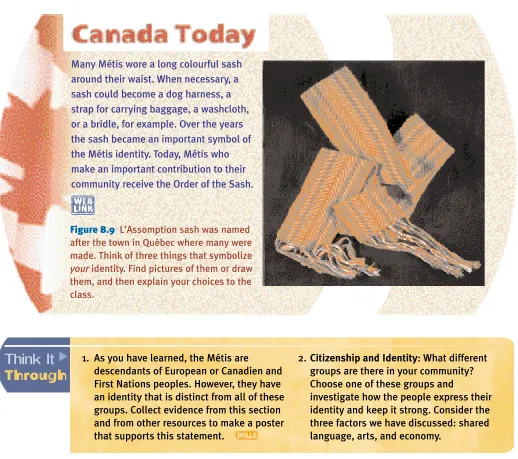
Many Métis wore a long colourful sash around their waist. When necessary, a sash could become a dog harness, a strap for carrying baggage, a washcloth, or a bridle, for example. Over the years the sash became an important symbol of the Métis identity. Today, Métis who make an important contribution to their community receive the Order of the Sash.
Figure 8.9 L’Assomption sash was named after the town in Québec where many were made. Think of three things that symbolize
youridentity. Find pictures of them or draw them, and then explain your choices to the class.
1. As you have learned, the Métis are
descendants of European or Canadien and First Nations peoples. However, they have an identity that is distinct from all of these groups. Collect evidence from this section and from other resources to make a poster that supports this statement.
2. Citizenship and Identity: What different groups are there in your community? Choose one of these groups and
investigate how the people express their identity and keep it strong. Consider the three factors we have discussed: shared language, arts, and economy.
Think It
Through
▲
Figure 8.8 Métis Hunting Buffalo on Horseback, painted by Paul Kane, 1848–1852. There were strict rules to guide the buffalo hunt. The rules were enforced by the captain and his “soldiers.” Here are a few examples: 1. No hunting buffalo on Sunday 2. No lagging behind or going forward
without permission
3. No running buffalo before the general order
I
n the early 1800s, a Scottish nobleman named Lord Selkirk bought a huge piece of land from the Hudson’s BayCompany. It was located where the Red and Assiniboine Rivers meet in present-day Manitoba. He brought dozens of families to the land from the Highlands of Scotland, where they were being forced off their farms to make room for sheep pastures. Selkirk hoped that the Highland Scots would be able to turn the land at Red River into a great farming colony.
However, as you have just learned, this land was not empty. A large Métis community was already living there. In this section you will examine the conflict that developed between the new colonists and the Red River Métis. You will also assess the
impact of these events on development in the West.
Métis Reaction to the
Colonists[]
The Métis had no legal papers to say they owned the land they had been farming for more than 100 years. They feared the colonists would try to push them off their farms. The Métis were also concerned that their way of life could be overrun by the British culture of the colonists.
The North West Company employees (called Nor’Westers), who were allied with the Métis, also opposed the colony. The North West Company was competing against the Hudson’s Bay Company for control of the fur trade. The employees believed that the Hudson’s Bay Company had sent Selkirk and the colonists to disrupt their trade.
Conflict over Resources]
While the colonists prepared the land to grow their first crops, they relied on the buffalo as food. The governor of the colony worried that his colonists would starve if too much buffalo meat left the colony. So, in 1814, he banned the Métis from
exporting any meat, fish, or vegetables from Red River. This order was known as the Pemmican Proclamation.
The Nor’Westers and the Red River Métis were outraged! The buffalo meat trade was a very important part of the Métis identity and economy. Yet, the newcomers had put a stop to this trade without
discussing it with the Métis.
Together the Nor’Westers and the Métis set about driving the Selkirk colonists from
How did the arrival of colonists threaten the identity of the Red River Métis?
Focus
Conflict at Red River
Figure 8.10 The Hudson’s Bay Company territory in Western Canada was known as Rupert’s Land. This map shows the
boundaries of the Selkirk colony. Officially, it was called Assiniboia [uh-sih-nih-BOY-uh], but it was commonly called the Red River Colony. Why might the location and size of this new colony be a concern for the Métis?
the area. They stole farm equipment and horses, and they shot off their guns to frighten the settlers. A series of natural disasters, including a locust infestation, made matters worse for the Scottish colonists. In the summer of 1815 many of them loaded their belongings into canoes and left.
Battle of Seven Oaks ]
The tensions between the remaining Scottish colonists and the Métis remained high. In June 1816, a group of Métis led by Cuthbert Grant was passing by Fort Douglas. The fort was the headquarters of the colony. The governor, Robert Semple, led an armed group out of the fort to challenge Grant.
The two sides faced each other near a grove of oak trees beside the Red River. Angry words were exchanged. Suddenly, a shot rang out! Fierce fighting followed, and
within a few minutes a Métis and 21 colonists lay dead.
Eventually, many of the key people involved in these incidents were arrested and put on trial. An investigation showed that one of the settlers was the first to open fire at Seven Oaks. The issues dividing the colonists, the Métis, and the fur-trading companies remained.
The Battle of Seven Oaks was the first time the Métis stood up as a united group against the Canadian government. Country Born Métis joined with the Francophone Métis to defend their common interests. This event marked the beginning of the Métis nation.
Migration Further West]
In 1821, the Hudson’s Bay Company took over its rival, the North West Company. This meant that the Red River Colony and all the
a) How did the Selkirk colonists and the Hudson’s Bay Company show a lack of respect for the Métis identity and way of life?
b) How did the Métis respond to this threat to their identity?
c) Can you think of any other ways the Métis and the colonists could have tried to resolve the conflict?
d) How do Canadians resolve conflicts like this today?
Think It
Through
▲
land surrounding it now belonged to the British. There would be no further violent clashes between the two fur-trading companies. Red River recovered from its troubled beginnings. It grew into a stable community. Not all the Métis were content to stay, however.
One important business for the Red River Métis was the buffalo robe trade. As you know, the Métis had long hunted the buffalo. During the 1840s, there was increased demand for the furry hide of the animals. The hides were made into blankets and coats. Buffalo fur was thickest during the coldest months. Therefore, Métis hunters and their families spent the winter on the plains close to the herds.
As the buffalo began to die out, hunters had to travel very far from the Red River Colony to find a herd. As a result, many Métis were away from their homes and farms in Red River for most of the year. Some gave up farming in favour of hunting buffalo out on the plains. They migrated, or moved, west and set up communities such as Batoche (near Duck Lake, Saskatchewan) and St. Albert (in Alberta). They also settled in the Cypress Hills in southern
Saskatchewan. Catholic missionaries who ran churches and schools joined the Métis in these new communities. These were some of the earliest Francophone communities in Western Canada.
T
he Red River Métis felt that Rupert’s Land belonged to them. They had beenliving there with their families for over 100 years. Their livelihood depended on being able to farm, trap animals, and hunt buffalo in this vast territory. However, the government of Canada was beginning to see it as a good place to send more European colonists. This section investigates these differing perspectives on Rupert’s Land.
Canada Takes an
Interest in the West ]
For many years, outsiders believed that the prairies were barren lands that could not be
farmed. This vast territory, known as Rupert’s Land, was left to the Aboriginal people who lived there.
Things began to change during the 1850s. In 1857, the Canadian government sent scientific teams to the West. They wanted to learn about the climate and resources of the area. The scientists reported that parts of Rupert’s Land were well suited to farming. They also said the land had a wealth of natural resources. Suddenly, outsiders started to take notice of the West.
At the same time, good farmland was becoming scarce in Ontario. People began to look outside central Canada for new areas to colonize. Rupert’s Land looked like just such a place. Many Ontarians felt it was time for Rupert’s Land to join Canada.
How did the conflicting points of view between the Métis and the government affect the identity of
the Métis and the future of Rupert’s Land?
Focus
Red River Resistance, 1869
Points of View on
the West ]
Different people in Canada had different ideas about the future of the West.
I am perfectly willing to leave Rupert’s
Land a wilderness for the next half
century, but I fear that if the Canadians
do not go in, the Yankees will, and with
that fear I would gladly see a crown
colony established there.
—John A. Macdonald, 1865
Source: J. Bradley Cruxton and W. Douglas Wilson, Flashback Canada
(Toronto: Oxford University Press, 2000), p. 82.
Figure 8.15 Sir John A. Macdonald was the first Prime Minister of Canada. He served from 1867 to 1873 and from 1878 to 1891.
This is our land! It isn’t a piece of
pemmican to be cut off and given in little
pieces to us. It is ours and we will take
what we want.
—Pitikwahanapiwiyin (Poundmaker), 1874
Source: Peter Erasmus, Buffalo Days and Nights(Calgary: Fitzhenry & Whiteside, 1974), p. 244.
Figure 8.16 Pitikwahanapiwiyin, known in English as Poundmaker, was a well-respected Cree leader at the time Rupert’s Land was being sold to Canada. He voiced the concerns of many First Nations people living in the region.
Let the merchants of Toronto consider
that if their city is ever to be made really
great—if it is ever to rise above the rank
of a fifth-rate American town—it must
be by the development of the great British
territory lying to the north and west.
—George Brown
Source: The Globe
newspaper, 26 December 1856.
Rupert’s Land Joins
Canada ]
By the 1860s, the Red River Colony was connected by a steamboat route to
Minnesota in the United States. A trickle of American newcomers was arriving. Trade with the US was growing steadily. Some people in Ontario who favoured western expansion and some British colonists in Red River began to worry that if Canada did not quickly claim Rupert’s Land, the United States would.
Following Confederation in 1867, the government of Canada began talks with the Hudson’s Bay Company. In 1869, they
struck a deal. Canada purchased the territory from the HBC for $1.5 million.
Fears of Assimilation ]
Now Canada claimed to own Rupert’s Land. The First Nations and Métis living there felt uncertain about their future. They had not been consulted about the sale of the land. The West belonged to them, they said. It could not be bought and sold by outsiders.
The First Nations and Métis were also worried about assimilation. Assimilationis a process by which a culture or individual is absorbed into another culture. Sometimes whole cultures or individual members may assimilate by choice. In this case, members of the culture freely adopt another group’s culture and language. But sometimes assimilation is forced on people. The Aboriginal peoples worried that they would be forced to give up their way of life. They feared they would become like the English-speaking newcomers who were moving into the West. They had many questions:
• Would there be a role for Métis and First Nations in the new government?
• Would the Red River Métis be able to keep their French language and Catholic religion?
• Would they be able to keep their farms and way of life?
• Would English-speaking Protestants from the East overwhelm them?
At that time, there were few answers.
The Red River
Resistance, 1869 []
Canada was ready to take control of Rupert’s Land on 1 December 1869. Just before this, the federal government sent surveyors to Red River. Their job was to Figure 8.17 The Métis divided up their farmland
prepare the land for the expected rush of farming colonists. The government did not warn the local First Nations and Métis that the surveyors would be coming in October of 1869. So, when the Métis saw these strangers measuring lots along the river, they confronted them and asked them to explain what they were doing. However, the surveyors spoke only English and the French-speaking Métis could not
understand them. So, they sent for one of their fellow villagers, a Métis named Louis Riel, who spoke French, English, and Cree fluently. Riel stopped the surveyors in their tracks and told them to leave Red River immediately.
Although they had bought themselves some time, the Métis knew the surveyors would be back. In the meantime, they had to decide how they would protect their land from what they saw as a foreign
government. The Métis were used to governing themselves. They set up a
National Committee to protect their right to the land. Louis Riel became an important
member of the committee. He was a
member of a well-known Métis family in the Francophone community of St. Boniface. Riel was a devout Roman Catholic who had been studying to be a priest in Montréal.
In December the Métis took control of Fort Garry, a major fur-trade centre in Manitoba. There they established a Métis Provisional Government (provisionalis another word for temporary). They chose Louis Riel, a 25-year-old Métis who was passionate about his people’s rights, to be president.
Métis Bill of Rights [
If they had no choice about joining Canada, the Métis at least wanted to negotiate terms. The provisional government drew up a Bill of Rightsto present to the government of Canada. It was a clear attempt to protect the varied interests of the peoples already living in the territory. It was also a clear demand for certain provincial powers, such as the right to elect a legislature.
Figure 8.18 This image shows the Métis National Committee in 1869. Louis Riel is seated in the centre of the middle row. He became the leader of the Métis resistance to the government’s takeover. What qualities made Riel an effective leader for the Métis?
• Either French or English would be used in the Legislature. Government documents would be printed in both languages. • Laws for the new province would be
decided by the residents.
• The Métis would keep the rights to their land.
• Local officials (sheriffs, magistrates, school commissioners, and so on) would be elected by the local people.
French and English
Canada Take Sides [
Not everyone in Red River supported the Métis resistance. Members of the “Canada Party,” for example, were looking forward to the Canadian takeover. This group was made up of English-speakers originally from Ontario or Britain, and they were furious at the actions of the Francophone Métis. Some of them took up arms against the
provisional government. The Métis put them in jail. One of these prisoners was Thomas Scott, a 28-year-old labourer from Ontario. Scott threatened to kill Riel and insulted his Métis guards until they lost patience with him. He was put on trial, found guilty, and placed in front of a firing squad. It is still unclear today whether the guards were ordered only to scare Scott or to fire at him. Nevertheless, he was shot and killed.
The Anglophone Perspective
Scott was an English-speaking Protestant. His death set the huge British population of Ontario against the Métis Provisional Government. Newspapers in Ontario called for revenge against the Métis leaders who were responsible.
The Francophone Perspective
The Canadiens in Québec reacted differently. The Red River Métis were mainly Francophone Roman Catholics. (Remember, for example, that Louis Riel was a Francophone who had been educated to be a priest.) Because of this, many
Canadiens saw the Métis as defenders of the Francophone Catholic way of life in the West. The Canadiens took up the cause of the Métis as their own and demanded that they be given their rights.
The conflict between the Francophone Métis and English-speaking colonists in the West revived the old anger between the English-speaking Protestants in Ontario and the French-speaking Roman Catholics in Québec. The situation at Red River threatened to become a national crisis.
1. At the time and since, some people have called the creation of the provisional government in Red River a “rebellion.” This text uses the term resistance. Consult your dictionary and discuss as a class the differences between these two terms. Then, write your own answers to the following:
a) Why did the Métis feel they needed the provisional government?
b) Were the Métis trying to overthrow the government of Canada?
c) Were the Métis attempting to set up an independent nation of their own?
d) Why do you think the Métis people today refer to this event as a “resistance?” 2. a) Why do you think people might fear
assimilation? Create a web diagram to show your thinking, or write a short opinion piece following the guidelines in the Skill Check feature on page 170. b) Do some research at the library or on
the Internet to find out about some Métis organizations that promote Métis identity today. Give a short description of one of them, and explain its importance to the Métis community it serves.
Think It
Through
▲
To see images of Louis Riel at different stages of his life, open Chapter 8 on your
Voices and Visions
CD-ROM.
P
rime Minister John A. Macdonald wanted to find a solution that would seem to please all sides in the Red Rivercrisis. The Métis Provisional
Government sent representatives to Ottawa with its Bill of Rights. The prime minister recognized the provisional government as legal. He met with them and agreed to almost all the items on the list. In July 1870 the government passed the Manitoba Act, which created the province of Manitoba.
But this solution was not as easy as it sounds. This section investigates the compromises that were necessary to bring Manitoba into Canada.
The Manitoba Act
The Manitoba Act created Canada’s fifth province. Some of the important terms of the Act were the following:
• Manitoba would have its own provincial government.
• Both French and English would be used in the government and courts.
• The province would be able to send four elected members to the House of
Commons in Ottawa and two members to the Senate.
• There would be two publicly funded school systems, one for Protestants and one for Catholics. (It would be similar to the school system in Québec, which was meant to meet the needs of both the French-speaking Catholic majority and the English-speaking Protestant minority.) • An area of land (560 000 hectares) would
be set aside for the Métis to use. • The natural resources of the new
province would remain under the control of the federal government. (This meant that unclaimed land, for example, belonged to Ottawa.)
The Canadian government promised to grant a pardon to any Métis who had been involved in the resistance at Red River. However, in the end, a pardon was not included in the Manitoba Act.
The Creation of Manitoba
What impact did the Red River Métis have on the creation of the province of Manitoba?
Focus
Figure 8.19 Manitoba occupied only a small portion of what had been Rupert’s Land. The rest passed into the hands of the Canadian government. This larger area was called the North-West Territories, and it was ruled by officials appointed by the government of Canada. Compare this map to a modern map of Manitoba. How has it changed?
Soldiers on the March []
At the same time as he discussed Métis terms, the prime minister sent 1200 soldiers
to Red River. The government said that the soldiers were meant to keep the peace in the new province. Their job was also to defend the territory in case the United States tried to claim it. But many of the soldiers were
Ontario volunteers who thought their job was to punish the Métis and capture Louis Riel. “I should like to hang him from the highest tree,” said the commander of the troops.
Knowing that he was in danger, Riel escaped across the border into the United States. Later, the federal government agreed not to put him on trial for the death of Thomas Scott. However, it did banish him from Canada for five years. (While Riel was away the people of Manitoba showed their continued support for him by electing him to Parliament in Ottawa even though he could not serve there.)
Meanwhile, some of the soldiers took out their anger on the Métis when they arrived at Red River. Several Métis were killed. Others were jailed and beaten. It was a sour beginning for the new province.
Figure 8.20 This painting from 1877 by Frances Hopkins, the wife of a fur trader, shows the military force making its way from Ontario. It took them 13 weeks to reach Manitoba. Do you think sending the military to Red River was a good decision, or did it make things worse? Explain your thinking.
1. The Manitoba Act was a compromise between the different parties involved in the dispute at Red River. Make an
organizational chart to show what each of the following groups achieved from the compromise: First Nations, Métis, English-speaking residents, and Francophones. 2. Compare and contrast the federal
government’s Manitoba Act and the Métis
Bill of Rights. (You may want to refer to Skill Check: Compare and Contrast on page 54 before beginning.)
a) Create a chart that compares the two under different headings: language rights, education, political
representation, and so on. b) Assess the success of the Métis in
gaining their rights.
Think It
Through
▲
To see a series of 10 images about the Red River Expedition from Ontario to Red River, open Chapter 8 on your Voices and VisionsCD-ROM.
T
he creation of the province of Manitoba did not solve all the concerns of the Métis and First Nations.There were still disagreements over land ownership. Also, the Métis’ fears of assimilation grew as more and more newcomers
flooded into the area.
This section explores what happened after the government ignored the Aboriginal peoples’ complaints. You will also investigate how the
government managed to gain even greater control over the West.
Problems Persist []
When Manitoba was created, land was set aside for the Métis. Each family was supposed to receive a scrip giving them ownership to about 240 acres (97 hectares). (A scrip is like a coupon.) But the system did not work well, and many Métis did not receive their land.
Newcomers from the East did not show respect for the Métis identity and way of life. They wanted to build a society in Manitoba that was similar to Ontario’s. They dreamed of bringing in so many
Anglophones that Manitoba would become a place of English-speaking, Protestant farmers. Feeling cheated and frustrated, many Métis left Manitoba to move farther west and north where they could live as hunters, trappers, and farmers. As the buffalo began to disappear from the plains, the Métis turned to other ways of making a living, such as ranching, logging, and running small businesses.
In some of these new Western settlements, the Métis set up their own governments with their own laws. The village of St. Laurent, on the South Saskatchewan River, was one example. Gabriel Dumont became president, and an elected council collected taxes and
governed the community. The laws in the community were based on the traditional rules of the buffalo hunt (see Figure 8.8), with additional laws for keeping the peace. In other words, the Métis were looking after their own affairs as they had always done. But to outsiders, it seemed as if they were opposing the Canadian government.
Métis and First Nations
Grievances []
By the 1880s the Métis faced a number of challenges to their way of life, such as starvation and poverty that resulted from the drastically reduced buffalo population. The First Nations people were facing similar threats. In response, many First Nations people had no other option but to make treaties with the Canadian government. You will read more about those treaties in Chapter 12. The Métis were sometimes allowed to join a First Nation’s treaty, but they did not qualify for their own treaties.
Second Métis Uprising, 1885
What was Louis Riel’s role in preserving the Métis identity?
Focus
The Government Ignores Warnings
Government officials working in the area that would one day become Saskatchewan were aware of the growing tension in Manitoba. They offered advice to Ottawa about how to avoid another Métis uprising. However, the federal politicians would not listen. They were focused on what they considered a more important issue—the westward expansion of the Canadian Pacific Railway (CPR). The building of this railway through the prairies was a priority for Ottawa because it would encourage more colonists to move onto the prairies and develop the land.
Riel Returns []
The Métis and First Nations sent at least 15 petitions to Ottawa to address their concerns (outlined in the chart above). The government ignored all of them. In the summer of 1884, a group of Métis, led by Gabriel Dumont, travelled to the United
• Some Métis felt that they had been cheated out of their land in Manitoba. • Outside of Manitoba, land ownership was
unclear. Some of the Métis were living on property that had also been claimed by the Hudson’s Bay Company or the railway company.
• Newcomers were moving into the West, and the Métis feared losing their land and jobs. They also feared being assimilated into the new society that was emerging. • The buffalo were disappearing due to
over-hunting. The livelihoods of many Métis were disappearing along with them. • The federal government was ignoring their
problems. The Métis sent 15 petitions to Ottawa that were not answered.
• The government had not kept some of the promises it had made to provide food rations and farming equipment.
• The buffalo were disappearing due to over-hunting by outsiders.
• Some First Nations people were starving, in part because the government restricted their movements. This made it difficult for them to hunt and find food. The
government owed them food rations as repayment, but none were given. • With the arrival of so many newcomers,
they worried that they would not be able to hold on to what little land was left to them. • Some First Nations leaders wanted a large
territory where their people could live together. The government, however, forced the people to live on small reserves
separate from each other.
Métis Concerns First Nations Concerns
States and invited Louis Riel back to Canada. The Métis were angry and impatient that the government was not doing anything about their complaints. They wanted Riel to be their voice.
Led by Riel, the Métis set up their own government at the community of Batoche. From there, they sent a Bill of Rights to Ottawa. Among other things, they wanted the land issue solved and two new
provinces created west of Manitoba. They also demanded more food rations for the First Nations. When nothing happened, Riel suggested they take up arms. Many Métis didn’t want to go to battle because they knew they would be outnumbered.
However, Dumont was a strong supporter of Riel. Many Métis respected Dumont, and so they decided to join the uprising. Dumont was named general of the Métis forces.
Rising in Arms []
The Northwest Resistance of 1885 was violent, but brief. On 26 March, the Métis defeated a group of North West Mounted Police at a place called Duck Lake, forcing the police to retreat. A few days later, a group of Cree joined the resistance. At Frog Lake they killed nine people and captured a police post. The police and neighbourhood farm families were allowed to leave unharmed.
The Government Reacts ]
The federal government rushed thousands of soldiers west aboard the newly built railway. This army advanced on the Métis village of Batoche. Many Métis women remained in the village during the battle to help in whatever way they could. They carried food, messages, and supplies to the men. They melted down lead plates to make bullets. It wasn’t long before the Métis ran out of bullets and were firing stones and nails.
After three days of fighting, the 200 to 300 Métis and their Cree and Dakota allies surrendered. The resistance was over. A total of 53 soldiers from Ontario died in the fighting, and 118 were injured. Thirty-five First Nations and Métis people were killed.
When reading sections of text, it is sometimes helpful to try to picture in your head the people and events being described. If you prefer, you could draw sketches on paper to illustrate what you have read. This could be done in a
storyboard format, which is similar to the series of boxed drawings in newspaper cartoons.
Mistahimaskwa, Leader of the Cree
(1825–1887)
Cree Leader Mistahimaskwa, known in English as Big Bear, headed the largest group of Cree on the Plains (in the area around Frog Lake). He was very suspicious of the outsiders who were coming into the West. In 1883, Mistahimaskwa spoke to a council of Cree elders and a visiting government agent.
Long before the advent of the Palefaces this vast land was the hunting ground of my people, this land was then the hunting ground of the Plains and the Wood Crees, my fathers. It was then teeming with buffalo and we were happy. This fair Land … is now the land of the white man—the land of the stranger. Our Big Game is no more. You now own our millions of acres—according to treaty papers—as long as grass grows on the prairies or water runs in our big Rivers. We have no food. We live not like the white man, nor are we like the Indians who live on fowl and fish. True, we are prom-ised great things, but they seem far off and we cannot live and wait.
Source: Robert S. Allen, “The Breaking of Big Bear,”
Horizon Canada, vol. 5 (1987), p. 1191.
He hoped to form an alliance of all the First Nations so that they would be stronger in their dealings with the government. He feared that his people would lose their freedom, and their land, if they made a treaty. The
government promised food rations as part of the treaty agreement. In the end, the starvation of his people forced Mistahimaskwa to sign.
Even as conditions for his people got worse, Mistahimaskwa opposed the use of violence. He hoped to solve the issues through peaceful talks with the government. This did not work. Instead, fearing trouble, the federal
government made it illegal for First Nations people to leave their home reserves without permission. Such permission could only be granted by the government agent on each reserve.
When the Métis took up arms, a few Cree people joined them against
Mistahimaskwa’s wishes. After the resistance was over, the soldiers tracked down the Cree group and arrested its members. Mistahimaskwa was sent to jail for treason. He was released in 1887 but died soon after.
Biography
Biography
1. Write a letter from the government of Canada responding to
Mistahimaskwa’s speech. 2. Refer to the Skill Check feature
on page 170 to learn how to write an opinion piece. Then, write a few paragraphs stating your opinion on the government’s treatment of Mistahimaskwa. If you find you do not have enough information to write your piece, you should do some more research on Mistahimaskwa (Big Bear) on the Internet or at the library.
The Fate of Louis Riel ]
Following the resistance, more than a dozen Métis ended up in prison. Louis Riel
surrendered and stood trial for treason—the betrayal of one’s country. A jury found him guilty and Riel was sentenced to hang. Prime Minister Macdonald could have stepped in and saved Riel’s life. Twice Macdonald delayed the execution while he debated what to do.
Macdonald’s government was heading into a federal election after the trial.
Whatever decision he made, it would cost his party votes. However, the number of voters in Ontario was larger than the
number in Québec. Macdonald knew that if he sided with Ontario, his party would likely win the election.
Finally, the prime minister made up his mind. “Riel shall hang though every dog in Québec shall bark,” he was heard to say. On 16 November 1885, Riel was taken from his Regina jail cell and hanged. When news reached Québec, flags were dropped to half-mast. Macdonald was burned in effigy in the streets. The Canadiens blamed English Canadians in Ontario for Riel’s death. The Riel execution confirmed the suspicions of the Canadiens that their Confederation “partnership” with English Canada was unequal.
The Government
Tightens Its Grip [
Once the uprising of 1885 was over, the government finally responded to some of Figure 8.23 This painting shows Canadian troops surrounding the
Métis at Batoche. The Métis held the soldiers off by firing at them from the shelter of their trenches. In the end, the government troops overran the town. Imagine you are a reporter covering the battle for your newspaper. Write a story describing the scene, the colours, the sounds, and the smells. Explain the background to the fighting.
Many Ontarians thought the Métis leader Louis Riel was a traitor and a murderer. They wanted him hanged.
Canadiens considered Riel a hero. They thought of him as a defender of French
language rights and the Catholic religion in the West.
Macdonald’s Dilemma
the complaints that had led to it. The North-West Territories did not become two new provinces as the Métis had demanded in their Bill of Rights. The government began issuing scrip (certificates for land) again to Métis people at Red River. However, the Métis remembered how difficult it was to actually obtain their land the last time scrip was issued. So, this time they sold their scrip, often for much less than it was worth.
Aboriginal people in the West were punished for their role in the resistance. Along with the Métis, 44 First Nations men were found guilty of crimes. Eight of them were hanged; the rest were sent to prison. Only a few First Nations had joined the resistance, but whole communities were punished severely by having their government food rations stopped even though, in all of Canada, there were only 100 buffalo left. First Nations people were told to stay on their reserves unless they had permission from a government agent to travel. These restrictions on the First
Nations opened up the land to more European farmers. It also allowed the government to continue expanding the CPR without fear of another resistance.
As an independent nation, the Métis had tried to deal peacefully with Canada. They wanted rights equal to those enjoyed by people in other provinces, but the government ignored their requests. The outcome of the resistance set back the Métis and their struggle to be recognized as a distinct people. The government of Canada, backed by the army, gained firm control of the West. Many of the issues that led to the violence of 1885 would remain unsettled in the years to come.
Figure 8.25 This photograph shows Louis Riel (standing, centre) at his trial. Riel was found guilty of treason. What did Prime Minister Macdonald mean when he said, “Riel shall hang though every dog in Québec shall bark”?
1. Make a chart to compare the Red River Resistance (1869) to the Second Métis Uprising (1885). You may want to refer to Skill Check: Compare and Contrast on page 54 before beginning.
a) Compare the issues and concerns that led to each resistance. Compare the government responses in both cases. Also compare the outcomes of each resistance.
b) Were some of the factors the same? What do you think is the most important difference between the two events? Explain your answer.
2. a) What compromises were made by the Métis, First Nations, and Francophone and English peoples in order to create the province of Manitoba?
b) How would each group have felt about the final outcome?
To learn more about Mistahimaskwa
(Big Bear) and Pitikwahanapiwiyin (Poundmaker) and their efforts on behalf of their people, open Chapter 8 on your
Voices and Visions
CD-ROM.
Tech Link
Think It
Through
Chapter 8
PROJECT
Writing an Opinion Piece on Louis Riel
F
rom his own day to the present, Louis Riel has been a person of controversy.This chapter project challenges you to analyze this historical issue in order to form and support an opinion.
State Your Position]
Using Skill Check: Develop an Opinion (page 170) as your guide, write a one-page opinion piece on the issue: Was Louis Riel a hero, a traitor, or neither?
Research for Evidence ]
Review the details in Chapter 8 that provide facts, figures, and quotations to support your opinion. Take notes in your own words. Identify direct quotes with quotation marks, and include the page numbers where they are found.
You may also need to review information found on the Internet or at your local library.
Organize Your Opinion Piece
Before you begin writing, organize your ideas using an outline or graphic organizer.
Write Your Opinion Piece ]
Write a strong opening paragraph. Follow it with facts to support your opinion. Conclude with a thought-provoking summary. Create a title that sums up your opinion in a few words.
Polish and Present [
In a small group, share your writing. Use informal debate to discuss the differing viewpoints
regarding the issue. Take note of comments, concerns, and questions raised by other students. Decide if your piece needs more work, and then revise accordingly. Do a final proofread. Present your opinion piece in writing or as a speech.
To us, you are … the valiant leader of this population
that is strongly confident that, God willing, you will
one day bring to victory our just claims.
Source: Letter in the Riel Papers, Manitoba Archives, cited in Maggie Siggins, Riel: A Life of Revolution, (Toronto: HarperCollins, 1995), p. 364.
Had I been born on the banks of the Saskatchewan,
I would myself have shouldered a musket to fight
against the neglect of the government and the
shameless greed of speculators.
Source: Peter Russell, “Laurier and the Prairie West.” www.collectionscanada.ca/04/042423_e.html.
Louis Riel, Métis leader, executed November 16, 1885,
political martyr! Guilty of having loved his oppressed
compatriots! Victim of fanaticism, to which politicians
without soul and without heart have sacrificed him.
Source: R. Douglas Francis, et al.,
Destinies: Canadian History Since Confederation
(Toronto: Harcourt Brace Canada, 2000), p. 96.
Grievances did not give anyone the right to organize
and lead a rebellion in which more than a hundred
died.
Source: Ottawa Citizen, 22 January 1998.
And the province of Manitoba? Without our
provisional government it would still be nothing more
than a colony tied to the apron strings of Canada.
I deserve to be called the Father of Manitoba.
Source: Quoted in the Montréal newspaper the Weekly Star, August 1885.
—Residents of the Métis community of St-Louis de Langevin, 1885
—Sir Wilfrid Laurier, future prime minister, after Riel’s hanging in 1885
—A poster handed out in Québec, 1885
—Desmond Morton, historian, 1998
![Figure 8.1 Red River was located where theAssiniboine [uh-SIH-nih-boyn] and Red Riversmeet](https://thumb-us.123doks.com/thumbv2/123dok_us/334684.2030340/4.594.163.564.462.718/figure-red-river-located-theassiniboine-sih-boyn-riversmeet.webp)