Culture
Cultureis a way of life or a way of being that is shared by a group of people. Culture includes the knowledge, experiences, and values that a group shares and that shape the way its members see the world. Governments, relationships with nature, languages, and beliefs, for example, are all part of your culture. It can include the foods you eat, the clothes you wear, the sports you play, and the entertainment you enjoy.
Because culture is an active part of our lives and our identities, it changes to reflect changes in our society. However, even though a culture may change over time, it always stays associated with a particular group of people.
Societies
Key
CONCEPT
▲
Pluralistic Societies
Canada is a pluralistic society. This means that our history has helped us learn to value all cultures. We are a society made up of many groups of people. All these groups have unique identities, ideas, cultures, and ways of seeing the world. Individual members within each group have their own points of view and identity, which may be different from those of other members. Pluralismmeans that we respect and value the individual and collective opinions and identities of all people. This respect for diversity in Canada encourages the development of a vibrant, democratic society.
Long before Canada became the country we know today, the many First Nations and Inuit [IN-yoo-it] who lived here formed a pluralistic society. Each group had its own ideas, world view, language, spiritual beliefs, government, and way of life.
This chapter explores three of the groups: the Mi’kmaq [MIG-mah], Haudenosaunee [hah-duh-nuh-SAH-nee], and Anishinabe [a-nih-shih-NAH-bee]. They are the first three peoples to come in contact with the European explorers who travelled to North America in the 1400s and 1500s.
Who are the diverse Aboriginal peoples who have contributed
to the building of the country we now call Canada?
Chapter
INQUIRY
You will encounter many different images throughout this textbook. Photographs, paintings, and other illustrations can be great ways to explore a people’s history and culture—if you know how to analyze them. The Skill Check feature in this chapter will show you how to Interpret Images. At the end of the chapter, you will be asked to work with images as part of the project, in which you’ll examine the importance of cross-cultural understanding.
Read aloud each of the quotations above. On the blackboard or on an overhead, record the values you think are being expressed by each speaker. Then discuss this question: Do these values exist in the broader Canadian society today?
Think
AHEAD
T
here is a saying that a picture is worth a thousand words. It is true that images— photographs, paintings, and drawings—can give us a lot of information about history and culture. But can images always be trusted?Points of View
All types of images are influenced by the photographer’s or artist’s point of view. This means that no matter how or when an image is made, it is affected by the views, values, and culture of the person who created it.
Critical Interpretation
When viewing an image, ask yourself the following questions in order to determine how authentic, or trustworthy and reliable, it is. • What is the image about? • Who made it, and when?
• What might be the point of view of the person who
made the image? • Is the image a
primary or
secondary source? • Do other images of the same event
show similar details? What does this suggest?
• Does the image maker show any bias toward the people or events being depicted? (A bias is a personal like or dislike of something or someone that is not necessarily based on fact. The statement “I do not trust teenaged male drivers” reflects a bias against a certain group of drivers.)
• Are there any details in the image that you know to be inaccurate?
• Is this image a reliable view of real events and people?
Further Research
What questions has the image raised? What are some sources you can use to find answers?
This painting was done by a European. It is supposed to show
a Haudenosaunee village before the society had had much contact with Europeans. Point out at least three historical inaccuracies in
the painting. What biases does the artist show?
S
KILL
C
HECK
:
Interpret
Images
Primary and Secondary
Source Images
A primary source image is one made by a witness during the time an event took place. A photograph of people signing a treaty is a primary source image. So is a sketch of a battle drawn by a reporter who is on the scene.
A
s mentioned at the beginning of the chapter, the First Nations in North America are diverse peoples. For example, the Mi’kmaq, Anishinabe, andHaudenosaunee, as well as all other First Nations, have different teachings about their history and origins. In this section, we will read about a few of these teachings. We will also examine some of the values and viewpoints that these three First Nations shared.
Diversity
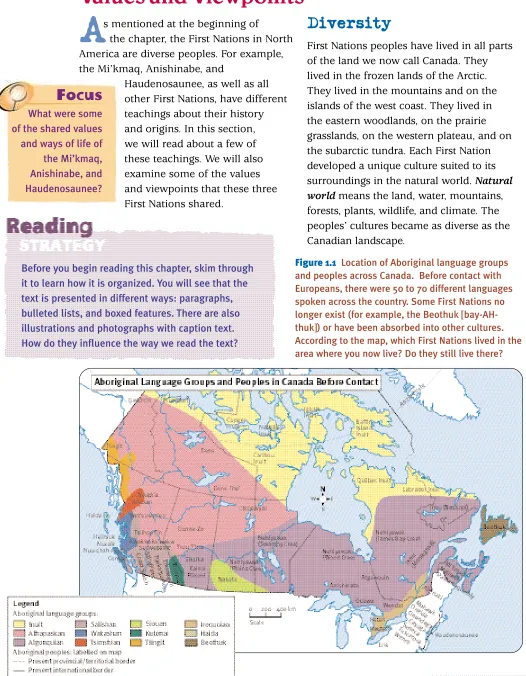
First Nations peoples have lived in all parts of the land we now call Canada. They lived in the frozen lands of the Arctic. They lived in the mountains and on the islands of the west coast. They lived in the eastern woodlands, on the prairie grasslands, on the western plateau, and on the subarctic tundra. Each First Nation developed a unique culture suited to its surroundings in the natural world. Natural worldmeans the land, water, mountains, forests, plants, wildlife, and climate. The peoples’ cultures became as diverse as the Canadian landscape.
Values and Viewpoints
What were some of the shared values
and ways of life of the Mi’kmaq, Anishinabe, and Haudenosaunee?
Focus
Before you begin reading this chapter, skim through it to learn how it is organized. You will see that the text is presented in different ways: paragraphs, bulleted lists, and boxed features. There are also illustrations and photographs with caption text. How do they influence the way we read the text?
World Views
So far, you have learned that there were many unique First Nation cultures here. However, these diverse peoples also shared some core values. Core values are important
ideas or beliefs about how people should live. Taken together, these values make up a world view. Many First Nations peoples, including the Mi’kmaq,
Anishinabe, and Haudenosaunee, shared values relating to their relationships with the Creator, the natural world, other people, and themselves. For example, they believed the following:
• People are not separate from nature or from the non-living world. Everything on earth is connected to everything else. • The wisdom and experience of the Elders
is highly valued. Elders deserve the
respect of all members of the community.
• A spiritual world exists. It plays a very important role in all that happens on earth. • People must live in harmony with each
other and in balance with nature.
Each of these values affected how these First Nations lived. However, different First
Nations also held some values that were not shared by all nations. You will investigate the diversity of the Mi’kmaq, Anishinabe, and Haudenosaunee in the upcoming sections of this chapter.
Indigenous Peoples
First Nations peoples are indigenousto North America. This means that they are the original people of this land. Each First Nation has unique beliefs about how the earth was created and how people came to exist.
These beliefs are often passed from generation to generation through
traditional teachings. Traditional teachings also help to explain the relationships
among the plants, animals, land, people, and the spirit world. On the next page is an example from the Mi’kmaq people. It tells about the creation of the earth and the first human, a man named Kluskap.
Figure 1.2 This painting is called Birth of the Earth and was created by Haudenosaunee artist Arnold Jacobs. It shows the first human, a woman, falling from the Sky World onto the back of a sea turtle. With the help of the animals, they create a continent of land around the turtle’s back. That is why some First Nations today call North America “Turtle
Some First Nations call the drum “the heartbeat of the earth.” Open Chapter 1 on your
Voices and Visions
CD-ROM to listen to a recording of a drumming piece.
On the other side of the Path of the Spirits, in ancient times, Kisúlk, the Creator,
made a decision. Kisúlk created the first born, Niskam, the Sun, to be brought
across the Milky Way to light the earth. Also sent across the sky was a bolt of
lightning that created Sitqamúk, the Earth. And from the same bolt, Kluskap was
also created out of the dry earth. Kluskap became a powerful teacher, whose gifts
and allies were great.
In another bolt of lightning came the light of fire, and with it came the
animals, the vegetation, and the birds. These other life forms gradually gave
Kluskap a human form. Kluskap rose from the earth and gave thanks to Kisúlk
as he honoured the six directions: the sun, the earth, and then the east, south, west,
and north. The abilities within the human form made up the seventh direction.
Kluskap asked Kisúlk how he should live, and Kisúlk in response sent
Nukumi, Kluskap’s grandmother, to guide him in life. Created from a rock that was
transformed into the body of an old woman through the power of Niskam, the
Sun, Nukumi was an Elder whose knowledge and wisdom were enfolded in the
Mi’kmaq language.
Source: Based on the ancient teachings of Mi’kmaq Elders and compiled by Kep’tin Stephen Augustine of Big Cove, NB, Evan Thomas Pritchard, comp., with annotations by Stephen Augustine, Introductory Guide to Micmac Words and Phrases(Rexton, NB: Resonance Communications, 1991).
Global Connections
Canada is not the only country in the world where indigenous peoples existed long before colonists arrived from other countries. The Aborigines of Australia, the Yanomami of Brazil and Venezuela, the Ainu of Japan, and the Maori of New Zealand are all examples of indigenous peoples around the world.
Global Connections
Figure 1.3 Indigenous peoples of the world, 2005. This graph shows the percentage of indigenous peoples living on the different continents. Investigate an indigenous people living outside of Canada to discover one of the traditional teachings on their origins.
This is an English translation of a teaching that was originally told in the language of the Mi’kmaq. What issues might there be with people using translations to try to understand another’s culture?
Keepers of Knowledge
Traditional teachings, such as the one about Kluskap, have been passed down orally from generation to generation by Elders. Elders have traditionally been the most respected members of Aboriginal communities. They have used their experience and wisdom to help people in their communities make good decisions. Language, traditions, ceremonies, laws, skills, and histories are some of the things they have taught. Elders’ teachings have been very important to the upbringing of every child.
Stories
One way Elders taught youngsters morals and values was by telling stories. Sometimes the stories were about the spiritual heroes of the First Nation. For example, the Siksika [sik-SIK-uh] told stories about Napi, and the
Cree (Nehiyawak [nay-HI-uh-wuk]) told about Wisakecahk. These stories were used not only for teaching lessons but for
entertaining listeners as well. Elders also told very old legends that had been passed down to them through the generations.
Copy the following story outline into your notebook. As you are reading the Ehep Legend on the next page, fill in the outline. Compare your completed outline with that of a classmate. Do your outlines differ? Why?
This legend starts when two people … After that …
Next … Then …
The story ends when …
Elders continue to play a very important role in their communities today. They do this by exploring the unique relationships that humans have with the land, places, and environment. Elders are helping young Aboriginal people reconnect with their culture by teaching them traditional
activities. One example was a program run in the community of Bigstone Cree Nation in Alberta. Students were taught how to trace their ancestry. As part of the program, Elders held workshops to teach the students about the history of their band. They also took part in hunting and canoe trips. The Elders were positive role models for the students. The program also gave the youths and the Elders the chance to build rewarding relationships.
Swampy Cree Elder Louis Bird is a well-known storyteller from Peawanuck, Ontario. He
explains that legends are a very important part of his people’s culture:
The legends were very, very useful. And it was part of the education system. They were made for that—an education medium—for any age group. And it is used for the young people, who always look forward to hearing it again, no matter where they go, no matter how many times they hear the legends. The same one. There’s always humour in it. Humour, humour— they always laugh. No matter if you have laughed at it before, another storyteller can create it in a different way that you still laugh at it.
Here is an example of one of the legends that Louis remembers.
Ehep Legend
When the first human beings [two people, a man and woman] came to the earth, they were somewhere in the land—we don’t know for sure exactly where, but they were there. And they noticed that there was a land down there, a land so beautiful, and they so wished to go and see that land. There was a giant spider who noticed that they were longing to go there.
So he says to them: “Do you wish to go and see and live in that land?”
So the people say: “Yes, I wish we could go there and see that land.”
So Ehep, the giant spider, says: “I will help you if you do what I say. I will lower you down with my string. But you will have to sit in here, in this sort of basket, but it is actually like a nest.” He says, “I will lower you down in this nest, but the thing you have to do is, you have to not look at the land even when you think you are getting closer. You must not look down until you touch down to this land. Because if you do that, if you look at it before you hit the ground, you will not be happy. You will have to suffer to live in that land, even though it’s beautiful.”
And so they got on and agreed not to look. So Ehep the giant spider lowered them with his nest. And so it went down and down—we don’t know how far it was, but it seemed to be far away and it took some time to lower them into this land, which is more like the earth, sort of. They were so eager, they were so excited. And when they thought that they should be there, that they should see it, they wondered what it looked like close up. So they went down—they looked—they looked over the side and noticed the land.
And it was just at that moment that the string that held them up sort of let go and they landed on the ground forcefully. They didn’t get hurt really. But what Ehep had said to them was that if they should look down they would not be happy on that land and that they would suffer in order to live there. And that was the end of the story.
Source: From a transcribed recording of Elder Louis Bird, 26 December 2002, www.ourvoices.ca.
“
”
V
OICES
V
OICES
Open Chapter 1 on your Voices and VisionsCD-ROM to see petroglyphs created by First Nations people thousands of years ago. These were found at Writing-On-Stone in southern Alberta.
CASE
STUDY
Oral and Written Histories
Right now, you are readingabout First Nations’ ways of life and events that took place in the past. Traditionally, young First Nations people learned about such things by listening. They listened to Elders and other people in their communities share their language, teachings, and traditional stories. The people recited histories, place names, family trees, laws, and events that took place locally and far away. The information was memorized and passed orally from one generation to the next. It did not need to be written down. In this way, the First Nations peoples developed a rich oral culture.
First Nations people had ways of making sure they remembered everything correctly.
• One method was to repeat the information often, so that they would not forget.
• Another method was to make visual reminders. One example is the wampum belts used by the Haudenosaunee. These belts were made from different-coloured pieces of seashells. The shells were woven into symbols and designs. A knowledgeable person would look at the symbols and “read” the belt.
When the European explorers came to North America, they recorded events in writing. For example, in the next chapter you will read the description of the explorer Jacques Cartier trading with the Mi’kmaq as he wrote about it in his journal (page 36). The Europeans also wrote down things that were done and said by First Nations. Some of these records have survived through the centuries. They can still be read today.
The First Nations did not record information in written documents. Therefore, many of the First Nations’ quotes in this textbook were actually recorded by Europeans. What issues might there be with using documents written by Europeans to explain First Nations’ histories?
Respond
What’s in a Name?
When someone calls you by the wrong name, you may feel insulted. After all, your name is an important part of who you are. Few people like it when someone says their name incorrectly or mixes them up with someone else.
This is what happened to the First Nations when Europeans came to North America in the 1400s and 1500s. During that time, Europeans tended to be
ethnocentric. This means that they judged other global cultures and ideas according to European values and standards. Generally they did not respect perspectives that differed from their own. For example, explorer Christopher Columbus sailed from Spain across the Atlantic Ocean in 1492. When he arrived in North America, he mistakenly thought he had reached India. He called the indigenous people he met “Indians” rather than asking them what they called themselves. Columbus brought the term back to Europe, where it was widely adopted even though it was known to be wrong. Today, the term Indianis still used, though many people feel this does not respect their identity.
As more Europeans came to North America, they renamed the First Nations peoples they met. Some examples are listed in the table that follows.
Today, many First Nations people affirm their identity by using their original names.
Aboriginal peoplesis a name for the indigenous peoples of North America and their descendants. The Canadian government recognizes three groups of Aboriginal
peoples—First Nations, Inuit, and Métis [may-TEE].
First Nations But European called explorers
themselves … re-named them …
This term came into use in the 1970s in Canada to replace the words bandand
Indian. The First Nations are the original inhabitants of the land, along with the Inuit. The Inuit are several different peoples. They are the original inhabitants of the coastal regions of the Canadian Arctic and Greenland.
Métisis a French word meaning “mixed blood.” The Métis are descendants of First Nations women and European explorers and fur traders. (You will learn more about the Métis in Chapter 8.) First
Nations
Inuit
Métis
1. Why were the Elders so important to First Nations communities? How do they continue to make positive contributions to their communities today?
2. What can you learn about the culture of a First Nation using maps?
a) Choose one of the First Nations from the map on page 7. Locate the region in which the nation lived on the climate
map and physical relief map in your atlas.
b) Using these and other atlas maps, list the characteristics of the environment in a web diagram. Consider landforms, bodies of water, vegetation, soils, and climate. c) Using your web diagram, explain how
this physical environment might have influenced the First Nation’s way of life.
T
he Mi’kmaq lived, and continue to live, in what is now Eastern Canada. They were one of the first peoples to makecontact with explorers who sailed here from Europe hundreds of years ago. In this section, we will look at some aspects of the Mi’kmaq culture. You will read about how this coastal people lived and the different roles played by members of the society.
Hunter-Gatherers
The Mi’kmaq lived in the woodlands and along the seacoasts of what are now the provinces of Nova Scotia, Prince Edward Island, and New Brunswick, and on the Gaspé Peninsula of Québec. They were hunters, fishers, and gatherers.
The Mi’kmaq lived in small villages of extended families, called clans. The clan system helped the people co-operate. It also allowed them to live together in harmony and organize the sharing of resources. For example, each clan had specific territories where they could hunt and fish. Because of their bountiful food supply and active lifestyle, the Mi’kmaq lived long and healthy lives. It was not unusual for people to reach 100 years of age!
Connection to Nature
Like all First Nations peoples who relied on hunting, fishing, and gathering, the
Mi’kmaq had a close relationship with nature, which they called Mother Earth.
The Mi’kmaq believed that humans were put on earth by Kisúlk, the Creator. Kisúlk made the humans equal to
everything else in nature. Humans were not separate from the mountains, plants, and animals, nor were they better than them. Due to this spiritual belief, the Mi’kmaq treated all living and non-living things in nature with respect. For example, it was a terrible wrong to destroy an animal for any reason other than need. The Mi’kmaq never wasted resources, nor did they ever take more from nature than they needed.
The Mi’kmaq of the East Coast
How did the Mi’kmaq people organize their societies?
Focus
Mi’kmaq Government
All cultures have some form of government. Government is the way people organize themselves to choose their leaders and make decisions. The Mi’kmaq government allowed the people to live in harmony, work together, and get things done.
Solving Problems [
The way that First Nations chose their leaders depended on how they organized their societies. You have learned that the Mi’kmaq lived together in small family clans. Each clan had a local leader called a sagamaw. This was usually someone who was a good hunter and knew how to search for game.
The land of the Mi’kmaq was divided into seven districts. A district leader and a council governed each district. They had the power to make war or peace. They also settled disputes and divided hunting and fishing territories among family clans.
At some time long ago, the Mi’kmaq decided to create a Sante Mawiomi(Grand Council) to solve problems affecting the entire Mi’kmaq Nation. The diagram in Figure 1.8 shows how the Grand Council was set up.
Making Decisions [
Mi’kmaq leaders did not tell the people what to do. In Mi’kmaq society, leaders were chosen for their ability to reach agreement among the people. The councils would listen to all the men and women who wanted to express an opinion on an issue. Then everyone discussed the issue until all
members of the council agreed on what to do. This is called decision making by consensus. The consensus process is a natural way of addressing issues and solving problems. You can apply this method in your own life. Suppose you and four friends are trying to decide on what topping to order on a pizza. To make this decision by consensus, the group would discuss the choices and try to persuade everyone to reach the same decision. Even if someone disagreed at first, the question could not be settled until a decision was made that everyone could live with. This method of decision making requires compromise from all members of the group.
Figure 1.8 The political structure of the Mi’kmaq. A Grand Council Leader was elected from among the District Chiefs. The remaining District Chiefs formed the Council. The Grand Council united the
The Role of Women [
Mi’kmaq women played important roles in their communities. They were responsible
for ensuring their families had all they needed to live a good life. They raised the children and took care of the homes. They collected and prepared the food and hunted small game for food and clothing.
Women also had an important role in the Mi’kmaq government. Although the leaders were usually men, women voiced their concerns in all matters. There were many female Elders. Their opinions were valued on small, local matters and on major questions, such as whether or not to go to war.
Figure 1.9 This scene of a traditional Mi’kmaq summer camp was painted by Mi’kmaq artist Roger Simon in 1991. It shows women preparing blueberry cakes for the coming winter. Using the Skill Check on page 6, analyze this painting to decide how authentic you think it is.
1. Reaching a consensus requires respect and co-operation among people. Think about an issue in your class or school and try to solve the problem by reaching a consensus. • Begin by discussing the issue as a class
to make sure everyone understands it. Then each student should express his or her opinion on the issue.
• Once everyone has had a chance to speak, brainstorm possible solutions. • Choose one solution and check to see if
there is a consensus. If there isn’t, discuss changes the class would like to make. Then check for consensus again. The proposal can be adopted only if everyone agrees to accept it. What is your opinion of this method of decision making?
2. Museums and historic sites throughout Atlantic Canada display collections of Mi’kmaq artifacts. A historic siteis a location of historical or cultural importance to a group of people or nation. Kejimkujik National Park in Nova Scotia is an example of a historic site because this area has old fishing sites, hunting territories, travel routes, and burial grounds that are
significant to the Mi’kmaq people. Working in groups of three or four, answer these questions:
• Why are museums and historic sites important?
• Why would a place such as Kejimkujik be important to Mi’kmaq?
• How can museums and historic sites foster pride in one’s cultural heritage? • Should Mi’kmaq artifacts be kept in a
museum or in the care of the community where they were found? What are the benefits and drawbacks of each choice? • How can museums ensure they are
presenting Aboriginal cultural artifacts accurately and with respect?
After your discussion, summarize your group’s ideas and share them with the class.
3. Democracyis a system of government in
which the people in a society are involved in the decision making. Usually, the people vote for representatives, who then make the people’s concerns and wishes known to the government. Was the government of the Mi’kmaq democratic? Give reasons to support your answer.
Think It
Through
▲
T
he Haudenosaunee are a group that includes six different First Nations: Mohawk, Oneida [oh-NY-duh], Onondaga [on-on-DOG-uh], Cayuga [kay-OO-guh],Seneca [SEN-uh-kuh], and (later) Tuscarora [TUS-kuh-ror-ruh]. At different periods in their history, they lived either to the north or south of the St. Lawrence River. While they shared a similar language (Algonquin) and some traditions, each of these nations had a distinct culture. This section looks at some of the things that all Haudenosaunee had in common. It also examines the way
they governed themselves and the role of women in the communities.
Haudenosaunee
World View
Although the Haudenosaunee held beliefs in common with other Aboriginal peoples, they also had their own set of values. These values formed their world view. It affected all aspects of their way of life, as you will see in this section. The following are some Haudenosaunee values, which are still an important part of their world view today: • collective thinking and considering the
future generations
• decision making by consensus; considering all points of view
• sharing labour and the benefits of that labour
• duty to family, clan, nation, and the Iroquois Confederacy
• equality; everyone is equal and is a full partner in the society, no matter what their age or gender
Source: Adapted from Haudenosaunee Home Page, http://sixnations.buffnet.net
The Original Farmers [
The Haudenosaunee hunted and fished and gathered nuts, roots, and berries. The soil was fertile and the climate mild where the Haudenosaunee lived. This allowed them to become one of Canada’s first farming peoples.
The Three Sisters
Corn, beans, and squash were the main crops. They were called the Three Sisters and they were always planted together to help each other grow. The corn stalks supported the climbing beans. The squash discouraged weeds from crowding the corn What were
some of the characteristics of the Haudenosaunee
way of life?
Focus
The Haudenosaunee of the
Northeastern Woodlands
and beans. Also, the big squash leaves shaded the soil and kept it moist. Eaten together, these three vegetables made for a well-balanced diet.
The origins of the Three Sisters are linked to the creation of the Haudenosaunee people. Traditional Teachings say that the earth began when the first human, called Sky Woman, fell to earth. She was pregnant before she fell, and when she landed she gave birth to a daughter. Years later the daughter died while she was giving birth to twin boys. Sky Woman buried her daughter. In the grave, she placed the plants and leaves that she had clutched in her hands when she
fell from the Sky World. Soon after, corn, beans, and squash began to grow from her daughter’s grave. These became the main foods of the Haudenosaunee people.
Sharing Work and Rewards
The Haudenosaunee also grew tobacco, cucumbers, melons, potatoes, turnips, and many other fruits and vegetables. It was one of the many roles of the women to care for the crops. The women worked together to do the planting. All the women were expected to share the work, just as they would share the harvest later.
The Haudenosaunee believed that all resources, such as land, crops, medicine, game, and housing, belonged to the entire community. So, when harvest time came, everyone shared the food. The women handed it out to each family according to need. The first to receive resources were the children, then the Elders, then the women, and finally the men.
Figure 1.12 A painting of a Haudenosaunee village behind a log stockade, by Lewis Parker about 1975. The Haudenosaunee lived in huge longhouses made of bark laid over a framework of poles. Several families, which could total as many as 100 people, lived in each longhouse. Each family had its own living space, with a cooking fire, a sleeping platform, and a storage area. Study this painting. What personal qualities do you think would be important to get along in a house where many
Role of Women
The society of the Haudenosaunee was matrilineal. This means that the head of
each longhouse was a woman. She was known as the Clan Mother. When a marriage took place, the husband went to live in his wife’s longhouse. All the women and children living in a longhouse were of the same clan, or extended family. The women of the clan owned all the
possessions in the house. Each clan had its own animal symbol, such as a bear, wolf, turtle, snipe, deer, eel, or hawk. Members of a clan were family, so
they could not marry one another. Instead, they married members of another clan.
Life Givers
Haudenosaunee women were well
respected for their ability to create life. They gave birth to children and they grew food crops from the body of Mother Earth. For these reasons, women’s role in the community was equal to men’s. Some of their responsibilities included
• deciding on the location of a new village • deciding what crops to plant, and where
they should be planted
• deciding whether the men would go to war, as well as when to make peace • controlling immigration and deciding
whether their community would accept refugees or orphans
• playing a central role in ceremonies by making sure rituals were performed correctly
• helping troubled people and teaching the children
Today, many First Nations women continue to play important roles both in their communities and in Canadian society. For example, many become doctors, scientists, professors, writers, or lawyers. Such women are role models for the younger members of their communities.
One such role model is Brenda Chambers, a member of the Champagne and Aishihik [AY-zhak] First Nations. Chambers began her media career by attending Grant MacEwan College in Edmonton. She eventually created her own media company to produce shows such as All My Relationsand Venturing Forth. She said, “You know what? I’ve got the talent. I’ve got the experience…. So, let’s put together an Aboriginal crew and tell Aboriginal stories from our perspective with our authentic voice.” She also teaches in the Aboriginal Film and Television Production Program at Capilano College in Vancouver.
Figure 1.13 Brenda Chambers, owner of Brenco Media.
Before the men could go to war, it was the
custom that the women would make them leather shoes, called moccasins, to wear. If the women did not want war, they would not make the moccasins.
All First Nations women tanned hides. Open Chapter 1 on your Voices and VisionsCD-ROM to view a video of a
Cree woman preparing a hide.
Haudenosaunee
Government
First Nations often formed alliances with each other. An allianceis a union in which groups agree to trade and help each other resolve disputes. One such alliance was the Iroquois Confederacy. It included the five Haudenosaunee nations living south of the Great Lakes: the Seneca, Cayuga, Onondaga, Oneida, and Mohawk.
According to oral tradition, long before the arrival of Europeans, the five nations were at war with one another. A peacemaker arrived in the land of the Haudenosaunee in a stone canoe. He brought a message of peace to the five nations and united them under the Iroquois Confederacy. In 1715, a sixth nation, the Tuscarora, joined the alliance. Then it became known as the Six Nations Confederacy.
The Peacemaker created the Great Law of Peace, called Gawyehnehshehgowa
[gahn-YEH-neh-seh-go-wah]. It was a set of laws that explained how the government would work and how people should behave in society.
Making Decisions [
Haudenosaunee women played an important role in government. Although the leaders were usually men, the Clan Mothers chose them. The women closely watched the actions of the men. They could veto any law the men passed. If the women thought that a leader was not doing a good job, they removed him from leadership. Then they appointed a new leader to take his place.
Each of the six nations that belonged to the Confederacy sent leaders to take part in a central council. The council consisted of 50 leaders chosen by the Clan Mothers. The council met at least once a year to discuss important issues, such as trade, disputes between nations, and treaties. Talks took place around a council fire. Ideas were passed back and forth across the fire until a consensus was reached. If there was no agreement, the matter was set aside for discussion later on.
The Seventh Generation
The Haudenosaunee believed they were responsible for the health of their environment. They knew that if they did not take care of Mother Earth, there would be no resources left for their future grandchildren and great-grandchildren. Therefore, whenever the Haudenosaunee made an important decision, they
considered it very carefully. They tried to guess what impacts their actions would have seven generations into the future. If it looked like an action could bring harm to their descendants, they would reconsider it.
The Great Law of Peace
The Great Law of Peace was memorized. It would take several days to recite the laws orally. As you read the following excerpt, identify the message and its three parts. How does each part support the message?
The Word that I bring is that all people should love one another and live together in peace. This message has three parts: Righteousness, Health, and Power ….
Righteousness means justice practised
between men and between nations. It also means the desire to see justice prevail.
Health means soundness of mind and body. It also means peace, for that is what comes when minds are sane and bodies are cared for.
1. Working with a partner, create a Venn diagram to compare the roles of women in Mi’kmaq and Haudenosaunee societies. Start by putting the similarities in the middle. What do you notice about the similarities and differences between the two cultures?
2. Create a culture web for the Haudenosaunee based on what you have learned in this chapter so far. You can use the web diagram you made for Think It Through activity 2 on page 13 as a model. If some information is missing, use the Internet to research the facts you need.
3. Apply the “Seventh Generation” rule on page 20 to Canadian society today. a) Think of an activity that Canadians
currently take part in that will affect future generations. Consider how the activity would affect various groups. b) Explain whether the effect will be positive
or negative and how you feel about it. You may present your response to this question in writing, orally, or visually (using, for example, a drawing, cartoon, collage, organizer, timeline, or multimedia).
Think It
Through
▲
Today, some members of the Haudenosaunee do not accept being governed by Canada or the United States. They believe that the Haudenosaunee, whose land is divided by the Canada–US border, are a sovereign
people. This means that they govern themselves and consider themselves independent of either country. They have their own police force to patrol their
territories. Also, the Grand Council issues its own passport—the document people need to travel outside their country. The Iroquois Nationals lacrosse team, pictured at right, has travelled to countries around the world using Haudenosaunee passports. The passport declares that the Haudenosaunee are “a sovereign people.”
T
he Anishinabe lived in the wooded country of northern and central Ontario and in southern Manitoba. TheEuropeans called them the “Ojibway” or “Saulteaux,” but the people called themselves
Anishinabe, meaning “the people.” Over time, some of the Anishinabe moved westward onto the Plains, where they still live today. This section describes the society of the Anishinabe and the way they governed themselves.
Anishinabe World View ]
In order to understand the Anishinabe culture, it is important to understand that they try to live their lives
according to seven main values: 1. Wisdom: to cherish
knowledge
2. Love: to know peace 3. Respect: to honour all
of Creation
4. Bravery: to face your foes 5. Honesty: to face a situation 6. Humility: to know yourself 7. Truth: to know all these things
Cycle of Life [
Like the Mi’kmaq, the Anishinabe were hunter-gatherers. However, they had an additional food source that set them apart from the other First Nations—wild rice. This grain, which the Anishinabe called
mamomin, played a central role in their way of life (see figure below).
The Anishinabe
What were some of the characteristics of Anishinabe culture?
Focus
Traditional teachings explain that “the Seven Grandfathers” gave these values to the
Anishinabe as gifts long ago. Edward Benton-Banai is an Anishinabe Elder. He wrote down the traditional teaching “The Seven
Grandfathers and the Little Boy” as it was told to him when he was young. In this teaching, Benton-Banai explains that before humans (called “the second people”) received these gifts, they were weak in spirit and body. Here are some excerpts:
The second people of the Earth grew in number and their villages began to spread across the land. But, in their early years, the second people had a very hard time. At first, they were a weak people. Diseases took many lives each year. There were many times when people would be killed by just stumbling and falling down. …
Ojibway tradition tells us that there were Seven Grandfathers who were given the responsibility by the Creator to watch over the Earth’s people. They sent their Osh-ka-bay-wis (helper) to the Earth to walk among the people and bring back to them a person who could be taught how to live in harmony with the
Creation.
The helper took a baby boy from his family and brought him back to the Seven
Grandfathers. The Grandfathers asked the helper to take the boy around the world and teach him how people should live. Seven years later, after their travels, the helper and the boy returned to the Seven Grandfathers. The
Grandfathers saw that the boy had grown into a good and honest person. They showed him a vessel covered with cloths of four colours
standing for the Four Directions: red (South), black (West), white (North), and yellow (East). Each grandfather reached into the vessel and brought out a “gift,” which they gave to the boy.
Then they asked an otter to guide the boy back to his people so that he could share the gifts with them.
Along the way, they stopped seven times. At each stop a spirit came and told the boy the meaning of one of the seven gifts that were given to him out of the vessel of the
Grandfathers.
The journey back to his village took a long time, and the boy was an old man by the time he arrived. The old man found his parents, but they and the other villagers were hungry and weak.
The old man pulled a gift out of his bundle and said to his parents, “I give you this. It
represents the power, love, and mercy of the Creator.” He continued on the visit and talked with the rest of his people. To the middle of the village he went with his bundle and all the people followed. At the village’s centre he stopped and put down his bundle.
He shared the Grandfathers’ lessons, to be physically strong and spiritually strong. Because of the gifts, the people became healthier. They began living in harmony with all of the Creation.
Source: Excerpts from Edward Benton-Banai, “The Seven Grandfathers and the Little Boy,” in The Mishomis Book: The Voice of the Ojibway
(Hayward, WI: Indian Country Communications, Inc., and Red School House Press, 1988), pp. 60–68.
“
”
V
OICES
V
OICES
“
”
“
The Role of Women
The Anishinabe believed in equality and balance. Men and women were equal partners in the annual cycle of work. Each had a specific set of jobs to do for the good of the community.
The work of the women was very important to the people’s economy. Women looked after the children and maintained the lodge. They hunted smaller animals, such as rabbits, birds, and porcupines. Women also harvested a variety of wild fruits, berries, nuts, roots, and wild rice. Then they dried and stored them for the winter. Without the work of gathering and storing food, the community would not survive.
Wild Rice Harvesters
Before the wild rice harvest began, the women would tie together sections of the tall stocks with different-coloured twine. This was a way for each family to claim a portion of the harvest. The Anishinabe also divided up the maple trees. Each family would use an axe to make a special mark in the trees they wished to tap when the sap started running. No one was allowed to touch the trees or the rice stocks that had been claimed by someone else.
Once the rice harvesting began, there were certain rules that everyone followed: • Only women and children took part in
the harvest. The men were hunting and trapping game.
• The harvest was communal. This meant that everyone was supposed to harvest the rice at the same time, in an organized way. • Harvesters had to use traditional
harvesting techniques. This ensured that unripe rice stocks were not damaged. • Most important, harvesters had to leave
enough rice unharvested to seed the next year’s crop.
Figure 1.16 Winnowing wild rice at Rice Lake, Ontario, in 1921. The Anishinabe believed that if they were in harmony with nature, the rice crop would always return. They sowed just enough rice seed to meet the needs of the people. How is this different
Solving Problems [
The Anishinabe lived in extended family clans in lodges made of birchbark. Each village usually looked after its own affairs, but they had contact with each other from
time to time. They also co-operated in short-term alliances.
In order to meet their needs for protection, education, food, medicine, and leadership, the Anishinabe people created a clan system. In this system, the people organized themselves into seven clans named after animals. Each clan had duties to carry out for the good of the entire nation, as seen in the diagram at left.
Making Decisions [
Each of the clans had a leader, who was chosen because he displayed courage, good character, or skill in hunting. The leaders of the Crane and the Loon clans were
responsible for making decisions that affected all the people of the community. Members of the Crane clan were leaders in matters outside the community. The Loon clan members were leaders in matters within the community. They worked together to create a balanced government. There could be times of conflict, though. In these cases, it was the role of the Fish clan to help settle disputes between the Cranes and the Loons.
1. Think about how leaders are chosen in your society.
a) Complete a chart similar to the one shown below.
b) Which method of choosing a leader do you think is the best? Give reasons for your answer.
2. In the Mi’kmaq, Haudenosaunee, and Anishinabe First Nations, women had many important roles and duties in the
community, and their opinions were highly valued. Men and women were considered equals. Do you think this is true in Canadian society today? Express your opinion in a journal entry or editorial, or draw a political cartoon that shows your point of view. (Before beginning, you may want to refer to Skill Check: Analyze Political Cartoons on page 218 and Skill Check: Develop an Opinion on page 170.)
Think It
Through
▲
WHO is the leader? HOW is this leader chosen? At home
A
n important part of every culture is the economy. This is the way in which people meet their basic needs, suchas food, clothing, and shelter. This section explains how First Nations’ economies differed according to the resources available to them.
Hunter-Gatherer
Economies ]
The economies of the First Nations were based on the food supply. If resources were scarce, the people spent most of their time gathering food. If resources were plentiful, life was easier. The people had more time to spend on other things, such as creating art and taking part in recreation.
In hunter-gatherer societies, the people gathered plants, hunted, and fished
according to the seasons. Most of the food was eaten fresh, but some of it was
preserved and stored to eat during the winter. The people had to have an excellent knowledge of the land and climate and the cycles of nature in order for this economy to work.
Hunter-gatherers moved their camps as the seasons and food supply changed. They did not gather many extra goods for trading because they would have to abandon them each time they moved. Although they did some trading, they focused more on being in rhythm with the seasons and nature. The Piikani [bee-GUN-ee], Kainai [KY-ny], and Siksika First Nations who lived on the Western Plains are examples of hunter-gatherers.
Economies and Resources
How did the economies of First Nations rely on the natural environment in which they lived?
Focus
Many First Nations peoples have adapted past economic activities into modern companies. The Anishinabe are no exception. For example, the Sucker Creek First Nation is located on Manitoulin Island in Ontario. This Anishinabe community runs the Wabuno Fish Farm. Operating since 1992, the fish farm has grown into a successful business. It uses computer technology and environmentally friendly practices to produce rainbow trout.
Figure 1.18 A photo of the Wabuno Fish Farm. What would happen if people did not adapt their economy to changes and advancements taking place in the broader society?
Both prairieand plainsrefer to any large area of flat, usually treeless,
CASE
STUDY
Economy of a Plains People
Before the arrival of Europeans, the grassy plains of the prairies teemed with buffalo. The First Nations peoples who lived on the Plains relied on the buffalo for their existence. It was the basis of their economy.
The Plains peoples had an expert understanding of the land and buffalo behaviour. They used this knowledge to develop effective hunting methods. One method was the buffalo jump. The Piikani, Kainai, and Siksika peoples used the Head-Smashed-In Buffalo Jump for almost 6000 years.
Hunters frightened the buffalo into a stampede. They directed the herd toward a steep cliff, and some of the animals would plunge over the edge. The
people set up camps at the base of the cliff to clean and prepare the meat of the fallen buffalo. Below, a Piikani Elder explains how all parts of the buffalo were used to meet the peoples’ needs:
When the Europeans arrived on the Plains, they set up a great number of farms to grow crops and raise animals. Overhunting and the technology of the newcomers, such as barbed-wire fences, guns, and trains, helped drive the herds to near extinction.
Figure 1.19 Head-Smashed-In Buffalo Jump in southern Alberta. Today, the buffalo jump is preserved as a historic site. How did the economy of the Piikani show respect for the natural world in which they lived?
My grandfather, he was the one who knew all about how the buffalo moved around and they (the people) followed and hunted the buffalo. The men would do the hunting and the women would take care of the kill.
They used every part of the buffalo, there was nothing they spoiled or wasted. This is what my mother told me. For example, the hide was used and the meat was sliced and dried so that it would last long. The bones were pounded and crushed and boiled. They were boiled for a long time. It was then cooled and the marrow was taken and used for grease. … The hides they would scrape and stretch and the women would also do this work. This they used for blankets and flooring and many other uses. Those even further back (the first people) would use the hides to build homes.
Source: Roxanne Warrior, “Case Study of the Economy of the Nation,” 1993.
How did the Plains peoples and the Europeans differ in their use of natural resources such as the land and buffalo in the West? Can it be said that one of these ways of using the resources was better than the other way? Why or why not? What factors would need to be considered in determining the best use of resources?
Farming Economies [
In some regions of the country where soil and weather were ideal for growing crops, farming economies developed. Farming societies did not move around as hunter-gatherer societies did. They stayed in the same village year-round. Only when the soil was depleted would the village be moved to a new location, which was usually not very far away.
Farming societies were often able to grow more food than the people needed.
This meant that less time had to be spent hunting and gathering. The people had more time for creating art, performing ceremonies, and recreation. They were able to produce and store extra food and many other goods. These extras could be used for trade with other groups, who had resources that did not exist in the farming region. As a result, farming nations were involved in a great deal of trade with other First Nations peoples.
Trading Networks [
The First Nations traded goods with one another long before European traders arrived. The people travelled across well-used trade routes that stretched over long distances. For example, the Haudenosaunee traded corn, tobacco, and other crops with neighbouring nations that were unable to grow crops. In return, they received such things as copper from the Anishinabe, who lived around Lake Superior. They also obtained seashells and birchbark to make canoes from the Mi’kmaq on the eastern coast.
All across North America, First Nations traded with each other to obtain goods they did not have. When Europeans arrived, they joined this trading network.
1. Think about what you have learned about the goods available to the Mi’kmaq, the Haudenosaunee, and the Anishinabe. Then complete a diagram similar to the one shown here to explain what goods might be exchanged among these three nations. 2. Make a chart in which you compare the
economies, governments, and role of women in the Mi’kmaq, Haudenosaunee, and Anishinabe First Nations. From your chart, determine aspects of their cultures that were very similar. Review the section
on world views on page 8. What core values might account for these similarities?
Think It
Through
▲
Chapter 1
PROJECT
The Importance of Cross-
Cultural Understanding
C
anada has many cultures that contribute to our diversity. Understanding other cultures is important. You have seen in this chapter that there are many different First Nations cultures in Canada. The physical environment, experiences, history, and values of the people have shaped each of these cultures.1. Complete the following statement: “It is important to understand other cultures because ….”
2. Use examples from this chapter to create a web diagram to explain why it is important to understand First Nations cultures.
3. Demonstrate your understanding of the First Nations cultures discussed in this chapter by completing the following statement for each one: “From the [name of the First Nation], we can learn ….”
Stereotypes
Hockey is a popular sport in Canada. But we know that many Canadians do not play hockey nor are they interested in watching it. So, to say that all Canadians love hockey would be untrue. It would be a stereotypeabout Canadians.
Stereotypes can be negative: for example, “Teens are troublemakers.” Or, they may seem positive: for example, “All Canadians are polite.” Either way, stereotypes should not be used, because they assume that a particular group of people are all the same. Stereotypes place a label on an entire group of people instead of
considering the characteristics of each
individual. This particularly applies to culture. People of a particular culture do notall have the same characteristics. While they may have some things in common, such as language, they are all individuals with many different qualities.
It is important to be aware of stereotypes in the media. Every day we see thousands of images. They appear in magazines and newspapers, on billboards and buses, and on television. Use the steps in Skill Check: Interpret Images on page 6 to help you recognize
stereotypes wherever you see them.
4. Create a web diagram to show that you understand the dangers of stereotypes.