Issues
ISSN: 2146-4138
available at http: www.econjournals.com
International Journal of Economics and Financial Issues, 2015, 5(3), 763-771.
Fiscal Decentralization Policy in Promoting Indonesia Human
Development
Ady Soejoto
1, Waspodo Tjipto Subroto
2*, Suyanto
31Department of Economic Education, Faculty of Economic, State University of Surabaya, Surabaya, Indonesia, 2Depatment of Economic Education, Faculty of Economic, State University of Surabaya, Surabaya, Indonesia, 3Department of Economic Education, University Dr. Sutomo of Surabaya, Surabaya, Indonesia. *Email: [email protected]
ABSTRACT
Goal of this research is promoting human development in Indonesia through fiscal decentralization. In general, funds decentralization, economic growth, public expenditure, and a decline in total poor population in the autonomous region provide significant positive effect on human development index (HDI), thus increasing decentralization funds as balance grants to autonomous regions can be used to finance local expenditure, especially public social expenditure in education and health increased more years. Fiscal decentralization policy is instrumental in supporting the success of Indonesia’s human development. In particular the research of fiscal decentralization policy yield in promoting human development as an economic overview of democracy in Indonesia counties and cities were assessed based on a review of theoretical and empirical can be concluded as follows: (1) Increased decentralization funds proven to provide significant positive effect on the amount of public expenditure, (2) increased decentralization funds proved to have a positive effect on economic growth, (3) the increasing of total poor population in the autonomous region, (4) regional economic growth is increased not provide significant effect on reducing total poor population, (5) decentralized funds that transferred from central government to autonomous region proven to provide significant positive effect on HDI, (6) economic growth provides significant positive effect on human development, (7) public expenditure of autonomous regions provides significant positive effect on human development, (8) the decline in total poor population of autonomous region provide significant positive effect on human development, (9) in general decentralization funds policies have positive impacts on human development of each autonomous region counties and cities.
Keywords: Fiscal Decentralization, Policy, Human Development
JEL Classifications: E6, O1
1. INTRODUCTION
1.1. Background
Based on Act No. 25 of 1999 then changed to Act No. 33 of 2004 declared that the decentralization fiscal policy embodied in the form of balancing funds. This balancing fund allocation policies, that are intended to: (1) Empower and improve regional economy capabilities; (2) creating a regional financing system that are fair, proportionate, rational, transparent, participatory, accountable, and certainly; and (3) realize balancing financial system between central and local governments that reflect division authority and responsibilities clearly between central and local governments.
As Bird and Vaillancourt (2000) classifies three ways are used as the basis for setting state funds that allocated through
services which should pay attention to the human development index (HDI).
According to theoretical and empirical reviews known that human development is influenced positively and significantly through two-way economic growth. Given the importance of this human development, then Act No. 25, 1999 Article 7, paragraph 8a and 8b were revised in Article 27-37 of Act No. 33 of 2004 include HDI variables in preparing transfer system in Indonesia. The use of HDI variables, certainly have a variety of considerations and reasons for the government, because the development essence is human development, so that this aspect should get priority in budget preparation. In addition, Indonesian human development is still very underdeveloped in comparison with many other countries.
Noting basic thoughts, as well as some considerations above, the research was conducted to prove decentralization effect of funds towards human development in Indonesia, as a study of the economic outlook of democracy.
1.2. Formulation and Limitation of the Problems
Formulation of the research problems are prepared: “Is decentralization funds policy that transferred from the central government as balance fund give effect toward Indonesian human development efforts, either directly or indirectly?”
This study was limited to the decentralization funds issues as balance fund, public expenditure, economic growth rate, total poor population, as well as the HDI. This study also pay attention to the appropriate field conditions encountered by the researchers during the study.
1.3. Research Objectives
Based on problem issues which have been mentioned above, then the specific objectives of this study are:
1. To prove the effect of decentralization funds toward autonomous region public expenditures
2. To prove the effect of decentralization funds toward economic growth
3. To prove the effects of decentralization funds and economic growth toward total poor population
4. To prove the effects of public expenditure, decentralization funds, economic growth, and total poor population toward HDI.
1.4. Research Urgency
1.4.1. Operational urgency for policy makers
Fiscal decentralization policy applied to date is not an end, but as a means to an end in promoting human development in Indonesia. Results of this study are expected to provide input to the government in order to implementation of fiscal decentralization remains in line with that goal.
1.4.2. Urgency for development studies
Since the implementation of the fiscal decentralization policy began in January 2001 to the present there have been changes to the fiscal management has been dominated central government switched to local governments. This policy is expected in the area
of fiscal management be able more effectively and efficiently, so as to promoting human development.
1.4.3. Urgency for other researchers
This study is expected to provide useful information, especially for other researchers who want to deepen fiscal decentralization relation to human development efforts. It is expected that other researchers can conduct further research by observing other variables comprehensively to boosting human development.
2. LITERATURE REVIEW
2.1. Theoretical Review
According to Bird and Vaillancourt (1998); and Martinez-Vasquez and McNab (2003), decentralization is generally defined as the power transfer process in making decisions on subnational governments. Meanwhile, according to Campo and Sundaram (2002); Sidik (2002); Martinez-Vasquez and McNab (1997), distinguishes decentralization be: (a) Geographical decentralization or territorial decentralization, namely division of a region into smaller areas with a clear jurisdictional authority between these areas; (b) functional decentralization is distribution of authority and state responsibility to various functional units in an administration; (c) political and administrative decentralization. Political decentralization concerned with decision-making authority shifting from higher to lower levels of government. In this context of local communities participation in decision-making processes get very broad opportunity. Mankiw (2003) said while the administrative decentralization is closely related to political decentralization, both factually is indistinguishable. But more focused on operationalization or implementation of public policy/decision in order to succeed as optimally; (d) financial decentralization, which is related to responsibility transfer for expenditure and revenue of the central government to local governments.
The implementation of fiscal decentralization and regional autonomy based on Act No. 22 of 1999 on Regional Government and Act No. 25 of 1999 on Financial Balance of the Central Government and the Regions (amended into Act No. 32 of 2004 and Act No. 33 of 2004) has given broad authority and tangible to local governments to manage and organize resources in accordance with the interests of a local community. The local government authorities to establish development priorities in accordance with potential and resources it has (BPS, 2005).
The main mission of the fiscal decentralization policy is to improve quality and quantity of public services and people welfare, create the effectiveness and efficiency of resource management areas and created a space for people to participate in the development process (Mardiasmo, 2001). Another reason of fiscal decentralization promoted because of the urgency to provide government services more efficient and aspirational.
to regulate and manage the region’s economy in order to create stability in the national economy (Sugiyono, 2003). All three functions under the authority and responsibility of the central government. However, to go to the government system more effective and efficient, much of the authority and responsibility of the central government devolved to local governments, which remain part of the authorities and responsibilities are still controlled by the central government, such as policies that govern the macro-economic variables.
According Sidik (2002); Bird and Vaillancourt (2000), that the key and main components in decentralization policy is fiscal decentralization, due to fiscal decentralization make financial management authority becomes larger. Definition of fiscal decentralization is the authority delegation to the regions to explore and use their own resources in accordance with regional revenue potential respectively. Furthermore, many experts stressed the need for fiscal decentralization to improve economic efficiency, cost efficiency, improved accountability, and increased mobilization of funds (Bird and Vaillancourt, 2000).
Theoretically this study describes the impact of fiscal decentralization on public expenditure, economic growth, a decrease in the amount of poverty, as well as to human development. The theories developed in this study is a departure from the decentralization theory (fiscal) which includes; concept and definition of decentralization, the goal of fiscal decentralization, decentralization instruments, transfers intergovernmental, fiscal decentralization and local government functions, theoretical relationship between fiscal decentralization on economic growth, economic growth model taking into account central and local governments, economic growth in human development model (Mardiasmo, 2002).
2.2. Empirical Review
In general, the ultimate goal of fiscal decentralization policy is to achieve optimal well-being of society. This can be achieved if the management of regional development is not only the responsibility of the central government, because local governments have better information about potential and problems of their region. Thus, if some management responsibilities construction handed over to the local government authority appropriate with its legally authority, then society welfare in region would be more quickly achieved.
Empirical review in this study describes the history of the Indonesia fiscal decentralization development, the implementation of Act No. 22 of 1999 and Act No. 25 of 1999 as well as Act No. 32 of 2004 and No. 33 of 2004, local revenue sources, which include: original local revenue, balance funds, as well as the local loan, the research yield on the decentralization effects on human development, the effect of fund decentralization toward public expenditure, the effect of funds decentralization toward economic growth rate, the effect of economic growth toward human development, as well as fiscal decentralization policy and symptoms of fly-paper effect (BAPPENAS, 2004). Empirically found the results of research on the effects of decentralization fund toward human development with varied results.
3. RESEARCH METHODS
3.1. Framework Concepts and Hypotheses
3.1.1. The conceptual framework
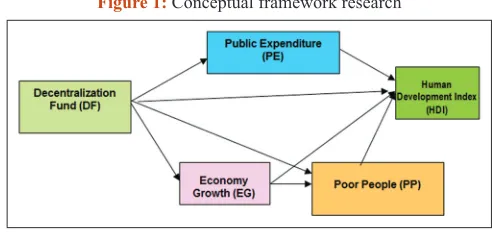
Thinking framework and concept of this study was based on a review of theoretical and empirical that has been compiled. Thinking and conceptual framework of this study refers to the theoretical and empirical arguments earlier, where the policy of fiscal decentralization has also been set up in accordance with Act No. 22 of 1999 and Act No. 25 of 1999 later amended to Act No. 32 of 2004 and Act No. 33 of 2004. The concept of this study can be seen Figure 1.
3.1.2. Research hypotheses
No. Hypotheses
1 Funds decentralization supposedly has positive effect on public expenditure in autonomous region counties and cities
2 Funds decentralization supposedly has positive effect on economic growth in autonomous region counties and cities
3 Funds decentralization supposedly has positive effect on economic growth rate toward decline number of poor people in autonomous regions and city districts
4 Funds decentralization supposedly has positive effect on economic growth rate, public expenditure, and a decline number of poor people toward human development
3.2. Types of Research
This study uses explanatory research design to test empirically the relationship and effects among variables of funds decentralization, public expenditure, economic growth, as well as total poor population toward human development.
3.3. Research Object
This study was conducted to determine the effect of fund decentralization on human development at counties and municipal governments in Indonesia using data panel regencies and cities in Indonesia, where each province is taken three counties and cities as samples.
This study focused on the realization of the revenue and expenditure of the budget, balance fund, economic growth, number of poor people, as well as the HDI of counties and cities in Indonesia after the enactment of Act No. 22 of 1999 and Act No. 25 of 1999 which was later replaced by Act No. 32 of 2004 and Act No. 33 of 2004, i.e., 2004-2007.
3.4. Data Research
Data that used in this study are secondary and primary data. Most of the secondary data derived from the Ministry of Finance, Ministry of Interior, BPS, Ministry of National Education, BAPPENAS, and other institutions related to the study. The data were collected, namely; balance funds data in the form of; tax revenue and non-tax (BHPP), general allocation fund (GAF), special allocation fund (SAF); public expenditure, economic growth, number of poor people, human development, as well as other data that support this research.
3.5. Research Variables
3.5.1. Independent variables
a. Variable of funds decentralization in relation to public expenditure variables
b. Variable of funds decentralization to HDI
c. Variable of funds decentralization to regional economic growth
d. Variable of funds decentralization and economic growth in relation to total poor population
e. Variables of public expenditure, funds decentralization, economic growth, as well as total poor population relation to HDI.
3.5.2. Dependent variables
a. Public expenditure variable in relation to funds decentralization b. HDI variable in relation to public expenditure
c. Economic growth variable in relation to funds decentralization d. Total poor population variable in relation to funds
decentralization and economic growth
e. HDI variable in relation to public expenditure, funds decentralization, economic growth, as well as total poor population.
3.6. Operational Definition and Measurement of
Variables
To operate each research variable then compiled operational definition as follows:
1. Tax fund sharing and non-tax (BHPP) is a funds transfer from central government to autonomous regencies and cities in the form of tax-sharing and natural resources. Measurement of the amount of funds is expressed in billions rupiah units
2. GAF (DAU) is a funds transfer from central government to autonomous regions and cities in the form of block grants. Measurement of the amount of funds is expressed in billions rupiah of units
3. SAF DAK is a funds transfer from central government to autonomous regions and cities in the form of specific grant. Measurement of the amount of funds is expressed in billions rupiah of units
4. Decentralization fund (DD) is a financial transfer in the form of balancing funds from central government to autonomous regions in the form of tax fund sharing and non-tax (BHPP), GAF (DAU) and SAF (DAK). The amount of the balancing funds is expressed in billions rupiah of units
5. Public expenditure is expenditure realization for
autonomous region counties and cities based on the budget. The amount of public expenditure is expressed in billions rupiah of units.
6. Economic growth rate liquid phase epitaxy is the relative change in the real value of gross domestic product in the autonomous region counties and cities within a given specific period (year). The magnitude of the autonomous region’s economic growth is expressed in terms of percent.
7. HDI is an increase in the HDI value each autonomous region expressed in percent.
8. Total poor population in autonomous region is the large of total poor population each autonomous region. Total poor population of autonomous regions based on data released by the central bureau of statistics.
3.7. Model and Analysis Techniques
a. Model analysis: A summary of the theory that is often expressed in mathematical formulation. This model describes fundamental relationship between variables of concern. Because it described is subject relationship, then model can clarify relationship between variables emphasis to other variables. Model analysis of this study is to use regression. b. Analysis technique: Analysis technique of this research using
panel data regression model with Eviews program. According to Wahyu (2007), Eviews is a computer program used to process statistical and econometrics data. This program can be used to solve problems in the form of time series, cross section, and panel data. Time series is the data of an object consisting of several periods. Cross section is data multiple objects at a time. While the data panel is the data have characteristic both time series and cross section, consists of multiple objects and covering several periods. This study uses data panel from 2004 to 2007.
3.7.1. Equation model for estimating the effect of
decentralization fund toward public expenditure autonomous region variable
Model equation of this study refers to the research model of Suyanto (2009); Langoday (2006), as well as Khusaini (2006). Decentralization fund expected positive effect of increasing public expenditure, thus increasing decentralization fund increase public expenditure of autonomous region. Based on this rationale, mathematically public expenditure (BP) was formulated:
BP = f (DD)
Where, BP is public expenditure autonomous regions; DD is the decentralization funds of autonomous regions. Model equations to estimate the effect of decentralization fund (DD) toward public expenditure of counties and cities formulated as follows:
BPit = β0 + β1DDit Where,
BP: Public expenditure β0: Constant
3.7.2. Equation model for estimating the effect of
decentralization fund toward economic growth variables of autonomous region
Decentralization funds expected positive effect on the regional economy growth rate, which means that increasing decentralization funds will improve the economy of the autonomous region. On the basis of this thinking, mathematically economy growth rate (PE) formulated: PE = f (DD), wherein: PE is economic growth; DD is the decentralization funds of autonomous regions.
Model equations to estimate the effect of decentralization fund (DD) to economic growth rate of counties and cities were formulated as follows:
PEit = β0 + β1 DDit
Where,
PE: Economic growth β0: Constant
β1: Regression coefficient DD: Decentralization fund
3.7.3. Equation model for estimating the effect of
decentralization and economic growth fund variable toward total poor population of autonomous region
To estimate the equation behavior in order to test that the decentralized fund variable and economic growth rate of autonomous regions has positive effect toward total poor population, then made specification equation based on the functionality. Decentralization funds is expected to promote local economy, and reduce total poor population. On the basis of this thinking, the function is mathematically formulated as follows:
PM = f (DD, PE)
Where, PM is total poor population of the autonomous regions; PE is an economic growth of autonomous regional; DD is decentralized funds.
The equation model to estimate the effects of decentralization funds and economic growth of autonomous regions can be formulated as follows:
PMit = β0 + β1 + DDit + β2 PEit
Where,
PM: Total poor population β0: Constant
β1: Regression coefficient PE: Variable economic growth DD: Decentralization fund
3.7.4. Equation model for estimating the effects of
decentralization fund, economic growth, public expenditure, and total poor population toward HDI of autonomous region
National development goals is to build a complete Indonesian. This policy is implemented by fiscal decentralization to empower local economy, reduce poverty, as well as closing the fiscal gap autonomous regions. On the basis of this thinking, then mathematically, human development counties and cities in Indonesia can be formulated as follows:
HDI = f (PM, BP, PE, DD)
Where, HDI is a HDI; DD is the decentralization funds; PM is total poor population; BP is the amount of public expenditure; PE is the economic growth of autonomous region.
Model equation to estimate the effect of funds decentralization, economic growth, public expenditure, as well as total poor population toward variable HDI of the autonomous regions are as follows:
IPMit = β0 + β1 DDit + β2 PEit + β3 BPit + β4 PMit
Description: IPM: HDI β0: Constant
β1, β2, β3, β4: Regression coefficient DD: Decentralization funds PE: Economic growth BP: Public expenditure
4. RESULTS AND DISCUSSION
4.1. Research
4.1.1. The effects of public expenditure toward fund decentralization of autonomous region of counties and cities
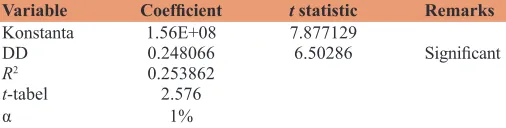
The results analysis of the effects of decentralization fund (DD) variable toward public expenditure (BP), which was conducted using panel data on 395 observations showed a significant effect. Significant effect of the decentralization fund result toward public expenditure is supposedly due to decentralization funds as balancing fund as the main source of budget revenue in each autonomous region. Analysis of the effects of decentralization funds toward public expenditure can be seen in Table 1.
The model equations based on the results of the Table 1 analysis are:
BP = 1.56E + 08 + 0.248066 DD (4.1)
t = 7.877129 6.50286
P = 0.0000 0.0000
R2 = 0.253862
Based on the results of t-test, decentralization fund (DD) variable were statistically significant effect on public expenditure (BP).
Table 1: The effects of decentralization fund toward public expenditure of autonomous region
Variable Coefficient t statistic Remarks
Konstanta 1.56E+08 7.877129
DD 0.248066 6.50286 Significant
R2 0.253862
t-tabel 2.576
α 1%
It is evident from t = 6.50286. This value is greater than t-table (6.50286>2.576) and a probability value of 0.0000, this value is smaller than α = 0.01, respectively. Results of this analysis showed a significant effect of the variable fund decentralization on public expenditure. Results of the analysis described above can further be seen in Figure 2.
4.1.2. The effects of decentralization fund toward economic growth of autonomous regions of counties and cities
Results analysis of the effect of decentralization fund (DD) variable toward economic growth (PE), which was conducted using panel data for 395 observations showed no significant positive results. Results analysis of the effect of decentralization funds on economic growth can be seen in Table 2.
The model equations based on the results of the Table 2 analysis are:
PE = 5.093366 + 3.40E-10 DD (4.2)
t = 7.877129 6.50286
P = 0.0000 0.4162
R2= 0.626522
Based on the results of t-test, decentralization fund (DD) has not statistically significant effect toward economic growth (PE). It is evident from t = 0.813877. This value is smaller than t-table (0.813877>1.645) and a probability value of 0.4162, this value is greater than α = 0.10. Results of this analysis showed there is no significant effect of the fund decentralization on economic growth. It is supposedly that decentralization funds transferred to the autonomous regions has been distributed to financing public services expenditure and regional development. Results of the analysis described above can be seen in Figure 3.
4.1.3. The effects of decentralization funds and economic growth toward total poor population of autonomous region of counties and cities
The analysis result of the effect of decentralization funds and economic growth toward total poor population of autonomous regions can be seen in Table 3.
The model equations based on the results of the Table 3 analysis are:
PM = 68.35482 + 8.76E-09 DD − 0.000828 PE (4.3)
t = 8.966515 3.985565 −0.002839
P = 0.0000 0.0001 0.9977
R2 = 0.980376
Determination coefficient value (R2) of 0.980376. This means that decentralized funds (DD) was able to explain economic growth (PE) of 98.04%. While the rest, i.e. 1.96% is explained by other variables outside of the model equations. This model analysis can be seen in Figure 4.
4.1.3.1. The effects of decentralization fund toward total poor
population
Based on the t-test result, decentralization fund (DD) variable statistically has significant effect on total poor population (PM). It is evident from t = 3.985565. This value is greater than t-table (3.985565>2.576) and a probability value of 0.0001, this value is smaller than α = 0.01. Thus, there is a significant effect of the decentralization funds to total poor population variable. This is supposedly more effective transfer formula for the autonomous regions, because considering the HDI.
4.1.3.2. The effects of economic growth toward total poor population
Based on t-test results, the variables of economic growth (PE) do not give a statistically significant effect on total poor population (PM). It is evident from t = −0.002839. This value is smaller than t-table (−0.002839>−1.645) and a probability value of 0.9977, this value is greater than α = 0.10. Thus, there was no significant effect of the variable of economic growth on poverty. It is supposedly to increase the growth has not been followed in a fair distribution of income. Results of the analysis described above can be seen in Figure 4.
4.1.4. Fiscal decentralization policy, economic growth, total poor population, and public toward HDI of autonomous regions of counties and cities
The analysis results of the variables effect of decentralization fund (DD), economic growth (PE), public expenditure (PB) and total poor population toward HDI which was conducted using panel data on 395 observations can be seen in Table 4.
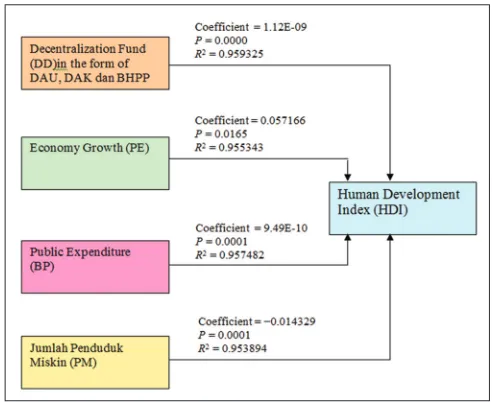
The model equations based on the results of the Table 4 analysis are:
HDI = 69.80728 + 1.12E-09 DD + 0.0572 PE + 9.49E-10bp PM − 0.0143 (4.4)
t = 129.8076 6.090260 2.409171 3.838080 −3.852457
P = 0.0000 0.0000 0.0165 0.0001 0.0001
R2 = 0.962618 Figure 2: Effect of decentralization fund toward public expenditure
Determination coefficient (R2) value of the equation by 0.962618. This means that decentralized funds (DD), Economic growth, public expenditure and total poor population able to explain the economic growth (PE) of 96.26%. While the rest, i.e., 4.74% is explained by other variables outside equation of the model equations. If Equation (4) described one by one (t-test) for each variable, it will be seen as a whole, as Figure 4.
The effects of decentralization funs toward HDI overall in this research can be seen in Figure 5.
Partially, this study found that fiscal decentralization policy, economic growth, total poor population, as well as public
Table 2: Effects of decentralization fund toward economic growth
Variable Coefficient t-statistic Remarks
Konstanta 5.093366 14.78434
DD 3.40E-10 0.813877 Insignificant
R2 0.626522
t-tabel 1.645
α 10%
Source: Analysis result is processed
Table 3: Effect of decentralization fund and economic growth toward total poor population
Variable Coefficient t-statistic Remarks
Konstanta 68.35482 8.966515
DD 8.76E-09 3.985565 Significant
PE −0.000828 −0.002839 Insignificant
R2 0.980376
t-table 2.576
α 1%
Source: Secondary data is processed
Table 4: The effects of decentralization fund, economic growth, and total poor population, toward HDI
Variable Coefficient t-statistic Remarks
Konstanta 69.80728 129.8076
DD 1.12E-09 6.090260 Significant
PE 0.057166 2.409171 Significant
BP 9.49E-10 3.838080 Significant
PM −0.014329 −3.852457 Significant
R2 0.962618
t-tabel 2.576 1.960
α 1% 5%
Source: Secondary data is processed. HDI: Human development index
Figure 4: Effect of decentralization fund and economic growth toward total poor population
expenditure are all giving a significantly positive effect on the HDI of autonomous region counties and cities. This shows that the fiscal decentralization policy has been increasingly effective for human development in the counties and cities.
4.2. Some Pitfalls Related Fiscal Decentralization Management Budgets
Some pitfalls of fiscal decentralization related regional budget management are influenced by many factors, among others, factors of human resources in the regions and central, capability of local bureaucracy and local institutional capacity, as well as factor of legal apparatus that are less consistent and frequent changes. These factors can lead to autonomy and fiscal decentralization is not running optimally, as well as many things that should be improved to promote economy growth rate, as well as human development.
Figure 5: The effects of fiscal decentralization policy, economic growth, and human development index
Figure 6: The effect of decentralization fund toward human
development index AQ10
4.3. Fiscal Decentralization Policy Perspective into Home
Implementation of the fiscal decentralization policy that goes well, it is required efforts to strengthen local governments capacity. Strengthening local governments capacity have begun to evaluate performance of the regional administration, through monitoring and evaluation, as well as special treatment for problematic areas. The evaluation mainly outcome (impact) of the policy areas, such as evaluating the impact of public services, health, education and poverty. For local governments failing to organize autonomy and welfare of its people, the central government did not hesitate to merge its territory, whether it’s provincial, district and city with other areas. Evaluation of local government is contained in government regulation (PP) No. 6 of 2008 on guidelines for evaluation of regional government, this PP is a command to Act No. 32 of 2004, Article 6 paragraph 3 which reads, the area able to removed and merged with other areas if it is not able to organize regional autonomy. Efforts governance evaluation can be done through three terms; First, implementation of the local government performance evaluation. This assessment refers to the principles of good governance. Secondly, evaluation of the implementation ability of regional autonomy. At this stage, the central government will look at the ability of the region, such as social welfare, public service quality, and competitiveness. Thirdly, new autonomous regions evaluation, with monitoring of completeness aspect of the regional governance development of the newly formed regions.
4.4. Contributions for the Research
4.4.1. Contributions for policymakers
Fiscal decentralization is an instrument to promote in achieving human development. The fiscal decentralization policy of local government is demanded to allocate budget appropriate withy priorities scale that can promote human development. Overall fiscal decentralization policy conducted today has positive influence on human development, but to finance local expenditure, local governments are increasingly dependent on the central fund to finance it regional budget. Therefore this fiscal decentralization policy should be followed decentralization funds management efforts effective and efficient in every autonomous region in order to transfer funds have a positive impact on economic growth, and reduce poverty.
4.4.2. Contribution to the development of science
This study proves that implementation of the fiscal decentralization policy as grants to human development in the county and city governments in Indonesia, has generally been in accordance with the formulation of concepts and theories that have been prepared. The main purpose of government provides transfer, in addition to addressing the vertical fiscal imbalance in autonomous regions, also promote regional economic and human development. This research model has been prepared based on the concepts, theories and facts empirical results of the fiscal decentralization policy implementation. Based on a model that has been developed is evident that the fiscal decentralization policy applied to the counties and cities need to be monitored and further evaluation, especially efforts to push the regional economy rate, as well as human development.
4.4.3. Contributions for other researchers
This research is very useful for other researchers who want to deepen fiscal decentralization policy. Based on these results it is expected that other researchers to conduct further research to examine in depth on variables that have not been examined yet in this study.
All variables that studied proved not all positive and significant effect. Relationships inter-variables having properties and varied influences. To that end, the results of this research in addition to very useful for other researchers, is also beneficial for the financial management field, both counties and cities or provinces in evaluating and monitoring the use of funds decentralization of central government each year increasingly. This research is also very useful for other researchers who want to conduct research using concepts and variables other than variables that have been used in this study.
4.5. Limitations and Weaknesses of Research
Difficulty and main weakness of this study, particularly when collecting research data, this is because some of the obstacles and barrier from bureaucratic or administrative. Another obstacle to the collection of research data is due to several budget data each year has undergone several changes, so researchers have to be very careful toward the budget data is used. So that data used in this study was valid and reliable, the data used to rigorously is the final realization of the implementation of the budget each year end, autonomous regions in counties and cities. Besides this, limited availability of data on the department concerned had result of this study is not in accordance with the specified target.
5. CONCLUSIONS AND SUGGESTIONS
5.1. Conclusion
In general, funds decentralization, economic growth, public expenditure, and a decline in total poor population in the autonomous region provide significant positive effect on HDI, thus increasing decentralization funds as balance grants to autonomous regions can be used to finance local expenditure, especially public social expenditure in education and health increased more years. Fiscal decentralization policy is instrumental in supporting the success of Indonesia’s human development.
In particular the research of fiscal decentralization policy yield in promoting human development as an economic overview of democracy in Indonesia counties and cities were assessed based on a review of theoretical and empirical can be concluded as follows: 1. Increased decentralization funds proven to provide significant
positive effect on the amount of public expenditure, then increased public expenditure have made autonomous regions increased their fiscal capacity
2. Increased decentralization funds proved to have a positive effect on economic growth, but not significantly. It is supposedly that increased decentralization funds in the autonomous region is still more widely used for personnel expenditure, business travel, as well as the needs of other government administration
region, the greater area over the allocation of balancing funds from central government
4. Regional economic growth is increased not provide significant effect on reducing total poor population, thus increasing decentralization funds is not followed by a decrease in total poor population significantly
5. Decentralized funds that transferred from central government to autonomous region proven to provide significant positive effect on HDI, thus increasing decentralization funds will lead to increased HDI value of it
6. Economic growth provides significant positive effect on human development, thus increasing economic growth rate in the autonomous region, will increase the HDI the areas concerned
7. Public expenditure of autonomous regions provides significant positive effect on human development. It is supposedly to increase public expenditure of autonomous regions will be followed to the improvement of public social expenditure in education and health
8. The decline in total poor population of autonomous region provide significant positive effect on human development, so that increase HDI in an area will be followed by a decrease in total poor population areas concerned
9. In general decentralization funds policies have positive impacts on human development of each autonomous region counties and cities, thus increasing decentralization of central government funding would increasing HDI the areas concerned.
5.2. Suggestions
1. Increased decentralization funds from central government to autonomous region counties and cities show has decentralized system of government and economy. Therefore, in accordance with the provisions of Act No. 32 of 2004 and Act No. 33 In 2004, the autonomous regional government has had the authority to regulate flexibility and decentralization fund that increasing numbers. These funds amount to significantly affect amount of expenditure autonomous region counties and cities. Consequently, the head area and the parliament should determine expenditure patterns, programs, and priority projects should be funded by the budget to promote human resources development. Management of decentralized funds as the main source of regional expenditure financing needs to be done more efficiently and effectively so that the budget expenditure actually touched on the needs of local communities in accordance preference is needed, especially basic services in education and health, and infrastructure. In addition, budget expenditure figures should be showing reality of the needs of local communities in basic services such as education and health
2. Local governments, the Regent/Mayor with DPRD should be able to cooperate to the fullest in order to not delay budget approval, as well as accelerate budget disbursement process. It is expected that the funds can be immediately absorbed by the budget for public services and regional development in particular to promote the means basic service needs of the community
3. The management of budget funds which increasingly depends on the amount of balancing funds from central should be done effectively and efficiently, so that local governments and legislators could make coordination and consultation with law enforcement authorities to realize creation of good governance, so that at the end of the year their budgets are not bound by the case law because of corruption. In addition, the increasing decentralization of funds used as well as possible to the shopping areas, the planning of programs and projects related areas in an effort to promote human development of autonomous regions should continue to be improved, including efforts to improve the quality of local government officials in handling various projects funded government, both central and local.
REFERENCES
Badan Pusat Statistik (BPS). (2005), Macro Indicator Analysis in East Java Province. Suarabaya: Center of Statistic.
Bird M, Richard and Vaillancourt, 1998. Fiscal Decentralization in Development Countries. Jakarta: Gramedia.
BAPPENAS dan UNDP. (2004), Human Developmnet Report. Economic from Democracy. Jakarta: Indonesian Human Development Cost.
Mankiw, N. G. (2003), Macroeconomics. 4th ed. New York: Worth Publisher.
Langoday, O.T, (2006), Influence of Decentarlization and Fiscal Equality and Tax in Nusa Tenggara Timur Province. Disertation Brawijaya University(Not published).
Mardiasmo. (2001), Budgeting Management Structure in Decentralization Era. Workshop Paper SIAGA Project. Yogyakarta: STIE.
Mardiasmo. (2002), Management and Otonomies Financial. Yogjakarta: Andi.
Martinez-Vasquez, J and R. McNab. 2001. Fiscal Decentralization and Economic Growth. International Studies Programme. Georgia State University. Working Paper # 01-1
Martinez-Vasquez, J., Boex, J. (2001), Russia’s Transition to a New Federalism, Report No. 22026.
Martinez-Vasquez, J., McNab, R. (1997), Fiscal Decentralization, Economic Growth, and Democratic.
Khusaini, M. (2006), Decentralization Finance Studies. Influences toward Public Economic, Growth and welfare society. Studies in East Java Province. Disertationi Brawijaya University (not published). Bird, M.R., Vaillancourt, F. (2000), Fiscal Decentralization in
Development Countries. Jakarta: Gramedia Pustaka Utama. Campo, S.S., Sundaram, P. (2002), To Serve and to Preserve: Improving
Public Administration in a Competitive World. Manila: Sean Development Bank.
Sidik, Muhammad. 2002, Balancing of Finance Central and Region for Fiscal Decentralization. Theory and Applied. Seminar paper in Gajahmada University. Yogyakarta: Local Politic Programme Study Postgraduet Gajahmada University.
Sugiyono. (2003), Handbook for Administration Metodology Reseach. Bandung: Alfabeta.
Suyanto. (2009), Region Outonom, Riil and responsibility. Jakarta: Ghalia.
Wahyu, W.W. (2007). Econometrica and Statistica Analysis with Eviews. Yogyakarta: Andy Publisher.