RESEARCH ARTICLE
Cheminformatics studies to analyze
the therapeutic potential of phytochemicals
from
Rhazya stricta
Abdullah Y. Obaid
1, Sreedhara Voleti
2, Roop Singh Bora
3,4, Nahid H. Hajrah
3, Abdulkader M. Shaikh Omer
5,
Jamal S. M. Sabir
3and Kulvinder Singh Saini
3,4*Abstract
Rhazya stricta is a unique medicinal plant source for many indole alkaloids, non-alkaloids, flavonoids, triterpenes and
other unknown molecules with tremendous potential for therapeutic applications against many diseases. In the
pre-sent article, we generated computational data on predictive properties and activity across two key therapeutic areas
of cancer and obesity, and corresponding cheminformatics studies were carried out to examine druggable properties
of these alkaloids. Computed physiochemical properties of the 78 indole alkaloids from R. stricta plant using
industry-standard scientific molecular modeling software and their predictive anti-cancer activities from reliable web-source
technologies indicate their plausible therapeutic applications. Their predictive ADME properties are further indicative
of their drug-like-ness. We believe that the top-ranked molecules with anti-cancer activity are clearly amenable to
chemical modifications for creating potent, safe and efficacious compounds with the feasibility of generating new
chemical entities after pre-clinical and clinical studies.
Keywords:
Rhazya stricta, Alkaloids, Physiochemical properties, Druggability, Anticancer molecules,
Anti-obesity molecules
© The Author(s) 2017. This article is distributed under the terms of the Creative Commons Attribution 4.0 International License (http://creativecommons.org/licenses/by/4.0/), which permits unrestricted use, distribution, and reproduction in any medium, provided you give appropriate credit to the original author(s) and the source, provide a link to the Creative Commons license, and indicate if changes were made. The Creative Commons Public Domain Dedication waiver (http://creativecommons.org/ publicdomain/zero/1.0/) applies to the data made available in this article, unless otherwise stated.
Background
Rhazya stricta Decsne
(Apocynaceae family), a traditional
herbal medicinal plant from Western and South Asia, has
been shown to have multiple pharmacological effects due
to the presence of over 100 alkaloids [
1
–
3
]. The
chemi-cal constituents of this plant (
R. stricta
) may possess
biological activities of antifungal, antimicrobial,
antioxi-dant, CNS, hypertension, metabolic, and inflammatory
disorders. Rhazimine, an alkaloid isolated from
R. stricta
leaves, was shown to affect arachidonic acid
metabo-lism in human blood [
4
]. This alkaloid was shown to be
a dual and selective inhibitor of platelet activating factor
(PAF)-induced platelet aggregation and arachidonic acid
metabolism. Other effects of the lyophilized extract of
R. stricta
include an antispasmodic effect in rat muscles
[
5
]. In another study, antioxidant effects were observed at
higher doses, and it reduced the hepatic and renal
con-centrations of glutathione (GSH) and increased the
ascor-bic acid levels, whereas the degree of lipid peroxidation
was reduced [
6
]. A recent study has shown that the basic
alkaloid fraction from
R. stricta
significantly induces one
of the chemopreventive enzyme-Nqo 1, through an Nrf
2-dependent mechanism, thereby establishing its role
as an anti-tumor agent [
7
]. In another pharmacological
study, the biochemical parameters including blood lipid
profile concentrations, liver enzyme activities and kidney
functions were analyzed in rats [
8
]. It was also found that
aqueous extract of
R. stricta
and indole alkaloids caused
a significant increase in serum adiponectin levels and
resulted in significant improvements in insulin resistance
[
9
]. In another follow up study, we observed
indole-alka-loids of
R. stricta
improved not only the lipid profile and
liver function but also led to improvements in the insulin
levels in rats, most likely via modulating insulin
resist-ance [
10
]. Indole-alkaloids of
R. stricta
had been reported
Open Access
*Correspondence: [email protected]
to have anticancer properties [
11
]. Other studies by our
departmental colleagues showed that alkaloid extract of
R. stricta
leaves inhibited proliferation, colony formation
and anchorage-independent growth in various cancer cell
lines such as colon cancer, breast cancer and lung cancer
[
12
–
14
].
Understanding the chemical structure,
physiochemi-cal, and chemical-informatic properties of these natural
product compounds will give clues for further
modifi-cations required in their structures responsible for their
biological activities. Even though, there have been about
100 chemical entities of indole-based alkaloid
constitu-ents of
R. stricta
which have been reported but their
chemical structures are yet to be clustered and identified,
and moreover the pharmacological application of any one
of these constituents towards human health is yet to be
identified. Understanding qualitative correlation of
struc-tures to their chemical druggability, IP potential, and their
applicability towards a therapeutic area would be worth
exploring prior to pre-clinical studies. Availability of this
plant (
R. stricta
), thus its phytochemical constituents
largely in Arabian and South Asian region makes it worth
studying through computational, synthetic, and
biologi-cal view point. Indole based alkaloids such as vinblastine
and vincristine are well known for their anti-cancer
prop-erties. From systematically generated informatics data
analysis, one would be able to evaluate the
physiochemi-cal properties of the potential therapeutic compounds.
These promising molecules which have “desirable
phar-macophores” may provide obvious extension to a better
targeted therapeutic benefit. Conventional drugs obey
set of rules such as Lipinski’s Rule-of-Five (RO5) [
15
],
wherein all orally administered molecules need to have
certain physiochemical properties. Calculation of these
cheminformatic properties has thus become essential for
all projects of new drug discovery which go through oral
route of administration. Along with RO5, the new
mol-ecules also have to adhere to certain parameters which
yield favorable ADMET outcome of an oral drug. We
further evaluated these molecules for therapeutic
activ-ity, including anticancer, anti-obesactiv-ity, anti-inflammatory,
and anti-bacterial properties. Although these predictions
are indicative only, the value of predictions in various
tar-get classes and therapeutic areas would be very useful for
future experimental studies. Moreover, their metabolic
fate with key enzymes such as P450’s is also predicted for
probable drug–drug and drug-target (P450) interactions
(reviewed in [
16
,
17
]).
Methods
For prediction of various therapeutic potential of these
molecules, commercially and publicly available
technolo-gies as below were utilized.
a. PharmaExpert (
http://www.pharmaexpert.ru
)—PASS
[
18
]
b. Superpred (
http://prediction.charite.de
)—Predictive
Targets [
19
]
c. SwissTargetPrediction (
http://www.swisstargetpre-diction.ch
)—Predictive Target [
20
]
d. CDRUG (
http://bsb.kiz.ac.cn/CDRUG
)—Anti-can-cer activity [
21
]
Schrodinger [
22
], a scientific software that predicts
drug-like properties and liabilities (viz. HERG and CNS),
and ACD/Labs [
23
] for physiochemical and
cheminfor-matics studies were utilized. Details of the molecules,
names, structures were obtained from the literature,
commercial sources, and knowledge-based web sources.
Tables
1
and
2
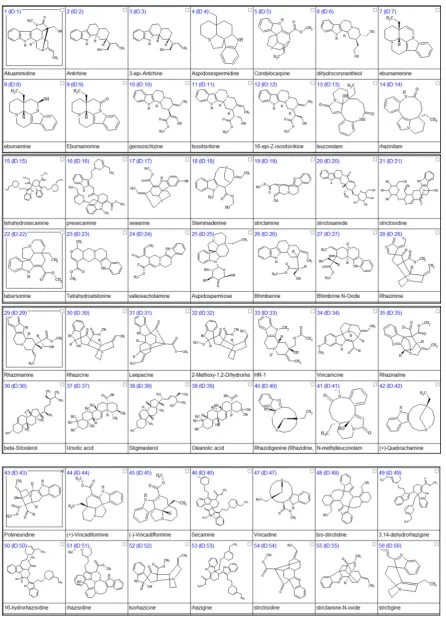
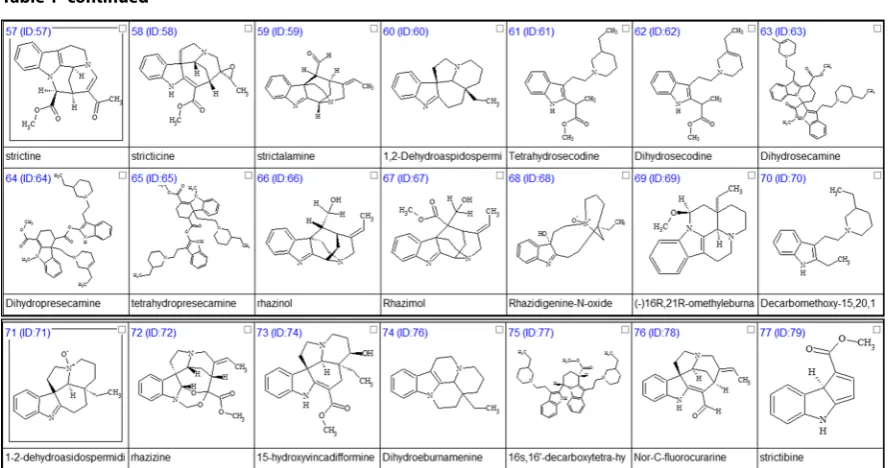
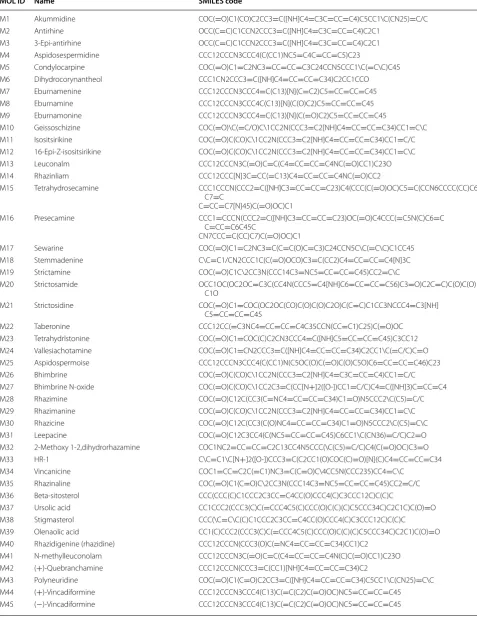
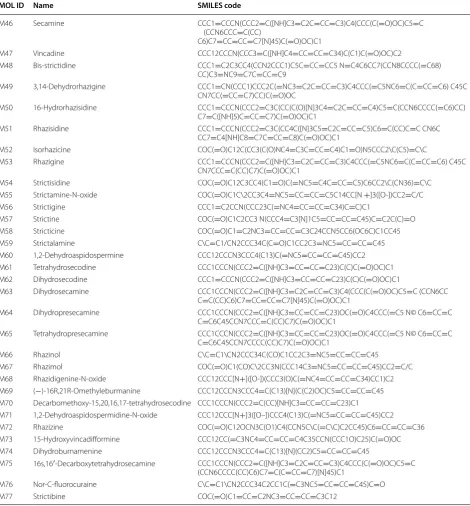
gives the details of these molecules
together with their 2D SMILES notation, respectively.
Results and discussion
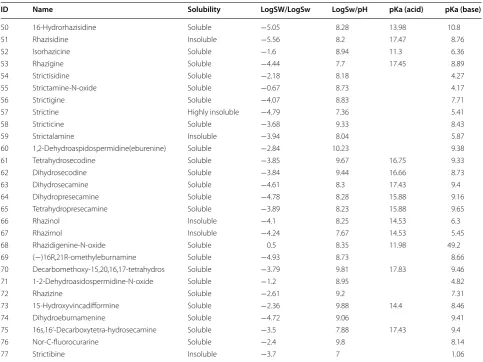
Physiochemical and cheminformatic studies
more than one, leading to a larger pKa at physiological
pH—thus leading most molecules are highly to
moder-ately soluble at physiological pH. Very few compounds
and non-indole alkaloids have no basic nitrogen leading
to highly insoluble compounds in water at
physiologi-cal pH. As the acidity goes up (leading towards pH 1),
most compounds become largely soluble. A
qualita-tive and quantitaqualita-tive (computational) estimate of
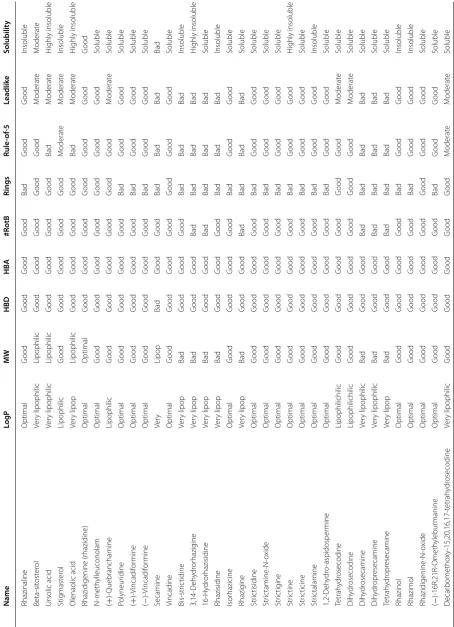
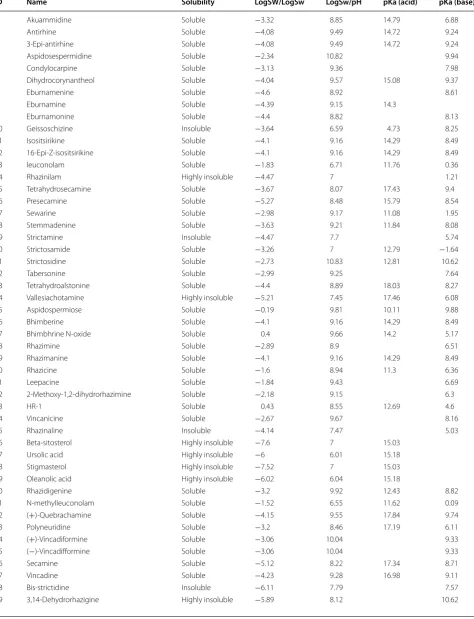
solu-bility of these compounds are given in Tables
3
and
4
,
respectively.
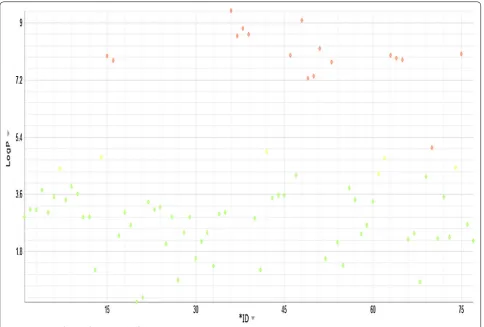
QUIKPROP calculations
Predicted Quikprop properties for potential cardiac
lia-bilities such as HERG, and CNS lialia-bilities
(Blood–Brain-Barrier) and drug-like nature of these molecules indicate
that many of these molecules are well within the
bounda-ries of accepted hit-, and lead-like nature. QuikProp
cal-culations were performed using Schrodinger’s Maestro
for various alkaloids of
R. stricta.
These predictions not
only give Rule-of-5 data, but also predict the
cardiotox-icity predictions (HERG) and CNS penetration
poten-tial (logBBB) properties. More importantly, it also gives
the prediction regarding cell-permeability (Caco2). All
these models are well validated in literature, and most
of them perform well within the reproducible results for
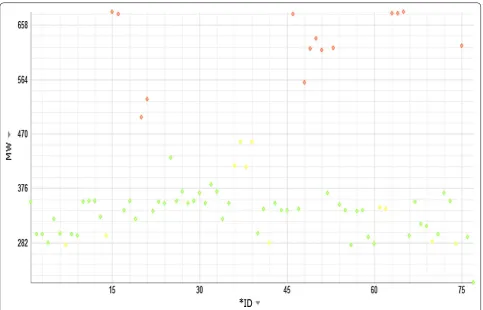
training datasets. Results indicate that many of the
mol-ecules have decent permeation through Caco2 cell lines
(>300), while the polar surface area (PSA) is not too high
(>120) for oral absorption. For HERG toxicity
predic-tion, below
−
5 (i.e.
−
6,
−
7 etc.) is not considered to be
safe. Hence, those molecules whose logHERG values are
well below -5 (such as geissoschizine, presecamine,
tet-rahydrosecamine) may exhibit cardioliability. The human
intestinal absorption is also predicted, and it appears for
most molecules, these values are larger. Any %HIA
pre-diction >90% is expected to be well absorbed, and their
polar surface area (PSA) is also a direct correlation to
it. Those molecules whose molecular weights are >500
exhibit rule-of-5 violation and this violation goes beyond
1 to a maximum of 3. Those molecules appear
structur-ally much larger and like dimers. Table
5
gives computed
Quikprop computed values of various alkaloids of
R.
stricta.
Table
6
also indicates various other
physiochemi-cal parameters including surface tension, parachor etc. of
R. stricta
indole and non-indole analogs.
Predicted therapeutic area applications
PASS—prediction of activity spectra for substances
This web-based predictive server from Way2Drug, has
variety of annotators of substances for their probability
Table 2 SMILES codes for Rhazya stricta compounds
MOL ID Name SMILES code
M1 Akummidine COC(=O)C1(CO)C2CC3=C([NH]C4=C3C=CC=C4)C5CC1\C(CN25)=C/C M2 Antirhine OCC(C=C)C1CCN2CCC3=C([NH]C4=C3C=CC=C4)C2C1
M3 3-Epi-antirhine OCC(C=C)C1CCN2CCC3=C([NH]C4=C3C=CC=C4)C2C1 M4 Aspidosespermidine CCC12CCCN3CCC4(C(CC1)NC5=C4C=CC=C5)C23
M5 Condylocarpine COC(=O)C1=C2NC3=CC=CC=C3C24CCN5CCC1\C(=C\C)C45 M6 Dihydrocorynantheol CCC1CN2CCC3=C([NH]C4=CC=CC=C34)C2CC1CCO M7 Eburnamenine CCC12CCCN3CCC4=C(C13)[N](C=C2)C5=CC=CC=C45 M8 Eburnamine CCC12CCCN3CCC4C(C13)[N](C(O)C2)C5=CC=CC=C45 M9 Eburnamonine CCC12CCCN3CCC4=C(C13)[N](C(=O)C2)C5=CC=CC=C45
M10 Geissoschizine COC(=O)\C(=C/O)C\1CC2N(CCC3=C2[NH]C4=CC=CC=C34)CC1=C\C M11 Isositsirikine COC(=O)C(CO)C\1CC2N(CCC3=C2[NH]C4=CC=CC=C34)CC1=C/C M12 16-Epi-Z-isositsirikine COC(=O)C(CO)C\1CC2N(CCC3=C2[NH]C4=CC=CC=C34)CC1=C\C M13 Leuconalm CCC12CCCN3C(=O)C=C(C4=CC=CC=C4NC(=O)CC1)C23O M14 Rhazinliam CCC12CCC[N]3C=CC(=C13)C4=CC=CC=C4NC(=O)CC2
M15 Tetrahydrosecamine CCC1CCCN(CCC2=C([NH]C3=CC=CC=C23)C4(CCC(C(=O)OC)C5=C(CCN6CCCC(CC)C6) C7=C
C=CC=C7[N]45)C(=O)OC)C1
M16 Presecamine CCC1=CCCN(CCC2=C([NH]C3=CC=CC=C23)OC(=O)C4CCC(=C5N(C)C6=C C=CC=C6C45C
CN7CCC=C(CC)C7)C(=O)OC)C1
M17 Sewarine COC(=O)C1=C2NC3=C(C=C(O)C=C3)C24CCN5C\C(=C\C)C1CC45 M18 Stemmadenine C\C=C1/CN2CCC1C(C(=O)OCO)C3=C(CC2)C4=CC=CC=C4[N]3C M19 Strictamine COC(=O)C1C\2CC3N(CCC14C3=NC5=CC=CC=C45)CC2=C\C
M20 Strictosamide OCC1OC(OC2OC=C3C(CC4N(CCC5=C4[NH]C6=CC=CC=C56)C3=O)C2C=C)C(O)C(O) C1O
M21 Strictosidine COC(=O)C1=COC(OC2OC(CO)C(O)C(O)C2O)C(C=C)C1CC3NCCC4=C3[NH] C5=CC=CC=C45
M22 Taberonine CCC12CC(=C3NC4=CC=CC=C4C35CCN(CC=C1)C25)C(=O)OC M23 Tetrahydrlstonine COC(=O)C1=COC(C)C2CN3CCC4=C([NH]C5=CC=CC=C45)C3CC12 M24 Vallesiachotamine COC(=O)C1=CN2CCC3=C([NH]C4=CC=CC=C34)C2CC1\C(=C/C)C=O M25 Aspidospermoise CCC12CCCN3CCC4(C(CC1)N(C5OC(O)C(=O)C(O)C5O)C6=CC=CC=C46)C23 M26 Bhimbrine COC(=O)C(CO)C\1CC2N(CCC3=C2[NH]C4=C3C=CC=C4)CC1=C/C M27 Bhimbrine N-oxide COC(=O)C(CO)C\1CC2C3=C(CC[N+]2([O-])CC1=C/C)C4=C([NH]3)C=CC=C4 M28 Rhazimine COC(=O)C12C(CC3(C=NC4=CC=CC=C34)C1=O)N5CCC2\C(C5)=C/C M29 Rhazimanine COC(=O)C(CO)C\1CC2N(CCC3=C2[NH]C4=CC=CC=C34)CC1=C\C M30 Rhazicine COC(=O)C12C(CC3(C(O)NC4=CC=CC=C34)C1=O)N5CCC2\C(C5)=C\C M31 Leepacine COC(=O)C12C3CC4(C(NC5=CC=CC=C45)C6CC1\C(CN36)=C/C)C2=O M32 2-Methoxy 1-2,dihydrorhazamine COC1NC2=CC=CC=C2C13CC4N5CCC(\C(C5)=C/C)C4(C(=O)OC)C3=O M33 HR-1 C\C=C1\C[N+]2([O-])CCC3=C(C2CC1(O)COC(C)=O)[N](C)C4=CC=CC=C34 M34 Vincanicine COC1=CC=C2C(=C1)NC3=C(C=O)C\4CC5N(CCC235)CC4=C\C
M35 Rhazinaline COC(=O)C1(C=O)C\2CC3N(CCC14C3=NC5=CC=CC=C45)CC2=C/C M36 Beta-sitosterol CCC(CCC(C)C1CCC2C3CC=C4CC(O)CCC4(C)C3CCC12C)C(C)C
M37 Ursolic acid CC1CCC2(CCC3(C)C(=CCC4C5(C)CCC(O)C(C)(C)C5CCC34C)C2C1C)C(O)=O M38 Stigmasterol CCC(\C=C\C(C)C1CCC2C3CC=C4CC(O)CCC4(C)C3CCC12C)C(C)C
M39 Olenaolic acid CC1(C)CCC2(CCC3(C)C(=CCC4C5(C)CCC(O)C(C)(C)C5CCC34C)C2C1)C(O)=O M40 Rhazidigenine (rhazidine) CCC12CCCN(CCC3(O)C(=NC4=CC=CC=C34)CC1)C2
M41 N-methylleuconolam CCC12CCCN3C(=O)C=C(C4=CC=CC=C4N(C)C(=O)CC1)C23O M42 (+)-Quebranchamine CCC12CCCN(CCC3=C(CC1)[NH]C4=CC=CC=C34)C2
of active or inactive towards few targets. Out of all
ser-vices and products of them, we utilized PASS method
of predictions. More than 100 activities are predicted
with their probability of activities and in-activities. Some
of them include kinase inhibitors, GPCR antagonists,
and some specific targets like adrenergic receptors, and
Table 2 continued
MOL ID Name SMILES code
M46 Secamine CCC1=CCCN(CCC2=C([NH]C3=C2C=CC=C3)C4(CCC(C(=O)OC)C5=C (CCN6CCC=C(CC)
C6)C7=CC=CC=C7[N]45)C(=O)OC)C1
M47 Vincadine CCC12CCCN(CCC3=C([NH]C4=CC=CC=C34)C(C1)C(=O)OC)C2
M48 Bis-strictidine CCC1=C2C3CC4(CCN2CCC1)C5C=CC=CC5 N=C4C6CC7(CCN8CCCC(=C68) CC)C3=NC9=C7C=CC=C9
M49 3,14-Dehydrorhazigine CCC1=CN(CCC1)CCC2C(=NC3=C2C=CC=C3)C4CCC(=C5NC6=C(C=CC=C6) C45C CN7CC(=CC=C7)CC)C(=O)OC
M50 16-Hydrorhazisidine CCC1=CCCN(CCC2=C3C(CC(C(O)[N]3C4=C2C=CC=C4)C5=C(CCN6CCCC(=C6)CC) C7=C([NH]5)C=CC=C7)C(=O)OC)C1
M51 Rhazisidine CCC1=CCCN(CCC2=C3C(CC4C([N]3C5=C2C=CC=C5)C6=C(CC)C=C CN6C CC7=C4[NH]C8=C7C=CC=C8)C(=O)OC)C1
M52 Isorhazicine COC(=O)C12C(CC3(C(O)NC4=C3C=CC=C4)C1=O)N5CCC2\C(C5)=C\C
M53 Rhazigine CCC1=CCCN(CCC2=C([NH]C3=C2C=CC=C3)C4CCC(=C5NC6=C(C=CC=C6) C45C CN7CCC=C(CC)C7)C(=O)OC)C1
M54 Strictisidine COC(=O)C12C3CC4(C1=O)C(=NC5=C4C=CC=C5)C6CC2\C(CN36)=C\C M55 Strictamine-N-oxide COC(=O)C1C\2CC3C4=NC5=CC=CC=C5C14CC[N +]3([O-])CC2=C/C M56 Strictigine CCC1=C2CCN(CCC23C(=NC4=CC=CC=C34)C=C)C1
M57 Strictine COC(=O)C1C2CC3 N(CCC4=C3[N]1C5=CC=CC=C45)C=C2C(C)=O M58 Stricticine COC(=O)C1=C2NC3=CC=CC=C3C24CCN5CC6(OC6C)C1CC45 M59 Strictalamine C\C=C1/CN2CCC34C(C=O)C1CC2C3=NC5=CC=CC=C45 M60 1,2-Dehydroaspidospermine CCC12CCCN3CCC4(C13)C(=NC5=CC=CC=C45)CC2 M61 Tetrahydrosecodine CCC1CCCN(CCC2=C([NH]C3=CC=CC=C23)C(C)C(=O)OC)C1 M62 Dihydrosecodine CCC1=CCCN(CCC2=C([NH]C3=CC=CC=C23)C(C)C(=O)OC)C1
M63 Dihydrosecamine CCC1CCCN(CCC2=C([NH]C3=C2C=CC=C3)C4(CCC(C(=O)OC)C5=C (CCN6CC C=C(CC)C6)C7=CC=CC=C7[N]45)C(=O)OC)C1
M64 Dihydropresecamine CCC1CCCN(CCC2=C([NH]C3=CC=CC=C23)OC(=O)C4CCC(=C5 N© C6=CC=C C=C6C45CCN7CCC=C(CC)C7)C(=O)OC)C1
M65 Tetrahydropresecamine CCC1CCCN(CCC2=C([NH]C3=CC=CC=C23)OC(=O)C4CCC(=C5 N© C6=CC=C C=C6C45CCN7CCCC(CC)C7)C(=O)OC)C1
M66 Rhazinol C\C=C1\CN2CCC34C(CO)C1CC2C3=NC5=CC=CC=C45
M67 Rhazimol COC(=O)C1(CO)C\2CC3N(CCC14C3=NC5=CC=CC=C45)CC2=C/C M68 Rhazidigenine-N-oxide CCC12CCC[N+]([O-])(CCC3(O)C(=NC4=CC=CC=C34)CC1)C2 M69 (−)-16R,21R-Omethyleburmanine CCC12CCCN3CCC4=C(C13)[N](C(C2)OC)C5=CC=CC=C45 M70 Decarbomethoxy-15,20,16,17-tetrahydrosecodine CCC1CCCN(CCC2=C(CC)[NH]C3=CC=CC=C23)C1
M71 1,2-Dehydroaspidospermidine-N-oxide CCC12CCC[N+]3([O–])CCC4(C13)C(=NC5=CC=CC=C45)CC2 M72 Rhazizine COC(=O)C12OCN3C(O1)C4(CCN5C\C(=C\C)C2CC45)C6=CC=CC=C36 M73 15-Hydroxyvincadifformine CCC12CC(=C3NC4=CC=CC=C4C35CCN(CCC1O)C25)C(=O)OC M74 Dihydroburnamenine CCC12CCCN3CCC4=C(C13)[N](CC2)C5=CC=CC=C45
M75 16s,16′-Decarboxytetrahydrosecamine CCC1CCCN(CCC2=C([NH]C3=C2C=CC=C3)C4CCC(C(=O)OC)C5=C (CCN6CCCC(CC)C6)C7=C(C=CC=C7)[N]45)C1
their kinase inhibitors. We considered the probability of
active (Pa) >0.3 (i.e. >30%), and should be greater than
probability of inactive (Pi). Given these conditions, we
observed many alkaloids have indicated Pa >0.8 in
cer-tain conditions (such as, anthrine has predicted Pa at 90%
towards β-adrenergic receptor kinase inhibitor, 5-HTA
release stimulant). Majority of them also is predicted to
be substrate to CYP3A4 and CYP2D6 indicating their
metabolic instability (Pa ~ 0.5, 0.4, respectively). Several
such predictions for all 78 alkaloids has been computed—
leaving predictions to be validated, experimentally.
Similarly, dihydrocorynantheol and corynantheol were
also predicted to be 5-HT release stimulants, and have
been projected to be chemosensitizers. Eburnamenine
is predicted to be a Nootropic agent at 90% Pa, while
eburnamine is predicted to be a CNS (anti-depressant
is a small molecule with ~70% Pa for antidyskinetic and
antineuronic agent,
1,2-dehydrospidospermidine-N-oxide is predicted to be 87% as analeptic.
Anticancer activity through CDRUG
This set of predictions using the structures and SMILES
codes of the alkaloids, annotates the anti-cancer
activ-ity by predicting “Mean logGI50”. Most molecules that
have Mean LogGI50 values lower than
−
5 are
consid-ered to have anti-cancer activity. It is interesting to know
that all the molecules of
R. stricta
alkaloids
(indole/non-indole) have predicted mean logGI50 values ranging
between
−
4.95 and
−
6.50—indicating they all may have
anti-cancer activities. There are about 10 compounds
that have predicted logGI50 values less than
−
6, which
indicate strong anti-cancer activity. Table
7
shows the
predicted mean LogGI50 values of all the compounds
considered in the present study.
SuperPred—predicted target interactions
From this server studies on
R. stricta
alkaloids, we
observed that many of these molecules may interact with
CYP2D6 or CYP3A4 as substrates. The indication of
these results mean that their target may be unknown, but
they do modify the drug metabolism, and affect drug–
drug interactions.
Table
3
c
on
tinued
ID
Name
LogP
MW
HBD
H
BA
#R
otB
Rings
Rule
-of-5
Leadlik
e
Solubilit
y
71
1,2-D
eh
ydr
oaspidosper midine
-N-oxide
Optimal
G
ood
G
ood
G
ood
G
ood
Bad
G
ood
G
ood
Soluble
72
Rhazizine
Optimal
G
ood
G
ood
G
ood
G
ood
Bad
G
ood
G
ood
Soluble
73
15-H
ydr
ox
yvincadiff
or mine
Optimal
G
ood
G
ood
G
ood
G
ood
Bad
G
ood
G
ood
Soluble
74
Dih
ydr
obur
namenine
Lipophilic
G
ood
G
ood
G
ood
G
ood
Bad
G
ood
M
oderat
e
Soluble
75
16s
,16
′
-D
ecar
bo
xyt
etra h
ydr
osecamine
Ver
y lipop
Bad
G
ood
G
ood
Bad
Bad
Bad
Bad
Soluble
76
Nor
-C-fluor
ocuraine
Optimal
G
ood
G
ood
G
ood
G
ood
Bad
G
ood
G
ood
Soluble
77
Str
ic
tibine
Optimal
G
ood
G
ood
G
ood
G
ood
G
ood
G
ood
G
ood
Insoluble
Lo
gP
par
tition-coefficien
t,
MW
molecular w
eigh
t,
HBD
h
ydr
ogen bond donor
,
HB
A
h
ydr
ogen bond ac
cept
ors
,
#RotB
number of r
ota
table bonds
,
Rings
# of ideally ac
ceptable r
ings
,
Rule
-of-5
Lipinsk
i’s rule of fiv
e,
Leadlik
e
leadlikeness
,
Solubilit
y
solubilit
y classifica
Table 4 Predicted solubility and pKa (acid and base) of various Rhazya stricta compounds
ID Name Solubility LogSW/LogSw LogSw/pH pKa (acid) pKa (base)
1 Akuammidine Soluble −3.32 8.85 14.79 6.88 2 Antirhine Soluble −4.08 9.49 14.72 9.24 3 3-Epi-antirhine Soluble −4.08 9.49 14.72 9.24 4 Aspidosespermidine Soluble −2.34 10.82 9.94 5 Condylocarpine Soluble −3.13 9.36 7.98 6 Dihydrocorynantheol Soluble −4.04 9.57 15.08 9.37 7 Eburnamenine Soluble −4.6 8.92 8.61 8 Eburnamine Soluble −4.39 9.15 14.3
9 Eburnamonine Soluble −4.4 8.82 8.13 10 Geissoschizine Insoluble −3.64 6.59 4.73 8.25 11 Isositsirikine Soluble −4.1 9.16 14.29 8.49 12 16-Epi-Z-isositsirikine Soluble −4.1 9.16 14.29 8.49 13 leuconolam Soluble −1.83 6.71 11.76 0.36 14 Rhazinilam Highly insoluble −4.47 7 1.21 15 Tetrahydrosecamine Soluble −3.67 8.07 17.43 9.4 16 Presecamine Soluble −5.27 8.48 15.79 8.54 17 Sewarine Soluble −2.98 9.17 11.08 1.95 18 Stemmadenine Soluble −3.63 9.21 11.84 8.08 19 Strictamine Insoluble −4.47 7.7 5.74 20 Strictosamide Soluble −3.26 7 12.79 −1.64 21 Strictosidine Soluble −2.73 10.83 12.81 10.62 22 Tabersonine Soluble −2.99 9.25 7.64 23 Tetrahydroalstonine Soluble −4.4 8.89 18.03 8.27 24 Vallesiachotamine Highly insoluble −5.21 7.45 17.46 6.08 25 Aspidospermiose Soluble −0.19 9.81 10.11 9.88 26 Bhimberine Soluble −4.1 9.16 14.29 8.49 27 Bhimbhrine N-oxide Soluble 0.4 9.66 14.2 5.17 28 Rhazimine Soluble −2.89 8.9 6.51 29 Rhazimanine Soluble −4.1 9.16 14.29 8.49 30 Rhazicine Soluble −1.6 8.94 11.3 6.36 31 Leepacine Soluble −1.84 9.43 6.69 32 2-Methoxy-1,2-dihydrorhazimine Soluble −2.18 9.15 6.3 33 HR-1 Soluble 0.43 8.55 12.69 4.6 34 Vincanicine Soluble −2.67 9.67 8.16 35 Rhazinaline Insoluble −4.14 7.47 5.03 36 Beta-sitosterol Highly insoluble −7.6 7 15.03
37 Ursolic acid Highly insoluble −6 6.01 15.18 38 Stigmasterol Highly insoluble −7.52 7 15.03 39 Oleanolic acid Highly insoluble −6.02 6.04 15.18
SwissTarget prediction
While predictions from this web-server may suggest each
molecule have certain target activity, they almost
corre-late well with the PASS server prediction—which gives
additional probability of prediction for each molecule to
be active or inactive against the target of interest.
Overall from the calculated cheminformatics
stud-ies and web-server predictions, we understand that
few molecules like anthrine, condylocarpine,
dihydro-corynantheol etc. have predicted GIC50 values in sub
µM concentrations, while they also have predicted drug–
drug activity towards CYP3A4, and CYP2D6 enzymes.
Solubility solubility classifications, LogSW/LogSw ratio of solubility in water vs. intrinsic solubility, LogSw/pH solubility in water at pH 7.0, pKa (acid) pKa in acidic pH, pKa(base) pKa in basic pHTable 4 continued
ID Name Solubility LogSW/LogSw LogSw/pH pKa (acid) pKa (base)
Table
5
c
on
tinued
Title
Name
M.W
HBD
H
BA
QP logP
QP logS
QP logHERG
QP C
ac
o2
QP logBB
%HO
A
PSA
RO5v
M73
15-H
ydr
ox
y-vincadiff
or
mine
354.448
1
5
3.2
−
3.8
−
5.3
302.4
−
0.1
90
67
0
M74
Dih
ydr
obur
namenine
280.412
0
2
3.9
−
3.6
−
4.8
2470.6
0
100
5
0
M75
16s
,16’-D
ecar
bo
xy-t
etrah
ydr
osecamine
622.892
1
6
7.6
−
6.1
−
6.8
295.2
0.5
90
45
2
M76
Nor
-C-fluor
ocuraine
292.38
0
3
2.8
−
2.3
−
3.8
512
0.4
92
52
0
M77
Str
ic
tibine
213.235
1
2
2.5
−
3.3
−
4.7
1789.3
−
0.2
100
49
0
MW
molecular w
eigh
t,
HBD
h
ydr
ogen bond donors
,
HB
A
h
ydr
ogen bond ac
cept
ors
,
QP
lo
gP
pr
edic
ted oc
tanol/w
at
er par
tition c
oefficien
t,
QP
lo
gS
pr
edic
ted aqueous solubilit
y,
QP
lo
gHER
G
pr
edic
ted IC50 v
alue f
or
block
age of HER
G K
+
channels
,
QPC
ac
o2
pr
edic
ted C
ac
o-2 c
ell per
meabilit
y,
QP
lo
gBB
pr
edic
ted br
ain/blood par
tition c
oefficien
t,
%HO
A
per
cen
tage of human or
al absor
ption,
PSA
polar sur
fac
e ar
ea,
RO5v
number of
viola
tions of Lipinsk
i’s Rule of F
iv
Table 6 Surface related and ring-related properties of Rhazya stricta compounds
ID Name CR NR NOR HetR #R Para Ind.Ref Sur.Ten Density Polar.
1 Akuammidine 0.81 0.08 0.19 0.19 6 743.43 1.68 65.34 1.35 39.32 2 Antirhine 0.86 0.09 0.14 0.14 4 676.25 1.65 56.53 1.2 35.76 3 3-Epi-antirhine 0.86 0.09 0.14 0.14 4 676.25 1.65 56.53 1.2 35.76 4 Aspidosespermidine 0.9 0.1 0.1 0.1 5 647.87 1.63 50.04 1.16 34.2 5 Condylocarpine 0.83 0.08 0.17 0.17 5 681.18 1.66 56.36 1.3 36.43 6 Dihydrocorynantheol 0.86 0.09 0.14 0.14 4 687.1 1.64 55.86 1.19 35.85 7 Eburnamenine 0.9 0.1 0.1 0.1 5 589.57 1.7 49.78 1.25 33.94 8 Eburnamine 0.86 0.09 0.14 0.14 5 595.24 1.72 54.34 1.35 34.28 9 Eburnamonine 0.86 0.09 0.14 0.14 5 595.24 1.72 54.34 1.34 34.28 10 Geissoschizine 0.81 0.08 0.19 0.19 4 762.54 1.66 61.38 1.29 40.01 11 Isositsirikine 0.81 0.08 0.19 0.19 4 776.63 1.64 59.3 1.27 40.13 12 16-Epi-Z-isositsirikine 0.81 0.08 0.19 0.19 4 776.63 1.64 59.3 1.27 40.13 13 Leuconolam 0.79 0.08 0.21 0.21 4 692.66 1.65 63.34 1.33 35.61 14 Rhazinilam 0.86 0.09 0.14 0.14 4 635.67 1.65 47.86 1.22 34.93 15 Tetrahydrosecamine 0.84 0.08 0.16 0.16 7 1449.04 1.63 46.81 1.23 78.28 16 Presecamine 0.84 0.08 0.16 0.16 7 1516.34 1.65 60.13 1.24 78.73 17 Sewarine 0.8 0.08 0.2 0.2 5 696.4 1.69 64.76 1.38 37.04 18 Stemmadenine 0.81 0.08 0.19 0.19 5 729.69 1.64 47.88 1.28 39.55 19 Strictamine 0.83 0.08 0.17 0.17 5 631.14 1.71 52.17 1.37 36.23 20 Strictosamide 0.72 0.06 0.28 0.28 6 986.67 1.72 84.28 1.53 50.75 21 Strictosidine 0.71 0.05 0.29 0.29 5 1078.5 1.66 74.07 1.44 54 22 Tabersonine 0.84 0.08 0.16 0.16 5 723.31 1.65 55.72 1.27 38.37 23 Tetrahydroalstonine 0.81 0.08 0.19 0.19 5 748.43 1.66 58.69 1.3 39.39 24 Vallesiachotamine 0.81 0.08 0.19 0.19 4 754.43 1.65 59.07 1.29 39.54 25 Aspidospermiose 0.77 0.06 0.23 0.23 6 885.22 1.68 74 1.42 45.19 26 Bhimberine 0.81 0.08 0.19 0.19 4 776.63 1.64 59.3 1.27 40.13 27 Bhimbhrine N-oxide 0.78 0.07 0.22 0.22 4 45.12 28 Rhazimine 0.81 0.08 0.19 0.19 6 690.3 1.69 54.96 1.38 38.6 29 Rhazimanine 0.81 0.08 0.19 0.19 4 776.63 1.64 59.3 1.27 40.13 30 Rhazicine 0.78 0.07 0.22 0.22 6 757.54 1.66 64.83 1.38 39.13 31 Leepacine 0.81 0.08 0.19 0.19 7 709 1.68 63.18 1.39 37.7 32 2-Methoxy-1,2-dihydrorhazimine 0.79 0.07 0.21 0.21 6 800.93 1.63 56.72 1.31 41.05 33 HR-1 0.78 0.07 0.22 0.22 4
Most molecules turnout to be modulators of membrane
receptor ligands while some have predicted
cholinest-erase, CNS (5HT2x), adenosine (A2A/A2B) activity.
Moreover, all molecules have predicted activity towards
certain targets (Pa > 30%).
Conclusions
Table
8
indicates the top 10-best naturally occurring
indole alkaloids of
R. stricta
that were predicted to be
having decent anti-cancer activity and other good
physi-ochemical properties together with cheminformatics
Table 6 continued
ID Name CR NR NOR HetR #R Para Ind.Ref Sur.Ten Density Polar.
50 16-Hydrorhazisidine 0.85 0.09 0.15 0.15 7 1345.28 1.65 48.02 1.24 73.94 51 Rhazisidine 0.87 0.09 0.13 0.13 8 1284.82 1.68 49.12 1.27 72.59 52 Isorhazicine 0.78 0.07 0.22 0.22 6 757.54 1.66 64.83 1.38 39.13 53 Rhazigine 0.87 0.09 0.13 0.13 7 1412.62 1.65 58.36 1.21 74.23 54 Strictisidine 0.81 0.08 0.19 0.19 7 635.5 1.78 63.63 1.55 37.59 55 Strictamine-N-oxide 0.8 0.08 0.2 0.2 5
56 Strictigine 0.9 0.1 0.1 0.1 5 622.49 1.63 42.69 1.14 34.52 57 Strictine 0.8 0.08 0.2 0.2 5 636.29 1.73 55.79 1.44 36.71 58 Stricticine 0.8 0.08 0.2 0.2 6 682.41 1.68 61.46 1.39 36.43 59 Strictalamine 0.86 0.09 0.14 0.14 5 580.88 1.74 55.15 1.37 33.92 60 1,2-Dehydroaspidospermidine 0.9 0.1 0.1 0.1 5 590.09 1.7 50.6 1.27 33.8 61 Tetrahydrosecodine 0.84 0.08 0.16 0.16 3 807.26 1.56 42.67 1.08 40.69 62 Dihydrosecodine 0.84 0.08 0.16 0.16 3 793.18 1.58 44.47 1.11 40.53 63 Dihydrosecamine 0.84 0.08 0.16 0.16 7 1449.04 1.63 46.81 1.23 78.28 64 Dihydropresecamine 0.84 0.08 0.16 0.16 7 1530.43 1.64 59.1 1.23 78.84 65 Tetrahydropresecamine 0.84 0.08 0.16 0.16 7 1544.52 1.63 58.11 1.22 78.96 66 Rhazinol 0.86 0.09 0.14 0.14 5 580.88 1.74 55.15 1.38 33.92 67 Rhazimol 0.81 0.08 0.19 0.19 5 690.3 1.69 54.96 1.39 38.6 68 Rhazidigenine-N-oxide 0.83 0.09 0.17 0.17 4
69 (-)16R,21R-omethyleburnamine 0.87 0.09 0.13 0.13 5 639.83 1.67 47.55 1.27 36.25 70 Decarbomethoxy-15,20,16,17-tetrahydros 0.9 0.1 0.1 0.1 3 703.65 1.57 40.68 1.02 36.31 71 1-2-Dehydroasidospermidine-N-oxide 0.86 0.09 0.14 0.14 5
72 Rhazizine 0.78 0.07 0.22 0.22 6 744.62 1.67 62.43 1.39 39.14 73 15-Hydroxyvincadifformine 0.81 0.08 0.19 0.19 5 750.68 1.65 60.33 1.32 39 74 Dihydroeburnamenine 0.9 0.1 0.1 0.1 5 589.57 1.7 49.78 1.26 33.94 75 16s,16′-Decarboxytetra-hydrosecamine 0.87 0.09 0.13 0.13 7 1339.61 1.64 46.2 1.21 73.6 76 Nor-C-fluorocurarine 0.86 0.09 0.14 0.14 5 624.5 1.68 57.83 1.29 33.99 77 Strictibine 0.81 0.06 0.19 0.19 3 442.8 1.65 51.74 1.29 23.76
Table 7 Predicted mean LogGI50 of Rhazya stricta com-pounds whose values lower than −6.0 are highlighted in italics may exhibit anti-cancer activity
MOL ID Name Mean LogGI50 CDRUG
M1 Akummidine −5.408 M2 Antirhine −5.408 M3 3-Epi-antirhine −5.408 M4 Aspidosespermidine −5.726 M5 Condylocarpine −5.726 M6 Dihydrocorynantheol −5.408 M7 Eburnamenine −5.096 M8 Eburnamine −5.096 M9 Eburnamonine −5.096 M10 Geissoschizine −5.048 M11 Isositsirikine −5.408 M12 16-Epi-Z-isositsirikine −5.408 M13 Leuconalm −5.154 M14 Rhazinliam −5.096 M15 Tetrahydrosecamine −4.975 M16 Presecamine −5.726 M17 Sewarine −5.726 M18 Stemmadenine −5.408 M19 Strictamine −5.726 M20 Strictosamide −5.256
M21 Strictosidine −5.937
M22 Taberonine −5.726 M23 Tetrahydrlstonine −5.408 M24 Vallesiachotamine −5.408 M25 Aspidospermoise −5.726 M26 Bhimbrine −5.408 M27 Bhimbrine N-oxide −5.408 M28 Rhazimine −5.726 M29 Rhazimanine −5.408 M30 Rhazicine −5.726 M31 Leepacine −5.726 M32 2-Methoxy 1-2,dihydrorhazamine −5.726 M33 HR-1 −5.096 M34 Vincanicine −5.726 M35 Rhazinaline −5.726
M36 Beta-sitosterol −5.918
M37 Ursolic acid −5.124 M38 Stigmasterol −5.918 M39 Olenaolic acid −5.124
Table 7 continued
MOL ID Name Mean LogGI50 CDRUG
M40 Rhazidigenine (rhazidine) −6.327
M41 N-methylleuconolam −5.154 M42 (+)-Quebranchamine −5.861 M43 Polyneuridine −5.408 M44 (+)-Vincadiformine −5.726 M45 (−)-Vincadiformine −5.726
M46 Secamine −6.298
M47 Vincadine −5.486 M48 Bis-strictidine −5.409 M49 3,14-Dehydrorhazigine −5.726
M50 16-Hydrorhazisidine −6.298
M51 Rhazisidine −5.406 M52 Isorhazicine −5.726 M53 Rhazigine −5.726 M54 Strictisidine −5.726 M55 Strictamine-N-oxide −5.726 M56 Strictigine −5.726 M57 Strictine −5.096 M58 Stricticine −5.726
M59 Strictalamine −6.327
M60 1,2-Dehydroaspidospermine −6.327
M61 Tetrahydrosecodine −5.783 M62 Dihydrosecodine −5.408
M63 Dihydrosecamine −6.298
M64 Dihydropresecamine −5.726 M65 Tetrahydropresecamine −5.726 M66 Rhazinol −5.726 M67 Rhazimol −5.726
M68 Rhazidigenine-N-oxide −6.327
M69 (−)-16R,21R-Omethyleburmanine −5.096
M70
Decarbomethoxy-15,20,16,17-tetrahy-drosecodine −6.471
M71
1,2-Dehydroaspidospermidine-N-oxide −6.327
M72 Rhazizine −4.878 M73 15-Hydroxyvincadifformine −5.726 M74 Dihydroburnamenine −5.096 M75 16s,16′
properties—these molecules are antirhine,
3-epi-anti-rhine, condylocarpine, eburnamine, eburnamonine,
taberonine, ursolic acid, stigmasterol, olenaolic acid,
(
+
)-vincadiformine, (
−
)-vincadiformine, (
−
)-16R,21R-omethyleburmanine, 15-hydroxy-vincadifformine, and
dihydroburnamenine.
Authors’ contribution
AYO, SV, RSB were involved in generation of computational data on predictive properties of various Rhazya stricta’s alkaloids; NHH and AMSO participated in data acquisition. SV, JSMS and KSS were involved in overall research planning & supervision, data analysis and manuscript writing. All authors read and approved the final manuscript.
Author details
1 Department of Chemistry, Faculty of Science, King Abdulaziz University, Jeddah 21589, Saudi Arabia. 2 Indras Pvt. Ltd, 44-347/6, Tirumalanagar, Moula Ali, Hyderabad 500040, India. 3 Biotechnology Research Group, Department of Biological Sciences, Faculty of Science, King Abdulaziz University, Jed-dah 21589, Saudi Arabia. 4 Department of Biotechnology, Eternal University, Baru Sahib 173101, India. 5 Department of Biological Sciences, Faculty of Sci-ence, King Abdulaziz University, Jeddah 21589, Saudi Arabia.
Acknowledgements
The authors gratefully acknowledge the financial support from KAU Vice President for Educational Affairs Prof. Dr. Abdulrahman O Alyoubi, The Dean-ship of Scientific Research (DSR) at King Abdulaziz University (KAU), Jeddah, Saudi Arabia, represented by the Unit of Strategic Technologies Research through the Project number (D 008/431) for the Project entitled: “Identification and Isolation of Salt and Heat-Tolerance Genes of R. stricta and Detection of Metabolites and their Therapeutic Effects via Cheminformatics”.
Competing interests
The authors declare that they have no competing interests.
Received: 30 May 2016 Accepted: 11 January 2017
References
1. Marwat SK, Fazal-ur-Rehman, Usman K, Shah SS, Anwar N, Ullah I (2012) A review of phytochemistry, bioactivities and ethno medicinal uses of
Rhazya stricta Decsne (Apocynaceae). Afr J Microbiol Res 6(8):1629–1641
2. Ahmad Y, Fatima K, Le Quesne PPW, Atta-ur-Rahman (1983) Further alkaloidal constituents of the leaves of Rhazya stricta. Phytochemistry 22:1017–1019
3. Atta-ur-Rahman, Zaman K, Habib-ur-Rehman, Malik S (1986) Studies on alkaloids of Rhazya stricta. J Nat Prod 49:1138–1139
4. Saeed SA, Simjee RU, Mahmood F, Sultana N, Atta-ur-Rahman (1993) Rhazimine from Rhazya stricta: a dual inhibitor of arachidonic acid metabolism and platelet activating factor-induced platelet aggregation. Planta Med 59(6):566–568
5. Tanira MO, Ali BH, Bashir AK, Wasfi IA, Chandranath I (1996) Evaluation of the relaxant activity of some United Arab Emirates plants on intestinal smooth muscles. J Pharm Pharmacol 47:457–459
6. Ali BH, Bashir AK, Tanira MO (2000) The anti-oxidant action of Rhazya
stricta in rats. Phytothera Res 14:469–471
7. El Gendy MAM, Ali BH, Michail K, Siraki AG, El Kadi AOS (2012) Induction of quinine oxidoreductase 1 enzyme by R. stricta through Nrf2-depend-ent mechanisms. J Ethnopharmacol 144:416–424
8. Baeshen NA, Lari SA, Aldoghaither HA, Elkady AI (2010) Biochemical evaluation of the effect of Rhazya stricta aqueous leaves extract in the liver and kidney functions in rats. Nat Sci 8:136–142
9. Baeshen N, Lari S, Al Doghaither HA, Ramadan HAI (2010) Effect of Rhazya
stricta extract on rat adiponectin gene and insulin resistance. J American
Sci 6:1237–1245
10. Baeshina NA, Yaghmoor SS, Ashmaouia HM, Kumosani TA, Saini KS (2014) The indole-alkaloid fraction of Rhazya stricta improves key biochemi-cal parameters associated with metabolic syndrome in rats. Bothalia J 44:358–371
11. Mukhopadhayay S, Handy GA, Funayama S, Cordell GA (1981) Anticancer indole alkaloids of Rhazya stricta. J Nat Prod 44:696–700
12. Baeshen NA, Elkady AI, AbuZinadah OA, Mutwakil MH (2012) Potential anticancer activity of the medicinal herb, Rhazya stricta, against human breast cancer. Af J Biotechnol 11(37):8960–8972
13. Elkady AI (2013) Crude alkaloid extract of Rhazya stricta inhibits cell growth and sensitizes human lung cancer cells to cisplatin through induction of apoptosis. Gen Mol Biol 36(1):12–21
Table 8 Key details of top molecules with predicted targets for anti-cancer and anti-obesity, probable rule-of-5, pre-dicted LogGI50 with prepre-dicted H-, and p values
SI. No Mol. name Mol. wt Predicted
LogG150/H-/p val Target RO5 violations Liability Comment
Anti-cancer Anti-obesity Druggability Hepatic HERG, renal issues
14. Elkady AI, Hussein RAH, Abu-Zinadah OA (2014) Differential control of growth, apoptotic activity and gene expression in human colon cancer cells by extracts derived from medicinal herbs, Rhazya stricta
and Zingiber officinale and their combination. World J Gastroenterol
20(41):15275–15288
15. Lipinski CA, Lombardo F, Dominy BW, Feeney PJ (2001) Experimental and computational approaches to estimate solubility and permeabil-ity in drug discovery and development settings. Adv Drug Deliv Rev 46(1–3):3–26
16. Purnapatre K, Khattar SK, Saini KS (2008) Cytochrome P450s in the devel-opment of target-based anticancer drugs. Cancer Lett 259:1–15 17. Singh D, Kashyap A, Pandey RV, Saini KS (2011) Novel advances in
cytochrome P450 research. Drug Discovery Today 16:793–799 18. Filimonov DA, Lagunin AA, Gloriozova TA, Rudik AV, Druzhilovskii DS,
Pogodin PV, Poroikov VV (2014) Prediction of the biological activity spec-tra of organic compounds using the PASS Online web resource. Chem Heterocycl Compd 50(3):444–457
19. Nickel J, Gohlke BO, Erehman J, Banerjee P, Rong WW, Goede A, Dunkel M, Preissner R (2014) SuperPred: update on drug classification and target prediction. Nucleic Acids Res 42:26–31
20. Gfeller D, Grosdidier A, Wirth M, Daina A, Michielin O, Zoete V (2014) Swiss Target prediction: a web server for target prediction of bioactive small molecules. Nucleic Acids Res 42(1–5):W32–W38. doi:10.1093/nar/gku293 21. Li GH, Huang JF (2012) CDRUG: a web server for predicting anticancer
activity of chemical compounds. Bioinformatics 28(24):3334–3335 22. Schrödinger Release 2015-4: Maestro, version 10.4, Schrödinger, LLC, New
York, 2015