Designed to Enhance Interprofessional
Collaborative Practice in Palliative Care: Findings
from the Caring Together Pilot Project
Colla J. MacDonald, EdD; Emma J. Stodel, PhD;
Pippa Hall, MD, CFPC, MEd, FFPC; Lynda Weaver, MHA, MEd
Abstract
Background: This study assessed the effectiveness of an online learning resource for staff in long-term care (LTC) homes. The resource was designed to increase palliative care and interprofessional patient-centred care (IPC) skills and knowl-edge and stimulate the transfer of knowlknowl-edge to the workplace.
Methods and Findings: A mixed methods approach was used. The Staged Innovation Design, which uses an experimental group and a control–replication group, was adopted. The resource was piloted in two not-for-profit LTC homes with 55 staff. Data were collected from four surveys. Individual interviews were conducted with 15 participants. Participants stated the resource exposed them to relevant, practical information regarding caring for residents at the end of life; the material was presented in an engaging, interactive manner; and e-learning was a convenient way to learn. The resource allowed learners to learn with, from, and about each other and increased palliative care and IPC skills and knowledge. Evidence regarding changes in learners’ attitudes toward IPC and transfer of knowledge was weak. Given the short time-frame from completion of the training to evaluation, this is not surprising.
Conclusions: Suggestions for improving the resource emerged from the evaluation, and these have been implemented.
Keywords: E-learning; Palliative care; Interprofessional practice
Introduction
Residents in long-term care (LTC) settings are an elderly, frail, and vulnerable popu-lation. When these individuals need palliative care, they require an interprofessional healthcare team to work collaboratively to offer the resident and his or her family the best possible end-of-life experience. Many feel that teamwork or interprofessional patient-centred care (IPC) is a prerequisite for enhanced communication among care-givers, improved case management, and efficient resident care [1,2]. Changing health-care processes to foster greater IPC is at the heart of many reform recommendations [3-5]. However, changing the way healthcare services are delivered requires changing the way healthcare workers are educated. In LTC, for example, the susceptible state of the resident, staff shortages, and financial constraints often make it difficult for staff to justify time away from caring for residents to participate in continuing professional development [6]. New approaches to educating this workforce need to be explored.
For the past two decades, educational theorists have described how technology has transformed, and will continue to transform, education [7-11]. Technology Journal of Research in
Interprofessional Practice and Education
Vol. 1.1
November, 2009
Journal of Research in Interprofessional Practice and Education (JRIPE) Vol. 1.1
© 2009
offers viable alternatives to the traditional teaching-learning process as ongoing advancements continue to offer new avenues for learning. The benefits of online learning are well documented in the literature [12,13]. However, the effectiveness and viability of online resources and tools as a means of creating engaging and effec-tive learning, particularly within the healthcare sector, remains relaeffec-tively unex-plored and, therefore, warrants further research.
E-learning technologies may provide a solution that promotes an interprofessional model of care while addressing the challenges that face educators teaching healthcare teams. E-learning offers methods for delivering convenient and flexible education that fit within the constraints of the healthcare workplace. Indeed, positive outcomes, such as satisfaction with learning and increased knowledge and skills, have been seen with the use of e-learning to deliver education to busy caregivers [12,14-16]. However, like any learning, e-learning must be grounded in sound pedagogical or andragogical principles [17,18]. Although the literature reveals a number of key elements that define effective online learning [19-22], often these recommendations and frame-works do not inform program design specifically [23], and there is a distressing incon-gruence between the use of sound learning models and online learning technologies [22,24]. Researchers have demonstrated that when a theoretical framework is used to guide program design, the quality of online learning is improved [21,25].
Consequently, the purpose of this pilot study was to assess the effectiveness of using an online learning resource to increase palliative care and IPC skills and knowledge and to stimulate the transfer of this knowledge to the workplace. W(e)Learn [26] (Figure 1), a framework for interprofessional education, was used to guide the design, development, delivery, and evaluation of the resource.
W(e)Learn draws on the knowledge and experience of healthcare professionals, educators, academics, and industry; considers key elements outlined in D’Amour and Oandasan’s framework [27]; incorporates best practices for interprofessional education (IPE) from the literature; and reflects expertise in curriculum design, psy-chopedagogy, e-learning, and evaluation methods. W(e)Learn outlines four critical dimensions of online IPE—structure, content, media, and service—and is grounded in socioconstructivist theories and interprofessionalism. W(e)Learn is intended to elicit four levels of outcome, the pinnacle of which is organizational change toward IPC and the resulting improvement in care delivery that promotes patient well-being. For an interactive explanation of the framework, visit http://www.ennova-tivesolution.com/WeLearn/.
The online learning resource piloted in this project was called Caring Together in the Last Hours of Life. It was designed to facilitate the development of palliative care and IPC skills and knowledge. The resource is intended for those who are involved in the care of residents at the end of life, including physicians, pharmacists, nurses, frontline care providers, housekeeping, administration, and recreational therapy. The resource uses case-based learning activities to permit the integration of clinical the-ory and practice, which situates learning in the workplace and fosters the develop-ment and application of work-related skills. The resource presents evidence-based discipline-specific knowledge essential to resident care so learners can identify with Journal of Research in
Interprofessional Practice and Education
Vol. 1.1
November, 2009
43
Caring Together
their own field while also learning about other disciplines and perspectives.
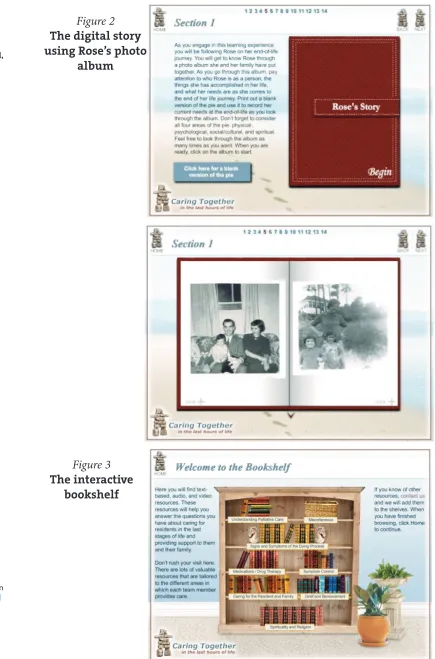
A multimedia-rich resource was designed to facilitate the immersion of the learn-ers into the learning environment through interaction with the content and an engaging design. The resource employs: digital storytelling (see Figure 2), interactive online activities and tools learners can share and print, an interactive resource library animations to show learners how to use the resource and highlight concepts (see Figure 3), 3-D objects that can be manipulated by the learners to obtain the informa-tion they need and want, videos to illustrate practice points and encourage reflecinforma-tion, audio clips from experts in the field, an artificial intelligence “expert” who responds to learners’ questions about grief and mourning, and interactive game-based activi-ties to help learners test their knowledge and monitor their learning. For a summary of the learning resource content, see Table 1.
Methodology
The project evaluated the use of an online learning resource as an intervention to improve palliative care and IPC knowledge and skills and to stimulate transfer of knowledge to the workplace. The following research questions guided the evalua-tion of Caring Together in the Last Hours of Life:
• How did learners react to the learning resource? Journal of Research in
Interprofessional Practice and Education
Vol. 1.1
November, 2009
44
Caring Together
MacDonald, Stodel, Hall, & Weaver
Journal of Research in
Interprofessional Practice and Education
Vol. 1.1
November, 2009
45
Caring Together
MacDonald, Stodel, Hall, & Weaver
Figure 2 The digital story using Rose’s photo
album
Figure 3 The interactive
• What new knowledge and skills regarding palliative care and collaborative practice did the learners acquire?
• How did the learners’ attitudes toward the value and use of team approaches to care change?
• How was learning transferred to the workplace? • How did interprofessional collaboration change? Journal of Research in
Interprofessional Practice and Education
Vol. 1.1
November, 2009
46
Caring Together
MacDonald, Stodel, Hall, & Weaver
Section Content
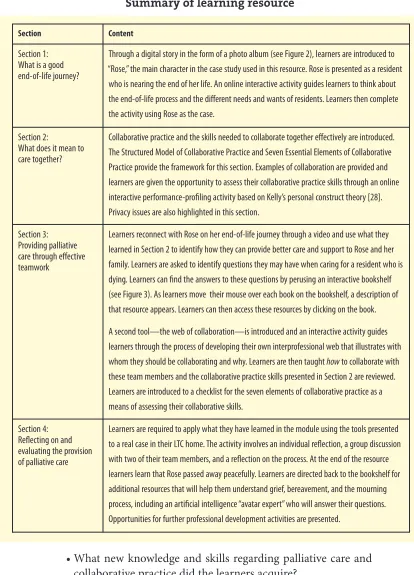
Section 1: What is a good end-of-life journey?
Through a digital story in the form of a photo album (see Figure 2), learners are introduced to “Rose,” the main character in the case study used in this resource. Rose is presented as a resident
who is nearing the end of her life. An online interactive activity guides learners to think about the end-of-life process and the different needs and wants of residents. Learners then complete the activity using Rose as the case.
Section 2:
What does it mean to care together?
Collaborative practice and the skills needed to collaborate together effectively are introduced. The Structured Model of Collaborative Practice and Seven Essential Elements of Collaborative Practice provide the framework for this section. Examples of collaboration are provided and learners are given the opportunity to assess their collaborative practice skills through an online interactive performance-profiling activity based on Kelly’s personal construct theory [28]. Privacy issues are also highlighted in this section.
Section 3: Providing palliative care through effective teamwork
Learners reconnect with Rose on her end-of-life journey through a video and use what they learned in Section 2 to identify how they can provide better care and support to Rose and her family. Learners are asked to identify questions they may have when caring for a resident who is dying. Learners can find the answers to these questions by perusing an interactive bookshelf (see Figure 3). As learners move their mouse over each book on the bookshelf, a description of that resource appears. Learners can then access these resources by clicking on the book.
A second tool—the web of collaboration—is introduced and an interactive activity guides learners through the process of developing their own interprofessional web that illustrates with whom they should be collaborating and why. Learners are then taught howto collaborate with these team members and the collaborative practice skills presented in Section 2 are reviewed. Learners are introduced to a checklist for the seven elements of collaborative practice as a means of assessing their collaborative skills.
Section 4: Reflecting on and evaluating the provision of palliative care
Learners are required to apply what they have learned in the module using the tools presented to a real case in their LTC home. The activity involves an individual reflection, a group discussion with two of their team members, and a reflection on the process. At the end of the resource learners learn that Rose passed away peacefully. Learners are directed back to the bookshelf for additional resources that will help them understand grief, bereavement, and the mourning process, including an artificial intelligence “avatar expert” who will answer their questions. Opportunities for further professional development activities are presented.
Table 1
Participants
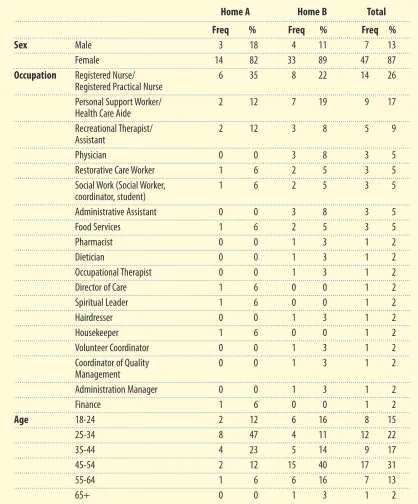
Participants were recruited from two not-for-profit LTC homes located in a mid-sized city in Ontario, Canada. The homes were of similar size: Home A had 128 res-idents and 189 staff and Home B had 100 resres-idents and 88 staff. Fifty-five caregivers from 19 disciplines volunteered to participate in the project (47 female, 7 male) (see Table 2). Seventeen (31%) were from Home A and 38 (69%) were from Home B. One-third (31%) were between 45 and 54 years old.
Journal of Research in
Interprofessional Practice and Education
Vol. 1.1
November, 2009
47
Caring Together
MacDonald, Stodel, Hall, & Weaver
Table 2
Demographic information for the learners
Home A Home B Total Freq % Freq % Freq %
Sex Male 3 18 4 11 7 13
Female 14 82 33 89 47 87
Occupation Registered Nurse/ 6 35 8 22 14 26 Registered Practical Nurse
Personal Support Worker/ 2 12 7 19 9 17 Health Care Aide
Recreational Therapist/ 2 12 3 8 5 9
Assistant
Physician 0 0 3 8 3 5
Restorative Care Worker 1 6 2 5 3 5
Social Work (Social Worker, 1 6 2 5 3 5 coordinator, student)
Administrative Assistant 0 0 3 8 3 5
Food Services 1 6 2 5 3 5
Pharmacist 0 0 1 3 1 2
Dietician 0 0 1 3 1 2
Occupational Therapist 0 0 1 3 1 2
Director of Care 1 6 0 0 1 2
Spiritual Leader 1 6 0 0 1 2
Hairdresser 0 0 1 3 1 2
Housekeeper 1 6 0 0 1 2
Volunteer Coordinator 0 0 1 3 1 2
Coordinator of Quality 0 0 1 3 1 2
Management
Administration Manager 0 0 1 3 1 2
Finance 1 6 0 0 1 2
Age 18-24 2 12 6 16 8 15
25-34 8 47 4 11 12 22
35-44 4 23 5 14 9 17
45-54 2 12 15 40 17 31
55-64 1 6 6 16 7 13
Research design
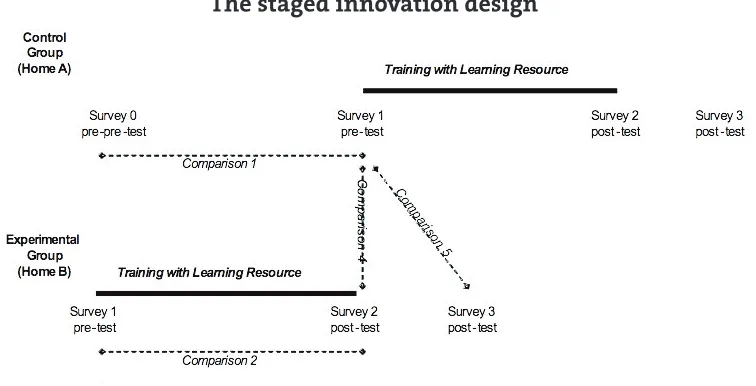
A mixed methods approach was used in this project to evaluate the effectiveness of the learning resource, as both quantitative and qualitative methods were required to answer the research questions. The triangulation design, the most common approach for mixed methods, was used to validate the quantitative results with the qualitative data [29]. Triangulation is an efficient design because both types of data are collected concurrently. Although analysis of both types of data can be time consuming, the team approach allowed us to be more efficient and increase the trustworthiness of the results. The Staged Innovation Design [30,31] (Figure 4), involving the use of an experimental group and a control–replication group, was adopted. The program was first introduced to the experimental group (Home B), while Home A served as a con-trol. Then, the program was introduced to the control–replication group (Home A). The results from the control–replication group (Home A) were then compared to those of the experimental group (Home B); as well, Home A served as a replication. This research design allowed the research to be conducted in a natural setting, thereby strengthening external validity while also maximizing internal validity [32].
Data collection tools
Data were collected from four surveys, as well as individual interviews with participants.
Surveys
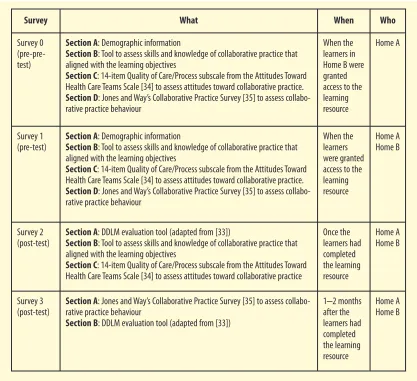
Four surveys were compiled that included demographic questions, questions related to the learning objectives of the resource, an adaptation of the Demand-Driven Learning Model (DDLM) evaluation tool [33], the Quality of Care/Process subscale from the Attitudes Toward Healthcare Teams Scale [34], and Jones and Way’s Collaborative Practice Survey [35]. Table 3 summarizes the composition and purpose of each survey, as well as when and to whom each survey was delivered (see also Figure 4).
Journal of Research in
Interprofessional Practice and Education
Vol. 1.1
November, 2009
48
Caring Together
MacDonald, Stodel, Hall, & Weaver
Figure 4
Survey 0 (see Table 3) was administered as a paper and pencil questionnaire to the learners in Home A; at the same time, the learners in Home B were granted access to the learning resource and completed Survey 1 (see Figure 4). Survey 0 was used as a pre-pre-test to control for threats to internal validity. Survey 1 was admin-istered online to all learners before they started using the learning resource. Learners were required to complete Survey 2 as soon as they completed all the activ-ities in the learning resource. One to two months after learners had completed the learning resource they were required to complete Survey 3.
Demographic questionnaire
The purpose of the demographic questionnaire was to obtain relevant information about the learners and solicit information regarding their computer skills and exprience, attitudes toward computers and learning, and their experience with e-learning and working in a team. The questionnaire was incorporated into Survey 1. The demographic information collected from the learners was used to help put the findings in context.
Journal of Research in
Interprofessional Practice and Education Vol. 1.1 November, 2009 49 Caring Together MacDonald, Stodel, Hall, & Weaver
Survey What When Who
Survey 0 (pre-pre-test)
Section A: Demographic information
Section B: Tool to assess skills and knowledge of collaborative practice that aligned with the learning objectives
Section C: 14-item Quality of Care/Process subscale from the Attitudes Toward Health Care Teams Scale [34] to assess attitudes toward collaborative practice. Section D: Jones and Way’s Collaborative Practice Survey [35] to assess collabo-rative practice behaviour
When the learners in Home B were granted access to the learning resource
Home A
Survey 1 (pre-test)
Section A: Demographic information
Section B: Tool to assess skills and knowledge of collaborative practice that aligned with the learning objectives
Section C: 14-item Quality of Care/Process subscale from the Attitudes Toward Health Care Teams Scale [34] to assess attitudes toward collaborative practice. Section D: Jones and Way’s Collaborative Practice Survey [35] to assess collabo-rative practice behaviour
When the learners were granted access to the learning resource Home A Home B Survey 2 (post-test)
Section A: DDLM evaluation tool (adapted from [33])
Section B: Tool to assess skills and knowledge of collaborative practice that aligned with the learning objectives
Section C: 14-item Quality of Care/Process subscale from the Attitudes Toward Health Care Teams Scale [34] to assess attitudes toward collaborative practice
Once the learners had completed the learning resource Home A Home B Survey 3 (post-test)
Section A: Jones and Way’s Collaborative Practice Survey [35] to assess collabo-rative practice behaviour
Section B: DDLM evaluation tool (adapted from [33])
1–2 months after the learners had completed the learning resource Home A Home B Table 3
Learning objectives questionnaire
This questionnaire aligned with the learning objectives of the resource. Learners were asked to rate how confident they were in each of the aspects of palliative care and IPC that the resource addressed and also to indicate whether they feel the learn-ing resource improved their knowledge and skills in these areas (see Table 4).
DDLM evaluation tool
The DDLM is the e-learning framework upon which W(e)Learn was based. The DDLM and W(e)Learn share many similar constructs, but W(e)Learn has evolved to be specific to IPE. The DDLM evaluation tool [33] aligns with the DDLM and is Journal of Research in
Interprofessional Practice and Education
Vol. 1.1
November, 2009
50
Caring Together
MacDonald, Stodel, Hall, & Weaver
Table 4
Percentage of learners who felt the learning resource contributed to their improved knowledge and skills relating to collaborative practice
Do you feel the learning resource helped you improve your ability to:
Learning objectives Yes (%) No (%)
Accurately define what is meant by collaborative practice 88.2 11.8
Use common language related to collaborative practice 92.2 7.8
Define the elements needed to collaborate (work together) effectively 88.2 11.8
Explain the benefits of collaborating (working together) with my colleagues 84.3 15.7
Identify who I should collaborate (work) with when providing end-of-life care 80.4 19.6
Define the roles and responsibilities of caregivers from different disciplines 84.3 15.7
Recognize the result of a team that is collaborating
(working together) effectively 80.4 19.6
Recognize the processes that facilitate collaboration (working together) 78.4 21.6
Access tools that will help me resolve any conflicts that may
occur with my colleagues 82.4 17.6
Explain the signs that someone is dying 82.4 17.6
Explain what to expect in the last couple of days prior to death 74.5 23.5
Comprehensively assess residents’ needs at the end-of-life 86.3 13.7
Explain my own views of dying 72.5 27.5
Recognize that everyone has different needs and ideas about what
a good end-of-life journey is 82.4 17.6
Provide support to the family members of residents who are at the
designed to evaluate e-learning in terms of the following constructs—content, deliv-ery, service, structure, and outcomes. These reflect the W(e)Learn constructs—con-tent, media, service, structure, and outcomes. The DDLM tool was chosen for this project as it aligns closely with the W(e)Learn framework that was used in the design, development, and delivery phases of the project. The DDLM evaluation tool has 59 items. Questions in the content, delivery, service, and structure sections are accom-panied by five response options: never, rarely, sometimes, often, or always. Questions on the program outcomes have four response options: strongly disagree, disagree, agree, or strongly agree. Twenty-six closed-item questions and three open-ended questions were selected from this tool and adapted as necessary for this project and incorporated into Surveys 2 and 3.
Attitudes toward health care teams scale
The purpose of the Attitudes Toward Healthcare Teams Scale [34] is to determine learners’ attitudes toward the value and efficiency of teamwork. The scale was psy-chometrically tested with a sample of 973 individuals from interdisciplinary geriatric healthcare teams [34]. Factor analysis was conducted to determine construct validity and reliability. Two factors emerged: Quality of Care/Process, which included 14 items (eigenvalue = 4.64; variance explained = 22.1%; Cronbach’s alpha = .83), and Physician Centrality, which contained 5 items (eigenvalue = 2.27; variance explained = 10.8%; Cronbach’s alpha = .68). The two subscales were not correlated. Correlations with other related measures supported construct validity for the Quality of Care/Process subscale but not for the Physician Centrality subscale. Only the 14-item Quality of Care/Process subscale was used in this project. It was incor-porated into Surveys 0, 1, and 2 as an indicator of team members’ perceptions of the quality of care delivered by healthcare teams and the quality of teamwork to accom-plish this. Participants were required to respond to the questions using a six-choice answer format, ranging from strongly agree (5) to strongly disagree (0).
Collaborative practice survey
Jones and Way’s Collaborative Practice Survey [35] asks respondents about the extent to which collaboration (i.e., IPC) with different team members takes place, as well as how satisfied they are with the process of this collaboration. There are seven response options for each question: strongly agree = 1 to strongly disagree = 7 or very satisfied = 1 to very dissatisfied = 7. Jones and Way’s Collaborative Practice Survey was chosen to assess collaborative practice in this project because it aligns with the definition of collaborative practice that was adopted in the learning resource. In this project, the 9-item scale for assessing the extent of collaboration was used in Surveys 0, 1, and 3.
Interviews
Fifteen individuals were purposefully selected to participate in individual interviews after they had completed the learning resource. Attempts were made to select a cross-section of participants from different disciplines with different experiences with the Journal of Research in
Interprofessional Practice and Education
Vol. 1.1
November, 2009
51
Caring Together
learning resource. The site coordinators from each home were asked to select the interview participants as they knew the struggles and successes of the participants.
The purpose of the interviews was to discover the participants’ experiences with the learning resource, specifically in terms of the W(e)Learn constructs (i.e., con-tent, media, service, structure, and outcomes) and in relation to the research ques-tions. The interviews were designed to identify the strengths of the learning resource and provide recommendations for where the resource could be further refined and improved. The interview schedule is presented in Appendix A.
Data analysis
Quantitative and qualitative analyses were conducted with the data collected from the surveys and interviews.
Quantitative data analysis
Paired-samples t-tests were conducted on the participants’ scores from Home A for the Learning Objectives Questionnaire, the Attitudes Toward Healthcare Teams Scale, and the Collaborative Practice Survey in Surveys 0 and 1 (Comparison 1, Figure 4). The purpose of these comparisons was to determine whether the collaborative practice knowledge, skills, attitudes, and behaviours of participants not exposed to the learning resource (i.e., the control–replication group, Home A) changed over time without any intervention. Paired-samples t-tests were then conducted on the participants’ scores from Home B for each of the questionnaires in Survey 1 and Surveys 2 and 3 (Comparisons 2 and 3, Figure 4). The purpose of these comparisons was to determine whether the knowledge, skills, attitudes, and behaviours of participants in the experimental group (Home B) changed as a result of completing the learning resource. These tests provided a preliminary estimate of the effectiveness of the learning resource. Next, if changes were found as a result of these tests, independent-samples t-tests were conducted with Home B participants’ post-test scores and Home A participants’ pre-test scores (Comparisons 4 and 5, Figure 4). The purpose of these comparisons was to confirm findings from Comparisons 2 and 3 regarding the effectiveness of the learning resource. Lastly, 2 HOME × 2 TESTTIME mixed factorial ANOVAs with repeated measures on the second factor were conducted on the pre- and post-test data to compare the pre- and post-test scores of both groups. A mixed factorial ANOVA was used in order to evaluate the interaction among the independent variables (i.e., home and test time) and the effects of this on the dependent vari-able (i.e., survey score).
Qualitative data analysis
Qualitative data analysis involved searching the interview transcripts for informa-tion that addressed learners’ reacinforma-tions to the learning resource, evidence of learners’ acquisition of new knowledge and skills and their implementation in the workplace, examples of changes in attitude, and the use of a collaborative approach. In the ini-tial step of the analysis, the transcripts were read and re-read and a preliminary list Journal of Research in
Interprofessional Practice and Education
Vol. 1.1
November, 2009
52
Caring Together
of relevant emergent categories was developed. The researchers read the data until no additional themes or categories emerged. A finding had to be identified by at least two participants to be identified as a theme. Once the categories reflected “the recurring regularities or patterns in the study” [36] and the researchers were satis-fied the themes reflected the views of the participants, the data were assigned to the categories and the findings compiled into a report. Direct quotations were used to preserve the voice of the participants.
Findings
Of the 55 caregivers who signed up to participate in this project, 51 (94%) com-pleted the learning resource and evaluation. The findings from the evaluation are presented as answers to the research questions.
How did learners react to the learning resource?
Overall, learners expressed excitement over the variety of activities and effective-ness of the resource. The praise came not only at the learner level but also at the organizational level. The findings related to the learners’ reactions are organized according to the constructs in W(e)Learn—content, media, service, and structure.
Content
Independent-samples t-tests conducted on the learners’ responses on the DDLM evaluation survey items showed no significant differences between groups (p> .05);
Journal of Research in
Interprofessional Practice and Education
Vol. 1.1
November, 2009
53
Caring Together
MacDonald, Stodel, Hall, & Weaver
Table 5
Learners’ responses to the content items in the DDLM evaluation tool (N= 51)
Mina Max Mean SDb
The material in the learning resource was boring. 1.00 5.00 2.20 1.02
In this learning resource, there was an appropriate
amount of team activities. 1.00 5.00 3.47 1.01
There were enough offline activities in the learning resource. 1.00 5.00 3.88 0.86
The content included information that I will be able to use
to deal with new situations at work. 1.00 5.00 4.06 0.76
The content included learning tasks that were similar
to those I face at work. 1.00 5.00 3.90 0.76
The content included information that I need in my work. 1.00 5.00 3.96 0.80
The content included enough online resources. 1.00 5.00 3.98 0.76
The content was well organized. 1.00 5.00 3.92 1.00
The content used words I did not understand. 1.00 4.00 1.71 0.86
The content was too difficult. 1.00 4.00 1.75 0.82
therefore, the findings from this tool are presented together for Home A and Home B. Learners’ responses to the content items on the DDLM evaluation tool all hovered around the neutral mark, leaning toward the positive end of the scale (see Table 5). Learners agreed most strongly that the resource included learning tasks that were similar to those they face at work, information that they need at work, and information they would be able to use to deal with new situations at work. In addi-tion, learners tended to agree that there was an appropriate amount of online resources and offline activities. They also felt the content was well organized. Lastly, the learners tended to disagree that the content was too difficult and that words were used that they did not understand. Learners were more neutral regarding the material in the resource being boring and the resource having an appropriate amount of team activities.
Qualitative analysis of the interview transcripts revealed seven themes related to content: authenticity of content, connecting with the content, breadth and depth of content, sensitivity of content, modelling reality, team activity, and length of the resource. These are presented below and triangulated with the quantitative data where possible.
Authenticity of content
Learners indicated they found the resource to be relevant, authentic, practical, and, consequently, valuable to their work situations. The Director of Care from one of the homes commented on how the authenticity of the content affected the learners: “It was so real and it touched our lives. A lot of people here who went through the program dropped some tears. It was sad. People believed that Rose was real!” (Director of Care).
Connecting with the content
Several learners commented on how they connected with Rose. They enjoyed “meeting” her and were curious to see what was going to happen to her. A few
learn-ers talked about Rose as if she were an actual plearn-erson and not a case-study: “Rose was fascinating. . . . Her story is a lesson to all of us. She was a fighter and a winner. She was brave and strong” (Personal Support Worker).
Breadth and depth of content
When asked in the DDLM evaluation survey to state what they liked most about the resource, four learners responded that it was easy to understand. However, a couple felt the language was at too high a level for frontline care providers, particularly those for whom English is not their first language (which includes a large propor-tion of today’s LTC staff). Two participants suggested there should be two levels of content.
Sensitivity of content
Although it is recognized that personal reactions to death and dying can affect the care provided, two learners reported feeling uncomfortable with content on this Journal of Research in
Interprofessional Practice and Education
Vol. 1.1
November, 2009
54
Caring Together
topic. At one point in the resource, learners are asked to reflect on their own views of dying and to think about what their wants and needs might be at the end of life. Two learners felt this exercise was too personal.
Modelling reality
Four learners believed that the care providers portrayed in the videos were insensi-tive to Rose and suggested that they should have acknowledged her in some way when they entered the room. A Director of Care indicated she used this video as a teaching moment with her staff. An Executive Director pointed out that Rose and her family were a stereotypical white family and suggested that different cultures be represented.
Team activity
Although several learners said they appreciated the benefits of completing the train-ing in teams, they also said they thought this expectation needed to be made clear upfront. Several reported they were working on the resource alone at home when they discovered the expectation to work in a group. They stated they found it diffi-cult to co-ordinate meetings with other learners.
Length of resource
Most learners felt the resource took an appropriate amount of time to complete. However, two indicated it was too long. One learner noted, “You want things that people could do in 10–15 minutes. This is really the time they have. When people need more information about palliative care, they can come back to the library as needed” (Physician).
Media
Learners’ responses to the items about delivery (media) on the DDLM evaluation tool were all positive. They thought the resource was well organized, uncluttered, functional, and easy to navigate. They also indicated they could easily access a com-puter when they needed to. There was only one significant difference between the two groups: those in the experimental group were more likely than those in the con-trol–replication group to agree that the navigation buttons did what they were sup-posed to do (p < .05). Three themes related to media emerged from the interview data: learning online, activities and resources, and usability.
Learning online
In the interviews, learners said they enjoyed the online format of the training. They appreciated the flexibility and convenience of learning online. Indeed, when asked in the DDLM evaluation tool what they enjoyed most about the learning resource, four learners indicated they liked the convenience of learning online, and another five mentioned they enjoyed being able to learn at their own pace. A number of learners had little or no computer experience, but, with the support of the site co-ordinators, successfully completed the training.
Journal of Research in
Interprofessional Practice and Education
Vol. 1.1
November, 2009
55
Caring Together
Activities and resources
In the interviews, learners commented on how impressed they were with the vari-ety of resources presented. However, in the DDLM evaluation tool, one learner indi-cated he/she would have liked more activities and less reading, and another stated he/she would have liked more videos as he/she found them helpful. The interactiv-ity afforded through the resource led one learner to comment: “I found it energiz-ing. It really made you think. . . . It gives you a notion of the dynamics of each family . . . and how they take [interpret] things” (Executive Director).
When learners were asked in the DDLM evaluation tool what they liked most about the resource, many (N= 9) indicated the bookshelf (Figure 3). Learners indi-cated it had “great reading material,” “great information and guidelines,” “great links to additional resources,” “information to help me within my own practice,” and “opportunities to learn more about palliative care.” Six learners indicated the videos were what they liked best, stating they were beneficial, relevant, and interesting. An Executive Director reported, “I really liked the video portion. . . . When you started to see things, you started to feel things. That was the closest you could get to expe-riencing something without actually expeexpe-riencing something.” Learners also appre-ciated the audio clips. The digital story of Rose was also a powerful learning tool. One learner attested how this approach was effective in getting caregivers to think of those they are caring for as whole people: “Sometimes you get desensitized in long-term care. By seeing [Rose’s] regression, the pictures from when she was younger to the end, it really reaffirmed her as a person” (Life Enrichment Coordinator).
Usability
When asked what they liked most about the resource, eight learners mentioned that it was easy to use. There were, however, a few technical glitches that were a source of frustration for some learners. These included problems completing surveys, see-ing and/or hearsee-ing the videos, accesssee-ing resources on the bookshelf, and download-ing software.
Service
In the DDLM evaluation tool, learners were asked to comment on their level of agreement with the following statement: While using the learning resource, I received support from my organization. Overall, learners agreed that they received support from their organization while using the resource (M = 3.96, SD = 0.85 [response options: 1 = strongly disagree, 5 = strongly agree]).
Structure
Based on their responses on the DDLM evaluation tool, learners tended to agree that there were opportunities for self-evaluation and for practicing what they had learned. In addition, they felt that the content and learning activities supported the learning objectives. To a lesser extent, they agreed that the resource kept their inter-est, met their learning needs, and respected their current knowledge and experience. Journal of Research in
Interprofessional Practice and Education
Vol. 1.1
November, 2009
56
Caring Together
Learners were only slightly more positive than neutral regarding whether the online format of the training made learning more convenient than learning face-to-face. They indicated that they were not replaced when they left their work duties to engage in learning (see Table 6).
What new knowledge and skills regarding palliative care and collaborative practice did the learners acquire?
Scores on the Learning Objectives Questionnaire in the experimental group were significantly higher after the training (M= 61.89, SD= 7.50) than before the train-ing, (M= 53.94, SD= 12.26), t(34) = −4.059, p< .05. These findings provide prelim-inary evidence that the training was effective in meeting the learning objectives. Further, scores in the experimental group after the training, (M= 61.89, SD= 7.50) were significantly higher than those in the control–replication group before the training, (M= 48.81, SD = 11.10), t(49) = −4.944, p< .05. These findings provide fur-ther confirmation regarding the effectiveness of the learning resource in meeting the learning objectives.
A 2 HOME ×2 TESTTIME mixed factorial ANOVA with repeated measures on the second factor conducted on the scores from the pre- and post-test of the learn-ing objectives questionnaire showed no TESTTIME by HOME interaction, F(1, Journal of Research in
Interprofessional Practice and Education
Vol. 1.1
November, 2009
57
Caring Together
MacDonald, Stodel, Hall, & Weaver
Table 6
Learners’ responses to the structure items in the DDLM evaluation tool (N= 51)
Mina Max Mean SDb
In the learning resource, I was replaced when I
left my work duties to do this learning. 1.00 5.00 2.49 1.29
In the learning resource, there were opportunities
for me to practice what I learned. 1.00 5.00 3.82 0.87
In the learning resource, there were
opportunities for self-evaluation. 1.00 5.00 4.00 0.66
In the learning resource, the content and learning
activities supported the learning objectives. 1.00 5.00 3.96 0.63
The learning resource kept my interest. 1.00 5.00 3.69 0.79
The learning resource met my learning needs. 1.00 5.00 3.76 0.71
The learning resource respected my current knowledge. 1.00 5.00 3.73 0.67
The learning resource respected my experience. 1.00 5.00 3.71 0.70
Having this learning resource online made learning
more convenient than learning face-to-face. 1.00 5.00 3.53 0.92
49) = 2.417, p= .126 (MSE= 65.50) or significant main effect for group, F(1, 49) = 0.957, p= .333, (MSE= 137.26). The latter finding indicates there were no between-group differences in scores. However, there was a significant main effect for test time F(1, 49) = 37.87, p= 0.000 (MSE= 65.50), indicating that knowledge and skills improved after training. In the post-test, learners were asked whether they felt it was the training that contributed to their improved knowledge and skills. The vast majority replied in the affirmative (see Table 4). Lastly, paired-samples t-tests con-ducted on the control–replication group’s scores for the learning objectives ques-tionnaires in Survey 0 and Survey 1 showed no significant differences between the scores, t(15) = 0.912, p > .05, providing further indication that the change in scores in the experimental group was due to the training.
The interview data supported these findings. Learners reported that they acquired new information related to both palliative care and IPC. For example, one learner discussed how the resource helped her learn to identify the symptoms when someone is dying: “I didn’t know the symptoms, but now when I walk into a room I would notice who is palliative or not. I found that really helpful” (Recreation Assistant). Not only did learners obtain new knowledge about providing palliative care but also about collaborative practice. A few learners interviewed mentioned that participating in the learning resource helped them understand the role of the different team members and how everyone on the team has an important part to play. For example:
It’s been helpful for me. . . . This resource helped me to understand the right people to go to, such as the housekeeping, nursing, or social worker. It would be helpful to me if I walk into a palliative care resi-dent’s room. I would understand what is going on, what kind of example I could use in this circumstance, and who to go to. The thing that helped me the most was to realize how much everybody’s role in the team is important, especially spiritual care that some-times has been put on the back burner. It made me more alert that my role is important—it is part of the total care that the residents need in the last stage of their life. It [has] been a good learning tool for me. (Chaplin)
How did the learners’ attitudes toward the value and use of team approaches to care change?
No significant differences were found between the experimental group’s scores on the Attitudes Toward Healthcare Teams Scale before and after the training, t(34) =–0.670, p> .05. These preliminary findings suggest that the resource was not effec-tive in changing participants’ attitudes. A 2 HOME ×2 TESTTIME mixed factorial ANOVA with repeated measures on the second factor conducted on the partici-pants’ scores from the pre- and post-test of the Attitudes Toward Healthcare Teams Scale showed no TESTTIME by HOME interaction, F(1, 49) = 0.197, p= .659 (MSE = 101.73), or significant main effects for group, F(1, 49) = 1.112, p= .297 (MSE = 179.77), or test time, F(1, 49) = 0.089, p= .766 (MSE= 101.73). These findings indi-Journal of Research in
Interprofessional Practice and Education
Vol. 1.1
November, 2009
58
Caring Together
cate that there were no between-group differences in scores and no changes in scores on the Attitudes Toward Healthcare Teams Scale following completion of the training.
When asked during the interviews whether their attitude toward collaborative practice had changed, most learners indicated that they felt they already had a pos-itive attitude toward working as a team before their learning. One Director of Care discussed how the staff in her home valued a team approach to care and empha-sized that all team members have a valuable role to play: “We call our housekeepers the ‘secret keepers’. . . . The housekeepers are the ones who hear things first, as they have that kind of relationship with the residents. It is very important to include these people in the team” (Director of Care). However, some stated they came to bet-ter understand and value the roles and responsibilities of those in other disciplines as a result of completing the training. One learner discussed how, as a result of the learning resource, she was making an effort to change her attitude and practices: “I am trying to be a little more sensitive of other people’s disciplines and where other people are coming from” (Social Worker).
How was learning transferred to the workplace?
On the DDLM evaluation tool following the training, 85% of learners agreed or strongly agreed they had applied new knowledge and skills in the workplace, and 79% agreed or strongly agreed they had applied new skills. However, there was lit-tle evidence to support the transfer of learning to the workplace in the qualitative data: many learners responded “Not yet,” “It is too soon to tell,” or “No, but I think I will in the future.” However, there were indications that what participants learned will impact how they deliver care in the future. One learner, a chaplain, noted, “The [pie] [Appendix B] is something I can take with me [and use] for any resident.” Another learner, who was responsible for her home’s palliative care manual, said she had already incorporated much of what she had learned into the manual: “What I learned in this project is going to help me educate and help other staff ”
(Nurse).
How did interprofessional collaboration change?
A paired-samples t-test was conducted with the experimental group’s pre- and post-scores on the Collaborative Practice Survey to determine whether they had changed their collaborative practice behaviours as a result of completing the train-ing. No significant difference in scores was observed, t(33) = −0.045, p > .05. These preliminary findings suggest that the learning resource was not effective in chang-ing the participants’ collaborative practice behaviours. However, when asked in the DDLM evaluation survey, 79% of the respondents agreed or strongly agreed with the statement that they worked more effectively as a team as a result of their par-ticipation.
A 2 HOME ×2 TESTTIME mixed factorial ANOVA with repeated measures on the second factor was conducted on the participants’ scores from the pre- and post-test of the Collaborative Practice Survey. The results showed no TESTTIME by Journal of Research in
Interprofessional Practice and Education
Vol. 1.1
November, 2009
59
Caring Together
HOME interaction, F(1, 45) = 0.962, p= .332 (MSE = 89.15), or significant main effects for group, F(1, 45) = 0.506, p= .481 (MSE= 115.57), or test time, F(1, 45) = 0.859, p= .359 (MSE = 89.15). These findings indicate that there were no between-group differences in scores and no changes in scores following completion of the training.
The qualitative data supported these findings. Most learners reported that they felt they already worked well as a team and, therefore, the training did not have a big impact on their practice in this regard. However, a few suggested they were working better as a team as a result of completing the training because they felt they better understood the importance of teamwork. A few administrators discussed how, after completing the training, they made more of an effort to include all team members and make them feel valued. For example, a Director of Care stated, “I think it made me make a more conscious effort to include them more. Just to make them more aware of collaboration: ‘maybe you could do this, she could do that’ . . . making them feel more valuable.”
Discussion
The effectiveness of the resource
The use of the Staged Innovation Design [30,31] controlled for some threats to internal validity and provided some support for the effectiveness of the resource in achieving the learning objectives. However, the results do not provide conclusive answers as to whether the learners’ attitudes toward IPC changed and whether learning was transferred to the point of care.
Quantitative analyses revealed that learners’ attitudes did not change as a result of completing the resource. Perhaps there was no change owing to a ceiling effect, as learners who were interviewed indicated they already had positive attitudes toward IPC. Alternatively, the lack of change in learners’ attitudes may have been due to the fact that the sample was too small to detect a difference.
Although the quantitative data indicated that learners believed they had applied their new knowledge and skills in the workplace, there was little qualitative evi-dence to support this. Preliminary findings regarding whether collaborative prac-tice had improved as a result of the training were not positive. Given the short time-frame from completion of the training to evaluation, this is not surprising. It is reasonable to expect that behavioural changes would require time. Follow-up data need to be collected before any firm conclusions can be made in this regard. Such research should collect data that objectively explore transfer of knowledge, organi-zational change, and the impact of staff learning on resident care.
The sample size of the two participant groups in this study was relatively small (17 and 38) due to the pilot nature of this study. Therefore, some of the findings need to be interpreted with caution. Moreover, as two groups of staff in two unique
settings were studied, the generalizability of these findings is somewhat limited [37]. Nevertheless, Merriam [38] advised that by providing detail, readers can determine themselves “whether the research setting sufficiently resembles their own situation to warrant adopting the same practices.”
Journal of Research in
Interprofessional Practice and Education
Vol. 1.1
November, 2009
60
Caring Together
The learner population
Frontline care providers and housekeeping staff spend the most time with residents and yet have the least amount of education. Thus, this group of care providers would likely benefit the most from engaging in the type of learning described in this article. Despite encouragement by the site co-ordinators, many such staff chose not to par-ticipate in the project because they felt intimidated by the training and did not want to “look stupid.” Many of those reluctant to participate were immigrants who did not speak English as their first language and who had little or no computer experience.
Of the 55 participants, only 4 (one registered nurse, one nurse practitioner, and two personal support workers) dropped out. They were of varying age, but all worked on the floor, directly caring for residents, and none had strong computer skills. Although it might be assumed that their lack of computer skills was a factor in dropping out, 24 other learners with similar skill levels successfully completed the training. Five (9%) of the participants had never used a computer before, yet four of them (80%) completed the learning. The appropriateness of online training for those who work on the floor, directly caring for residents, and the factors that will make such training successful, warrant further investigation.
Areas for improvement
The participants reacted positively not only to the content of the resource but also to the approaches and media used to deliver the content. However, the learners did not like it when they were blocked from moving forward in the resource until they had completed the activities; these learning activities have since been made optional. Another challenge was the activity in which learners were asked to share what they had learned in the resource with two members of their interprofessional healthcare team. Since participants were not forewarned that they would need to get together to complete this exercise, they found it hard to find people with whom they could do the activity and a time when they were all available to meet. The resource has since been modified to introduce the group activity at the start of the training. The fact that learners from one home were more likely than those from the other home to agree that the navigation buttons did what they were supposed to do may be related to how successful the homes were at setting up computers with the appro-priate software and whether the learners used these computers for the training. Indeed, learners complained about a number of technical glitches. Although many were related to how the computers were set up rather than the design of the resource, they were still a source of annoyance and frustration.
Two participants commented about cultural and religious references in the resource. The family used in the case study represented a “homogenized white fam-ily” and, as such, depicted a narrow view of dying from one specific culture. The use of multiple case-studies and stories may alleviate this concern. Moreover, although we made efforts to demonstrate exemplary care in the videos, learners still had suggestions as to how care could be improved. The feedback has since been used to develop further learning activities that build on the videos and address this issue.
Journal of Research in
Interprofessional Practice and Education
Vol. 1.1
November, 2009
61
Caring Together
Conclusion
To conclude, this online learning resource met the learners’ need of accessing edu-cational materials at their convenience and the organizations’ need for educating staff in palliative care. Many of the partner organizations will continue to benefit from having a learning resource they can integrate into their academic programs or clinical practices to enhance palliative care and collaborative practice. Other partners have benefited from gaining a deeper understanding of the complexities of using e-learning in healthcare. Suggestions to improve the resource that emerged from the evaluation have been addressed in a newer version, and plans will be made to disseminate it to other LTC facilities for their palliative care edu-cation efforts.
Acknowledgement
The authors would like to acknowledge the editing work of Gloria Baker in this article.
Funding
This project was funded in part by an Inukshuk Wireless Grant.
Competing Interests
The authors have no competing interests.
References
1. Atwal, A., & Caldwell, K. (2002). Do multidisciplinary integrated care pathways improve interpro-fessional collaboration? Scandinavian Journal of Caring Sciences,16(4), 360-367.
2. Sierchio, G.P. (2003). A multidisciplinary approach for improving outcomes. Journal of Infusion Nursing. 26(1), 34-43.
3. Health Canada. (2004). Interprofessional education for collaborative, patient-centred practice. Ottawa, ON: Government of Canada. URL: http://www.hc-sc.gc.ca/english/hhr/interprofes-sional/index.html [September, 24, 2009].
4. Health Council of Canada. (2006). Health care renewal in Canada: Clearing the road to quality. (8 sections). Toronto, ON: Health Council of Canada. URL: http://www.healthcouncil canada.ca/en/index.php?option=com_content&task=view&id=70&Itemid=72 [September, 24, 2009].
5. Kirby, M. & Keon, W. (Chairs). (2004). Mental health, mental illness, and addiction: Overview of policies and programs in Canada. Standing Senate Committee on Social Affairs, Science, and Technology. Report No. 1. Ottawa, ON: Senate of Canada.
6. Romanow, R. (Chair). (2002). Building on values: The future of healthcare in Canada. Commission on the Future of Healthcare in Canada. Catalog No.: CP 32-85/2002E-IN. Ottawa, ON: Government of Canada.
7. Burge, E. (1998). Beyond andragogy: Some explorations for distance learning design. Journal of Distance Education, 3(1), 5-23.
8. Khan, B.H. (1997). Web-based instruction (WBI): What is it and why is it? In Khan, B.H. (Ed.). Web-based instruction, (pp. 5-18). Englewood Cliffs, NJ: Educational Technology Publications.
9. MacDonald, C.J., & Gabriel, M.A. (1998). Toward a partnership model for web-based learning. Internet Higher Education,1(3), 203-216.
10. MacDonald, C.J., & Thompson, T.L. (2005). Structure, content, delivery, service, and outcomes: Quality e-Learning in higher education. The International Review of Research in Open and Distance Learning, 6(2) URL: http://www.irrodl.org/index.php/irrodl/article/view/237/321 [September, 24, 2009].
11. Turoff, M. (1990). Forward. In Harasim, L.M. (Ed.), Online education: Perspectives on a new envi-ronment, (pp. ix-xiii). New York: Praeger.
Journal of Research in
Interprofessional Practice and Education
Vol. 1.1
November, 2009
62
Caring Together
12. Chambers, L.W., Conklin, J., Dalziel, W.B., MacDonald, C.J., & Stodel, E.J. (2008). ELearning edu-cation to promote interprofessional eduedu-cation with physicians, pharmacists, nurses, and nurse practitioners in long-term care facilities: Promising potential solutions. International Journal of Biomedical Engineering and Technology, 1(3), 233-249.
13. Dy, S.M., Hughes, M., Weiss, C., & Sisson, S. (2008). Evaluation of a web-based palliative care pain management module for housestaff. Journal of Pain and Symptom Management, 36(6), 596-603.
14. MacDonald, C.J., Stodel, E.J., & Casimiro, L. (2006). Online dementia care training for healthcare teams in continuing and long-term care homes: A viable solution for improving quality of care and quality of life for residents. International Journal on E-Learning, 5(3), 373-399.
15. MacDonald, C.J., Stodel, E.J., & Chambers, L.W. (2008). An online interprofessional learning resource for physicians, pharmacists, nurse practitioners, and nurses in long-term care: Benefits, barriers, and lessons learned. Informatics for Health & Social Care, 33(1), 21-38. 16. Skorga, P. (2002). Interdisciplinary and distance education in Delta: The Delta Health Education
Partnership. Journal of Interprofessional Care, 16(2), 149-157.
17. Jonassen, D.H., Howland, J., Moore, J., & Marra, R.M. (2003). Learning to solve problems with tech-nology: A constructivist perspective. (2nd Ed.). Upper Saddle River, NJ: Merrill Prentice Hall. 18. MacDonald, C.J., Stodel, E.J., Farres, L.G., Breithaupt, K., & Gabriel, M.A. (2001). The
Demand-Driven Learning Model: A framework for web-based learning. The Internet and Higher Education, 1(4), 9-30.
19. Berge, Z.L. (1998). Guiding principles in web-based instructional design. Educational Media International, 35(2), 72-76.
20. Khan, B.H. (2001). A framework for web-based learning. In Khan, B.H.(Ed.), Web-based training, (pp. 75-98). Englewood Cliffs, NJ: Educational Technology.
21. Nicaise, M. (1998). Cognitive research, learning theory, and software design: the virtual library. Journal of Educational Computing Research,18(2), 105-121.
22. Salmon, G. (2000). E-moderating: the key to teaching and learning online. London: Kogan Page. 23. Farres, L.G., MacDonald, C.J. (2006). Activity theory and context: An understanding of the
devel-opment of constructivist instructional design models. In Figueiredo de, A.D. & Afonso, A.P. (Eds.), Managing learning in virtual settings: The role of context, pp. 161-178). Hershey, PA: IDEA Group.
24. Willis, J. (2000). The maturing of constructivist instructional design: Some basic principles that can guide practice. Educational Technology, 40(1), 5-16.
25. Ahern, T.C., El-Hindi, A.E. (2000). Improving the instructional congruency of a computer-medi-ated small-group discussion: A case study in design and delivery. Journal of Research on Computing in Education, 32(3), 385-400.
26. MacDonald, C. J., Stodel, E. J., Thompson, T-L., & Casimiro, L. (2009). W(e)Learn: A framework for interprofessional education. International Journal of Electronic Health Care, 5(1), 33-47. 27. D’Amour, D., & Oandasan, I. (2005). Interprofessionality as the field of interprofessional practice
and interprofessional education: An emerging concept. Journal of Interprofessional Care, 19(Suppl 1), 8-20.
28. Kelly, G.A. (1955). The psychology of personal constructs.New York: Norton.
29. Creswell, J.W., & Plano, Clark V.L. (2007). Designing and conducting mixed methods research. Thousand Oaks , CA: Sage.
30. Campbell, D.T. (1969). Reforms as experiments. American Psychologist, 24, 409-29.
31. Wagner, N. (1984). Instructional product evaluation using the Staged Innovation Design. Journal of Instructional Development, 7(2), 24-27.
32. Feldon, D.F., & Yates, K.A. (2007). Increasing validity in the evaluation of new distance learning tech-nologies. Computers in Human Behavior. 23(5), 2355-2366.
33. MacDonald, C.J., Breithaupt, K., Stodel, E.J., Farres, L.G., & Gabriel, M.A. (2002). Evaluation of based educational programs via the Demand-Driven Learning Model: A measure of web-based learning. International Journal of Testing, 2(1), 35-61.
34. Heinemann, G., Schmitt, M., Farrell, M., & Brallier, S. (1999). Development of an Attitudes Toward Healthcare Teams Scale. Evaluation and the Health Professionals, 22(1), 123-42. 35. Way, D., Jones, L., & Baskerville, N.B. (2001). Improving the effectiveness of primary Healthcare
delivery through nurse practitioner/family physician structured collaborative practice. Final report to the Primary Health Care Transition Fund, Report No.: NA342.Ottawa, ON: University of Ottawa.
Journal of Research in
Interprofessional Practice and Education
Vol. 1.1
November, 2009
63
Caring Together
36. Merriam, S.B. (1998). Qualitative research and case study applications in education. San Francisco: Jossey-Bass.
37. Wolcott H.F. (1990). Writing up qualitative research. Newbury Park, CA: Sage Publications. 38. Merriam S.B. (2001). Qualitative research and case study applications in education.(Rev. ed.). San
Francisco, CA: Jossey-Bass.
Journal of Research in
Interprofessional Practice and Education
Vol. 1.1
November, 2009
64
Caring Together
APPENDIX A
Interview Schedule for Learners
• Can you describe your experience using the Caring Together learning resource? (probe with regard to content, media, service, and structure). Did you like it? Did you benefit from it? Was it is easy to use?
• Have you used the new knowledge and skills that you learned at work? If so, can you give me an example of this? Was there anything that you learned in the learning resource that you would like to put into practice but are unable to? If so, why?
• Do you feel that you are working better as a team because of this learning resource? If so, in what ways? What parts of it helped you work better as a team?
• Do you feel you are able to care for the residents you work with better because of this learning resource? If so, in what ways?
• What motivated you to engage in this learning? • What motivated you to complete the learning? • Did you face any barriers to learning online?
If time permits:
• What was the most rewarding or satisfying aspect of the learning resource? • What was the least rewarding or satisfying aspect of the learning resource?
How could it be improved?
Journal of Research in
Interprofessional Practice and Education
Vol. 1.1
November, 2009
65
Caring Together
APPENDIX B “The Pie”
Journal of Research in
Interprofessional Practice and Education
Vol. 1.1
November, 2009
66
Caring Together