Equity Valuation Using Price Multiples: A
Comparative Study for BRICKS
Sanjay Sehgal (Corresponding author) Department of Financial Studies, University of Delhi, South Campus
ESC-PAU, France Email: [email protected]
Asheesh Pandey
IILM Institute for Higher Education, Gurgaon
Email: [email protected]
Received: November 30, 2009 Accepted: December 16, 2010
Abstract
In this paper, we evaluate the efficacy of three value drivers namely, earnings per share, book value and sales for developing stock price forecasts using two performance evaluation criteria: 1) Root Mean Squared Error and 2) Thail Inequality Coefficient. We employ data for BRICKS economies excluding Russia from 1993-2007. We conduct our analysis in three phases. In phase one we find that price to book value is the best standalone price multiple for the Asian economies (India, China and South Korea) while price to earnings does a better job for equity valuation in case of Brazil and South Africa. In the next phase we show that combination of value drivers do not significantly improve price forecast vis-à-vis standalone multiples. Our findings are in contrast with those for developed markets as shown by Penman (1996). We also find that in Indian context market regression is a better tool for price forecasting compared to sector regression as larger number of observations result in better estimator for our forecast equation. Our findings are extremely relevant for equity analysts and portfolio managers who are continuously involved in equity evaluation and developing global asset allocation strategies.
Keywords: Price Earnings Ratio, Price to Book Value ratio, Relative Valuation, Price Multiples, Discounted Cash flows
www.macrothink.org/ajfa
69 1. Introduction
Capital market activity plays an important role in financial system for most of the world
economies. The global capital markets have grown manifold both in terms of size as well as
operations over the past three decades. The academicians as well as researchers tend to
classify these global markets into mature and emerging blocks. The matured markets provide
historically low to medium returns and low risk exposures owing to low growth but stable
economies with evolved market microstructure and greater institutional trading resulting in
mature investor behavior. Emerging markets, on the other hand, are expected to provide high
return and risk exposures owing to fast growing but volatile economies involving less
evolved market microstructure and greater individual trading leading to less mature investor
behavior. BRICKS are large fast growing emerging economies and have caught attention of
global portfolios and fund managers who seek to diversify their international portfolios by
holding them across different market blocks to take advantage of low correlations.
BRIC (which is a subset of BRICKS) comprises of Brazil, Russia, Indian and China. These
economies account for a combined GDP of approximately 15.435 trillion dollars and are
estimated to become the most dominant economies by 2050 (see Goldman Sachs, report on
Dreaming with BRICs: The path to 2050, (2003)). More recently, the investment banking
industry has expanded the emerging markets1 basket from BRIC to BRICKS which now
additionally includes South Korea and South Africa. BRICKS countries have high potential
growth; they cover 30 % of land area of world, 47% of world population, and have a
combined GDP of approximately 17.403 trillion dollars, thus attracting investors from all
over the world. Goldman Sachs, have estimated that by 2050 the combined economies of
BRICs can become larger than G7 (US, Japan, UK, Germany, France, Canada and Italy) in
US dollar terms.
BRICKS countries equity markets have seen a remarkable increase since 2001 in their value:
Brazil has risen by 369%, Russia by 630%, India by 499%, China by 201%, South Korea by
opportunities, as their aggregate contribution to the world output has been 30% since the year
2000. Their economic growth has greatly influenced and in many cases propelled financial
markets. However, there has been a worldwide correction in the past one and a half year in
the world capital markets (including emerging markets) owing to current global financial
crisis. Given the potential of these emerging economies it is extremely important to study the
valuation dynamics in their capital markets.
All assets whether financial or real can be valued, but the complexities and the details of
valuation will vary from case to case. The role of valuation is different in different situations.
Like in portfolio management the role of valuation is determined by the investment
philosophy of the investor. Valuation plays a limited role in portfolio management for a
passive investor, whereas it plays a very important role for an active investor. There are
different techniques through which analysts value equities. Some analysts use discounted
cash flow (DCF) models to value shares, while others use price multiples such as the price
earnings and price-book value ratios. Technical analysts believe that prices are driven as
much by investor psychology as by any underlying financial variables. Then there are
Information traders, who attempt to trade in advance of new information or shortly after it is
revealed to financial markets, buying on good news and selling on bad news. Efficient
marketers believe that the market price at any point in time represents the best estimate of the
true value of the firm, and that any effort to exploit perceived market in-efficiencies will cost
more than it will make in extra-normal profits.
While we tend to focus more on discounted cash flow valuation, while discussing valuation,
the reality is that most valuations are relative in nature. The value of most assets, from the
house one buys to the stocks that one invests in, are based upon how similar assets are priced
in the market place. Relative valuation, estimates the value of an asset by looking at the
pricing of ‘comparable’ assets relative to a common variable such as earnings, cash flows,
book value or sales. There are two components to relative valuation. The first is that to value
www.macrothink.org/ajfa
71
multiples of corporate fundamentals. The second is to find similar firms, which is difficult to
do since no two firms are identical and firms in the same business can still differ on risk,
growth potential and cash flows. It is the most popular technique of valuing an asset
because firstly a valuation based upon a multiple for comparable firms can be quickly
estimated with far fewer assumptions and in a speedy manner compared to DCF analysis.
Secondly a relative valuation is simpler to understand and easier to present to clients and
customers. Finally in situations where market valuations are absent, either because the share
capital is privately held, or because the proposed publicly traded entity has not yet been
created like in case of spinoffs, relative valuation is the only solution to find value in such
cases. Valuations under this approach can be standardized relative to earnings firms generate,
to the book value or replacement value of the firms themselves, to the revenues that firms
generate or to measure a firm’s cash flows. Some of the important multiples in relative
valuations are earnings multiples which can be estimated using current earnings per share,
yielding a current Price to Earning (P/E), earnings over the last four quarters, resulting in a
trailing P/E, or expected earnings per share in the next year providing a forward P/E. Book
Value (P/BV) or Replacement Value Multiple which is the accounting estimate of book value
is determined by accounting rules and is heavily influenced by the original price paid for any
assets and any accounting adjustments (such as depreciation, inventory valuation etc.) made
since. For those who believe that book value is not a good measure of the true value of assets,
an alternative is to use the replacement cost of the assets, the ratio of value of firm to
replacement cost is called Tobin’s Q. Another important price multiple used in the industry is
based on firm revenues which is a ratio of the value of an asset to the revenue it generates.
For equity investors this ratio is Price to Sales ratio (P/S), where the market value per share is
divided by the revenues generated per share. Some equity researchers emphasize on Price to
Cash flow (P/CF) ratios instead of traditional P/E ratios as the later is impacted by the
accounting treatment for certain items, as mentioned for earnings above, in the firm’s
financial statements.
Analysts rely heavily on relative valuations for forecasting purposes because of their
Venture Capitalists, Trading Firms, Investment Banks, and Hedge Funds etc., relative
valuation is the most acceptable technique for valuing stocks apart from DCF valuation. A lot
of empirical work has been conducted for matured markets2 relating to the robustness of value
drivers in deriving equity prices. Similar work for emerging markets including India, is
however limited.
The study is organized into 7 sections. Section 2 is devoted to review the related literature.
Section 3 describes Data and their sources. Equity valuation using historical price multiples is
discussed in section 4. In section 5 we analyze equity valuation using combination of
historical price multiples and compare it with our findings for standalone multiples. Section
6 provides a comparison of sector regressions versus market regressions in forecasting prices
for the Indian environment. Summary and concluding remarks are contained in the last
section.
2. Review of literature
There is a lot of literature in textbooks (e.g. Copeland, Koller and Murrin (1994), Damodaran
(1996), and Palepu, Healey, and Bernard (2000) discussing price multiples. Interestingly
there are a few research papers published on the subject. Among all the value drivers most of
the research work has been done on historical earnings and cash flows. Boatsman and Baskin
(1981) study the valuation accuracy of P/E multiples based on two sets of comparable firms
from the same industry. They observe valuation errors were minimized when comparable
firms are chosen based on similar historical earnings growth relative to when they are chosen
randomly. Alford (1992) examine the effect of choosing comparables based on industry,
size (risk), and earnings growth on the meticulousness of valuation using P/E multiples. He
finds that pricing errors decline when the industry definition used to select comparable firms
is narrowed from a broad single digit SIC code to classifications based on two and three
digits. He also observes that controlling for size and earnings growth over and above
industrial controls, does not reduce valuation errors. Kaplan and Ruback (1995) analyze the
valuation properties of DCF approach for highly leveraged transactions. They find that
www.macrothink.org/ajfa
73
(earnings before interest, tax, depreciation and Amortization) multiples also result in similar
valuation accuracy.
Penman (1996) interprets the P/E ratio & market to book ratio and describe how they
articulate. The study also describes the role of book rate of return on equity (the ratio of their
denominators) in the determination of ratios and the relation between them. The study proves
that the description of P/E ratio reconciles the standard growth interpretation of the P/E with
the transitory earnings (Molodovsky effect, 1953) interpretation. Both are correct only in
special cases. Penmen (1997) investigate approximate benchmark valuations that combine
earnings & book value together. He estimate weights such that a benchmark price = w1*book
value + w2* earnings is calculated and he also examines the robustness of these weights over
time. The study shows that weights vary in a nonlinear way over the amount of earnings
relative to book value, and systematically so over time. It also demonstrates that estimated
weights are robust over time and can be used to predict prices when applied out of sample.
Tasker [1998] compares across-industry patterns in the selection of comparable firms by
investment bankers and analysts in acquisition transactions. She finds the systematic use of
industry-specific multiples, which is consistent with different multiples being more
appropriate in different industries Beatty, Riffe, and Thompson [1999] analyze different linear
combinations of value drivers derived from earnings, book value, dividends, and total assets.
They derive and document the benefits of using the harmonic mean, and introduce the
price-scaled regressions. They find the best performance is achieved by using (1) weights
derived from harmonic mean book and earnings multiples and (2) coefficients from
price-scaled regressions on earnings and book value.
Baker and Ruback [1999] empirically show that industry multiples estimated using the
harmonic mean are close to minimum-variance estimates based on Monte Carlo simulations.
They use the harmonic mean estimator to calculate multiples based on EBITDA, EBIT, and
sales, and find that industry-adjusted EBITDA performs better than EBIT and sales.
investigation of how initial public offering prices are set using multiples, add forecasted
earnings to a conventional list of value drivers, which includes book value, earnings, cash
flows, and sales. They find that forward P/E multiples, based on forecasted earnings,
dominate all other multiples in valuation accuracy, and that the Earning Per Share (EPS)
forecast for next year dominates the current year EPS forecast.
Liu, Nissim, & Thomas (March 2002) examine the valuation performance of a
comprehensive list of value drivers to find out which of them best explains the stock prices.
They find in terms of relative performance forward earnings measures are followed by
historical earnings measures, cash flow measures and book value of equity are tied for third,
and sales performs the worst. Liu, Nissim & Thomas (September 2002) extend their previous
work for 10 different countries. However, all the companies belong to the matured markets.
They find out that multiples based on earnings perform the best, those based on sales perform
the worst & dividends and cash flow multiple exhibit intermediate performance. Second,
using forecasts improve performance over multiples based on reported numbers with greatest
(smallest) improvement being earnings (sales). Liu, Nissim & Thomas (2007) try to find out
whether valuations based on cash flow multiples are better than earnings multiple. They
observe that despite intuitive claims that operating cash flows are better than earnings as a
summary measure of value, stock prices are better explained by reported earnings than
reported operating cash flows.
Huang, Tsai and Chen (2007) re – examine the P/E anomaly by decomposing P/E ratios into a
fundamental component and a residual component, which enables them to capture factors that
potentially provide better measures of investor overreaction. They find that both firm specific
and macroeconomic factors determine P/E multiples. Da and Schaumburg (2008) document
that within industry relative valuations implicit in analyst target prices do provide investors
with valuable information although the implied absolute valuations themselves are much less
www.macrothink.org/ajfa
75
Small body of literature on price multiples is also available for emerging markets including
India. Irina, Alexander and Ivan (2007) prove that using peers from developed markets would
overstate the estimation of equity value in emerging market, because companies from
emerging markets are subject to various factors such as political and economic risks, low
level of corporate governance and high negative skewness etc., and thus require an adequate
discount rate by applying an adjustment factor in emerging markets. Gill (2003) demonstrates
empirically that the stock market valuations are no longer driven solely by traditional
investment principles. She find that the low P/E ratio as an indicator does not hold good
anymore and there is nothing like a long-term investment strategy. Dhankar & Kumar (2007)
measure the performance of a set of portfolios, which are based on P/E of stocks. The study
finds no consistency between the portfolios’ expected return and their corresponding P/E
ratios. It observes that the stock market failed to reflect instantaneous response pertaining to
earnings information. Their findings question the efficient market hypothesis but hold the
application of capital asset pricing model in the Indian stock market.
Sehgal and Pandey (2009a) examine the behavior of price multiples in India from 1990-07.
They observe that price multiple distributions tend to be normal over the study period, thus,
making mean and standard deviation of these multiples as relevant parameters for equity
analysis in the Indian context. They also find that there is a very weak relationship between
price multiples and their fundamental determinants and hence the cross-sectional linear
models do not seem to be good descriptors of price multiples. The study also proves that
price multiples also seem to be sensitive to market conditions and therefore are generally
higher in upturns with the exception of infrastructure related sectors. Sehgal and Pandey
(2009b) evaluate alternative price multiples for equity valuation purposes in the Indian
context. They find that price to Earnings provide the best price forecast compared to other
three price multiples i.e. price to book value, price to cashflow and price to sales. The study
also reveals that historical price to earnings as a standalone multiple does a better job in
equity valuation vis a vis all value driver combinations.
the work done in emerging markets relates to P/E ratios while no concrete research has been
done on other value drivers like book value, sales & cash flows. In this paper, we attempt to
test the efficacy of alternative price multiples for BRICKS, which are the most important set
of countries in emerging market basket.
The study has the following objectives: (1) To understand which standalone value driver is
best for forecasting prices, (2) To evaluate whether combination of value drivers forecast
prices better than standalone value drivers. Its corollary would be that if a combination of
value drivers gives superior results than standalone value drivers then it means different value
drivers provide separate pieces of information for valuing stock, and hence they should be
combined to get the fair price and (3) To estimate whether price forecasting is better when
one uses sector regressions instead of market regressions. We verify the last objective only
for the Indian market owing to lack of sectoral information for other BRICK countries.
3. Data
We use data for six emerging economies, namely Brazil, Russia, India, China, South Korea
and South Africa (known as BRICKS) in our study. The data source is Thomson Reuters -
Datastream Software5. The sample financial ratios have been taken from Thomson Reutors
Datastream software which provides standardized data for all markets (as per global
accounting practices). Hence, differences in accounting system across countries do not pose
problems for cross country comparisons. The sample period is 1993-2007 (15 years). For
each country sample companies are selected based on the following criteria: (1) 250 large cap
companies for each country are selected on the basis of year end market capitalization for the
last sample year (2007). In case of Brazil and South Africa, since the data was available only
for 195 and 253 companies respectively, hence we use the entire basket without applying the
market capitalization rule, (2) the shortlisted companies must have prices available for at least
7 years out of the total sample period, (3) All the companies with prices of less than Rs. 20 in
a particular year have been omitted out of the sample for that year. This has been done to
remove the effect of penny stocks in forecasting the prices as they can make large distortions
www.macrothink.org/ajfa
77
given year. The details of sample companies for BRICKS are given in Exhibit A. We omit
Russia from our study owing to negligible number of companies which satisfy our filtering
criteria. The data set comprises of three value drivers namely EPS, BV and Sales for each
sample company. We exclude cashflow as a value driver from our work owing to lack of
relevant data for all sample companies except India. The definitions for value drivers are
given in Exhibit B. All information related to stock prices and value drivers (EPS, BV and
Sales) have been taken for the end of March for each sample year. This is required to
compare results for India with other BRICKS countries. It may be noted Financial Year is
April of year t to March of year t+1 for India. In the Indian context we additionally compare
the price forecasts provided by sector regressions as well as market regressions. For sector
regressions we use data for 13 out of 20 major sectors based on sector classification of
Bombay Stock Exchange 500 index (BSE500)4. Two sectors namely, Diversified and
Miscellaneous are excluded from our work as they are difficult to benchmark while other five
sectors (i.e. Media and Publishing, Tourism, Telecom, Consumer Durable and Transport
Services) have been omitted as they have few listed companies with not so frequent trading
record. For each sector 5 - 12 large cap5 companies are selected based on the criteria
mentioned above. The data details for sample sectors for India are given in Exhibit C.
Exhibit A: Details of Sample Companies for BRICKS
Country No. of Companies before Screening
No. of Companies after Screening
Brazil 195 195
Russia 75 -
India 500 145
China 1492 200
South Korea 931 200
Exhibit B: Definitions of Price and Value Drivers
Definitions
Price Closing Price
EPS (Net Profit – Preference Dividend –
Dividend Tax6)/Number of Shares
Book Value Net worth / Number Of Shares
And Net worth= Equity + Reserves & Surplus
Sales Net Sales = Gross Sales – Excise Duty
Exhibit C: Details of Sample Sectors for India
Serial No. Sector No. of Companies
1 Agriculture 12
2 Capital Goods 12
3 Chemical & Petrochemical 12
4 Finance 12
5 Fast Moving Consumer Goods (FMCG) 12
6 Healthcare 12
7 Housing Related 12
8 Information Technology (IT) 12
9 Metal, Metal Products & mining 12
10 Oil & Gas 12
11 Power 6
12 Textile 7
13 Transport Equipment 12
4. Equity valuation using historical price multiples
In this section we evaluate standalone price multiples to find out which one of them is most
efficient in forecasting prices for BRICKS. We forecast historical prices using three
standalone value drives namely, EPS, BV, and Sales. Forecasted price for each year is
calculated by using market regression procedure which has been explained below. We then
subtract forecasted price from the actual price each year to get the series of pricing errors for
www.macrothink.org/ajfa
79
Inequality Coefficient for the series of pricing errors obtained for the sample companies.
The price multiple for which pricing errors are minimum will be termed as the most efficient
one for valuing a share using historical data.
In order to compute the forecasted price OLS estimation can be done including an intercept
term as shown in the following equation:
t t it it it
p (1)
where, α t is the intercept which captures the average effect of those factors which are not
explained by value driver, x it is the value driver for firm i in year t, β t is the multiple on the
value driver and e it is the pricing error.
Many factors besides the value driver under investigation, affect price, and the average effect
of such omitted factors is unlikely to be zero. Since the intercept in equation (1) captures the
average effect of omitted factors, allowing for an intercept should improve the precision of
out of sample predictions.
Through above equation we regress the base year price on the base year’s value driver and
use the OLS estimates to find out expected price7 for base year.
To improve the estimation efficiency, we divide equation (1) by expected price.
(2)
We divide equation (1) by expected Price and make it a GLS estimation equation in order to
remove the effect of heteroscedasticity and to obtain a more efficient estimate of value driver.
Var (ε i) is hetroscadic with respect to square of expected prices in the form of Var (ε i) = f (E
(Pi) 2). Step 2 is performed only in those cases where there is significant heteroscedasticity
as shown by white hetroskedasticity (no cross term term) residual test8.
it it
it it
it t
it it
p p t p p
Estimating equation (2) with no restriction minimizes the square of pricing errors, but the
expected value of these errors is non zero. Empirically it has been proved by Liu, Nissim, and
Thomas (2002) that when we impose the restriction that expected pricing errors (E (ε /p)) be
zero it generates lower pricing errors for most firms, relative to an unrestricted estimate, but it
generates substantially higher errors in the tail of the distribution. By restricting ourselves to
unbiased pricing errors, we are in effect assigning lower weights to extreme pricing errors,
relative to unrestricted approach. By doing so we are also maintaining consistency with the
tradition in econometrics that strongly prefers unbiasedness over reduced dispersion.
Therefore, we impose the restriction that pricing errors be unbiased. That is, we seek to
estimate the Parameters α t andβ t that minimize the variance of
it it p
,subject to the restriction that expected value of residual term is zero:
it it t it t it it t t it it it p p p p p
1 1 var var var min , (3a)s.t
.
0 it it p
(3b)
It can be shown that the estimates for αtand βtthat satisfy (3a) and (3b) are as follows:
www.macrothink.org/ajfa
81
it it
t
t
t
p E
p E
1
1
(5)where, the different Et[.], var(.), and cov(.) represent the means, variances, and covariances of
those expressions for the population, and are estimated using the corresponding sample
moments for the comparable group.
After putting the above said restriction we compute the forecasted price for next year through
GLS estimation.
We next estimate pricing errors, defined by equation (6), and examine their distributions to
determine performance.
it it t t it
it it
p p
p
(6)
The pricing error is calculated as a difference between actual and forecasted price. We repeat
the same procedure for each country for all the sample years.
We compute Root MSE and Thail Inequality Coefficient on the series of pricing errors over
the study period and the price multiple with minimized pricing error is termed as the most
efficient one.
Root Mean Squared Error depends on the scale of dependent variable. It is used as a relative
measure to compare forecasts for the same series across different models. According to this
criterion the smaller the error in a model, the better is the forecasting ability of that model. It
Root Mean Squared Error = h y h T t t t t
y
1 2 (7) Where,y
t = Observed value
t
y
= forecasted value
h = number of observations
Thail Inequality Coefficient is scale invariant. It always lies in between 0 and 1, where 0
indicates a perfect fit. It is estimated as follow:
Thail Inequality Coefficient =
h y h h y h T T t t h T T t t h T t t t t
y
y
1 2 1 2 1 2 (8)Through these two measures we evaluate the market pricing errors to determine the most
efficient price multiple based on error minimization criteria. The price multiple whose pricing
error, as per both measures, is least among the three multiples viz. P/E, P/BV and P/S will be
termed as the most efficient one in forecasting prices.
We find that the pricing errors for forecasted prices based on P/BV multiples are lowest for
India, China and South Korea as compare to other multiples, using both the forecast
evaluation measures. As shown in Table1 P/BV exhibits minimum pricing error for these
three Asian economies. P/E is the next efficient price multiple whereas P/S is the worst
performer according to both the tests. We also observe that in case of India and China errors
given by Book Value and EPS are almost equal, wherein BV has a slight edge over EPS. On
the other hand for the two non Asian economies i.e. Brazil and South Africa, P/E proves to be
www.macrothink.org/ajfa
83
in case of emerging economies price forecasting should be done by P/E or P/BV ratios.
5. Equity valuation using combined historical multiples
In this section we evaluate combined historical price multiples to verify the following
propositions:
i. Which is the best combination for forecasting prices and
ii. How do the combined multiples perform vis-à-vis standalone multiples in equity
valuation.
We evaluate three combinations of value drivers’ namely: EPS-BV, EPS-Sales, and
BV-Sales to analyze combined historical multiples. We follow the following estimation
process:
In step 1 we make stock price as a function of a combination of value drivers as shown in
equation (9) below.
t t t t t it itp
2 2 1 1
(9)
where, α t is the intercept which captures the average effect of those factors which are not
explained by value driver, x it is the value driver for firm i in year t,
t
1
and
t 2
are price
multiples for the respective value drivers and e it is the pricing error.
Through above equation we regress the base year price with the base year’s value drivers to
find out expected price for base year.
To improve the estimation efficiency, we divide equation (9) by expected price. This Step is
performed only in those cases where there is significant heteroscedasticity as shown by white
hetroskedasticity (no cross term) residual test.
(10)
it it
it t t it
t t it
t
it it
p p p
p p
We estimate equation (10) imposing the restriction for the error term specified in the previous
section i.e,
it it
p
=0 so that our regression estimates are unbiased. We obtainforecasted prices from equation (10) and then use them to calculate our pricing errors using
equation (8).
We adopt Root MSE and Thail Inequality Coefficient as our criteria for checking the quality
of price forecast as was done in previous section.
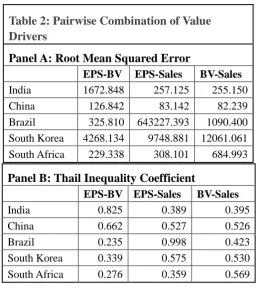
The results for combined multiples are given in Table 2. While analyzing pricing error
distributions for combined multiples we find that for India and China the errors are minimum
for the combination of BV-Sales value drivers according to both the criteria. EPS-Sales is the
next best value driver while EPS-BV performs worst in forecasting prices. However, it is to
be noted that pricing errors through EPS-Sales are almost equal to BV-Sales for India and
China. In case of other three emerging economies EPS-BV is a better measure than other two
combinations of value drivers as per both the criteria.
We next compare standalone value drivers with value driver combinations. It can be seen
from Tables 1 and 2, that BV (the best standalone value driver) outperforms BV-Sales (the
best combination of value drivers) for India as per both the evaluation criteria. The value
driver combinations do not consistently do better than standalone value drivers as per our
evaluation criteria for China and South Korea.
On the other hand for Brazil and South Africa we get inconsistent results as per both the
criteria. In case of South Africa, EPS (the best standalone value driver) performs better than
EPS-BV (the best combination of value driver) while for Brazil EPS-BV gets better results
than EPS as per Root Mean Squared Error. While as per Thail Inequality Coefficient criteria
EPS and EPS-BV are the best multiples in forecasting prices for Brazil and South Africa
www.macrothink.org/ajfa
85
forecast and hence, equity valuations can be better done by keeping the process simple by
using standalone multiples. Our results for emerging markets are in contrast with Penman
(1997), who finds that combined value drivers do a better job than standalone value drivers in
case of matured markets. Our findings may be explained by the fact that different price
multiples are driven more by investor sentiment in emerging markets where the investors do
not perceive each price multiple to be providing different information. See Sehgal and
Pandey (2009). Hence, use of multivariate models does not improve our price forecasts.
6. Sector regressions versus Market regressions: The Indian Case
In this section we analyze Indian companies to find out whether sector regressions better
explain the stock prices than market regressions. Sector regressions are not performed for
other sample countries as sector classification information for them is not available with us.
In case of sector regressions the price forecasts are obtained using data for sample companies
belonging to a particular sector. We calculate pricing errors by taking the difference between
actual and forecasted prices. The distributions of pricing errors are then used to estimate our
forecast evaluation criteria namely, Root MSE and Thail Inequality Coefficient. In case of
market regressions, the estimation procedure is similar except that price forecasts are
obtained by using information for all the sample companies i.e. for the market as a whole.
Some equity analysts argue that sector regressions are better than market regressions owing
to the fact that the former controls for inter – sectoral differences while developing price
forecast. Others argue in favour of market regressions as all securities compete with each
other for each dollar of investment in financial markets, irrespective of their sector
classification. The data employed for India is same as is used in section 3.
We find that pricing errors are lower for market regressions compared to sector regressions as
is shown in Table3 both for standalone as well as for pairwise combination of value drivers as
per both the evaluation criteria. The reason for this could be that in market regressions the
companies used for sector regressions. The high degree of freedom in case of market
regressions may result in better parameter estimation for price forecast purposes. Our results
show that contrary to popular belief that price multiples based on sector regressions result in
better forecasting of prices, we find that market regressions provide better performance. We
therefore, suggest that market regressions should be preferred over sector regressions for
equity valuation in the Indian context. We could not do similar analysis for other BRICKS
countries owing to lack of sector classification information for them. Similar work for these
countries shall be greatly useful for equity analysts and global portfolio managers.
7. Summary and concluding remarks
In this study we evaluate the efficacy of alternative value drivers namely, EPS, BV and Sales
in providing price forecasts. We conduct this analysis for BRICKS (excluding Russia) which
is the most important basket amongst the emerging markets. We employ two performance
evaluation criteria i.e. Root MSE and Thail Inequality Coefficient for checking the accuracy
of our price forecasts.
Our work involves three phases. In phase one we evaluate the price forecasts provided by
standalone price multiples and find that while BV is the best value driver in case of Asian
economies (India, China and South Korea), EPS performs best for Brazil and South Africa. In
the second phase we experiment with binary combinations of value drivers and find that
BV-Sales is the best combination for India and China, while BV-EPS provides best price
forecasts for Brazil, South Korea and South Africa. We further observe that combinations of
value drivers do not seem to outperform standalone multiples. We recommend that equity
valuation process for the sample countries should be kept simple by using relevant standalone
price multiples as use of additional multiples do not seem to be providing any significant
extra information to investors for developing price forecast. Our findings on emerging
www.macrothink.org/ajfa
87
In the final phase we verify if sector regressions result in lower pricing errors compared to
market regressions in the Indian context. We could not conduct similar analysis for other
countries owing to lack of sectoral information. We find that contrary to popular belief sector
regressions perform worse than market regressions. While estimating price forecasts our
results may be outcome of the fact that market regressions are estimated using large pool of
observations (sample companies) resulting in more efficient estimation of the parameters
involved in our forecast regressions. We suggest that market regressions should be preferred
over sector regressions for equity valuation in the Indian environment. Similar companies for
other BRICKS countries are desirable and should be covered in further research.
Our findings are extremely relevant for equity analysts and global portfolio managers who
are continuously involved in security evaluation and developing strategic allocation strategies
involving distribution of investible funds across world markets including BRICKS. Our study
contributes to the equity valuation literature for emerging markets. Similar work for other
world markets is desirable for inter-country comparisons on the subject.
Notes
1. Emerging Markets: For details refer to Irina, Alexander and Evan (2007), Gill
(2003), Dhankar and Kumar (2007), and Sehgal and Pandey (2009).
2. Matured Markets: For details refer to Boatsman and Baskin (1981), Alford (1992),
Kaplan and Ruback (1995), Penman (1996), Penman (1997), Tasker (1998), Baker
and Ruback (1999), Beatty, Riffe and Thompson (1999), Kim and Ritter (1999), Liu,
Nissim and Thomas (2002), Liu, Nissim and Thomas (2007), Huang, tsai and Cheng (2007)and Da and Schaumburg (2008).
3. Thomson Reuters - Datastream Software: It is a financial and macroeconomic database, covering major instruments, company fundamentals, equities, fixed income securities and economic indicators for 177 countries and 60 markets worldwide. 4. BSE 500: Bombay Stock Exchange Limited constructed a new index, christened
5. Large Cap: In Indian context large cap is a term used by the investment community to refer to companies with a market capitalization value of more than $5
billion. Large cap is an abbreviation of the term "large market capitalization". Market capitalization is calculated by multiplying the number of a company's shares
outstanding by its stock price per share.
6. Dividend Tax: It is an additional tax to be paid by domestic companies when they declare and distribute dividend among equity shareholders. The tax is levied at
prescribed rate (for example in India it is 15% + 7.5% + 3% (dividend tax + surcharge + SHEC) on the amount which is meant for the payment of dividend).
7. Expected price is computed by using the parameters estimated in equation (1) in the
form
it it
p
Where,
it = value driver
8. White Hetroskedasticity Test: These tests are the extension of White's (1980) test to systems of equations as discussed by Kelejian (1982) and Doornik (1995). The test regression is run by regressing each cross product of the residuals on the cross products of the regressors and testing the joint significance of the regression. The No Cross Terms option uses only the levels and squares of the original regressors, while the With Cross Terms option includes all non- redundant cross-products of the original regressors in the test equation. The test regression always includes a constant term as a regressor. If the chi-square value at the chosen level of significance, or if the p-value of the compute chi square value is reasonably low (say 1% or 5%), we can reject the null hypothesis of hetrocedasticity.
References
Alford, A. (1992).The effect of the set of comparable firms on the accuracy of the price-earnings valuation method. Journal of Accounting Research, 30, 94–108
Anthony, E. Bopp. (1985). On Combining Forecasts: Some Extensions And Results. Management Science, 31, 1492-1498
Baker, M., & Ruback, R. (1999). Estimating Industry Multiples. working paper: Harvard University, Cambridge, MA
Beatty, R.P., Riffe, S.M., & Thompson, R. (1999).The method of comparables and tax court valuations of private firms: an empirical investigation. Accounting Horizons, 13, 177–199
www.macrothink.org/ajfa
89 Accounting Review, 56, 38-53.
Copeland, T., Koller, T., & Murrin. J. (1994). Valuation . New York: Willey
Da, Z., & Schaumburg, E. (2011). Relative Valuation and Analyst Target Price Forecasts. Journal of Financial Markets, 14, 161-192
Damodaran, A. (1996). Damodaran on Valuation. New York: Willey
Huang, Y., Tsai, C.H., & Chen, C.R. (2007). Expected P/E, Residual P/E, and Stock Return Reversal: Time – Varying Fundamentals or Investor Overreaction?. International Journal of Business and Economics, Vol. 6, No.1, 11-28
Irina, I., Alexander, P., & Ivan, K. (2007). Adjustments to Market Multiples – Based Valuation in Emerging Markets: Empirical Study for Russia. Working paper, Corporate Finance Center, Higher School of Economics, Moscow, Russia
Kaplan, S. N., & Ruback, R. S. (1995). The valuation of cash flow forecasts: An empirical analysis. The Journal of Finance, 50, 1059–1093
Kim, M., & Ritter,J. (1999). Valuing IPOs. Journal of Financial Economics, 53, 409–37. Koutroumanidis, T., Iliadis, L., & Sylaois, G.K. (1986).The Fisher Hypothesis Under Different Monetary Regime. The Review of Economics and Statistics, 68, 674-679
Liu, J., Nssim, D., & Thomas, J. (2002a).Equity Valuation Using Multiples. Journal of Accounting Research, 40, 135-172
Liu, J., Nissim, D., & Thomas, J. (2002b). International Equity Valuation using multiples. Working Paper, Anderson Graduate School of Management, University of California at Los Angeles.
Liu, J., Nissim, D., & Thomas, J. (2007). Is Cash Flow King in Valuations. Financial Analyst Journal, Volume 63, 56-65.
Palepu, K., Healey, P., & Bernard, V. (2000).Business Analysis and Valuation (2nd
ed). Cincinnati, Ohio: South Western College Publishing
Penman, S. H. (1996a). The Articulation of Price-Earnings Ratios and Market –to- Book Ratios and the Evolution of growth. Journal of Accounting Research, 34, 253-259
Sehgal, S. & Pandey, A. (2009). The Behavior of Price Multiples in India (1990-2007). Asian Academy of Management Journal of Accounting and Finance, 5, 31-65
Sehgal, S. & Pandey, A. (2010). Equity Valuation using Price Multiples: Evidence from India. Asian Academy of Management Journal of Accounting and Finance, 6, 89-108
Tasker, S. C. (1998). Industry preferred multiples in acquisition valuation. Working paper, Cornell University, Ithaca, NY
Thomas,A.Barthold., & William.R, Dougan. (1986). The Fisher Hypothesis Under Different Monetary Regimes. The Review of Economics and Statistics, 68, 674-679
Tables
Table 1: Standalone Value Drivers
Panel A: Root Mean Squared Error
EPS BV Sales
India 245.371 227.190 266.736 China 83.427 82.111 87.087 Brazil 740.142 1137.737 1307.666 South Korea 18196.243 7635.384 27903.628
South Africa 220.254 304.812 303.202
Panel B: Thail Inequality Coefficient
EPS BV Sales
India 0.392 0.387 0.434 China 0.526 0.527 0.538 Brazil 0.287 0.427 0.429 South Korea 0.763 0.325 0.656
www.macrothink.org/ajfa
91
Table 2: Pairwise Combination of Value Drivers
Panel A: Root Mean Squared Error
EPS-BV EPS-Sales BV-Sales
India 1672.848 257.125 255.150
China 126.842 83.142 82.239 Brazil 325.810 643227.393 1090.400 South Korea 4268.134 9748.881 12061.061 South Africa 229.338 308.101 684.993
Table 3: Sector Vs Market Regressions for India
Root Mean Squared Error Thail Inequality Coefficient
Sector Regression
Market Regression
Sector Regression
Market Regression
EPS 290.91 245.371 0.418 0.392
BV 322.321 227.190 0.456 0.387
Sales 678.838 266.736 0.648 0.434 EPS-BV 9166.62 1672.848 0.960 0.825 EPS-Sales 560.851 257.125 0.576 0.389 BV-Sales 332.357 255.150 0.440 0.395
Copyright Disclaimer
Copyright reserved by the author(s).
This article is an open-access article distributed under the terms and conditions of the Creative Commons Attribution license (http://creativecommons.org/licenses/by/3.0/).
Panel B: Thail Inequality Coefficient
EPS-BV EPS-Sales BV-Sales
India 0.825 0.389 0.395 China 0.662 0.527 0.526 Brazil 0.235 0.998 0.423 South Korea 0.339 0.575 0.530