JIEM, 2017 – 10(1): 49-73 – Online ISSN: 2013-0953 – Print ISSN: 2013-8423 https://doi.org/10.3926/jiem.2012
Co-Creating Value through Agents Interaction
within Service Network
Liane Okdinawati , Togar M. Simatupang , Yos Sunitiyoso
School of Business and Management, Bandung Institute of Technology (Indonesia)
[email protected], [email protected], [email protected]
Received: June 2016 Accepted: February 2017
Abstract:
Purpose: The purpose of this paper is to give further understanding on value co-creation mechanisms in B-to-B service network by reinforcing the processes, the relationships, and the influences of other agents where Collaborative Transportation Management (CTM) forms might be best employed.
Design/methodology/approach: In order to model the interactions among agents in the collaboration processes and the value co-creation processes, this research used three collaboration cases in Indonesia. The agent-based simulation was used to capture both the collaboration process and the value co-creation process of the three collaboration cases.
Findings: The interactions among the agents both inside and outside their collaboration environments determined agent’s role as a value co-creator. The willingness of an agent to accept the opinion of another agent determined the degree of their willingness to co-operate and to change their strategies, and perceptions. Therefore, interaction among agents influenced the size of the value obtained by them in each collaboration process.
Practical implications: It is crucial for the practitioners to interact with another agent both inside and outside their collaboration environment. The opinions of another agent inside the collaboration environment also need to be considered.
Originality/value: This research is derived from its emphasis on how a value is co-created by reinforcing both the collaborative processes and the interactions among agents as well as on how CTM might be best employed.
Keywords: value co-creation, collaboration, transportation services, interaction, agent-based modelling, service network
1. Introduction
One of the challenges in today’s business environment is to create value for customers. This has become the idea behind the Service-Dominant (S-D) Logic, where all agents in a business environment are concerned with the exchange of service by using resources, knowledge, and skills for the benefit of consumers (Vargo & Lusch, 2011). The main challenge for a company is to develop its business strategy based on S-D logic in order to create a value when the value co-creation emerges from the interaction of many parties and the complex configurations of resources and information within companies and across companies (Maglio & Spohrer, 2013). Therefore, collaboration strategies are required as business strategy to create a value.
In this research, a collaboration in transportation area was used to increase an understanding on how to increase service provision in a service network, where service providers and service clients act together to co-create a value in complex value networks. Collaboration in transportation area, known as Collaborative Transportation Management (CTM), adds a value to a collaborative relationship and an entire collaboration process, by using information sharing to support decision makers in strategic collaborative logistics, transport design, and planning. (Gonzalez-Feliu, Morana, Grau & Ma, 2013). Esper and Williams (2003) and Bishop (2004) state the needs to incorporate CTM into logistics to avoid logistics bottlenecks, reduce inefficiency, and provide mutual benefits for all collaborative parties.
operational processes in the transportation area (Okdinawati, Simatupang & Sunitiyoso, 2015). This might have been caused by the fact that the complexities and dynamics of a collaborative transportation service network that include different objectives, perspectives, roles, and responsibilities among agents in collaboration processes. Therefore, value networks, value co -creation processes, and interaction among different agents in the transportation area need to be modeled.
A value is created collaboratively in interactive configurations when all social and economic actors engaged in mutual exchange (Vargo & Lusch, 2011). Interactions among agents not only enhance the development of mutual relationships among agents in a supply chain but also increases the opportunities to deliver a value for their customers through actions that influence the other agent’s process (Gronroos & Ravald, 2011). They also state that value co-creation for the customer is created throughout the interactions and relationships between the customer and business parties. According to Kanter (2008), there are three fundamental aspects of the business relationship: mutual benefits for all agents; a collaboration to create value; and a close relationship among agents. Therefore, all agents in CTM have to share their information through interactions and close relationships, to create services together, and to learn from one another in order to co-create a value.
In order to simulate the interactions among agents in this research, the agent-based model was used based on the consideration that the agent-based model captures the interaction among agents and learning processes in CTM. Gilbert (2010) states that the agent-based model consist of agents that interact within an environment where they can interact and pass information to one another as well as use the information for the learning process. Therefore, the agent-based model is considered appropriate to model the behaviors of the agents in CTM, which leads to co-create a value.
The purpose of this research is to increase an understanding of value co-creation in the transportation service network through the interactions, close relationships among agents, and influences of other agents. This research addresses on how interactions among agents influence the relationships and learning processes of value co-creation in CTM in order to achieve a mutual value. By using the agent-based model, this research has provided empirical findings that present evidence on the interactions among agents, on the value co-creation process, and on the collaborative process.
2. Theoretical Background
2.1. Value Co-Creation
A value is created when a customer is satisfied with the product or service that is given by a company, and at the same time, the cross-functional involvement when value co-created was a key driver of revenue generated for the company (Lambert & Enz, 2012). The term of value in businesses has two approaches: the goods-centered approach and service-centered approach. The objective of the good-dominant (G-D) logic is to create and deliver products to be sold to the customer (Sebastiani, Corsaro & Vargo, 2014). Therefore, a value is embedded into products and signified by the price of the products or based on what the customer is willing to pay (Vargo & Lusch, 2008). While S-D logic focuses on the action and value, as the exchanges of a service, a value is co-created by mutual efforts, interactions, and experiences by all business parties and the customer (Vargo & Lusch, 2011; Prahalad & Ramaswamy, 2004). A value in S-D logic is defined as the value-in-use, which is created by the customer based on their accumulated experiences that are combined with resources, processes, and outcomes (Voima, Heinonen & Strandvik, 2010).
Value co-creation is created through interactions and close relationships between business parties and their customers (Gronroos & Ravald, 2011). Storbacka, Frow, Nenonen and Payne (2012) also mention that a value co-creation process is performed by using information, knowledge, skills, and other competencies of all business parties to achieve a particular goal. Based on that, the term of value co-creation is related to the interactions, the integration of recourses, and exchanges between all parties in a business network. In this research, the value co-creation in CTM is defined as a value that is co-created by agents in every stage of a collaboration, where the agents exchange information and competences in order to achieve a value for themselves, for other agents, and eventually for the customer throughout an on-going process.
2.2. Collaborative Transportation Management (CTM)
travelling time, inefficiency, and CO2, increased responsiveness (Esper & Williams, 2003; Sutherland,
2003; Bishop, 2004; VICS, 2004; Gonzalez-Feliu et al., 2013).
VICS (2004) developed CTM because several activities were not included in the CPFR, such as shipment assignments, carrier assignments, scheduling, and tracks and traces. VICS (2004) defines CTM as a holistic process that brings together all parties in the supply chain, especially shippers, receivers, and carriers to reduce inefficiencies and to improve performances of all parties involved through a collaboration in the transportation planning and execution process. CTM has been used in different types of collaboration to create the optimal scenarios for the collaborative parties in different planning levels. There are three planning level used by VICS (2004), i.e. the strategic level (the first level), the tactical level (the second level), and the operational level (the last level).
3. Interaction Models
In order to model the interactions among agents in both the collaboration processes and the value co-creation processes, this research used three collaboration cases in Indonesia. Six informants, as the representatives of each company in the collaboration cases, were interviewed for 2-3 hours in 4 different sessions. Other sources of data collection were also used, such as contract documents, company records, and reports. The selection of the collaboration cases, based on the recommendations of practitioners and academics, was determined on the bases of the degree of the collaboration maturity and involvement of each agent in the collaborative processes.
The first collaboration case is the collaboration between Lookman Djaja and Enseval. Enseval is one of the largest pharmaceutical distributors in Indonesia (The Jakarta Post, 2011) and has 40 branches across Indonesia. Enseval has a role both as the shipper and as the receiver in CTM to dispatch supplies within 24 hours to hospitals, clinics, and outlets. Lookman Djaja, as a carrier, was considered as the best vendor by Enseval in the year 2014. Lookman Djaja owned 280 trucks distributing healthcare products from the Enseval Regional Distribution Centre in Jakarta to the Enseval Distribution Centre in Surabaya.
products from the 7-Eleven Central Distribution Centre to all 7-Eleven stores in Jakarta. There are two types of services given by Iron Bird to 7-Eleven. The first service is dedicated services, tailor-made services, which is adapted specifically for 7-Eleven. The second service is on call service, designed to give transportation services outside the scheduled services.
The third collaboration case is the collaboration between Inprase and Indorama Ventures Indonesia (IVI). IVI is known as the world’s largest producer of polyester, synthetic rubber gloves, and resins (Karmali, 2014). Inprase, as the carrier, owns 350 trucks that distribute IVI’s raw materials from Merak to Tanggerang. The main business specialty of Inprase is to distribute oil, natural gas, and chemical goods.
3.1. Collaboration Process
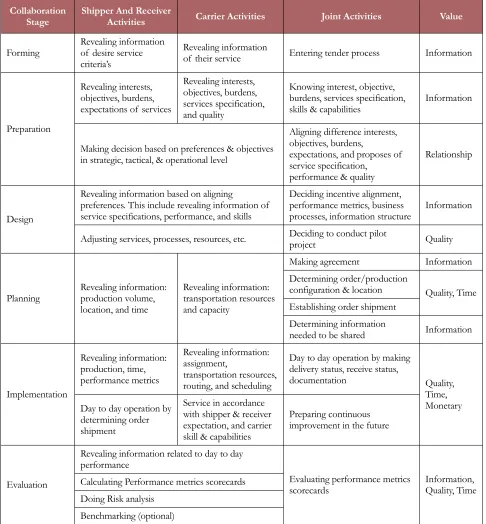
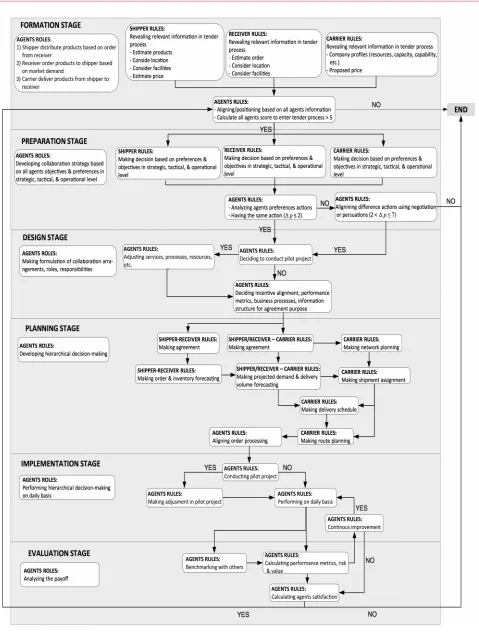
The collaboration process for CTM was developed in six stages. It was developed to capture the interactions, actions, and the effects of a decision-making for the vertical collaboration in business processes. The collaboration stages were adopted from Dwyer, Schurr and Oh (1987). The first stage is the formation stage. In this stage each agent is considered feasible as a collaborative partner and is only limited to enhance one another’s attractiveness to join collaboration. Revealing the specific information among agents is used to position their own attractiveness to join collaboration.
The second stage is the preparation stage. In the preparation stage, each agent’s interests, obligations, benefits, and burdens are explored. In this stage, all agents align their perceptions based on each agent’s strategic structure formation, communication, and power structure. The third stage is the design stage. In this stage, each agent agrees on its own roles and responsibilities as part of collaborative arrangements, which is based on several considerations such as incentive alignment, information structure, performance metrics, and process integration.
modify or to terminate the agreement they have made. The results of the evaluation stage are also used to measure the economic impacts and the outcomes of CTM.
3.2. Value Co-Creation Process
In order to model the interactions of agents in value co-creation, the five value in CTM are used. Those values are developed based on the objectives of the customers and all agents involved in CTM. Sutherland (2003) state that value in CTM may include improving the transportation’s components of the supply chain, eliminating inefficiencies, reducing costs, and ensuring reliability in the movement of goods. The five value in CTM are as follows:
(1) Information value (Allee, Schwabe & Babb, 2015; Graves, 2010) refers to information that can be drawn on by agents in order for them to function effectively in CTM.
(2) Relationship value (Smith & Colgate, 2007; Sanders & Simons, 2009; O’Cass & Ngo, 2011; Ritter & Walter, 2012) is the way in which agents and their customers regard and behave toward each other in a collaborative process.
(3) Quality value (O’Cass & Ngo, 2011) as the value of service performance, includes durability, reliability, etc. of that service.
(4) Time value (Smith & Colgate, 2007) refers to the measured or measurable period during which an action, process, or condition exists.
(5) Monetary value (Sanders & Simons, 2009; O’Cass & Ngo, 2011; Smith & Colgate, 2007; Allee et al., 2015) relates to economic aspects such as cost and price of a service in exchange for the service.
Collaboration
Stage Shipper And ReceiverActivities Carrier Activities Joint Activities Value
Forming Revealing information of desire service criteria’s
Revealing information
of their service Entering tender process Information
Preparation
Revealing interests, objectives, burdens, expectations of services
Revealing interests, objectives, burdens, services specification, and quality
Knowing interest, objective, burdens, services specification,
skills & capabilities Information
Making decision based on preferences & objectives in strategic, tactical, & operational level
Aligning difference interests, objectives, burdens,
expectations, and proposes of service specification,
performance & quality
Relationship
Design
Revealing information based on aligning
preferences. This include revealing information of service specifications, performance, and skills
Deciding incentive alignment, performance metrics, business
processes, information structure Information
Adjusting services, processes, resources, etc. Deciding to conduct pilot project Quality
Planning Revealing information: production volume, location, and time
Revealing information: transportation resources and capacity
Making agreement Information
Determining order/production
configuration & location Quality, Time Establishing order shipment
Determining information
needed to be shared Information
Implementation Revealing information: production, time, performance metrics Revealing information: assignment, transportation resources, routing, and scheduling
Day to day operation by making delivery status, receive status,
documentation Quality,
Time, Monetary Day to day operation by
determining order shipment
Service in accordance with shipper & receiver expectation, and carrier skill & capabilities
Preparing continuous improvement in the future
Evaluation
Revealing information related to day to day performance
Evaluating performance metrics
scorecards Information, Quality, Time Calculating Performance metrics scorecards
Doing Risk analysis Benchmarking (optional)
4. Simulation Process
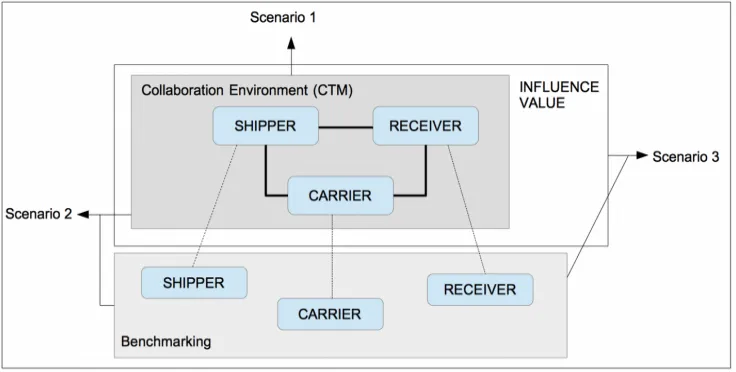
Both the collaboration process and the value co-creation process in this research are developed based on the three collaboration cases. They have provided insights on the application of the multi-agent model in the real system. Each agent has a different role, perspective, and objective when joining the collaboration. There are three different strategies used in the collaborative process of the three cases. In this research, those strategies are simulated in three different scenarios from which the agents can choose. The first scenario is used when all agents interact with one another only inside their collaboration environment. The second scenario is used when all agents interact with one another in their collaboration environment and also interacts with one another outside their collaboration environment. All agents interact with one another outside their collaboration environment for benchmarking purposes. The third scenario is used when agents interact with one another both inside and outside their collaboration environment, and also when they use their opinion value inside their collaboration environment.
Figure 1. Simulation Scenario
define the required information properly. In this action, the levels of value co-creations improve, but they still remain low if compared to other actions.
Each agent has its own criteria for the components of a value, and each criterion has randomly been generated by computers at the initialization of the simulation process. Each agent also has its own perspectives based on the components of the value. SOARS is used for the simulation of agent-based model in this research. The simulation process runs for 15 iterations, representing years and for 50 times. Q-learning algorithm is also used to model how the agents in CTM learn and adapt to choose the actions based on trial and error in each collaboration stage in order to co-create a value. In addition, the Q-learning algorithm is used to calculate the value captures of the agents in CTM in each collaboration stage. Therefore, in this algorithm, the agents in the environment learn to choose the actions based on trial and error, which give higher value than the previously selected actions (Watkins & Dayan, 1992; Pandey, Khumar & Pandey, 2010). The Q-learning function (Watkins & Dayan, 1992) is defined as follows:
(1)
Where: Qt+1(st, at) = new value,
αt = learning rate,
Rt+1 = reward,
γ = discount factor,
max Qt(st+1,a) = estimate of optimal future value,
Qt(st,at) = old value.
Learning rate (0 < α ≤ 1) represents the extent of the new information that substitutes the old information. 0 learning rate represents that the agent in the model does not learn anything, and 1 represents that the agent in the model considers only the most recent information. Discount factor determines the importance of the future value for the agent in the model. 0 represents that the agent only focuses on the current value, and 1 represents a long-term high value. In this research, although αt
decreases from 1 to almost 0 (αt = 1/iteration), it is regarded as a learning rate with the consideration that
by using this learning rate all of the agents detect and absorb not only new information. For the discount factor, γ = iteration/Σiteration, it is used based on the consideration that all of the agents focus on the long-term reward, which is to co-create a value.
Value function that is adopted from Stewart and Ebrary (2010) is also used to define the value co-creations of all of the agents in CTM. The value function is expressed as follows:
In order to co-create a value, two types of learning are used, i.e. individual learning and coordination learning. Individual learning is used when an agent learns its own strategies independently, while coordination learning is used when the agents need to coordinate their actions to jointly create a value. These two types of learning are used based on the consideration that in the first stage, which is the formation stage, all of the agents interact with one another using its own information and choosing the actions individually. For the other stages, coordination learning is used to coordinate the agents’ actions in the collaborative processes. When an agent use coordination learning, it learns a joint action based on the information shared by all agents.
Reinforcement learning is used in this research with the purpose of allowing each agent to explore its own environment in order to maximize a value. Therefore, Boltzmann exploration is used as the exploration technique where each agent chooses the actions by exploring its own environment based on the probability. Boltzmann’s distribution is expressed as follows:
(3)
Where Q(s,a) is the agent’s estimate of the Q-value of performing action a at state s.
For scenario 3, when the agents interact with one another in both inside and outside their collaboration environment, not only do they communicate with one another, but also their actions can influence the other agents’ behaviors. This approach is based on Influence Value Reinforcement Learning (IVRL), where agents calculate the value of their actions based on the influence rates and the opinions of the other agents that relate to the executed actions (Barrios-Aranibar & Gonçalves, 2009). The IVRL is defined as the Equation (4).
(4)
Where: βi(j) = the influence rate of the agent j over i.
OPj(i) = the opinion of agent j in relation to action executed by the agent i.
(5)
(6)
Where: Pe(s(t),ai(t)) = the occurrence index (times action ai is executed by the agent i in state s(t) over
times the agent i hasbeen in state s(t)),
Q(s(t),aj) = the value of the state-action pair of the agent j at time t,
Aj = the set of all agents’ action j can be executed.
Influence rate (0 ≤ β ≤ 1) represents that an agent either is or is not influenced by the opinions of the other agents. Opinion value is described as the value of an agent that is related to the actions of the other agents. Based on IVRL, if the reward of the action chosen by an agent is greater than the value of its own action, the opinions about the action, performed by the other agents, are positive. Furthermore, if the reward of the action chosen by an agent is lesser than the value of its own action, the opinions related to the action, made by the other agents, are negative. It indicates that when an agent has a positive opinion of the other agents’ actions, the other agents will eventually repeat the same actions and will eventually avoid the actions that cause negative opinions.
There are two stages of validation process in this research. The first validation was done when the interaction models developed both the collaboration processes and the value co-creation processes. The second validation was done to validate the simulation results. Face validation was used for both stages, where both the experts and the practitioners were asked to make a judgment if the interaction models and the simulation results had a similar pattern with the real system and achieved the intended purposes.
5. Simulation Results and Discussion
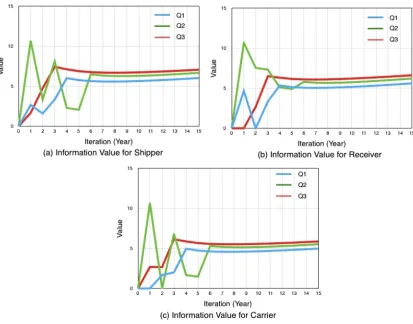
In the first stage, which is the formation stage, an agent learned independently to continue the collaboration process to achieve a better value. In scenario 3, the agents had the probability of 100% to learn to choose action 6 in 6 years. In scenario 2, all agents also had the probability of 100% to choose action 6 in 6 years. However, in scenario 1, all agents only had 100% probability to learn to choose the action 6 in 10 years. At this stage, the information value is obtained by the agents individually. For all agents, the highest information value obtained in scenario 3 was at the end of iteration. This occurred because the agents in scenario 1 only had limited information to choose an action to obtain a maximum information value. Information value of the agents can be seen in Figure 3.
Figure 3. Information Value of the Agents in Formation Stage: (a) Shipper, (b) Receiver, and (c) Carrier
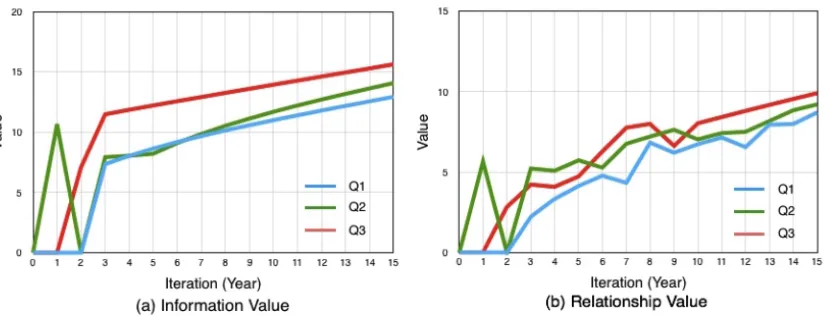
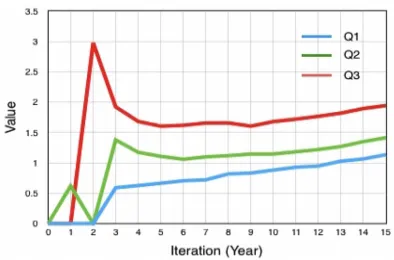
other scenarios. Moreover, since the agents were able to align their preferences and objectives in this stage, the agents were able to accelerate the probability of choosing action 6. They accelerated the probability to choose action 6 from 10 years to 6 years in scenario 1, from 6 years to 5 years in scenario 2, and from 6 years to 4 years in scenario 3. These happened because the influence and opinion of the other agents contributed to one agent’s decision to continue, negotiate, or stop the collaboration process. In this research, when one agent chose to negotiate with the other agents, more information would be obtained and so the agent had a better understanding of the other agents’ objectives and preferences. The value of information and relationship in the preparation stage can be seen in Figure 4. Figure 4 shows each time the agents choose to stop the collaboration process, the relationship value declines. Also, each time the agents choose to continue or negotiate with the other agents, the relationship value increases.
Figure 4. Value Generated in Preparation Stage: (a) Information Value, (b) Relationship Value
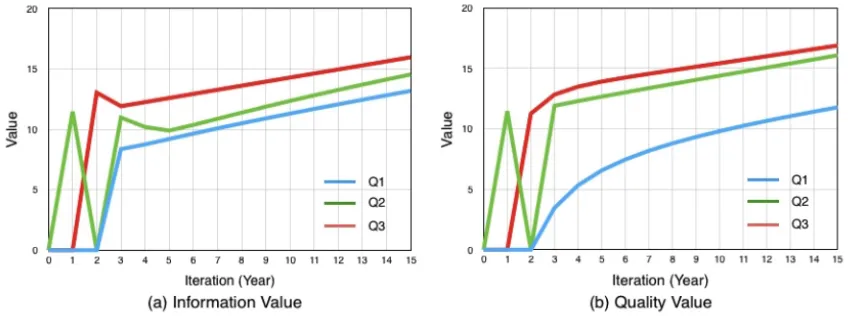
Figure 5. Value Generated in Design Stage: (a) Information Value, (b) Quality Value
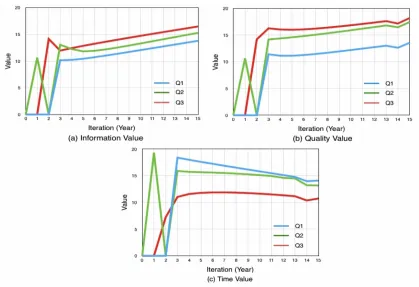
Figure 6. Value Generated in Planning Stage: (a) Information Value, (b) Quality Value, and (c) Time Value
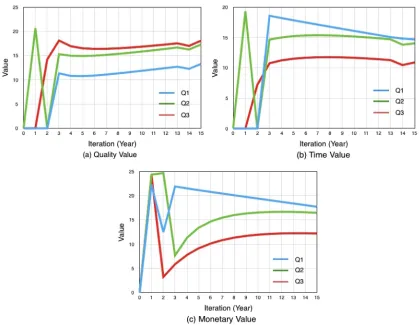
Figure 7. Value Generated in Implementation Stage: (a) Quality Value, (b) Time Value, and (c) Monetary Value
Figure 8. Value Generated in Evaluation Stage: (a) Information Value, (b) Quality Value, and (c) Time Value
Figure 9. Value Co-creation Obtained by Agents
6. Conclusions
Value co-creation is defined as the development of relationships between agents as collaborative partners through ongoing interactions and through systemic, networked, service exchange relationships from all agents involved (Vargo & Lusch, 2011). The three collaboration cases in this research provided the insight of integrating the value co-creation processes into the collaboration processes among the three agents in CTM: a shipper, a receiver, and a carrier. In this research, the value co-creation is focused on the collaborative process of transportation services. The interactions among the agents as well as the integration of their collaborative processes, learning mechanisms, and the agents’ opinions improve the existing services, and the agents’ experience.
opinion of another agent determined the degree of their willingness to co-operate and to change their strategies, operation processes, objectives, and perceptions, too.
This research responds to the needs for empirical research on value co-creation mechanisms for B-to-B service network, particularly in the transportation area. Moreover, the novelty of this research is derived from its emphasis on how a value is co-created by reinforcing both the collaborative processes and the interactions among agents as well as on how CTM might be best employed. The contribution of this research for the policy makers is that agents have to learn and adapt in the collaborative process to maximize their benefits of joining the collaborations. For the practitioners in CTM, it is crucial for them to interact with another agent both inside their collaboration environment and outside their collaboration environment. The opinions of another agent inside the collaboration environment also need to be considered to achieve a better customer satisfaction.
However, since the three collaboration cases among the three agents in CTM had brought forth the limitations to generalize the interaction among the agents in the value co-creation process, further research for the value co-creation in the service network, especially in the transportation area, needs to be done in the future. Several interesting aspects to be addressed are (1) how to encourage agents to co-operate and adjust their perceptions and objectives in a value co-creation process, (2) how end customers take a certain role in a service network through direct interactions with all agents in collaborative process, and (3) how the opinions of customers influence the value co-creation process so that the agents adjust their strategic decisions and service development that bring more benefits to the customers.
References
Allee, V., Schwabe, O., & Babb, M.K. (2015). Value Networks and the True Nature of Collaboration. Meghan-Kiffer Press.
Barrios-Aranibar, D., & Gonçalves, L.M. (2009). Influence Value Q-Learning: A Reinforcement Learning Algorithm for Multi Agent Systems. I-Tech, Vienna, Austria. ISBN 978-3-902613-55-4.
Bishop, S.B. (2004). Collaborative Transportation Management Benefits. Supply Chain Systems Inc. Available online at: http://www.vics.org (Accessed: October 2013).
Deutsch, A. (2011). 7-Eleven Becomes Indonesia’s Trendy Hangout. Available online at:
http://www.ft.com/cms (Accessed: November 2015).
Esper, T.L., & Williams, L.R. (2003). The value of Collaborative Transportation Management (CTM): Its Relationship to CPFR and Information Technology. Transportation Journal, 42(4), 55-65.
https://doi.org/10.2307/1251126
Gilbert, G.N. (2010). Computational Social Science. London: Sage.
Gonzalez-Feliu, J., Morana, M., Grau, J.M.S., & Ma, T.Y. (2013). Design and Scenario Assessment for Collaborative Logistics and Freight Transport Systems. International Journal of Transport Economics, 207-240.
Graves, T. (2010). Mapping the enterprise: modelling the enterprise as services with the enterprise canvas. Tetradian Books.
Gronroos, C., & Ravald, A. (2011). Service as Business Logic: Implications for Value Creation Service as Business. Journal of Service Management, 22(1), 5-22. https://doi.org/10.1108/09564231111106893
Hutton, J. (2015). Indonesia’s Blue Bird Targets New Growth: Noni Purnomo. Forbes Asia. Available online at: http://forbes.com/sites/forbesasia (Accessed: November 2015).
Kanter, R.M. (2008). Collaborative Advantage: The Art of Alliances. Harvard Business Review, 72(4), 96-108.
Karmali, N. (2014). Indorama’s Amit Loha is the Prince of Polyester. Forbes Asia. Available online at:
http://forbes.com/sites/forbesasia(Accessed: November 2015)..
Lambert, D.M., & Enz, M.G. (2012). Managing and Measuring Value Co-Creation in Business-to-Business Relationships. Journal of Marketing Management, 28(13-14), 1588-1625.
https://doi.org/10.1080/0267257X.2012.736877
Lockamy III, A., & McCormack, K. (2004). Linking SCOR Planning Practices to Supply Chain Performance: An Exploratory Study. International Journal of Operations & Production Management, 24(12), 1192-1218. https://doi.org/10.1108/01443570410569010
Maglio, P.P., & Spohrer, J. (2013). A Service Science Perspective on Business Model Innovation. Industrial marketing Management, 42(5), 665-670. https://doi.org/10.1016/j.indmarman.2013.05.007
O’Cass, A., & Ngo, L. (2011). Examining the Firm’s Value Creation Process: A Managerial Perspective of the Firm’s Value Offering Strategy and Performance. British Journal of Management, 22(4), 646-671.
https://doi.org/10.1111/j.1467-8551.2010.00694.x
Pandey, P., Khumar, S., & Pandey, D. (2010). Reinforcement Learning by Comparing Immediate Reward.
International Journal of Computer Science and Information Security, 8(5).
Prahalad, C., & Ramaswamy, V. (2004). Co creation Experiences: The Next practice in Value Creation.
Journal of Interactive Marketing, 18(3), 5-14. https://doi.org/10.1002/dir.20015
Ramirez, R. (1999). Value Co-production: Intellectual Origins and Implications for Practice and Research.
Strategic Management Journal, 20(1), 49-65.
https://doi.org/10.1002/(SICI)1097-0266(199901)20:1<49::AID-SMJ20>3.0.CO;2-2
Ritter, T., & Walter, A. (2012). More is not always better: The impact of relationship functions on customer-perceived relationship value. Industrial Marketing Management, 41(1), 136-144.
https://doi.org/10.1016/j.indmarman.2011.11.020
Sanders, L., & Simons, G. (2009). A Social Vision for Value Co-Creation In Design. Open Source Business Resource.
Sebastiani, R., Corsaro, D., & Vargo, S.L. (2014). Transitioning to value co-development. In Managing Consumer Services, 131-149. https://doi.org/10.1007/978-3-319-04289-3_8
Smith, J.B., & Colgate, M. (2007). Customer Value Creation: A Practical Framework. Journal of Marketing Theory and Practice, 15(1), 7-23. https://doi.org/10.2753/MTP1069-6679150101
Stewart, R.B., & Ebrary, I. (2010). Value Optimization for Project and Performance Management. Hoboken, N.J.: Wiley.
Storbacka, K., Frow, P., Nenonen, S., & Payne, A. (2012). Designing Business Models for Value Co-creation. In Special Issue–Toward a Better Understanding of the Role of Value in Markets and Marketing, 51-78.
https://doi.org/10.1108/S1548-6435(2012)0000009007
Sutherland, J.L. (2003). Collaborative Transportation Management–Creating Value Trough Increased Transportation Efficiencies. Business Briefing – Pharmagenerics, 1-4.
The Jakarta Post (2011). Enseval Eyes 20% Rise in Revenue, Profit. Available online at:
http://www.thejakartapost.com/news (Accessed: November 2015).
Vargo, S.L., & Lusch, R.F. (2008). Service-dominant Logic: Continuing the Evolution. Journal of the Academy of Marketing Science, 36(1), 1-10. https://doi.org/10.1007/s11747-007-0069-6
VICS (CTM sub-committee of the Voluntary Inter-Industry Commerce Standards Logistic Committee) (2004). Collaborative Transportation Management White Paper Version 1.0. http://www.vics.org(Accessed: October 2013).
Voima, P., Heinonen, K., & Strandvik, T. (2010). Exploring Customer Value Formation–a Customer Dominant Logic Perspective. Working paper No. 552. Publications of Hanken School of Economics, Helsinki, Finland.
Watkins, C.J.C.H., & Dayan, P. (1992). Q-learning. Machine learning, 8(3-4), 279-292.
https://doi.org/10.1007/BF00992698
Journal of Industrial Engineering and Management, 2017 (www.jiem.org)
Article’s contents are provided on an Attribution-Non Commercial 3.0 Creative commons license. Readers are allowed to copy, distribute and communicate article’s contents, provided the author’s and Journal of Industrial Engineering and Management’s