The Thirty-Third AAAI Conference on Artificial Intelligence (AAAI-19)
Dirichlet Multinomial Mixture with Variational
Manifold Regularization: Topic Modeling over Short Texts
Ximing Li, Jiaojiao Zhang, Jihong Ouyang
College of Computer Science and Technology, Jilin University, ChinaKey Laboratory of Symbolic Computation and Knowledge Engineering of Ministry of Education, China [email protected]
Abstract
Conventional topic models suffer from a severe sparsity prob-lem when facing extremely short texts such as social media posts. The family of Dirichlet multinomial mixture (DMM) can handle the sparsity problem, however, they are still very sensitive to ordinary and noisy words, resulting in inaccu-rate topic representations at the document level. In this paper, we alleviate this problem by preserving local neighborhood structure of short texts, enabling to spread topical signals among neighboring documents, so as to correct the inaccurate topic representations. This is achieved by using variational manifold regularization, constraining the close short texts should have similar variational topic representations. Upon this idea, we propose a novel Laplacian DMM (LapDMM) topic model. During the document graph construction, we further use the word mover’s distance with word embeddings to measure document similarities at the semantic level. To evaluate LapDMM, we compare it against the state-of-the-art short text topic models on several traditional tasks. Ex-perimental results demonstrate that our LapDMM achieves very significant performance gains over baseline models, e.g., achieving even about 0.2 higher scores on clustering and clas-sification tasks in many cases.
Introduction
Short texts, such as text advertisements and social media posts, are becoming more and more prevalent on the In-ternet. With the emerging large-scale collections of short texts, discovering the hidden topic structure from them is important for many content analysis applications. However, short texts, as suggested by the name, often contain very few words. For example, in StackOverFlow of question titles, each title sample has only about 4.9 word tokens averagely after a removal of the meaningless stopwords. Therefore, there must be very limited valuable information for short text collections at the document level, resulting in the so-called sparsity problem.
Conventional topic models, such as probabilistic latent se-mantic indexing (PLSI) (Hofmann 1999) and latent Dirich-let allocation (LDA) (Blei, Ng, and Jordan 2003), also suf-fer from the sparsity problem. That is because with
statisti-Copyright c2019, Association for the Advancement of Artificial Intelligence (www.aaai.org). All rights reserved.
cal methods, the topic inference is mainly depended on the document-level word co-occurrence information (Wang and McCallum 2006) that the short texts lack. This raises up a significant challenge to topic modeling of short texts.
2017), which are widely used on analysis tasks of short texts (Xin et al. 2011).
Orthogonal to BTM and WNTM, the family of DMM can maintain document-specific topic structure, and the recent variants (Li et al. 2016; 2017) have empirically shown very competitive performance. However, a salient problem is that they are sensitive to ordinary and noisy words, therefore the document-level topic representation can be easily miscalcu-lated. We refer to this as thesensitivity problem. For ex-ample, if the majority of words in a short text are without any topic-inclination or even noises, the topic of this docu-ment can be probably miscalculated. Unfortunately, this of-ten happens as short texts contain very few words.
Our Model
To break the limitation of DMM, we develop a novel LaplacianDMM(LapDMM) topic model for short texts. Our basic idea is to extend DMM by preserving local neigh-borhood structure of short texts using manifold regulariza-tion, which has been successfully used for topic models (Cai et al. 2008; Cai, Wang, and He 2009; Huh and Fienberg 2010; Du et al. 2015; Hu et al. 2017). The manifold regular-ization implies that the learned manifolds should be smooth, which here constrains nearby document pairs have similar latent topic representations. This can indirectly spread topi-cal signals among neighboring documents, enabling to cor-rect the miscalculated topic representations, so as to remedy the sensitivity problem of DMM.
We would like to notice that the manifold regularization can not be directly applied to DMM, because it supposes that each document only covers a single topic. To solve this, we train LapDMM following the spirit of collapsed variational inference (Teh, Newman, and Welling 2006), a more accu-rate inference method for topic models (Chi et al. 2018) than Gibbs sampling used in other DMM variants (Li et al. 2016; 2017). We then incorporate a manifold regularization term with respect to variational distributions into the original variational objective of DMM, such that the close short texts should have similar variational topic representations. LapDMM is optimized by maximizing the regularized vari-ational objective. To better capture similarities between short texts, we employ the word mover’s distance (WMD) (Kusner et al. 2015) with word embeddings (Mikolov, tau Yih, and Zweig 2013), which describes document similar-ities at the semantic level. We employ a regularized ver-sion of WMD with an entropic regularizer (Cuturi 2013) for efficient computations. Empirical results indicate that our LapDMM significantly outperforms the state-of-the-art baselines.
The main contributions of this paper are summarized as follows:
1 We develop a novel LapDMM model by incorporating a variational manifold regularization term.
2 We use the WMD with word embeddings to measure (se-mantic) similarities between short text pairs.
3 Empirical results on popular benchmark datasets demon-strate that our LapDMM significantly outperforms the state-of-the-art baselines on topic quality, clustering and
classification tasks. Specifically, the performance gain achieves even above 0.2 in many cases.
Model
In this section, we give a brief introduction to Dirichlet multinomial mixture (DMM) (Nigam et al. 2000; Yin and Wang 2014), and then describe the proposed LapDMM topic model for short texts.
Dirichlet Multinomial Mixture
DMM is a generative topic model with the assumption that each document covers only a single topic. Actually, this as-sumption can indirectly enrich word co-occurrences at the document level, making the model more effective for short texts.
Formally, DMM consists of (1) K topic distributions φ over the vocabulary ofVwords, drawn from a Dirichlet prior β and (2) a corpus-level distribution θ over topics, drawn from a Dirichlet priorα. For each documentd, it first draws a topic indicatorzdfromθ, and then draws each word token
wdnfrom the selected topicφzd. Given a corpus ofDshort
texts, the generative process of DMM can be described as follows:
1. Draw a distribution over topics:θ∼Dir(α)
2. For each topick
a. Draw a distribution over wordsφk ∼Dir(β)
3. For each documentd
a. Draw a topic :zd ∼Multinomial(θ)
b. For each of theNdwordswdn
i. Draw a word:wdn∼Multinomial(φzd)
LapDMM with Variational Manifold
Regularization
We propose an extension of DMM with variational manifold regularization, namely LapDMM, to preserve local neigh-borhood structure of short texts.
Manifold regularization In the context of topic model-ing, the manifold regularization constrains that the latent topic representations of document pairs should be similar to each other if they are nearest neighbors in document mani-folds.
Formally, consider a directed graph with D vertices, where each vertex corresponds to a document in the corpus. Each component of the edge weight matrixWis defined by:
Wij=
1 if di∈Ω(dj) or dj∈Ω(di)
0 otherwise , (1)
whereΩ(d)is a document set containingRnearest neigh-bors of document d. Specifically, let θd denote a latent
K-dimensional topic representation of documentd. We define a least square manifold regularization term as follows:
R= 1
2
K
X
k=1
D
X
i,j=1
Variational objective of LapDMM Note that we can not directly incorporate the manifold regularization term of Eq.2 into DMM inference. Because in DMM each document is supposed to be drawn from a single topic, there are no ex-plicitK-dimensional topic representationsθfor documents. To address this issue, we resort to the collapsed variational inference optimization (Teh, Newman, and Welling 2006), and propose a variational manifold regularization term in-stead.
Thanks to the conjugate Dirichlet-multinomial design in DMM, the two distributions θ andφ can be marginalized out. We then define a mean-field variational distribution with respect to the topic assignmentzof documents,
q(z) =
D
Y
d=1
q(zd|γd), (3)
where each q(zd|γd) is a multinomial distribution with
a K-dimensional variational parameter vector γd, i.e.,
PK
k=1γdk = 1. Given a short text collection S, we train DMM by maximizing the following variational objective with respect toγ:
L(γ) = Eq(z)[logp(S, z|α, β)−logq(z)] (4)
Since each document-specific variational distribution q(zd|γd)is used as an approximation to the latent topic
rep-resentation of the current document, we can define a varia-tional manifold regularization term onq(z)to achieve man-ifold constraints. That is, we re-write the manman-ifold regular-ization (i.e., Eq.2) by replacing θ with theK-dimensional variational parameterγas follows:
R(γ) = 1 2 K X k=1 D X i,j=1
(γik−γjk)
2
Wij (5)
By combining Eq.4 and Eq.5, we reach the final regular-ized variational objective of LapDMM:
b
L(γ) = 1
DL(γ)−λR(γ), (6)
whereλ∈[0,1]is a regularization parameter.
Optimization
We use a double-loop optimization procedure to maximize the objective of LapDMML(bγ)of Eq.6. In the outer iter-ation, we optimizeγ by maximizing the first term of Eq.6, i.e., the original variational objective of DMM; in the inner iteration, we use the Newton-Raphson method to updateγ by minimizing the second term of Eq.6, i.e., the variational manifold regularization, until the value ofL(bγ)decreases. Due to the space limitation, we omit derivation details, and directly show the update equations.
Outer iteration Actually, the outer update is a standard step of collapsed variational inference for DMM. Following
(Bishop 2006), the optimum ofγis given by:
γdk∝exp Eq(z¬d)
logp(S, z¬d, zd=k|α, β
∝exp Eq(z¬d)
" X
v∈d Ndv
X
n=1
log β+Nkv¬d+n−1
+ logα+Nbk¬d
−
Nd
X
n=1
log V β+Nk¬d+n−1 #!
,(7)
whereNdvis the number of times wordvoccurring in
doc-umentd;Nbkis the number of documents assigned to topic
k;NkvandNkare the number of wordvassigned to topick
and total number of words assigned to topick, respectively; the superscript “¬d” means the corresponding variables and counts with documentdexcluded.
We can efficiently compute an approximation of Eq.7 us-ing the first-order Taylor expansion at the expectation values of number counts in Eq.7:
γdk∝
α+ Eq(z¬d)
h b Nk¬d
i
×
P
v∈d Ndv
P
n=1
β+ Eq(z¬d)
N¬d
kv
+n−1
Nd
P
n=1
V β+ Eq(z¬d)
N¬d
k
+n−1
, (8)
where for example the expectation ofNbk¬dis PD
i6=dγik, and
the other two expected number counts are similar. We refer readers to (Asuncion et al. 2009) for more details of this Taylor expansion approximation.
Inner iteration In the inner iteration, we focus on min-imizing R(γ). We continue updating γ using Newton-Raphson iterations as long as the value of the overall ob-jectiveL(bγ)does not decrease (Cai et al. 2008). The update equation is as follows:
γdk←γdk−ρ
R0(γ
dk)
R00(γ
dk)
←(1−ρ)γdk+ρ
PD
i=1γikWdi PD
i=1Wdi
, (9)
whereρ ∈ [0,1]is the learning rate. Note that this update equation guaranteesPK
k=1γdk= 1for any documentd. Remark: The learning rateρcan be roughly considered as a tuning parameter used to balance the two terms in Eq.9. When ρ = 0, LapDMM is downgraded to the standard DMM without manifold constraints.
Full algorithm Given the optimum of γ, the point esti-mates ofφandθcan be computed by:
φkv=
Eq(z)[Nkv] +β
Eq(z)[Nk] +V β
(10)
θk =
Eq(z)[Nbk] +α
D+Kα (11)
Algorithm 1Optimization for LapDMM
1: Setmodel and training parameters, including the num-ber of nearest neighborsR, the regularization parameter λand Newton-Raphson learning rateρ
2: Constructthe document graph
3: Initializeγrandomly and then expected number counts 4: Fort= 1,2, . . . ,MaxIter
5: Updateγusing Eq.8 6: bγ←γ
7: WhileL(bγ)≤L(bγb)
Do
8: γ←bγ
9: Updatebγusing Eq.9 10: End While
11: Update expected number counts with the currentγ 12: End for
13: Computeφandθusing Eqs.10 and 11
Graph Construction
Before LapDMM training, we need to construct a document graph, i.e., findingRnearest neighbours for each document (ref. Eq.1). In this paper, we exploit two ways to measure distances between document pairs detailed as below:
Measuring document distances in the original term spaceStraightforwardly, we employ the popular cosine dis-tance of documents’ term frequency vectors.
Measuring document distances in a latent semantic
space with word embeddings(Mikolov, tau Yih, and Zweig
2013) In the sparse short text context, semantically related documents may not contain any same word, so that they seem far away in the term space. To alleviate this, we em-ploy the word mover’s distance (WMD) (Kusner et al. 2015) to measure document distances at the semantic level. The formulation of WMD of a document pair (di, dj) with an
entropic regularization term (Cuturi 2013) is given by:
Wc(di, dj) = inf P∈Π(di,dj)
hP, Ci − 1
λ0H(P) (12)
wheredi denotes the normalized term frequency vector of
documentithat can be considered as a multinomial distri-bution; Π(di, dj) is the set of the joint distributions ofdi
anddj;H(·)denotes the entropy;λ0is a regularization
pa-rameter1; andCis the distance matrix measured by the
co-sine distances of word embedding pairs (i.e., semantic dis-tances between words measured by the corresponding word embeddings). In summary, the WMD actually measures the optimal (i.e., cheapest) transport from one document to any other in a semantic space with word embeddings. We can use the method proposed in (Cuturi 2013) to efficiently optimize Eq.12 and then obtain the WMD values.
For clarity, we refer to LapDMM using the two document distances as LapDMMTand LapDMMW, respectively.
Discussion Actually, the document graph construction is independent of LapDMM, so it can be done off-line.
How-1
Following previous studies, in this work we setλ0to 10.
ever, it computes the distances of all document pairs, requir-ing O(D2)time. This is computationally expensive, espe-cially for big datasets and streaming data. Such limitation not only arises in LapDMM, but also other models with manifold regularization. We will attempt to alleviate this problem in the future work.
Related Work
We review recent related works on topic models for short texts and topic modeling with manifold regularization.
Topic Models for Short Texts
Conventional topic models, such as PLSI and LDA, suffer from the sparsity problem when facing short texts, because they are lack of word co-occurrences at the document level. The models proposed in (Cheng et al. 2014; Zuo, Zhao, and Xu 2016; Lu et al. 2017) address the sparsity problem by directly using word co-occurrences at the corpus level. For example, BTM considers a corpus as a single big document, and models all the biterms, i.e., word co-occurrence patterns, extracted from documents. DMM assumes that each docu-ment is drawn from a single topic. Given the sparse con-tent of short texts, this assumption is more reasonable, mak-ing DMM more effective than traditional topic models (Xin et al. 2011). GPU-DMM and GPU-PDMM (Li et al. 2016; 2017), two extensions of DMM, incorporate a generalized P´olya urn process into the topic inference process, so that similar words measured by word embeddings should be clustered in topics. In contrast to DMM and GPU-PDMM, our LapDMM not only captures the semantic infor-mation of word embeddings, but further considers document similarities with manifold constraints.
Besides, many other models (Mehrotra et al. 2013) ad-dress the sparsity problem of short texts by aggregating them into long pseudo-documents before applying LDA. Some recent extensions (Quan et al. 2015; Zuo et al. 2016; Li et al. 2018b) can adaptively aggregate short texts without using side information, e.g., user ID. Roughly, this kind of adaptive aggregation-based models is equivalent to an EM-like iteration process, i.e., clustering short texts (E-step) and LDA optimization (M-step). In some sense, our LapDMM is aggregating short texts by linking neighboring documents. In contrast, LapDMM is safer since it learns topics with the help of the neighboring document graph, instead of short text clusters that may be inaccurate.
Topic Modeling with Manifold Regularization
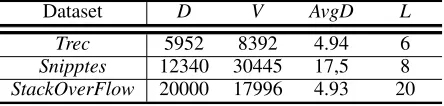
Table 1: Summary of the datasets.D: the number of docu-ments.V: the number of unique words.AvgD: the average document length.L: the number of categories.
Dataset D V AvgD L
Trec 5952 8392 4.94 6
Snipptes 12340 30445 17,5 8 StackOverFlow 20000 17996 4.93 20
term that not only pulls neighboring document pairs closer together, but also separates non-neighboring document pairs from each other. However, those previous models mainly fo-cus on modeling normal long texts, therefore they also suffer from the sparsity problem of extremely short texts.
Experiment
We now present the empirical results of LapDMM on topic quality, clustering and classification tasks.
Experimental Setup
Dataset We employ three datasets, includingTrec2,
Snip-pets3 andStackOverFlow4. TheTrec is a question dataset, consisting of 6 question types. The Snippets dataset was selected from the results of web search transaction of 8 different domains. The StackOverFlowdataset is a collec-tion of quescollec-tion titles from 20 different tags. For each one, we removed the standard stopwords. The statistics of these datasets are summarized in Table 1.
Baseline model We compare LapDMM against four exist-ing baseline topic models of short texts. For all models, the Dirichlet priorsαandβare set to 0.1 and 0.01, respectively. For LapDMM, the parameters are empirically set as:R = 9, λ= 0.1andρ= 0.1. The specific settings of baseline mod-els are presented as follows:
• DMM. We use collapsed variational inference for model inference.
• GPU-DMM(Li et al. 2016; 2017): an extension of DMM with word embeddings. We use the code provided by its authors5. To compute word similarities, we employ pre-trained 100-dimensional GloVe6 word embeddings,
trained onWikipedia + Gigaword. For LapDMM, we use the same word embeddings to compute WMD values. Additionally, we haven’t shown the empirical results of GPU-PDMM, since it have performed almost at the same level with GPU-DMM in our early experiments.
• Latent topic model (LTM) (Li et al. 2018b): a LDA-based topic model by adaptively aggregating short texts. We tune its parameters following the suggestions in the original paper.
2
http://cogcomp.cs.illinois.edu/Data/QA/QC/ 3
http://jwebpro.sourceforge.net/data-web-snippets.tar.gz 4https://github.com/jacoxu/STC2
5
https://github.com/NobodyWHU/GPUDMM 6
https://nlp.stanford.edu/projects/glove/
• BTM(Cheng et al. 2014): a topic model of biterms for short texts. We use the code provided by its authors7.
For all models, we tune their parameters, and report the best scores in all evaluation tasks.
Evaluation by Topic Quality
This section shows the topic quality evaluation results. We quantitatively evaluate the topic quality using the topic coherence (TC) project8 developed by (Roder, Both, and
Hinneburg 2015). This project automatically computes TC scores by counting co-occurrences of topical top-M words on a big reference corpus. The intuition is that for a topic, more co-occurrences between its top words, more semanti-cally coherent it is.
Table 2 shows the average TC scores of top-10 words of all models. We have several observations. First, LapDMMW performs the best among all models, where it ranks the first in most (i.e., 4/6) settings. LapDMMWbeats LapDMMTin all settings. We argue that is because the WMD can bet-ter capture similarities between short texts at the semantic level. Second, LapDMMTis also capable of outputting co-herent topics. TC scores of LapDMMTare roughly competi-tive with those of BTM, GPU-DMM and LTM, and it signif-icantly outperforms BTM onTrec. Finally, we observe that both versions of LapDMM outperform the standard DMM. This indicates that the manifold regularizer can effectively improve the quality of learned topics.
Evaluation by Clustering
We compare LapDMM against baseline models by cluster-ing. Here, each topic corresponds to a cluster, and the num-ber of topics is set to the true category numnum-ber of datasets. For LapDMM, we assign a documentdto the largest topic in its variational approximationq(zd|γd).
We employ two clustering metrics, i.e., accuracy (ACC) and normalized mutual information (NMI). For a document d, its true label and estimated cluster are respectively de-noted to beydandcd. Then the ACC score can be computed
by:
ACC=
PD
d=1I(yd, map(cd))
D , (13)
whereI(·)denotes the indicator function; andmap(cd)is
the mapping function betweencdandyd, computed by the
Hungarian algorithm. Besides, let Y andC be the true la-bel set and the estimated cluster lala-bel set of a given dataset, respectively. The NMI score can be computed by:
N M I(Y, C) =pM I(Y, C)
H(Y)H(C), (14)
whereM I(Y, C)denotes the mutual information ofY and C; andH(·)denotes the entropy.
Table 3 shows the average scores of 10 independent runs. Surprisingly, we see that LapDMM significantly outper-forms the baseline models. For example, the performance
7
http://code.google.com/p/btm/ 8
Table 2: Results of topic coherence (mean±std). “‡” means that the gain of LapDMM is statistically significant at 0.01 level.
Dataset Topic LapDMMT LapDMMW DMM BTM GPU-DMM LTM
Trec K=25 0.46±0.08 0.48±0.06 0.44±0.07
‡ 0.35±0.04‡ 0.47±0.07 0.48±0.07
K=50 0.47±0.08 0.49±0.08 0.46±0.07‡ 0.36±0.06‡ 0.47±0.07 0.48±0.07
Snippets K=25 0.45±0.07 0.46±0.08 0.43±0.07
‡ 0.43±0.06‡ 0.43±0.06‡ 0.47±0.07
K=50 0.45±0.09 0.47±0.08 0.43±0.09‡ 0.45±0.06‡ 0.43±0.08‡ 0.45±0.08
StackOverFlow K=25 0.37±0.07 0.39±0.09 0.37±0.08
‡ 0.40±0.07 0.38±0.07 0.36±0.08‡
K=50 0.36±0.09 0.37±0.08 0.34±0.08‡ 0.36±0.07 0.35±0.06‡ 0.35±0.07‡
Table 3: Clustering results of NMI and ACC (mean±std). “‡” means that the gain of LapDMM is statistically significant at 0.01 level.
Dataset Topic LapDMMT LapDMMW DMM BTM GPU-DMM LTM
Trec NMI 0.292±0.02 0.288±0.04 0.125±0.06
‡ 0.109±0.05‡ 0.127±0.04‡ 0.114±0.06‡
ACC 0.499±0.05 0.484±0.05 0.355±0.05‡ 0.337±0.04‡ 0.352±0.03‡ 0.348±0.05‡
Snippets NMI 0.634±0.04 0.653±0.01 0.526±0.05
‡ 0.521±0.02‡ 0.544±0.02‡ 0.539±0.02‡
ACC 0.761±0.06 0.793±0.03 0.698±0.04‡ 0.683±0.04‡ 0.723±0.02‡ 0.705±0.05‡
StackOverFlow NMI 0.641±0.01 0.645±0.02 0.457±0.05
‡ 0.429±0.02‡ 0.439±0.01‡ 0.442±0.01‡
ACC 0.728±0.02 0.710±0.05 0.494±0.03‡ 0.472±0.01‡ 0.482±0.03‡ 0.498±0.02‡
gain of NMI is about 0.15∼0.17 on Trec and the gain of ACC is even about 0.23∼0.25 onStackOverFlow. The pos-sible reason is that the manifold regularizer effectively re-mains the local manifold structures, i.e., pulling closer short texts together at the topic level. This is obviously benefit to unsupervised learning tasks such as clustering. Our result is consistent with the previous study of (Cai et al. 2008), where it has shown that the manifold regularization scheme signif-icantly improved the clustering performance of PLSI.
Evaluation by Classification
We compare LapDMM against baseline models by classi-fication. For all models, we train topical features (i.e., the SW representation described in (Li et al. 2016)) to represent short texts, and then feed them into SVMs.9The classifica-tion accuracy is computed by 5-fold cross validaclassifica-tion. In the experiment, the topic number has been set to 40 and 60.
Table 4 shows the average classification accuracies of 10 independent runs. Fortunately, we again observe significant improvement of LapDMM just as observations in clustering experiments. For example, the accuracy scores of LapDMM are about 0.17 and 0.09 higher than those of baseline mod-els onTrecandStackOverFlow, respectively. That is to say, our LapDMM can output more discriminative topical rep-resentations, leading to better classification performance. Besides, we observe that LapDMMW performs better than LapDMMT, especially forTrecwith 40 topics. This again implies that the WMD is a better distance measurement for short texts.
Parameter Evaluation
In this subsection, we empirically evaluate two crucial pa-rameters of LapDMM, including the nearest neighbor
num-9
http://scikit-learn.org/
berRand Newton learning rateρin the inner iteration. To this end, for each dataset we show the clustering and classi-fication10scores of LapDMMW.
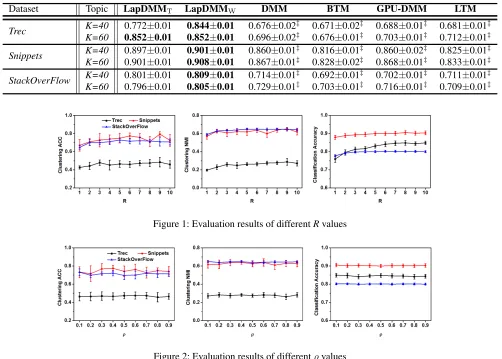
We first evaluate the impact of different R values over the set{1,2,· · · ,10}. The results are shown in Figure 1. Roughly, the overall trend is that the performance becomes better as the value ofRincreases, e.g., the classification ac-curacy ofTrec. The best scores are achieved atR=8 and 9 in most cases. The clustering ACC score seems a bit unsmooth, howeverR=9 also performs the best. The results tell us that using more nearest neighbors in manifolds is helpful. We thus fixR=9 in our experiments, and suggest to set a rela-tively larger value ofRin practice.
Then, we evaluate the impact ofρwith different values over the set{0.1,0.2,· · ·,0.9}. The experimental results are shown in Figure 2. Overall, we argue that LapDMM is in-sensitive toρ, and smaller values ofρperform a little better. In some sense, the learning rateρdescribes the importance degree of the manifold regularizer during model training. A smaller value ofρis safer when we cannot accurately find the nearest neighbors of short texts. Thus we useρ= 0.1as the default setting of LapDMM.
Conclusion
In this paper, we develop a novel LapDMM topic model for short texts. which incorporates a variational manifold regu-larization term into DMM. That is, we use collapsed varia-tional inference to train DMM with a manifold regulariza-tion term with respect to variaregulariza-tional distriburegulariza-tions. To con-struct document graph for manifold constraints, we employ the WMD to measure semantic similarities between short texts. Extensive experiments show that LapDMM performs significantly better than the state-of-the-art baseline models.
10
Table 4: Results of classification accuracy (mean±std). “‡” means that the gain of LapDMM is statistically significant at 0.01 level.
Dataset Topic LapDMMT LapDMMW DMM BTM GPU-DMM LTM
Trec K=40 0.772±0.01 0.844±0.01 0.676±0.02
‡ 0.671±0.02‡ 0.688±0.01‡ 0.681±0.01‡
K=60 0.852±0.01 0.852±0.01 0.696±0.02‡ 0.676±0.01‡ 0.703±0.01‡ 0.712±0.01‡
Snippets K=40 0.897±0.01 0.901±0.01 0.860±0.01
‡ 0.816±0.01‡ 0.860±0.02‡ 0.825±0.01‡
K=60 0.901±0.01 0.908±0.01 0.867±0.01‡ 0.828±0.02‡ 0.868±0.01‡ 0.833±0.01‡
StackOverFlow K=40 0.801±0.01 0.809±0.01 0.714±0.01
‡ 0.692±0.01‡ 0.702±0.01‡ 0.711±0.01‡
K=60 0.796±0.01 0.805±0.01 0.729±0.01‡ 0.703±0.01‡ 0.716±0.01‡ 0.709±0.01‡
Figure 1: Evaluation results of differentRvalues
Figure 2: Evaluation results of differentρvalues
An limitation of LapDMM is that the document graph construction may be time-consuming, especially for big datasets and streaming data. We plan to investigate this prob-lem in the future work.
Acknowledgements
We would like to acknowledge support for this project from the National Natural Science Foundation of China (NSFC) (No.61602204, No.61876071).
References
Asuncion, A.; Welling, M.; Smyth, P.; and Teh, Y. W. 2009. On smoothing and inference for topic models. InConference on Uncertainty in Artificial Intelligence, 27–34.
Bishop, C. M. 2006. Pattern Recognition and Machine Learning. Springer.
Blei, D. M.; Ng, A. Y.; and Jordan, M. I. 2003. Latent Dirichlet allocation.Journal of Machine Learning Research 3:993–1022.
Cai, D.; Mei, Q.; Han, J.; and Zhai, C. 2008. Modeling
hidden topics on document manifold. InACM Conference on Information and Knowledge Management, 911–920.
Cai, D.; Wang, X.; and He, X. 2009. Probabilistic dyadic data analysis with local and global consistency. In Interna-tional Conference on Machine Learning, 105–112.
Cheng, X.; Yan, X.; Lan, Y.; and Guo, J. 2014. BTM: Topic modeling over short texts.IEEE Transactions on Knowledge and Data Engineering26(12):2928–2941.
Chi, J.; Ouyang, J.; Li, X.; and Li, C. 2018. Empiri-cal study on variational inference methods for topic mod-els. Journal of Experimental & Theoretical Artificial Intel-ligence30(1):129–142.
Cuturi, M. 2013. Sinkhorn distances: Lightspeed computa-tion of optimal transport. InAdvances on Neural Informa-tion Processing Systems, 2292–2300.
Du, J.; Jiang, J.; Song, D.; and Liao, L. 2015. Topic mod-eling with document relative similarities. InInternational Joint Conference on Artificial Intelligence, 3469–3475.
In International ACM SIGIR Conference on Research and Development in Information Retrieval, 50–57.
Hu, W.; Zhu, J.; Su, H.; Zhuo, J.; and Zhang, B. 2017. Semi-supervised max-margin topic model with manifold posterior regularization. InInternational Joint Conference on Artifi-cial Intelligence, 1865–1871.
Huh, S., and Fienberg, S. E. 2010. Discriminative topic modeling based on manifold learning. InACM SIGKDD In-ternational Conference on Knowledge Discovery and Data Mining, 653–662.
Kusner, M. J.; Sun, Y.; Kolkin, N. I.; and Weinberger, K. Q. 2015. From word embeddings to document distances. In International Conference on Machine Learning, 957–966. Li, C.; Wang, H.; Zhang, Z.; Sun, A.; and Ma, Z. 2016. Topic modeling for short texts with auxiliary word embeddings. In International ACM SIGIR Conference on Research and Development in Information Retrieval, 165–174.
Li, C.; Duan, Y.; Wang, N.; Zhang, Z.; Sun, A.; and Ma, Z. 2017. Enhancing topic modeling for short texts with auxil-iary word embeddings. ACM Transactions on Information Systems36(2):Article No.11.
Li, X.; Li, C.; Chi, J.; Ouyang, J.; and Li, C. 2018a. Data-less text classification: A topic modeling approach with doc-ument manifold. InACM International Conference on Infor-mation and Knowledge Management, 973–982.
Li, X.; Li, C.; Chi, J.; and Ouyang, J. 2018b. Short text topic modeling by exploring original documents.Knowledge and Information Systems56(2):443–462.
Li, X.; Wang, Y.; Zhang, A.; Li, C.; Chi, J.; and Ouyang, J. 2018c. Filtering out the noise in short text topic modeling. Information Sciences456:83–96.
Li, X.; Zhang, A.; Li, C.; Guo, L.; Wang, W.; and Ouyang, J. 2018d. Relational biterm topic model: Short text topic modeling using word embeddings. The Computer Journal. bxy037, https://doi.org/10.1093/comjnl/bxy037.
Lu, H.-Y.; Xie, L.-Y.; Kang, N.; Wang, C.-J.; and Xie, J.-Y. 2017. Don’t forget the quantifiable relationship between words: Using recurrent neural network for short text topic discovery. In AAAI Conference on Artificial Intelligence, 1192–1198.
Mehrotra, R.; Sanner, S.; Buntine, W.; and Xie, L. 2013. Im-proving LDA topic models for microblogs via Tweet pool-ing and automatic labelpool-ing. In International ACM SIGIR Conference on Research and Development in Information Retrieval, 889–892.
Mikolov, T.; tau Yih, W.; and Zweig, G. 2013. Linguistic regularities in continuous space word representations. In An-nual Conference of the North American Chapter of the As-sociation for Computational Linguistics: Human Language Technologies, 2292–2300.
Nigam, K.; Mccallum, A. K.; Thrun, S.; and Mitchell, T. 2000. Text classification from labeled and unlabeled docu-ments using EM.Machine Learning39(2):103–134. Quan, X.; Kit, C.; Ge, Y.; and Pan, S. J. 2015. Short and sparse text topic modeling via self-aggregation. In Interna-tional Joint Conference on Artificial Intelligene, 2270–2276.
Roder, M.; Both, A.; and Hinneburg, A. 2015. Exploring the space of topic coherence measures. InInternational Confer-ence on Web Search and Data Mining, 399–408.
Sridhar, V. K. R. 2015. Unsupervised topic modeling for short texts using distributed representations of words. In An-nual Conference of the North American Chapter of the As-sociation for Computational Linguistics: Human Language Technologies, 192–200.
Teh, Y. W.; Newman, D.; and Welling, M. 2006. A collapsed variational bayesian inference algorithm for latent Dirichlet allocation. InAdvances in Neural Information Processing Systems, 1353–1360.
Wang, X., and McCallum, A. 2006. Topics over time: A non-Markov continuous-time model of topical trends. In ACM SIGKDD International Conference on Knowledge Discovery and Data Mining, 424–433.
Xin, W.; Jiang, Z.; Shu, J.; He, W.; Lim, E.-P.; Yan, H.; and Li, X. 2011. Comparing twitter and traditional media us-ing topic models. InEuropean Conference on Information Retrieval, 338–349.
Yin, J., and Wang, J. 2014. A Dirichlet multinomial mix-ture model-based approach for short text clustering. InACM SIGKDD International Conference on Knowledge Discov-ery and Data Mining, 233–242.
Zhang, M.-L., and Zhou, Z.-H. 2014. A review on multi-label learning algorithms.IEEE Transactions on Knowledge and Data Engineering26(8):1819–1837.