Local algorithms for interactive clustering
Pranjal Awasthi [email protected]
Department of Computer Science Rutgers University
Maria Florina Balcan [email protected]
School of Computer Science Carnegie Mellon University
Konstantin Voevodski [email protected]
Google, NY, USA
Editor:Le Song
Abstract
We study the design of interactive clustering algorithms. The user supervision that we consider is in the form of cluster split/merge requests; such feedback is easy for users to provide because it only requires a high-level understanding of the clusters. Our algorithms start with any initial clustering and only make local changes in each step; both are desirable properties in many applications. Local changes are desirable because in practice edits of other parts of the clustering are considered churn - changes that are perceived as quality-neutral or quality-negative. We show that in this framework we can still design provably correct algorithms given that our data satisfies natural separability properties. We also show that our framework works well in practice.
1. Introduction
Clustering is usually studied in an unsupervised learning scenario where the goal is to partition the data given pairwise similarity information. Designing provably-good clustering algorithms is challenging because given a similarity function there may be many possible clusterings of the data. Traditional approaches resolve this ambiguity by making assumptions on the data-generation pro-cess. For example, there is a large body of work on clustering data that is generated by a mixture of Gaussians (Achlioptas and McSherry, 2005; Kannan et al., 2005; Dasgupta, 1999; Arora and Kan-nan, 2001; Brubaker and Vempala, 2008; Kalai et al., 2010; Moitra and Valiant, 2010; Belkin and Sinha, 2010), and finding clusters with certain density (Rinaldo and Wasserman, 2010; Chaudhuri and Dasgupta, 2010). But instead of making such assumptions and trying to set the correspond-ing hyperparameters, we can use limited user (expert) supervision to help the algorithm reach the correct answer.
Interactive clustering algorithms have been facilitated by the availability of cheap crowd-sourcing tools in recent years, which enable collection of relevant user input. In certain applications such as search and document classification, where users are willing to help a clustering algorithm arrive at their own desired answer with a small amount of additional feedback, interactive clustering al-gorithms are very useful. The works of Balcan and Blum (2008) and Awasthi and Zadeh (2010) provide some initial theoretical results in this new and exciting research area, but their models are not very practical.
c
We observe that in many practical settings we already start with a fairly good clustering com-puted with semi-automated techniques. For example, consider a massive online news portal that maintains a large collection of news articles. Suppose that the news articles are clustered on the “back-end,” and are used to serve several “front-end” applications such as recommendations and article profiles. For such a system, we do not have the freedom to compute arbitrary clusterings and present them to the user, which has been suggested in prior interactive clustering work (Balcan and Blum, 2008; Awasthi and Zadeh, 2010). But it is still feasible to get specific feedback on the current
proposed clustering andlocallyedit this clustering. In particular, we may only want to change the
“bad” part of the clustering that is revealed by the feedback without changing the rest of the
clus-tering. Our intuition for only consideringlocaledits is that in practice changes to other parts of the
clustering are consideredchurn- changes that are perceived as quality-neutral or quality-negative.
This observation is especially true for large clustering systems that serve many users, which op-erate on the assumption that if some of the data is broken, it will be pointed out by a user. For such applications it is undesirable to change what the user is not complaining about. Motivated by
these observations, in this paper we study the problem of designinglocalalgorithms for interactive
clustering.
We propose a theoretical interactive clustering model and provide strong experimental evidence supporting its utility in practice. In our model we start with some initial clustering of the data. The algorithm then interacts with the user in stages. In each stage the user provides limited feedback on
the proposed clustering in the form ofsplitandmergerequests. The algorithm then makes alocal
edit to the clustering that is consistent with user feedback. Such edits are aimed at improving the problematic part of the clustering pointed out by the user. The goal of the algorithm is to quickly converge (using as few requests as possible) to a clustering that the user is happy with - we call this clustering the target (ground truth) clustering.
In our model the user may request a certain cluster to besplitif it is overclustered(intersects
two or more clusters in the target clustering). The user may also request tomergetwo given clusters
if they areunderclustered(both intersect the same target cluster). Note that the user does not tell
the algorithm how to perform the split or the merge; such input is unrealistic because it requires a manual analysis of the data points in the corresponding clusters. We also restrict the algorithm to
only makelocalchanges at each step - in response we may change only the cluster assignments of
the points in the corresponding clusters. If the user requests to split a clusterCi, we may change
only the cluster assignments of the points inCi, and if the user requests to mergeCi andCj, we
may only reassign the points inCiandCj.
The split and merge requests in our model are a natural form of feedback. It is easy for users to spot over/underclustering errors and request the corresponding splits/merges (without having to provide any additional information about how to perform the edit). For our model to be practically applicable, we also need to account for noise in the user requests. In particular, if the user requests a merge, only a fraction or a constant number of the points in the two clusters may belong to the same target cluster. Our model (see Section 2) allows for such noisy user responses.
We study the complexity of algorithms in this framework (the number of edits requests needed to find the target clustering) as a function of the error of the initial clustering. We define clustering
error in terms ofunderclusteringerrorδuandoverclusteringerrorδo(see Section 2). Given that the
initial error is often fairly small1, we would like to develop algorithms whose complexity depends
polynomially onδu,δoand only logarithmically onn, the number of data points. We show that this
is indeed possible given that the target clustering satisfies a naturalstabilityproperty (see Section 2).
In addition, we develop provably correct algorithms for the well-known correlation-clustering ob-jective (Bansal et al., 2004), which considers pairs of points that are clustered inconsistently with respect to the target clustering (see Section 2).
1.1 Our Results
Our local interactive clustering model is summarized in Section 2.4. This model is then instantiated
with specific split/merge algorithms in Section 3 and Section 4. In Section 3 we study theη-merge
model. Here we assume that the user may request to split a cluster Ci only ifCi contains points
from several ground-truth clusters. The user may request to mergeCi andCj only if anη-fraction
of the points in eachCiandCj are from the same ground-truth cluster. Note that these restrictions
are on the user requests, and not the clustering we are editing. In particular, there may be pairs of
clustersCi andCj where a smaller fraction of the points are from the same target cluster. But we
assume that the user will not request to mergeCiandCj in such cases because there is not enough
evidence to request this merge. Instead, we assume that the user will ask for a split ofCiand/orCj
first, or ask for another merge involvingCiorCj(where there is more evidence that they need to be
merged). This is a realistic restriction because we assume that the merge requests come from high-level observations about the clusters, for example from observing the cluster profiles/summaries.
For this model forη > 0.5, given an initial clustering with overclustering errorδo and
under-clustering errorδu, we present interactive clustering algorithms that require δo split requests and
2(δu+k) log 1
1−ηnmerge requests to find the target clustering, wherenis the number of points in
the data set. Forη >2/3, given an initial clustering with correlation-clustering errorδcc, we present
algorithms that require at mostδccedit requests to find the target clustering.
In Section 4 we relax the condition on the merges and allow the user to request a merge even if
CiandCjonly have a single point from the same target cluster. We call this theunrestricted-merge
model. Here the requirement on the accuracy of the user response is much weaker and we need to make further assumptions about the nature of the requests. In particular, we assume that each merge request is chosen uniformly at random from the set of possible merge requests. Under this
assumption we present algorithms that with probability at least1−requireδo split requests and
O(logkδu2)merge requests to find the target clustering.
Our interactive clustering algorithms take either global or local pairwise similarity data as input.
Our most general algorithms use the global average-linkage treeTglob to compute local clustering
edits. This tree is constructed from all the data points in the clustering, but it is too large to be directly pruned by users. Still, we can use this global tree to compute accurate local clustering edits.
Our split algorithm finds the node inTglobwhere the corresponding points are first split in two. It
is more challenging to design a correct merge procedure, given that we allow “impure” merges, where the clusters in the merge request intersect more than one ground-truth cluster. To perform
such merges, in the η-merge model we design an algorithm to extract the “pure” subsets of the
two clusters, which must only contain points from the same target cluster. Our algorithm searches
for the deepest node inTglob that has enough points from both clusters. In the unrestricted-merge
When the data satisfies stronger assumptions, we present more efficient split and merge algo-rithms that do not require global pairwise similarity information. These procedures compute the edit by only considering the similarities between the points in the user request.
In Section 5 we demonstrate the effectiveness of our algorithms on real data. We show that for the purposes of splitting known overclustering instances, our split algorithm performs better than well-known algorithms in unsupervised split/merge clustering literature, such as spectral clustering and k-means. We also test our entire interactive clustering framework on the 20 Newsgroup data set, which is known to very challenging for unsupervised (Telgarsky and Dasgupta, 2012; Heller and Ghahramani, 2005; Dasgupta and Hsu, 2008; Dai et al., 2010; Boulis and Ostendorf, 2004; Zhong, 2005) and semi-supervised clustering methods (Basu et al., 2002, 2004). We find that in many scenarios our framework is able find the target Newsgroup clustering after a limited number of edit requests.
1.2 Related work
In this section we give an overview of the related work in the literature.
Interactive Clustering: Interactive clustering models in previous works (Balcan and Blum,
2008; Awasthi and Zadeh, 2010) were inspired by an analogous model for learning under feedback (Angluin, 1998). In this model, the algorithm can propose a hypothesis to the user (in this case, a clustering of the data) and get some feedback regarding the correctness of the current hypothesis. As in our model, the feedback in Balcan and Blum (2008); Awasthi and Zadeh (2010) is in the form of split and merge requests. The goal is to design efficient algorithms that require few user requests. A major limitation in the models of Balcan and Blum (2008) and Awasthi and Zadeh (2010) is that the algorithm is able to choose any arbitrary clustering as the starting point, and can make arbitrary changes to the clustering in each step. Hence these algorithms may propose a series of “bad” clusterings to the user to quickly prune the search space and reach the target clustering. Our interactive clustering model is in the context of an initial clustering; we are restricted to only making local changes to this clustering to correct the errors pointed out by the user. This model is well-motivated by several applications, including the Google application described in Section 5.1.
Active Clustering: Other active clustering frameworks have been proposed, whereactive
ei-ther refers to selecting which pairwise similarities to consider (not studied here), or requesting user supervision with respect to the ground-truth clustering. For the former problem, Erikkson et al. (2011) study minimizing the number of pairwise similarities needed for an algorithm to compute an accurate clustering. They propose an adaptive algorithm that selects which pairwise similarities to
consider. The assumption on the similarity function that they study, which they calltight clustering
condition, is equivalent to thestrict separationproperty studied here. Krishnamurthy et al. (2012) propose a different framework to adaptively select which pairwise similarities to consider. They
also study an assumption on the similarity function, which is a generalization of thestrict
separa-tionproperty that considers the expected pairwise similarities. Their framework recursively splits
clusters; they propose a spectral-clustering algorithm to perform the split. They also suggest using the k-means algorithm to perform the split (albeit with no provable guarantees). In our experimental section we compare our proposed split procedures with a similar spectral clustering algorithm and the k-means algorithm (see Section 5.1).
(unsu-pervised setting), or with a non-empty set of initial labels (semi-su(unsu-pervised setting). The algorithm minimizes an estimate of Bayes error with respect to the unlabeled instances.
Basu et al. (2002) study the same semi-supervised clustering problem in the context of the k
-means objective. Their algorithm has access to the class labels of some seed fractionf of the points
in the data set. They propose two variations of a supervised k-means algorithm: one which only
uses the known labels to compute the initial clustering (termedSeeded K-Means), and another that
also enforces that the known labels do not change while the centers/clusters are updated (termed
Constrained K-Means). They perform experiments on the same 20 Newsgroups data sets that we consider in Section 5.2. The experiments of Basu et al. (2002) show that even though the supervision
improves accuracy, even forf >0.5the output clustering still has many mistakes. They also show
that the accuracy depends on how difficult the data set is w.r.t. the separability of the ground-truth
clusters, and show improved accuracy on an easier instance (termedDifferent-3 Newsgroups) when
compared to a harder one (termed Same-3 Newsgroups). In a related work, Basu et al. (2004)
study the same problem but with supervision in the form of pairwise must-link andcannot-link
constraints. They propose another supervisedk-means algorithm and perform experiments on the
same 20 Newsgroups data sets. They are still unable to come close to recovering the
ground-truth for a difficult Newsgroups data set (termedNews-sim3), but have more success with an easier
Newsgroup data set (termed News-diff3). Ashtiani et al. (2016) also study thek-means objective
with supervision in the form of pairwisemust-linkandcannot-linkconstraints, which are modeled as
oracle queries. For center-based clustering instances (specified by a Voroni decomposition around a set of centers) that satisfy a separability condition with respect to the cluster centers, they propose an accurate algorithm that requires a limited number of queries; they do not provide any experimental results.
In our experimental section we give a comparison of our results on the 20 Newsgroups data sets with those of Basu et al. (2002) and Basu et al. (2004) (see Section 5.2.4). Our comparison considers the amount of required supervision and accuracy of the final clustering output. We show that only our framework is able to fully recover the ground-truth clustering, albeit we can do this consistently only with some restrictions on the requested merges. On the other hand, Basu et al. (2002) and Basu et al. (2004) do not come close to finding the ground-truth for the harder Newsgroups data sets even when they use a large amount of supervision.
We also note that the supervision considered by Nie et al. (2012), Basu et al. (2002), Basu et al. (2004) and Ashtiani et al. (2016) is harder for the user to provide. Such supervision requires an understanding of the individual data points on the part of the user. The user must study the individual data points to provide instance class labels as in Nie et al. (2012) and Basu et al. (2002), or study pairwise relationships between individual data points to provide must-link and cannot-link constraints as in Basu et al. (2004) and Ashtiani et al. (2016). The supervision in the form of cluster split/merge requests that we consider here is a more realistic form of interaction - it only requires the user to understand the high-level properties of the clusters.
Split/Merge Techniques: Several unsupervised split/merge frameworks have also been
pro-posed (Ding and He, 2002; Lee et al., 2012; Chaudhuri et al., 1992). They focus on designing split/merge algorithms but do not consider any user feedback. Ding and He (2002) propose to use a spectral clustering algorithm to perform the splits. To perform merges, they only consider returning the union of the points in the two clusters. In our experiments, we compare the effectiveness of our split procedures with splits given by spectral clustering (see Section 5.1). With respect to merges,
in our framework merges may only be initiated by user requests, while Ding and He (2002) propose automatically selecting the next clusters to merge using the max-min-cut criterion (without any user supervision), which they show works well in practice. However, the experiments of Ding and He (2002) also assume that we know the target number of clusters, while our model does not make such assumptions.
Lee et al. (2012) propose a different unsupervised split/merge framework based on optimizing Bayes error. They propose spectral clustering and k-means for computing the splits, which we compare with in our experimental section (see Section 5.1). To perform merges, they again only consider returning the union of the two clusters; the next two clusters to merge are selected by op-timizing Bayes error. Unlike Ding and He (2002), they do not assume that we know the number of target clusters. They show good experimental results for video segmentation, but their unsuper-vised approach may not work for challenging data sets like 20 Newsgroups, where it may not be possible to find the ground truth without user feedback. Chaudhuri et al. (1992) propose another unsupervised split/merge framework for image-segmentation applications. Their split procedure is application-specific because it considers gray-scale values (we cannot compare with it), while their merge is based on edge density.
Data Separability Properties: The data separability (stability) property that we consider in
this work is a natural generalization of the “stable marriage” property (see Definition 2), which has been studied in a variety of previous works (Balcan et al., 2008; Bryant and Berry, 2001). It is
the weakest among the stability properties that have been studied recently such asstrict separation
andstrict threshold separation(Balcan et al., 2008; Erikkson et al., 2011; Ackerman et al., 2012; Ackerman and Dasgupta, 2014; Balcan et al., 2014). This property is also known to hold for real-world data. In particular, Voevodski et al. (2012) observed that this property holds for protein sequence data, where similarities are computed with sequence alignment and ground truth clusters correspond to evolutionary-related proteins. Other stronger separability properties have also been considered in the literature (Awasthi and Balcan, 2015).
2. Notation and Preliminaries
Given a data setX ofnpoints we defineC = {C1, C2, . . . Ck}to be a k-clustering ofX where
theCi’s represent the individual clusters. Given two clusterings CandC0, we next define several
notions of clustering error, which are used in our theoretical analysis.
2.1 Clustering Error
Given two clusteringsCandC0, we define the distance between a clusterC
i ∈ Cand the clustering
C0as:
dist(Ci,C0) =|{Cj0 ∈ C0 :Cj0 ∩Ci 6=∅}| −1.
This distance is the number ofadditionalclusters inC0that contain points fromCi; it evaluates
to 0 when all points inCiare contained in a single cluster inC0. Naturally, we can then define the
distance betweenCandC0 as:
dist(C,C0) = X
Ci∈C
Notice that this notion of clustering distance is asymmetric: dist(C,C0) 6= dist(C0,C). Also
note thatdist(C,C0) = 0if and only ifCrefinesC0. Observe that ifCis the ground-truth clustering,
andC0 is a proposed clustering, then dist(C,C0) can be considered anunderclustering error, and
dist(C0,C)anoverclustering error.
An underclustering error is an instance of several clusters in a proposed clustering containing
points from the same ground-truth cluster; this ground-truth cluster is said to be underclustered.
Conversely, an overclustering error is an instance of points from several ground-truth clusters
con-tained in the same cluster in a proposed clustering; this proposed cluster is said to beoverclustered.
In the following sections we useC∗ ={C1∗, C2∗, . . . Ck∗}to refer to the ground-truth clustering, and
useCto refer to a proposed clustering. We useδuto refer to the underclustering error of a proposed
clustering, and δo to refer to the overclustering error. In other words, we have δu = dist(C∗,C)
andδo = dist(C,C∗). We useδto denote the sum of the two errors: δ =δu+δo. We callδ the
under/overclustering error, and useδ(C,C∗)to refer to the error ofCwith respect toC∗.
We observe that the under/overclustering error δ(C,C∗) may also be restated in terms of the
bipartite cluster-intersection graphof Xiang et al. (2012). This bipartite graph G = (C,C∗, E)
describes the relationships between the clusters ofCandC∗, with nodes on one side corresponding
to the clusters of C and nodes on the other side corresponding to the clusters of C∗. The set of
(unweighted) edgesEcorresponds to the intersections between the two sets of clusters: there is an
edge if the corresponding clusters intersect on at least one data point (Xiang et al., 2012). Then
we can express theunder/overclustering errorδ(C,C∗)using vol(G), the sum of the degrees of the
nodes ofG:
δ(C,C∗) =vol(G)− |C| − |C∗|.
In addition to the under/overclusteringerror defined above, in parts of our analysis we define
the distance between two clusterings using thecorrelation-clustering objective function. Given a
proposed clusteringC, and a ground-truth clusteringC∗, we define the correlation-clustering error
δccas the number of (ordered) pairs of points that are clusteredinconsistentlywithC∗:
δcc=|{(u, v)∈X×X:c(u, v)6=c∗(u, v)}|,
wherec(u, v) = 1ifuandvare in the same cluster inC, and 0 otherwise;c∗(u, v) = 1ifuandv
are in the same cluster inC∗, and 0 otherwise. In our analysis we also call each such pair of points
apairwise correlation-clustering error.
Note that as before we may divide the correlation-clustering errorδcc into overclustering
com-ponentδccoand underclustering componentδccu:
δcco=|{(u, v)∈X×X:c(u, v) = 1andc∗(u, v) = 0}|,
δccu =|{(u, v)∈X×X:c(u, v) = 0andc∗(u, v) = 1}|.
Observe that by definitionδcc=δcco+δccu.
2.2 Definitions
Our interactive clustering model concerns computinglocalclustering edits, which only change the
Definition 1 (Local algorithm) We say that an interactive clustering algorithm islocalif in each iteration only the cluster assignments of the points involved in the edit request may be changed. If the user requests to splitCi, the algorithm may only reassign the points inCi. If the user requests
to mergeCiandCj, the algorithm may only reassign the points inCi∪Cj.
We next define the properties of a clustering that we study in this work, which describe how separable the ground-truth clusters are.
Definition 2 (Stability) Given a clusteringC={C1, C2,· · ·Ck}over a domainXand a similarly
function S : X×X 7→ <, we say that C satisfies stability with respect to S if for all i 6= j, and for all A ⊂ Ci and A0 ⊆ Cj, S(A, Ci \ A) > S(A, A0), where for any two sets A, A0,
S(A, A0) =Ex∈A,y∈A0S(x, y).
In addition to thestabilityproperty, we also study the strongerstrict separationandstrict
thresh-old separation properties, which were first introduced in Balcan et al. (2008). They are defined
below. Clearly, we can verify thatstrict separationandstrict threshold separationimplystability.
Definition 3 (Strict separation) Given a clusteringC={C1, C2,· · ·Ck}over a domainXand a
similarly functionS:X×X7→ <, we say thatCsatisfies strict separation with respect toSif for alli6=j,x, y∈Ciandz∈Cj,S(x, y)> S(x, z).
Definition 4 (Strict threshold separation) Given a clusteringC = {C1, C2,· · ·Ck} over a
do-mainXand a similarly functionS :X×X7→ <, we say thatCsatisfies strict threshold separation with respect toSif there exists a thresholdtsuch that, for alli,x, y∈Ci,S(x, y)> t, and, for all
i6=j,x∈Ci, y ∈Cj,S(x, y)≤t.
We model the user as an oracle that provides edit requests. In order for our algorithms to make progress, the oracle requests must be somewhat consistent with the target clustering, which is captured by the following definitions.
Definition 5 (η-merge model) The oracle may request to split a cluster Ci only if Ci contains
points from more than one target cluster. The oracle may request to merge two clustersCi andCj
only if at least anη-fraction of the points in eachCiandCj belong to the same target cluster.
Definition 6 (unrestricted-merge model) The oracle may request to split a cluster Ci only ifCi
contains points from more than one target cluster. The oracle may request to merge two clustersCi
andCj only ifCiandCjboth intersect the same target cluster.
Note that the assumptions about the split requests are the same in both models. With respect
to the merges, in theη-merge model the oracle may request to merge two clusters if both have a
constant fractionof points from the same target cluster. In the unrestricted-merge model, the oracle
may request to merge two clusters even if both only havesomepoints from the same target cluster.
In each model, we will refer to the split/merge requests that satisfy these definitions asvalidedit
requests.
Also note that in theη-merge model the restrictions on valid merge requests are with respect to
the oracle requests, and not the clustering we are editing. In particular, there may be pairs of clusters
Ci andCj where a smaller fraction of the points are from the same target cluster. But we assume
that the oracle will not request to mergeCiandCjin such cases. Instead, we assume that the oracle
2.3 Generalized clustering error
We observe that the clustering errors defined in the previous section may be generalized by
abstract-ing their common properties. We define the followabstract-ing properties of what we callnaturalclustering
error, which is any integer-valued error that decreases when we locally improve the proposed clus-tering.
Definition 7 We say that a clustering error isnaturalif it satisfies the following properties:
• If there exists a clusterCi that contains points fromCj∗ and some other ground-truth
clus-ter(s), then splitting this cluster into two clustersCi,1 =Ci∩Cj∗andCi,2 =Ci−Ci,1must decrease the error.
• If there exist two clusters that contain only points from the same target cluster, then merging them into one cluster must decrease the error.
• The error is integer-valued.
We expect a lot of definitions of clustering error to satisfy the above criteria (especially the first two properties), in addition to other domain-specific criteria. Clearly, the under/overclustering error
δ = δu +δo and the correlation-clustering errorδcc are alsonatural clustering errors (Claim 8).
Given a natural clustering errorγ, a proposed clustering C and the target clustering C∗, we will
useγ(C,C∗)to denote the magnitude of the error ofCwith respect toC∗. We can also prove that
the under/overclustering error defined in the previous section is the lower-bound on any natural
clustering error (Theorem 9).
Claim 8 The under/overclustering error and the correlation clustering error satisfy Definition 7
and hence are natural clustering errors.
Theorem 9 For anynaturalclustering errorγ, any proposed clusteringC, and any target clustering
C∗,γ(C,C∗)≥δ(C,C∗).
Proof Given any proposed clusteringC, and any target clusteringC∗, we may transformCintoC∗
via the following sequence of edits. First, we split all overclustering instances using the following
iterative procedure: while there exists a cluster Ci that contains points from Cj∗ and some other
ground-truth cluster(s), we split it into two clustersCi,1=Ci∩Cj∗andCi,2=Ci−Ci,1. Note that
this iterative split procedure will require exactlyδosplit edits, whereδois the initial overclustering
error. Then, when we are left with only “pure” clusters (each intersects exactly one target cluster), we merge all underclustering instances using the following iterative procedure: while there exist
two clusters Ci andCj that contain only points from the same target cluster, merge Ci and Cj.
Note that this iterative merge procedure will require exactlyδu merge edits, whereδu is the initial
underclustering error. Let us useγ to refer to anynaturalclustering error of Cwith respect toC∗.
By the first property ofnaturalclustering error, each split must have decreasedγ by at least one.
By the second property, each merge must have decreasedγ by at least one as well. Given that we
performed exactlyδ =δo+δu edits, it follows that initiallyγ(C,C∗)must have been at leastδ.
the error” with “must increase the similarity” in Definition 7). In addition, the Rand criteria and the Mirkin criteria discussed in Meil˘a (2007) are closely related to the correlation clustering error defined here (all three measures are a function of the number of pairs of points that are clustered incorrectly).
2.4 Local interactive clustering
We now give a general overview of our local interactive clustering model. This model is then instan-tiated by specific split/merge algorithms in Section 3 and Section 4 (depending on the assumptions about the oracle requests and the separability of the data).
Our approach is outlined in Figure 1 - we iteratively keep on making the local edits requested by the oracle. Note that the oracle does not provide the algorithm with any additional information about how to execute the split/merge. The description in Figure 1 also assumes that the requests come one at a time. Batch requests can be handled as well by queuing them in arbitrary order and then executing them one at a time (as long as the clusters in the request have not changed).
Given that the oracle requests must be somewhat consistent with the target clustering (see our assumptions about the validity of such requests in Section 2.2), and that our algorithms must there-fore make progress with respect to finding the target clustering (see our analysis in Section 3 and Section 4), we expect the loop to terminate when we reach the target clustering.
Also note that the description in Figure 1 does not say anything about the sequence of oracle
re-quests. The algorithms for theη-merge model in Section 3 are consistent with this description; they
make no additional assumptions about this sequence. However, the algorithms in the unrestricted-merge model in Section 4 do make an additional assumption that each unrestricted-merge request is drawn uniformly at random from the set of valid merge requests.
Figure 1: Local interactive clustering model
while(there exists split/merge request from oracle)
• perform corresponding local clustering edit
3. Theη-merge model
In this section we describe and analyze our split/merge algorithms in the η-merge model. As a
preprocessing step for all our split/merge algorithms, we first run the hierarchical average-linkage algorithm on all the points in the data set to compute the global average-linkage tree, which we
denote byTglob. The leaf nodes in this tree contain the individual points, and the root node contains
all the points. The tree is computed in a bottom-up fashion: starting with the leafs in each iteration
the two most similar nodes are merged, where the similarity between two nodesN1 andN2is the
average similarity between the points inN1and the points inN2.
We assign a label “impure” to each cluster in the initial clustering; these labels are used by the merge procedure but are not visible to the user. Given a split or merge request from the oracle, a
To implement Step 1 in Figure 2, we start at the root ofTgloband “follow” the points inCidown one of the branches until we find a node that splits them. In order to implement Step 2 in Figure 3, it
suffices to perform a post-order traversal ofTgloband return the first node that has “enough” points
from both clusters.
Figure 2: Split procedure
Algorithm: SPLITPROCEDURE
Input: ClusterCi, global average-linkage treeTglob.
1. SearchTglobto find the nodeN at which the set of points inCiare first split in two.
2. LetN1andN2be the children ofN. SetCi,1 =N1∩Ci,Ci,2 =N2∩Ci.
3. DeleteCiand replace it withCi,1andCi,2. Mark the two new clusters as “impure”.
The split procedure is fairly intuitive: if the average-linkage tree is consistent with the target clustering, it suffices to find the node in the tree where the corresponding points are first split in two. It is more challenging to develop a correct merge procedure: note that Step 2 in Figure 3 is only
correct ifη > 0.5, which ensures that if two nodes in the tree have more than anη-fraction of the
points fromCiandCj, one must be an ancestor of the other. If the average-linkage tree is consistent
with the ground-truth, then clearly the node equivalent to the corresponding target cluster (thatCi
andCj both intersect) will have enough points fromCi andCj; therefore the node that we find in
Step 2 must be this node or one of its descendants. In addition, because our merge procedure may replace two clusters with three, we require pure/impure labels for the merge requests to terminate: “pure” clusters may only have other points added to them, and retain this label throughout the execution of the algorithm.
Figure 3: Merge procedure
Algorithm: MERGEPROCEDURE
Input: ClustersCi andCj, global average-linkage treeTglob.
1. IfCiis marked as “pure” setη1= 1else setη1 =η. Similarly setη2forCj.
2. SearchTglob for a node of maximal depth N that contains enoughpoints fromCi and
Cj:|N∩Ci| ≥η1|Ci|and|N ∩Cj| ≥η2|Cj|.
3. ReplaceCibyCi\N, replaceCjbyCj \N.
4. Add a new cluster containingN∩(Ci∪Cj), mark it as “pure”.
We now state the performance guarantee for these split and merge algorithms.
Theorem 10 Suppose the target clustering satisfies stability, and the initial clustering has
in Figure 2 and Figure 3 require at mostδosplit requests and2(δu+k) log 1
1−ηnmerge requests to
find the target clustering.
In order to prove the theorem, we must do some preliminary analysis. First, we observe that if
the target clustering satisfies stability, then every node of the average-linkage tree must belaminar
(consistent) with respect to the target clustering. Informally, each node in a hierarchical clustering
treeT is said to belaminar(consistent) with respect to the clusteringCif for each clusterCi ∈ C,
the points inCiare first grouped together inT before they are grouped with points from any other
clusterCj6=i. We formally state and prove these observations next.
Definition 11 (Laminar) A nodeN is laminar with respect to a clustering C if for each cluster
Ci∈ Cwe have eitherN ∩Ci=∅,N ⊆Ci, orCi ⊂N.
Lemma 12 Suppose the ground-truth clusteringC∗over a domainXsatisfies stability with respect
to a similarity functionS. LetT be the average-linkage tree forXconstructed withS. Then every node inT is laminar w.r.t.C∗.
Proof The proof of this statement can be found in Balcan et al. (2008). The intuition is that if there
is a node inT that is not laminar w.r.t. C∗, then the average-linkage algorithm, at some step, must
have merged A ⊆ Ci∗, withB ⊂ Cj∗ for somei 6= j. However, this will contradict the stability
property for the sets A and/or B.
It follows that the split computed by the algorithm in Figure 2 must also be consistent with the
target clustering; we call such splitsclean.
Definition 13 (Clean split) A partition (split) of a clusterCi into clustersCi,1 andCi,2 is said to
becleanifCi,1andCi,2are non-empty, and for each ground-truth clusterCj∗such thatCj∗∩Ci6=∅,
eitherCj∗∩Ci =Cj∗∩Ci,1orCj∗∩Ci =Cj∗∩Ci,2.
We now prove the following properties regarding the correctness of the split/merge procedures; these properties are then used in the proof of Theorem 10.
Lemma 14 If the ground-truth clustering satisfies stability andη >0.5then,
a. The split procedure in Figure 2 always produces a clean split.
b. The new cluster added by the merge procedure in Figure 3 must be “pure”, i.e., it must contain points from a single ground-truth cluster.
Proof a.For purposes of contradiction, suppose the returned split is not clean:Ci,1andCi,2contain
points from the same ground-truth clusterCj∗. It must be the case thatCicontains points from
sev-eral ground-truth clusters, which implies that w.l.o.g.Ci,1contains points from some other
ground-truth clusterCl∗6=j. This implies thatN1is not laminar w.r.t.C∗, which contradicts Lemma 12.b.By
our assumption, at leastη|Ci|points fromCiandη|Cj|points fromCj are from the same
ground-truth clusterCl∗. Clearly, the nodeN0inTglobthat is equivalent toCl∗(which contains all the points
descendants ofN0may contain more than anη >1/2fraction of points from both clusters.
There-fore, the nodeN that we find in Step 2 in Figure 3 must beN0 or one of its descendants, and will
only contain points fromCl∗.
We also prove an additional property of the split algorithm - it always makes progress with respect to reducing overclustering error. This property is then used in the proof of Theorem 10.
Lemma 15 If the ground-truth clustering satisfies stability, then the split algorithm in Figure 2
must reduce overclustering error by exactly 1.
Proof Suppose we execute Split(C1), and call the resulting clustersC2 andC3. Callδ1 the
over-clustering error before the split, andδ2 the overclustering error after the split. Let’s usek1 to refer
to the number of ground-truth clusters that intersectC1, and definek2 andk3in the same manner.
Due to theclean splitproperty, no ground-truth cluster can intersect both C2 andC3, therefore it
must be the case thatk2+k3=k1. Also, clearlyk2, k3 >0. Therefore we have:
δ2 = δ1−(k1−1) + (k2−1) + (k3−1)
= δ1−k1+ (k2+k3)−1
= δ1−1.
Using Lemma 14 and Lemma 15, we can now prove the bounds on the number of split and merge requests stated in Theorem 10.
Proof [Proof of Theorem 10] We first give a bound on the number of splits. Lemma 15 shows
that each split reduces the overclustering error by exactly 1. It is easy to verify that merges cannot
increase overclustering error. Therefore the total number of splits may be at mostδo.
We next give the argument about the number ofimpureandpuremerges. We call a mergepure
if both clusters have the label “pure”, and call itimpureotherwise. We first argue that we cannot
have too many impure merges before each cluster in C is marked pure. Consider the clustering
P = {Ci∩Cj∗ |Ciis marked “impure” andCi∩Cj∗ 6=∅}. Clearly, at the start|P|= δu+k. A
merge does not increase the number of clusters inP, and the splits do not changeP at all (because
of theclean splitproperty). Moreover, each impure mergedepletessomePi ∈Pby moving at least
η|Pi|of its points to a pure cluster. Clearly, we can then have at mostlog1/(1−η)nmerges depleting
eachPi. Since each impure merge must deplete somePi, it must be the case that we can have at
most(δu+k) log1/(1−η)nimpure merges in total.
Notice that a pure cluster can only be created by an impure merge, and there can be at most one pure cluster created by each impure merge. Clearly, a pure merge removes exactly one pure cluster. Therefore the number of pure merges may be at most the total number of pure clusters that are created, which is at most the total number of impure merges. Therefore the total number of
merges must be less than2(δu+k) log1/(1−η)n.
We can also restate the run-time bound in Theorem 10 in terms of anynaturalclustering error
Corollary 16 Suppose the target clustering satisfies stability, and the initial clustering has cluster-ing errorγ, whereγis anynaturalclustering error as defined in Definition 7. In theη-merge model, for anyη > 0.5, the algorithms in Figure 2 and Figure 3 require at mostO((γ+k) log 1
1−ηn)
edit
requests to find the target clustering.
3.1 Algorithms for correlation-clustering error
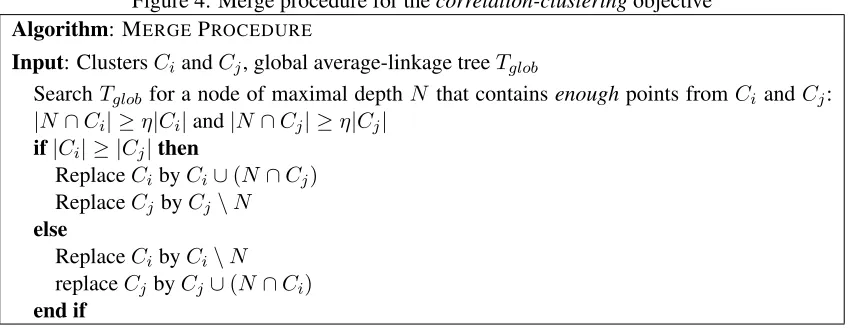
To efficiently find the target clustering with respect to the correlation clustering error, we propose a different merge procedure, which is described in Figure 4.
Figure 4: Merge procedure for thecorrelation-clusteringobjective
Algorithm: MERGEPROCEDURE
Input: ClustersCi andCj, global average-linkage treeTglob
SearchTglobfor a node of maximal depth N that containsenoughpoints fromCi andCj:
|N ∩Ci| ≥η|Ci|and|N ∩Cj| ≥η|Cj|
if|Ci| ≥ |Cj|then
ReplaceCi byCi∪(N ∩Cj)
ReplaceCj byCj\N
else
ReplaceCi byCi\N
replaceCj byCj∪(N∩Ci)
end if
Here instead of creating a new “pure” cluster, we add the corresponding points to the larger of the two clusters in the merge request. Notice that this algorithm is much simpler than the merge algorithm in Figure 3, and does not require pure/impure labels. Using this merge procedure and the split procedure presented earlier gives the following performance guarantee.
Theorem 17 Suppose the target clustering satisfies stability, and the initial clustering has
correlation-clustering errorδcc. In theη-merge model, for anyη >2/3, using the split and merge procedures
in Figures 2 and 4 requires at mostδccedit requests to find the target clustering.
Proof Recall that we may express the correlation clustering errorδccas a summation of
overclus-tering error δcco and underclustering errorδccu (see Section 2.1). Consider the contributions of
individual points toδccoandδccu, which are defined as:
δcco(u) =|{v∈X:c(u, v) = 1andc∗(u, v) = 0}|,
δccu(u) =|{v∈X :c(u, v) = 0andc∗(u, v) = 1}|.
We first argue that a split of a clusterCimust reduceδcc. Given that the split isclean, it is easy
to verify that the outcome may not increaseδccu(u)for anyu∈Ci. We can also verify that for each
u ∈ Ci,δcco(u)must decrease by at least 1. This completes the argument, given that for all other
pointsw /∈Ci,δcco(w)andδccu(w)remain unchanged.
We now argue that if η > 2/3, each merge of Ci and Cj must reduce δcc. Without loss of
moved toCi. We observe that the outcome must remove at leastδ1pairwise correlation-clustering errors(see Section 2.1), whereδ1satisfiesδ1≥2|P|(η|Ci|). Similarly, we observe that the outcome
may add at mostδ2pairwise correlation-clustering errors, whereδ2 satisfies:
δ2 ≤2|P|((1−η)|Ci|) + 2|P|((1−η)|Cj|)≤4|P|((1−η)|Ci|).
It follows that for η > 2/3, δ1 must exceed δ2; therefore the number of pairwise
correlation-clustering errors must decrease, giving a lower correlation-correlation-clustering error.
Observe that the runtime bound in Theorem 17 is tight up to a constant: in some instances any
localalgorithm requires at leastδcc/2edits to find the target clustering. To verify this, suppose the
target clustering is composed ofnsingleton clusters, and the initial clustering containsn/2clusters
of size 2. In this instance, the initial correlation clustering errorδcc =n, and the oracle must issue at
leastn/2split requests before we reach the target clustering (one for each of then/2initial clusters).
3.2 Algorithms under stronger assumptions
When the data satisfies stronger separability properties we may simplify the presented algorithms
and/or obtain better performance guarantees. In particular, if the data satisfies thestrict separation
property (see Definition 3), we may change the split and merge algorithms to use the local average-linkage tree, which is constructed from only the points in the edit request. In addition, if the data
satisfiesstrict threshold separation(see Definition 4), we may remove the restriction onηand use
a different merge procedure that is correct for anyη >0.
Theorem 18 Suppose the target clustering satisfies strict separation, and the initial clustering has
overclustering errorδo and underclustering errorδu. In theη-merge model, for anyη > 0.5, the
algorithms in Figure 5 and Figure 6 require at mostδosplit requests and2(δu+k) log 1 1−ηn
merge
requests to find the target clustering.
Proof Let us useL∗to refer to the ground-truth clustering of the points in the split/merge request.
If the target clustering satisfies strict separation, it is easy to verify that every node in the local
average-linkage treeTlocmust be laminar (consistent) w.r.t. L∗. We can then use this observation
to prove the equivalent of Lemma 14 for strict separation for the split procedure in Figure 5 and the merge procedure in Figure 6. Similarly, we can prove the equivalent of Lemma 15 for strict separation for the split procedure in Figure 5. The analysis in Theorem 10 remains unchanged.
Theorem 19 Suppose the target clustering satisfies strict threshold separation, and the initial
clus-tering has overclusclus-tering errorδoand underclustering errorδu. In theη-merge model, for anyη > 0, the algorithms in Figure 5 and Figure 7 require at mostδosplit requests and2(δu+k) log 1
1−ηn
merge requests to find the target clustering.
Proof If the target clustering satisfies strict threshold separation, we can verify that for anyη > 0,
To verify that the split procedure always produces a clean split, again let us use L∗ to refer to
the ground-truth clustering of the points in the split request. If the target clustering satisfies strict
threshold separation, we can again verify that every node in the local average-linkage treeTlocmust
be laminar (consistent) w.r.t. L∗. It follows that the split procedure always produces a clean split
and must reduce overclustering error by exactly 1. Note that clearly this argument does not depend
on the setting ofη.
We now verify that the new cluster added by the merge procedure in Figure 7 must be “pure” (must contain points from a single target cluster). Observe that due to the strict threshold separation
property, in the graphGin Figure 7, all pairs of points from the same target cluster must be
con-nected before any pairs of points from different target clusters. It follows that the first component
that contains at least anη-fraction of points fromCiandCj must be “pure”. Note that this argument
applies for anyη >0.
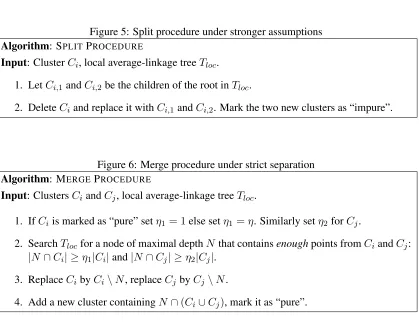
Figure 5: Split procedure under stronger assumptions
Algorithm: SPLITPROCEDURE
Input: ClusterCi, local average-linkage treeTloc.
1. LetCi,1andCi,2be the children of the root inTloc.
2. DeleteCiand replace it withCi,1andCi,2. Mark the two new clusters as “impure”.
Figure 6: Merge procedure under strict separation
Algorithm: MERGEPROCEDURE
Input: ClustersCi andCj, local average-linkage treeTloc.
1. IfCiis marked as “pure” setη1= 1else setη1 =η. Similarly setη2forCj.
2. SearchTlocfor a node of maximal depthN that containsenoughpoints fromCiandCj:
|N∩Ci| ≥η1|Ci|and|N ∩Cj| ≥η2|Cj|.
3. ReplaceCibyCi\N, replaceCjbyCj \N.
4. Add a new cluster containingN∩(Ci∪Cj), mark it as “pure”.
As in Corollary 16, we may also restate the run-time bounds in Theorem 18 and Theorem 19
in terms of any natural clustering error γ. The following corollaries follow from Theorem 18,
Theorem 19 and Theorem 9.
Corollary 20 Suppose the target clustering satisfies strict separation, and the initial clustering has
clustering errorγ, whereγis anynaturalclustering error as defined in Definition 7. In theη-merge model, for anyη >0.5, the algorithms in Figure 5 and Figure 6 require at mostO((γ+k) log 1
1−η n)
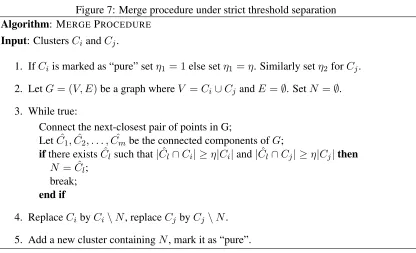
Figure 7: Merge procedure under strict threshold separation
Algorithm: MERGEPROCEDURE
Input: ClustersCi andCj.
1. IfCiis marked as “pure” setη1= 1else setη1 =η. Similarly setη2forCj.
2. LetG= (V, E)be a graph whereV =Ci∪Cj andE=∅. SetN =∅.
3. While true:
Connect the next-closest pair of points in G;
LetCˆ1,Cˆ2, . . . ,Cˆmbe the connected components ofG;
ifthere existsCˆlsuch that|Cˆl∩Ci| ≥η|Ci|and|Cˆl∩Cj| ≥η|Cj|then
N = ˆCl; break; end if
4. ReplaceCibyCi\N, replaceCjbyCj \N.
5. Add a new cluster containingN, mark it as “pure”.
Corollary 21 Suppose the target clustering satisfies strict threshold separation, and the initial
clus-tering has clusclus-tering error γ, whereγ is any natural clustering error as defined in Definition 7. In the η-merge model, for any η > 0, the algorithms in Figure 5 and Figure 7 require at most
O((γ+k) log 1
1−η n)edit requests to find the target clustering.
4. The unrestricted-merge model
In this section we further relax the assumptions about the nature of the oracle requests. As before, the oracle may request to split a cluster if it contains points from two or more target clusters. For
merges, now the oracle may request to merge Ci and Cj if both clusters contain only a single
point from the same ground-truth cluster. We note that this is a minimal set of assumptions for a local algorithm to make progress, otherwise the oracle may request irrelevant splits or merges that prevent the algorithm from finding the target clustering. For this model we propose the merge algorithm described in Figure 8. The split algorithm remains the same as in Figure 2.
To provably find the ground-truth clustering in this setting we require that each merge request
must be chosen uniformly at random from the set of valid merge requests. This assumption is
consistent with the observation in Awasthi and Zadeh (2010) that in the unrestricted-merge model with arbitrary request sequences, even very simple clustering instances require a prohibitively large number of requests. We do not make additional assumptions about the nature of the split requests;
in each iteration anyvalidsplit may be proposed by the oracle. In this setting our algorithms have
the following performance guarantee.
Theorem 22 Suppose the target clustering satisfies stability, and the initial clustering has
Figure 8: Merge procedure for the unrestricted-merge model
Algorithm: MERGEPROCEDURE
Input: ClustersCi andCj, global average-linkage treeTavg.
1. LetCi0,Cj0 = Split(Ci∪Cj), where the split is performed as in Figure 2.
2. DeleteCiandCj.
3. If the setsCi0andCj0 are the same asCiandCj, then addCi∪Cj, otherwise addCi0and
Cj0.
merge request is chosen uniformly at random from the set of valid merge requests, with probability at least 1−, the algorithms in Figure 2 and Figure 8 require δo split requests and O(logkδ2u)
merge requests to find the target clustering.
Theorem 22 is proved in the following lemmas. We first state a lemma regarding the correctness
of the Algorithm in Figure 8. We argue that if the algorithm mergesCiandCj, it must be the case
that bothCiandCj only contain points from the same ground-truth cluster.
Lemma 23 If the algorithm in Figure 8 merges Ci and Cj in Step 3, it must be the case that
Ci⊂Cl∗ andCj ⊂Cl∗for some ground-truth clusterCl∗.
Proof We prove the contrapositive. SupposeCi andCj both contain points fromCl∗, and in
addi-tionCi∪Cj contains points from some other ground-truth cluster. Let us defineS1 =Cl∗∩Ciand
S2 =Cl∗∩Cj. Because the clustersCi0,Cj0 result from acleansplit, it follows thatS1, S2 ⊂Ci0or
S1, S2 ⊂Cj0. Without loss of generality, assumeS1, S2 ⊂Ci0. Then clearlyCi0 6=Ci andCi0 6=Cj,
soCiandCj are not merged.
Theδobound on the number of split requests follows from the observation that each split reduces
the overclustering error by exactly 1 (see Lemma 15), and the fact that the merge procedure does not increase overclustering error (see Lemma 24).
Lemma 24 The merge algorithm in Figure 8 does not increase overclustering error.
Proof Suppose Ci ∪Cj intersects several ground-truth clusters, and hence we obtain two new
clustersCi0,Cj0. Let us callδ1 the overclustering error before the merge, andδ2 the overclustering
error after the merge. Let’s usek1 to refer to the number of ground-truth clusters that intersectCi,
k2to refer to the number of ground-truth clusters that intersectCj, and definek10 andk20 in the same
manner. The new clustersCi0 andCj0 result from a “clean” split, therefore no ground-truth cluster
may intersect both of them. It follows thatk01+k20 < k1+k2. Therefore we now have:
δ2 = δ1−(k1−1)−(k2−1) + (k01−1) + (k20 −1)
IfCiandCj are both subset of the same ground-truth cluster, then clearly the merge operation has no effect on the overclustering error.
Finally, Lemma 25 and Lemma 26 bound the number of impure and pure merges. Here we
call a proposed mergepureif both clusters are subset of the same ground-truth cluster, andimpure
otherwise.
Lemma 25 The merge algorithm in Figure 8 requires at mostδuimpure merge requests.
Proof We argue that the result of each impure merge request must reduce the underclustering error
δuby at least 1. Recall from Section 2.1 that we may expressδuas a summation of underclustering
error with respect to each target cluster. Suppose the oracle requests to mergeCi andCj, andCi0
andCj0 are the resulting clusters. Clearly, the local edit has no effect on the underclustering error
with respect to target clusters that do not intersectCi orCj. In addition, because the new
clus-tersCi0 andCj0 result from acleansplit, for target clusters that intersect exactly one ofCi,Cj, the
underclustering error must stay the same. For target clusters that intersect bothCiandCj, the
un-derclustering error must decrease by exactly one; the number of such target clusters is at least one.
Lemma 26 Assuming that each merge request is chosen uniformly at random from the set of valid
merge requests, the probability that the algorithm in Figure 8 requires more thanO(logkδ2u)pure merge requests is less than.
Proof We first consider the pure merge requests involving points from some ground-truth
clus-ter Ci∗, the total number of pure merge requests (involving any ground-truth cluster) can then be
bounded with a union-bound. To facilitate our argument, let us assign an identifier to each cluster
containing points fromCi∗in the following manner:
1. Maintain a cluster-id variable, which is initialized to 1. To assign a “new” identifier to a
cluster, set its identifier tocluster-id, and incrementcluster-id.
2. In the initial clustering, assign anewidentifier to each cluster containing points fromCi∗.
3. When we split a cluster containing points fromCi∗, assign its identifier to the newly-formed
cluster containing points fromCi∗.
4. When we merge two clusters that are not both subset of the same target cluster, if one of the
clusters contains points fromCi∗, assign its identifier to the newly-formed cluster containing
points fromCi∗. If both clusters contain points fromCi∗, assign anewidentifier to the
newly-formed cluster containing points fromCi∗.
5. When we merge two clustersC1andC2, and both contain only points fromCi∗, if the outcome
is one new cluster, assign it anewidentifier. If the outcome is two new clusters, assign them
the identifiers ofC1andC2.
Observe that when clusters containing points from Ci∗ are assigned identifiers in this manner,
of the initial clustering with respect toCi∗:δi = dist(Ci∗, C). To verify this, consider that we assign
exactlyδi+ 1new identifiers in Step 2, and each time we assign a new identifier in Steps 4 and 5,
δidecreases by one.
We say that a pure merge request involving points fromCi∗ is originalif the user has never
asked us to merge clusters with the given identifiers, otherwise we say that this merge request is
repeated. Given that the maximum value ofcluster-id is bounded byO(δi), the total number of
originalmerge requests must beO(δi2).
We now argue that if a merge request is not original, we can lower bound the probability that it
will result in the merging of the two clusters. For a repeated merge requestMi =Merge(C1, C2),
letXibe a random variable defined as follows:
Xi =
1 if neitherC1norC2 have been involved in a pure merge request since
the last time a merge of clusters with these identifiers was proposed.
0 otherwise.
Clearly, when Xi = 1 it must be the case thatC1 andC2 are merged. Assuming that each
merge request is chosen uniformly at random from the set of valid merge requests, we observe that
Pr[Xi = 1] > 2δ1
i+1. To verify this, observe that in each merge request the probability that the
user requests to mergeC1 andC2 is m1, and the probability that the user requests a pure merge
involvingC1 orC2 and some other cluster is less than 2mδi, wheremis the total number of valid
merge requests; we can then bound the probability that the former happens before the latter.
We can then use a Chernoff bound to argue that aftert=O(logkδ2i)repeatedmerge requests,
the probability thatPt
i=1Xi < δi (which must be true if we need morerepeatedmerge requests)
is less than /k. Therefore, the probability that we need more than O(log kδ2i) repeated merge
requests is less than/k.
By the union-bound, the probability that we need more than O(logkδi2) repeated merge
re-quests foranyground-truth clusterCi∗ is less thank·/k = . Therefore with probability at least
1−for all ground-truth clusters we need P
iO(log
k
δ2i) = O(logk
P
iδi2) = O(logkδ2u)
re-peatedmerge requests, where δu is the underclustering error of the initial clustering. Also recall
that for all ground-truth clusters we needP
iO(δ2i) = O(δu2)originalmerge requests. Adding the
two terms together, it follows that with probability at least1−we need a total ofO(log kδ2u)pure
merge requests.
As in the previous section, we also restate the run-time bound in Theorem 22 in terms of any
naturalclustering errorγ. The following corollary follows from Theorem 22 and Theorem 9.
Corollary 27 Suppose the target clustering satisfies stability, and the initial clustering has
cluster-ing errorγ, whereγ is anynatural clustering error as defined in Definition 7. In the unrestricted-merge model, assuming that each unrestricted-merge request is chosen uniformly at random from the set of valid merge requests, with probability at least 1−, the algorithms in Figure 2 and Figure 8 require
O(logkγ2)edit requests to find the target clustering.
4.1 Algorithms under stronger assumptions
As in Section 3.2, if the data satisfiesstrict separation, then instead of the split procedure in Figure 2
only the points in the user request). Similarly, we can modify the merge procedure in Figure 8 to perform the split as in Figure 5. We can then prove the equivalent of Theorem 22 and Corollary 27 for strict separation for these split/merge algorithms.
5. Experimental Results
We perform two sets of experiments. We first test our proposed split algorithm on the clustering of business listings maintained by Google. We then test the proposed model in its entirety on the 20 Newsgroups data set.
5.1 Clustering business listings
Google maintains a large collection of data records representing businesses, which as of 2013 con-tained more than 100 millions records. These records are initially clustered using a similarity func-tion. Each cluster is expected to contain records about the same distinct business. Clusters are then summarized; these summaries are served to users online via various front-end applications. Users report bugs such as “you are displaying the name of one business, but the address of another” (caused by overclustering), or “a particular business is shown multiple times” (caused by under-clustering). The clusters involved in these requests are often quite large and usually contain records about several businesses. Therefore this setting closely matches our interactive clustering model - users provide high-level feedback requesting cluster merges/splits, where the corresponding data points intersect several ground-truth clusters.
Here we evaluate the effectiveness of our proposed split algorithm in such cases. Correctness of a split is evaluated with respect to the ground-truth labels, which are obtained through manual inspection of the listings in the cluster. For example, from manual inspection it is very easy to see that two Starbucks records with different addresses are in fact different businesses (have different ground-truth labels) even if, say, they have the same corporate phone number. But this observation is not necessarily captured by the noisy similarity function, causing the listings to incorrectly cluster together.
We consider two criteria to determine whether a split is correct or not, and show experimental results for both. We first consider a binary split correct if the two resulting sub-clusters are “clean” according to Definition 13. Note that a clean split is sufficient and necessary for reducing the under/overclustering error in our model. To compute the splits, we use the algorithm in Figure 5,
which we refer to asClean-Split. This algorithm is easier to implement and run than the algorithm
in Figure 2 because it only requires local pairwise similarities (for the listings in the cluster). But this algorithm is still provably correct under stronger assumptions on the data (see Theorem 18 and Theorem 19), which we believe are still satisfied in this application.
We compare performance with two well-known split algorithms from split/merge clustering
lit-erature: the optimal 2-median clustering (2-Median), and a “sweep” of the second-smallest
eigen-vector of the corresponding graph Laplacian matrix. With respect to the spectral split algorithm, let
{v1, . . . , vn}be the order of the vertices when sorted by their eigenvector entries. We compute the
partition{v1, . . . , vi}and{vi+1, . . . , vn}such that its conductance is smallest (Spectral-Balanced),
and a partition such that the similarity betweenviandvi+1is smallest (Spectral-Gap).
Table 1: Number of correct (clean) splits on the Google business listings data sets.
Clean-Split 2-Median Spectral-Gap Spectral-Balanced
19 13 12 3
these data-sets and made them publicly available.2 The results are presented in Table 1. We
ob-serve that the Clean-Split algorithm works best, giving a correct split in 19 out of the 20 cases.
The well-knownSpectral-Balancedtechnique usually does not give correct splits in this
applica-tion. The balance constraint causes it to put records about the same business on both sides of the partition (especially when all the “clean” splits are not well-balanced), which increases clustering
error. As expected, the Spectral-Gap technique improves on this limitation (because it does not
have a balance constraint), but the result is often still incorrect. The2-Medianalgorithm performs
fairly well, but it is still a limited approach in this application: the optimal centers may correspond to listings about the same business, and even if they represent distinct businesses, the resulting split is still sometimes incorrect.
In addition to using the clean-split criterion, we also evaluate the computed splits using the
correlation-clustering (cc) error. We find that using this criterionClean-Splitand2-Mediancompute
the best splits, while the other two algorithms perform significantly worse. The results for
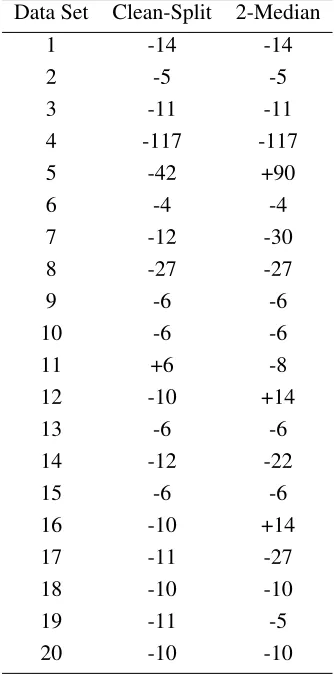
Clean-Split and2-Medianare presented in Table 2 - we see thatClean-Splitis more reliable because it
fails to reduce the cc-error only once, compared to 4 such failures for 2-Median. Table 2 also
reinforces our theoretical understanding of the effectiveness of our split algorithm. We know that a clean split is sufficient to reduce the cc-error, but it is not necessary. Our experiments illustrate
these observations:Clean-Splitmakes progress in reducing the cc-error in 19 out of 20 cases (when
the resulting split is clean), while we have also confirmed that2-Mediansometimes still reduces the
cc-error even when the resulting split is not clean.
5.2 Clustering Newsgroup documents
In order to test our entire interactive clustering model, we perform experiments on the 20
News-groups data set.3 The points in the data set are posts to twenty different online forums (called
newsgroups). We sample these data to generate 5 data sets of manageable size (containing 276-301 points), which are labeled A through E in the figures. Each data set contains some documents from every newsgroup. The purpose of these 5 data sets is to check the consistency of our results, given that there may be considerable variation in how separable the ground-truth clusters are in each case. For each data set, the ground-truth is determined by the newsgroups that the documents belong to.
Each Newsgroup document is represented by a term frequency - inverse document frequency (tf-idf) vector (Salton and Buckley, 1988). We use cosine similarity to compare these vectors, which
gives a similarity score in[0,1]. We compute an initial clustering by using the following procedure
to perturb the ground-truth: for each document we keep its ground-truth cluster assignment with
probability0.5, and otherwise reassign it to one of the other clusters, which is chosen uniformly
at random. This procedure generates initial clusterings with overclustering error of about 100, underclustering error of about 100, and correlation-clustering error of about 5000.
Table 2: Change in correlation-clustering error for splits on the Google business listings data sets. A negative value corresponds to a decrease in error.
Data Set Clean-Split 2-Median
1 -14 -14
2 -5 -5
3 -11 -11
4 -117 -117
5 -42 +90
6 -4 -4
7 -12 -30
8 -27 -27
9 -6 -6
10 -6 -6
11 +6 -8
12 -10 +14
13 -6 -6
14 -12 -22
15 -6 -6
16 -10 +14
17 -11 -27
18 -10 -10
19 -11 -5
20 -10 -10
To simulate user feedback, we compute the set of all valid split and merge requests. Consistent with our model, a split of a cluster is considered valid if it contains points from 2 or more
ground-truth clusters, and a merge is considered valid if at least anη- fraction of the points in each cluster
are from the same ground-truth cluster. We then choose one of the valid splits/merges uniformly at random, and ask the algorithm to compute the corresponding split/merge. We continue to iterate until we find the ground-truth clustering or reach a limit on the number of edit requests (set to 20000).
The Newsgroup data is know to be very challenging for unsupervised (Telgarsky and Dasgupta, 2012; Heller and Ghahramani, 2005) and semi-supervised clustering algorithms (Basu et al., 2002, 2004). In particular, on harder Newsgroup clustering instances Basu et al. (2002) and Basu et al. (2004) report that they are unable to come close to finding the ground-truth clustering even with considerable supervision.
data set, we perform experiments with the original (unpruned) data set, a pruned data set with 2 points removed per target cluster, and a pruned data set with 4 points removed per target cluster, which prunes 40 and 80 points, respectively. Our pruning heuristic generates clustering instances where the ground-truth clusters are more separable, similar to the Different-3 data set of Basu et al. (2002) and the News-diff3 data set of Basu et al. (2004).
5.2.1 EXPERIMENTS IN THEη-MERGE MODEL
We first experiment with algorithms in theη-merge model. Here we use the algorithm in Figure 2
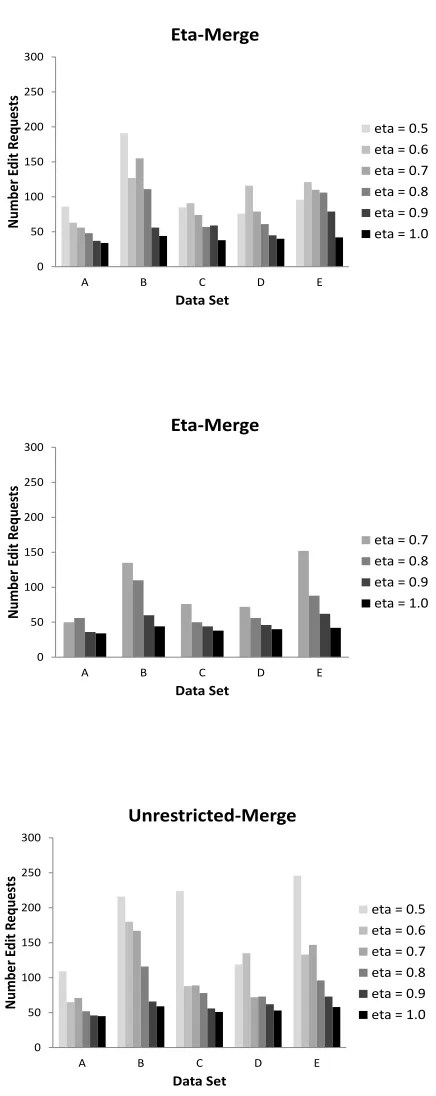
to perform the splits, and the algorithm in Figure 3 to perform the merges. We show the results for data set A in Figure 9; the complete experimental results are in Appendix B. We find that for larger
settings ofη, the amount of supervision (number of split/merge requests needed to find the target
clustering) is quite low and consistent with our theoretical analysis. The results are better for pruned
data sets, where we get very good performance regardless of the setting ofη. The results for the
algorithms in Figure 2 and Figure 4 (for the correlation-clustering objective) are very favorable as well.
5.2.2 EXPERIMENTS IN THE UNRESTRICTED-MERGE MODEL
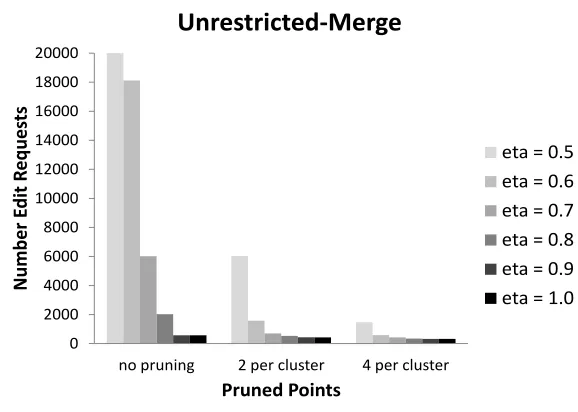
We also experiment with algorithms in the unrestricted merge model. Here we use the same algo-rithm to perform the splits, and use the algoalgo-rithm in Figure 8 to perform the merges. We show the results on data set A in Figure 10; the complete experimental results are in Appendix B. We find
that again for larger settings ofη the amount of supervision is quite low and consistent with our
theoretic analysis (we only show results forη ≥0.5), and performance improves further for pruned
data sets. Our investigations show that for unpruned data sets and smaller settings ofη, we are still
able to quickly achieve very small clustering error (results not shown), but the algorithms are unable to converge to the ground-truth clustering due to inconsistencies in the average-linkage tree. We can address some of these inconsistencies by constructing the tree in a more robust way, which indeed gives improved performance (see Appendix C).
5.2.3 EXPERIMENTS WITH SMALL INITIAL ERROR
We also consider a setting where the initial clustering is already very accurate. In order to simulate this scenario, when we compute the initial clustering, for each document we keep its ground-truth
cluster assignment with probability 0.95, and otherwise reassign it to one of the other clusters,
which is chosen uniformly at random. This procedure usually gives us initial clusterings with over-clustering and underover-clustering error between 5 and 20, and correlation-over-clustering error between 500 and 1000. Note that this setting also closely matches the scenario where the initial clustering is computed using a good clustering algorithm, which is quite realistic in some applications.