MULTISET SURFACE IRRIGATION SYSTEM*
byW. W Rasmussen, J. A. Bondurant and R. D. Berg.
" Soil Scientist, Agricultural Engineer, and Agricultural Research Technician, respectively Snake River Conservation Research Center, Kimberly, Idaho.
INTRODUCTION
More than 80 per cent of the irrigated land in the United States is served by surface irrigation systems( 2), of which about 90 per cent is furrow-irrigated. The furrow irrigation system has been used extensively because of its relative simplicity, adaptability, and low initial invest-ment for most soils and cropping systems. This use has persisted for many decades even though soil and water losses may be high on many fields. Efficiencies are generally low in most furrow-irrigated fields, although irrigation efficiency can be relatively high in surface sys-tems that are well designed, constructed and operated(). More efficient irrigation is becoming mandatory • in many areas because of irrigation water costs and
limit-ed supplies. Effective irrigation of any crop at all stages of growth requires that irrigation water be applied under control and with optimum efficiency. Many present systems of surface irrigation are inefficient, require much labor, and are not always compatible with desired field geometry and farming practice. Sprinkler irrigation methods also have either a high labor requirement or high first cost, are not adaptable to some crops, and do not apply water uniformly under some conditions. Present subsurface irrigation systems that control the water table, use excessive amounts of water and intensify drainage and salinity problems. The newer subsurface irrigation methods, utilizing buried pipe with perforations or drippers, have numerous maintenance and equipment problems.
The fundamentals of obtaining efficient furrow irriga-tion require limited. stream sizes and lengths of run with the use of cut-back streams(s). Cutback streams have not generally been used because practical systems and techniques have not been developed. Constant sized streams on long furrow lengths produce at least 20 per cent runoff under most field conditions if uniform distribution is to be obtained(s), Efficient irrigation can be obtained under these conditions if reuse systems are used. The large equipment used by today's farmer makes longer furrows more economical to farm.
• Contribution from the Northwest Branch, Soil and Water Conservation Research Division, Agricultural Research Service, USDA ; Idaho Agricultural Experiment Station bk. co-operating.
The major variables involved in surface irrigation system design and operation are: (a) infiltration rate, (b) slope, (c) rate of advance, (d) rate of recessiqa, (e) boundary geometry, (f) surface roughness and (g) stream size or inflow rate (4). The theoretical and practi-cal problems involved in evaluating and controlling the separate parameters are formidable and have been the subject of much research over many years. Complete integration of the several parameters in irrigation hydraulics is vastly complicated. Although much useful progress has beenmade, the problem of adequate surface irrigation design and implementation has not been accep-tably solved. Either many of the major variables will have to be controlled, or better water application control must be achieved before furrow irrigation becomes simple and efficient. Changes of furrow shape and furrow geo-metry can induce small but significant variations in furrow intake rate. Also, alteration of field geometry, slope, and length of run can produce significant changes in irrigation efficiencies. However, reduction in length of run is frequently limited by other considerations, i.e., ease of operation of machinery, cost of land for additional head ditches, and additional labor in setting up irrigation. Slope can be reduced by contouring fur-rows, benching, and terracing, but these practices also present problems. Extensive cutting may expose infertile subsoil, increase the heterogeneity in waterinfiltiation, and intensify irrigation and soil management problems. Up till now the major variable subject to practical control has been the inflow rate, but even the magnitude of this control is subject to the inter-relationship of the other parameters.
MULTISET IRRIGATION SYSTEM
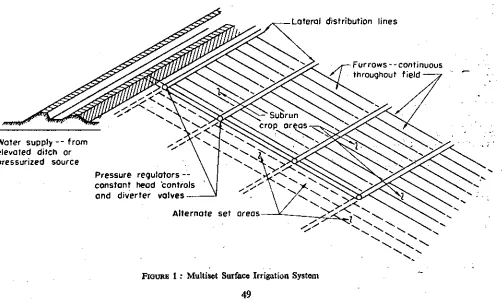
Lateral distribution lines
Furrows-- continuous throughout field
Water supply -- from elevated ditch or pressurized source
Pressure regulators --constant head 'controls and diverter valves
Alternate set areas
.4-_ `N. -5. (length of run), rate of advance, and rate of recession.
Infiltration rate and furrow roughness also may be amenable to limited control with the greater precision possible wit hthe Multiset Irrigation System. The use of small, uniform streams and short, multiple lengths of furrow runs reduces water loss and improves uniformity of water application, It is expected that the system will limit erosion and decrease the sediment loss from cropped areas and the resultant pollution of drainage streams from irrigated runoff. The system can be readily moved so that tillage, harvesting, and other field operations can be performed on large, unbroken fields.
The Multiset Irrigation System (MIS) is described, and the operation and potential use of the system is discussed in this article. Additional tests will be needed, and design criteria developed for more extensive applica-tion of the system.
DESCRIPTION
The Multiset System (shown diagrammatically in Figure 1) conveys water to the field and distributes it to irrigation furrows at several intermediate points along the overall length or field run of the furrow. This is accomplished by a pipe distribution system that applies water. from portable pipe laterals spaced at intervals along the furrow. Thus, the overall furrow length will be divided into subruns of only 150 to 300 feet (45.72-91.44 m), Significantly smaller rates of flow are deliver-ed to the furrows at the beginning of each shortendeliver-ed subrun through laterals equipped with fixed-size orifices than would be requ ired for the entire furrow. The inflow to each subrun from he main line is controlled by regulating the pressure head at the inflow to each distri-bution line or section of distridistri-bution line.
TEST OF THE SYSTEM
Tests of the system were conducted in 1969 on Port-neuf silt loam, a high silt, loessial soil near Kimberly, Idaho. Portneuf soil is the most extensively irriggted soil in south-central and south-eastern Idaho and is extremely erodible, Erosion resulting from surface irri-gation is considered to be the most serious soil manage-ment problem in the area. Erosion resulting from a single preplanting irrigation under average field irrigation using moderate furrow streams and 600-foot furrow runs, is shown in Figure 2.
DESIGN 01? EXPERIMENT
The field experiment was a randomized block design with five treatments and two replications. The five treatments consisted of one standard irrigation practice irrigating the entire furrow length from the upper end, and four methods of multiset operations divided into three subruns. These treatments were:
1. Multiset, solid set.
2. Multiset, downfield sequencing. - 3. Multiset, upheld sequencing.
4. Multiset, alternate sequencing.
5. Standard practice with cutback stream. PROCEDURE
The Multiset Irrigation System was installed on a test field, 450 feet long, which was subdivided into three subruns or sections each 150 feet long. Water was deli-vered to the furrows at the head of each subrun through aluminium laterals equipped with fixed-size orifices. Water was provided to the laterals from a main pipeline parallel to the furrows, and each lateral was leveled to
FIGURE 1: Multiset Surface Irrigation System
a
•
Ettotrag 2 : Soil erosion. in irrigation furrows resulting from a preplanting irrigation on Portn.euf silt loam soil near IC.imherly, Idaho. Tin loessial soils are highly erodible particu-larly during early seasonirrigations and following cultivation.
provide uniform flow into each furrow. A full coverage system was provided and the alternate, upheld, and down-field severing was obtained by closing off orifices not used in the replicated treatment plots. The laterals were 4-inch (10.16 cm) aluminium distribution pipe with 3/8 inch (9.4 mm) diameter orifices drilled on 24-inch (60.96 cm) spacing. Low pressure overflow, constant head boxes regulated the flow into the distributionlines. The head was adjusted so that the flow rate was 1.33 gem/orifice. Seven-row plots were used, allowing one dry furrow between plots, two border furrows, and two wheel travel and two nonwheel compacted furrows. The plots were planted to pinto beans on 24-inch (60.96-cm) row spacing. Field data were taken only on the first irrigation and after planting when the bean plants were approximately 8 inches (20-32 cm) high. Inflow streams were measured and stream advance times were recorded. Runoff from each 150-foot (45.72 m) section was measured and allow-ed to flow onto the next plot. A range of intake rates was obtained by utilizing wheel-compacted and non-compacted furrows. On this silt loam soil, for the early season irrigations, the intake rate for compacted furrows may only be one-third to one-half the rate in noncorapacted furrows. The data presented are for the wheel-compacted furrows, which approximated intake characteristics at midseason for Portneuf soil.
RV-SULTS AND DISCUSSION
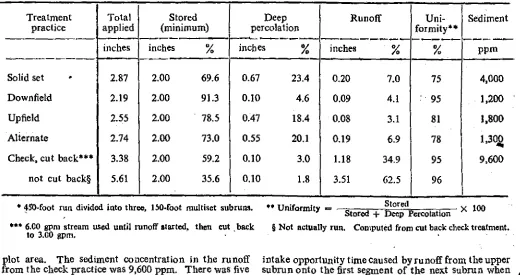
The irrigation on each section was run until more than a 2-inch (5.08-cm) irrigation was applied. The stream advance and hydrograph data were analyzed to obtain intake rates, and infiltration patterns for a 2-inch (5.08-cm) minimum irrigation were subsequently computed for each section of each treatment on the compacted furrows. The computed moisture distribution patterns under each treatment are shown in Figures 3 A-E, and a summary of the partitioning of applied irrigation water is:given in Table L This analysis shows that the amount
of water needed to apply a minimum 2-inch (5.08-cm) irrigation any place along the total length of run was 2.19 to 2.87 inches (5.56 to 7.29 cm) for the multiset operation. The standard or check with cutback stream required 3.38 inches (8.59 cm) and would have required 5.61 inches (14.25 cm) if not cut back. The check irrigation treatment used a 6-gpm initial stream size and was cut back to 3.0 gpin after 1.75 hours or shortly after runoff began at the lower end of the field.
On the , basis of overall efficiency, the downfield se-quence required the least water to accomplish the 2-inch (5.08-cm) minimum irrigation. This was followed by the upfield sequence, the alternate sequence, and, lastly, the solid set sequence. The alternate sequence in this case consisted of irrigating the upper and lower sections first, and when that irrigation was completed, then the middle sectionwas irrigated. The uniformity of irrigation on the medium to low intake rate soil for the test period was just as good on the check plot as it was on any of the multiset operations. The 2-inch (5.08-cm) irrigation was accomp-lished with only 0.1 inch (2.54ram) deep percolation for both the check and the downfield multiset practice. If the runoff from the check irrigation were subsequently re-cycled, this would be a very efficient irrigation practice from the water use startdpoint(9. It is not, however, normal practice for this area. Water normally is not measured to the field, the net application is not comput-ed, and sets arc 12 or 24 hours induration instead of the 8.5 hours needed to apply 2 inches (5.08 cm).
FIGURES 3 A-I3 : Plot _of the computed stored moisture
distribution patterns under the several Multiset Irrigation System operational treatments and for the conventional
full-run (chock) system.
TABLE I
Computed distribution of water under multiset and standard irrigation practice for a 2.0-inch irrigation*
Treatment
practice appliedTotal (minimum)Stored percolationDeep Runoff fortuity**Uni- Sediment
inches inches % inches % inches % ox ppm
Solid set • 2.87 2.00 69.6 0.67 23.4 0.20 7.0 75 4,000
Downfield 2.19 2.00 91.3 0.10 4.6 0.09 4.1 ' 95 1,200
Upfield 2.55 2.00 78.5 0.47 18.4 0.08 3.1 81 1,800
Alternate 2.74 2.00 73.0 0.55 20.1 0.19 6.9 78 1,302
Check, cut back*** 3.38 2.00 59.2 0.10 3.0 1.18 34.9 95 9,600
not cut back§ 5.61 2.00 35.6 0.10 1.8 3.51 62.5 96
Stored * 450•foot run divided into three, 150-foot multiset subruns.
*** 6.00 gum stream used until runoff started, then cut back to 3.00 gum.
plot area. The sediment concentration in the runoff from the check practice was 9,600 ppm. There was five times as much run off from the check practice as from any multiset operations, so 10 to 12 times as much sediment was produced from this practice as from any multiset practice.
The computed, stored moisture curves (Figures 3A-E) indicate the variation in the pattern and extent of deep percolation for the several treatments. The depth of application for the check treatment (Figure 3E) is exceptionally uniform for the conventional irrigation method. This resulted from using a larger stream size and the limited (450 feet) length of run. This decreased the advance time and therefore decreased deep percolation, but increased runoff and sediment loss from the field. The curve for the solid set treatment (Figure 3A) shows the increased appli-cation and deep percolation that occurs at the junction of the subruns. The effect of the augmented streamflows on intake is maximized at the areas of over-run. The furrow stream running off the upper section (Section I) slightly increased total intake in the first portion of Section II, probably by increasing the wetted perimeter during the initial period of higher intake rate. The augmented flow from Section II also increased the deep percolation on the upper portion of Section III. This resulted both from an increased wetted perimeter and a longer intake opportunity time during the initial period of irrigation when intake rates were higher.
The downfield sequencing treatment (Figure 313) also shows greater deep percolation at the junction of the subru ns. This results primarily from the increased
** Uniformity =
Stored + Deep Percolation
§ Not actually run. Computed from cut back check treatment. •
intake opportunity time caused by runoff from the upper subrun onto the first segment of the next subrun when the soil was initially dry and intake rates were greater. In the upfield sequencing (Figure 3C), the effect of over-flow is minimized since the segm.ents of the subruns affect-ed by runoff from the above sections occur on previously wetted soil where intake rates are lower.
In the alternate sequecing treatment-with only three sections -the treatment points up the combined effect of both the upfield and downfield sequencing. The computed, cumulative intake curve (Figure 3D) shows the typical effect of runoff from the upper section on deep percolation in the first 50 to 75-foot (15.24-m to 22.86-m) segment of the previously dry middle section. The over-run flow occurred during he intake opportunity time when the soil intake rate was higher. The increased deep percolation in the upper 100-foot (30,48-m) segment (between 300 and 400 feet or (91.44 and 121.92 in) of Section III resulted from the cumulative effect of over-run flow from both Section I and Section II occurring during the total irrigation period.
Analyses of these data indicate the flexibility of the system for controlling intake over selected segments of the total field run. This is accomplished by minimizing or maximizing intake to modify the effect of changes in slope, varying soil characteristics. antecedent soil moisture and other factors on intake at selected intervals along the overall field length. This flexibility permits limiting stream sins and lengths of run and provides maximum control of erosion. It may be possible to alternate lateral locations between irrigations to take advantage of the
deep percolation areas as greater depths of irrigation are required later in the season.
Irrigation data from tillage and cropping experiments conducted on several soils, using a plot-type irrigation system essentially of the same design and configuration as the Multiset system, were analyzed as further tests of the multiset concept. Inflow and outflow hydrographs were available for all seasonal irrigations for several years from replicated, differentially treated subplots each 150 feet (45.72 rri) long, and from check furrow runs 650 feet (198.12 in) long. Water distribution patterns and water use efficiencies were calculated for tests "simulating some of the treatments or mode of operation of the MIS. The data, not presented, indicate that very high water distribution efficiency is possible utilizing the m,ultiset principle. The above observations were obtained on moderate to low intake soils. Preliminary analyses indicate that much improvement in water application efficiency can be obtained on high intake soils in compa-rison to conventional furrow systems.
Multiset Irrigation Systems can probably be installed on most farms now set up with standard furrow irriga-tion systems without excessive field alterairriga-tion or irrigation system rearrangement. The systems can operate under low pressure heads from slightly elevated ditches or other low pressure water sources. Initially, system installations might be limited to higher value Crops which require light, early irrigations and precise water control, or to areas where soil erosion is exceptionally hazardous. Complete coverage systems are estimated to cost approximately $300 per acre,
(5 741 per ha), approximately the cost of solid set sprinkler systems without pump and pumping costs.
SUMMARY
• A unique furrow irrigation system, termed a "Multiset Irrigation System", comparable to a solid set sprinkler system, is described. The system applies water to furrows at intervals through portable aluminium or plastic irriga-tionpipeli nes using drilled orifices or simple, sized outlets. Stream sizes are adjusted to accommodate variable intake rates by varying the head on the distribution pipe, Length of run can be adjusted in multiples of the distribution run spacing. When runoff occurs, the inflow can be reduced by stopping one or more distribution lines, or by reducing stream inflow.The system can be easily moved so t hat tillage and other field operations can be perform-ed on longer, unbroken fields.
In principle, the Mtiltiset System controls, by design, four major variables involved in surface irrigation. By delivering inflow to several points along the furrow, in-flow rate (stream size) and the boundary geometry (length
of run) are positively controlled along with indirect con-trol of the related dependent variables—rate (and time) of advance and recession. Infiltration rate, furrow rough-ness, and other hydraulic characteristics may be amenable to some practical control utilizing the greater precision possible with the Multiset System.
The concept of the system was successfully used on a variety of field crops for several years. The field-scale system was tested under several methods of operation. The results indicate that use of the system can reduce or limit soil erosion within the field, reduce sediment loss from the cropped aea, and control sediment pollution in irrigation runoff water. Correctly designed and operat-ed, this system can improve water use ef
f
iciency and uni-formity of application, and is compatible with present-day farming practices. The system can be economically automated and greatly reduce skilled labor requirements. Acceptable, operational field- scale models utilizing automatic controls, such as pressure regulators and variable flow orifices, will need to be designed for generalfarm use. Many existing and experimental pipeline control devices could be adapted to this system. The cost of
a complete coverage system is estimated to be
comparable to a solid set sprinkler irrigation system,LITERATURE CITED
BONDURANT, J.A., and WILLARDSON, L.S., "Recirculating farm irrigation systems ," ASCE Irrig. and Drain. Specialty Conf. Proc., 1966, p 243-256, Bozeman, Montana.
(2) BROWNSCOMBE, R.H., and FANGMEIER, D.D., "Applying water over the surface uniformly under automechanization," Proc. ASAE Nat. Irrig. Symp., Univ. of Nebraska, Lincoln, Nebr.,
1970, Nov 1970.
(3) :CRIDDLE, W.D., DAVIS, S., PAIR, C.H., and SHOCKLEY D.G., "Methods for evaluating irrigation systems," USDA Agric. Handbook 82,
1956.
(4) HANSEN, VAUGHN E., "The importance of hydraulics of surface irrigation", J. Irrig. Drain. Div. ASCE, Pap. n 1788, 1958.
U.S. BUREAU OF RECLAMATION "Use of water on federal irrigation projects, (19641968). -Summary Report, Vol. I," Washington, D.C., Legion I, 1971.
(6) WILLARDSON, L. S., and BISHOP A. A., "Analysis of surface irrigatoin application efficiency" J. Irrig. Drain. Div. ASCE, 1967, v 93, nIR 2,p 21-36.
( 1)
(5)