The Thirty-Third AAAI Conference on Artificial Intelligence (AAAI-19)
Find Me if You Can: Deep Software Clone Detection by
Exploiting the Contest between the Plagiarist and the Detector
Yan-Ya Zhang, Ming Li
National Key Laboratory for Novel Software Technology, Nanjing University Collaborative Innovation Center of Novel Software Technology and Industrialization
Nanjing 210023, China {zhangyy, lim}@lamda.nju.edu.cn
Abstract
Code clone is common in software development, which usu-ally leads to software defects or copyright infringement. Re-searchers have paid significant attention to code clone detec-tion, and many methods have been proposed. However, the patterns for generating the code clones do not always remain the same. In order to fool the clone detection systems, the plagiarists, known as the clone creator, usually conduct a se-ries of tricky modifications on the code fragments to make the clone difficult to detect. The existing clone detection ap-proaches, which neglects the dynamics of the “contest” be-tween the plagiarist and the detectors, is doomed to be not robust to adversarial revision of the code. In this paper, we propose a novel clone detection approach, namely ACD, to mimic the adversarial process between the plagiarist and the detector, which enables us to not only build strong a clone detector but also model the behavior of the plagiarists. Such a plagiarist model may in turn help to understand the vulner-ability of the current software clone detection tools. Experi-ments show that the learned policy of plagiarist can help us build stronger clone detector, which outperforms the existing clone detection methods.
Introduction
Software clones are usually introduced when people reuse the code by copy-paste operations (Roy and Cordy 2007) to shorten software development time. To avoid the infringe-ment of copyright, they intend to camouflage the reused code. Such code clones not only violate the intellectual prop-erties of the software being cloned but also lead to the injec-tion of software defects easily due to the lack of detailed knowledge about the cloned code. Thus, software clone de-tection, aiming to find those plagiarized code automatically has attracted significant attention.
Many clone detection models have been proposed, most of them hand-craft certain similarity between two code frag-ments by exploiting either lexical information or syntac-tical information of the code. For example, NICAD (Roy and Cordy 2008) considers the similarity of code frag-ments in lexical level, Deckard (Jiang et al. 2007) com-putes the code syntax similarity based on Abstract Syntax Tree. Recent studies suggest to learn semantic features from
Copyright c2019, Association for the Advancement of Artificial Intelligence (www.aaai.org). All rights reserved.
the code pairs for detecting software clones. For example, CDLH (Wei and Li 2017) formalizes the clone detection as a supervised learning to hash problem and learns deep features for functional clone detection, CDPU (Wei and Li 2018) ad-dresses the clone detection in a positive-unlabeled (PU) per-spective to leverage the unlabeled data for functional feature learning.
All of these approaches have shown their effectiveness in software clone detection. However, the clone detection is not a task in a closed and static environment. The pla-giarists can easily acquire the techniques of clone detection tools, and by studying the tools they can camouflage the cloned code with particularly designed strategies. Therefore, the software clone detectors may have to deal with new pat-terns of code cloning. The current data for training the clone detector is always insufficient to identify the new clone pat-terns, and the clone detector is doomed to be not robust to such adversarial revision of the code.
In fact, there exists a contest between the plagiarists and the clone detectors, where the former will modify the cloned code in order to fool the detectors, and the latter tries to learn the patterns of the modifications made by the plagiarists. Only if such contest is considered in learning the clone de-tector, the model can be robust to adversarial code revisions in real world.
Experiments on software clone detection benchmarks in-dicates that our approach not only can improve the overall detection performance by identifying the clone pairs with some camouflage which are not easily detected by existing clone detection approaches, but also provide some insight on the behavior of the plagiarist, which may help to understand the potential vulnerability of the current clone detectors.
The contribution of our paper lies in three folds:
• We are the first to highlight dynamic nature of software clone detection and the importance of explicitly modeling the contest between the plagiarist and the detector. • We propose novel adversarial clone detection approach,
namely ACD, which is able to mimic the adversarial pro-cess in software clone detection by simultaneously learn-ing the a plagiarist model and a detector model.
• The proposed approach can not only build a strong soft-ware clone detector which is capable to identify the pla-giarized code fragments but also can provide some insight on the vulnerability of the current software clone detec-tion tools from the plagiarist model.
The rest of the paper is organized as follows. We first present the ACD approach, and then we report the experi-mental results. Finally, we discuss some related work and conclude the paper.
Adversarial Clone Detection
Givenncode fragments{C1,· · · , Cn}whereCiis thei-th raw code fragment, and pairwise labels to indicate whether two code fragments belong to a clone pair of not:yi,j= 1if
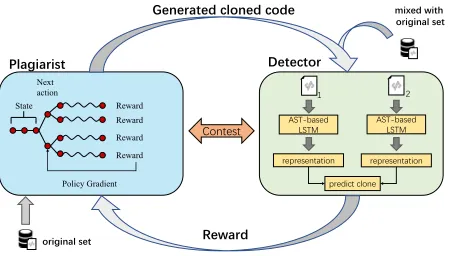
(Ci, Cj)is a clone pair,yi,j=−1if not, andyi,j= 0if their relation is unlabeled. Moreover, we useCi∗ to indicate the modified code after implementing a series of changes onCi. Our goal is to learn a plagiaristPθthat can produce decep-tive cloned code, and train a detectorDφ which maps any pairs of code fragments to{−1,1} to decide whether they belong to a clone pair. Figure 1 summarizes the overall ar-chitecture of ACD. The detectorDφis trained by the mixing data from original code({C1,· · ·, Cn})and modified code
({Ci1∗,· · ·, Cim∗}). At the same time, the plagiaristPθ is updated by employing a policy gradient and MC search on the basis of the expected end reward coming from the detec-torDφ. As the detector works on the pairwise data, we use
f nto represent the true cloned code that is predicted as non-cloned one which means the non-cloned code generated by our plagiarist can fool the detectorDφ. The reward is estimated by the false negative rateF N R, and the specific formulation is given in the next subsection.
The Plagiarist Model
The purpose of plagiarist is to build a model that can act like the real-world plagiarists to produce different cloned code that implement the same functionality. To the best of our knowledge, changing the structure of the code is likely to fool the clone detection model (Mann and Frew 2006). There are three operations to alter the structure of the code, insertion, replacement and deletion, however deletion may change the functionality when some meaningful lines are
Reward Reward Reward Reward State
Next action
Policy Gradient
Figure 1: The architecture of ACD.
deleted, therefore, we choose insertion and replacement as optional changes.
• Insertion: add redundant always-true if statement;
• Replacement: extract judging condition and assign it to
a new boolean variable, replace the judging condition by this variable.
The specific operations are shown in Figure 2. Additionally, to explore the effect of position where we modified the code, we find eight potential positions to do the changes (as shown in Table 1) via constructing ASTs of the dataset, these posi-tions are very common in the structure of code. The combi-nation of different changes and positions constitutes a mod-ification spaceMwhich contains sixteen distinctive modi-fications (as shown in Figure 3).
+: inserted line
- : deleted line
{ int i = 0; int j = 1;
+ boolean if_flag = true; + if ( if_flag ) {
+ print( “hello world !” ); }
if ( i == 0 ) { print( “ i == 0 ” ); }}
Insertion
{ int i = 0;
+ boolean logic_flag = i == 0;
int j = 1;
- if ( i == 0 ) {
+ if ( logic_flag ) {
print( “ i == 0 ” ); }} { int i = 0;
int j = 1; if ( i == 0 ) {
print( “i == 0 ” ); } }
Replacement
Figure 2: Two types of change: insertion and replacement.
Table 1: Positions to do changes in JAVA and C. Decl stands for Declaration.
JAVA For Decl Do While Try Assignment Return If C For Decl Do While Func Call Assignment Return If
...
+ boolean flag = true; + if ( flag ) {
+ print( “hello world” ); }
for ( int i =0 ; i < 10 ; i++ ) { ... } ...
...
+ boolean flag = true; + if ( flag ) {
+ print( “hello world” ); }
int i =0 ; ...
...
+ boolean flag = true; + if ( flag ) {
+ print( “hello world” ); }
do {
... } while ( boolean ) ...
...
+ boolean flag = true; + if ( flag ) {
+ print( “hello world” ); }
while ( boolean ) { ... } ...
...
+ boolean flag = true; + if ( flag ) {
+ print( “hello world” ); }
try { ...
} catch ( Exception e ) { ... } ...
(insertion, try)
... int i = 0; …
+ boolean flag = true; + if ( flag ) {
+ print( “hello world” ); }
i = 1; ...
...
+ boolean flag = true; + if ( flag ) {
+ print( “hello world” ); }
return 0; ...
...
+ boolean flag = true; + if ( flag ) {
+ print( “hello world” ); }
if ( boolean ) { ... } ...
...
+ boolean flag = logic_condition;
for ( int i =0 ; i < 10 ; i++ ) { ... } ...
- if ( logic_condition ) { + if ( flag ) {
...} …
(replacement, for)
...
+ boolean flag = logic_condition;
int i = 0; ...
- if ( logic_condition ) { + if ( flag ) {
... } …
...
+ boolean flag = logic_condition;
do {
... } while ( boolean ) ...
- if ( logic_condition ) { + if ( flag ) {
... } …
...
+ boolean flag = logic_condition;
while ( boolean ) { ... } ...
- if ( logic_condition ) { + if ( flag ) {
... } …
...
+ boolean flag = logic_condition;
try { ...
} catch ( Exception e ) { ... } ...
- if ( logic_condition ) { + if ( flag ) {
... } …
(replacement, try)
... int i = 0; …
+ boolean flag = logic_condition;
i = 1; …
- if ( logic_condition ) { + if ( flag ) {
... } …
…
+ boolean flag = logic_condition;
return 0; …
- if ( logic_condition ) { + if ( flag ) {
... } …
…
+ boolean flag = logic_condition;
if ( boolean ) { ... } …
- if ( logic_condition ) { + if ( flag ) {
... } …
(insertion, declaration ) (insertion, do )
(insertion, for) (insertion, while )
(insertion, assignment) (insertion, return) (insertion, if )
(replacement, declaration) (replacement, do) (replacement, while)
(replacement, assignment) (replacement, return) (replacement, if)
Figure 3: The above figure shows the sixteen modifications combined by different types of change and positions in JAVA.
before the “else” statement, if we apply insertion at “else” statement position, it will change the code meaning which is contrary to our intention, and if we apply replacement at the same position, it will cause compiling error directly. Hence, these nodes will be marked as unchangeable when we build the statement trees. Secondly, considering the judging condi-tion statement may contain some variables, in order to keep the functionality unchanged, we have to ensure that the dec-laration of the new boolean variable which replaces the judg-ing condition inserted into a position after the last assign-ment of these variables. Besides, to avoid compiled error, the new boolean variable should be inserted into a position before the judging condition statement; After we determine the interval where the new boolean variable can be inserted, we just need to choose a position that allowed to place it.
In the process of generating cloned code, the original code
Ciis considered to be the initial states0, and the modified code after t step is referred to as statest. At each step, ACD first builds a statement tree from current code (as shown in Figure 5), then the plagiarist Pθ offers the probability of which change to be chosen and where it is placed accord-ing to the tree, once the modification has been chosen, we apply it on the current code to acquire a new codeCt
i∗. After the T step, the completely modified cloned codeCT
i∗will be generated.
Insertion
{ boolean flag = true; int i = 0;
if ( flag ) { print( “ture” ); }
+ boolean if_flag = true; + if ( if_flag ) {
+ print( “hello world !” ); }
else { print( “false” ); } if ( i == 0 ) {
print( “i = 0” ); }} { boolean flag = true;
int i = 0; if ( flag ) {
println( “ture” ); }
+ boolean logic_flag = i == 0;
else {
print( “false” ); } - if ( i == 0 ) { + if ( logic_flag ) {
print( “i = 0” ); }} { boolean flag = true;
int i = 0; if ( flag ) {
print( “ture” ); } else {
print( “false” ); } if ( i == 0 ) {
print( “i=0” );}}
Replacement
Figure 4: Wrong position to do changes.
{ int count=0; do {
int sum= 0;
for ( int j = 0 ; j < 10; j++ ) sum = sum+ j ; count = count+1; } while ( count < 10); }
original code statement tree
root
decl do
decl for assign
assign
The Detector Model
In this paper, we reuse the AST-based LSTM in CDLH as our discriminative model since it can learn the latent features that characterizing the functionality of the code by simulta-neously considering both the lexical information and syn-tactical structure of code fragments. Specifically, the detec-torDφ learns a non-linear representation mappingφwhich transforms code fragments {Ci}n to d-dimensional repre-sentation{zi}n.
During the training process, we randomly pick a batch of code fragments {Ci1,· · ·, Cim}, where i1,· · · , im ∈ {1,2,· · ·, n}as the input of plagiarist, after that the corre-sponding cloned code{Ci1∗,· · · , Cim∗}are produced. The cloned code will keep the relation that the original one has (i.e.yi∗,j = yi,j,yi∗,j∗ = yi,j ), meanwhile the modified and original code will be labeled as clone pair, setyi∗,i= 1 and the detector will be trained on the hybrid new dataset.
ACD via Policy Gradient
Since the detector only evaluate the entire generated cloned code, we follow the (Sutton et al. 2000), when we can not acquire an intermediate reward, the goal of plagiarist (pol-icy)Pθ(mt|Cit∗−1)is to generate a cloned code from the start states0to maximize its expected end reward.
J(θ) =E[RT|s0, θ] = X
mT∈M
Pθ(mT|s0)·QDPθφ(s0, mT),
(1) where RT is the reward for a completely modified code given by the detector Dφ. QPDθφ(s, a) is the action-value function which is the expected accumulative reward. Ad-ditionally, we use the REINFORCE algorithm (Williams 1992) to estimate the action-value function. As the detector works on the pairwise data, we useF N Ras the reward.
F N R= f n
(tp+f n), (2)
where f n represents the number of code Cj that is mis-labeled as non-cloned with generated code by detector
Dφ(Ci∗,Cj),j∈ {1,2,· · ·, n}, andtpstands for the number of code that is labeled as cloned pair correctly. Naturally, we have:
QPθ
Dφ(a=mT, s=C T−1
i∗ ) =F N R. (3) As the detector can only provide a reward for a com-pletely modified code, and we not only care about whether the modification we applied at present is best, but also should consider the future outcome it brings. Thus, we ap-ply Monte Carlo search with a roll-out policyPβ to sam-ple the unknown last T − t modifications on the basis of the current state. In our experiment, the roll-out pol-icy is set the same as the plagiarist. After N-time Monte Carlo search, we represent the N modified code of origi-nal codeCi as{Ci1∗,· · · , CiN∗}, whereCin∗is the code after operatingMn
1:T = {m n
1,· · ·, mnT} modifications. Accord-ingly, we represent theF N Rof N modified code as follow: {F N R1,· · ·, F N RN}. We run the roll-out policy starting from the current state till the end of the sequence for N times
to get a batch of output samples. Thus, we have:
QPθ Dφ(s=C
t−1
i∗ , a=mt) =
1 N
N P
n=1
F N Rn, t < T,
F N R, t=T.
(4) where, we find that when there is no intermediate reward, we will iteratively generate modifications starting from state
s0 =Cit∗−1and roll out to the end.
It is beneficial to use theF N Rfrom detector as a reward, because when detector is updated dynamically, the F N R
will reflect the update and it can further improve the plagia-rist iteratively. Once we generate a set of cloned code (size is m), we will add it to the original training dataset (size is n) and retrain the detector model as follows (Wei and Li 2017):
min
φ m+n
X
i=1 m+n
X
j=1
|yi,j|[yi,j−
1
dφ(Ci)φ(Cj)]
2. (5)
We update the plagiarist once acquiring a new detector. The long-term reward can be maximized directly via op-timizing the parametrized policy. Following (Sutton et al. 2000), the gradient of the objective functionJ(θ)w.r.t the plagiarist’s parametersθcan be derived as
∇θJ(θ) = T X
t=1
EM1:t−1∼Pθ[ X
mt∈M
∇θPθ(mt|Cit∗−1)
·QPθ Dφ(C
t−1 i∗ , mt)].
(6)
Using likelihood ratios (Glynn 1990; Sutton et al. 2000; Yu et al. 2017), we build an unbiased estimation for Eq. (6):
∇θJ(θ)' T X
t=1 X
mt∈M
∇θPθ(mt|Cit∗−1)·QPDθ φ(C
t−1 i∗ , mt)
=
T X
t=1
Emt∼Pθ(mt|Cit∗−1)[∇θlogPθ(mt|C t−1 i∗ )
·QPθ Dφ(C
t−1 i∗ , mt)]
(7)
whereM1:t−1={m1,· · · , mt−1}is the modifications have
been applied on codeCi, and theCit∗−1is observed cloned code after these modifications. Given the knowledge that the expectationE[·]can be approximated by sampling methods, we can update the plagiarist’s parameters as:
θ←θ+αh∇θJ(θ), (8)
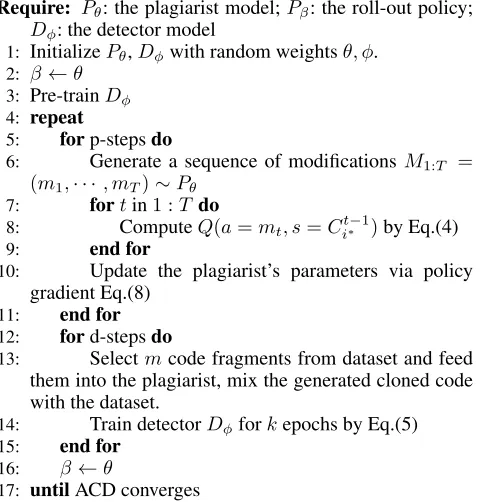
Algorithm 1Adversarial Clone Detection
Require: Pθ: the plagiarist model;Pβ: the roll-out policy;
Dφ: the detector model
1: InitializePθ,Dφwith random weightsθ, φ.
2: β ←θ
3: Pre-trainDφ
4: repeat
5: forp-stepsdo
6: Generate a sequence of modifications M1:T =
(m1,· · ·, mT)∼Pθ
7: fortin1 :T do
8: ComputeQ(a=mt, s=Cit∗−1)by Eq.(4)
9: end for
10: Update the plagiarist’s parameters via policy
gradient Eq.(8)
11: end for
12: ford-stepsdo
13: Selectmcode fragments from dataset and feed
them into the plagiarist, mix the generated cloned code with the dataset.
14: Train detectorDφforkepochs by Eq.(5)
15: end for
16: β←θ
17: untilACD converges
Experiment
In this section, we conduct experiments on real-world datasets to certify the effectiveness of ACD. We compare ACD with the state-of-the-art clone detection approaches together with self-training model to show the improvement that the ACD can bring. Besides, we design experiments to explore which kind of clone the detector is vulnerable to, finally, we study the performance variations with different parameter settings.
Experimental Setting
We conduct our experiments on two real-world datasets cov-ering different programming languages: BigCloneBench, a widely used benchmark dataset for clone detection (Sva-jlenko et al. 2014) (with JAVA code fragments) and OJClone from a pedagogical programming open judge (OJ) system1
(with C code fragments).
BigCloneBench contains projects coming from 25,000 systems, covers 10 functionalities including 6,000,000 clone pairs and 260,000 non-clone pairs. All labeled clone types are given by domain experts. We discard code fragments without any tagged true or false clone pairs and use the re-maining 9,134 code fragments.
OJClone (Mou et al. 2016) is consisted of various kinds of source code submitted by students for 104 programming problems. Since we do not have experts to label the data in OJClone, we consider two different source code as a clone pair when they solve the same programming problem be-cause they implement the same functionality. In the experi-ment, we select the first 15 programming problems and for
1
http://programming.grids.cn
Table 2: Overall information of datasets
Datasets Language code fragments AVG length
% data la-beled BigCloneBench JAVA 9,134 28.60 0.021 OJClone C 7,500 35.25 0.026
each problem there are 500 source code files.
For BigCloneBench, a code fragment is a method, and for OJClone a code fragment is a file. We use javalang2to parse
JAVA code to ASTs, and apply pycparser3to parsing C files
to ASTs. Besides, to obtain word embeddings for tokens of code fragments, we use word2vec4to generate word
embed-ding of length 100 for both datasets. The overall information for dataset is shown in Table 2. We use precision (P), recall (R), F1 values as performance measurement.
Performance of Clone Detection
In this section, we compare our proposed ACD with follow-ing the state-of-the-art clone detection approaches and self-training model to verify its effectiveness as a clone detection tool.
• Deckard (Jiang et al. 2007) clone detection model based on syntax
• SourcererCC (Sajnani et al. 2016) a popular lexical based clone detection
• CDLH (Wei and Li 2017) a supervised clone detection model which learns deep features in an end-to-end way
The overall precision, recall and F1 are displayed in Table 3. It is easy to find that ACD outperforms the other clone detection methods in terms of F1. We can see that ACD improves the recall a lot, considering that the data in Big-CloneBench is labeled by experts, they just report the clone pairs that they happen to discover, when the clone pair does not appear or is not labeled as clone by experts, the other approaches are not capable to recognize them while ACD trained by the plagiarist can. As for dataset OJClone, it con-sists of code submitted by students who used to reuse the same code snippet with slight modifications like classical algorithm bubble sort and so on. These diverse lexical or syntactical modifications make the clone code hard to be de-tected by other approaches. However, with the help of the plagiarist, our clone detection model can cover more clone types, accordingly, the recall will improve a lot. Among the compared clone detection methods, the CDLH use almost the same deep learning model to detect clone pairs with ACD, we can observe that it beats other clone detection model, but its F1 value is still not as good as ACD’s, mean-ing that the plagiarist can really help to build a strong clone detection model.
Apart from the state-of-the-art clone detection models, we compare the ACD with training approach. In Self-training model, we still use the same detector as ACD, but at
2https://github.com/c2nes/javalang 3
https://pypi.python.org/pypi/pycparser/
4
each epoch, we randomly pick a batch of unlabeled pairs and use the detector to mark them, then we retrain the detector on the new training set and repeat the above operations. The performance of Self-training is shown in Table 3. In Big-CloneBench, its precision is very close to 1, we can assume that the label it predicted is correct, but its F1 still cannot compare with ACD, which means the improvement brought by ACD not only thanks to the increase in the amount of la-beled data, the more important reason lies in the benefit from the adversarial training.
Table 3: Precision, recall and F1 comparison of all
Approaches BigCloneBench OJClone
P R F1 P R F1
CDLH 0.92 0.74 0.82 0.47 0.73 0.57
SourcererCC 0.85 0.02 0.03 0.1 0.75 0.18
Deckard 0.93 0.02 0.03 0.99 0.05 0.10
Self-training 0.96 0.62 0.76 0.17 0.20 0.19
ACD 0.98 0.88 0.92 0.73 0.73 0.73
The vulnerability of the current software clone
detection tools
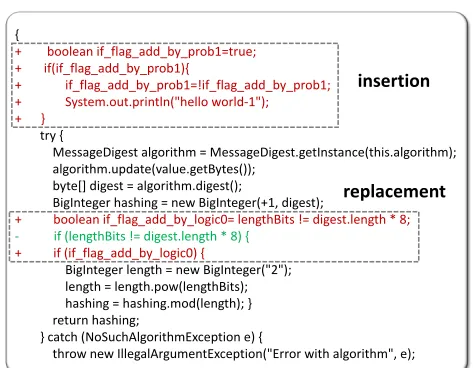
In this section, we design experiments to show which kind of clone may fool the detector. Firstly, we train a detection model on original dataset and then apply it to the newly gen-erated clone pairs. Figure 6 shows the gengen-erated codeCi∗, and the code written in black is the original oneCi, we can find that compared to the original one, the generated code does not have many differences in lexical. But when we use CDLH to detect clone pairs aboutCi∗, about 459 clone pairs are labeled as non-clone incorrectly and they can be labeled properly before changed, the total number of clone pairs of this code is 1145. It is hard to explain from a lexical per-spective, but when we build the AST of these two code, we can find that they differ a lot which means the alteration of structure is really helpful to camouflage clone code and this kind of clone is hard to detect for current software detection tools.
The Figure 7 displays a clone pair we find from the original dataset, it contains the similar clone type that pro-duced by the plagiarist. Compared to code 2, the code 1 has two more insertions, we apply CDLH and ACD to detect them respectively, CDLH mislabels them as a non-clone pair while ACD marks it correctly, it also proves the traditional detection model is vulnerable to such kind of clone, while the ACD can handle it by understanding the behavior of the plagiarists.
Table 4, 5 gives the probabilities that the plagiarist learned to build deceptive clone code. We can see that the two clone types have the comparable ability to fool the detec-tor. However when it comes to positions, the probabilities differ greatly. In JAVA, when we do modifications at con-trol statements like “Do” and “While”, it most likely to de-ceive the detector, whereas in C, the most deceptive posi-tion is “FuncCall” and “Decl”. This consequence is inter-pretable, in JAVA, the structures of control statements are usually more complicated than others, so they are the most
{
+ boolean if_flag_add_by_prob1=true; + if(if_flag_add_by_prob1){
+ if_flag_add_by_prob1=!if_flag_add_by_prob1; + System.out.println("hello world-1"); + }
try {
MessageDigest algorithm = MessageDigest.getInstance(this.algorithm); algorithm.update(value.getBytes());
byte[] digest = algorithm.digest();
BigInteger hashing = new BigInteger(+1, digest);
+ boolean if_flag_add_by_logic0= lengthBits != digest.length * 8; - if (lengthBits != digest.length * 8) {
+ if (if_flag_add_by_logic0) {
BigInteger length = new BigInteger("2"); length = length.pow(lengthBits); hashing = hashing.mod(length); } return hashing;
} catch (NoSuchAlgorithmException e) {
throw new IllegalArgumentException("Error with algorithm", e);
insertion
replacement
Figure 6: Clone type produced by the plagiarist that is hard to detect.
deceptive positions, while in C, by analyzing the code from dataset, we find that the “Decl” usually appears along with “FuncCall”, like “int a = func(0)”, and when we build the ASTs of a C code file, the AST of the called function is set as the children node of “FuncCall”, so modifying code at these positions may bring pretty good effect.
Table 4: Probabilities of modifications to be chosen.
Language Insertion Replacement
JAVA 0.54 0.46
C 0.51 0.49
Table 5: Probabilities of position to be chosen. F, D, W, T, A, R, I, FC stand for For, Declaration, While, Try, Assignment, Return, If and Func Call statement.
F D Do W T/FC A R I
JAVA 0.1 0.12 0.19 0.27 0.07 0.09 0.06 0.1 C 0.11 0.24 0.08 0.1 0.2 0.12 0.06 0.09
Sensitivity to Hyper-Parameters
code 1
code 2
{final FileInputStream input = new FileInputStream(in); try {
final FileOutputStream output = new FileOutputStream(out); try {
final byte[] buf = new byte[4096]; int readBytes = 0;
while ((readBytes = input.read(buf)) != -1) { output.write(buf, 0, readBytes); }
} finally { output.close(); }
} finally { input.close(); }
} {
if ( !isNewFile() ) { return; } if ( !folder.exists() ) { folder.mkdir(); } File dest = new File(folder, name); try {
FileInputStream in = new FileInputStream(currentPath); FileOutputStream out = new FileOutputStream(dest); byte[] readBuf = new byte[1024 * 512];
int readLength; long totalCopiedSize = 0; boolean canceled = false;
while ((readLength = in.read(readBuf)) != -1) { out.write(readBuf, 0, readLength); } in.close();
out.close(); if (canceled) {
dest.delete(); } else {
currentPath = dest; newFile = false; }
} catch (FileNotFoundException e) { e.printStackTrace();
} catch (IOException e) { e.printStackTrace(); } }
insertion
insertion
Figure 7: A clone pair from dataset which have the similar clone type produced by the plagiarist.
Figure 8: The influence of batch size on ACD.
Figure 9: The influence of number of changes on ACD.
Related Work
Software Clone Detection
Copying code fragments and then reuse them by pasting with or without little modifications are common activities in software development and this behavior is called code cloning (Roy, Cordy, and Koschke 2009). Since code clone may easily lead to the injection of software defects or copy-right infringement (Brixtel et al. 2010; Baker 1995), soft-ware clone detection, aiming to identify similar code
frag-ments, has attracted significant attractions in recent years. Many clone detection approaches have been studied to find clones automatically so far. Deckard (Jiang et al. 2007) in-troduces AST (Abstract Syntax Tree) to measure the struc-ture similarity of two code fragments. CCFinderX (Kamiya, Kusumoto, and Inoue 2002) and SourcererCC (Sajnani et al. 2016) treat source code as bags of tokens and compare sub-sequences to detect clones. NICAD (Roy and Cordy 2008) applies slight transformations to code and measures simi-larity by comparing sequences of text. CDLH (Wei and Li 2017) formalizes the software clone detection as a super-vised learning to hash problem and learns supersuper-vised deep features in an end-to-end way for software functional clone detection. Recently, CDPU (Wei and Li 2018) has been pro-posed to formalize the clone detection task as a Positive-Unlabeled (PU) learning problem and leverage the unlabeled data to improve the detection performance.
Sequence Generative Model
Conclusion
In this paper, we deal with the software clone detection prob-lem by exploiting the contest between the plagiarist and the detector, which enables us to not only build strong a clone detector but also model the behavior of the plagiarists. Ac-cording to human prior knowledge, the plagiarist is able to construct interpretable cloned code without altering the functionality, and such a plagiarist model may in turn help to understand the vulnerability of the current software clone detection tools. The contest with the plagiarist drives the de-tector to achieve better performance. Experiments on soft-ware clone detection benchmarks indicate that the learned policy of plagiarist can help us build stronger clone detector, which outperforms the existing clone detection methods.
Acknowledgement This research was supported by
National Key Research and Development Program
(2017YFB1001903) and NSFC (61751306).
References
Bachman, P., and Precup, D. 2015. Data generation as se-quential decision making. InAdvances in Neural Informa-tion Processing Systems, 3249–3257.
Baker, B. S. 1995. On finding duplication and near-duplication in large software systems. InProceedings of 2nd Working Conference on Reverse Engineering, 86–95. IEEE. Brixtel, R.; Fontaine, M.; Lesner, B.; Bazin, C.; and Robbes, R. 2010. Language-independent clone detection applied to plagiarism detection. InProceedings of 10th IEEE Working Conference on Source Code Analysis and Manipulation, 77– 86. IEEE.
Browne, C. B.; Powley, E.; Whitehouse, D.; Lucas, S. M.; Cowling, P. I.; Rohlfshagen, P.; Tavener, S.; Perez, D.; Samothrakis, S.; and Colton, S. 2012. A survey of monte carlo tree search methods. IEEE Transactions on Computa-tional Intelligence and AI in games4(1):1–43.
Glynn, P. W. 1990. Likelihood ratio gradient estimation for stochastic systems.Communications of the ACM33(10):75– 84.
Goodfellow, I.; Pouget-Abadie, J.; Mirza, M.; Xu, B.; Warde-Farley, D.; Ozair, S.; Courville, A.; and Bengio, Y. 2014. Generative adversarial nets. InAdvances in Neural Information Processing Systems, 2672–2680.
Jiang, L.; Misherghi, G.; Su, Z.; and Glondu, S. 2007. Deckard: Scalable and accurate tree-based detection of code clones. InProceedings of the 29th international conference on Software Engineering, 96–105. IEEE Computer Society. Kamiya, T.; Kusumoto, S.; and Inoue, K. 2002. Ccfinder: a multilinguistic token-based code clone detection system for large scale source code. IEEE Transactions on Software Engineering28(7):654–670.
Mann, S., and Frew, Z. 2006. Similarity and originality in code: plagiarism and normal variation in student assign-ments. InProceedings of the 8th Australasian Conference on Computing Education, 143–150. Australian Computer Society, Inc.
Mou, L.; Li, G.; Zhang, L.; Wang, T.; and Jin, Z. 2016. Convolutional neural networks over tree structures for pro-gramming language processing. InProceedings of the 30th AAAI Conference on Artificial Intelligence, 1287–1293. Roy, C. K., and Cordy, J. R. 2007. A survey on software clone detection research. Queen’s School of Computing TR 541(115):64–68.
Roy, C. K., and Cordy, J. R. 2008. Nicad: Accurate detection of near-miss intentional clones using flexible pretty-printing and code normalization. In Proceedings of the 16th IEEE International Conference on Program Comprehension, 172– 181. IEEE.
Roy, C. K.; Cordy, J. R.; and Koschke, R. 2009. Comparison and evaluation of code clone detection techniques and tools: A qualitative approach. Science of Computer Programming 74(7):470–495.
Sajnani, H.; Saini, V.; Svajlenko, J.; Roy, C. K.; and Lopes, C. V. 2016. Sourcerercc: Scaling code clone detection to big-code. InProceedings of IEEE/ACM 38th International Conference on Software Engineering, 1157–1168. IEEE. Silver, D.; Huang, A.; Maddison, C. J.; Guez, A.; Sifre, L.; Van Den Driessche, G.; Schrittwieser, J.; Antonoglou, I.; Panneershelvam, V.; Lanctot, M.; et al. 2016. Mastering the game of go with deep neural networks and tree search. Nature529(7587):484.
Sutskever, I.; Vinyals, O.; and Le, Q. V. 2014. Sequence to sequence learning with neural networks. InAdvances in Neural Information Processing Systems, 3104–3112. Sutton, R. S.; McAllester, D. A.; Singh, S. P.; and Mansour, Y. 2000. Policy gradient methods for reinforcement learning with function approximation. InAdvances in Neural Infor-mation Processing Systems, 1057–1063.
Svajlenko, J.; Islam, J. F.; Keivanloo, I.; Roy, C. K.; and Mia, M. M. 2014. Towards a big data curated benchmark of inter-project code clones. In Processings of the IEEE Interna-tional Conference on Software Maintenance and Evolution, 476–480. IEEE.
Wei, H.-H., and Li, M. 2017. Supervised deep features for software functional clone detection by exploiting lexical and syntactical information in source code. In Proceedings of the 26th International Joint Conference on Artificial Intelli-gence, 3034–3040.
Wei, H.-H., and Li, M. 2018. Positive and unlabeled learn-ing for detectlearn-ing software functional clones with adversarial training. InProceedings of the 27th International Joint Con-ference on Artificial Intelligence, 2840–2846.
Williams, R. J. 1992. Simple statistical gradient-following algorithms for connectionist reinforcement learn-ing. Springer. 229–256.